
Life, 1921-10-20 · page 26 of 34
Life — October 20, 1921 — page 26: what you’re looking at
What you’re looking at
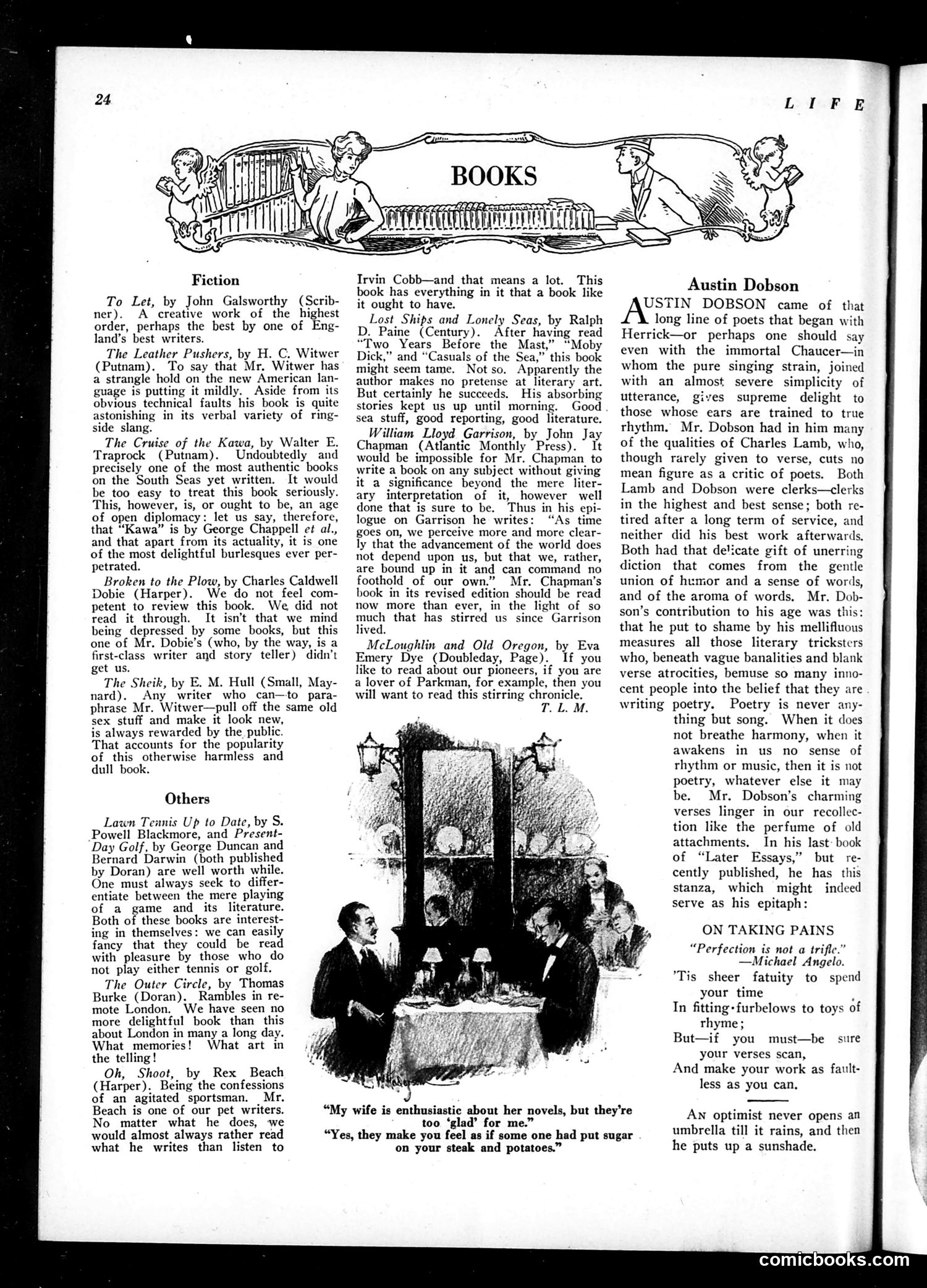
This is a **book review section** from Life magazine, not a political cartoon page. The main illustration shows two men dining, with the caption joking that one man's wife reads novels that make her feel "glad" he exists—a domestic humor dig at romantic fiction's unrealistic standards. The reviews themselves are literary criticism of early 1920s books. Notable: the critic dismisses *The Sheik* as "harmless and dull" despite its popularity, suggesting readers reward "sex stuff" over quality. The review praises *William Lloyd Garrison* (a biography) for its contemporary relevance to post-WWI society. References to classic sea literature (*Moby Dick*, *Two Years Before the Mast*) establish the magazine's educated, elite readership. The tone is sophisticated but accessible—Life positioned itself as smart entertainment for educated Americans. No major political content appears on this page.
📄 Transcribed text from this page (OCR, searchable)
Machine-transcribed from the original scan — historical spelling and the odd misread are preserved.
Fiction To Let, by John Galsworthy (Scrib- ner). A creative work of the highest order, perhaps the best by one of Eng- land’s best writers. The Leather Pushers, by H. C. Witwer (Putnam). To say that Mr. Witwer has a strangle hold on the new American lan- guage is putting it mildly. Aside from its obvious technical faults his book is quite astonishing in its verbal variety of ring- side slang. The Cruise of the Kawa, by Walter E. Traprock (Putnam). Undoubtedly and precisely one of the most authentic books on the South Seas yet written. It would be too easy to treat this book seriously. This, however, is, or ought to be, an age of open diplomacy: let us say, therefore, that “Kawa” is by George Chappell et al., and that apart from its actuality, it is one of the most delightful burlesques ever per- petrated. Broken to the Plow, by Charles Caldwell Dobie (Harper). We do not feel com- petent to review this book. We did not read it through. It isn’t that we mind being depressed by some books, but this one of Mr. Dobie’s (who, by the way, is a first-class writer and story teller) didn’t get us. The Sheik, by E. M. Hull (Small, May- nard). Any writer who can—to para- phrase Mr. Witwer—pull off the same old sex stuff and make it look new, is always rewarded by the_public. That accounts for the popularity of this otherwise harmless and dull book. Others Lawn Teanis Up to Date, by S. Powell Blackmore, and Present- Day Golf, by George Duncan and Bernard Darwin (both published by Doran) are well worth while. One must always seek to differ- entiate between the mere playing of a game and its literature. Both of these books are interest- ing in themselves: we can easily fancy that they could be read with pleasure by those who do not play either tennis or golf. The Outer Circle, by Thomas Burke (Doran). Rambles in re- mote London. We have seen no more delightful book than this about London in many a long day. What memories! What art in the telling! Oh, Shoot, by Rex Beach (Harper). Being the confessions of an agitated sportsman. Mr. Beach is one of our pet writers. No matter what he does, we would almost always rather read what he writes than listen to Irvin Cobb—and that means a lot. This book has everything in it that a book like it ought to have. Lost Ships and Lonely Seas, by Ralph D. Paine (Century). After having read “Two Years Before the Mast,” “Moby Dick,” and “Casuals of the Sea,” this book might seem tame. Not so. Apparently the author makes no pretense at literary art. But certainly he succeeds. His absorbing stories kept us up until morning. Good sea stuff, good reporting, good literature. William Lloyd Garrison, by John Jay Chapman (Atlantic Monthly Press). It would be impossible for Mr. Chapman to write a book on any subject without giving it a significance beyond the mere liter- ary interpretation of it, however well done that is sure to be. Thus in his epi- logue on Garrison he writes: “As time goes on, we perceive more and more clear- ly that the advancement of the world does not depend upon us, but that we, rather, are bound up in it and can command no foothold of our own.” Mr. Chapman’s book in its revised edition should be read now more than ever, in the light of so much that has stirred us since Garrison lived. McLoughlin and Old Oregon, by Eva Emery Dye (Doubleday, Page). If you like to read about our pioneers, if you are a lover of Parkman, for example, then you will want to read this stirring chronicle. T. L. M. “My wife is enthusiastic about her novels, but they’re too ‘glad’ for me.” “Yes, they make you feel as if some one had put sugar on your steak and potatoes.” Austin Dobson USTIN DOBSON came of that long line of poets that began with Herrick—or perhaps one should say even with the immortal Chaucer—in whom the pure singing strain, joined with an almost severe simplicity of utterance, gives supreme delight to those whose ears are trained to true rhythm. Mr. Dobson had in him many of the qualities of Charles Lamb, who, though rarely given to verse, cuts no mean figure as a critic of poets. Both Lamb and Dobson were clerks—clerks in the highest and best sense; both re- tired after a long term of service, and neither did his best work afterwards. Both had that delicate gift of unerring diction that comes from the gentle union of humor and a sense of words, and of the aroma of words. Mr. Dob- son’s contribution to his age was this: that he put to shame by his mellifluous measures all those literary tricksters who, beneath vague banalities and blank verse atrocities, bemuse so many inno- cent people into the belief that they are writing poetry. Poetry is never any- thing but song. When it does not breathe harmony, when it awakens in us no sense of rhythm or music, then it is not poetry, whatever else it may be. Mr. Dobson’s charming verses linger in our recollec- tion like the perfume of old attachments. In his last: book of “Later Essays,” but re- cently published, he has this stanza, which might indeed serve as his epitaph: ON TAKING PAINS “Perfection is not a trifle.” —Michael Angelo. ‘Tis sheer fatuity to spend your time 3 In fitting-furbelows to toys of rhyme; But—if you must—be your verses scan, And make your work as fault- less as you can, sure AN optimist never opens an umbrella till it rains, and then he puts up a sunshade. comicbooks.com