
A complete issue · 34 pages · 1921
Life — October 13, 1921
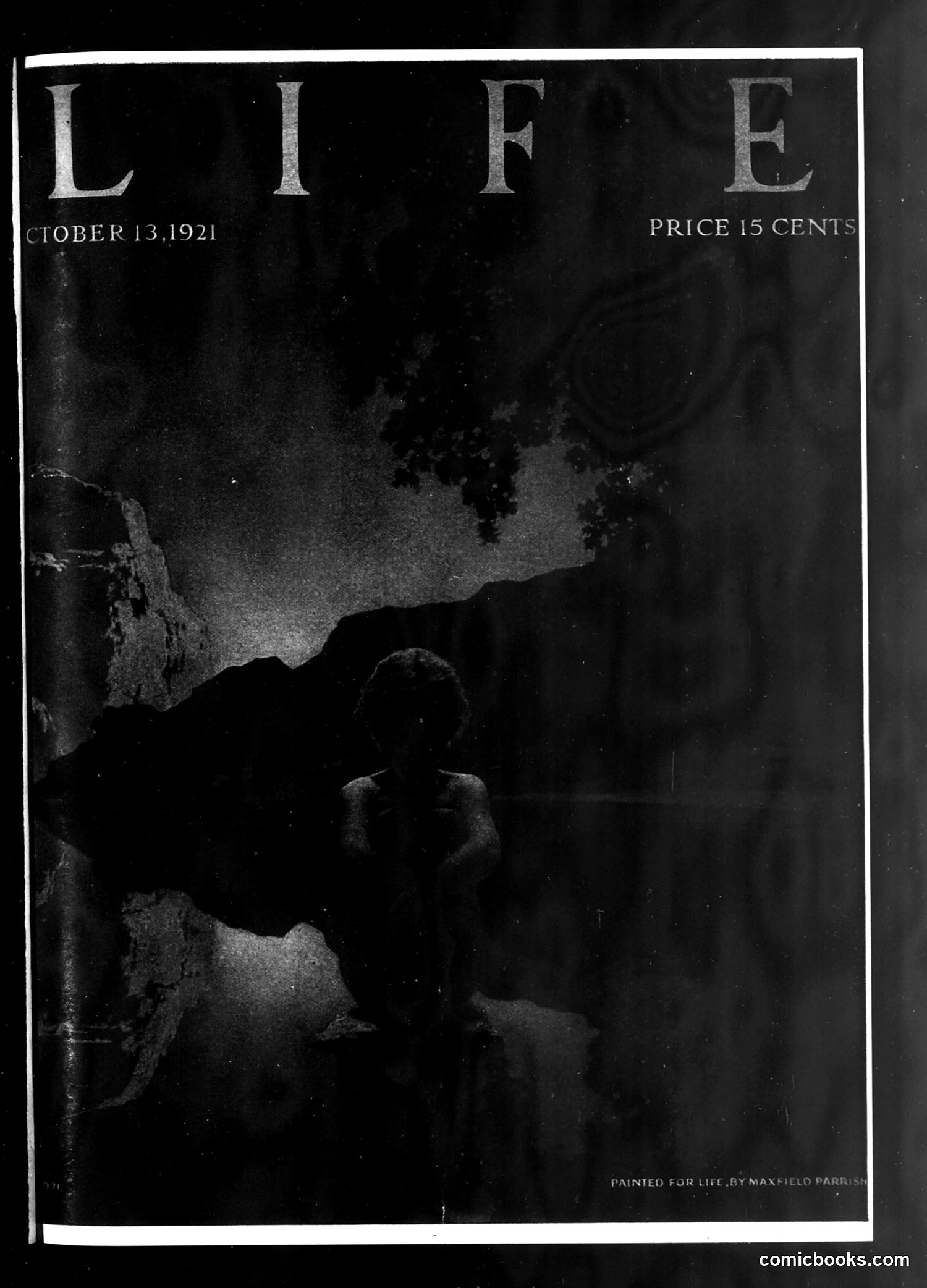
This appears to be a dramatic black-and-white illustration rather than a political cartoon. It depicts a solitary figure in shadow observing what looks like a ghostly or luminous form above—possibly representing a supernatural or allegorical scene. The image's meaning is unclear from the visual alone. Without readable caption text or article titles visible on this cover, I cannot definitively identify the specific political or social reference intended. The dramatic, noir-like style suggests commentary on a contemporary 1921 issue, but determining whether this addresses labor unrest, prohibition, spiritualism, or another topic would require additional textual context not legible in this reproduction. The credit line mentions "Painted for Life by Maxfield Parrish," the renowned illustrator, suggesting artistic rather than journalistic intent.
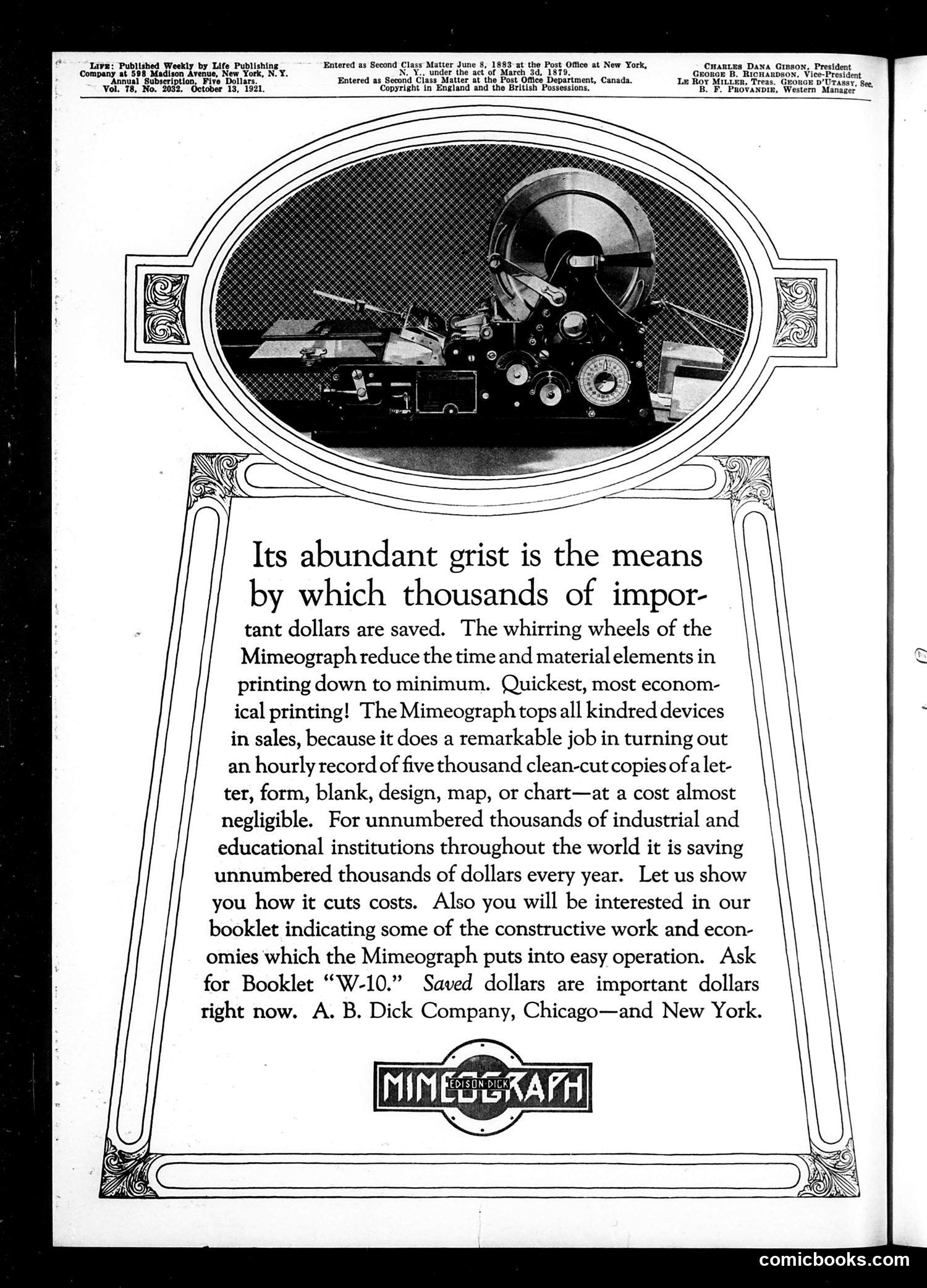
This is **not a political cartoon or satire page**—it's a straightforward advertisement for the Mimeograph machine, made by A.B. Dick Company of Chicago and New York. The page features a photograph of the machine's internal mechanisms (the "whirring wheels" mentioned) displayed in an ornate oval frame typical of 1920s design. The copy emphasizes the machine's practical business value: it could produce 5,000 clean copies per hour at minimal cost, making it economical for "industrial and educational institutions." The ad promises significant dollar savings and references a booklet ("W-10") for interested parties. This represents routine commercial advertising from Life magazine's era, not editorial content or satire.
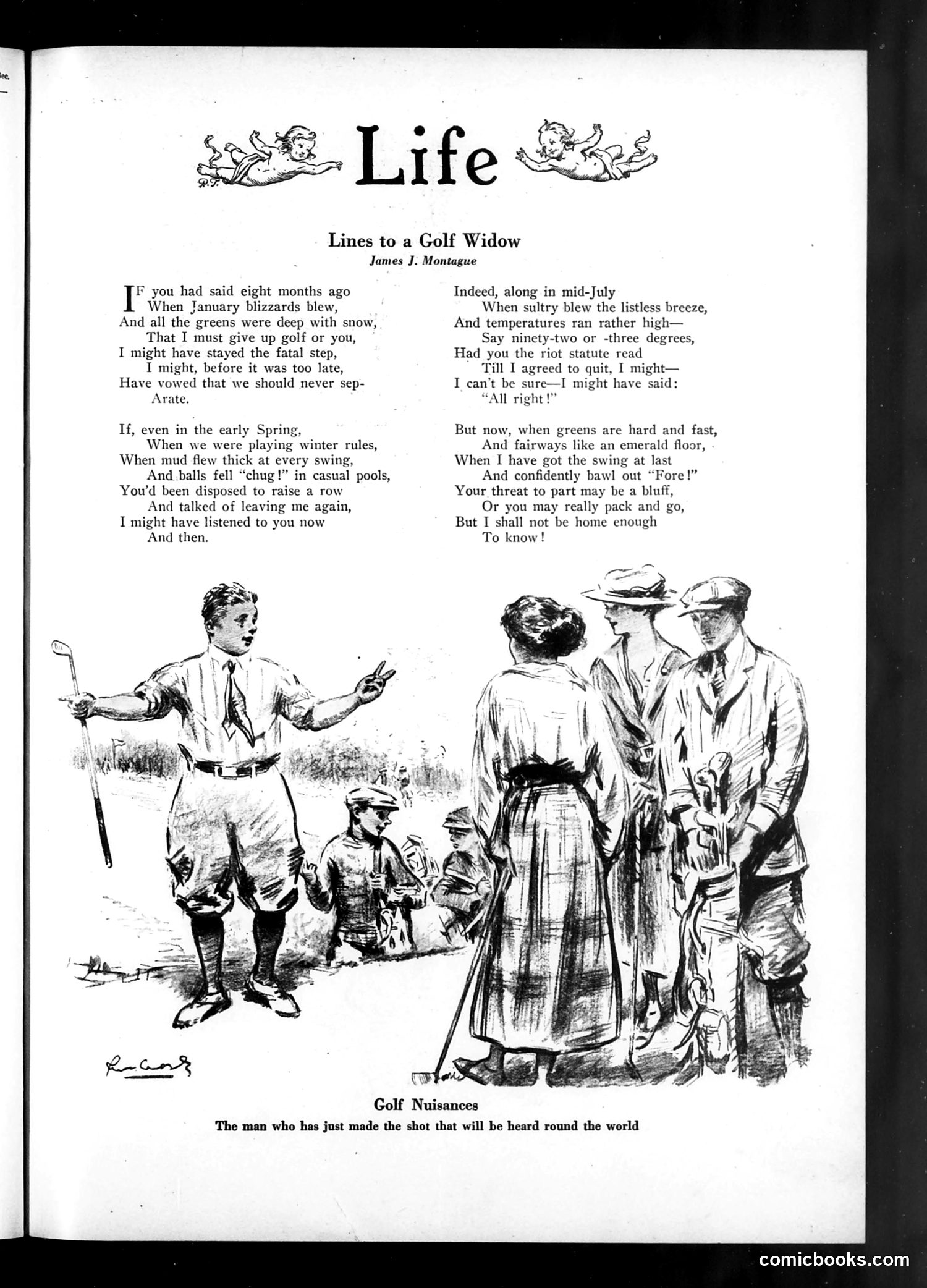
This page contains two distinct pieces: **"Lines to a Golf Widow"** by James J. Montague is a humorous poem addressing a wife whose husband is obsessed with golf. The poem mocks how the husband initially promised to quit golf during winter, but by summer he's fully committed again—threatening to leave permanently if she objects. The satire targets golf's addictive nature and the sport's ability to dominate men's lives and marriages. **"Golf Nuisances"** (bottom cartoon) depicts a man who has just hit a notably loud golf shot. The caption jokes that this shot "will be heard round the world"—likely referencing the famous phrase about "the shot heard round the world" (Concord, 1775). The satire mocks golfers whose wild, poor shots become embarrassingly public spectacles.
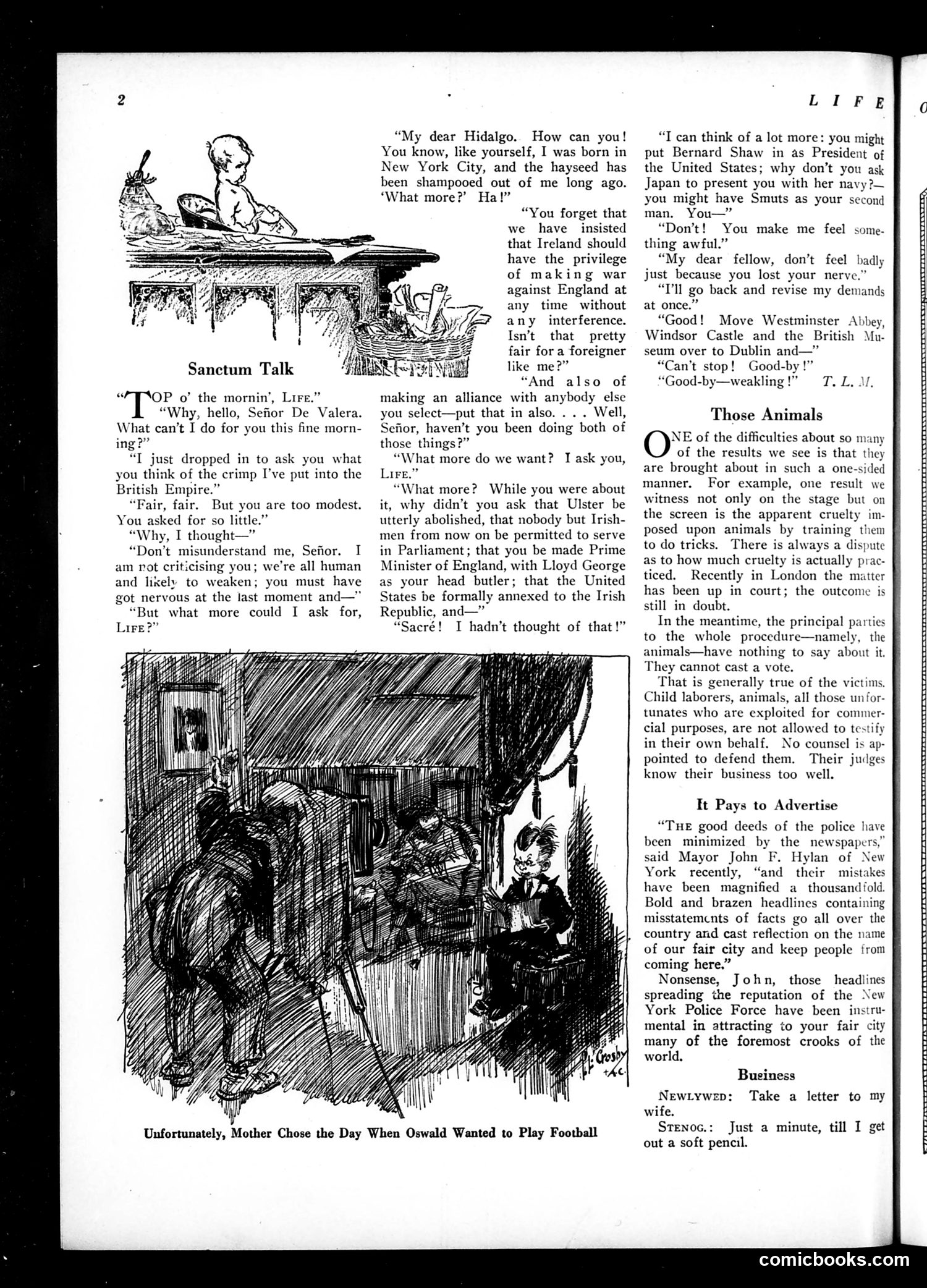
**"Sanctum Talk"** features a conversation between the magazine's editor and a visitor (labeled "Señor De Valera," likely Éamon de Valera, Irish independence leader) about Irish-British relations. The dialogue satirizes De Valera's negotiating position, mocking Ireland's demands while suggesting he's overlooked more ambitious goals—hinting at contradictions in Irish nationalist strategy. **"Those Animals"** section critiques animal cruelty in entertainment and training, noting that victims like animals and child laborers cannot testify in their own defense in court proceedings. **"It Pays to Advertise"** quotes NYC Mayor Hylan criticizing negative police coverage in newspapers, arguing sensational headlines damage the city's reputation. The lower cartoon, captioned "Unfortunately, Mother Chose the Day When Oswald Wanted to Play Football," depicts domestic disruption (unclear specifics without fuller context).
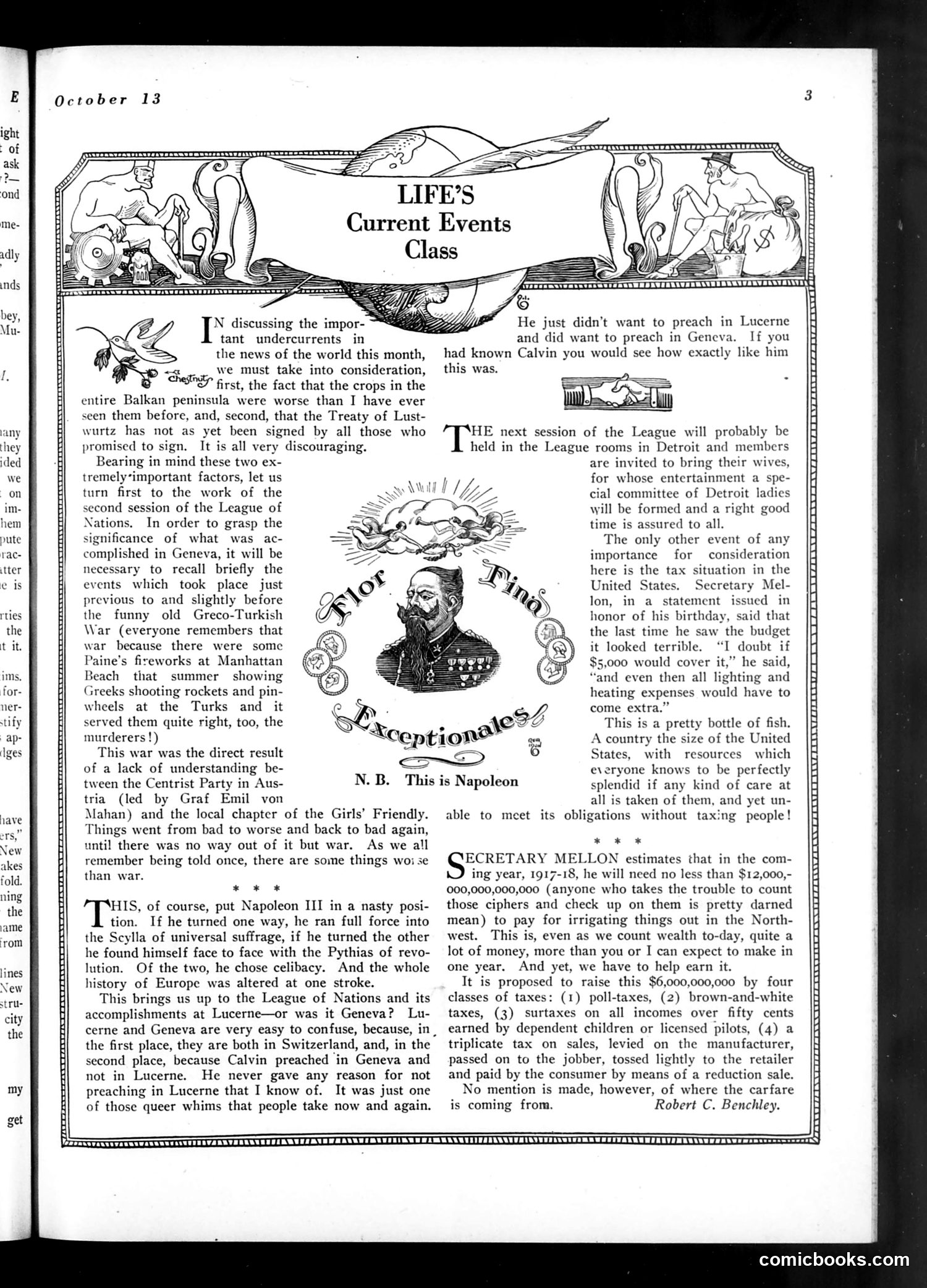
This page satirizes post-WWI European politics. The central cartoon depicts **Napoleon** labeled "For Eminent Exceptionales," likely mocking contemporary political figures through historical comparison. The text discusses the **League of Nations** and its Geneva sessions, the **Treaty of Lusitania** (unsigned by key parties), and Balkan instability. A key satirical point: the author criticizes **Calvin** (likely John Calvin, referenced ironically) for refusing to preach in certain cities, portraying religious/political obstinacy as absurd as historical Napoleon-era conflicts. The piece also references **Secretary Mellon's** budget estimates requiring $12 billion in taxes, critiquing wartime fiscal excess. The overall tone mocks political leaders' inability to resolve post-war problems sensibly, comparing modern incompetence to historical folly.
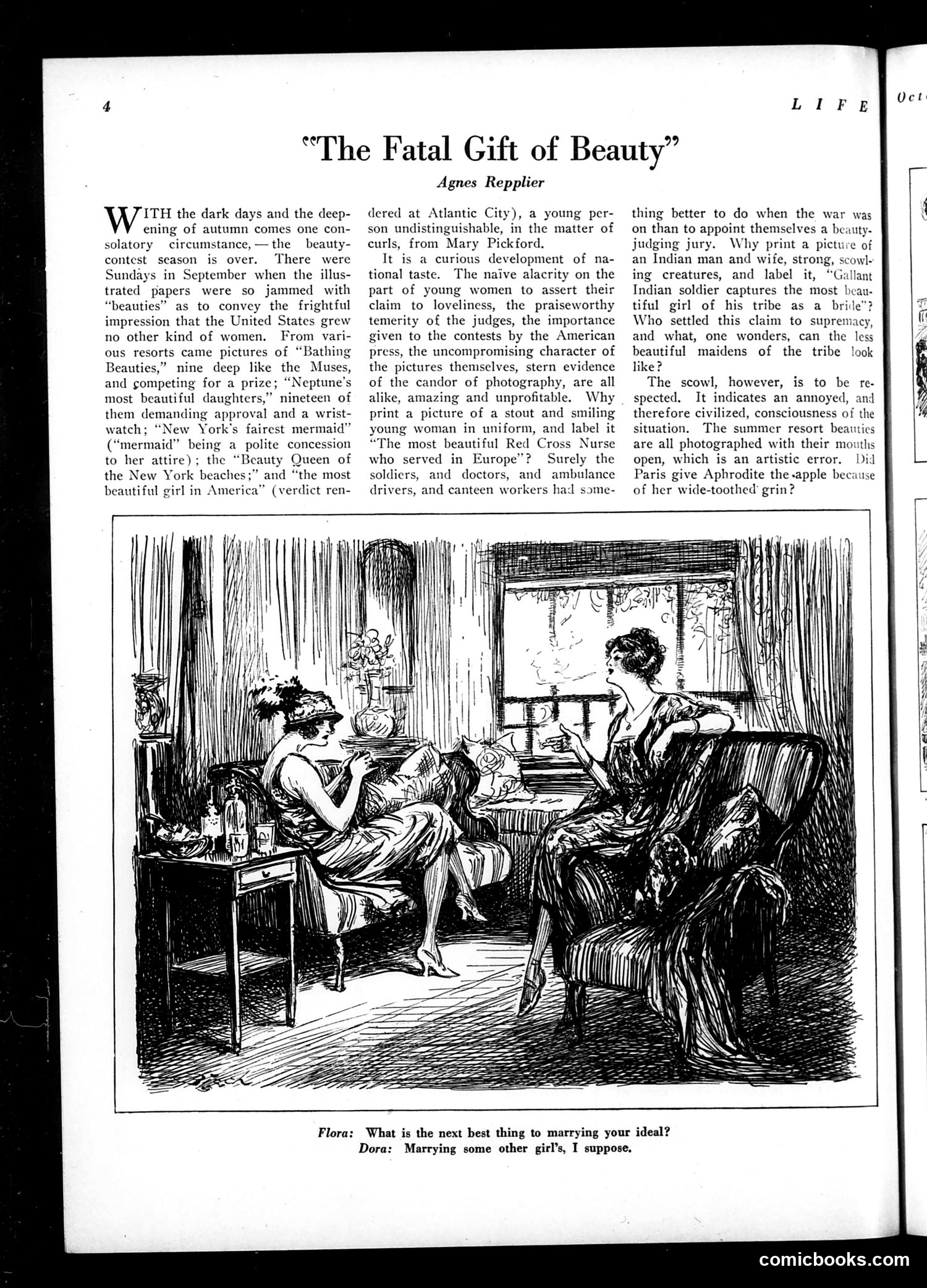
This satirical article critiques the American obsession with beauty contests during World War I. Repplier mocks the "Bathing Beauties" contests—illustrated publications featuring young women judged for attractiveness—as frivolous and contradictory. While soldiers, doctors, and ambulance drivers served Europe, Americans appointed beauty judges to crown "fairest mermaids" and "most beautiful girls." The accompanying cartoon shows two women in conversation. The caption reveals the joke: Flora asks what's better than marrying one's ideal; Dora replies, "Marrying some other girl's, I suppose"—a cynical comment on female competition and the shallow values the contests promoted. Repplier argues such contests distract from serious wartime concerns and reduce women to decorative objects.
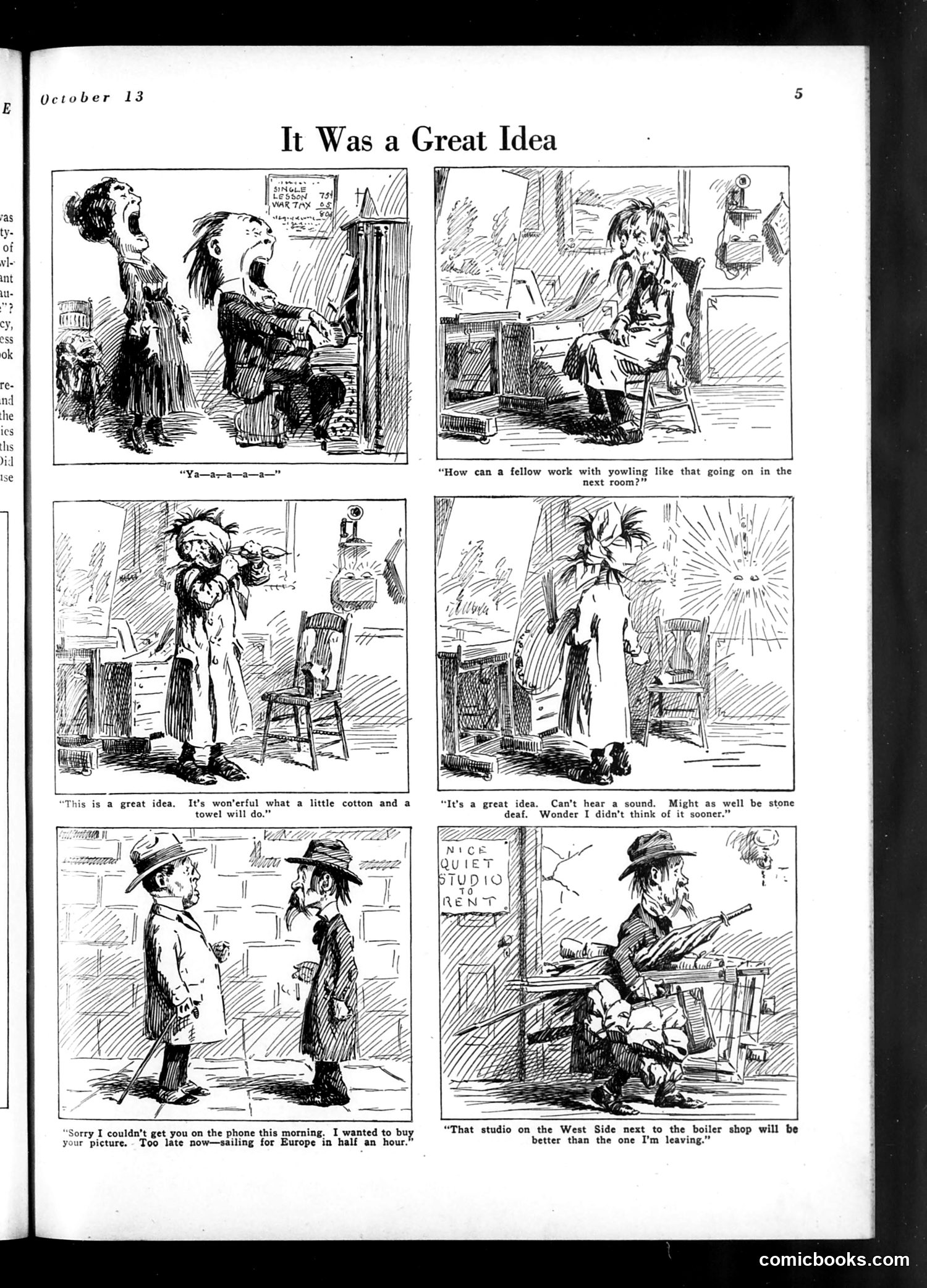
This six-panel comic satirizes a soundproofing scheme gone wrong. A person proposes using "cotton and a towel" to muffle noise from a neighboring room. The subsequent panels show escalating chaos: the cotton-stuffed walls become increasingly chaotic, eventually requiring the person to relocate their studio. The satire mocks both the original "great idea" (overly simplistic solutions to complex problems) and the consequences of not thinking through practical implications. The final panel's resignation—moving to a studio "next to the boiler shop"—suggests ironic defeat: trading one noise problem for a worse one. The humor relies on physical comedy and the universal experience of noise complaints in shared living spaces, making it timeless despite its early 20th-century setting.
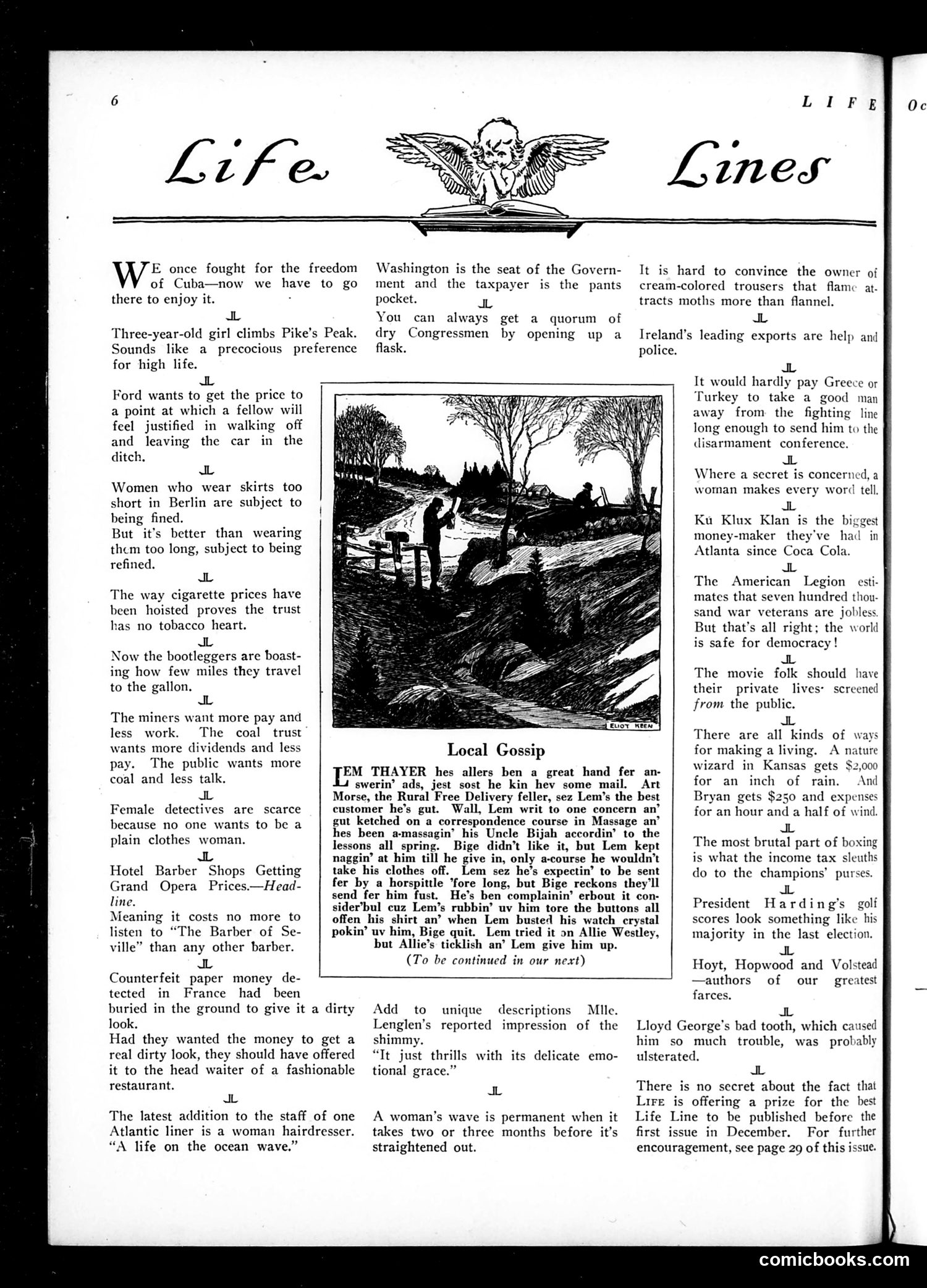
The main illustration shows a pastoral scene of rural labor—a farmer or worker digging/working the land near water and trees. The surrounding "Life Lines" are brief satirical quips on contemporary issues: - **Cuba** and freedom (likely referencing post-independence tensions) - **Washington politics** (mocking Congress and government inefficiency) - **Berlin fashion** (women's hemlines and social propriety) - **Cigarette prices** and trust monopolies - **Labor disputes** (miners, coal industry wages) - **Female detectives** and gender roles - **Bootleggers and prohibition** (suggesting widespread flouting of alcohol laws) - **Counterfeiting** in France The tone is satirical commentary on 1920s American life: politics, labor conflicts, Prohibition enforcement, gender conventions, and economic inequality. The humor relies on readers' familiarity with contemporary scandals and social debates.
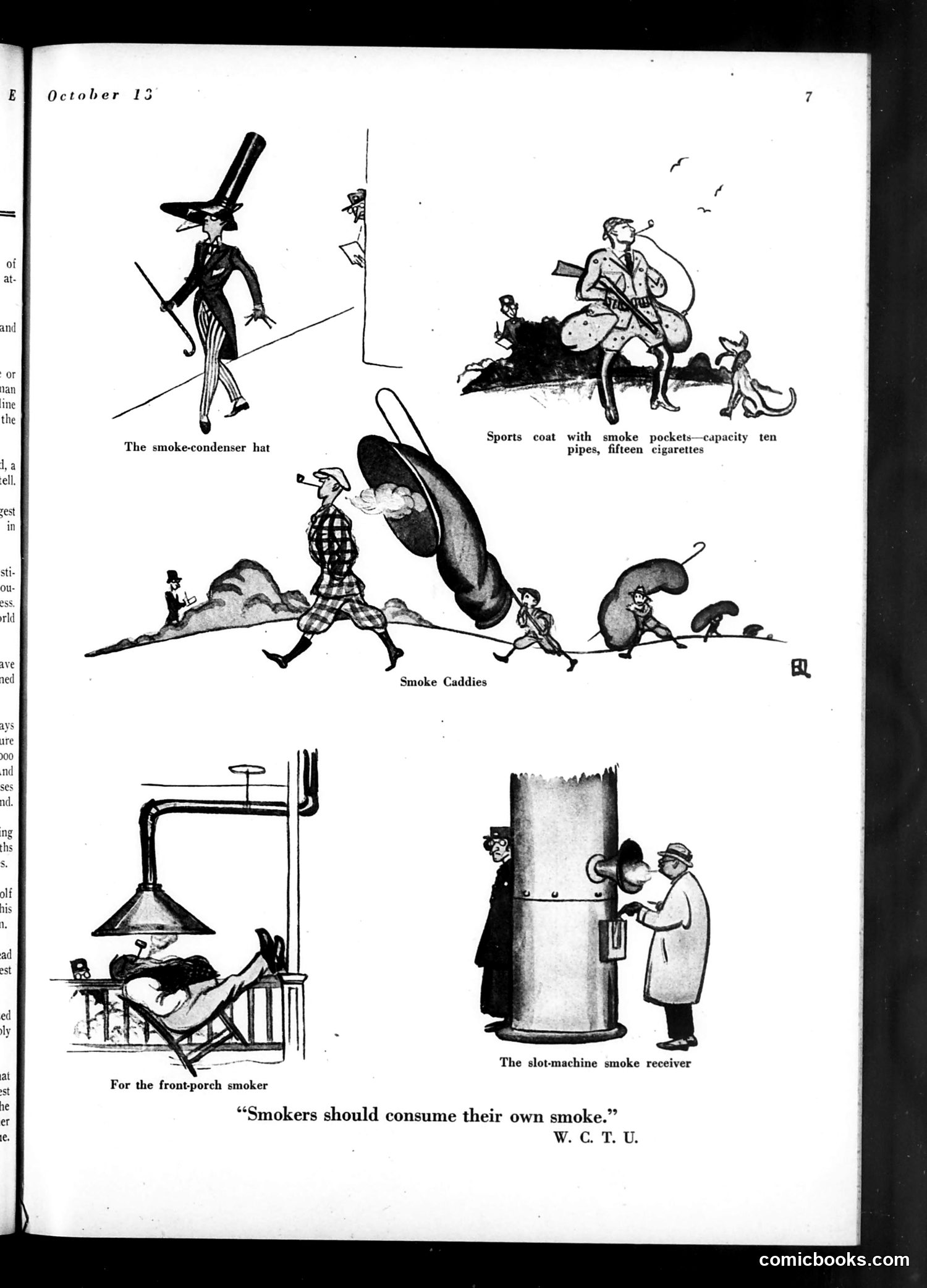
This October 13 page from *Life* magazine presents satirical inventions mocking smoking culture. The cartoons propose absurd devices to contain secondhand smoke—a "smoke-condenser hat," "smoke caddies" (devices people carry like golf bags), a "front-porch smoker" apparatus, and a "slot-machine smoke receiver." The quote at bottom—"Smokers should consume their own smoke"—clarifies the satire's point: smokers impose their smoke on others, so these inventions mockingly suggest ways to isolate or recycle it back to the smoker. This reflects early-20th-century concerns about smoking in shared public spaces, before modern ventilation or smoking restrictions existed. The humor targets smokers' inconsideration of non-smokers' comfort.
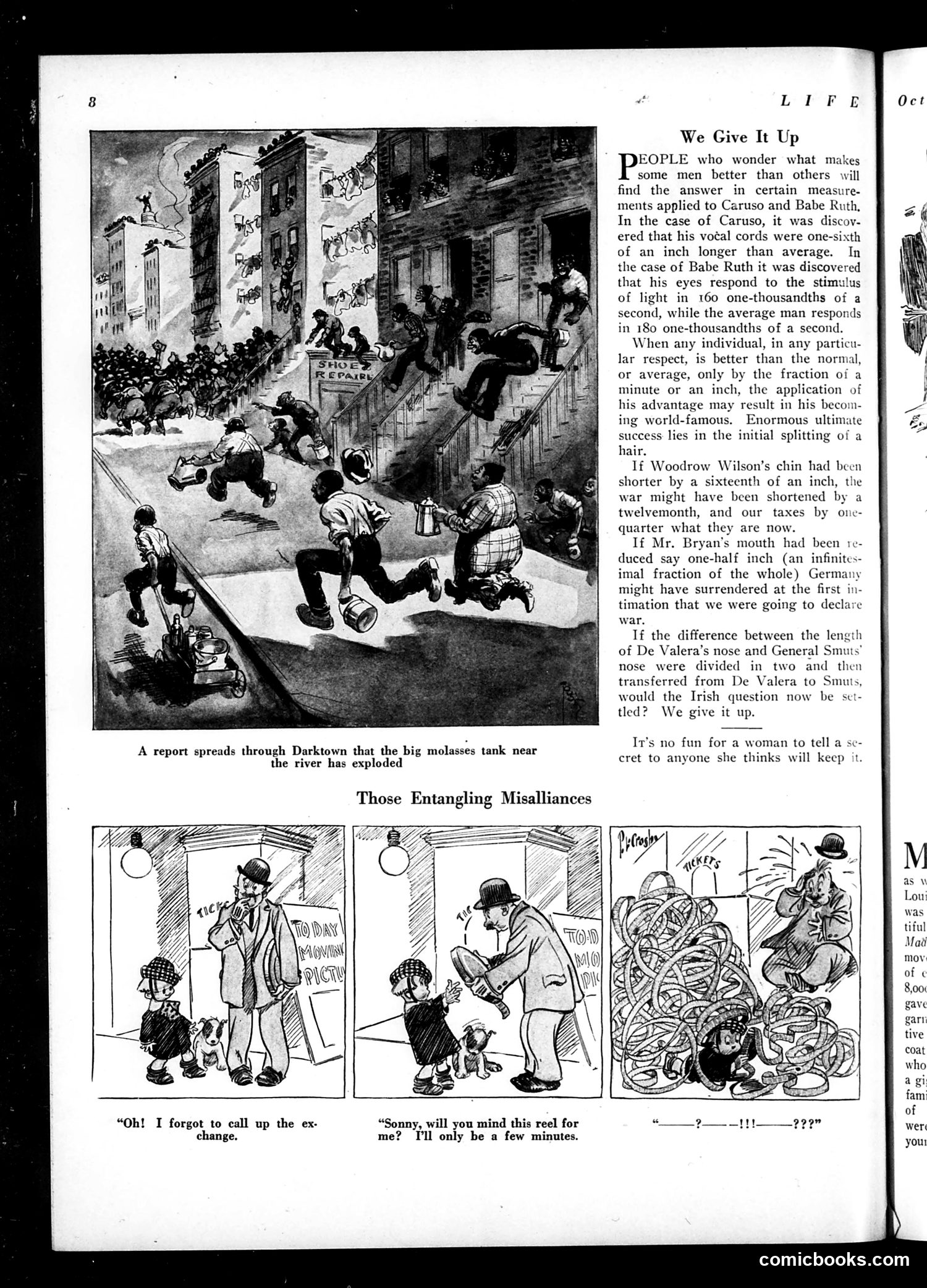
The top article humorously argues that tiny physical differences—a fraction of an inch—can have enormous consequences. It references Woodrow Wilson's chin length, William Jennings Bryan's mouth size, and the noses of De Valera and General Smuts, suggesting these minor variations could have altered World War I's outcome, taxation rates, and Irish independence negotiations. The comic strip below titled "Those Entangling Misalliances" depicts domestic mishaps caused by telephone miscommunication: a man forgets to call the telephone exchange; someone asks a stranger to "mind a reel" (fishing line), resulting in tangled chaos. The satire mocks how easily everyday entanglements occur through simple oversights or misunderstandings.
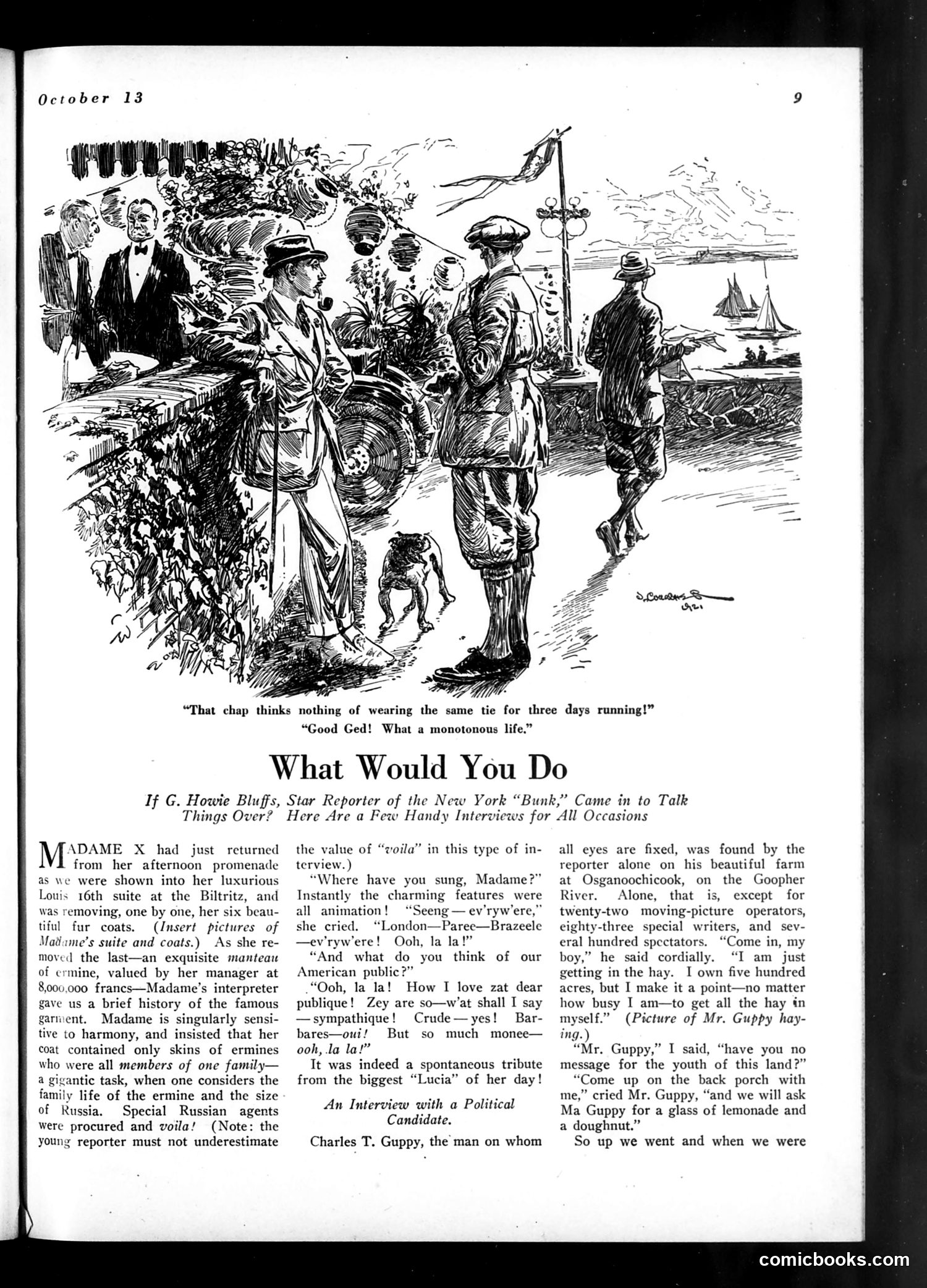
This page features social satire about wealth and fashion. The cartoon depicts well-dressed figures at what appears to be a seaside resort, with one character remarking that another man "thinks nothing of wearing the same tie for three days running!" followed by "Good God! What a monotonous life." The satire targets wealthy elites' obsession with conspicuous consumption and constant wardrobe changes—wearing the same tie for three days is presented as shockingly austere behavior for the wealthy class. The illustration mocks the extreme frivolity of the wealthy during this period. The accompanying text announces interviews with notable figures, including "Madame X" (a wealthy socialite) and a political candidate named Charles T. Guppy, presenting humorous social commentary about high society and political figures.
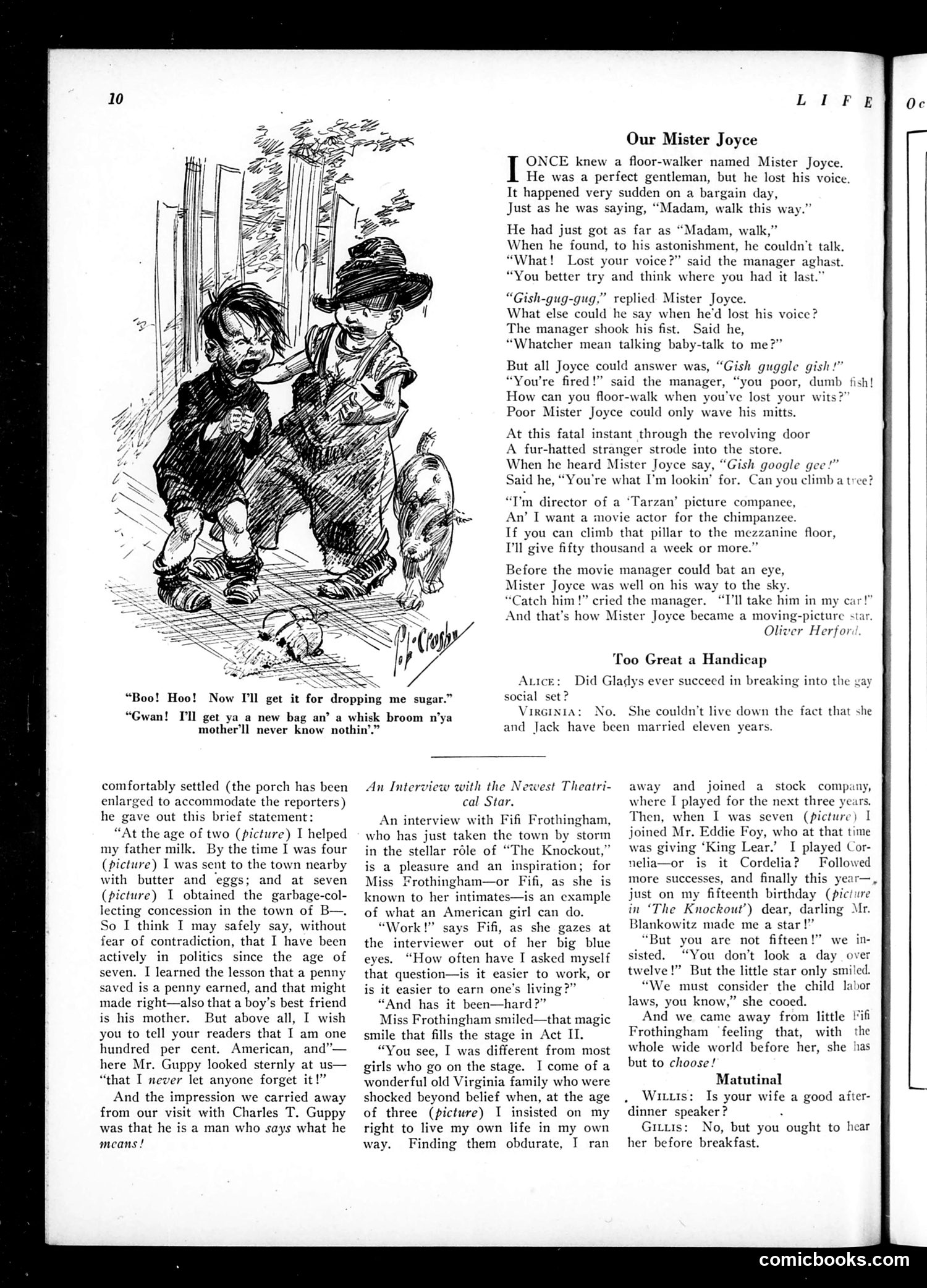
This page contains a humorous short story accompanied by a cartoon illustration. The story mocks a floor-walker named Mister Joyce who loses his voice while trying to make a sale. When a movie director overhears him attempting to speak, he mistakes Joyce's condition for a theatrical talent and hires him as a film actor. The cartoon shows two men in period dress (one appearing to be a child or young person) interacting near a doorway. The accompanying dialogue jokes about getting "a new bag an' a whisk broom" as compensation for "dropping me sugar." The satire targets early silent film casting, suggesting that incompetence or mere luck could launch someone to stardom in the nascent movie industry—a common theme in 1910s-era satirical magazines.
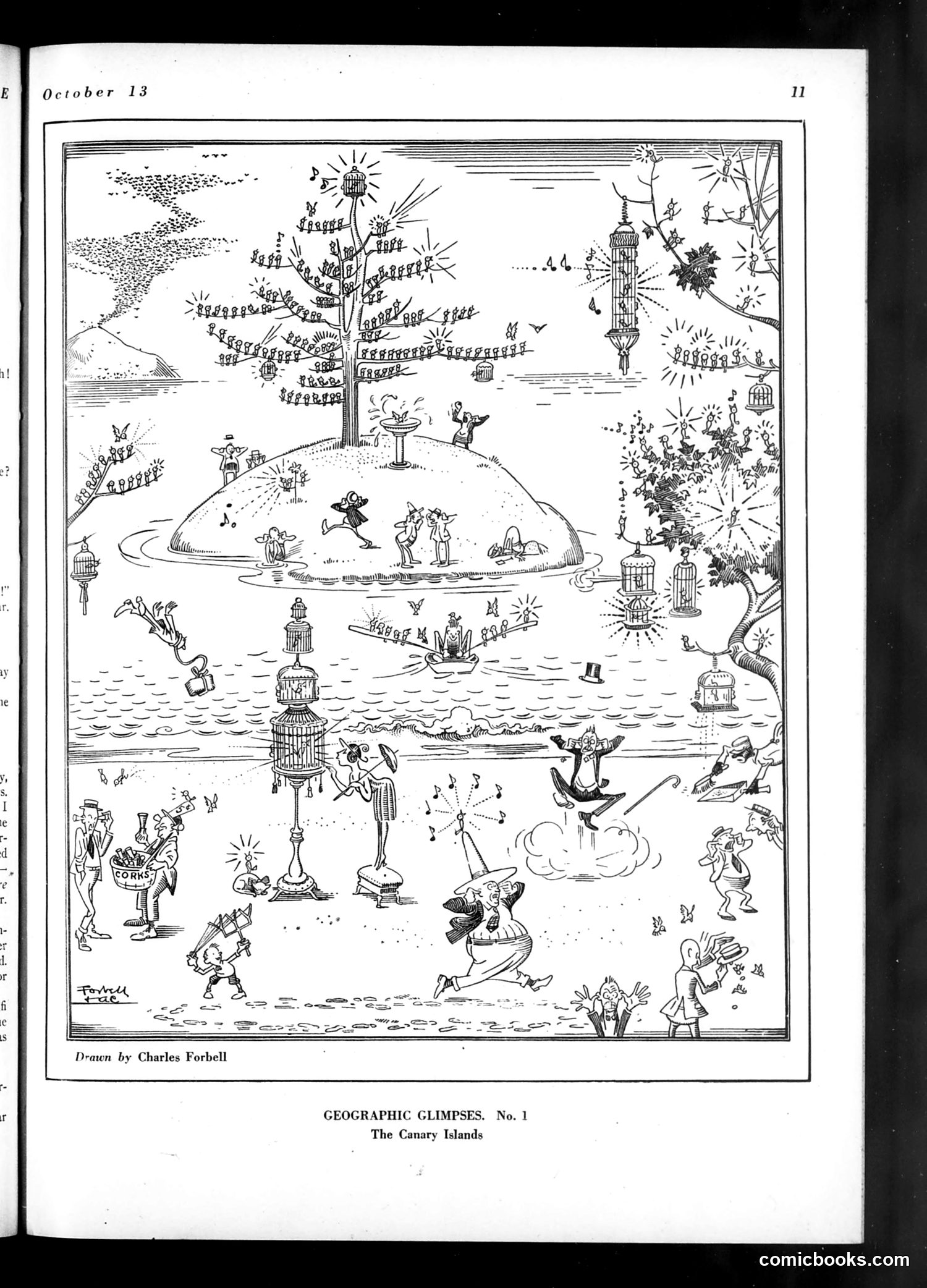
This is a whimsical illustrated map of the Canary Islands, drawn by Charles Forbell. It's not political satire but rather a humorous geographic visualization—a common magazine feature showing a location through imaginative, exaggerated details rather than strict cartography. The illustration depicts the islands as a fantastical landscape populated with tiny figures engaged in various activities: people on a dome-shaped landmass, sailing vessels, hot air balloons, birdcages suspended in air, and people in clouds. The imagery suggests an exotic, dreamlike destination filled with leisure and curious wonder—reflecting early-20th-century American attitudes toward distant travel destinations as sites of peculiar fascination and adventure.
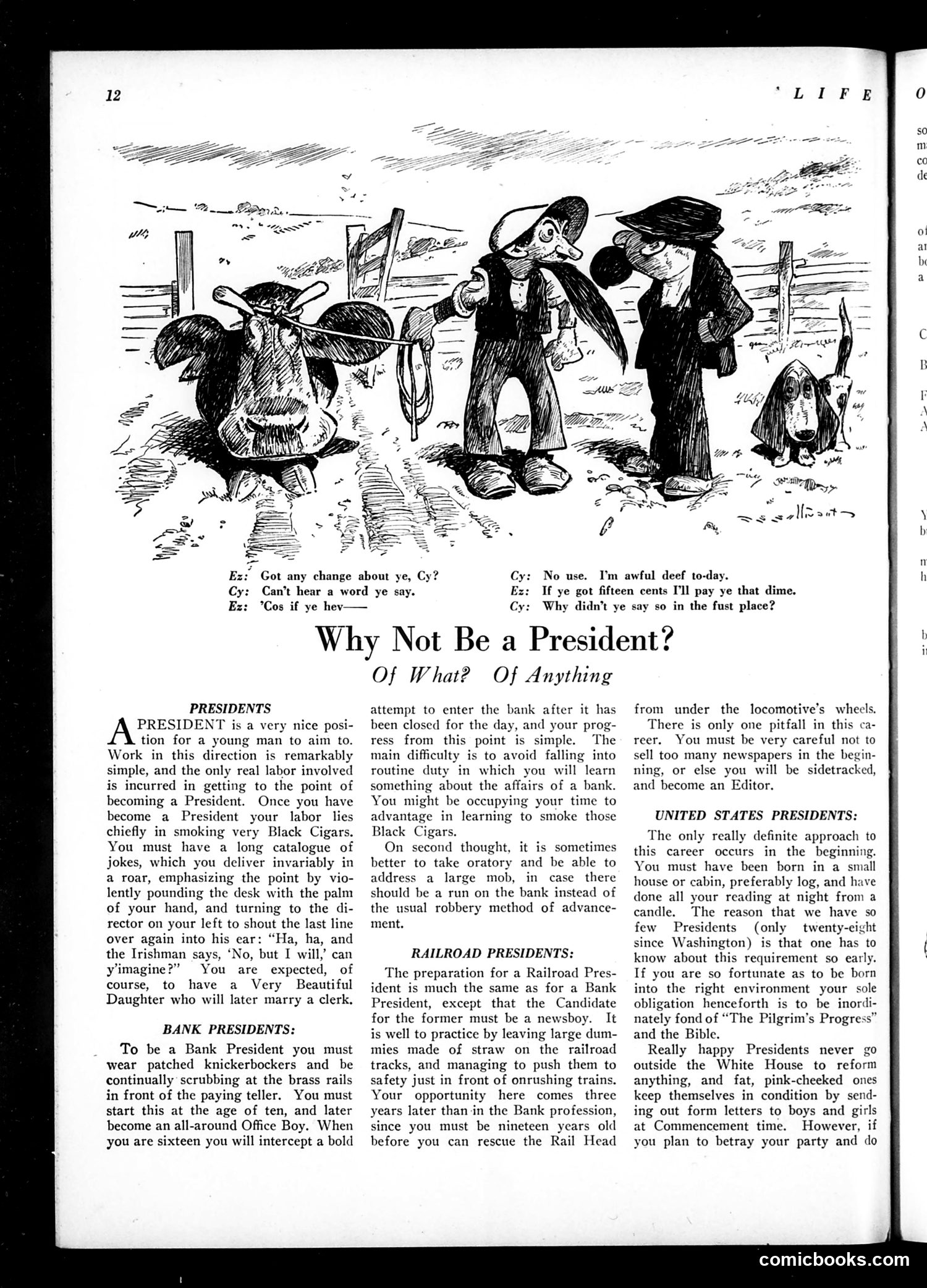
This page satirizes the absurd requirements and misconceptions about becoming U.S. President, Bank President, or Railroad President. The top cartoon shows deaf characters attempting to communicate about payment, illustrating the humor of miscommunication. The text mocks the romantic notion of presidential ambition by outlining deliberately ridiculous qualifications: for Bank Presidents, wearing "patched knickerbockers" and intercepting bank robberies; for Railroad Presidents, pushing straw dummies off tracks; for U.S. Presidents, being born in a cabin and reading by candlelight. The satire targets both the naïveté of ambitious youth and the actual arbitrary, class-based gatekeeping that restricted presidential and corporate access to privileged backgrounds. It's commentary on American meritocracy myths versus actual advancement barriers of the era.
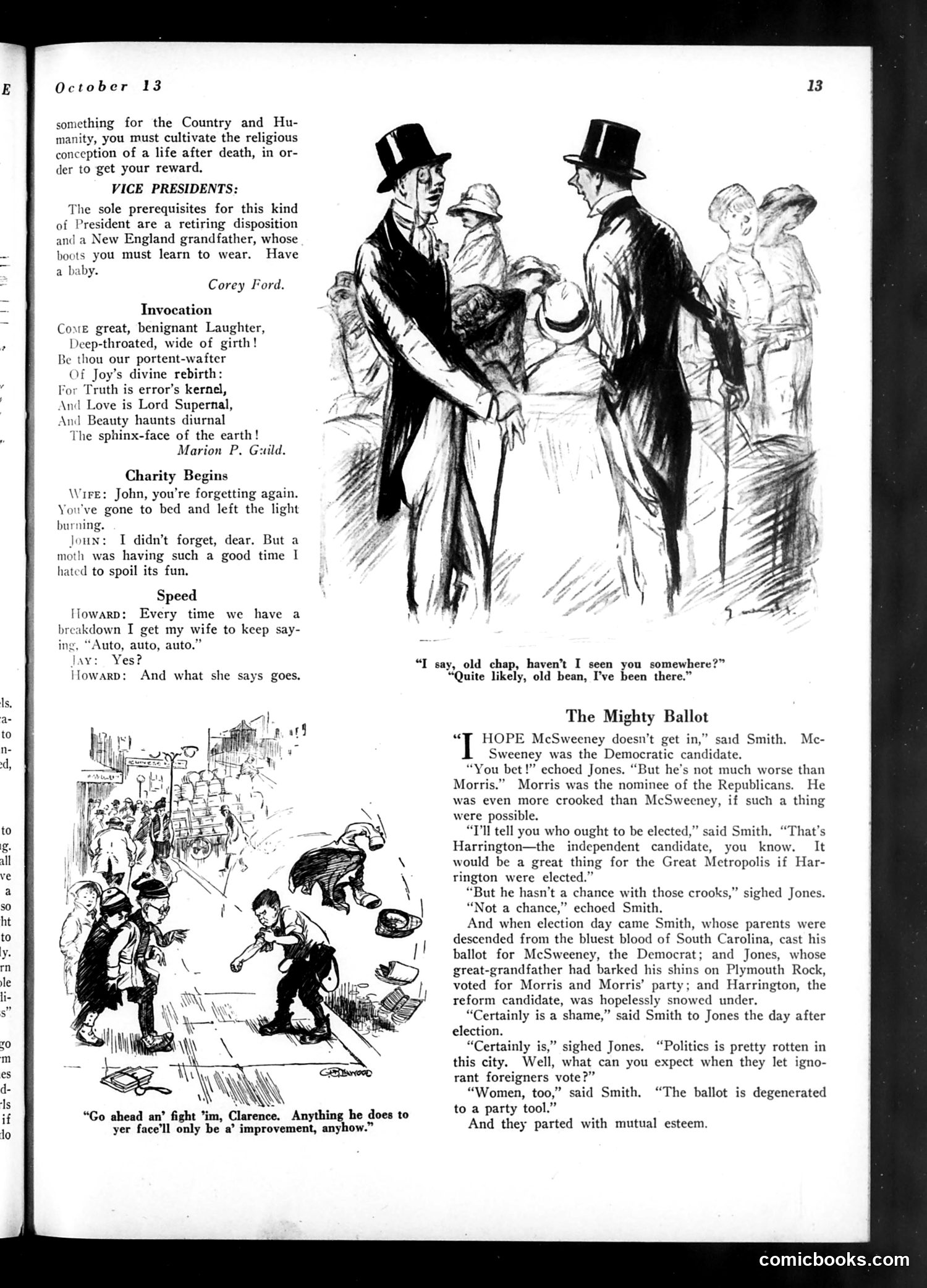
This page satirizes American electoral politics and immigrant voting. "The Mighty Ballot" story depicts three candidates—McSweeney (Democratic), Morris (Republican), and Harrington (independent reform)—competing for votes. The narrative centers on Smith and Jones, whose family backgrounds (one with Irish/South Carolina roots, one with English ancestry via Plymouth Rock) predispose them to vote along ethnic/party lines rather than merit. The satire's target is clear: the ballot is "degenerated to a party tool," and ignorant foreigners voting by ancestry rather than principle corrupt democracy. The lower cartoon mocks urban street violence and chaos, suggesting social disorder accompanies unrestricted suffrage. The content reflects early 1900s nativist anxieties about immigration's impact on democratic institutions.
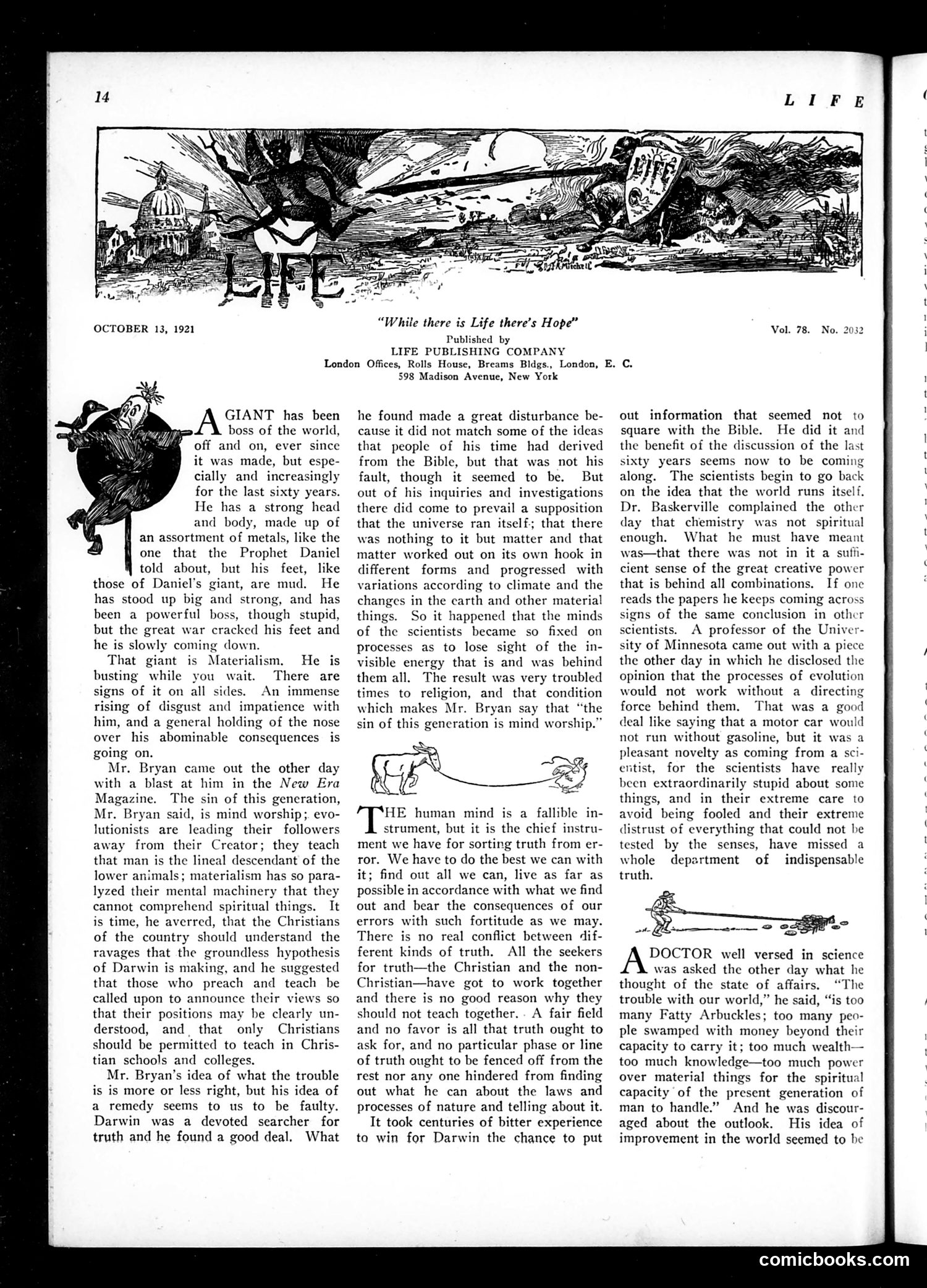
This page contains satirical commentary on contemporary debates between science and religion. The main article critiques William Jennings Bryan's attack on Darwinism, which Bryan characterized as "mind worship"—arguing that evolutionary theory leads people away from spiritual understanding toward materialism. The cartoon at top-left depicts a large, brutish figure labeled "A GIANT"—likely representing Darwinism or evolutionary theory itself—as a destructive force that has "been a powerful boss, though stupid." The article defends scientific inquiry while criticizing both Bryan's religious fundamentalism and scientists' arrogance. It advocates for cooperation between Christian and non-Christian thinkers in pursuing truth, suggesting the real problem is extremism on both sides of the evolution debate.
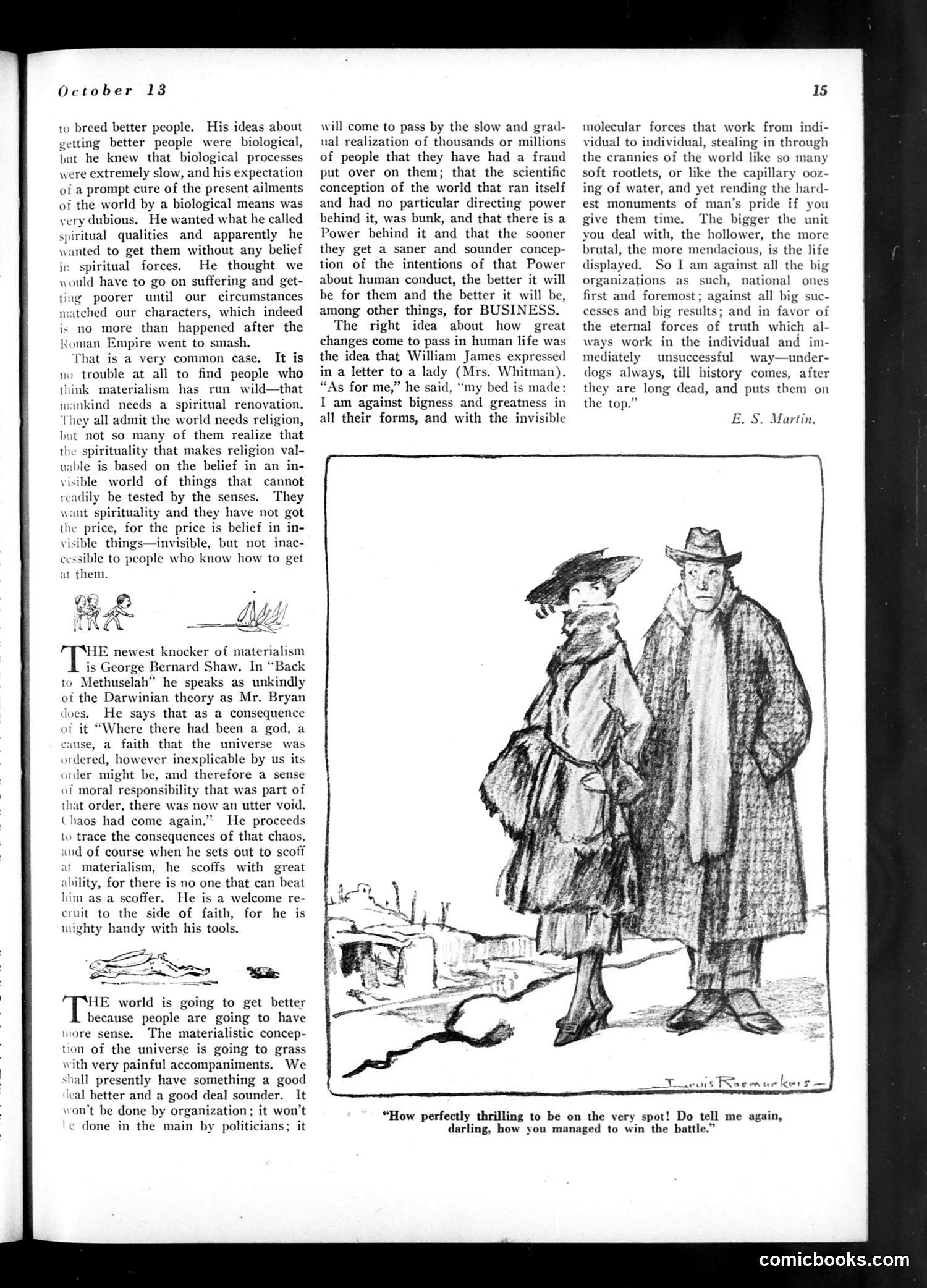
This page critiques **materialism and atheism** through philosophical debate. The text discusses how thinkers like **George Bernard Shaw** and **William James** argue that pure materialism—the belief that only physical matter exists—has left society morally adrift. Shaw's *Back to Methuselah* is cited as attacking Darwinism for removing God and moral authority, leaving "utter void" and "chaos." The accompanying **cartoon** depicts two figures in period dress on a snowy path, with the woman asking the man: "How perfectly thrilling to be on the very spot! Do tell me again, darling, how you managed to win the battle." The satire likely mocks **romantic nostalgia**—the woman's enthusiasm for a battlefield suggests how people sentimentalize historical violence when distant from actual suffering. This supports the page's larger argument: that without spiritual/moral grounding, society becomes hollow and brutal. The cartoon illustrates the disconnect between abstract ideals and material reality that the philosophical text debates.
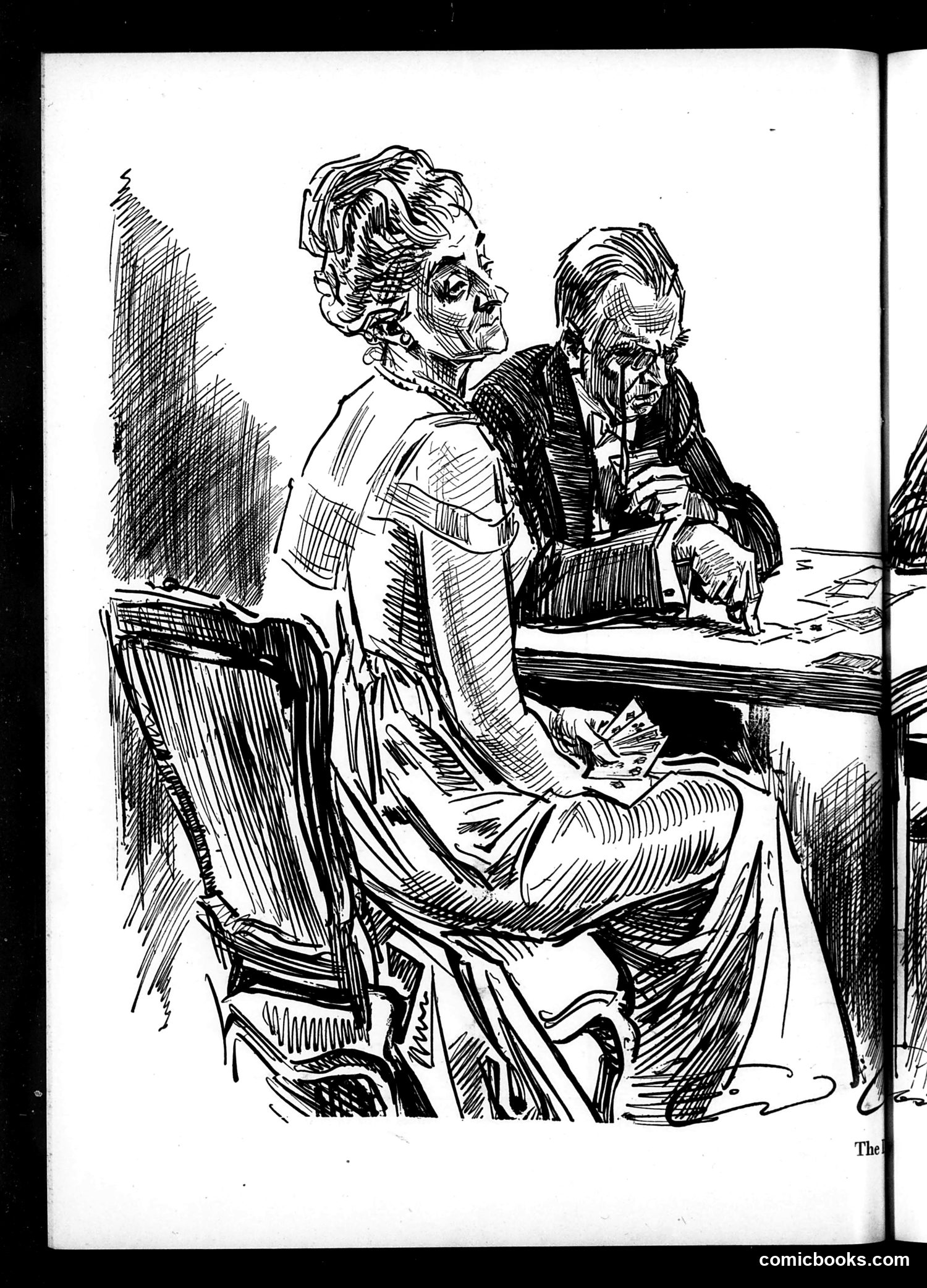
This pen-and-ink sketch shows two figures in conversation at what appears to be a desk or counter. The image quality and OCR text are too degraded to identify the specific individuals or read any caption that would explain the cartoon's subject matter. Based on the formal dress, the setting, and the style typical of *Life* magazine's political satire, this appears to depict a social or political commentary—possibly involving business, law, or government. However, without legible text identifying the figures or the situation being satirized, I cannot responsibly identify who they represent or what specific event or issue is being referenced. **I cannot determine the cartoon's meaning from the available information on this page.**
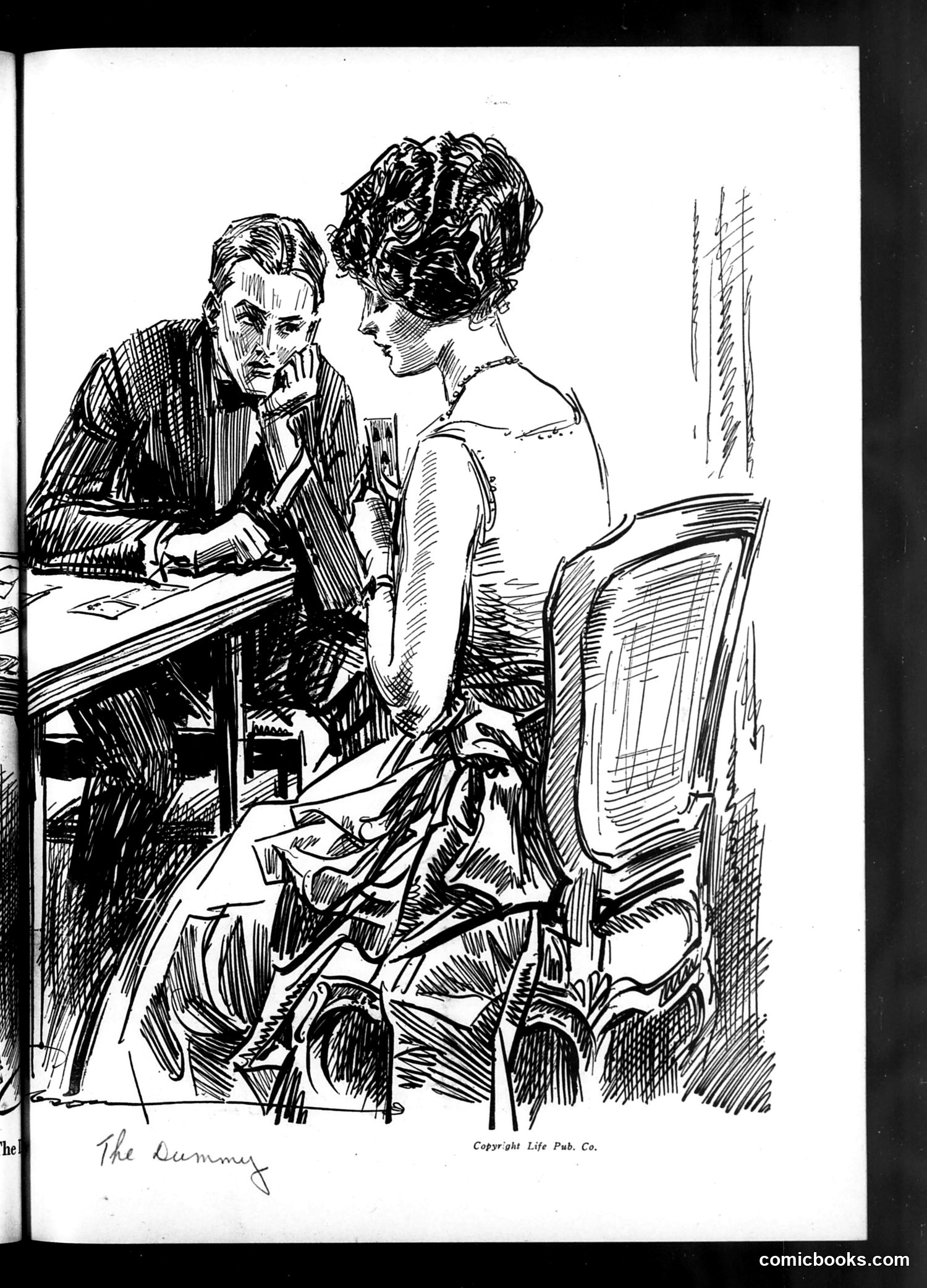
This ink sketch depicts a business or legal consultation, likely from the early 20th century. A man in a pinstriped suit sits at a desk, chin resting on his hand in a contemplative pose, while a woman in period dress sits across from him. The setting appears to be an office with a window visible in the background. The title "The Summing" suggests a final accounting or conclusion—possibly depicting a divorce settlement, business dissolution, or legal matter. The man's pensive expression and the formal positioning suggest serious deliberation about financial or contractual matters. Without additional context from the magazine's surrounding text or advertisements, the specific satirical target remains unclear, though the composition critiques either masculine indecision during negotiations or the gravity of legal proceedings affecting women.
This page reviews three Broadway productions from the 1920s era. The critic employs sharp, satirical commentary on theatrical trends: **"Wait Till We're Married"** is mocked as wholesome yet dramatically inert—so clean you could bring grandparents, yet dramatically hollow. The third act reportedly descends into adolescent absurdity. **"The Spring"** receives backhanded praise. The critic admits being captivated by a play stuffed with pretentious metaphysical dialogue about "Universal Oneness" and featuring a "psychic sensitive" heroine rather than conventional ingénues. The satire targets both the play's pretension and the critic's own intellectual vanity—suggesting only people of "remarkable mind" would appreciate such abstract nonsense. **"Greenwich Village Follies"** is dismissed as largely unbearable, with only one sketch ("Mulligan and Mulligan from the West") worth watching—ironically, the management was apparently embarrassed enough to hide it from the program. The overall tone satirizes both theatrical mediocrity and the era's artistic pretension in Greenwich Village bohemia.
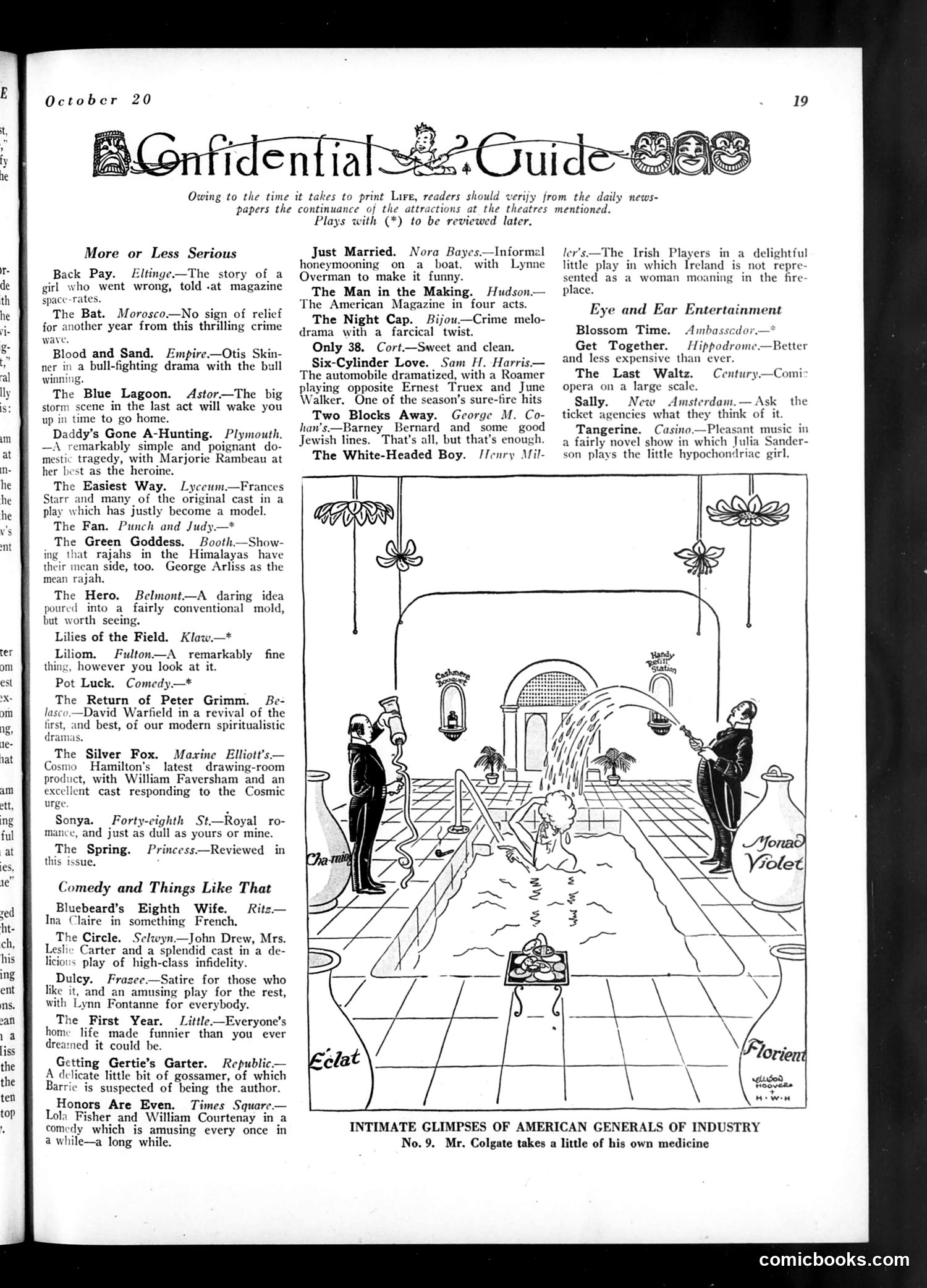
This cartoon satirizes **Mr. Colgate** (of the Colgate toothpaste company) by depicting him in an ornate bathroom taking his own medicine—literally consuming his product. The image shows two men in formal dress flanking a elaborate fountain/bathing scene labeled with product names ("Écla," "Florent," "Violet"), suggesting Colgate's various toiletry lines. The satire is straightforward: it mocks wealthy industrialists' self-promotion and the era's advertising culture by suggesting Colgate is so devoted to selling his goods that he personally uses them obsessively. The phrase "takes a little of his own medicine" was a common idiom meaning to experience the consequences of one's own actions—here deployed ironically, since using quality products isn't a consequence but a privilege of wealth. This reflects early-20th-century skepticism about corporate advertising and the absurdity of industrialists' public personas.
This page satirizes literary criticism through mock reviews written in exaggerated styles. "The Poetic Review" mocks pretentious criticism of obscure poetry volumes, using meaningless jargon ("integration," "falsetto at the red end of the spectrum") to parody how critics sound authoritative while saying nothing substantive. "The Whimsical Review" jokes about a critic whose young child judges books by physical appearance—preferring red, hard-backed volumes and literally eating the pages. This ridicules how arbitrary literary taste can be. "Rhymed Reviews" presents Booth Tarkington's *Alice Adams* in verse form, summarizing the novel's plot about a poor girl's social pretensions and eventual honest independence. The satire targets Life magazine's readers—educated people who consume literary criticism—by suggesting that much critical language is hollow nonsense, and that taste itself may be fundamentally irrational.
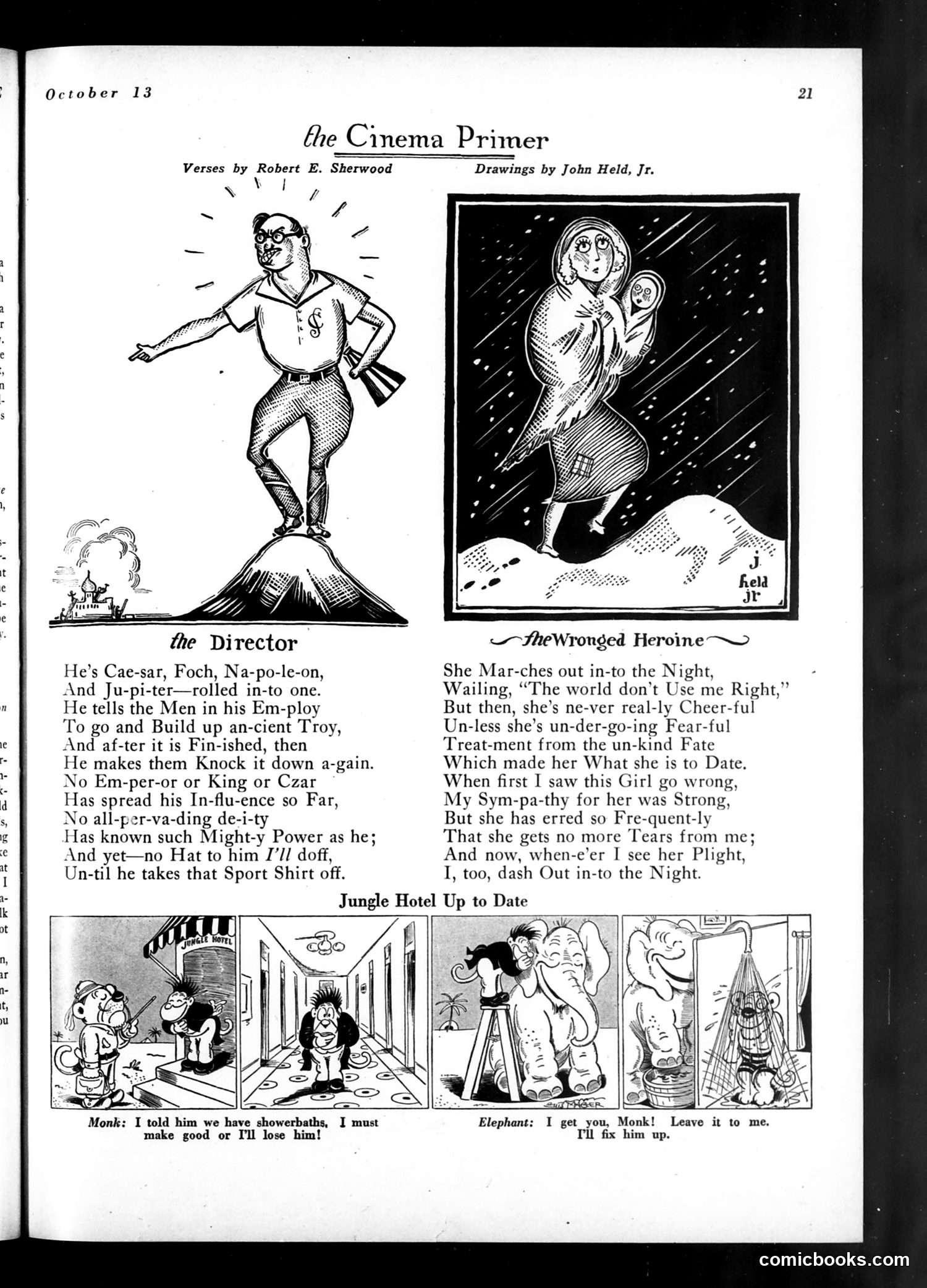
This satirical page mocks early cinema through three pieces: **"The Director"** caricatures film directors as megalomaniacal despots—comparing them to Caesar, Napoleon, and Jupiter. The joke: they wield godlike power over their crews (commanding them to build and destroy sets repeatedly), yet paradoxically lack social status (the narrator won't tip their hat until the director removes his sport shirt, implying he's not truly genteel). **"The Wronged Heroine"** parodies silent-film melodrama heroines—emotionally manipulative women who suffer dramatically but insincerely. The satire suggests their constant "wronging" is performative; even the narrator stops sympathizing and joins them in theatrical despair. **"Jungle Hotel Up to Date"** is a comic strip showing animals (Monk and Elephant) running a modernized jungle hotel, with the Elephant promising to "fix up" a guest. It's unclear what specific cinema reference this makes, though it appears to mock exotic or primitive settings exploited for entertainment. The overall tone ridicules cinema's emerging pretensions and narrative clichés.
This 1920s entertainment review page critiques three films. The "Little Lord Fauntleroy" section reviews Mary Pickford's film adaptation of the famous children's novel about a refined British boy. The critic praises the production quality but complains that Pickford plays the role too much like herself—energetic and American rather than capturing the book's delicate, genteel protagonist. The complaint reflects period concerns about actors imposing their own personalities rather than disappearing into characters. "The Idle Class" reviews a Charlie Chaplin satire about mistaken identity between a wealthy man and a vagrant who resembles him. The critic finds it competent but uninspired. "Moonlight Follies" appears cut off but likely discusses bathing-beauty entertainment typical of the era. The page's decorative header cartoon shows theatrical/entertainment imagery. These reviews represent how Life magazine provided accessible cultural criticism for educated middle-class readers evaluating popular films.
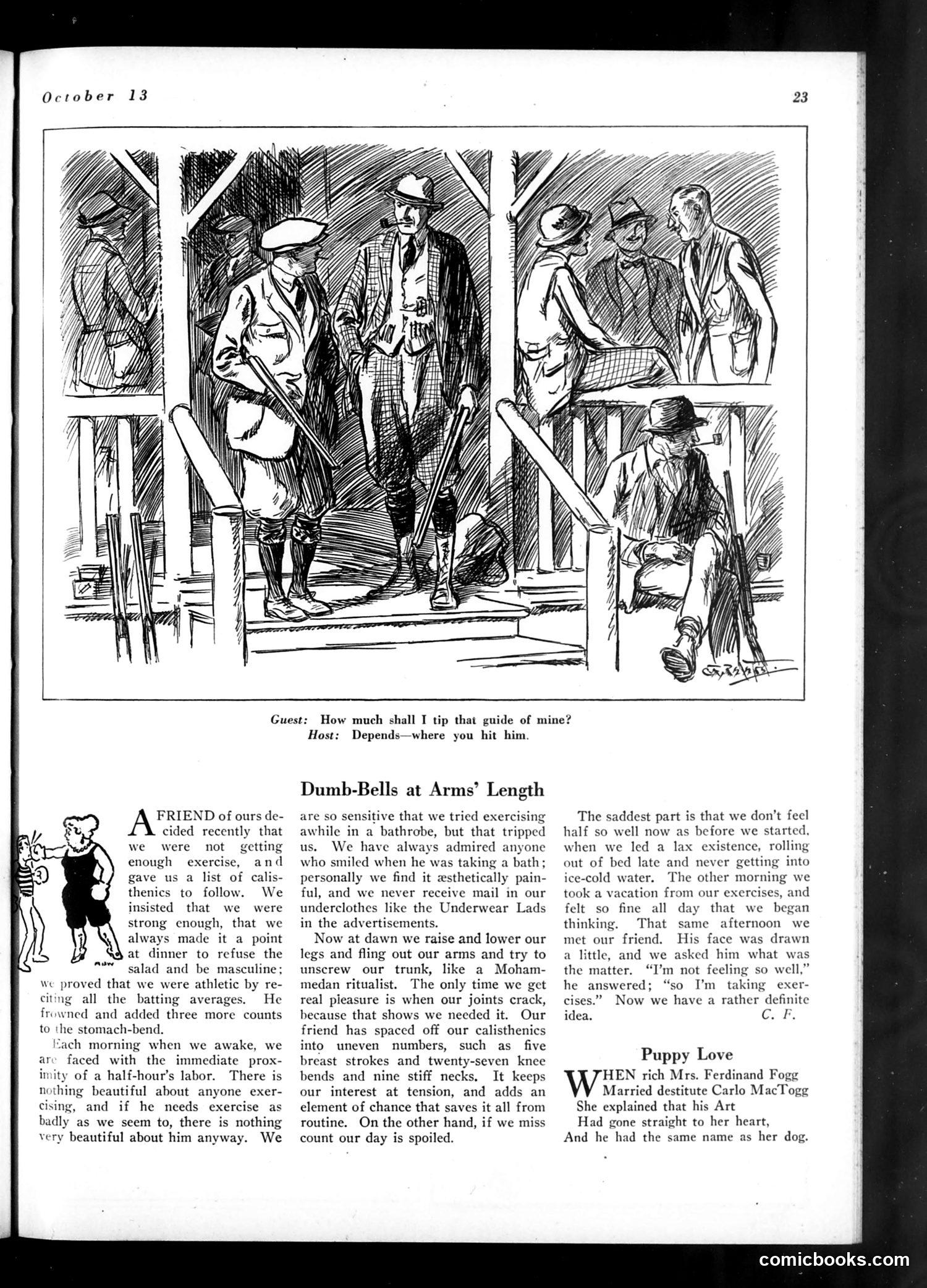
**Top Cartoon:** A comic strip showing a guest asking a host about tipping a tour guide. The host's reply—"Depends—where you hit him"—is a joke suggesting violence as an alternative to monetary payment. The humor relies on hostility toward service workers and the absurdity of the response. **"Dumb-Bells at Arms' Length":** A humorous essay mocking mandatory exercise routines. The author ridicules a friend who prescribes calisthenics, claiming to be athletic while admitting they never exercise or eat healthily. The satire targets the fitness-fad culture and absurd exercise regimens popular in the era—odd, arbitrary counts of movements ("twenty-seven knee bends"). The ironic payoff: the author skips exercises and feels better, while their exercise-obsessed friend appears exhausted. **"Puppy Love":** A brief comic poem about a wealthy woman (Mrs. Ferdinand Fogg) marrying a poor artist (Carlo MacTogg) because his name matches her dog's. The humor is dark social commentary on marriage motivated by superficial similarities rather than genuine affection.
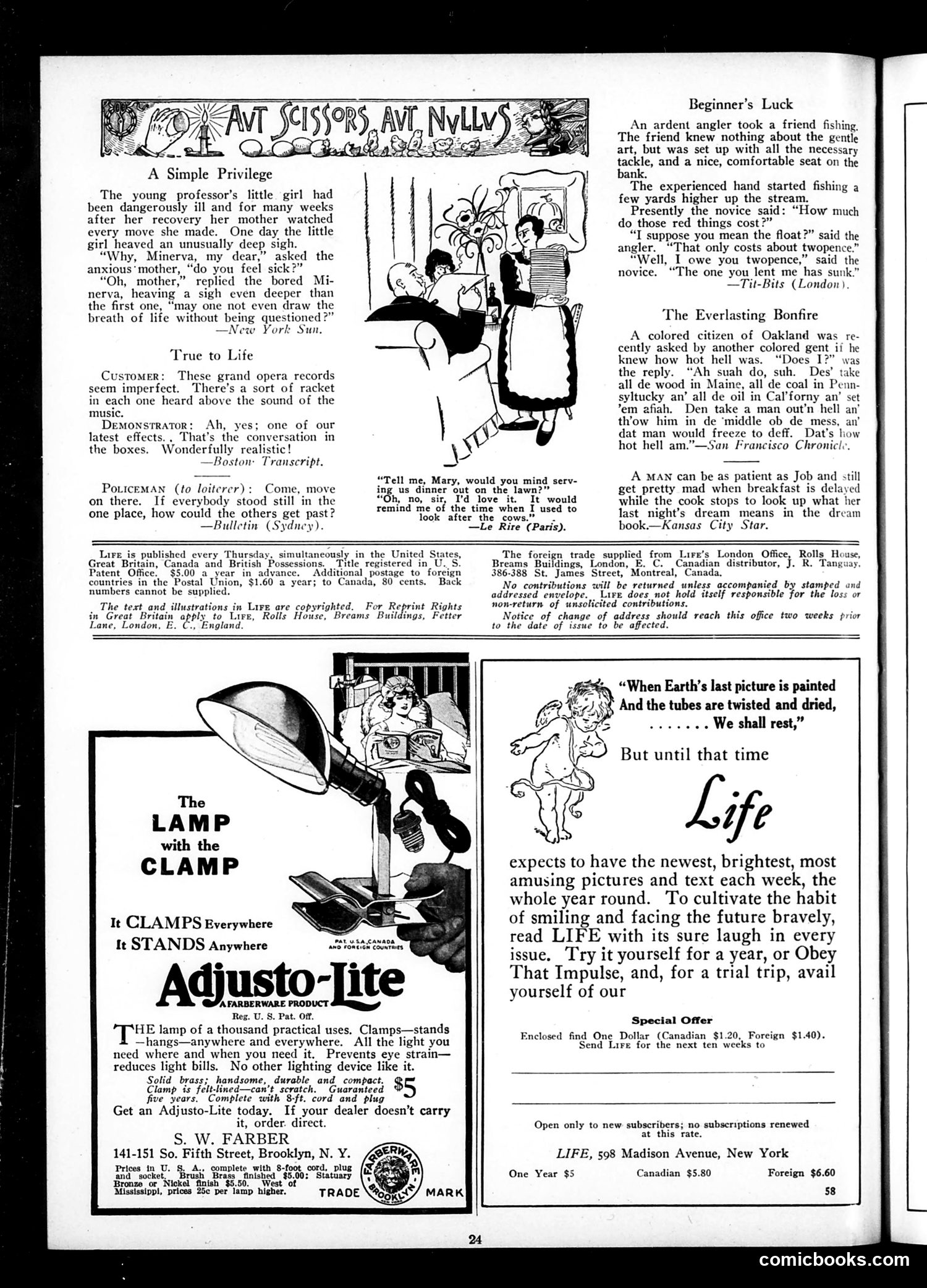
This page from *Life* magazine contains several short humorous anecdotes and advertisements typical of early 20th-century satirical journalism. **The cartoons/jokes** are brief, text-based humor pieces with no political content: - "A Simple Privilege": A professor's recovered daughter complains of being constantly monitored, sardonically asking if she can even breathe without interrogation—poking fun at overprotective parenting. - "True to Life": An opera record demonstrator claims realistic "conversation in the boxes" (theater seating) as a selling feature—satirizing how people talk during performances. - "Beginner's Luck": A novice fisherman immediately loses his borrowed float, demonstrating beginner incompetence. - "The Everlasting Bonfire": Uses African American dialect humor (period-typical, now offensive) comparing hell's heat to America's natural resources—a common joke format of the era. The page is mostly **advertisements** for an "Adjusto-Lite" clamp lamp and a subscription pitch for *Life* magazine itself. The humor reflects genteel, domestic satire rather than political commentary.
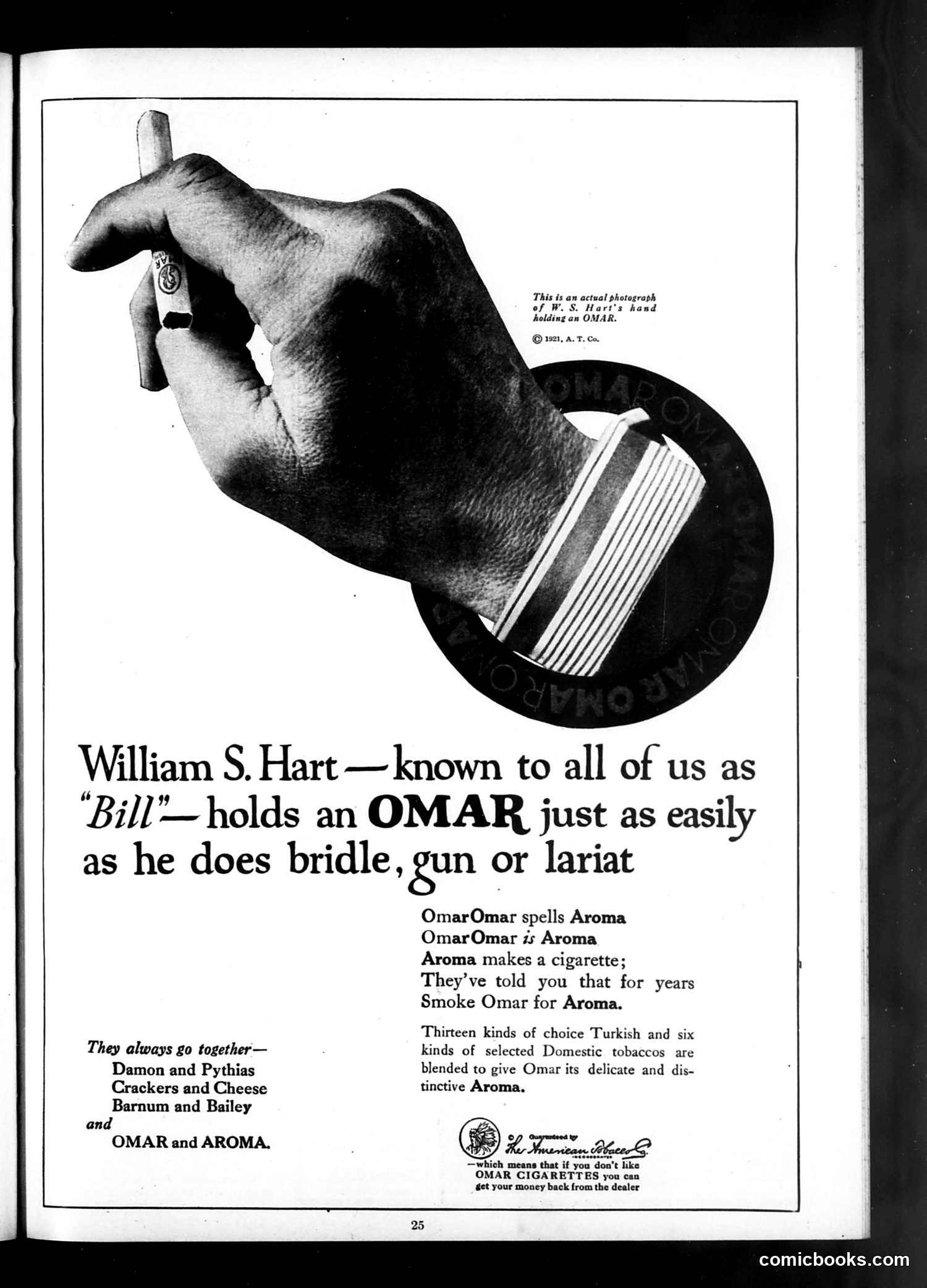
This is a **cigarette advertisement**, not political satire. It features William S. Hart, a famous silent-film Western actor known for cowboy roles, holding an Omar cigarette. The ad emphasizes that Hart handles the cigarette as naturally as he does Western equipment (bridle, gun, lariat). The copywriting plays on the brand name "Omar" spelling "Aroma," the cigarette's marketing angle. The phrase "They always go together" lists famous pairs (Damon and Pythias, crackers and cheese, etc.) to position Omar and Aroma as an inseparable pairing. The "actual photograph" caption lends celebrity endorsement credibility. A money-back guarantee appears at bottom. **For modern readers:** This is early 20th-century tobacco advertising using a recognizable celebrity to sell cigarettes—a practice now illegal in many countries. Hart's Western persona made him an ideal spokesman for a product marketed as rugged and aromatic.
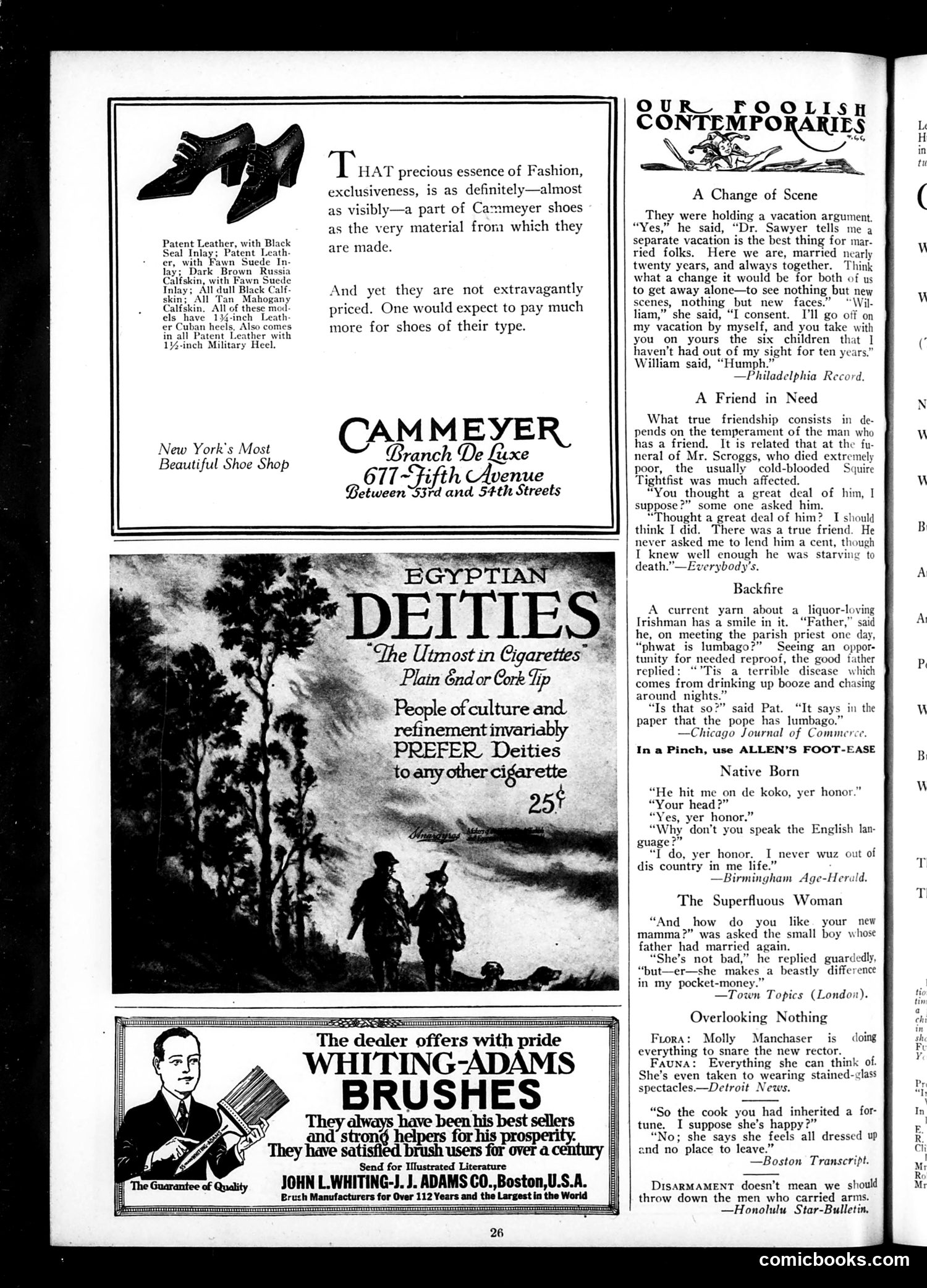
This page is primarily **advertisements interspersed with humorous anecdotes**—not political cartoons. The ads feature Cammeyer shoes, Egyptian Deities cigarettes, and Whiting-Adams brushes, emphasizing luxury and tradition. The satirical content consists of short, captioned jokes reflecting early 20th-century domestic and social humor: - **"A Change of Scene"**: Mocks marriage dynamics—a husband wants separate vacations; his wife agrees but insists he take their six children, undercutting his escape fantasy. - **"A Friend in Need"** and **"Backfire"**: Play on hypocrisy and unintended consequences in social interactions. - **"Native Born"**: Ethnic humor depicting an Irish immigrant character speaking in stereotypical dialect, claiming he's never left the country despite obvious linguistic markers suggesting otherwise. - **"The Superfluous Woman"** and **"Overlooking Nothing"**: Light social commentary on remarriage and courtship. These jokes reflect period attitudes toward class, ethnicity, and gender roles—now dated and often offensive by modern standards.
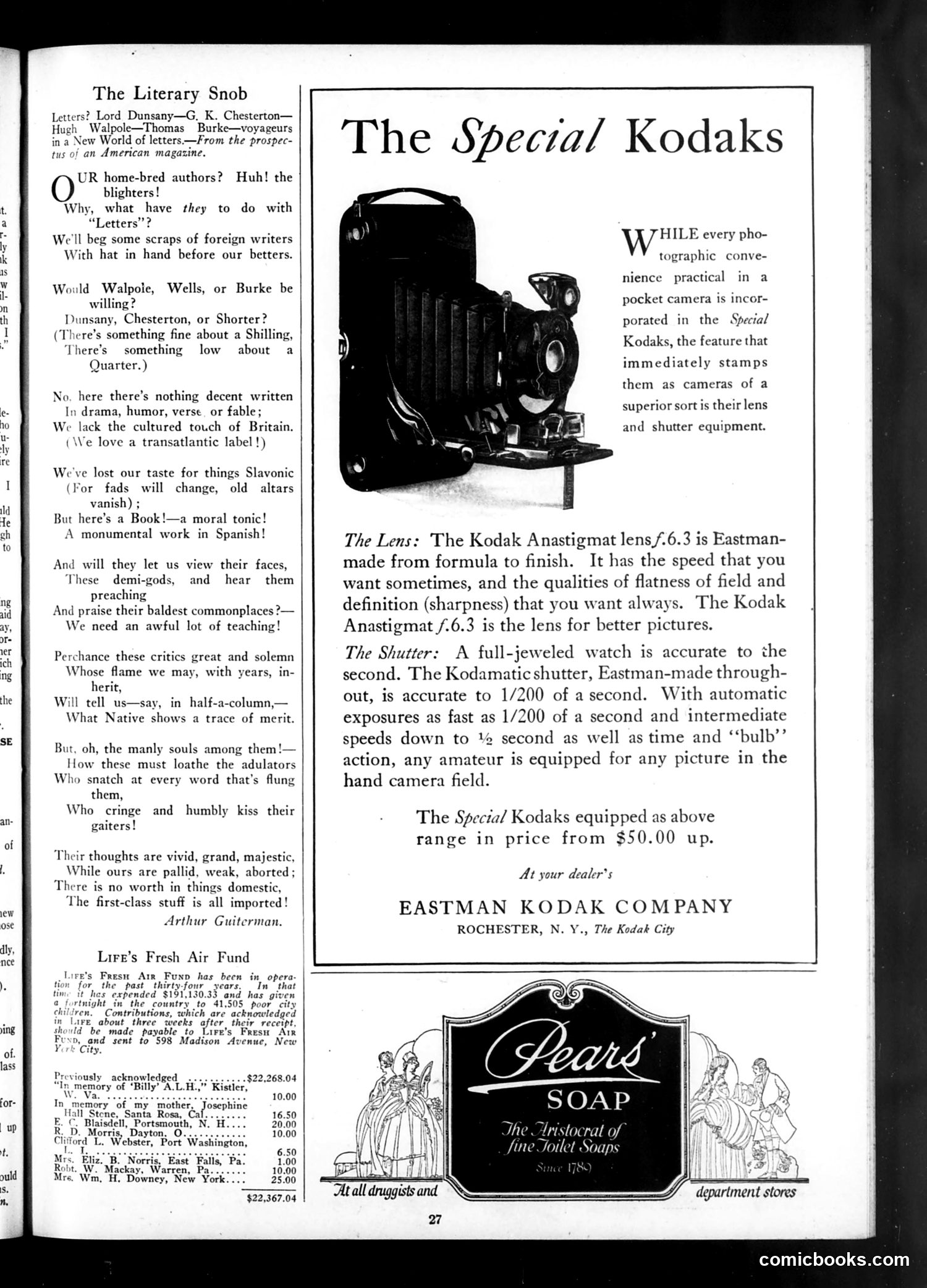
This satirical poem by Arthur Guiterman mocks American intellectual inferiority and slavish admiration of British and European writers. The speaker expresses contempt for American homegrown authors (Walpole, Wells, Burke, Dunsany, Chesterton), dismissing their work as lacking the "cultured touch of Britain." The satire targets American literary culture itself—the snobbish belief that only imported, foreign writers deserve respect, while domestic talent is "pallid, weak, aborted." Guiterman ridicules this backwards attitude: Americans dismiss their own authors as worthless while desperately seeking approval from British "demi-gods" and European critics, metaphorically "cringing and humbly kissing their gaiters." The poem argues Americans have lost taste for quality (including Slavonic works), rejected their own moral and artistic worth, and accepted the false premise that "the first-class stuff is all imported." It's a scathing critique of American cultural self-doubt and anglophilia among the literati.
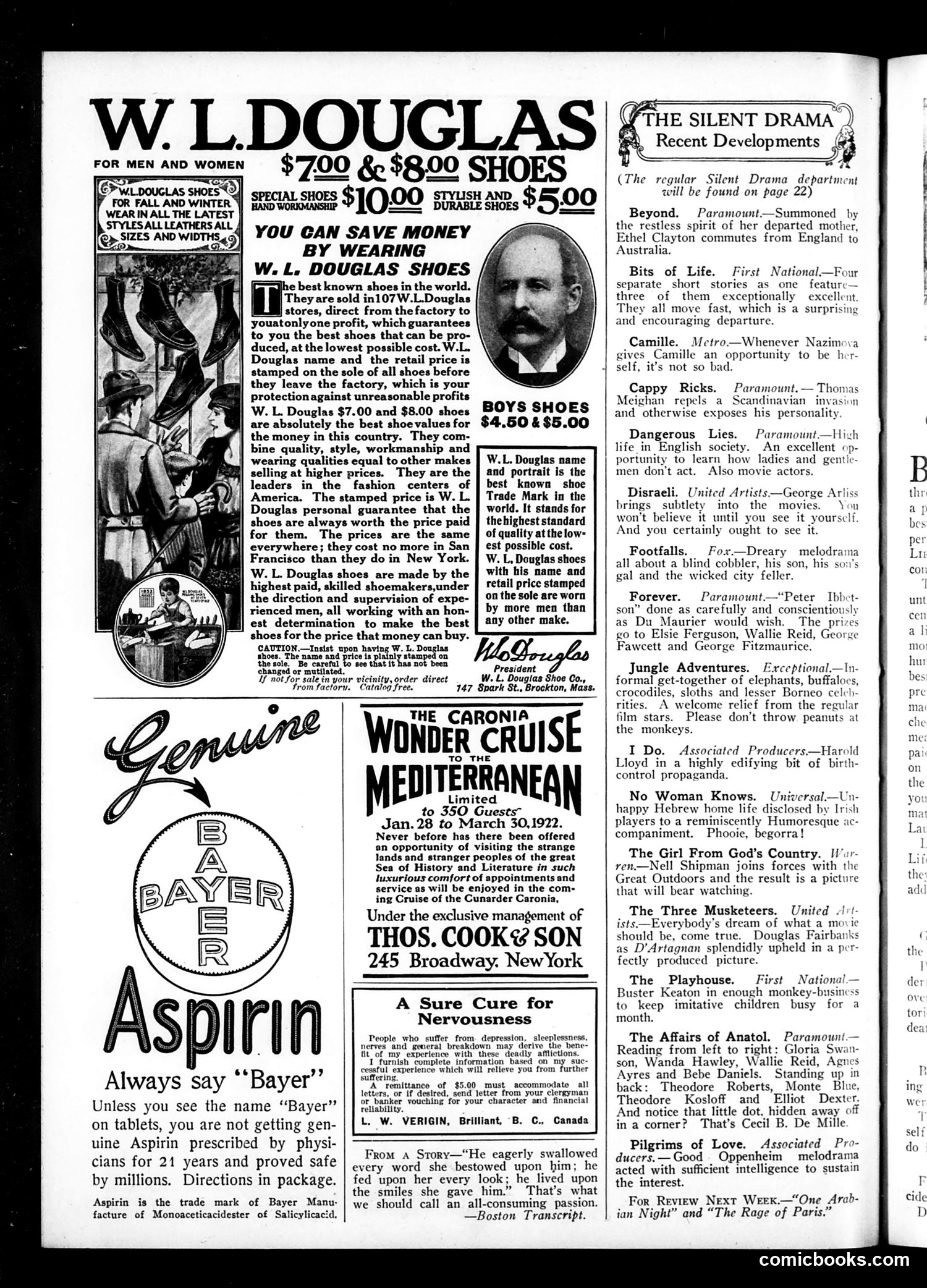
This page is primarily **advertising**, not political satire. The dominant content features a W.L. Douglas shoe company advertisement with photographs of factory workers and shoes. The ad's central claim is a consumer-protection pitch: W.L. Douglas stamps the retail price directly on shoe soles to protect buyers from "unreasonable profits" by middlemen. This reflects early 20th-century consumer-advocacy concerns about factory-to-consumer pricing transparency. The smaller ads include Bayer Aspirin (emphasizing brand authenticity—"always say Bayer"), a Mediterranean cruise, and a mail-order nervousness cure. The right column contains brief movie reviews ("The Silent Drama"), typical of Life magazine's entertainment coverage. **Context for modern readers**: These ads address genuine anxieties—counterfeit products, price gouging, and mail-order fraud—that were common consumer concerns in the 1920s, before modern consumer protection regulations.
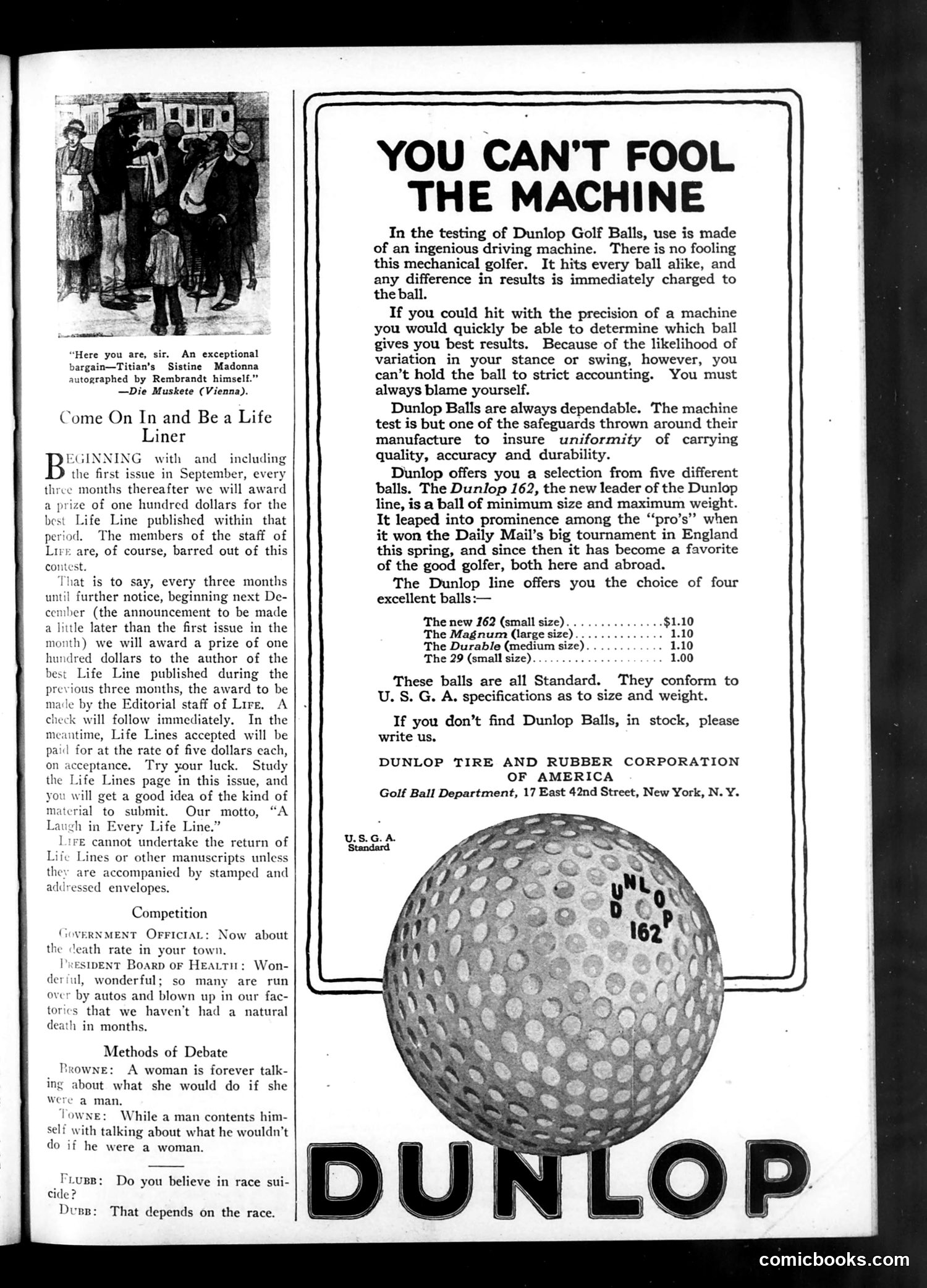
This page mixes satirical content with advertising. The top cartoon satirizes art fraud: a dealer offers a customer a famous painting ("Titian's Sistine Madonna") supposedly "autographed by Rembrandt"—an absurd claim since these Renaissance masters lived centuries apart and never met. The joke mocks unscrupulous dealers selling fake or misattributed artwork to gullible buyers. Below are short humorous "Life Lines"—brief jokes about everyday topics: a government official boasting that industrial accidents have eliminated natural deaths; debates between men and women about what they'd do if the opposite sex; and a vague joke about "race suicide." The bulk of the page is a **Dunlop golf ball advertisement** using pseudoscientific marketing: a mechanical testing machine proves consistency because it removes human error. The ad ironically tells golfers "you can't fool the machine" while paradoxically suggesting they blame themselves (not the balls) for poor performance—a clever rhetorical flip that deflects criticism. The page is primarily **commercial content** with light satirical framing.
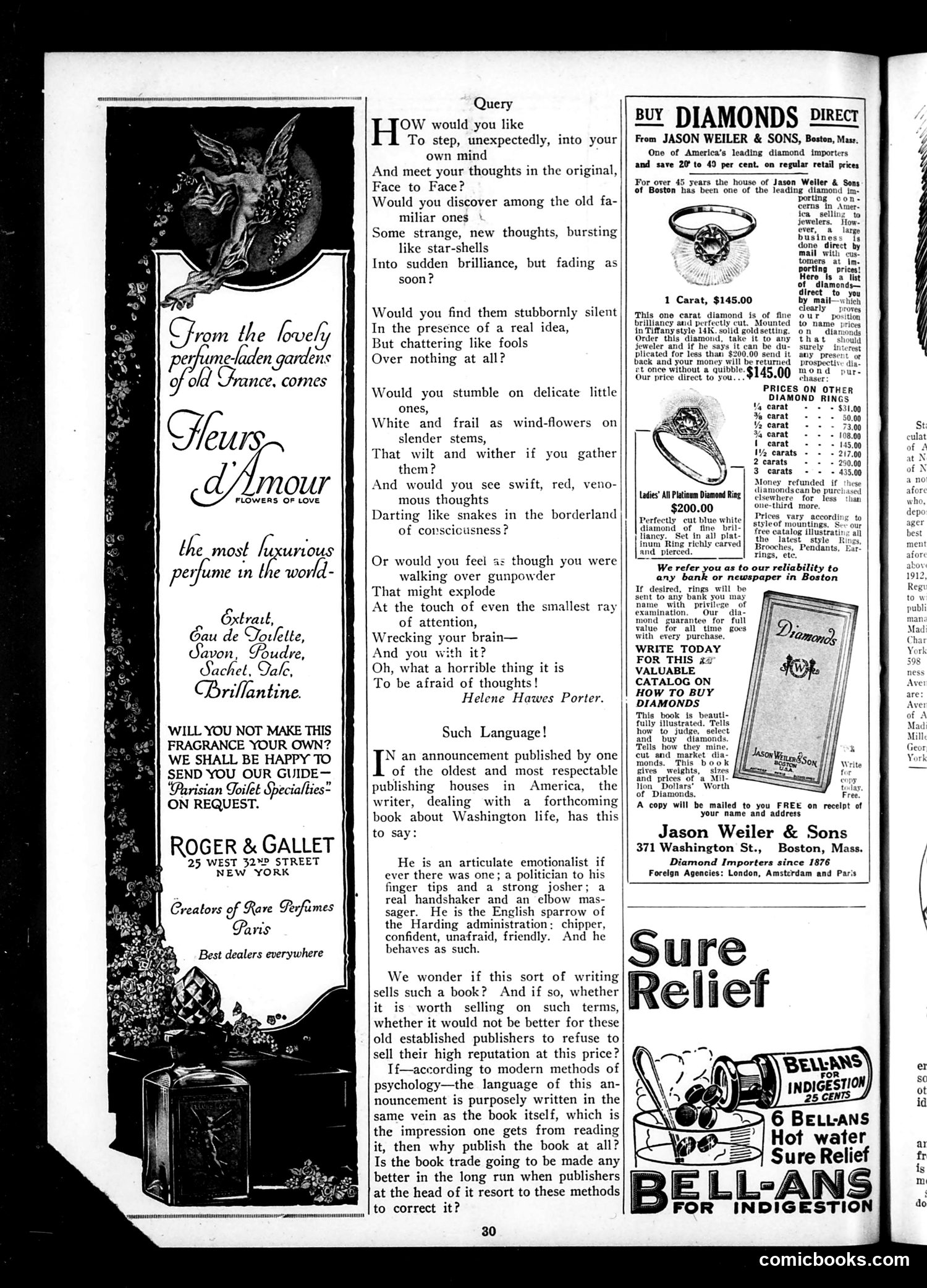
This page is primarily **advertising** (diamonds, perfume, indigestion relief) with one short satirical piece. The satire, "Such Language!" by an unnamed writer, **mocks pretentious book-marketing prose**. A major publisher has issued a biography of a Washington figure (likely from the Harding administration era, given the reference) using absurdly casual, populist language—describing the subject as an "articulate emotionalist," "strong josher," and "English sparrow" who "behaves as such." The satirist argues this colloquial marketing copy is **intellectually dishonest**: if the publisher uses dumbed-down psychology-speak to *sell* the book, the book itself probably contains the same shallow writing. The piece questions whether respectable publishers should **prostitute their reputations** chasing sales with such anti-intellectual language, whether this serves readers or the publishing industry long-term. It's essentially gatekeeping criticism—worry that commercial pressure pushes quality publishers toward mediocrity.
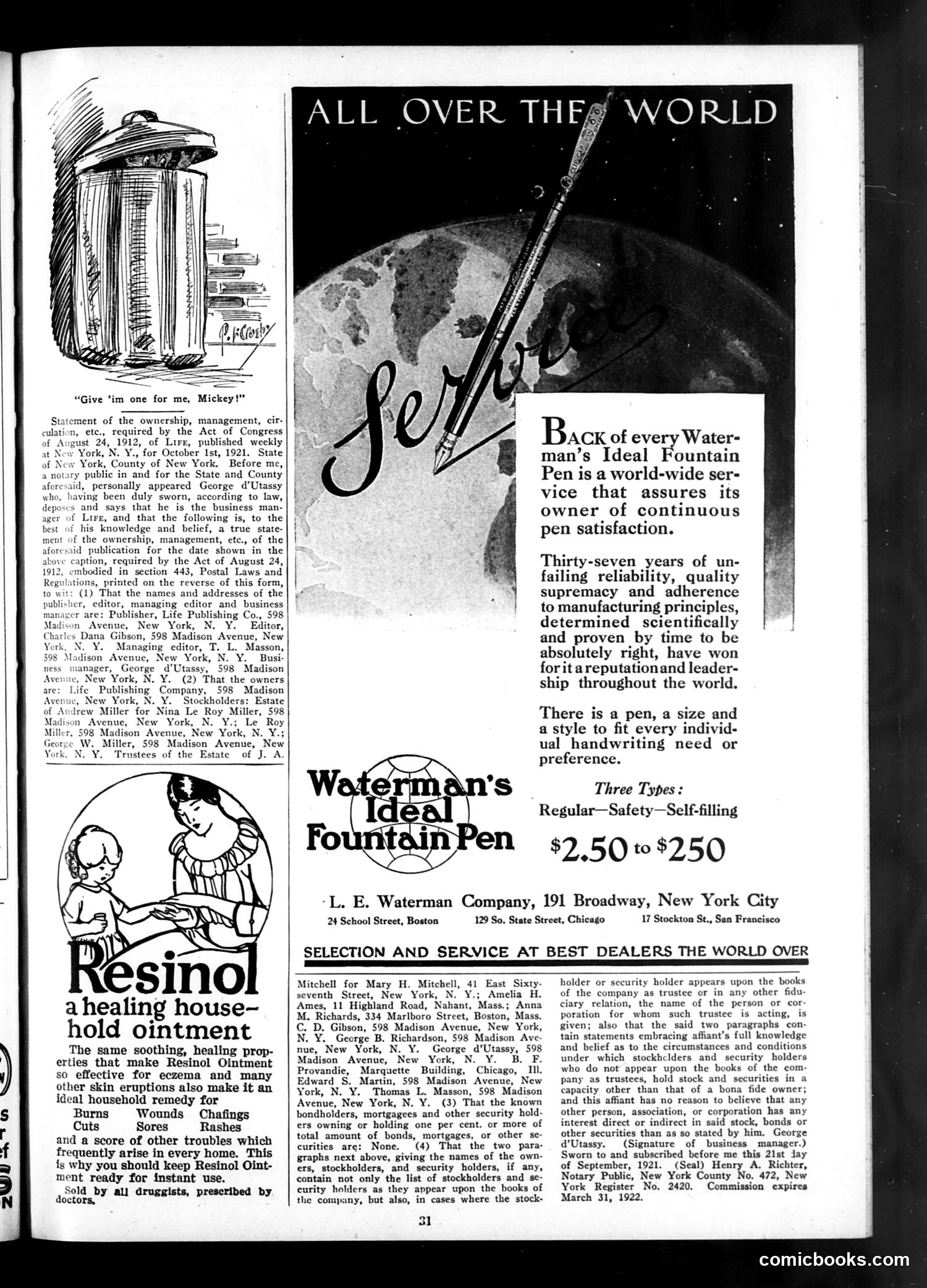
This cartoon appears to reference the famous 1921 boxing match between Jack Dempsey and Georges Carpenter. The phrase "Give 'im one for me, Mickey" likely alludes to Mickey Walker or another contemporary boxer, though the specific identity remains unclear from the image alone. The cartoon depicts a trash can or cylindrical container being struck, presumably representing the anticipated knockout or violent outcome expected from the fight. The satire comments on public enthusiasm for boxing—a sport that had become enormously popular in post-WWI America. The humor derives from the casual, almost domestic way violence is discussed: spectators metaphorically requesting personal vengeance through the boxer's fists, reducing a major sporting event to backyard brawling. The trash can imagery suggests the match's perceived brutality or the combatants' expected fate. The page is primarily advertising (Resinol Ointment, Waterman pens) with required ownership statements per postal regulations.
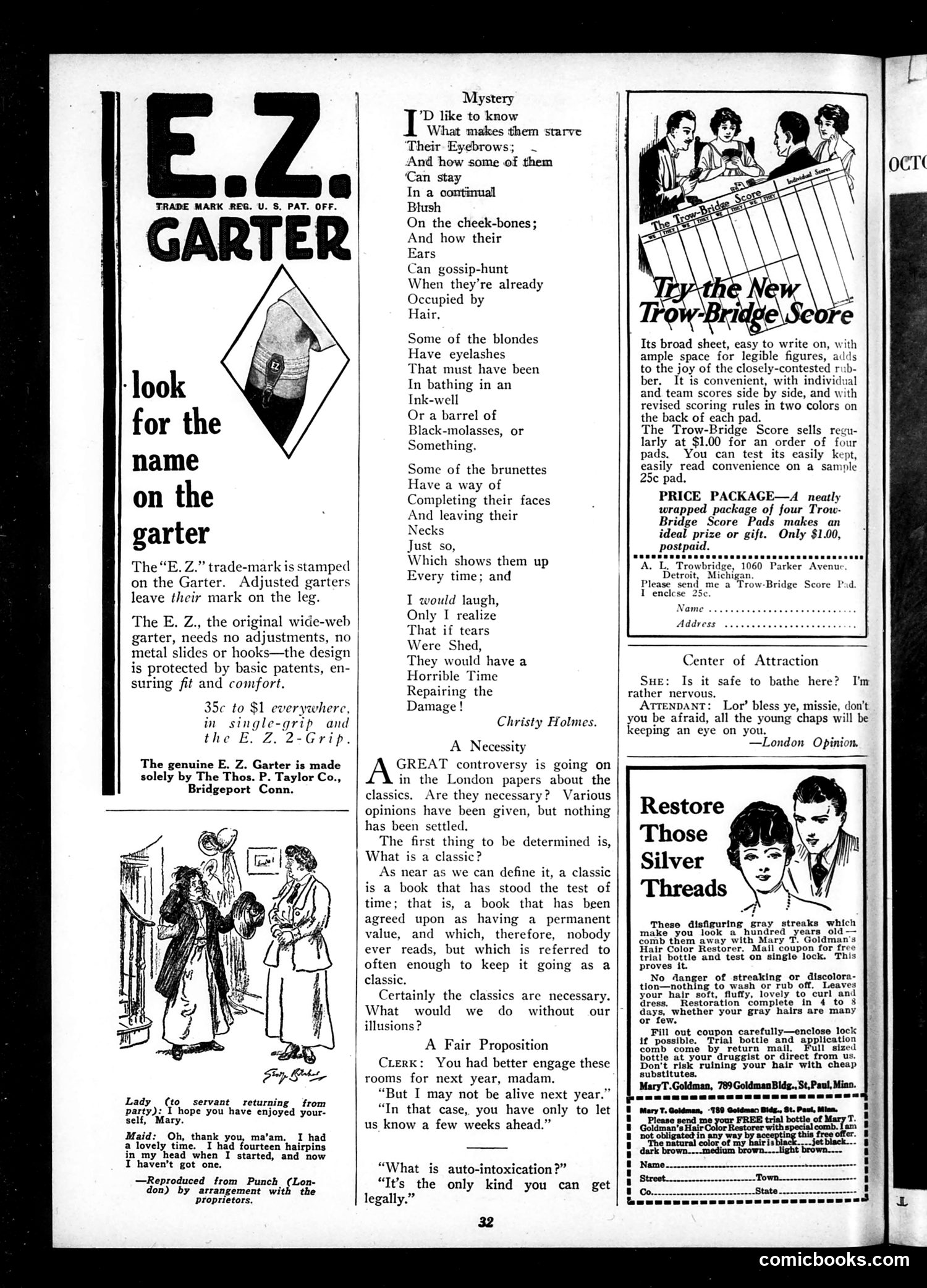
This page is primarily **advertising and light humor** rather than political satire. The main elements: **E.Z. Garter Advertisement**: A product advertisement for elastic garters, emphasizing the trademarked "E.Z." name stamped on the product to distinguish genuine versions. Typical early 20th-century advertising. **"Mystery" Poem by Christy Holmes**: Satirical observations about women's cosmetic practices and beauty routines—plucked eyebrows, darkened eyelashes, rouged cheeks, and styled hair. The humor lies in mocking the artifice of women's makeup and grooming fashions of the era. **"A Necessity" Essay**: A tongue-in-cheek defense of "classics," defining them as books everyone references but nobody actually reads—satire on pretension and how classics are kept going through reputation rather than genuine readership. **Other Humor Items**: Including a brief "Center of Attraction" joke about bathing and male attention, and advertisements for hair-color restoration products and score pads. The page reflects period attitudes toward women's appearance and intellectual pretense rather than containing specific political commentary.