
Life, 1921-10-13 · page 22 of 34
Life — October 13, 1921 — page 22: what you’re looking at
What you’re looking at
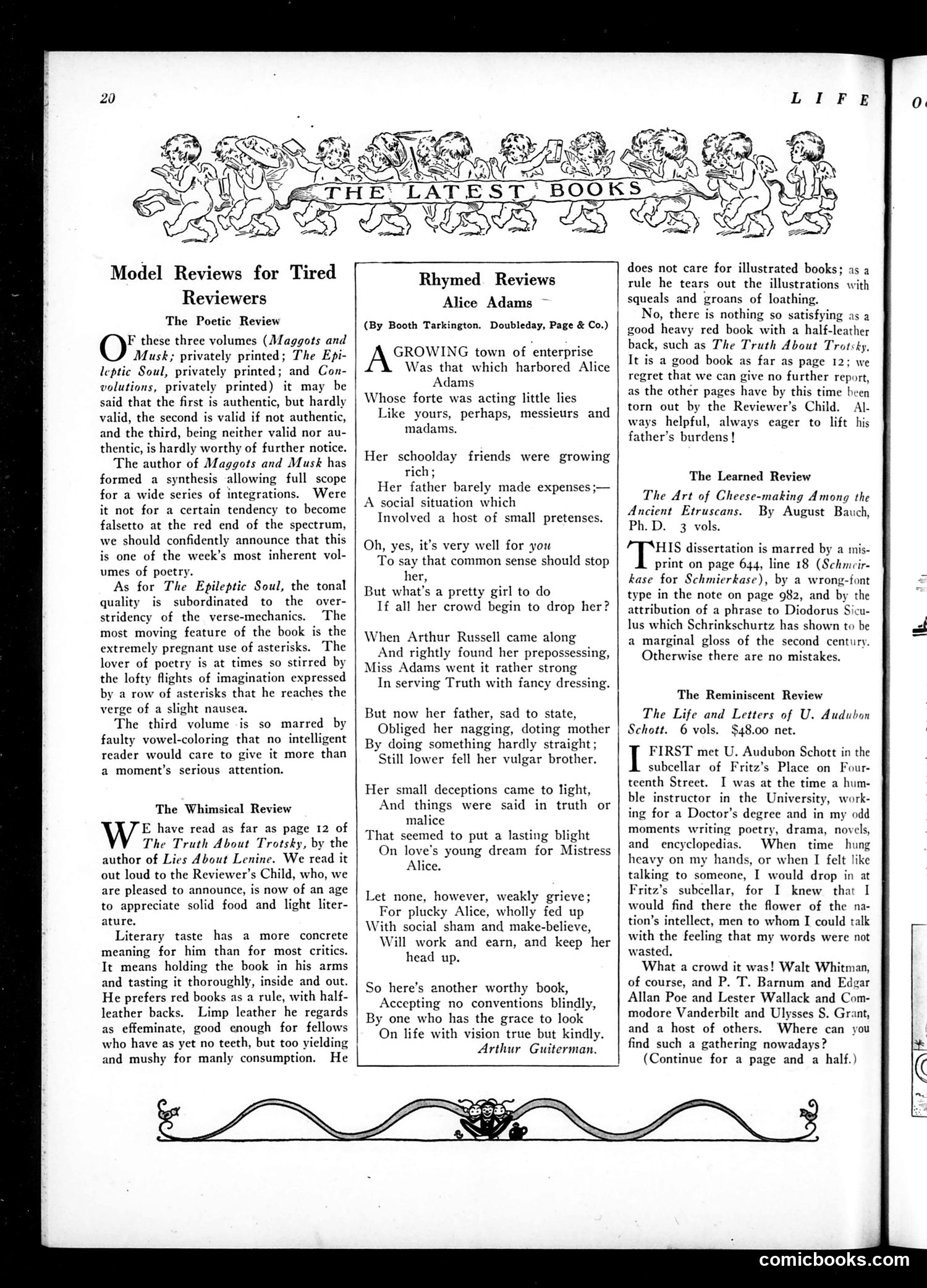
This page satirizes literary criticism through mock reviews written in exaggerated styles. "The Poetic Review" mocks pretentious criticism of obscure poetry volumes, using meaningless jargon ("integration," "falsetto at the red end of the spectrum") to parody how critics sound authoritative while saying nothing substantive. "The Whimsical Review" jokes about a critic whose young child judges books by physical appearance—preferring red, hard-backed volumes and literally eating the pages. This ridicules how arbitrary literary taste can be. "Rhymed Reviews" presents Booth Tarkington's *Alice Adams* in verse form, summarizing the novel's plot about a poor girl's social pretensions and eventual honest independence. The satire targets Life magazine's readers—educated people who consume literary criticism—by suggesting that much critical language is hollow nonsense, and that taste itself may be fundamentally irrational.
📄 Transcribed text from this page (OCR, searchable)
Machine-transcribed from the original scan — historical spelling and the odd misread are preserved.
Model Reviews for Tired Reviewers The Poetic Review F these three volumes (Maggots and Musk; privately printed; The Epi- leptic Soul, privately printed; and Con- volutions, privately printed) it may be said that the first is authentic, but hardly valid, the second is valid if not authentic, and the third, being neither valid nor au- thentic, is hardly worthy of further notice. The author of Maggots and Musk has formed a synthesis allowing full scope for a wide series of integrations. Were it not for a certain tendency to become falsetto at the red end of the spectrum, we should confidently announce that this is one of the week’s most inherent vol- umes of poetry. As for The Epileptic Soul, the tonal quality is subordinated to the over- stridency of the verse-mechanics. The most moving feature of the book is the extremely pregnant use of asterisks. The lover of poetry is at times so stirred by the lofty flights of imagination expressed by a row of asterisks that he reaches the verge of a slight nausea. The third volume is so marred by faulty vowel-coloring that no intelligent reader would care to give it more than a moment's serious attention. The Whimsical Review E have read as far as page 12 of The Truth About Trotsky, by the author of Lies About Lenine. We read it out loud to the Reviewer’s Child, who, we are pleased to announce, is now of an age to appreciate solid food and light liter- ature. Literary taste has a more concrete meaning for him than for most critics. It means holding the book in his arms and tasting it thoroughly, inside and out. He prefers red books as a rule, with half- leather backs. Limp leather he regards as effeminate, good enough for fellows who have as yet no teeth, but too yielding and mushy for manly consumption. He Rhymed_ Reviews Alice Adams (By Booth Tarkington, Doubleday, Page & Co.) GROWING town of enterprise Was that which harbored Alice Adams Whose forte was acting little lies Like yours, perhaps, messieurs and madams. Her schoolday friends were growing rich; Her father barely made expenses ;— A social situation which Involved a host of small pretenses. Oh, yes, it’s very well for you To say that common sense should stop her, But what's a pretty girl to do If all her crowd begin to drop her? When Arthur Russell came along And rightly found her prepossessing, Miss Adams went it rather strong In serving Truth with fancy dressing. But now her father, sad to state, Obliged her nagging, doting mother By doing something hardly straight; Still lower fell her vulgar brother. Her small deceptions came to light, And things were said in truth or malice That seemed to put a lasting blight On love's young dream for Mistress Alice. Let none, however, weakly grieve; For plucky Alice, wholly fed up With social sham and make-believe, Will work and earn, and keep her head up. So here’s another worthy book, Accepting no conventions blindly, By one who has the grace to look On life with vision true but kindly. Arthur Guiterman. does not care for illustrated books; as a rule he tears out the illustrations with squeals and groans of loathing. No, there is nothing so satisfying as a good heavy red book with a half-leather back, such as The Truth About Trotsky, It is a good book as far as page 12; we regret that we can give no further report, as the other pages have by this time been torn out by the Reviewer’s Child. Al- ways helpful, always eager to lift his father’s burdens! The Learned Review The Art of Cheese-making Among the Ancient Etruscans. By August Bauch, Ph.D. 3 vols. ‘HIS dissertation is marred by a mis- print on page 644, line 18 (Schmcir- kase for Schmierkase), by a wrong-font type in the note on page 982, and by the attribution of a phrase to Diodorus Sicu- lus which Schrinkschurtz has shown to be a marginal gloss of the second century. Otherwise there are no mistakes. The Reminiscent Review The Life and Letters of U. Audubon Schott. 6 vols. $48.00 net. FIRST met U. Audubon Schott in the subcellar of Fritz’s Place on Four- teenth Street. I was at the time a hum- ble instructor in the University, work- ing for a Doctor’s degree and in my odd moments writing poetry, drama, novels, and encyclopedias. When time hung heavy on my hands, or when I felt like talking to someone, I would drop in at Fritz’s subcellar, for I knew that I would find there the flower of the na- tion’s intellect, men to whom I could talk with the feeling that my words were not wasted, What a crowd it was! Walt Whitman, of course, and P. T. Barnum and Edgar Allan Poe and Lester Wallack and Com- modore Vanderbilt and Ulysses S. Grant, and a host of others. Where can you find such a gathering nowadays? (Continue for a page and a half.) 1| ? J~e comicbooks.com