
Life, 1921-10-13 · page 12 of 34
Life — October 13, 1921 — page 12: what you’re looking at
What you’re looking at
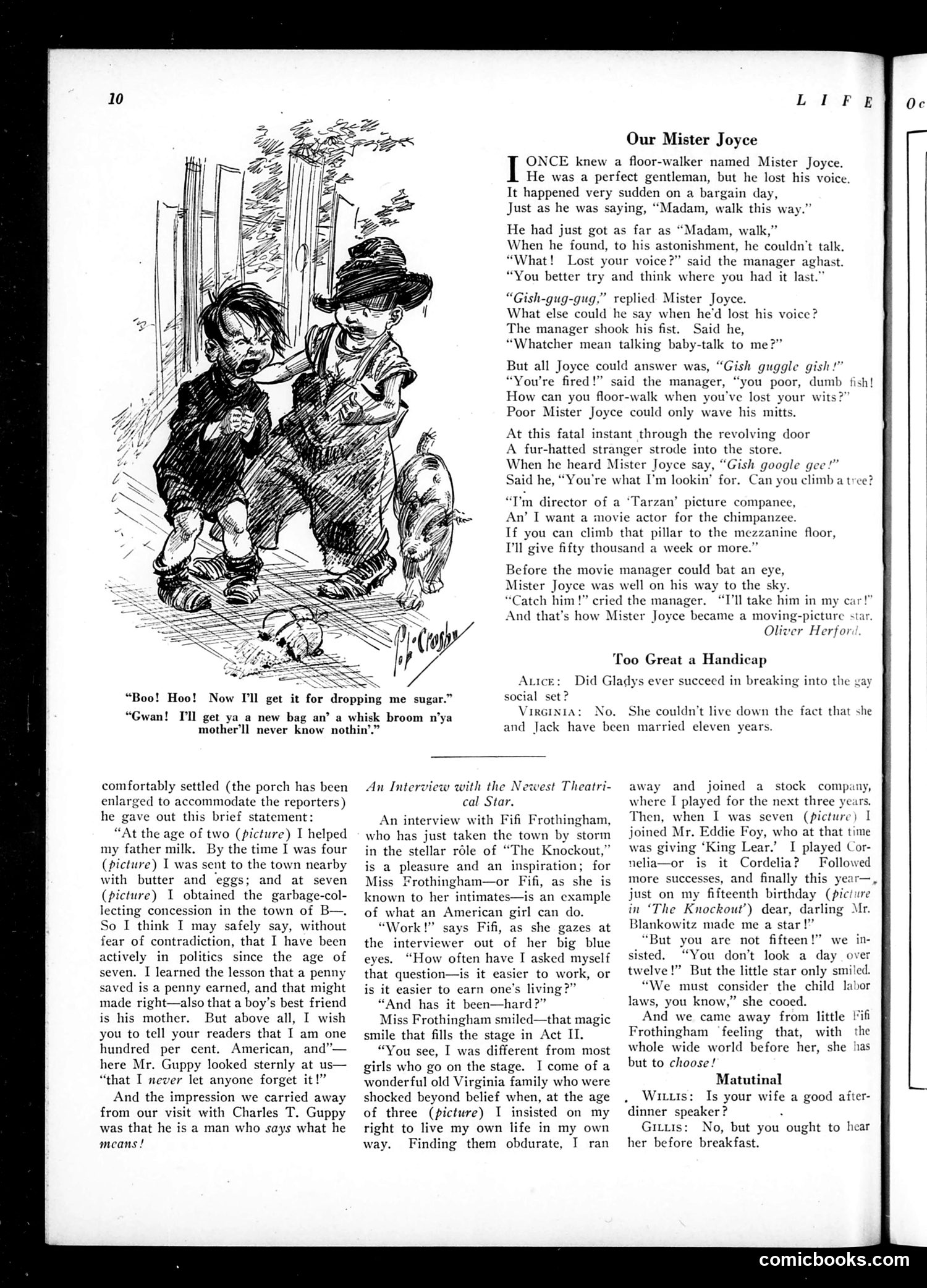
This page contains a humorous short story accompanied by a cartoon illustration. The story mocks a floor-walker named Mister Joyce who loses his voice while trying to make a sale. When a movie director overhears him attempting to speak, he mistakes Joyce's condition for a theatrical talent and hires him as a film actor. The cartoon shows two men in period dress (one appearing to be a child or young person) interacting near a doorway. The accompanying dialogue jokes about getting "a new bag an' a whisk broom" as compensation for "dropping me sugar." The satire targets early silent film casting, suggesting that incompetence or mere luck could launch someone to stardom in the nascent movie industry—a common theme in 1910s-era satirical magazines.
📄 Transcribed text from this page (OCR, searchable)
Machine-transcribed from the original scan — historical spelling and the odd misread are preserved.
LIFE Oc Our Mister Joyce ONCE knew a floor-walker named Mister Joyce. He was a perfect gentleman, but he lost his voice. It happened very sudden on a bargain day, Just as he was saying, “Madam, walk this way.” He had just got as far as “Madam, walk,” When he found, to his astonishment, he couldn't talk. “What! Lost your voice?” said the manager aghast. “You better try and think where you had it last.” “Gish-gug-gug,” replied Mister Joyce. What else could he say when he'd lost his voice? The manager shook his fist. Said he, “Whatcher mean talking baby-talk to me?” But all Joyce could answer was, “Gish guggle gish!” “You're fired!” said the manager, “you poor, dumb fish! How can you floor-walk when you've lost your wits? Poor Mister Joyce could only wave his mitts. At this fatal instant through the revolving door A fur-hatted stranger strode into the store. When he heard Mister Joyce say, “Gish google gee!” Said he, “You're what I’m lookin’ for. Can you climb a tree? “I'm director of a ‘Tarzan’ picture companee, An’ I want a movie actor for the chimpanzee. If you can climb that pillar to the mezzanine floor, I'll give fifty thousand a week or more.” Before the movie manager could bat an eye, Mister Joyce was well on his way to the “Catch him!” cried the manager. “I'll take him in my c: And that's how Mister Joyce became a moving-picture star. Oliver Herfor ‘Too Great a Handicap Did Gladys ever succeed in breaking into the yay “Boo! Hoo! Now I'll get it for dropping me sugar.” No. She couldn't live down the fact that she “Gwan! I'll get ya a new bag an’ a whisk broom n’ya mother’ll never know nothin’.” comfortably settled (the porch has been enlarged to accommodate the reporters) he gave out this brief statement: “At the age of two (picture) I helped my father milk. By the time I was four (picture) I was sent to the town nearby with butter and eggs; and at seven (picture) I obtained the garbage-col- lecting concession in the town of B—. So I think I may safely say, without fear of contradiction, that I have been actively in politics since the age of seven. I learned the lesson that a penny saved is a penny earned, and that might made right—also that a boy’s best friend is his mother. But above all, I wish you to tell your readers that I am one hundred per cent. American, and’— here Mr. Guppy looked sternly at us— “that I never let anyone forget it!” And the impression we carried away from our visit with Charles T. Guppy was that he is a man who says what he means ! An Interview with the Newest Theatri- cal Star. An interview with Fifi Frothingham, who has just taken the town by storm in the stellar role of “The Knockout,” is a pleasure and an inspiration; for Miss Frothingham—or Fifi, as she is known to her intimates—is an example of what an American girl can do. “Work!” says Fifi, as she gazes at the interviewer out of her big blue eyes. “How often have I asked myself that question—is it easier to work, or is it easier to earn one’s living?” “And has it been—hard?” Miss Frothingham smiled—that magic smile that fills the stage in Act IT. “You see, I was different from most girls who go on the stage. I come of a wonderful old Virginia family who were shocked beyond belief when, at the age of three (picture) I insisted on my right to live my own life in my own way. Finding them obdurate, I ran and Jack have been married eleven years. away and joined a stock comp: where I played for the next three year: Then, when I was seven (picture) I joined Mr. Eddie Foy, who at that time was giving ‘King Lear.’ I played Cor- nelia—or is it Cordelia? Followed more successes, and finally this year— just on my fifteenth birthday (piciure in ‘The Knockout’) dear, darling Mr. Blankowitz made me a star!” “But you are not fifteen!” we in- sisted. “You don’t look a day over twelve!” But the little star only smiled. “We must consider the child labor laws, you know,” she cooed. And we came away from little lifi Frothingham ‘feeling that, with the whole wide world before her, she has but to choose! Matutinal Wiis: Is your wife a good after- dinner speaker? : Gittis: No, but you ought to hear her before breakfast. comicbooks.com