
Life, 1921-10-13 · page 17 of 34
Life — October 13, 1921 — page 17: what you’re looking at
What you’re looking at
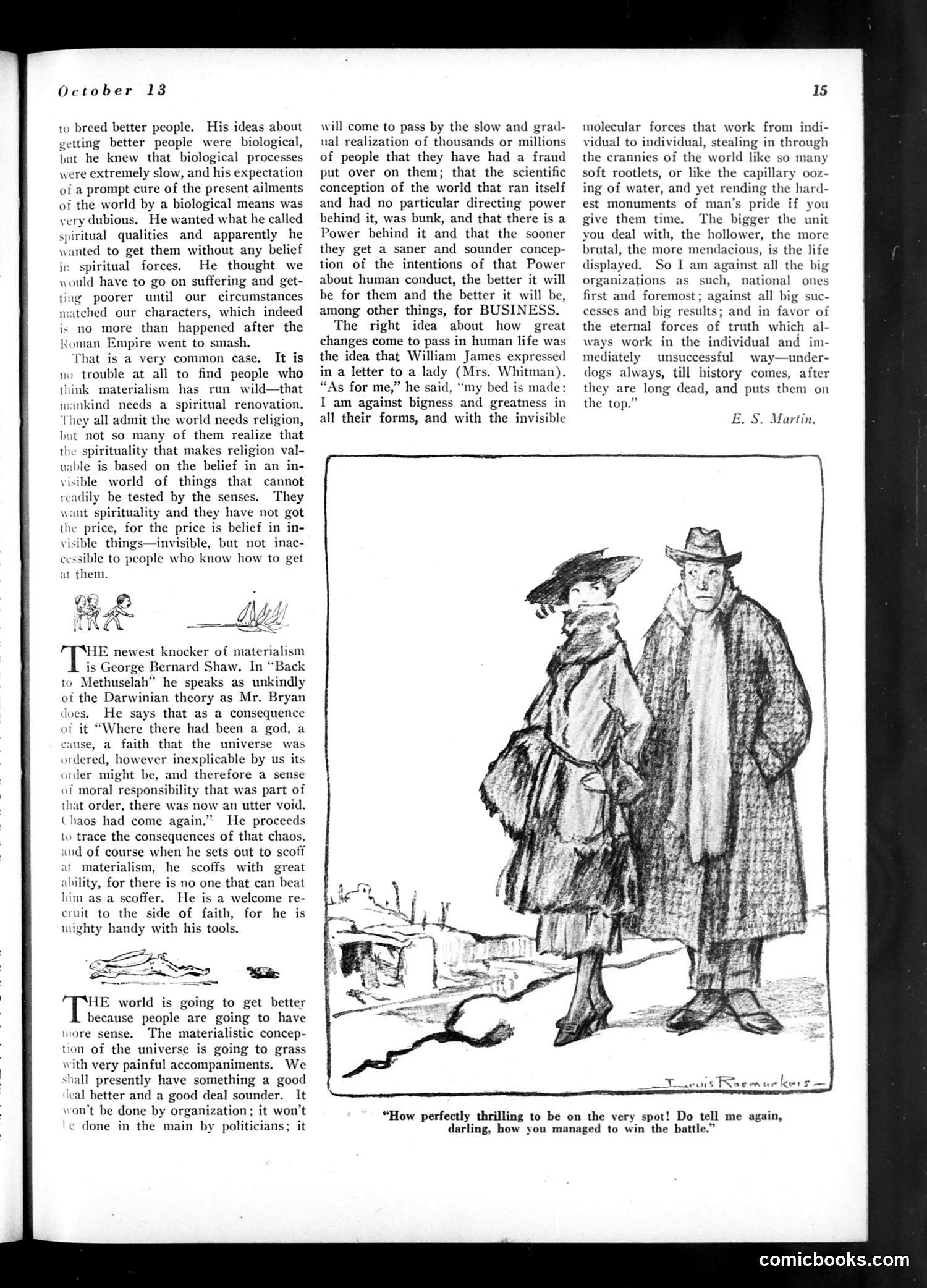
This page critiques **materialism and atheism** through philosophical debate. The text discusses how thinkers like **George Bernard Shaw** and **William James** argue that pure materialism—the belief that only physical matter exists—has left society morally adrift. Shaw's *Back to Methuselah* is cited as attacking Darwinism for removing God and moral authority, leaving "utter void" and "chaos." The accompanying **cartoon** depicts two figures in period dress on a snowy path, with the woman asking the man: "How perfectly thrilling to be on the very spot! Do tell me again, darling, how you managed to win the battle." The satire likely mocks **romantic nostalgia**—the woman's enthusiasm for a battlefield suggests how people sentimentalize historical violence when distant from actual suffering. This supports the page's larger argument: that without spiritual/moral grounding, society becomes hollow and brutal. The cartoon illustrates the disconnect between abstract ideals and material reality that the philosophical text debates.
📄 Transcribed text from this page (OCR, searchable)
Machine-transcribed from the original scan — historical spelling and the odd misread are preserved.
October 13 to breed better people. His ideas about getting better people were biological, but he knew that biological processes were extremely slow, and his expectation of a prompt cure of the present ailments of the world by a biological means was very dubious. He wanted what he called spiritual qualities and apparently he wanted to get them without any belief in spiritual forces. He thought we would have to go on suffering and get- ting poorer until our circumstances matched our characters, which indeed is no more than happened after the koman Empire went to smash, That is a very common case. It is no trouble at all to find people who think materialism has run wild—that mankind needs a spiritual renovation. lhey all admit the world needs religion, but not so many of them realize that the spirituality that makes religion val- uable is based on the belief in an in- visible world of things that cannot readily be tested by the senses. They ituality and they have not got the price, for the price is belief in in- visible things—invisible, but not inac- cessible to people who know how to get at them, HE newest knocker of materialism is George Bernard Shaw. In “Back to Methuselah” he speaks as unkindly of the Darwinian theory as Mr. Bryan He says that as a consequence of it “Where there had been a god, a cause, a faith that the universe was ordered, however inexplicable by us its order might be, and therefore a sense of moral responsibility that was part of that order, there was now an utter void. (Chaos had come again.” He proceeds to trace the consequences of that chaos, and of course when he sets out to scoff materialism, he scoffs with great ability, for there is no one that can beat him as a scoffer. He is a welcome re- cruit to the side of faith, for he is mighty handy with his tools. does. HE world is going to get better because people are going to have iiore sense. The materialistic concep- tion of the universe is going to grass with very painful accompaniments. We shall presently have something a good leal better and a good deal sounder. It won't be done by organization; it won't e done in the main by politicians; it will come to pass by the slow and grad- ual realization of thousands or millions of people that they have had a fraud put over on them; that the scientific conception of the world that ran itself and had no particular directing power behind it, was bunk, and that there is a Power behind it and that the sooner they get a saner and sounder concep- tion of the intentions of that Power about human conduct, the better it will be for them and the better it will be, among other things, for BUSINESS. The right idea about how great changes come to pass in human life was the idea that William James expressed in a letter to a lady (Mrs. Whitman). “As for me,” he said, “my bed is made: I am against bigness and greatness in all their forms, and with the invisible 15 molecular forces that work from indi- vidual to individual, stealing in through the crannies of the world like so many soft rootlets, or like the capillary ooz- ing of water, and yet rending the hard- est monuments of man’s pride if you give them time. The bigger the unit you deal with, the hollower, the more brutal, the more mendacious, is the life displayed. So I am against all the big organizations as such, national ones first and foremost; against all big suc- s and big result: id in favor of the eternal forces of truth which al- ways work in the individual and im- mediately unsuccessful way—under- always, till history comes, after are long dead, and puts them on the top.” E. S. Martin. eu s eae ae ker s — “How perfectly thrilling to be on the very spot! Do tell me again, darling, how you managed to win the battle.” comicbooks.com