
Life, 1921-10-13 · page 24 of 34
Life — October 13, 1921 — page 24: what you’re looking at
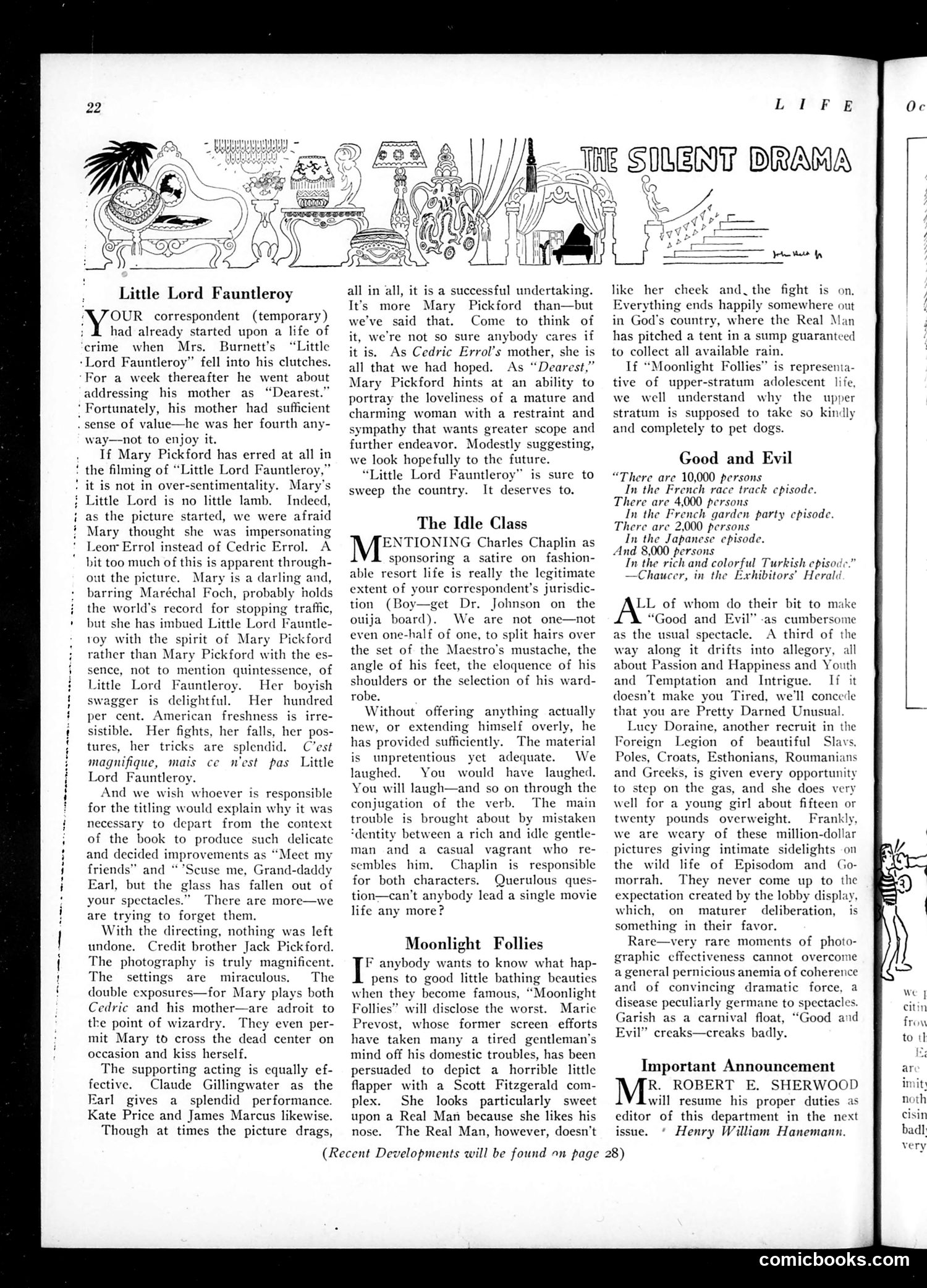
What you’re looking at
This 1920s entertainment review page critiques three films. The "Little Lord Fauntleroy" section reviews Mary Pickford's film adaptation of the famous children's novel about a refined British boy. The critic praises the production quality but complains that Pickford plays the role too much like herself—energetic and American rather than capturing the book's delicate, genteel protagonist. The complaint reflects period concerns about actors imposing their own personalities rather than disappearing into characters. "The Idle Class" reviews a Charlie Chaplin satire about mistaken identity between a wealthy man and a vagrant who resembles him. The critic finds it competent but uninspired. "Moonlight Follies" appears cut off but likely discusses bathing-beauty entertainment typical of the era. The page's decorative header cartoon shows theatrical/entertainment imagery. These reviews represent how Life magazine provided accessible cultural criticism for educated middle-class readers evaluating popular films.
📄 Transcribed text from this page (OCR, searchable)
Machine-transcribed from the original scan — historical spelling and the odd misread are preserved.
LIFE Little Lord Fauntleroy ‘ OUR correspondent (temporary) had already started upon a life of crime when Mrs. Burnett's ‘Little -Lord Fauntleroy” fell into his clutches. For a week thereafter he went about addressing his mother as “Dearest.” ‘Fortunately, his mother had sufficient ‘ sense of value—he was her fourth any- way—not to enjoy it. If Mary Pickford has erred at all in ! the filming of “Little Lord Fauntleroy,” : it is not in over-sentimentality. Mary's } Little Lord is no little lamb. Indeed, as the picture started, we were afraid Mary thought she was impersonating Leon Errol instead of Cedric Errol. A bit too much of this is apparent through- out the picture. Mary is a darling and, barring Maréchal Foch, probably holds the world’s record for stopping traffic, but she has imbued Little Lord Fauntle- voy with the spirit of Mary Pickford rather than Mary Pickford with the es- sence, not to mention quintessence, of Little Lord Fauntleroy. Her boyish swagger is delightful. Her hundred per cent. American freshness is irre- stible. Her fights, her falls, her pos- tures, her tricks are splendid. C'est magnifique, mais ce n'est pas Little Lord Fauntleroy. And we wish whoever is responsible for the titling would explain why it was necessary to depart from the context of the book to produce such delicate and decided improvements as “Meet my friends” and “’Scuse me, Grand-daddy Earl, but the glass has fallen out of your spectacles.” There are more—we are trying to forget them. With the directing, nothing was left undone. Credit brother Jack Pickford. The photography is truly magnificent. The settings are miraculous. The double exposures—for Mary plays both Cedric and his mother—are adroit to tke point of wizardry. They even per- mit Mary to cross the dead center on occasion and kiss herself. The supporting acting is equally ef- fective. Claude Gillingwater as the Earl gives a splendid performance. Kate Price and James Marcus likewise. Though at times the picture drags, all in all, it is a successful undertaking. It’s more Mary Pickford than—but we've said that. Come to think of it, we're not so sure anybody cares if it is. As Cedric Errol’s mother, she is all that we had hoped. As “Dearest,” Mary Pickford hints at an ability to portray the loveliness of a mature and charming woman with a restraint and sympathy that wants greater scope and further endeavor. Modestly suggesting, we look hopefully to the future. “Little Lord Fauntleroy” is sure to sweep the country. It deserves to. The Idle Class NTIONING Charles Chaplin as ponsoring a satire on fashion- able resort life is really the legitimate extent of your correspondent’s jurisdic- tion (Boy—get Dr. Johnson on the ouija board). We are not one—not even one-half of one, to split hairs over the set of the Maestro’s mustache, the angle of his feet, the eloquence of his shoulders or the selection of his ward- robe. Without offering anything actually new, or extending himself overly, he has provided sufficiently. The material is unpretentious yet adequate. We laughed. You would have laughed. You will laugh—and so on through the conjugation of the verb. The main trouble is brought about by mistaken identity between a rich and idle gentle- man and a casual vagrant who re- sembles him. Chaplin is responsible for both characters. Querulous ques- tion—can’t anybody lead a single movie life any more? Moonlight Follies F anybody wants to know what hap- pens to good little bathing beauties when they become famous, “Moonlight Follies” will disclose the worst. Maric Prevost, whose former screen efforts have taken many a tired gentleman's mind off his domestic troubles, has been persuaded to depict a horrible little flapper with a Scott Fitzgerald com- plex. She looks particularly sweet upon a Real Man because she likes his nose. The Real Man, however, doesn’t like her cheek and.the fight is on, Everything ends happily somewhere out in God's country, where the Real Man has pitched a tent in a sump guaranteed to collect all available rain. If “Moonlight Follies” is representa- tive of upper-stratum adolescent life, we well understand why the upper stratum is supposed to take so kindly and completely to pet dogs. Good and Evil “There are 10,000 persons In the French race track episode. There are 4,000 persons In the French garden party episode. There are 2,000 person In the Japanese episode. And 8,000 persons In the rich and colorful Turkish episode.” —Chaucer, in the Exhibitors’ Herald L of whom do their bit to make Good and Evil” -as cumbersome as the usual spectacle. A third of the way along it drifts into allegory, all about Passion and Happiness and Youth and Temptation and Intrigue. Ii it doesn’t make you Tired, we'll concede that you are Pretty Darned Unusual. Lucy Doraine, another recruit in the Foreign Legion of beautiful Slavs, Poles, Croats, Esthonians, Roumanians and Greeks, is given every opportunity to step on the gas, and she does very well for a young girl about fifteen or twenty pounds overweight. Frankly, we are weary of these million-dollar pictures giving intimate sidelights on the wild life of Episodom and Go- morrah, They never come up to the expectation created by the lobby display, which, on maturer deliberation, is something in their favor. Rare—very rare moments of photo- graphic effectiveness cannot overcome a general pernicious anemia of coherence and of convincing dramatic force, a disease peculiarly germane to spectacles. Garish as a carnival float, “Good and Evil” creaks—creaks badly. Important Announcement R. ROBERT E. SHERWOOD will resume his proper duties as editor of this department in the next issue. Henry William Hanemann. (Recent Developments will be found on page 28) Oc cisin badl: very comicbooks.com