
Life, 1921-10-13 · page 6 of 34
Life — October 13, 1921 — page 6: what you’re looking at
What you’re looking at
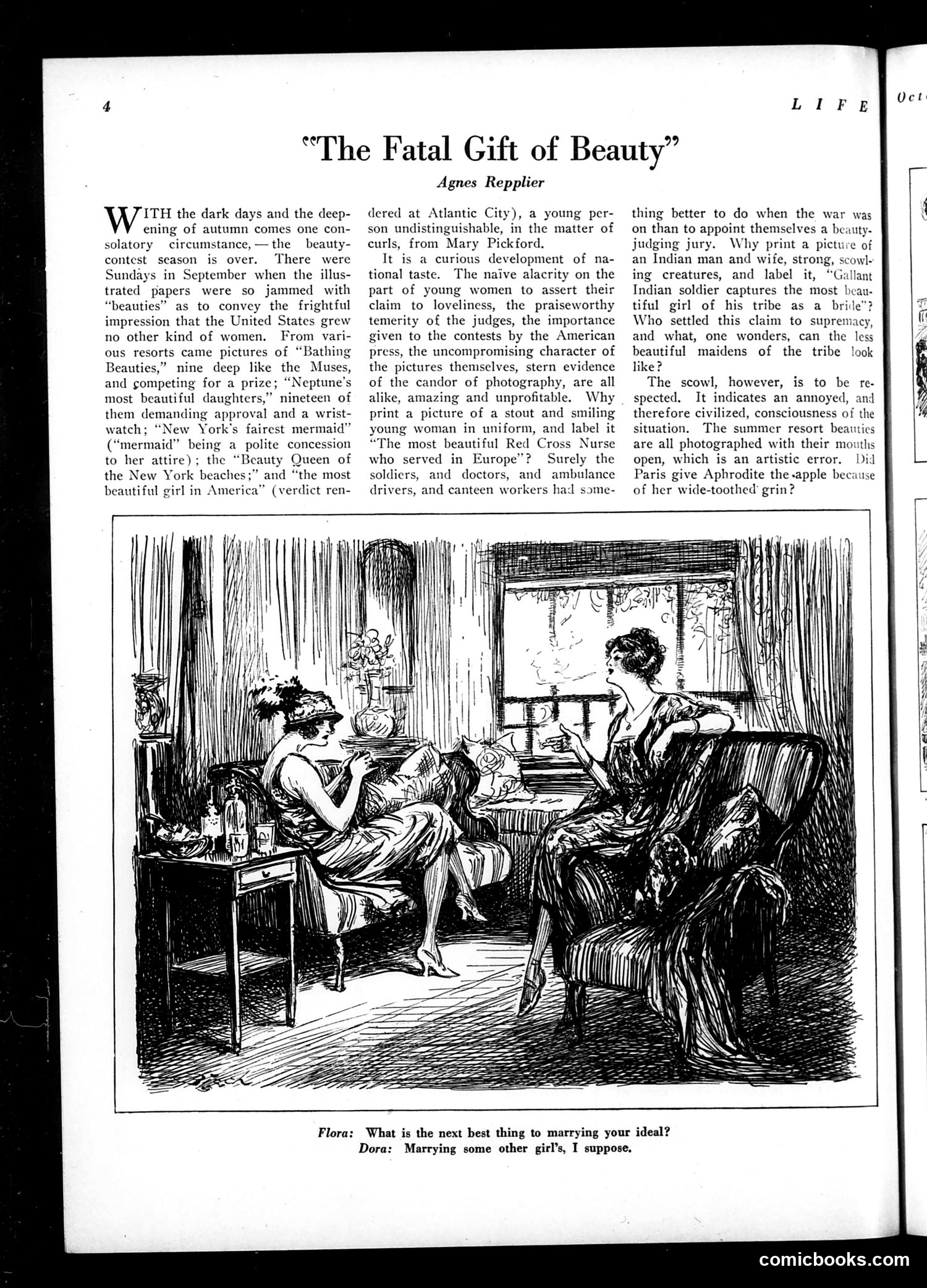
This satirical article critiques the American obsession with beauty contests during World War I. Repplier mocks the "Bathing Beauties" contests—illustrated publications featuring young women judged for attractiveness—as frivolous and contradictory. While soldiers, doctors, and ambulance drivers served Europe, Americans appointed beauty judges to crown "fairest mermaids" and "most beautiful girls." The accompanying cartoon shows two women in conversation. The caption reveals the joke: Flora asks what's better than marrying one's ideal; Dora replies, "Marrying some other girl's, I suppose"—a cynical comment on female competition and the shallow values the contests promoted. Repplier argues such contests distract from serious wartime concerns and reduce women to decorative objects.
📄 Transcribed text from this page (OCR, searchable)
Machine-transcribed from the original scan — historical spelling and the odd misread are preserved.
“The Fatal Gift of Beauty” Agnes Repplier ITH the dark days and the deep- ening of autumn comes one con- solatory circumstance, —the beauty- contest season is over. There were Sundays in September when the illus- trated papers were so jammed with “beauties” as to convey the frightful impression that the United States grew no other kind of women. From vari- ous resorts came pictures of “Bathing Beauties,” nine deep like the Muses, and competing for a prize; “Neptune’s most beautiful daughters,” nineteen of them demanding approval and a wrist- watch; “New York's fairest mermaid” (“mermaid” being a polite concession to her attire); the “Beauty Queen of the New York beach and “the most beautiful girl in America” (verdict ren- dered at Atlantic City), a young per- son undistinguishable, in the matter of curls, from Mary Pickford. It is a curious development of na- tional taste. The naive alacrity on the part of young women to assert their claim to loveliness, the praiseworthy temerity of the judges, the importance given to the contests by the American press, the uncompromising character of the pictures themselves, stern evidence of the candor of photography, are all alike, amazing and unprofitable. Why print a picture of a stout and smiling young woman in uniform, and label it “The most beautiful Red Cross Nurse who served in Europe”? Surely the soldiers, and doctors, and ambulance drivers, and canteen workers had some- thing better to do when the war was on than to appoint themselves a beauty- judging jury. Why print a picture of an Indian man and wife, strong, scowl- ing creatures, and label it, “Gallant Indian soldier captures the most be tiful girl of his tribe as a_ bridle”? Who settled this claim to supremacy, and what, one wonders, can the less beautiful maidens of the tribe look like? The scowl, however, is to be re- spected. It indicates an annoyed, and therefore civilized, consciousness of the situation. The summer resort beauties are all photographed with their mouths open, which is an artistic error. Did Paris give Aphrodite the apple because of her wide-toothed’ grin? —_ Flora: What is the next best thing to marrying your ideal? Dora: Marrying some other girl’s, I suppose. comicbooks.com