
Life, 1921-10-13 · page 20 of 34
Life — October 13, 1921 — page 20: what you’re looking at
What you’re looking at
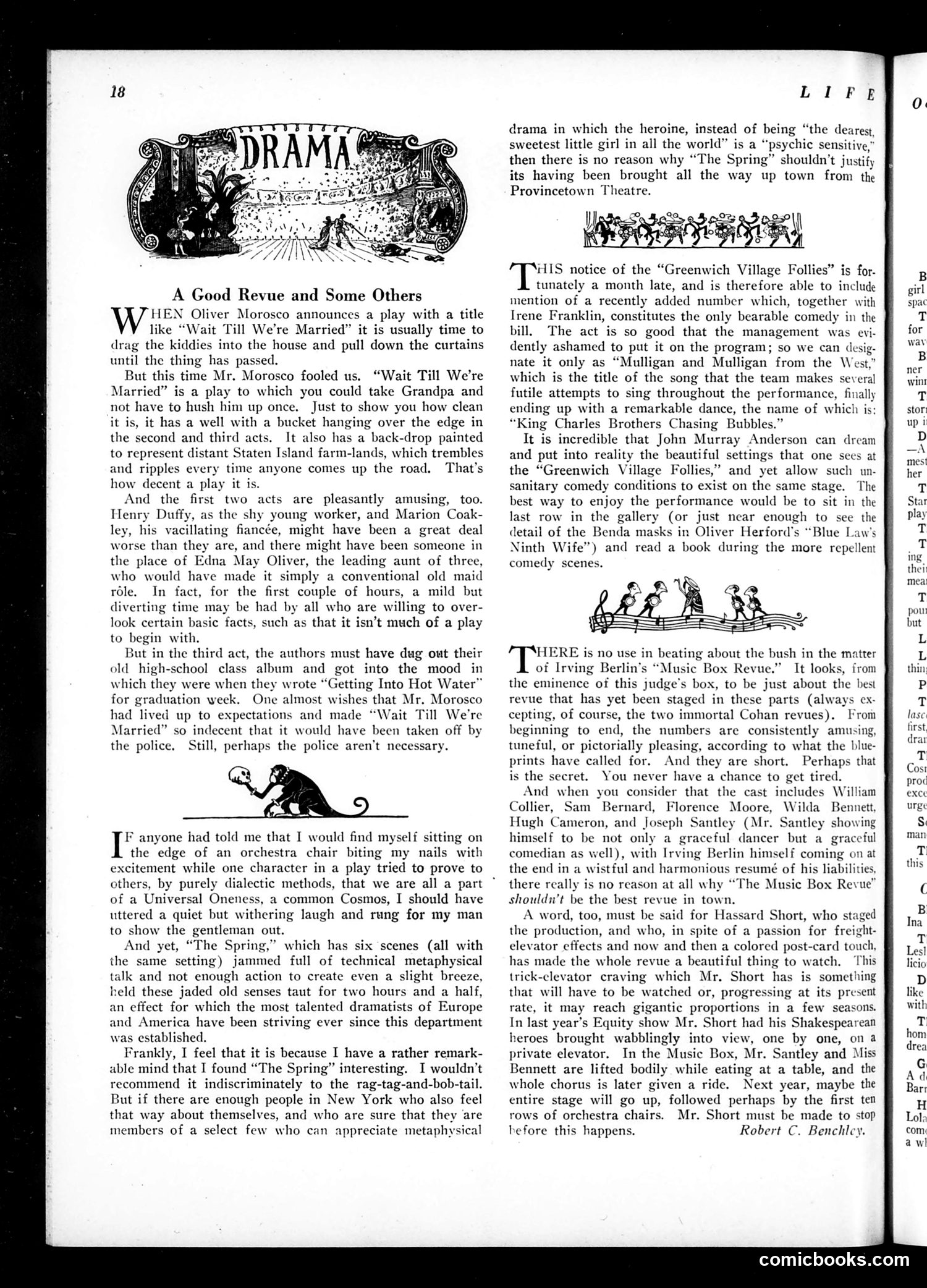
This page reviews three Broadway productions from the 1920s era. The critic employs sharp, satirical commentary on theatrical trends: **"Wait Till We're Married"** is mocked as wholesome yet dramatically inert—so clean you could bring grandparents, yet dramatically hollow. The third act reportedly descends into adolescent absurdity. **"The Spring"** receives backhanded praise. The critic admits being captivated by a play stuffed with pretentious metaphysical dialogue about "Universal Oneness" and featuring a "psychic sensitive" heroine rather than conventional ingénues. The satire targets both the play's pretension and the critic's own intellectual vanity—suggesting only people of "remarkable mind" would appreciate such abstract nonsense. **"Greenwich Village Follies"** is dismissed as largely unbearable, with only one sketch ("Mulligan and Mulligan from the West") worth watching—ironically, the management was apparently embarrassed enough to hide it from the program. The overall tone satirizes both theatrical mediocrity and the era's artistic pretension in Greenwich Village bohemia.
📄 Transcribed text from this page (OCR, searchable)
Machine-transcribed from the original scan — historical spelling and the odd misread are preserved.
A Good Revue and Some Others HEN Oliver Morosco announces a play with a title like “Wait Till We’re Married” it is usually time to drag the kiddies into the house and pull down the curtains until the thing has passed. But this time Mr. Morosco fooled us. “Wait Till We're Married” is a play to which you could take Grandpa and not have to hush him up once. Just to show you how clean it is, it has a well with a bucket hanging over the edge in the second and third acts. It also has a back-drop painted to represent distant Staten Island farm-lands, which trembles anyone comes up the road. and ripples every time That's how decent a play it is. And the first two acts are pleasantly amusing, too. Henry Duffy, as the shy young worker, and Marion Coak- ley, his vacillating fiancée, might have been a great deal worse than they are, and there might have been someone in the place of Edna May Oliver, the leading aunt of three, who would have made it simply a conventional old maid role. In fact, for the first couple of hours, a mild but diverting time may be had by all who are willing to over- look certain basic facts, such as that it isn’t much of a play to begin with. But in the third act, the authors must have dug out their old high-school class album and got into the mood in which they were when they wrote “Getting Into Hot Water” for graduation week. One almost wishes that Mr. Morosco had lived up to expectations and made “Wait Till We're Married” so indecent that it would have been taken off by the police, Still, perhaps the police aren't necessary. I anyone had told me that I would find myself sitting on the edge of an orchestra chair biting my nails with excitement while one character in a play tried to prove to others, by purely dialectic methods, that we are all a part of a Universal Oneness, a common Cosmos, I should have uttered a quiet but withering laugh and rung for my man to show the gentleman out. And yet, “The Spring,” which has six scenes (all with the same setting) jammed full of technical metaphysical talk and not enough action to create even a slight breeze, held these jaded old senses taut for two hours and a half, an effect for which the most talented dramatists of Europe and America have been striving ever since this department was established. Frankly, I feel that it is because I have a rather remark- able mind that I found “The Spring” interesting. I wouldn’t recommend it indiscriminately to the rag-tag-and-bob-tail. But if there are enough people in New York who also feel that way about themselves, and who are sure that they are members of a select few who can appreciate metaphysical drama in which the heroine, instead of being ‘ sweetest little girl in all the world” is a “psychic sensitive,” then there is no reason why “The Spring” shouldn't justify its having been brought all the way up town from the Provincetown Theatre. i Bee notice of the “Greenwich Village Follies” is for- tunately a month late, and is therefore able to include mention of a recently added number which, together with Irene Franklin, constitutes the only bearable comedy in the bill. The act is so good that the management was evi- dently ashamed to put it on the program; so we can desig. nate it only as “Mulligan and Mulligan from the West,” which is the title of the song that the team makes several futile attempts to sing throughout the performance, finally ending up with a remarkable dance, the name of which is: “King Charles Brothers Chasing Bubbles.” It is incredible that John Murray Anderson can dream and put into reality the beautiful settings that one sees at the “Greenwich Village Follies,” and yet allow such un- sanitary comedy conditions to exist on the same stage. The best way to enjoy the performance would be to sit in the last row in the gallery (or just near enough to see the detail of the Benda masks in Oliver Herford’s “Blue Law's Ninth Wife”) and read a book during the more repellent comedy scenes. HERE is no use in beating about the bush in the matter of Irving Berlin’s “Music Box Revue.” It looks, from the eminence of this judge's box, to be just about the best revue that has yet been staged in these parts (always ex- cepting, of course, the two immortal Cohan revues). From beginning to end, the numbers are consistently amusing, tuneful, or pictorially pleasing, according to what the blue- prints have called for. And they are short. Perhaps that is the secret. You never have a chance to get tired. And when you consider that the cast includes William Collier, Sam Bernard, Florence Moore, Wilda Bennett, Hugh Cameron, and Joseph Santley (Mr. Santley showing himself to be not only a graceful dancer but a graceful comedian as well), with Irving Berlin himself coming on at the end in a wistful and harmonious resumé of his liabilities, there really is no reason at all why “The Music Box Revue” shouldn’t be the best revue in town. A word, too, must be said for Hassard Short, who staged the production, and who, in spite of a passion for freight- elevator effects and now and then a colored post-card touch, has made the whole revue a beautiful thing to watch. This trick-clevator craving which Mr. Short has is something that will have to be watched or, progressing at its present rate, it may reach gigantic proportions in a few seasons. In last year’s Equity show Mr. Short had his Shakespearean heroes brought wabblingly into view, one by one, on a private elevator. In the Music Box, Mr. Santley and Miss Bennett are lifted bodily while eating at a table, and the whole chorus is later given a ride. Next year, maybe the entire stage will go up, followed perhaps by the first ten rows of orchestra chairs. Mr. Short must be made to stop before this happens. Robert C. Benchley. B girl spac T for wav B ner wint T stor’ up i D —A mest her T Star play pow but lase first drat T Cost proc exce urge Les! licio comicbooks.com