
Life, 1921-10-13 · page 5 of 34
Life — October 13, 1921 — page 5: what you’re looking at
What you’re looking at
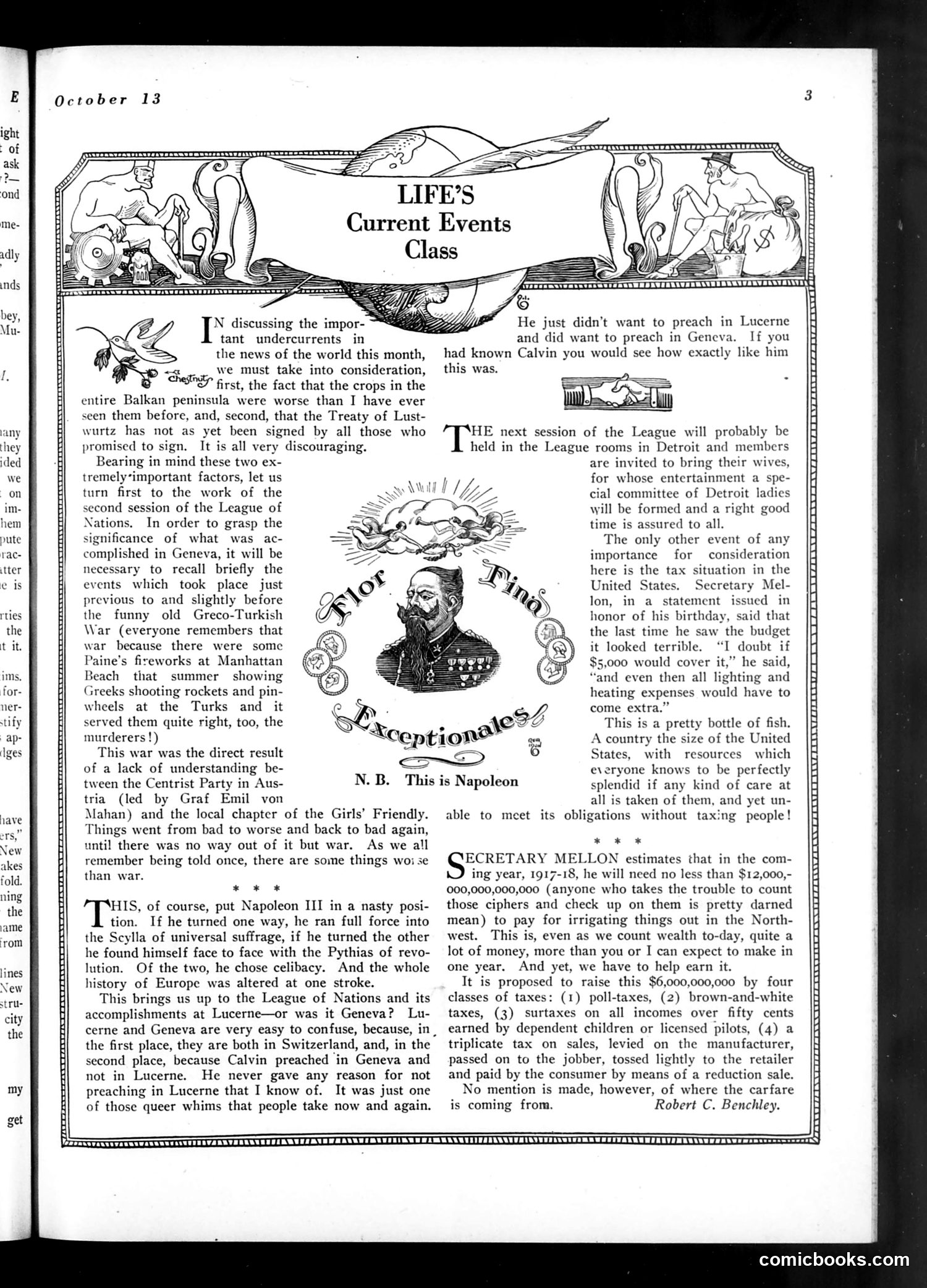
This page satirizes post-WWI European politics. The central cartoon depicts **Napoleon** labeled "For Eminent Exceptionales," likely mocking contemporary political figures through historical comparison. The text discusses the **League of Nations** and its Geneva sessions, the **Treaty of Lusitania** (unsigned by key parties), and Balkan instability. A key satirical point: the author criticizes **Calvin** (likely John Calvin, referenced ironically) for refusing to preach in certain cities, portraying religious/political obstinacy as absurd as historical Napoleon-era conflicts. The piece also references **Secretary Mellon's** budget estimates requiring $12 billion in taxes, critiquing wartime fiscal excess. The overall tone mocks political leaders' inability to resolve post-war problems sensibly, comparing modern incompetence to historical folly.
📄 Transcribed text from this page (OCR, searchable)
Machine-transcribed from the original scan — historical spelling and the odd misread are preserved.
E ight of ask 2 ‘ond me- adly nds bey, Mu- any they ided we on im- hem pute rac- itter e is rties the t it. ims, for- ning the ame ‘rom lines ew October 13 N discussing the impor- tant undercurrents in the news of the world this month, we must take into consideration, first, the fact that the crops in the entire Balkan peninsula were worse than I have ever seen them before, and, second, that the Treaty of Lust- wurtz has not as yet been signed by all those who promised to sign. It is all very discouraging. Bearing in mind these two ex- tremely*important factors, let us turn first to the work of the second session of the League of Nations. In order to grasp the significance of what was ac- complished in Geneva, it will be necessary to recall briefly the events which took place just previous to and slightly before the funny old Greco-Turkish War (everyone remembers that war because there were some Paine’s fireworks at Manhattan Beach that summer showing Greeks shooting rockets and pin- wheels at the Turks and it served them quite right, too, the murderers !) This war was the direct result of a lack of understanding be- tween the Centrist Party in Aus- tria (led by Graf Emil von Mahan) and the local chapter of the Girls’ Friendly. Things went from bad to worse and back to bad again, until there was no way out of it but war. As we all remember being told once, there are some things woi se than war. * * * ‘HIS, of course, put Napoleon III in a nasty posi- tion. If he turned one way, he ran full force into the Scylla of universal suffrage, if he turned the other he found himself face to face with the Pythias of revo- lution. Of the two, he chose celibacy. And the whole history of Europe was altered at one stroke. This brings us up to the League of Nations and its accomplishments at Lucerne—or was it Geneva? Lu- cerne and Geneva are very easy to confuse, because, in, the first place, they are both in Switzerland, and, in the second place, because Calvin preached in Geneva and not in Lucerne. He never gave any reason for not preaching in Lucerne that I know of. It was just one of those queer whims that people take now and again. N. B. This is Napoleon LIFE’S Current Events He just didn’t want to preach in Lucerne and did want to preach in Geneva. If you had known Calvin you would see how exactly like him this was. HE next session of the League will probably be held in the League rooms in Detroit and members are invited to bring their wives, for whose entertainment a spe- cial committee of Detroit ladies will be formed and a right good time is assured to all. The only other event of any importance for consideration here is the tax situation in the United States. Secretary Mel- lon, in a statement issued in honor of his birthday, said that the last time he saw the budget it looked terrible. “I doubt if $5,000 would cover it,” he said, “and even then all lighting and heating expenses would have to come extra.” This is a pretty bottle of fish. A country the size of the United States, with resources which everyone knows to be perfectly splendid if any kind of care at all is taken of them, and yet un- able to meet its obligations without taxing people! * * * ECRETARY MELLON estimates that in the com- ing year, 1917-18, he will need no less than $12,000,- 000,000,000,000 (anyone who takes the trouble to count those ciphers and check up on them is pretty darned mean) to pay for irrigating things out in the North- west. This is, even as we count wealth to-day, quite a lot of money, more than you or I can expect to make in one year. And yet, we have to help earn it. It is proposed to raise this $6,000,000,000 by four classes of taxes: (1) poll-taxes, (2) brown-and-white taxes, (3) surtaxes on all incomes over fifty cents earned by dependent children or licensed pilots, (4) a triplicate tax on sales, levied on the manufacturer, passed on to the jobber, tossed lightly to the retailer and paid by the consumer by means of a reduction sale. No mention is made, however, of where the carfare is coming from. Robert C. Benchley. comicbooks.com