
A complete issue · 38 pages · 1921
Life — March 3, 1921
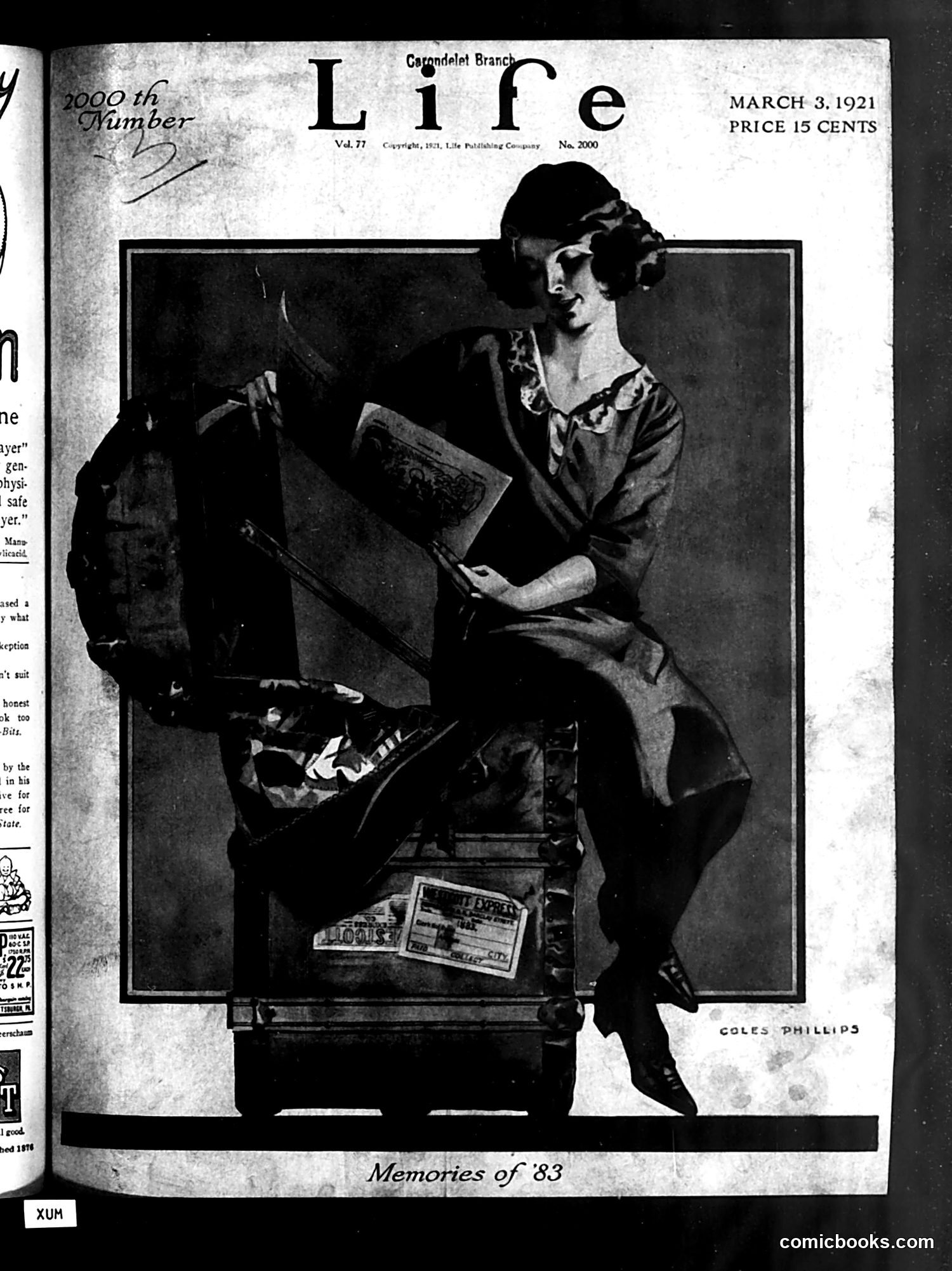
This is the cover of Life magazine's 2000th issue, featuring a photograph credited to Coles Phillips. The image shows a woman examining what appears to be old photographs or memorabilia from a trunk or storage box, with the caption "Memories of '83" below. The piece appears to be nostalgic rather than satirical—celebrating Life's 100-issue milestone by reflecting on older content from 1883 (38 years prior). This was a common magazine practice: retrospectively showcasing how publication and society had evolved. The photograph itself exemplifies 1920s aesthetics and gender representation, depicting a woman engaged in the domestic activity of reviewing personal memories. Without accompanying text visible, the specific satirical point remains unclear, though the nostalgic framing suggests commentary on changing times.
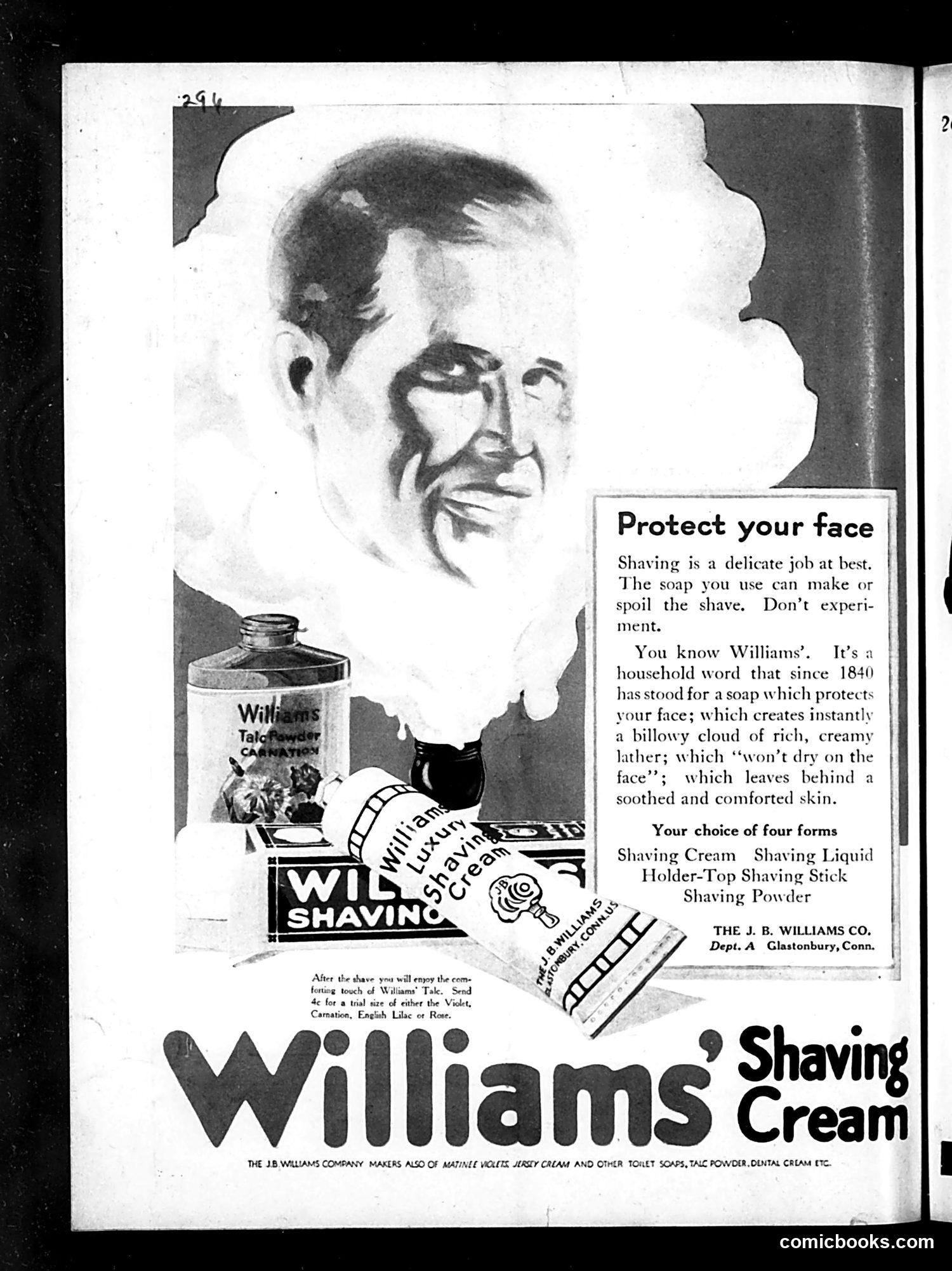
This is a **commercial advertisement**, not political satire. The page promotes Williams' Shaving Cream, a real product manufactured by the J.B. Williams Company of Glastonbury, Connecticut since 1840. The image shows an illustrated man's face with shaving lather, designed to demonstrate the product's benefit: creating "a pillowy cloud of rich, creamy lather" that "won't dry on the face." The ad emphasizes skin protection during shaving. The page offers four product formats: Shaving Cream, Shaving Liquid, Holder-Top Shaving Stick, and Shaving Powder. Text encourages readers to order a trial size for 4¢. This represents typical early-to-mid 20th century men's grooming advertising, emphasizing product quality and consumer choice.
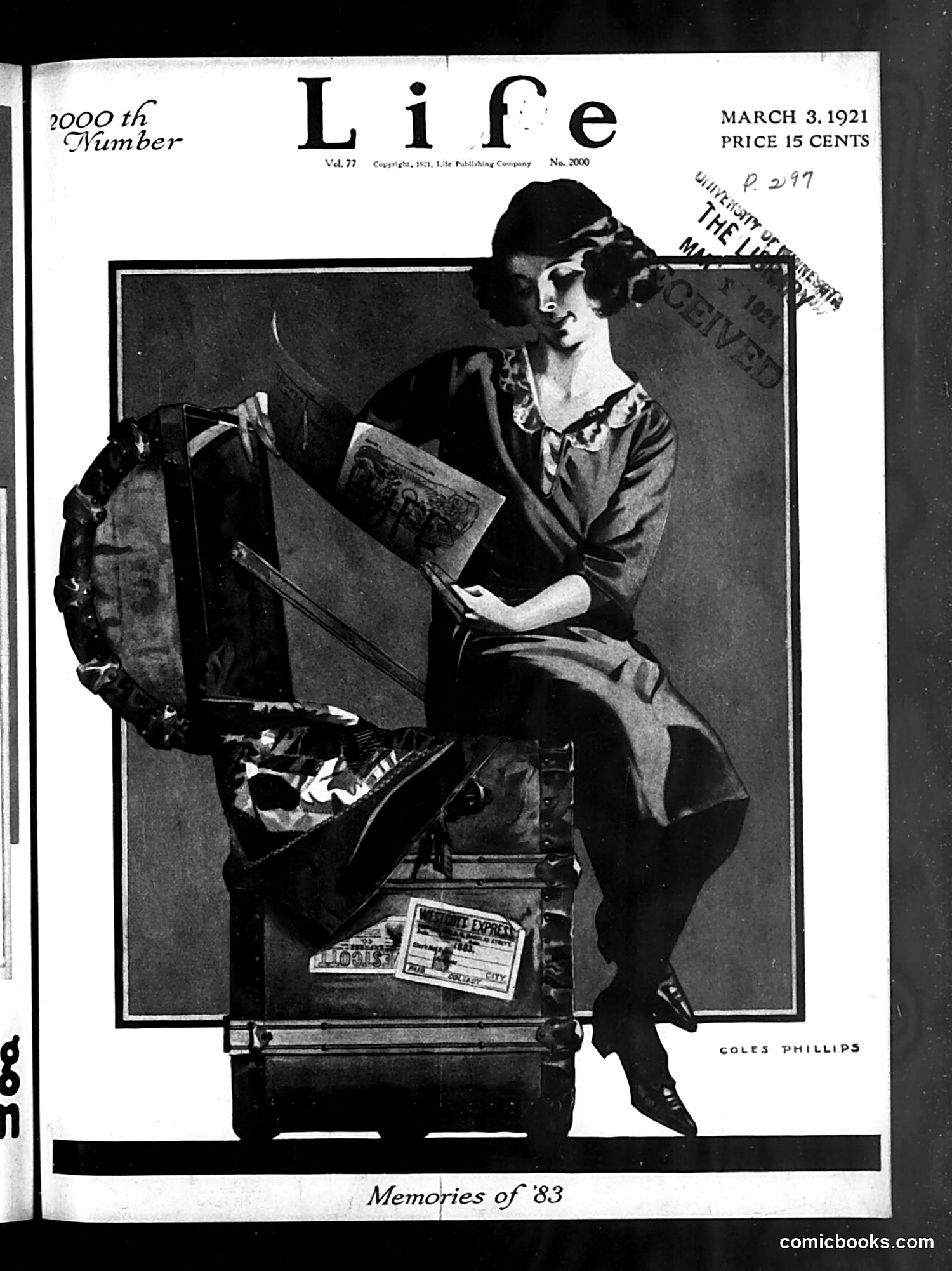
This cover depicts a woman posed with an open steamer trunk, holding what appears to be a photograph or illustration labeled "Memories of '83." The photograph credit reads "COLES PHILLIPS." The image appears to be nostalgic commentary, likely referencing someone looking back at memories from 1883—roughly 38 years prior. The steamer trunk suggests travel or relocation. Without additional context or visible captions identifying the specific subject, the exact satirical target remains unclear, though the composition suggests commentary on aging, memory, or perhaps a specific public figure's past. The cover costs 15 cents and represents Life's typical blend of visual humor with contemporary social observation.
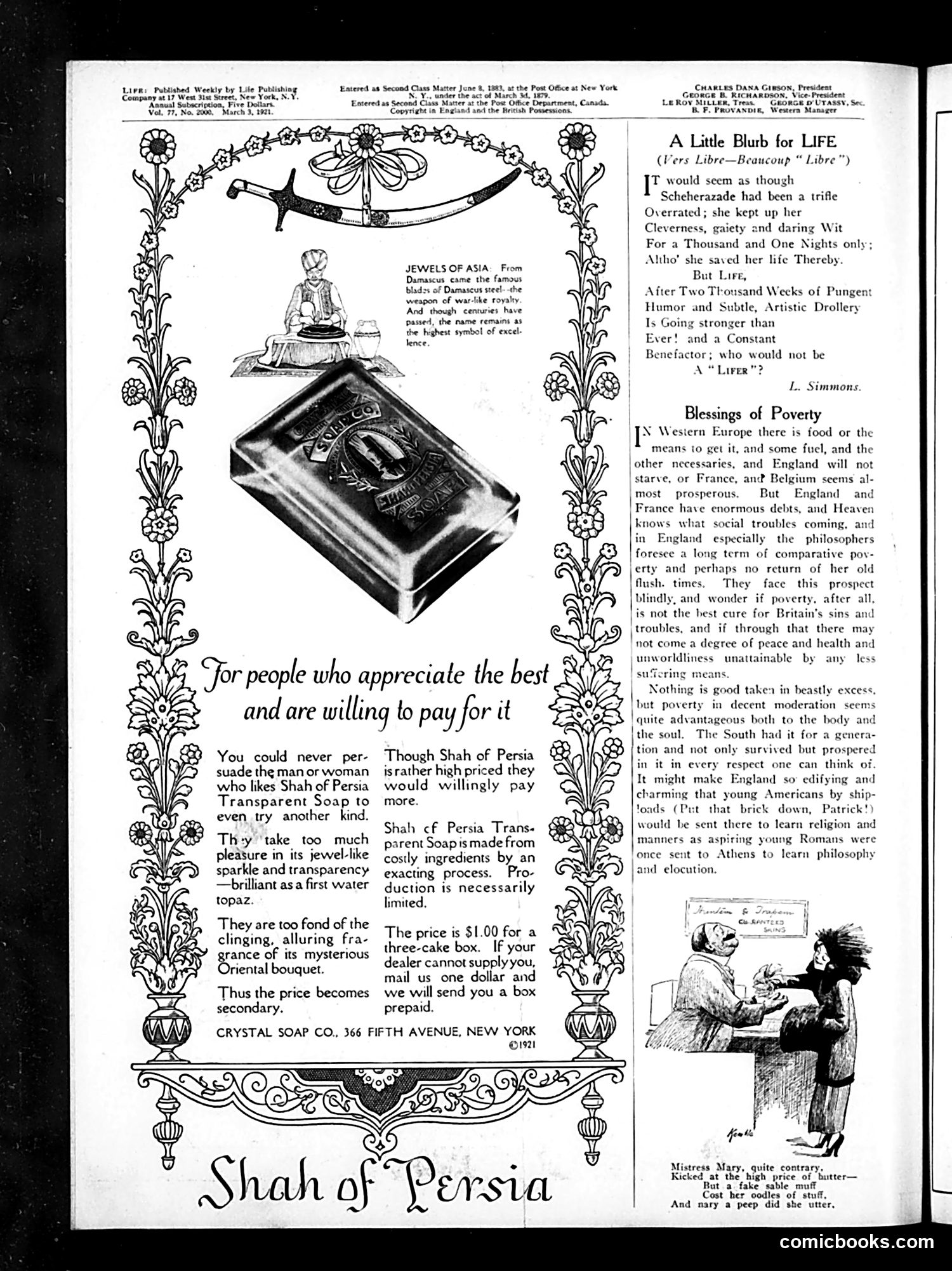
This page is primarily **advertising for Shah of Persia Transparent Soap** rather than political satire. The ornate left side features a luxury soap product advertisement emphasizing exclusivity and premium pricing ($1.00 per box—expensive for 1921). The right side contains unrelated editorial content: "A Little Blurb for Life" praises the publication's satirical contributions, while "Blessings of Poverty" discusses post-WWI economic hardship in Western Europe, questioning whether poverty might paradoxically benefit Britain morally. The small cartoon titled "Mistress Mary" (lower right) appears to be a nursery-rhyme based joke, but details are unclear from the image. The page demonstrates how 1920s Life magazine interspersed luxury advertising with social commentary.
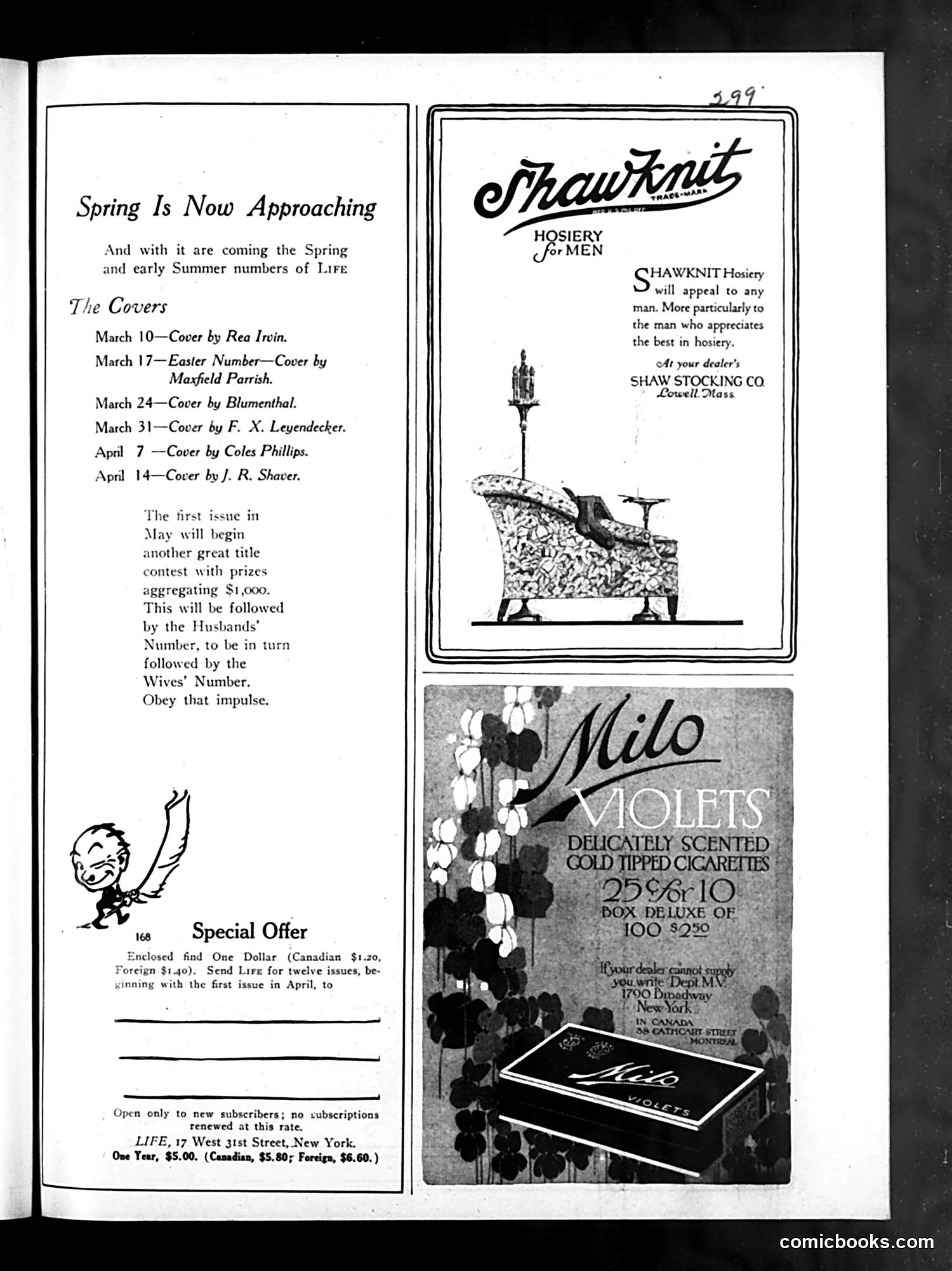
This page consists primarily of **advertisements** rather than political cartoons. The left side announces upcoming LIFE magazine cover artists and a subscription special offer ($5.00 yearly). A small decorative illustration shows a mischievous cherub or sprite figure—typical period ornamentation rather than political satire. The right side displays two product ads: **Shawknit Hosiery** for men (featuring a decorative chair illustration) and **Milo Violets** cigarettes (showing violet flowers and a cigarette box). These represent early 20th-century consumer goods marketing. The "Special Offer" is noteworthy: new subscribers received one dollar if they enclosed payment upfront—a common subscription incentive of the era. The page reflects LIFE's dual function as both satirical publication and advertising vehicle.
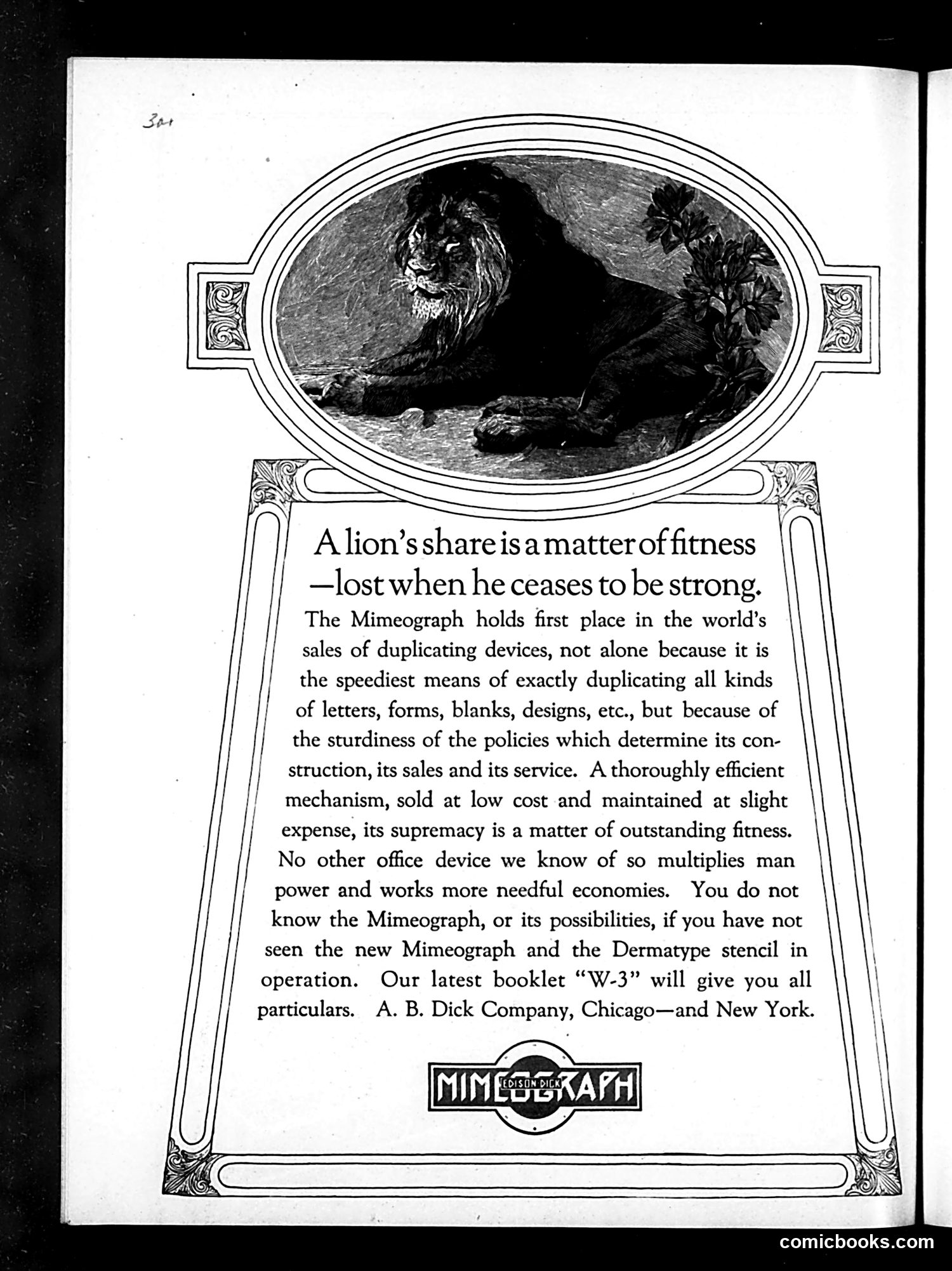
This page is **primarily advertising**, not satire or political commentary. It's a Mimeograph company advertisement from A.B. Dick Company (Chicago and New York). The headline uses a metaphorical comparison: "A lion's share is a matter of fitness—lost when he ceases to be strong." The lion image illustrates business durability and competitive advantage. The ad argues that the Mimeograph duplicating machine dominates office equipment sales because of its sturdy construction, low cost, and efficient maintenance—not just speed, but overall "fitness" as a business tool. The text promotes their latest model and a booklet ("W-3") offering product details. This is straightforward commercial advertising emphasizing reliability and market leadership, with no political or satirical content.
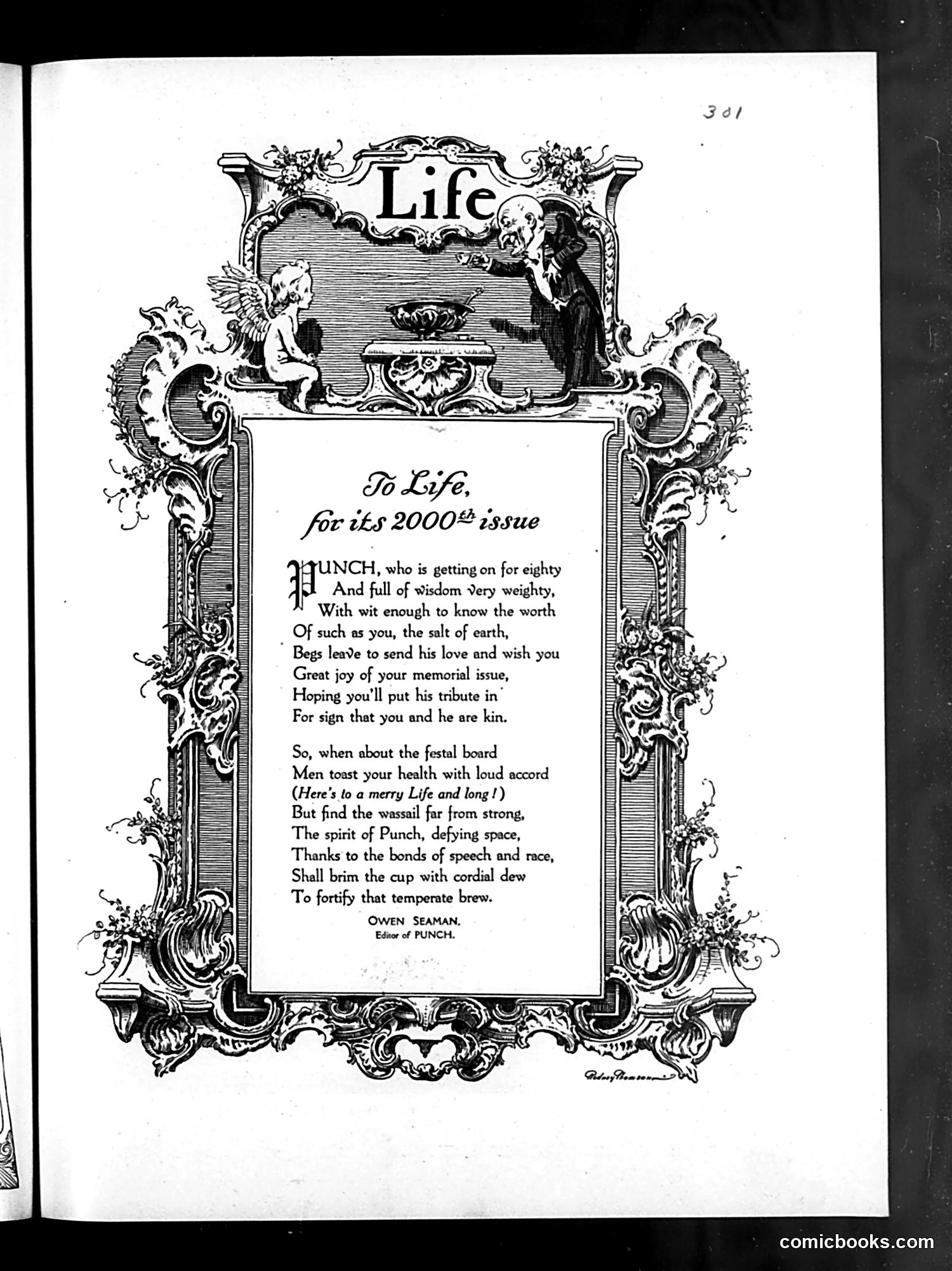
This is a tribute page from *Life* magazine celebrating its 2000th issue. The ornate decorative border frames a poem by Owen Seaman (identified as "Editor of PUNCH") addressed to *Life* magazine. The poem humorously toasts the magazine's longevity and influence. It references *Life* as "the salt of the earth" and celebrates its satirical spirit ("the spirit of Punch, defying space"). The imagery at the top shows a cherub and a skeletal figure (likely Death or Time) flanking a classical urn—typical Victorian memento mori symbolism suggesting the magazine's enduring legacy despite time's passage. The verse is celebratory rather than satirical, functioning as a formal congratulatory message from a competing British satirical publication.
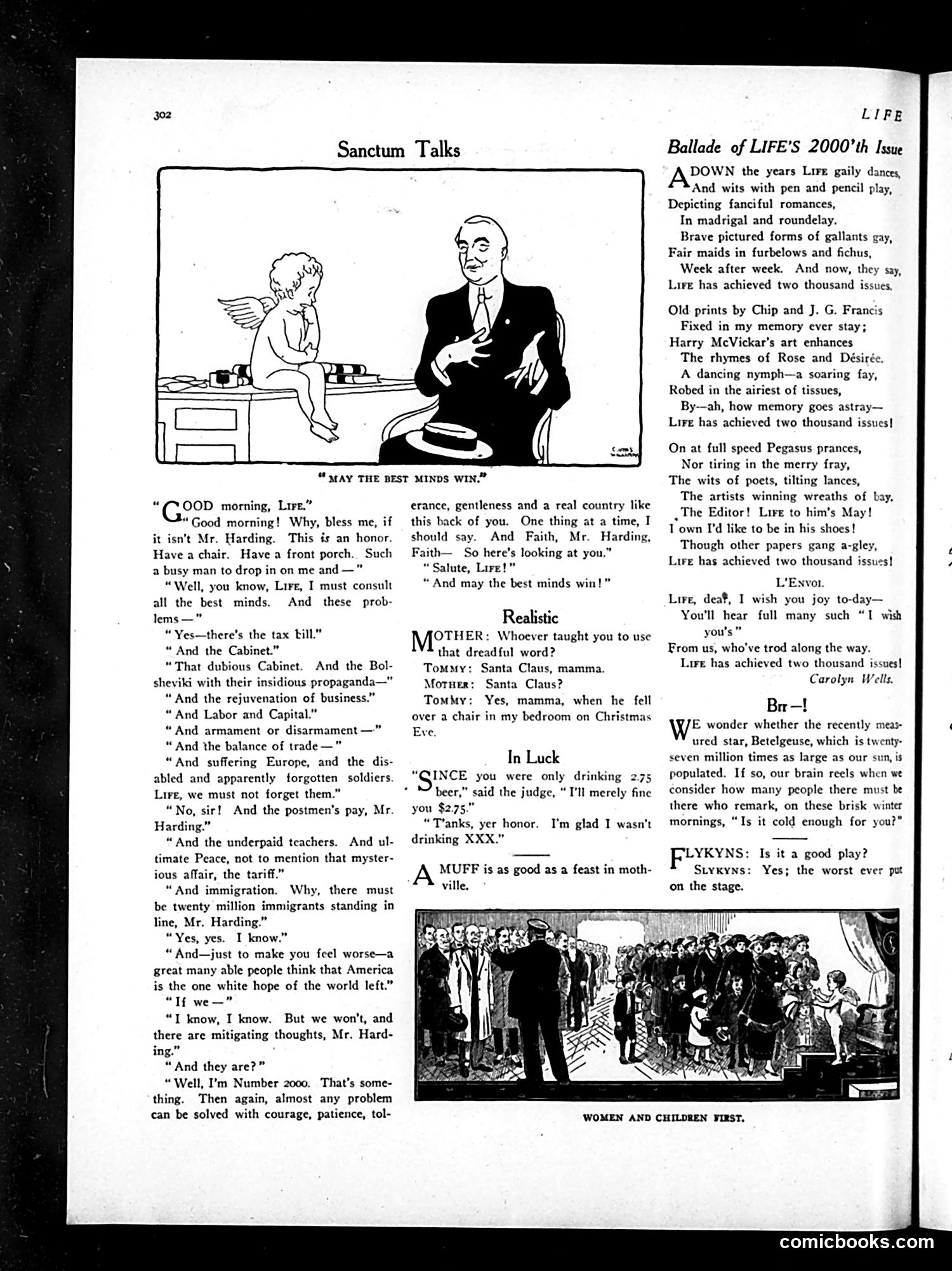
This page celebrates Life's 2000th issue with satirical content featuring "Sanctum Talks"—a dialogue between Life magazine personified (shown as an angel-like figure) and an unnamed man in business attire, likely representing a politician or government official. The conversation mocks post-WWI American problems: taxation, Cabinet scandals, business struggles, labor issues, European suffering, and immigration. The man appears to be President Harding (based on context clues and the "Mr. Harding" references in dialogue), defending his administration against Life's pointed critiques. The satire attacks government incompetence and indifference to social problems, with Life's angel urging action on forgotten issues. The accompanying illustration "Women and Children First" appears to reference maritime disaster protocol, likely commenting on social priorities.
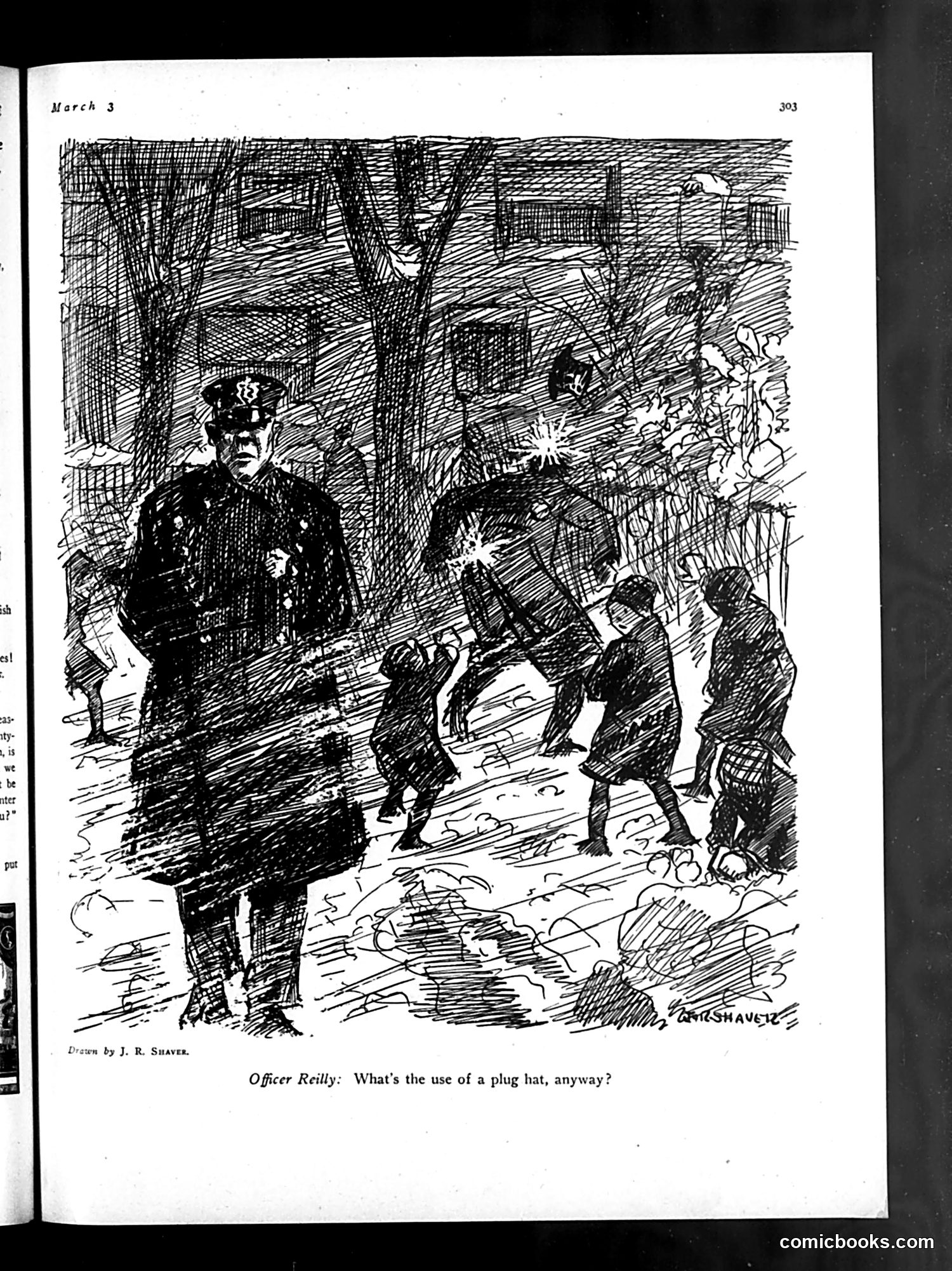
This cartoon, drawn by J.R. Shaver, depicts a police officer (Officer Reilly, identified by name in the caption) standing among children playing in snow. The joke plays on the contrast between the officer's formal attire—specifically his "plug hat" (a tall formal top hat)—and the practical reality of his job managing street children in winter conditions. The humor lies in the officer questioning the usefulness of his formal uniform hat when dealing with messy, snow-covered street situations. It's gentle satire about the disconnect between official police dress codes and the actual, unglamorous work of urban law enforcement, particularly involving poor children in city neighborhoods.
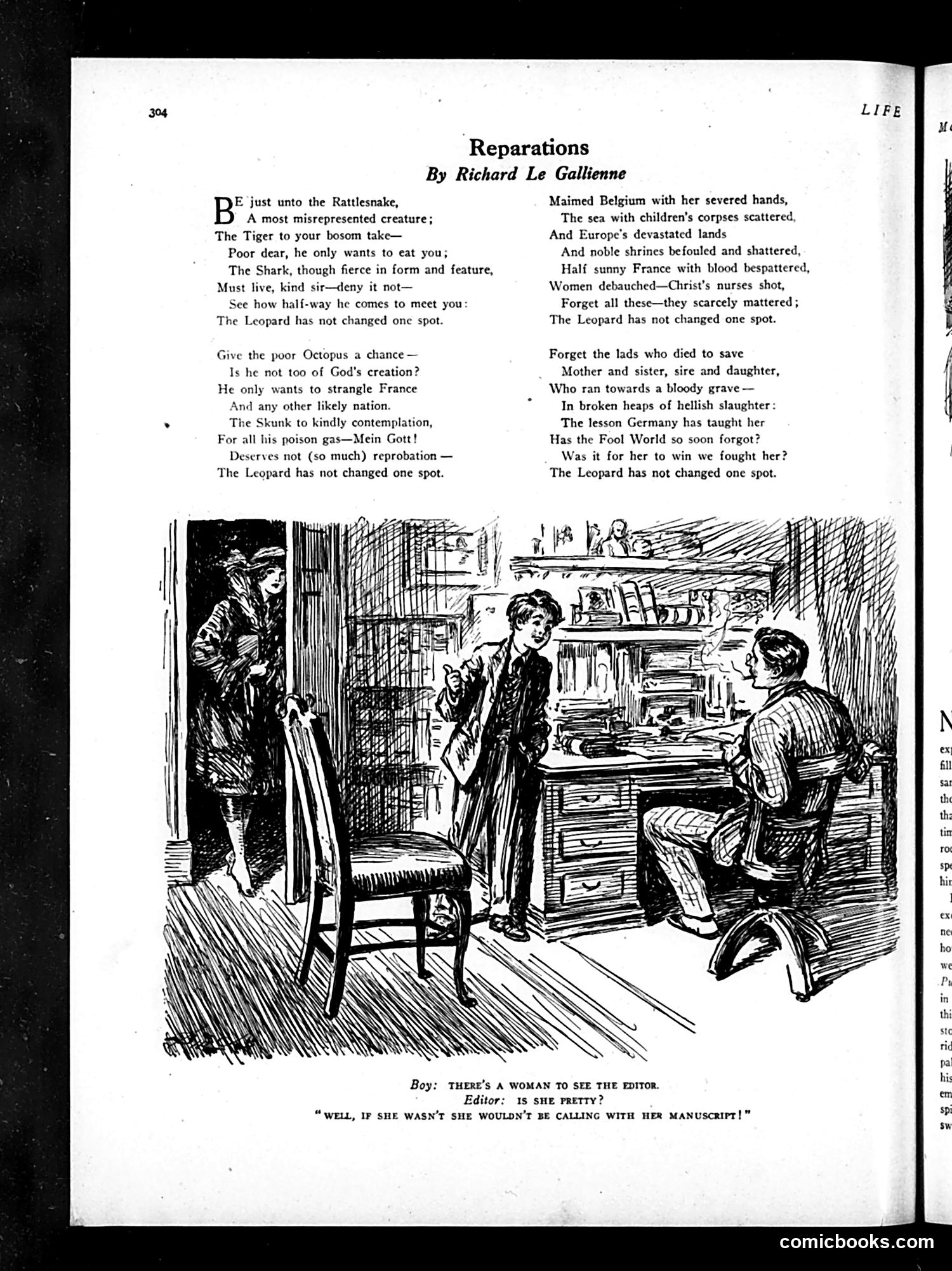
This page contains Richard Le Gallienne's poem "Reparations," a post-WWI critique of proposed German war reparations. The poem argues against punitive measures, suggesting they won't change Germany's fundamental nature ("The Leopard has not changed one spot"). It references France's devastation, Belgium's suffering, and the futility of expecting reform through punishment. The cartoon below depicts an office scene where a boy announces a female visitor to an editor. The editor's dismissive response—asking if she's "pretty" rather than seriously considering her manuscript—satirizes editorial gatekeeping and sexism in publishing. The joke highlights how women writers were routinely judged on appearance rather than merit, a common workplace discrimination of the era.
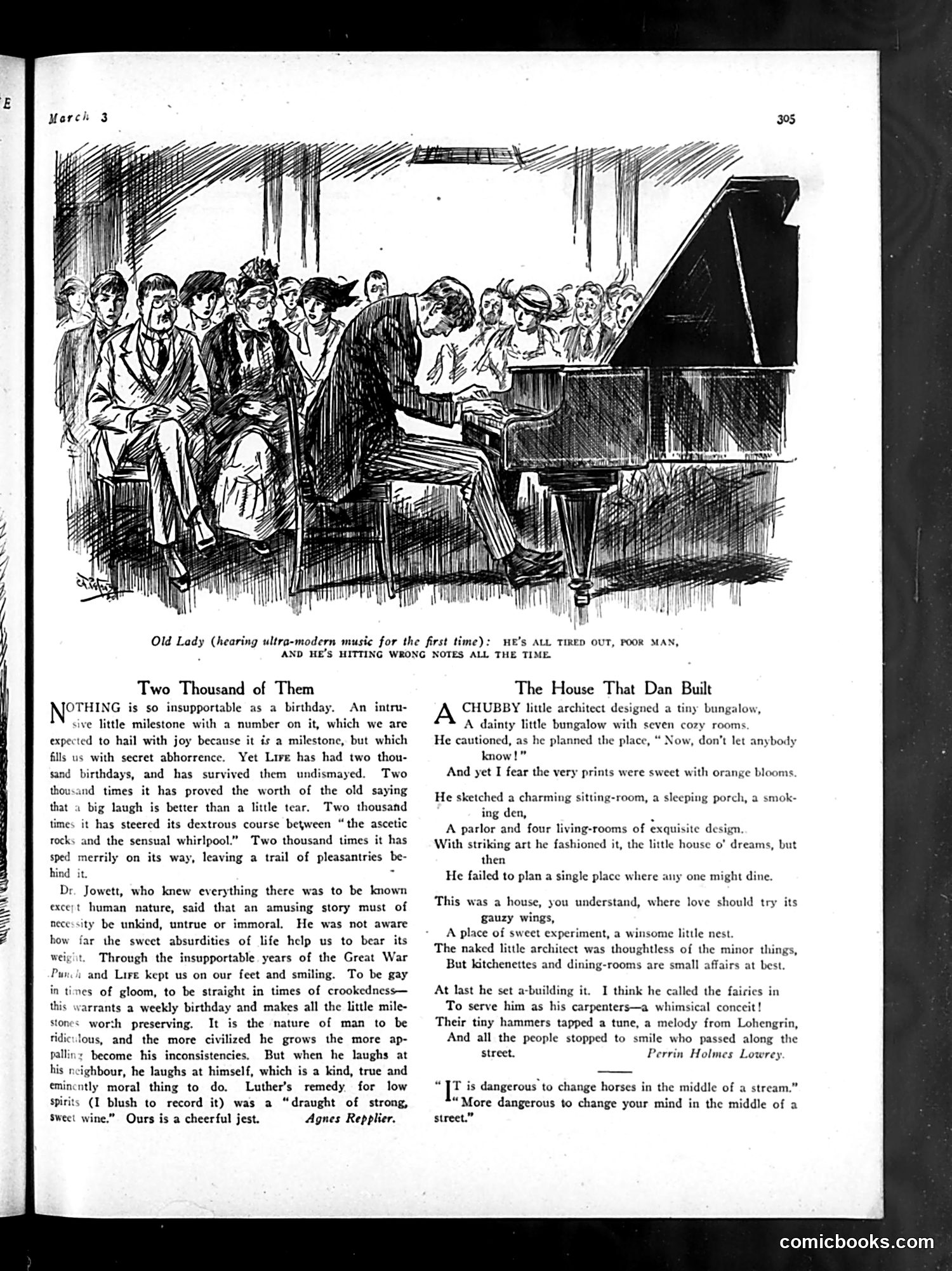
The page contains two separate pieces: **"Two Thousand of Them"** by Agnes Repplier is an essay celebrating Life magazine's 2,000th birthday issue, written in a humorous tone about the magazine's longevity and role in keeping readers cheerful through difficult times (likely referencing WWI and its aftermath). **"The House That Dan Built"** is a short story about a naive architect who designs an impractical small bungalow with beautiful sitting rooms and decorative elements but fails to include a dining room—a satirical commentary on impractical idealism versus functional reality. **The cartoon** (top) shows an elderly woman hearing "ultra-modern music" played on piano for the first time, hitting wrong notes. It's a period joke about modernist music's dissonance sounding like incompetent playing to traditional ears.
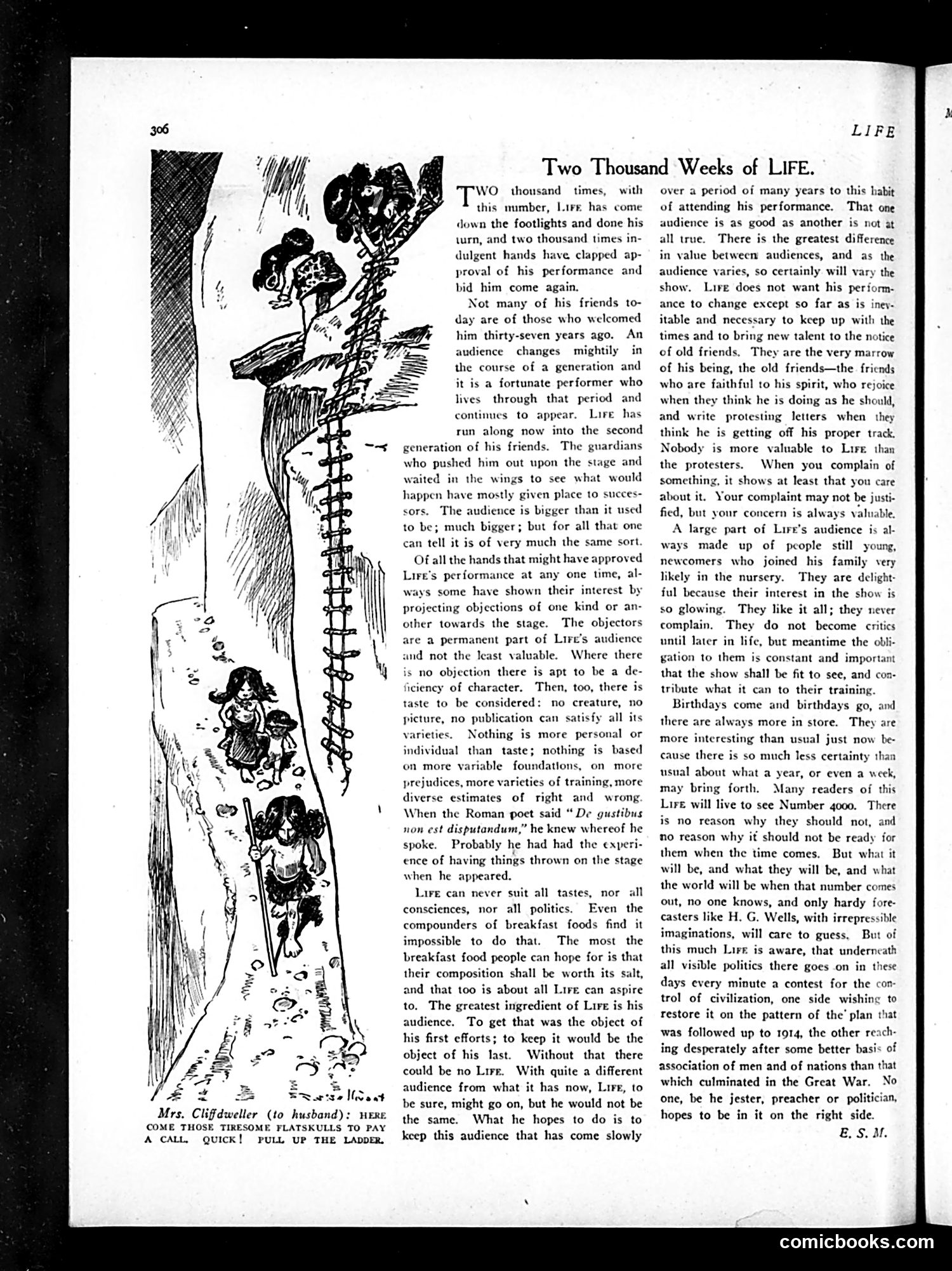
This page celebrates Life magazine's longevity with a tall vertical cartoon showing performers climbing a ladder alongside theatrical figures descending. The illustration depicts Life's two-thousand-week milestone of publication. The accompanying article discusses Life's enduring audience and the magazine's relationship with its performers and readers. It notes that while some early supporters have left, new younger audiences join constantly. The piece emphasizes that Life values loyal "old friends" who sustain the publication, though it welcomes newcomers. The article references a Roman poet's quote about variability in public taste, suggesting that Life accepts it cannot please everyone equally. It concludes by hoping Life maintains its current audience while continuing its satirical mission post-1914, avoiding alignment with any particular political side.
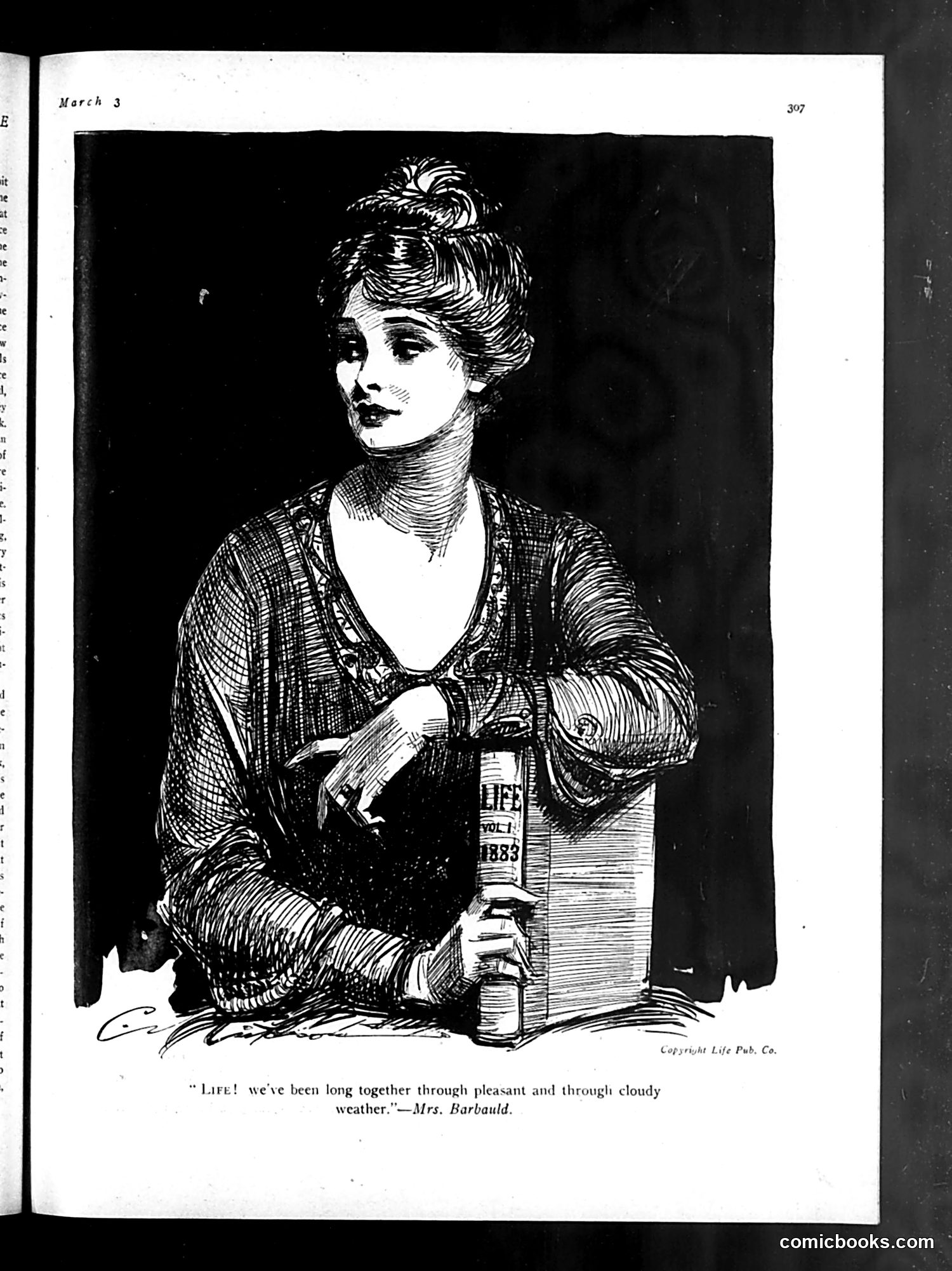
This illustration from Life magazine (page 397, March 3) depicts a woman holding a bound volume labeled "LIFE VOL. I 1893." The caption quotes Mrs. Barbauld: "Life! we've been long together through pleasant and through cloudy weather." The satire appears to celebrate Life magazine's longevity and relationship with its readers. By personifying the magazine as a companion "through pleasant and through cloudy weather," the illustration suggests Life has been a reliable presence during both good and difficult times. The woman's elegant presentation and the formal inscription of the date suggest this marks an anniversary or commemorative moment for the publication. The work likely celebrates the magazine's endurance and intimate connection with American audiences over its years of publication.
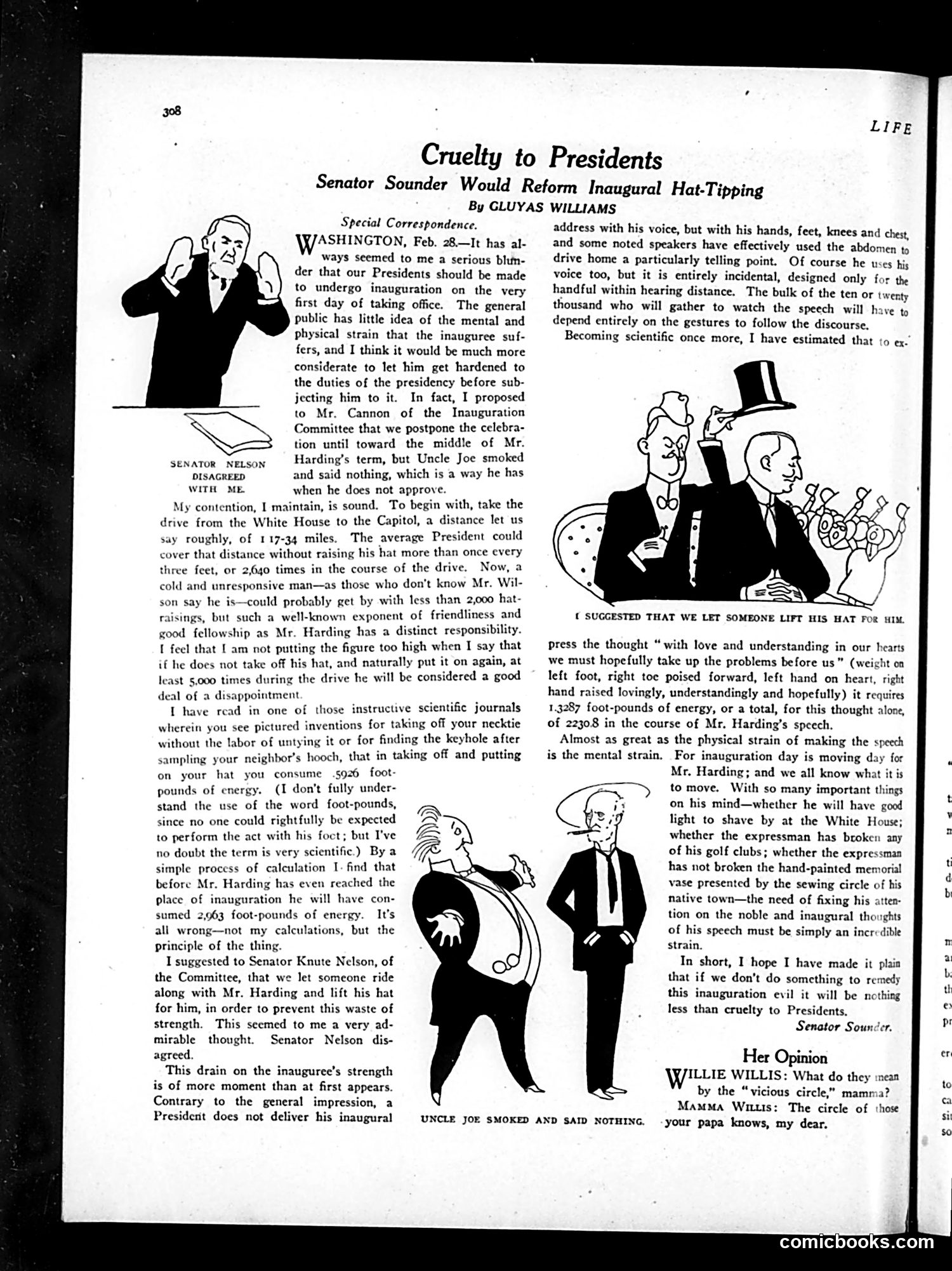
This satirical piece by Gluyas Williams mocks the physical demands of presidential inaugurations. Senator Sounder proposes postponing inaugural ceremonies until mid-term to let new presidents harden themselves for duty first. The cartoons illustrate the author's tongue-in-cheek argument: Presidents must endure a grueling drive from White House to Capitol (17-34 miles), repeatedly tip their hats to crowds, and deliver speeches while gesturing—activities requiring thousands of foot-pounds of energy. The "Uncle Joe smoked and said nothing" caption references Vice President Joseph (unclear which), portrayed as wisely avoiding these exhausting traditions. The satire targets the physical toll of inaugural rituals on aging or unfit presidents, suggesting reform to prevent this "cruelty."
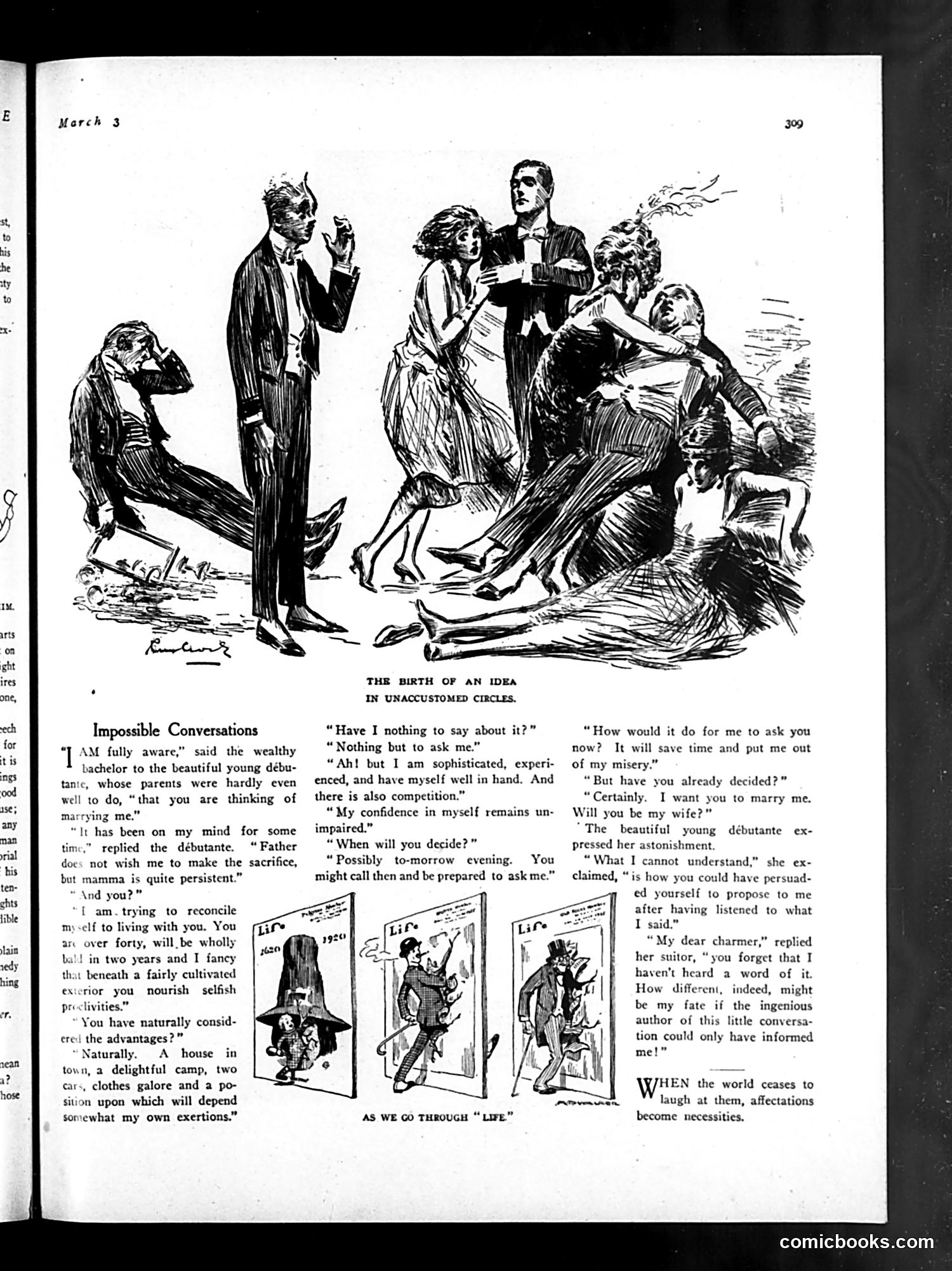
This satirical piece depicts a wealthy bachelor resisting marriage proposals from a debutante. The main cartoon shows "THE BIRTH OF AN IDEA IN UNACCUSTOMED CIRCLES" — the wealthy man's resistance to matrimony, which the text suggests was unusual among his social class. The satire targets upper-class marriage conventions: the debutante's parents expect him to marry her, but he resists, citing selfish "pre-nuptial extravagances" and claiming his father (now deceased) opposed marriage. The humor lies in his tortured rationalizations and the woman's astonishment that someone would reject such a socially advantageous match. Three small "Life" magazine covers below illustrate the conversation's progression, a recurring feature noted in the caption "AS WE GO THROUGH 'LIFE.'"
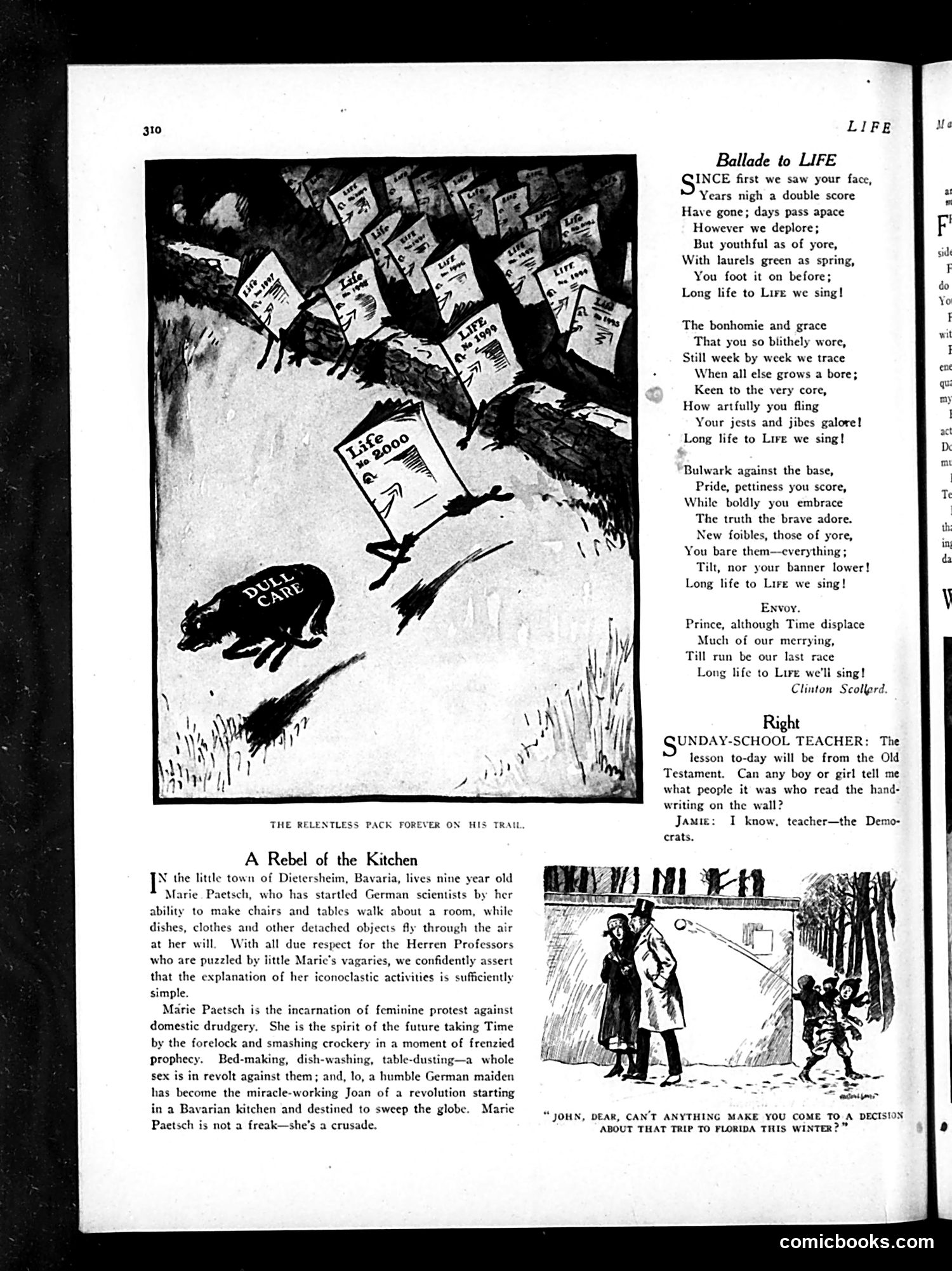
**Main Cartoon:** "The Relentless Pack Forever on His Trail" depicts a pig labeled "BULL CARE" pursued by numerous papers/documents labeled "LIFE." This satirizes persistent media scrutiny—Life magazine itself relentlessly pursuing and exposing some target (likely a political figure or public person) with investigative reporting. **Text Section:** "A Rebel of the Kitchen" describes nine-year-old Marie Paetsch of Bavaria, who creates domestic chaos by flinging objects through rooms. The article treats her as a humorous proto-revolutionary figure, calling her "the miracle-working Joan of a revolution starting in a Bavarian kitchen." **Humor:** The piece uses exaggerated, mock-heroic language to satirize both childhood misbehavior and revolutionary fervor, suggesting that domestic rebellion mirrors political upheaval—a common satirical trope of the era.
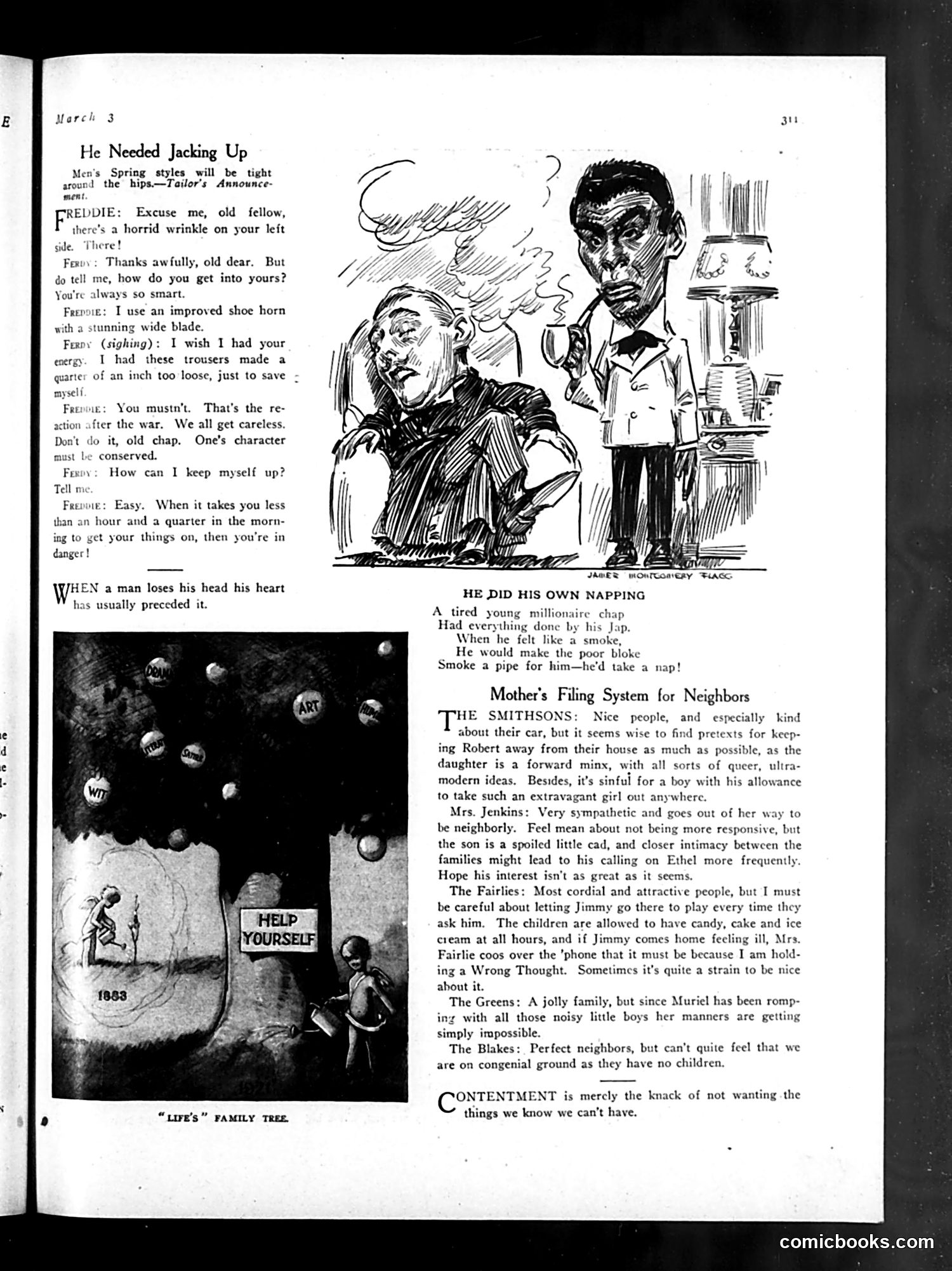
**"He Needed Jacking Up"**: A dialogue between two fashionable men discusses the challenge of fitting into tight spring menswear. The joke centers on post-WWI carelessness about personal appearance—one man admits buying trousers intentionally loose to avoid effort, which his friend scolds as character deterioration. The cartoon mocks how men must "jack themselves up" (maintain discipline) to manage new tight-fitting styles. **"He Did His Own Napping"**: A satirical poem about a wealthy young man employing a Japanese servant to perform even trivial tasks, including smoking a pipe so the employer can nap undisturbed. This reflects early 20th-century attitudes toward servant employment and leisure-class excess. **"Mother's Filing System for Neighbors"**: A social commentary where a mother categorizes neighbors while restricting her children's contact—criticizing the Smithsons' daughter as "forward," the Jenkinses' son as "spoiled," the Fairlies' indulgent parenting, and the Greens' rowdy children. Only the childless Blakes escape judgment, highlighting middle-class social anxiety and gossip.
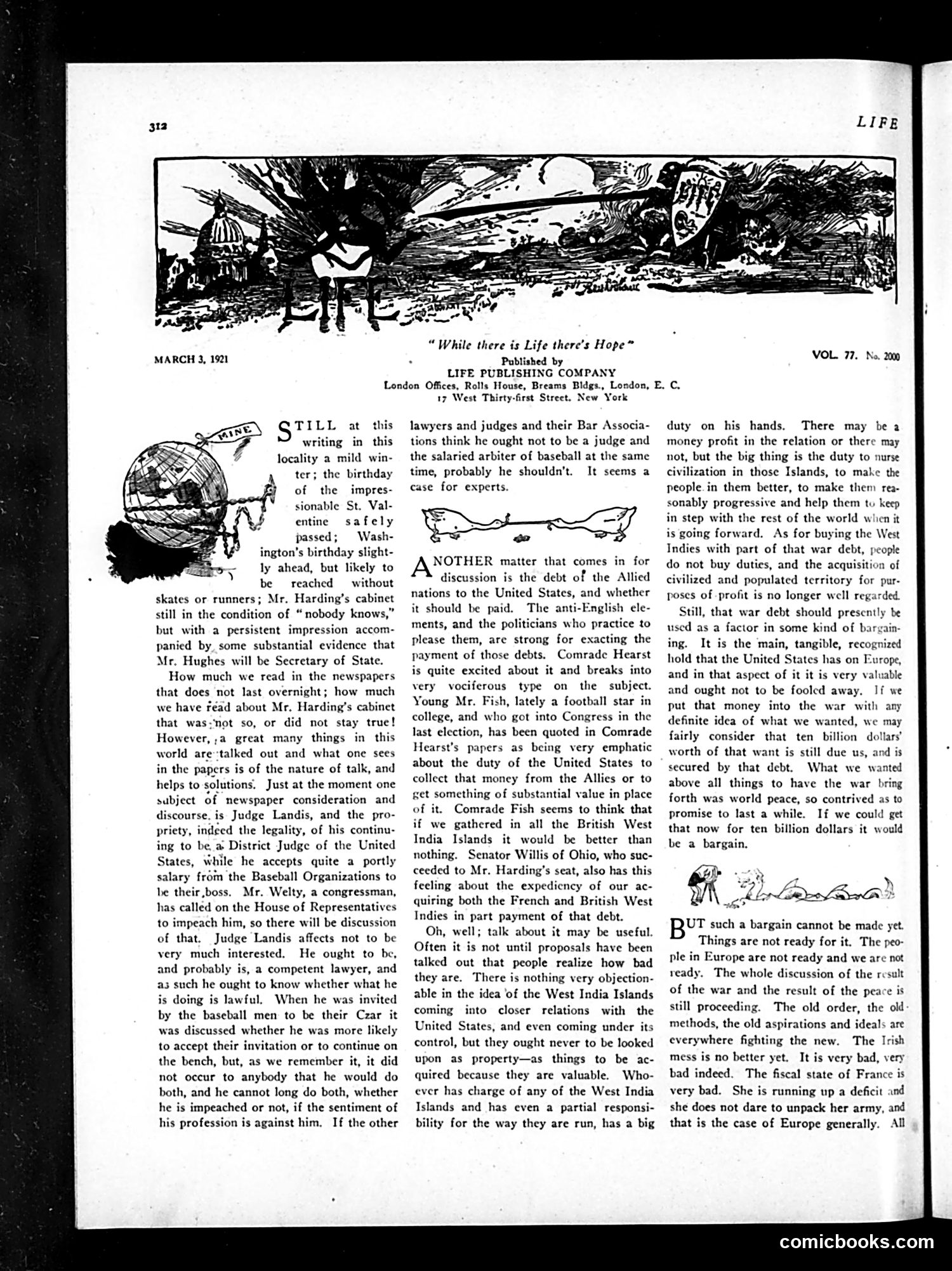
This editorial page discusses two major controversies of early 1921: **Judge Landis controversy**: The writer critiques Judge Kenesaw Mountain Landis for simultaneously serving as a federal judge while accepting a substantial salary as baseball's commissioner (its "Czar"). Congressman Welty has called for his impeachment. The piece argues this dual role is legally and ethically questionable—Landis cannot serve both positions, and the legal profession should pressure him to choose. **War debts and territorial acquisition**: The article mocks politicians (particularly William Randolph Hearst and Congressman Hamilton Fish Jr.) for demanding Allied nations repay WWI debts by ceding territory—specifically suggesting Britain and France surrender their West Indian colonies to the United States. The writer finds this crude, arguing these territories shouldn't be treated as mere "property" to be seized as payment, though closer U.S. relations with them aren't inherently objectionable. The tone is satirical critique of post-war opportunism and legal hypocrisy among American political figures.
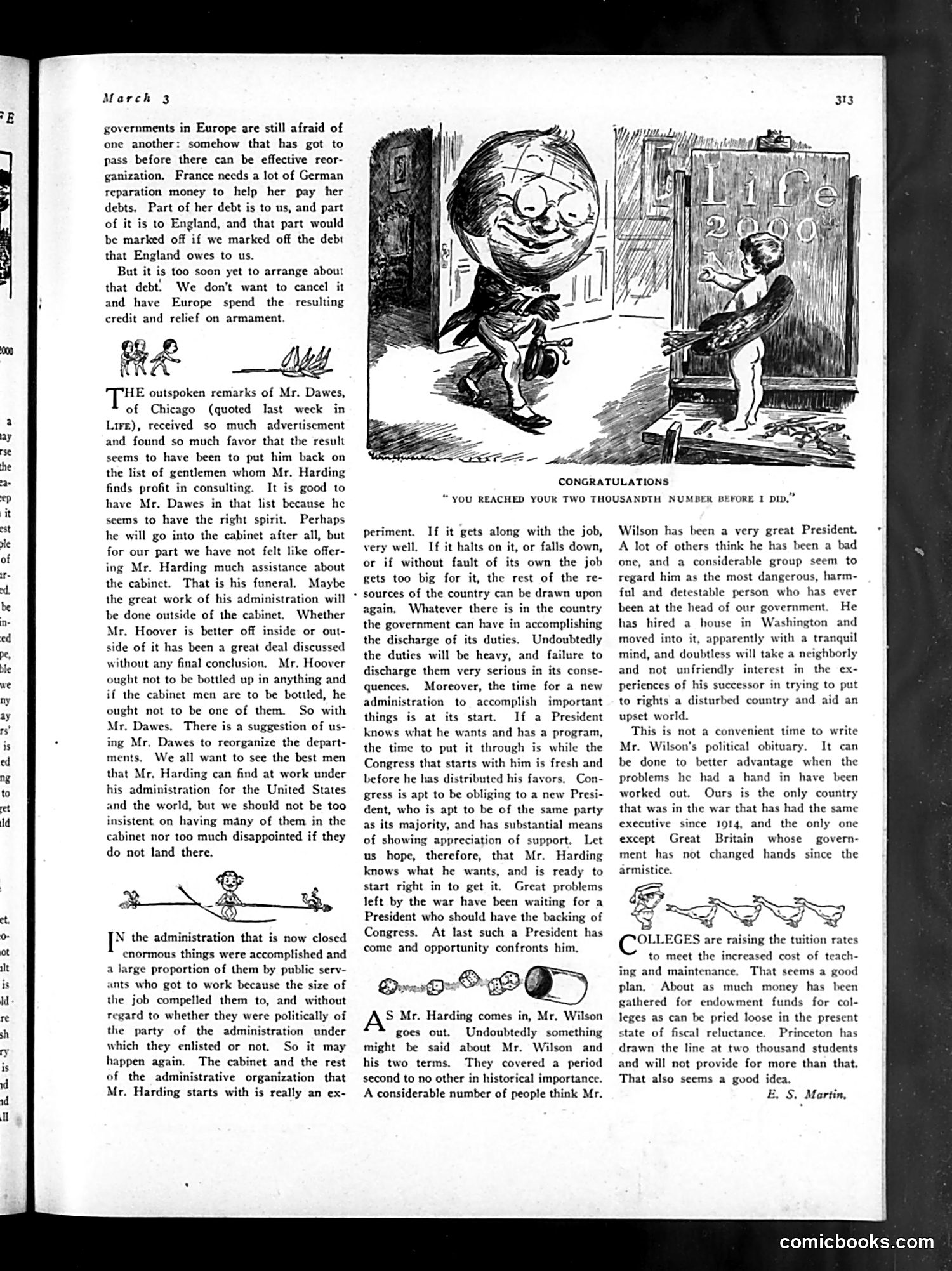
The main cartoon depicts a caricatured figure (likely representing post-WWI Europe or a specific nation) with an exaggerated grinning face reaching toward a large door marked "2000," congratulating themselves for reaching "two thousandth number before I did." This appears to celebrate Life magazine's 2000th issue milestone, with the joke being a playful competition between the publication and some contemporary figure or entity. The text discusses President Warren G. Harding's new administration and the cabinet selections, particularly praising Charles Dawes (a Chicago businessman and future Vice President) for his practical approach to government reorganization. The article contrasts this with the departing Wilson administration, noting that capable people work effectively regardless of political party affiliation when the job demands it. The surrounding discussion addresses post-WWI European debt and reparations—contextualizing American financial entanglements with France, Germany, and England after World War I.
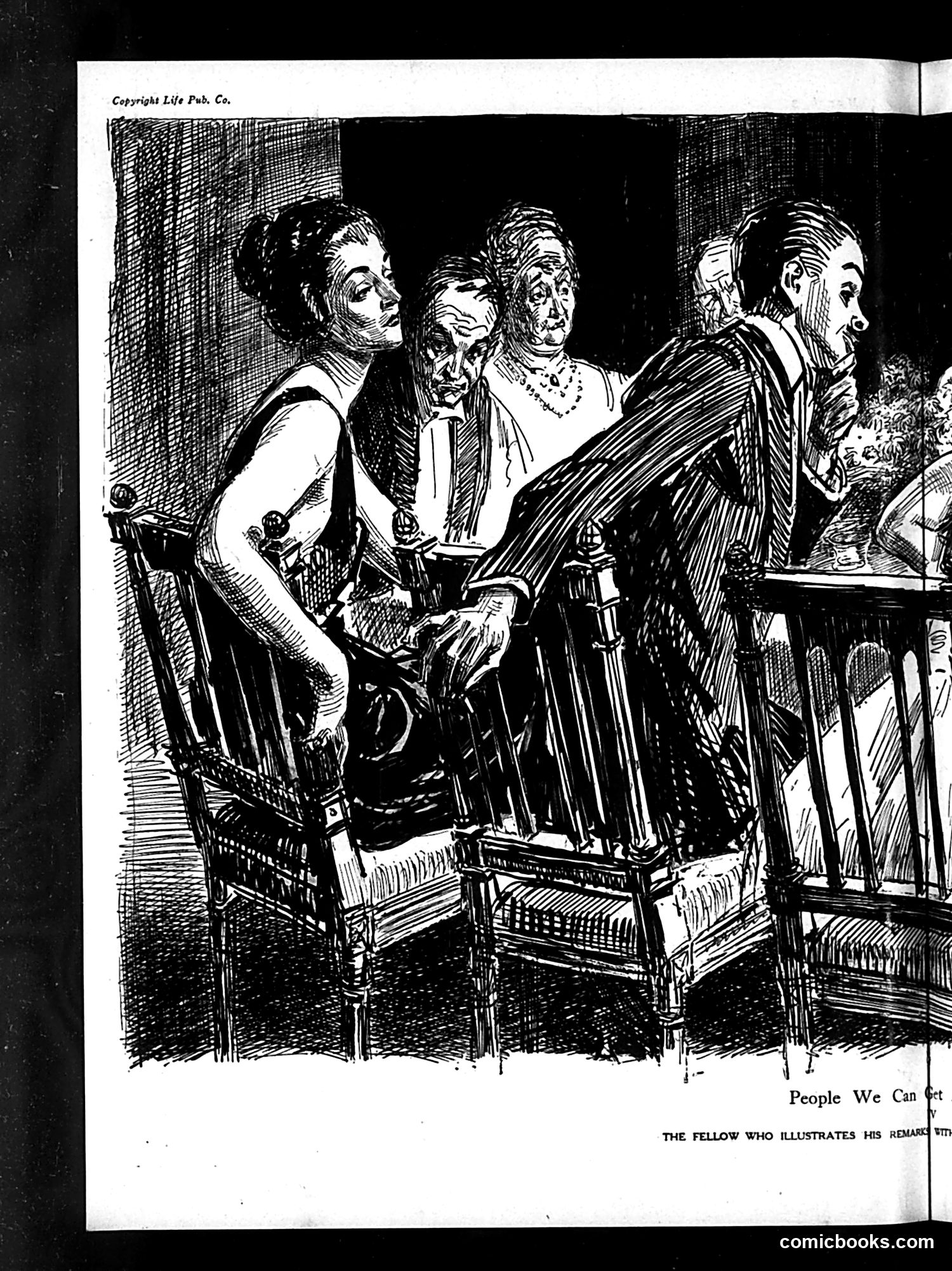
This appears to be a page from *Life* magazine featuring a satirical illustration titled "The Fellow Who Illustrates His Remarks With..." (text cut off). The black-and-white line drawing depicts a social scene with four figures seated together—likely at a dinner party or social gathering. The cartoon satirizes a particular social type: a man (right) who apparently emphasizes his conversation through exaggerated gestures or physical demonstration. The other figures' expressions suggest they're reacting to his animated behavior—a common *Life* magazine satire of early-to-mid 20th century social pretension or awkward social conduct. The specific identity of the "fellow" being mocked remains unclear from the visible text, but the humor targets excessive gesticulation as poor social etiquette during refined social occasions.
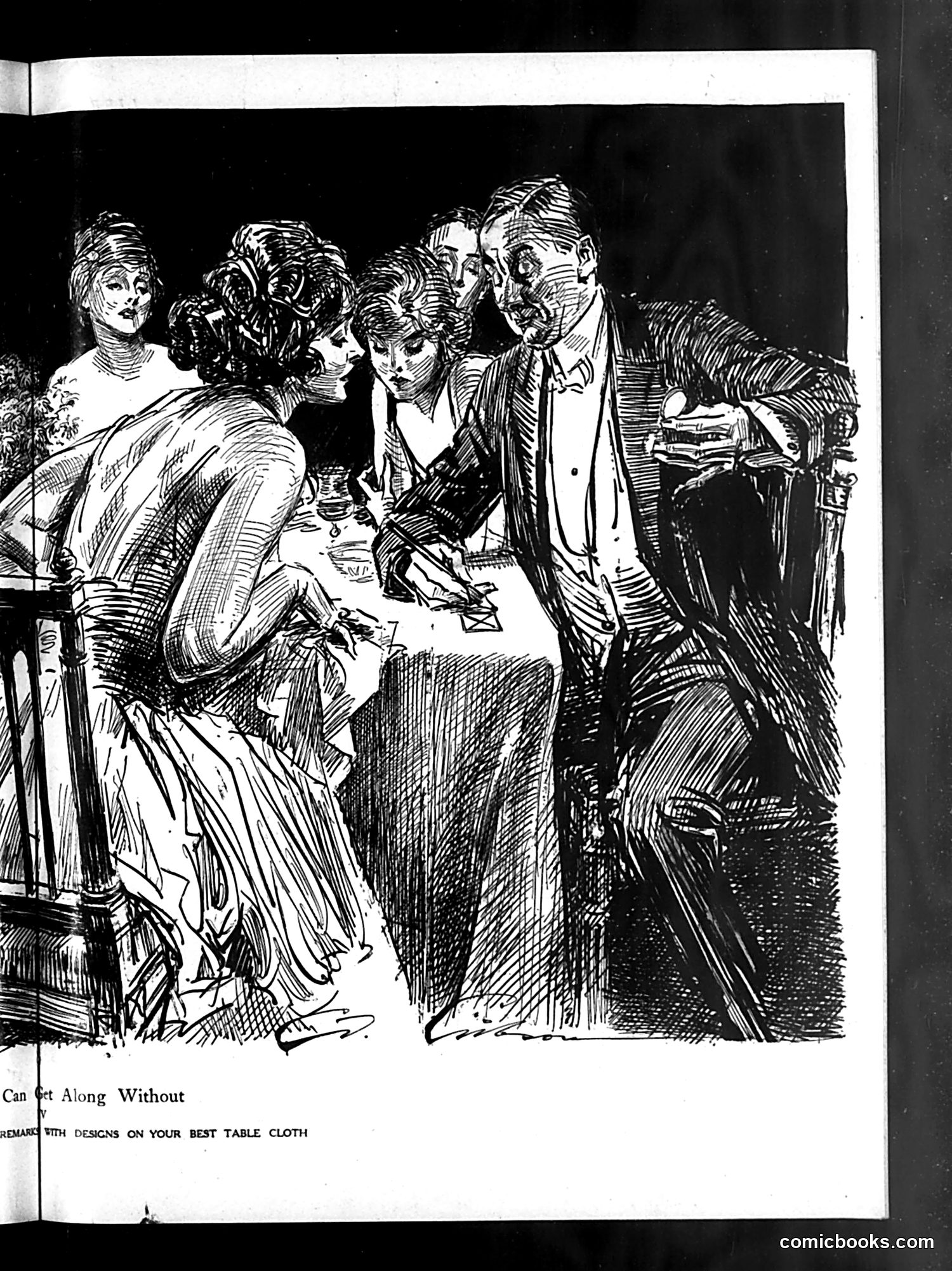
This appears to be a satirical cartoon from Life magazine depicting a formal dinner or social gathering. The visible text references getting along "without designs on your best table cloth," suggesting the satire concerns social pretension or unwanted guests with designs (schemes) on the host's possessions. The sketch shows elegantly dressed figures in evening wear gathered around a table in what appears to be an upper-class social setting. The style and composition suggest commentary on high-society behavior or etiquette. However, the OCR text is heavily corrupted and incomplete, making it difficult to identify specific figures or the precise social commentary intended. The full caption and context are unclear from this image alone.
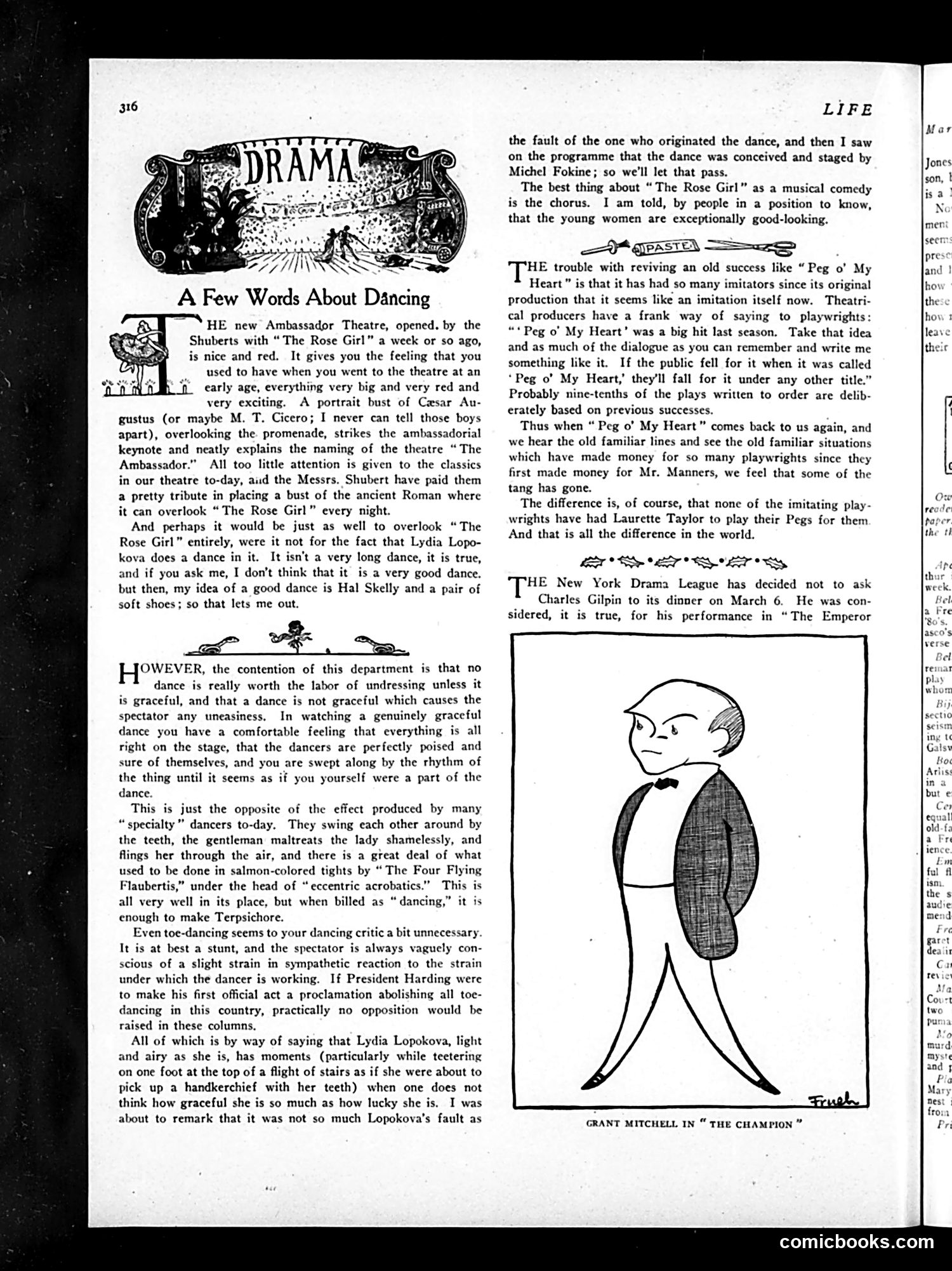
This drama column critiques contemporary theatrical dancing, particularly referencing **Lydia Lopokova**, a celebrated Russian prima ballerina of the 1920s who performed in "The Rose Girl" at the new Ambassador Theatre. The author argues that graceful dancing should feel effortless to audiences, while "specialty" dancers of the era perform acrobatic stunts—swinging partners by their teeth, throwing them through air—disguised as dance. The piece mocks extreme techniques like toe-dancing and toe-standing on staircases. The cartoon (credited to an artist, likely Frueh) depicts **Grant Mitchell** in "The Champion," showing a portly, ungainly figure in formal wear—visual satire of awkward physical performance. The column concludes by blaming choreographer **Michel Fokine** for Lopokova's occasionally clumsy moments, though acknowledging her inherent grace. It also satirizes theatrical producers who cynically imitate successful plays like "Peg o' My Heart," instructing playwrights to copy previous hits.
This page contains theater reviews and a significant satirical commentary by Robert C. Benchley criticizing racial discrimination in New York's cultural institutions. **The Main Satire:** Benchley critiques the hypocrisy of a dinner committee that excluded Charles Gilpin, a Black actor who had just achieved critical success in Eugene O'Neill's *The Emperor Jones* (listed among theater reviews). The satire exposes how "embarrassment" about Black guests would cause white diners to leave—yet the committee dismisses this as unimportant loss. **The Point:** Benchley acidly notes the absurdity: a man whose talent sensationally impressed audiences all season is excluded solely because he's Black. He invokes Alexandre Dumas (the famous French author of mixed race) to highlight the historical irony of denying prestigious association to accomplished Black figures in "this land of equal opportunity." **Context:** This reflects 1920s racial segregation in elite American spaces. Gilpin's acclaimed performance in *The Emperor Jones* made his exclusion particularly glaring—and Benchley's sardonic tone underscores the moral bankruptcy of such discrimination.
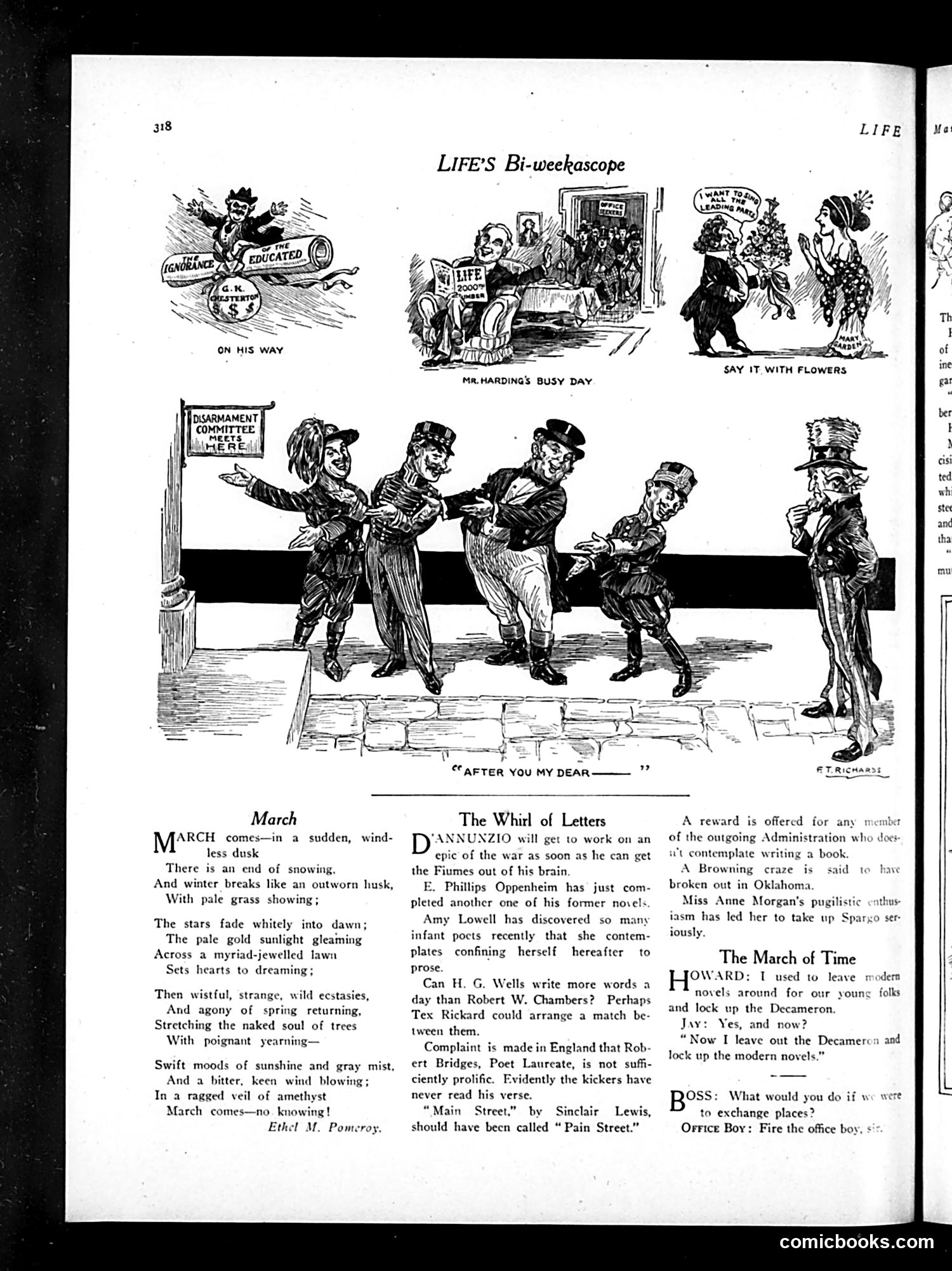
This page from *Life* satirizes post-WWI American culture through multiple cartoons and literary commentary. The main cartoon "After You My Dear" depicts competing figures (likely politicians or bureaucrats) bowing excessively at a "Disarmament Committee" meeting—mocking the era's peace negotiations and disarmament talks following World War I, suggesting hollow political courtesy masking self-interest. The smaller cartoons at top mock contemporary figures: one shows someone labeled with references to "ignorance" and "education," criticizing public figures' pretensions. "The Whirl of Letters" section satirizes famous writers' productivity. It jokes that poet Robert Bridges isn't prolific enough, mocks H.G. Wells versus Robert W. Chambers in a writing "match," and quips that Sinclair Lewis's *Main Street* should be called "Pain Street"—critiquing the novel's dark portrait of small-town American life. The page reflects 1920s intellectual culture's obsession with literary output, wartime recovery, and modernist skepticism about earnest political gestures and contemporary literature's social commentary.
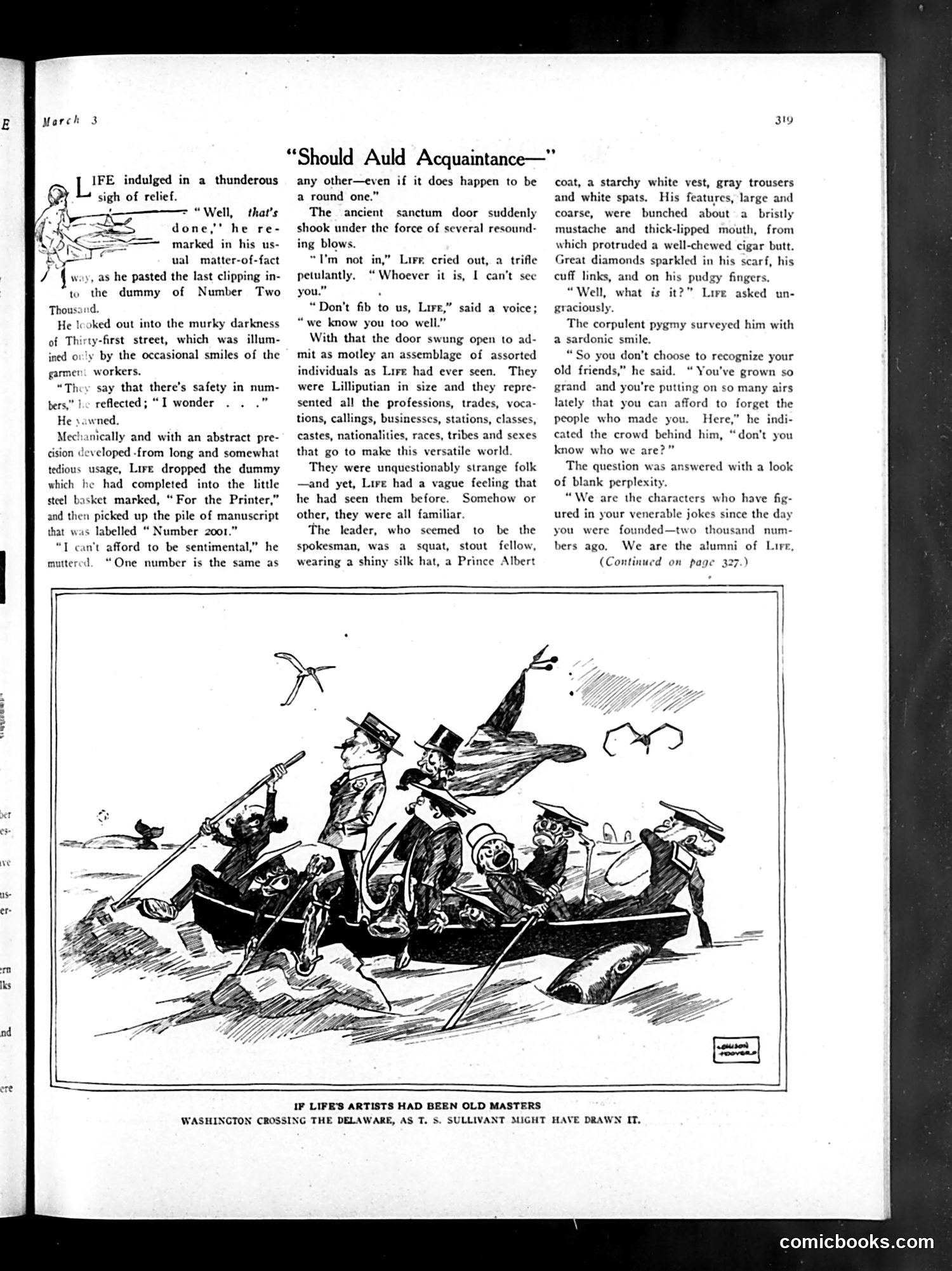
This page contains two satirical elements: **Main Story ("Should Auld Acquaintance—"):** A fictional narrative where the editor of *Life* magazine is visited by personified characters—"two thousand" of them—who claim to be the comedic figures that have appeared in the magazine since its founding. They're portrayed as a diverse crowd representing "all the professions, trades, vocations, callings, businesses, stations, classes, castes, nationalities, races, tribes and sexes." The joke appears to be about *Life's* recurring stock characters confronting the editor, suggesting these archetypal figures have become the magazine's identity. **Cartoon Below:** Titled "If Life's Artists Had Been Old Masters," it reimagines Emanuel Leutze's famous historical painting *Washington Crossing the Delaware* in a chaotic, absurdist style—likely mimicking how cartoonist T. S. Sullivant might redraw it. This is a meta-joke: satirizing how different artistic styles would interpret the same iconic American scene. Both elements celebrate *Life's* satirical tradition and its roster of recurring characters and artists.
This page reviews early silent films, satirizing both cinema snobs and the medium itself. The opening joke mocks pretentious film critics who claim a "Mutt and Jeff" cartoon represents cinema's artistic peak—a deliberately absurd assertion meant to ridicule serious film analysis. The reviews then earnestly discuss actual films: Harold Lloyd and Buster Keaton comedies (genuinely respected), Bill Hart westerns, and Shirley Mason vehicles. The satire is gentle—Life acknowledges these are genuinely good entertainments while poking fun at overwrought dramatic plots (like Hart's "O'Malley of the Mounted," where duty loses to romance). A secondary joke targets "Wing Toy," which exploits a tired "exotic Chinese heroine" stereotype common in stage drama. The final review of "The Kentuckians" criticizes modern filmmakers who over-explain through subtitles rather than trusting audience imagination—echoing classical Greek theater's use of the chorus. The satire targets both filmmakers' artistic pretensions and audiences' limited imagination.
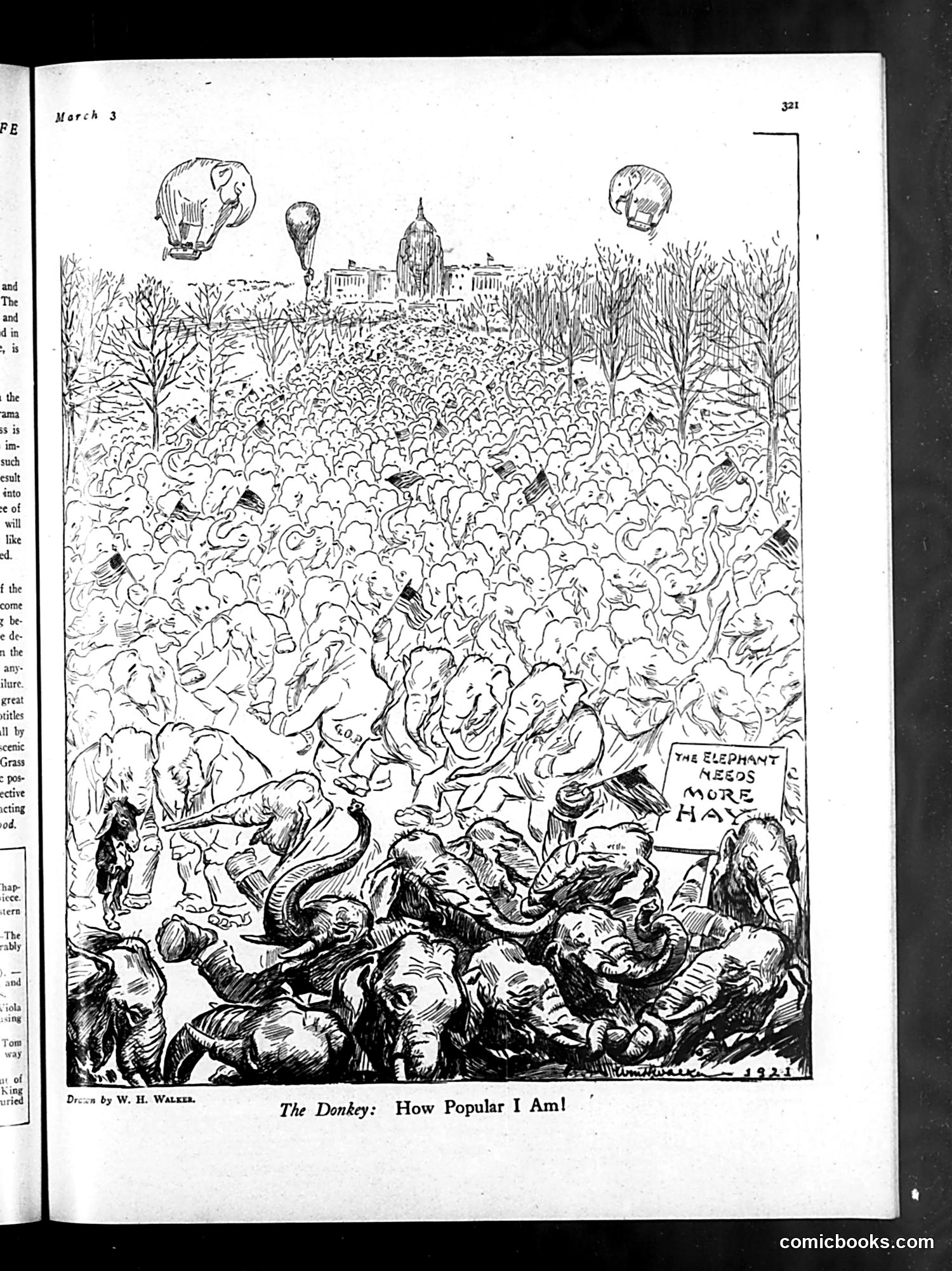
This 1923 cartoon by W.H. Walker depicts a large crowd of people swarming around what appears to be a donkey (visible in the foreground, darker/shaded). A sign reads "THE ELEPHANT NEEDS MORE HAY," suggesting political commentary—likely referencing the Republican Party (symbolized by the elephant) and their political needs or demands. The massive crowd surrounding the donkey suggests the donkey (possibly representing the Democratic Party or a political opponent) has become unexpectedly popular despite efforts to diminish it. The Washington Capitol building is visible in the background, confirming the political context. The satire appears to mock the irony of something dismissed as a "donkey" actually gaining substantial public support.
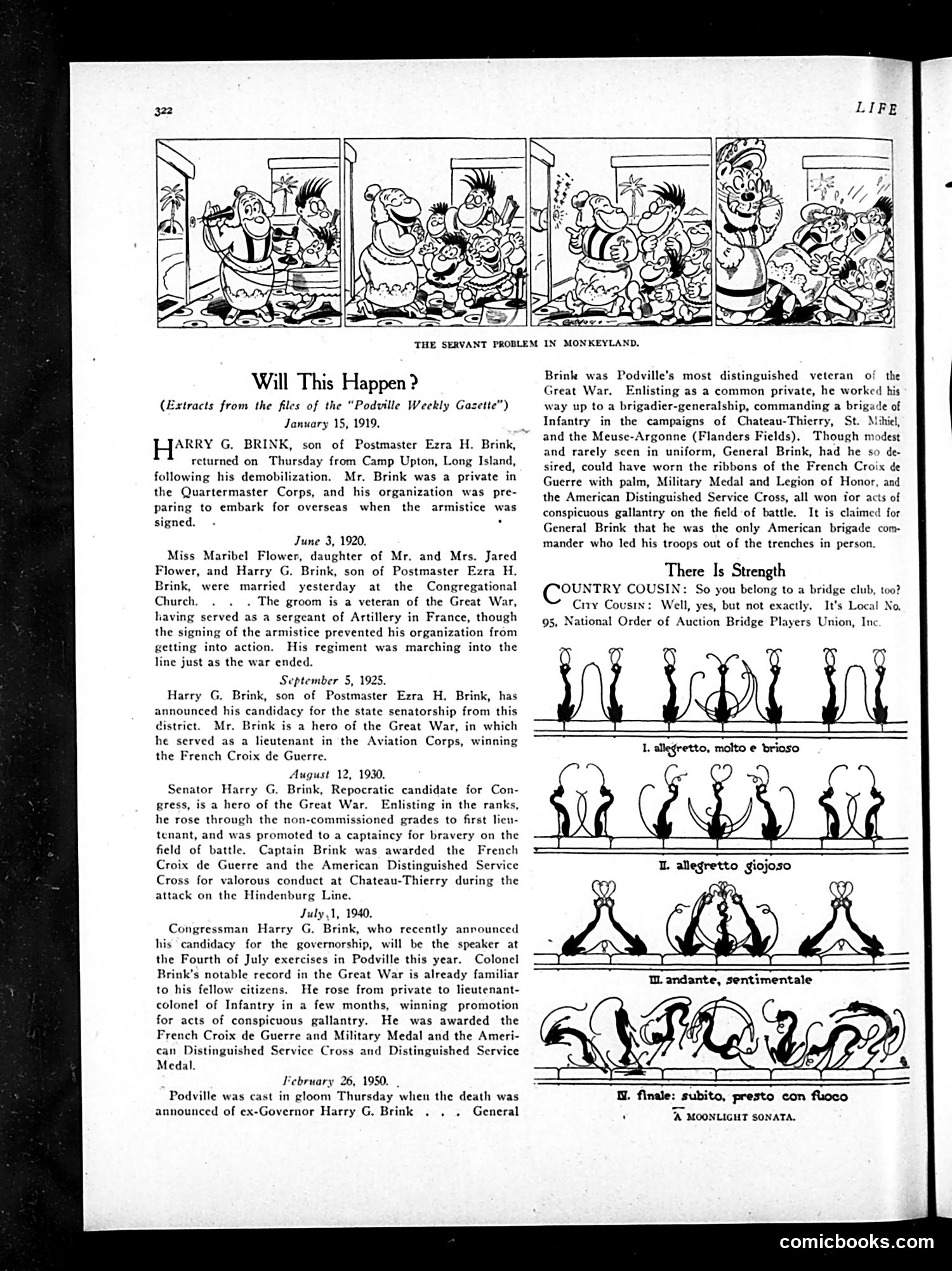
The top cartoon satirizes political opportunism and embellished résumés. It depicts Harry G. Brink's military record becoming increasingly exaggerated across successive newspaper accounts spanning 1919–1950. Initially a private who never saw combat, Brink's biography inflates with each political advancement: he becomes a sergeant, then lieutenant, then captain, then colonel, finally brigadier-general. His decorations multiply similarly—the French Croix de Guerre appears in every version with escalating honors. The satire targets how politicians exploit war service for career advancement, and how newspapers uncritically perpetuate inflated claims. The "monkeyland" framing suggests the absurdity of this pattern. The cartoon warns readers that candidates' heroic narratives deserve skepticism, as facts become increasingly unreliable the more they're recycled for political benefit. The bottom section is unrelated—a music notation joke about bridge players.
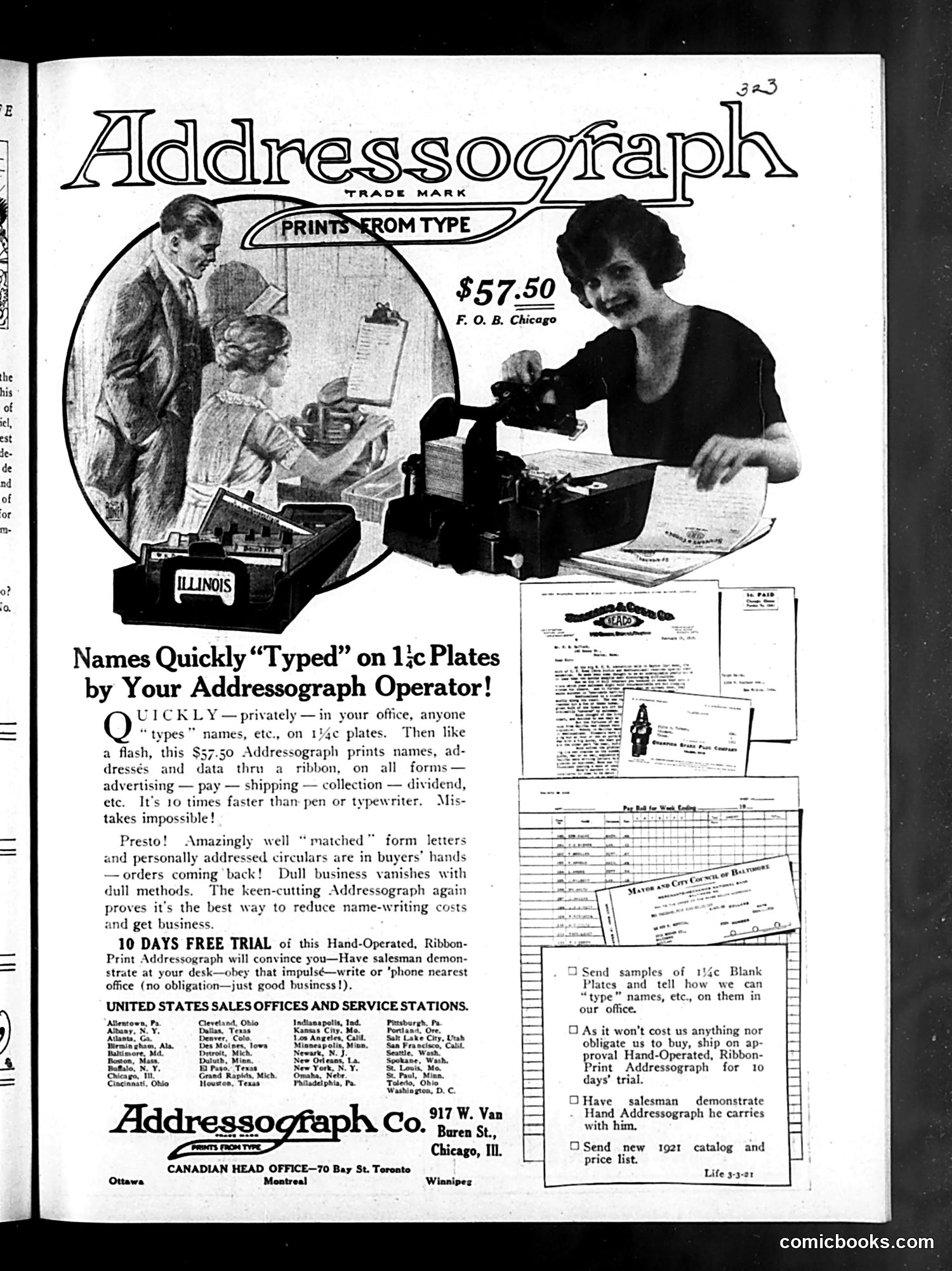
This is a **product advertisement, not political satire**. It promotes the Addressograph, a mechanical mail-addressing machine priced at $57.50 (FOB Chicago, circa 1921). The page shows the device in use: a woman operates the hand-cranked machine while an illustration depicts a businessman and woman reviewing efficiently-produced form letters and addressed materials. **The appeal to modern readers**: This advertisement demonstrates how businesses in the 1920s sought to automate tedious clerical work—specifically the mass-producing of personalized mail for advertising, collection notices, and dividend distributions. The machine promised to reduce labor costs and "name-writing" expenses while maintaining a personal touch through matched form letters. The "10 Days Free Trial" offer and checkbox-style reply card (visible on the right) are early examples of direct-response marketing. There is no political content or satirical commentary—only straight commercial persuasion targeting office managers seeking efficiency.
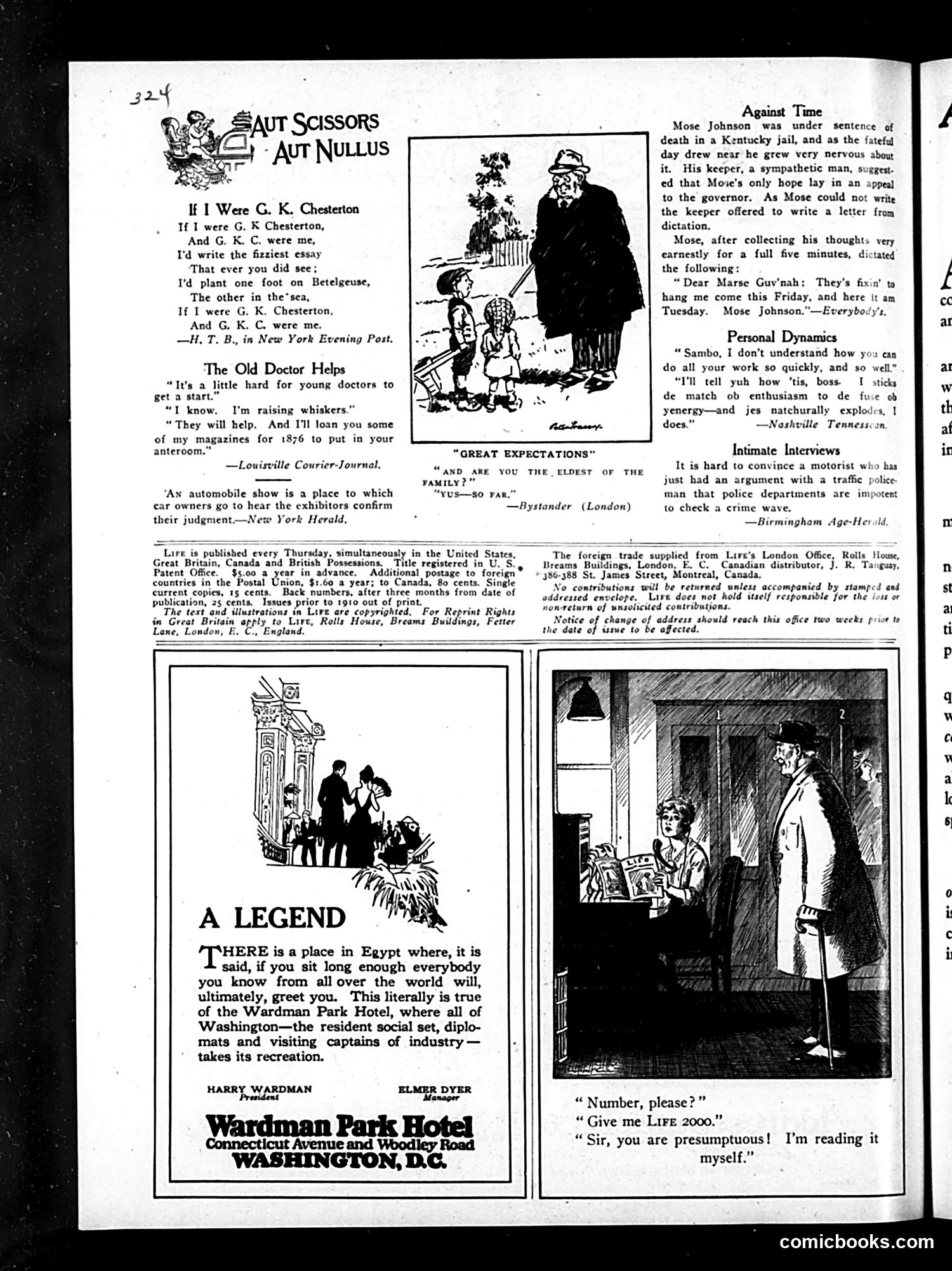
This page from Life magazine contains several brief satirical pieces typical of early 20th-century humor: **"If I Were G. K. Chesterton"** playfully imagines swapping places with the famous British writer and critic, mocking his grandiose intellectual style through absurd imagery (planting feet on distant stars). **"The Old Doctor Helps"** jokes that young physicians can establish credibility by growing whiskers and displaying old medical magazines—poking fun at how appearance and authority were conflated in medical practice. **"Personal Dynamics"** uses dialect humor (common but now offensive) where a Black worker describes enthusiasm as a "fuse" igniting energy—a metaphor for work motivation. **The cartoon bottom-right** shows a telephone operator refusing a caller's demand for "LIFE 2000," retorting that she's reading the current issue herself—advertising Life magazine's desirability. **"A Legend"** is an advertisement for Washington's Wardman Park Hotel, claiming it's where all important people inevitably meet. The page showcases Life's mix of literary satire, light humor, and advertising from this era.
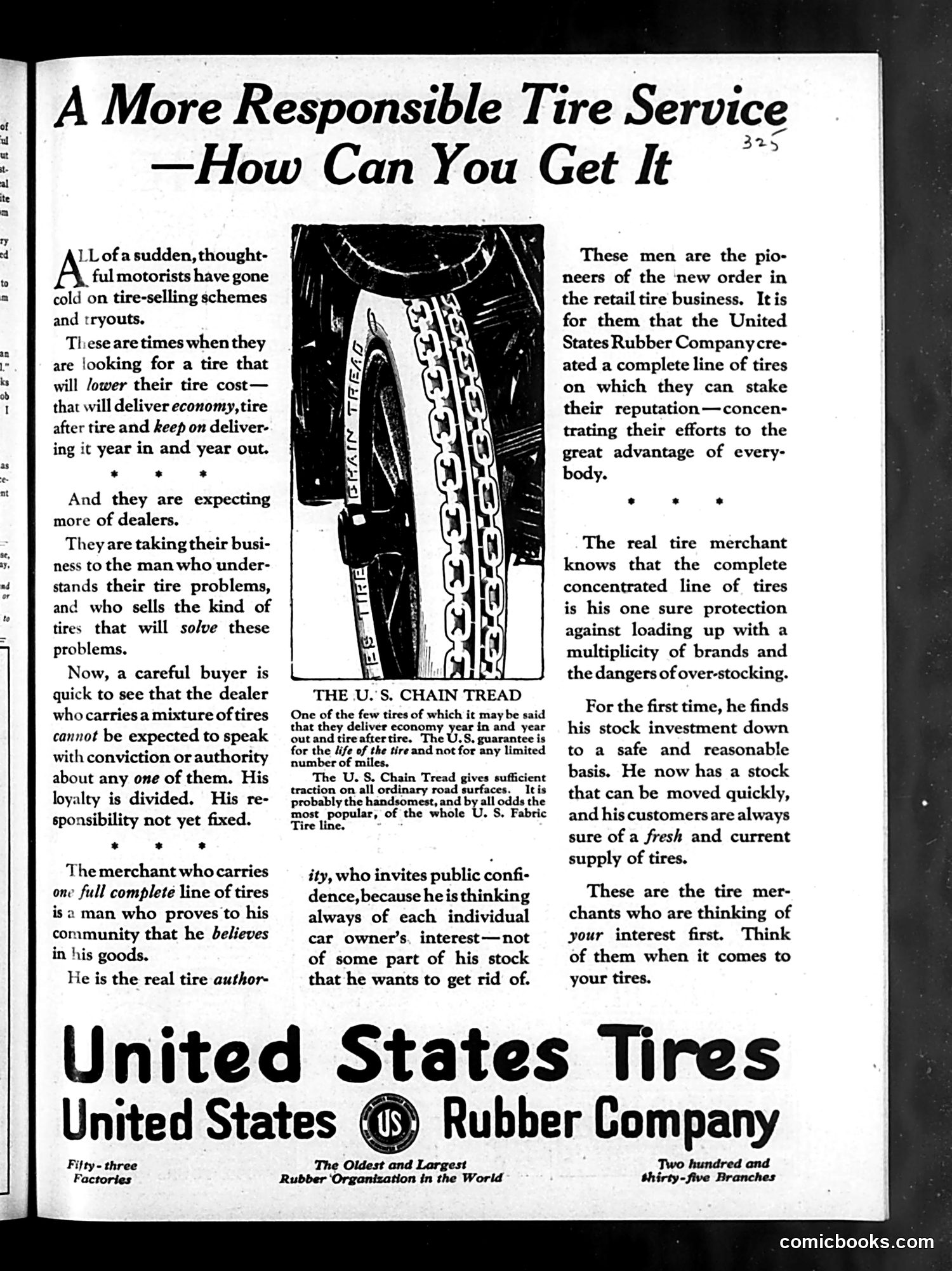
This is a **United States Rubber Company advertisement**, not satire or political commentary. The page promotes U.S. Tires to consumers by positioning responsible tire dealers favorably. The central argument targets motorists seeking economy and reliability. The ad distinguishes between two dealer types: those carrying multiple tire brands (presented as disloyal and untrustworthy) versus those stocking one complete U.S. Tires line (presented as principled and customer-focused). The "U.S. Chain Tread" tire featured in the image is positioned as the solution—durable, guaranteed for tire life (not mileage limits), and delivering consistent economy. The ad's rhetoric emphasizes "responsibility" and "authority," appealing to early-20th-century consumer concerns about product reliability and merchant trustworthiness. By suggesting that dealers carrying multiple brands lack conviction, U.S. Rubber essentially argues: loyal merchants stake their reputations on single quality lines, benefiting everyone through fresher inventory and better service. This represents standard product advertising of the era, not editorial satire.
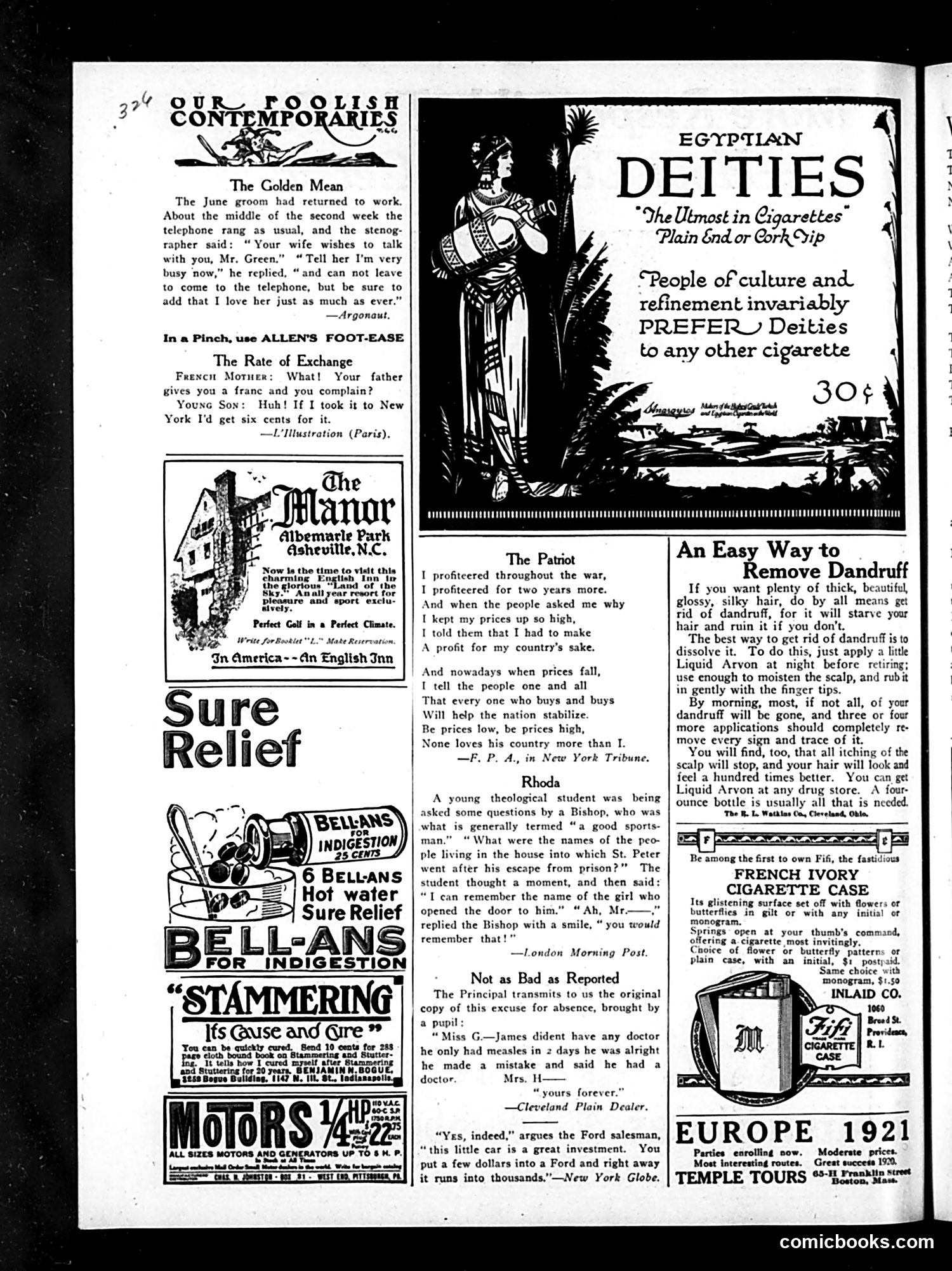
This page mixes **satirical humor pieces with period advertisements** from approximately 1920-1921. ## Satirical Content: **"The Golden Mean"** jokes about a newlywed husband who tells his wife he's too busy to take her call, then instructs the secretary to assure her he loves her—satirizing superficial gestures replacing genuine attention. **"The Patriot"** mocks war profiteers who raised prices claiming patriotism, then argue price cuts also serve the nation—exposing hypocrisy in using nationalism to justify greed from both directions. **"Rhoda"** is a mild theological joke: a bishop asks a student about people in a biblical house; the student remembers only the girl's name, prompting the bishop's knowing smile about selective memory. ## Advertisements: The page features typical 1920s ads: cigarettes (Egyptian Deities, French Ivory cases), remedies (Bellans indigestion tablets, Liquid Arvon dandruff treatment), a resort hotel, and motor parts—reflecting consumer products and health anxieties of the era. The humor reflects post-WWI disillusionment with profiteering and institutional hypocrisy.
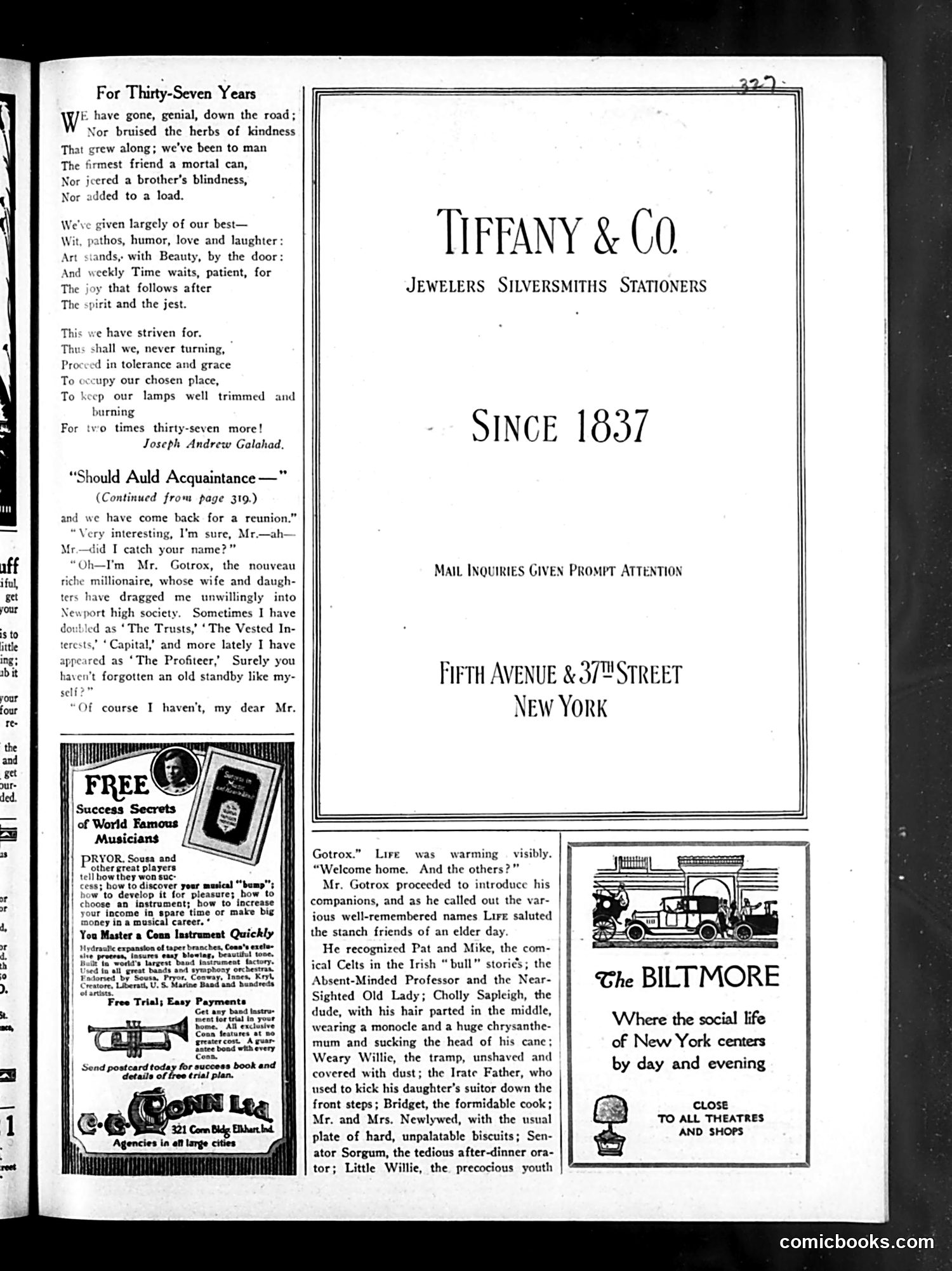
This page is primarily **advertising and narrative content** rather than political satire. The left column features a sentimental poem celebrating Life magazine's 37 years of publication, emphasizing its values of kindness, wit, and tolerance. It's an anniversary tribute promising another 37 years of service. The main text continues a serialized story titled "Should Auld Acquaintance—" featuring a character named Mr. Gotrox, a "nouveau riche millionaire" whose wife dragged him into high society. The passage humorously catalogs stock character types Gotrox introduces—Irish stereotypes ("Pat and Mike"), comic archetypes like "Weary Willie" the tramp, and social types like "Senator Sorgum" and "Little Willie." The right side contains a **Tiffany & Co. advertisement** (established 1837, matching Life's anniversary) and a hotel advertisement for the Biltmore. The humor relies on recognizing these familiar **period stereotypes and social caricatures** common to early 20th-century American comedy—not specific political figures, but rather generalized character types readers would recognize from popular entertainment.
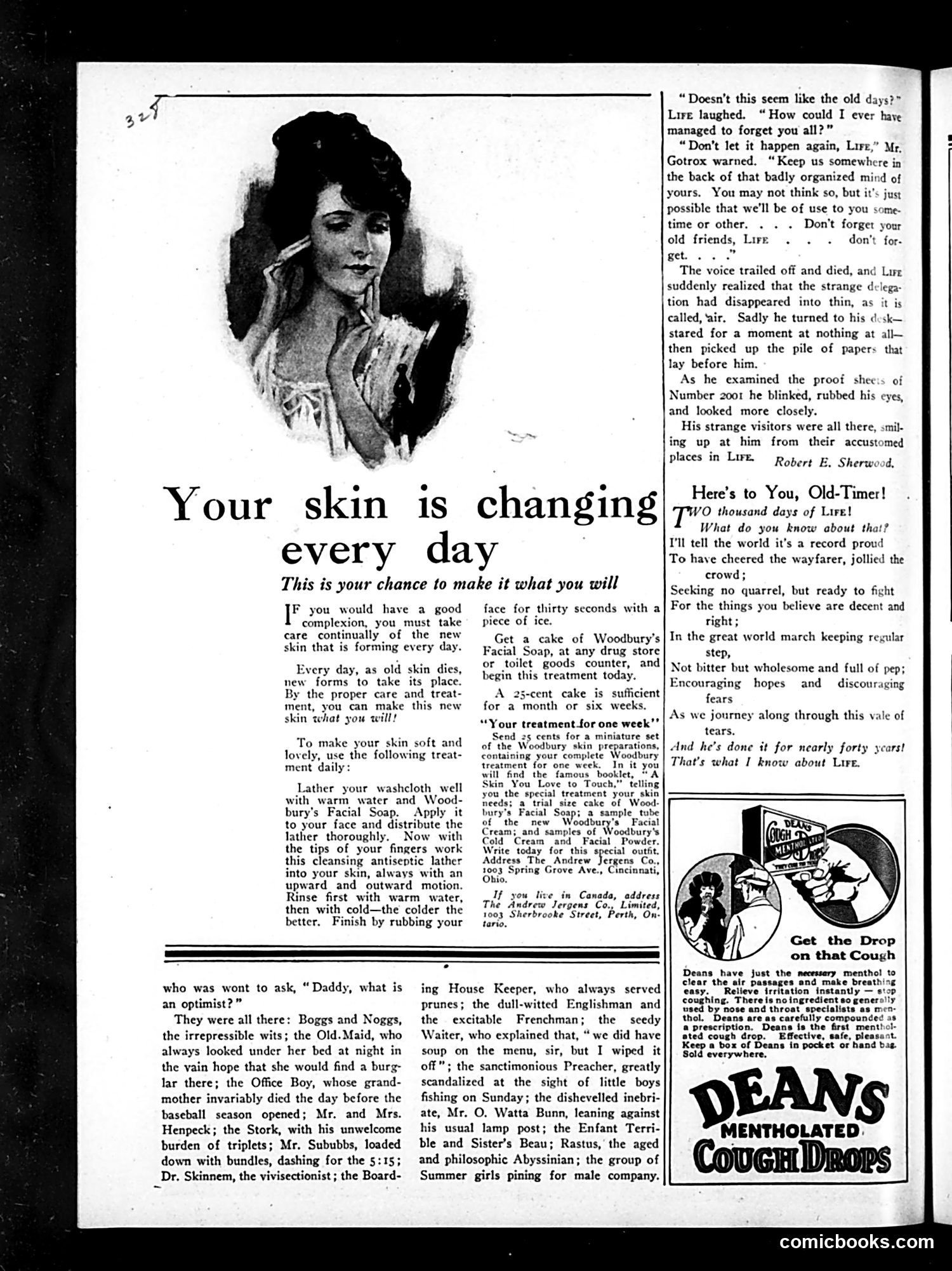
This page is **primarily advertising**, not political satire. The dominant content is a Woodbury's Facial Soap advertisement featuring a portrait of a woman and skincare instructions—a common early 20th-century beauty product ad emphasizing daily skin renewal. Below the ad runs a fictional narrative titled "Here's to You, Old-Timer!" by Robert E. Sherwood, apparently commemorating 2,000 days of *Life* magazine's publication. The story describes "Lire" (likely representing the magazine personified) being visited by recurring comic character types—stock figures like "Boggs and Noggs" (witty characters), "the Old Maid," "the Office Boy," various ethnic stereotypes ("the Frenchman," "Rastus, the aged and philosophic Abyssinian")—representing *Life*'s recurring satirical cast. The narrative is celebratory rather than sharply satirical, treating these familiar character types as beloved fixtures of the magazine's humor tradition. The page documents *Life*'s institutional identity through both commerce and editorial content.
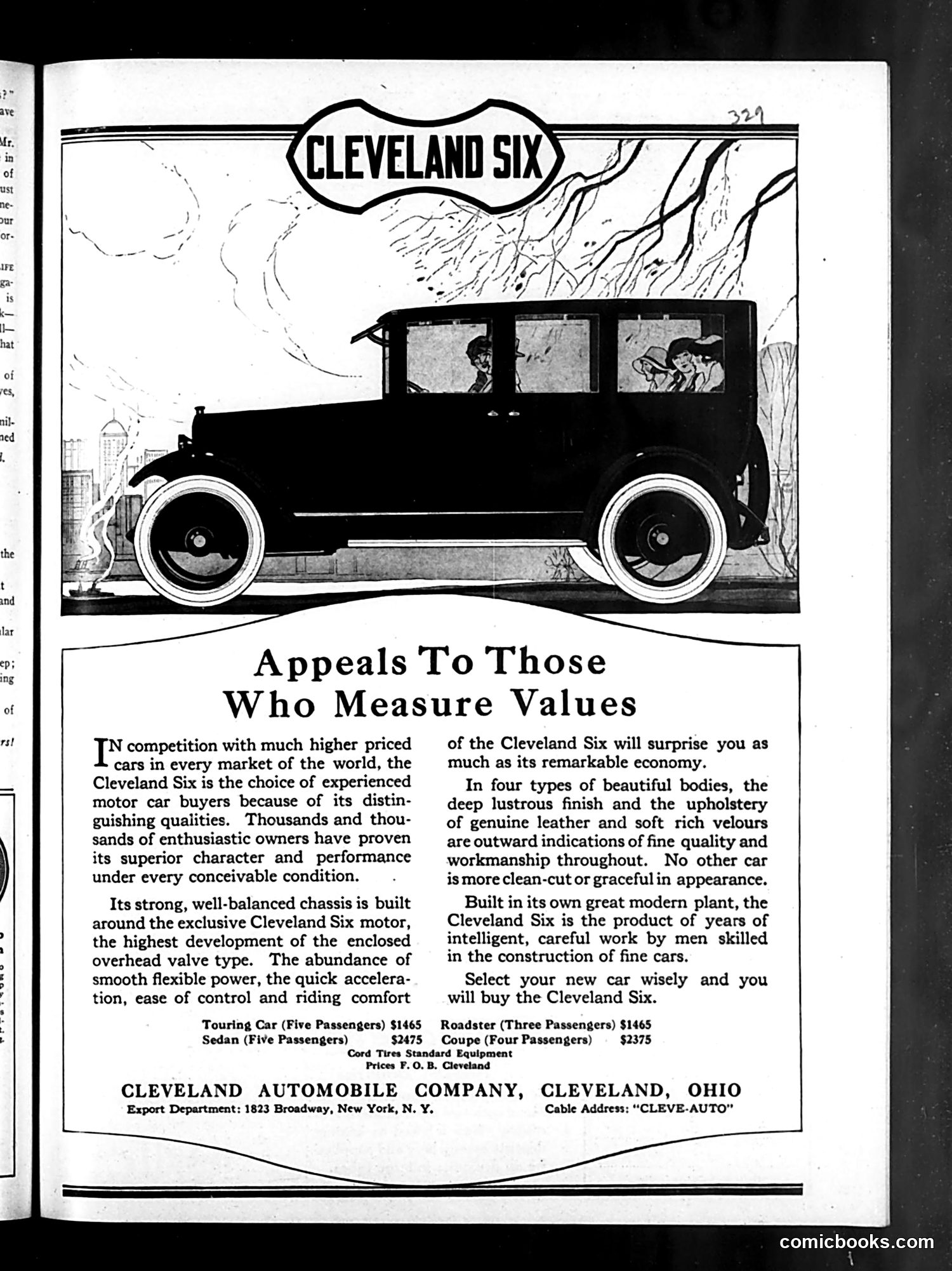
This is not a cartoon or satire—it's a **straightforward automobile advertisement** for the Cleveland Six motor car, circa 1920s. The page features a side-profile illustration of a closed sedan automobile with passengers visible through windows. The ad emphasizes the car's value proposition: it competes with more expensive vehicles while offering superior quality, economy, and craftsmanship. Key selling points highlighted include the exclusive overhead-valve motor, smooth power delivery, leather upholstery, and modern manufacturing. Prices range from $1,465 to $2,475 depending on body style (touring car, sedan, roadster, coupe). The tagline "Appeals To Those Who Measure Values" targets practical, quality-conscious buyers rather than luxury seekers. This was typical 1920s marketing rhetoric positioning mid-range American automobiles as smart investments. There is no political or satirical content—this is simply period advertising from the Cleveland Automobile Company in Cleveland, Ohio.
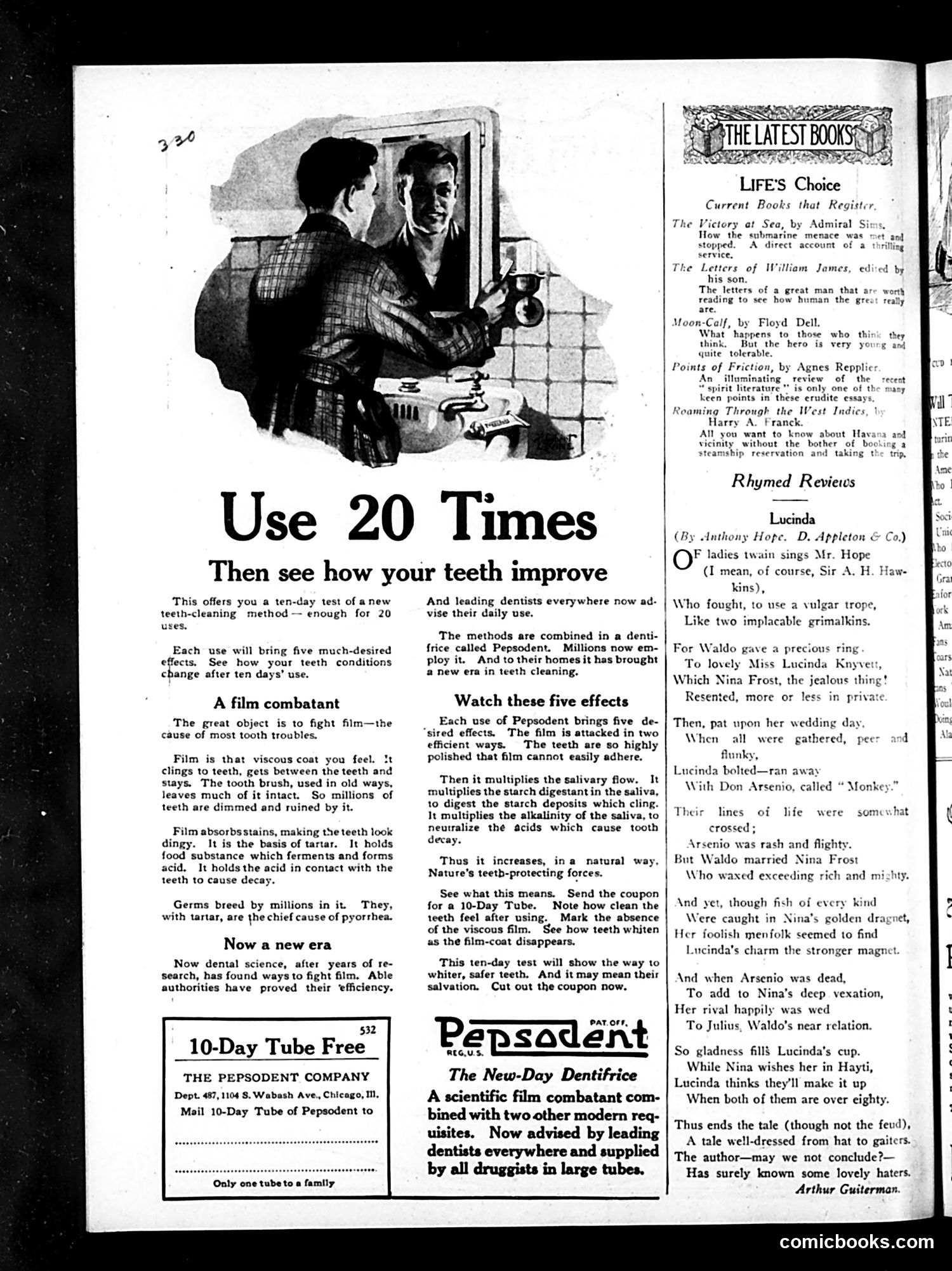
This page is primarily a **commercial advertisement** for Pepsodent toothpaste, not political satire. The illustration shows a man examining his teeth in a mirror—a straightforward product demonstration image. The ad promotes a "10-Day Tube Free" trial of Pepsodent, claiming it fights tooth "film" (plaque buildup) through five scientific effects: attacking film, polishing teeth, increasing saliva flow, boosting starch digestant, and neutralizing decay-causing acids. The copy emphasizes "modern" dental science and endorsement by "leading dentists everywhere." The right column contains book reviews and a poem about "Lucinda" (unrelated to the ad). This was typical Life magazine layout—mixing advertisements with editorial content. The advertisement reflects early 20th-century marketing that dressed consumer products in scientific language to build consumer confidence in newer commercial goods.
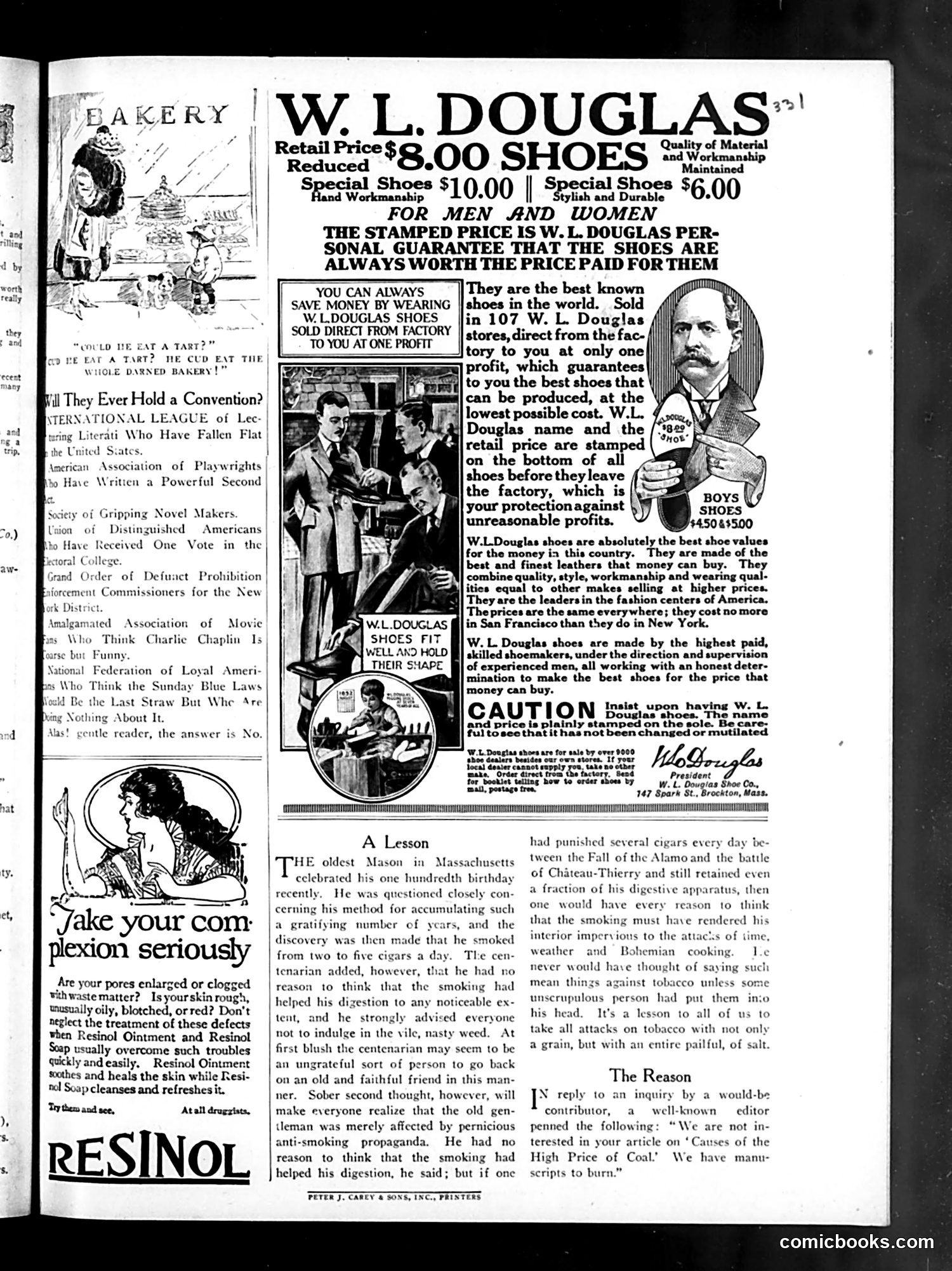
This page is primarily **advertising-heavy**, dominated by a large W. L. Douglas Shoes advertisement featuring the company founder's portrait and guarantees about shoe quality and fair pricing. The page includes two satirical cartoons: 1. **"Could He Eat a Tart?"** (top left) — A nursery-rhyme style joke playing on gluttony, seemingly unrelated to surrounding content. 2. **"Jake Your Complexion Seriously"** (lower left) — Advertises Resinol Ointment/Soap for skin problems, using period beauty standards to market skincare products. The text article **"A Lesson"** mocks anti-smoking propaganda by describing a 100-year-old Mason who smoked cigars daily but then hypocritically warned others against smoking. The satire suggests the centenarian's anti-smoking advice is merely influenced by "pernicious anti-smoking propaganda" rather than genuine concern—implying skepticism toward contemporary health warnings. The overall page reflects early 20th-century magazine conventions mixing entertainment, advertising, and light social commentary.
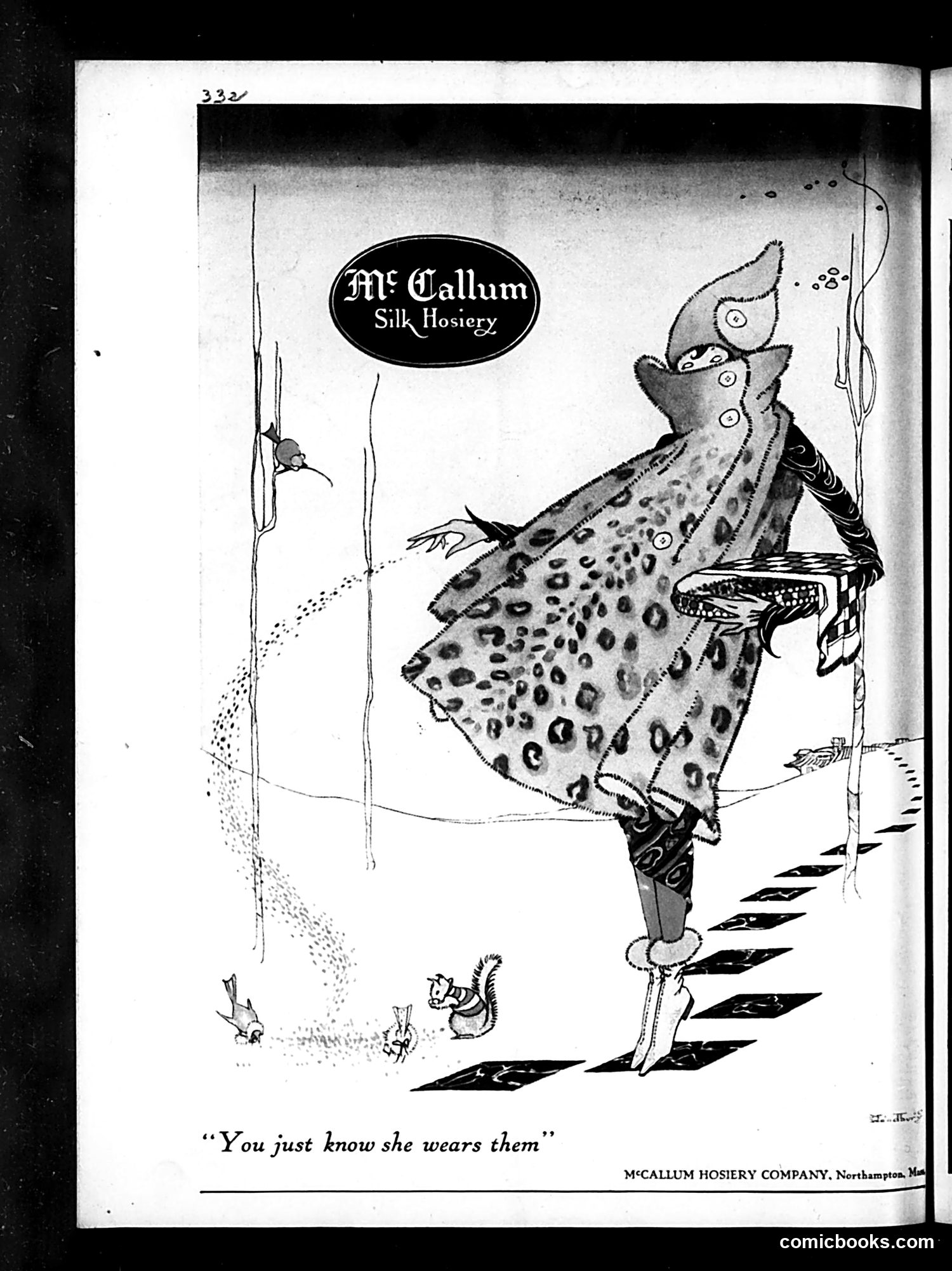
This is a vintage advertisement for McCallum silk hosiery, not political satire. The image depicts an elegantly dressed woman in 1920s-style clothing with a patterned coat, striking a fashionable pose. Small figures (appearing to be cherubs or cupids) and animals surround her whimsically. The tagline "You just know she wears them" uses social inference as a marketing strategy—suggesting that a woman's refined appearance and sophistication unmistakably signal she wears quality McCallum hosiery. The ad implies that silk stockings were a status symbol and marker of good taste among well-dressed women of the era. The playful, decorative illustration was typical of upscale product advertising in early-20th-century magazines.