
Life, 1921-03-03 · page 18 of 38
Life — March 3, 1921 — page 18: what you’re looking at
What you’re looking at
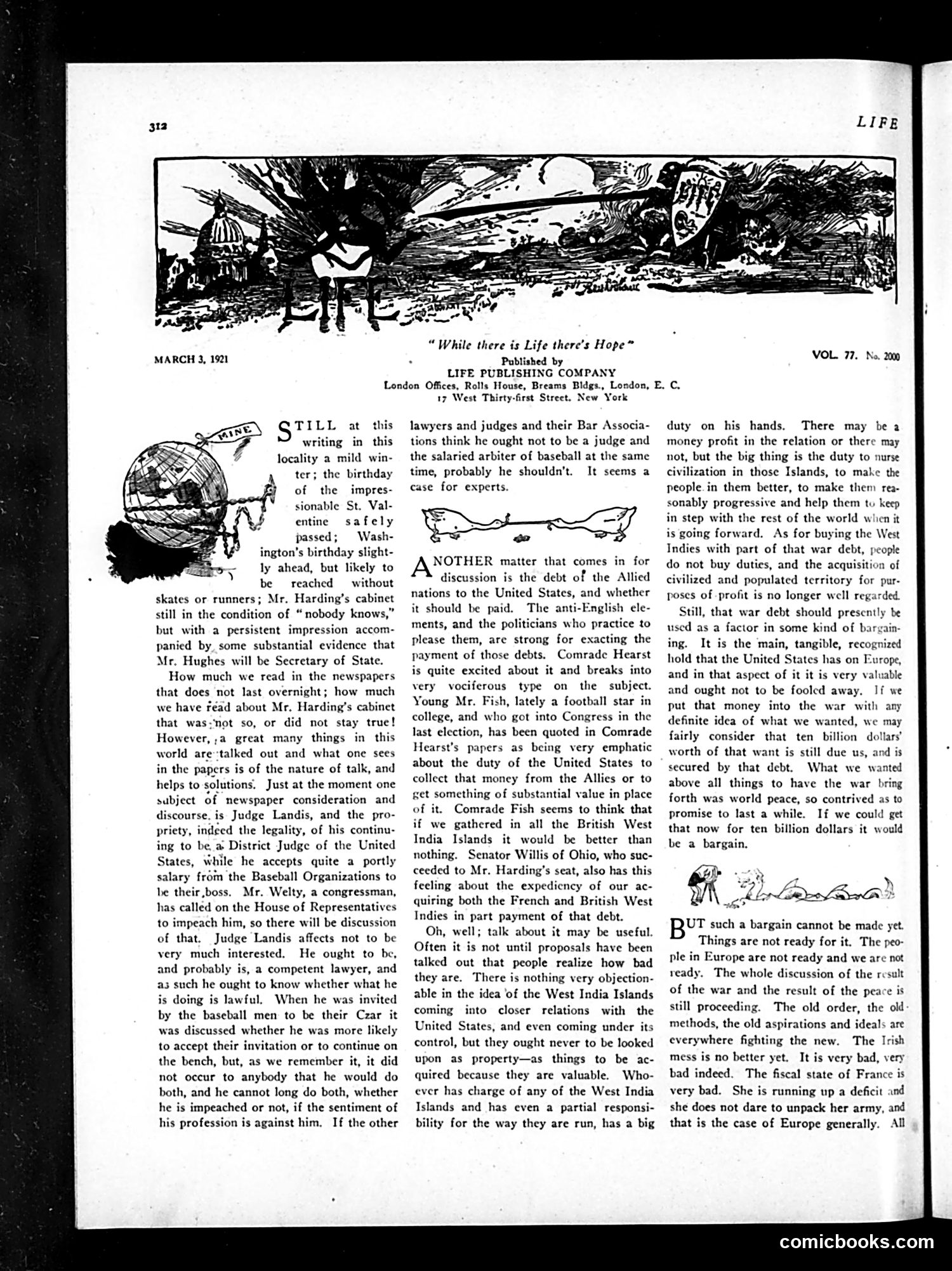
This editorial page discusses two major controversies of early 1921: **Judge Landis controversy**: The writer critiques Judge Kenesaw Mountain Landis for simultaneously serving as a federal judge while accepting a substantial salary as baseball's commissioner (its "Czar"). Congressman Welty has called for his impeachment. The piece argues this dual role is legally and ethically questionable—Landis cannot serve both positions, and the legal profession should pressure him to choose. **War debts and territorial acquisition**: The article mocks politicians (particularly William Randolph Hearst and Congressman Hamilton Fish Jr.) for demanding Allied nations repay WWI debts by ceding territory—specifically suggesting Britain and France surrender their West Indian colonies to the United States. The writer finds this crude, arguing these territories shouldn't be treated as mere "property" to be seized as payment, though closer U.S. relations with them aren't inherently objectionable. The tone is satirical critique of post-war opportunism and legal hypocrisy among American political figures.
📄 Transcribed text from this page (OCR, searchable)
Machine-transcribed from the original scan — historical spelling and the odd misread are preserved.
MARCH 3, 1921 London Offices, Rolls House, Breams Bld, TILL at writing in this locality a mild win- ter; the birthday of the impres- sionable St. Val- entine safely passed; © Wash- ington's birthday slight- ly ahead, but likely to be reached — without skates or runners; Mr. Harding’s cabinet still in the condition of “nobody knows,” but with a persistent impression accom- panied by, some substantial evidence that Mr. Hughes will be Secretary of State. How much we read in the newspapers that does not last overnight; how much we have réad about Mr. Harding’s cabinet that was-‘not so, or did not stay true! However, ;a great many things in this world are ‘talked out and what one sees in the papers is of the nature of talk, and helps to solutions. Just at the moment one subject of newspaper consideration and discourse, is Judge Landis, and the pro- priety, indeed the legality, of his continu- ing to be, a District Judge of the United States, while he accepts quite a portly salary from the Baseball Organizations to le their,boss. Mr. Welty, a congressman, has called on the House of Representatives to impeach him, so there will be discussion of that. Judge Landis affects not to be very much interested. He ought to be, and probably is, a competent lawyer, and as such he ought to know whether what he is doing is lawful, When he was invited by the baseball men to be their Czar it was discussed whether he was more likely to accept their invitation or to continue on the bench, but, as we remember it, it did not occur to anybody that he would do both, and he cannot long do both, whether he is impeached or not, if the sentiment of his profession is against him. If the other this “While there is Life there’s Hope” : Published by LIFE PUBLISHING COMPANY 17 West Thirty-first Street. New York lawyers and judges and their Bar Associa- tions think he ought not to be a judge and the salaried arbiter of baseball at the same time, probably he shouldn't. It seems a case for experts. ANOTHER matter that comes in for discussion is the debt of the Allied nations to the United States, and whether it should be paid. The anti-English ele- ments, and the politicians who practice to please them, are strong for exacting the payment of those debts. Comrade Hearst is quite excited about it and breaks into very vociferous type on the subject. Young Mr. Fish, lately a football star in college, and who got into Congress in the last election, has been quoted in Comrade Hearst’s papers as being very emphatic about the duty of the United States to collect that money from the Allies or to get something of substantial value in place of it. Comrade Fish seems to think that if we gathered in all the British West India Islands it would be better than nothing. Senator Willis of Ohio, who suc- ceeded to Mr. Harding's seat, also has this feeling about the expediency of our ac- quiring both the French and British West Indies in part payment of that debt. Oh, well; talk about it may be useful. Often it is not until proposals have been talked out that people realize how bad they are. There is nothing very objection- able in the idea ‘of the West India Islands coming into closer relations with the United States, and even coming under its control, but they ought never to be looked upon as property—as things to be ac- quired because they are valuable. Who- ever has charge of any of the West India Islands and has even a partial responsi- bility for the way they are run, has a big VOL. 77. No. 200 London, E. C. duty on his hands, There may be a money profit in the relation or there may not, but the big thing is the duty to nurse civilization in those Islands, to make the people. in them better, to make them rea- sonably progressive and help them tu keep in step with the rest of the world whien it is going forward. As for buying the West Indies with part of that war debt, people do not buy duties, and the acquisition of civilized and populated territory for pur- poses of profit is no longer well regarded. Still, that war debt should presently be used as a factor in some kind of ba ing. It is the main, tangible, recognized hold that the United States has on Europe, and in that aspect of it it is very valuable and ought not to be fooled away. If we put that money into the war with any definite idea of what we wanted, we may fairly consider that ten billion dollars’ worth of that want is still due us, is secured by that debt. What we wanted above all things to have the war bring forth was world peace, so contrived as to promise to last a while. If we could get that now for ten billion dollars it would be a bargain. Bu such a bargain cannot be made yet. Things are not ready for it. The peo- rope are not ready and we are not ready. The whole discussion of the result of the war and the result of the peace is still proceeding. The old order, the old methods, the old aspirations and ideals are everywhere fighting the new. The Irish mess is no better yet. It is very bad, very bad indeed. The fiscal state of France is very bad. She is running up a deficit and she does not dare to unpack her army, and that is the case of Europe generally. All comicbooks.com