
Life, 1921-03-03 · page 22 of 38
Life — March 3, 1921 — page 22: what you’re looking at
What you’re looking at
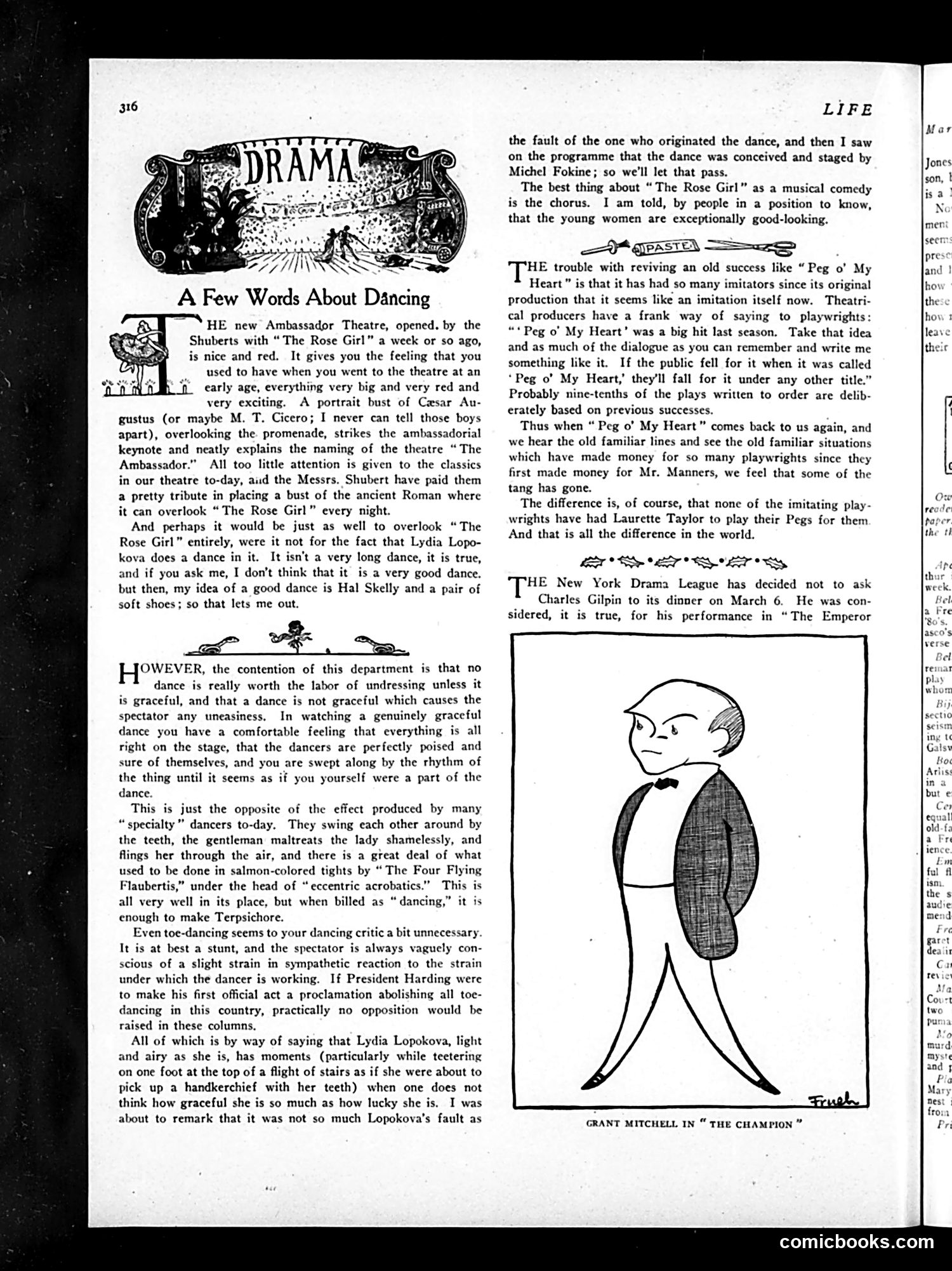
This drama column critiques contemporary theatrical dancing, particularly referencing **Lydia Lopokova**, a celebrated Russian prima ballerina of the 1920s who performed in "The Rose Girl" at the new Ambassador Theatre. The author argues that graceful dancing should feel effortless to audiences, while "specialty" dancers of the era perform acrobatic stunts—swinging partners by their teeth, throwing them through air—disguised as dance. The piece mocks extreme techniques like toe-dancing and toe-standing on staircases. The cartoon (credited to an artist, likely Frueh) depicts **Grant Mitchell** in "The Champion," showing a portly, ungainly figure in formal wear—visual satire of awkward physical performance. The column concludes by blaming choreographer **Michel Fokine** for Lopokova's occasionally clumsy moments, though acknowledging her inherent grace. It also satirizes theatrical producers who cynically imitate successful plays like "Peg o' My Heart," instructing playwrights to copy previous hits.
📄 Transcribed text from this page (OCR, searchable)
Machine-transcribed from the original scan — historical spelling and the odd misread are preserved.
HE new Ambassador Theatre, opened. by the Shuberts with “ The Rose Girl” a weck or so ago, is nice and red. It gives you the feeling that you used to have when you went to the theatre at an early age, everything very big and very red and very exciting. A portrait bust of Cesar Au- gustus (or maybe M. T. Cicero; I never can tell those boys apart), overlooking the. promenade, strikes the ambassadorial keynote and neatly explains the naming of the theatre “The Ambassador.” All too little attention is given to the classics in our theatre to-day, aud the Messrs. Shubert have paid them a pretty tribute in placing a bust of the ancient Roman where it can overlook “The Rose Girl” every night. And perhaps it would be just as well to overlook “The Rose Girl” entirely, were it not for the fact that Lydia Lopo- kova does a dance in it. It isn’t a very long dance, it is true, and if you ask me, I don’t think that it is a very good dance. but then, my idea of a good dance is Hal Skelly and a pair of soft shoes; so that lets me out. i a HOWEVER, the contention of this department is that no dance is really worth the labor of undressing unless it is graceful, and that a dance is not graceful which causes the spectator any uneasiness, In watching a genuinely graceful dance you have a comfortable feeling that everything is all right on the stage, that the dancers are perfectly poised and sure of themselves, and you are swept along by the rhythm of the thing until it seems as if you yourself were a part of the dance. This just the opposite of the effect produced by many “ specialty” dancers to-day, They swing each other around by the teeth, the gentleman maltreats the lady shamelessly, and flings her through the air, and there is a great deal of what used to be done in salmon-colored tights by “ The Four Flying Flaubertis,” under the head of “eccentric acrobatics.” This is all very well in its place, but when billed as “dancing,” it is enough to make Terpsichore. Even toe-dancing seems to your dancing critic a bit unnecessary. It is at best a stunt, and the spectator is always vaguely con- scious of a slight strain in sympathetic reaction to the strain under which the dancer is working. If President Harding were to make his first official act a proclamation abolishing all toe- dancing in this country, practically no opposition would be raised in these columns, All of which is by way of saying that Lydia Lopokova, light and airy as she is, has moments (particularly while teetering on one foot at the top of a flight of stairs as if she were about to pick up a handkerchief with her teeth) when one does not think how graceful she is so much as how lucky she is. I was about to remark that it was not so much Lopokova’s fault as LIFE the fault of the one who originated the dance, and then I saw on the programme that the dance was conceived and staged by Michel Fokine; so we'll let that pass. The best thing about “The Rose Girl” as a musical comedy is the chorus. I am told, by people in a position to know, that the young women are exceptionally good-looking. HE trouble with reviving an old success like “Peg o' My Heart” is that it has had so many imitators since its original production that it seems like an imitation itself now. Theatri- cal producers have a frank way of saying to playwrights: “* Peg o' My Heart’ was a big hit last season. Take that idea and as much of the dialogue as you can remember and write me something like it. If the public fell for it when it was called ‘Peg o’ My Heart,’ they'll fall for it under any other title.” Probably nine-tenths of the plays written to order are delib- erately based on previous successes. Thus when “ Peg o’ My Heart” comes back to us again, and we hear the old familiar lines and see the old familiar situations which have made money for so many playwrights since they first made money for Mr. Manners, we feel that some of the tang has gone. The difference is, of course, that none of the imitating play- wrights have had Laurette Taylor to play their Pegs for them And that is all the difference in the world. i ea a HE New York Drama League has decided not to ask Charles Gilpin to its dinner on March 6. He was con- sidered, it is true, for his performance in “The Emperor GRANT MITCHELL IN “ THE CHAMPION ” comicbooks.com