
Life, 1921-03-03 · page 23 of 38
Life — March 3, 1921 — page 23: what you’re looking at
What you’re looking at
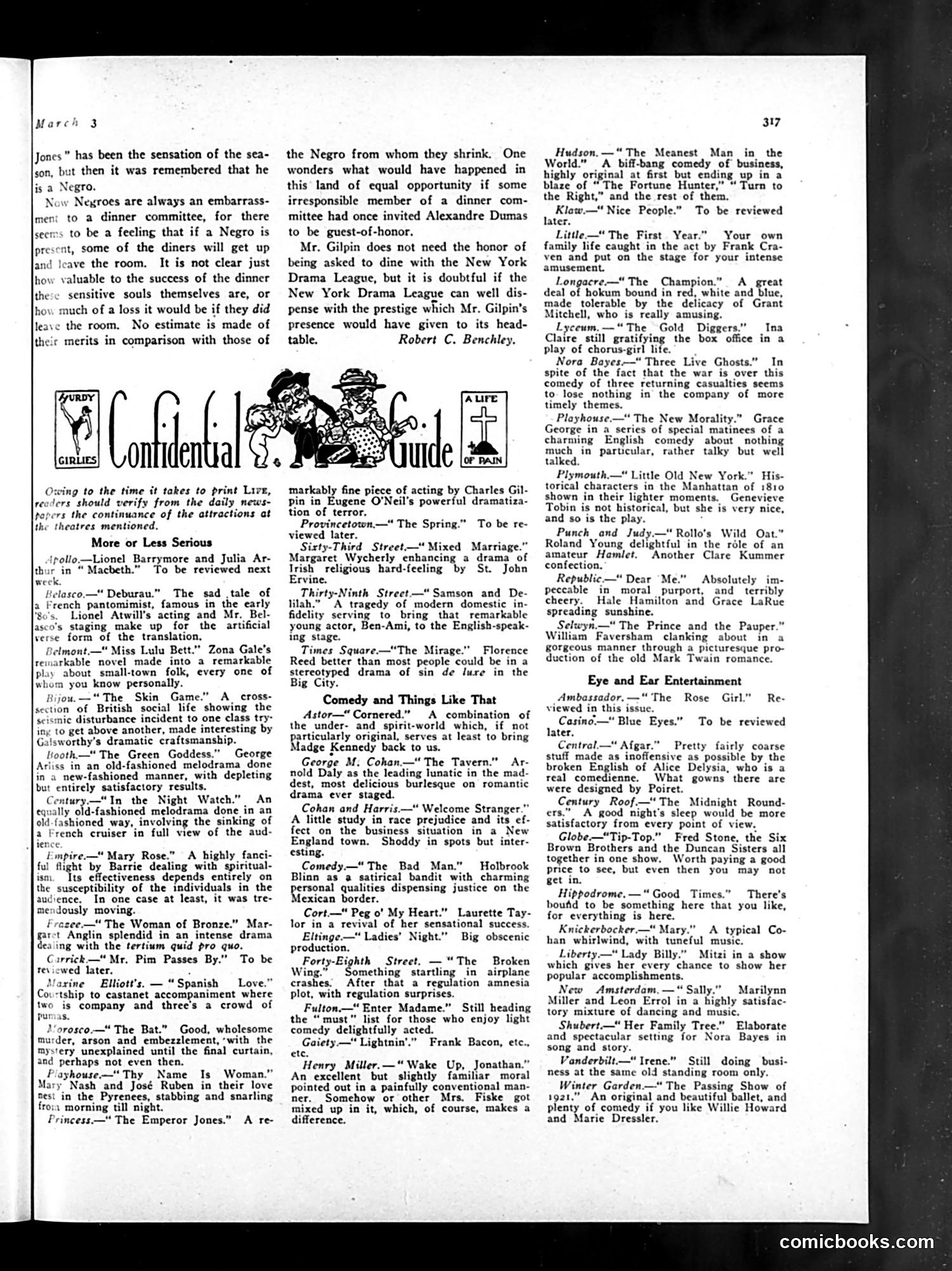
This page contains theater reviews and a significant satirical commentary by Robert C. Benchley criticizing racial discrimination in New York's cultural institutions. **The Main Satire:** Benchley critiques the hypocrisy of a dinner committee that excluded Charles Gilpin, a Black actor who had just achieved critical success in Eugene O'Neill's *The Emperor Jones* (listed among theater reviews). The satire exposes how "embarrassment" about Black guests would cause white diners to leave—yet the committee dismisses this as unimportant loss. **The Point:** Benchley acidly notes the absurdity: a man whose talent sensationally impressed audiences all season is excluded solely because he's Black. He invokes Alexandre Dumas (the famous French author of mixed race) to highlight the historical irony of denying prestigious association to accomplished Black figures in "this land of equal opportunity." **Context:** This reflects 1920s racial segregation in elite American spaces. Gilpin's acclaimed performance in *The Emperor Jones* made his exclusion particularly glaring—and Benchley's sardonic tone underscores the moral bankruptcy of such discrimination.
📄 Transcribed text from this page (OCR, searchable)
Machine-transcribed from the original scan — historical spelling and the odd misread are preserved.
March 3 Jones” has been the sensation of the sea- son, but then it was remembered that he is a Negro. Now Negroes are always an embarrass- to a dinner committee, for there seems to be a feeling that if a Negro is present, some of the diners will get up land leave the room. It is not clear just how valuable to the success of the dinner these sensitive souls themselves are, or how much of a loss it would be if they did leave the room. No estimate is made of their merits in comparison with those of men: Owing to the time it takes to print Live, recders should verify from the daily news- fopers the continuance of the attractions at the theatres mentioned. More or Less Serious ipollo.—Lionel Barrymore and Julia Ar- in “ Macbeth.” To be reviewed next " The sad tale of ist, famous in the early Lionel Atwill's’ acting and Mr. Bel- lasco’s staging make up for the artificial verse form of the translation, Belmont.—" Miss Lulu Bett.” Zona Gale’s remarkable novel made into a remarkable play about small-town folk, every one of whom you know personally. Bijou. —“ The Skin Game.” A cross- section of British social life showing the seismic disturbance incident to one class try- iny to get above another, made interesting by Galsworthy’s dramatic craftsmanship. Kooth.—" The Green Goddess.” George Arliss in an old-fashioned melodrama done in a new-fashioned manner, with depleting but entirely satisfactory results. Century—“In the Night Watch.” An equally old-fashioned melodrama done in an old-fashioned way, involving the sinking of a French cruiser in full view of the aud- J ience Empire-—" Mary Rose.” A highly fanci- ful flight by Barrie dealing with spiritual- ism. ‘its effectiveness depends entirely on the susceptibility of the individuals in the audience, In one case at least, it was tre- mendously moving. Frosee-— The Woman of Bronze.” Mar- garct Anglin splendid in an intense drama dealing with the tertium quid pro quo. Carrick —“ Mr. Pim Passes By.” To be revicwed later. * xine Elliott's. — “Spanish Love.” Courtship to castanet accompaniment where two is company and three's a crowd of Pumas. Morosco.— The Bat.” Good, wholesome murder, arson and embezzlement, ‘with the mystery unexplained until the final curtain, and perhaps not even then. Playhouse—"“ Thy Name Is Woman.” Mary Nash and José Ruben in their love the Pyrenees, stabbing and snarling fro:a morning till night. Princess—" The Emperor Jones.” "So's. A re the Negro from whom they shrink. One wonders what would have happened in this land of equal opportunity if some irresponsible member of a dinner com- mittee had once invited Alexandre Dumas to be guest-of-honor. Mr. Gilpin does not need the honor of being asked to dine with the New York Drama League, but it is doubtful if the New York Drama League can well dis- pense with the prestige which Mr. Gilpin’s presence would have given to its head- Robert C. Benchley, markably fine piece of acting by Charles Gil- pin in Eugene O’Neil’s powerful dramatiza- tion of terror. Provincetown.—" The Spring.” viewed later. Sixty-Third Street— Mixed Marriage.” Margaret Wycherly enhancing a drama of Irish religious hard-feeling by St. John Ervine. Thirty-Ninth Street —“ Samson and De- lilah.” "A tragedy of modern domestic in- fidelity serving to bring that remarkable young actor, Ben-Ami, to the English-speak- ing stage. Times Square-—"The Mirage.” Florence Reed better than most people could be in a stereotyped drama of sin de lure in the Big City. Comedy and Things Like That Astor—“ Cornered.” A combination of the under- and spirit-world which, if not particularly original, serves at least ‘to bring Madge Kennedy back to us. George M. Cohan—“ The Tavern.” Ar- nold Daly as the leading lunatic in the mad- dest, most delicious burlesque on romantic drama ever staged. Cohan and Harris.— Welcome Stranger.” A little study in race prejudice and its ef- fect on the business situation in a New England town. Shoddy in spots but inter- esting. Comedy—" The Bad Man.” Holbrook Blinn as a satirical bandit with charming ersonal qualities dispensing justice on the Mexican border. Cort.—" Peg o' My Heart.” Laurette Tay- lor in a revival of her sensational success. Eltinge.—“ Ladies’ Night.” Big obscenic production. Forty-Eighth Street. — “The Wing.” Something startling in crashes. After that a regulation plot, with regulation surprises. “Enter Madame.” To be re- Broken airplane amnesia Still heading the “must” list for those who enjoy light comedy delightfully acted. Gaiety —" Lightnin’.” Frank Bacon, etc., ete, Henry Miller. —“ Wake Up, Jonathan.” An excellent but slightly familiar moral pointed out in a painfully conventional man- ner. Somehow or other Mrs. Fiske got mixed up in it, which, of course, makes a difference. 317 Hudson.—“ The Meanest Man in the World.” A biff-bang comedy of business, highly original at first but ending up in a blaze of “ The Fortune Hunter,” “Turn to the Right,” and the rest of them. Klaw.—" Nice People.” To be reviewed later. Little —" The First Year.” Your own family life caught in the act by Frank Cra- ven and put on the stage for your intense amusement. Longacre.—“ The Champion.” A_ great deal of hokum bound in red, white and blue, made tolerable by the delicacy of Grant Mitchell, who is really amusing. Lyceum, —“ ¢ Gold Diggers.” Ina Claire still gratifying the box office in a play of chorus-girl lite. Nora Bayes-—" Three Live Ghosts.” In spite of the fact that the war is over this comedy of three returning casualties seems to lose nothing in the company of more timely themes. Playhouse.— The New Morality.” Grace George in a series of special matinees of a charming English comedy about nothing much in particular, rather talky but well talked. Plymouth.—" Little Old New York.” His- torical characters in the Manhattan of 1810 shown in their lighter moments. Genevieve Tobin is not historical, but she is very nice, and so is the play. Punch and Judy.—" Rollo’s Wild Oat.” Roland Young delightful in the réle of an amateur Hamlet. Another Clare Kummer confection. Republic—" Dear “Me.” Absolutely im- peceable in moral purport, and terribly cheery. Hale Hamilton and Grace LaRue spreading sunshine. Selwyn.—" The Prince and the Pauper.” William Faversham clanking about in a gorgeous manner through a picturesque pro- duction of the old Mark Twain romance. Eye and Ear Entertainment Ambassador. —“ The Girl.” Re- viewed in this issue. Casino.—" Blue Eyes.” later, Central—" Afgar.” Pretty fairly coarse stuff made as inoffensive as possible by the broken English of Alice Delysia, who is a real comedienne. What gowns there are were designed by Poiret. Century Roof.— The Midnight Round- ers.” A good night's sleep would be more satisfactory from every point of view, Globe—“Tip-Top.” Fred Stone, the Six Brown Brothers and the Duncan Sisters all together in one show. Worth paying a good Price to see, but even then you may not get in, Hippodrome.—"“ Good Times.” There's boufid to be something here that you like, for everything is here. Knickerbocker—" Mary.” A typical Co- han whirlwind, with tuneful music. Liberty. Lady Billy.” Mitzi in a show which gives her every chance to show her popular accomplishments. New Amsterdam.—“ Sally.” Marilynn Miller and Leon Errol in a highly satisfac- tory mixture of dancing and music. Shubert—" Her Family Tree.” Elaborate and spectacular setting for Nora Bayes in song and story. Vanderbilt" Irene.” Still doing _ busi- ness at the same old standing room only. Winter Garden—* The Passing Show of 1921.” An original and beautiful ballet, and plenty of comedy if you like Willie Howard and Marie Dressler. Rose To be reviewed comicbooks.com