
Life, 1921-03-03 · page 26 of 38
Life — March 3, 1921 — page 26: what you’re looking at
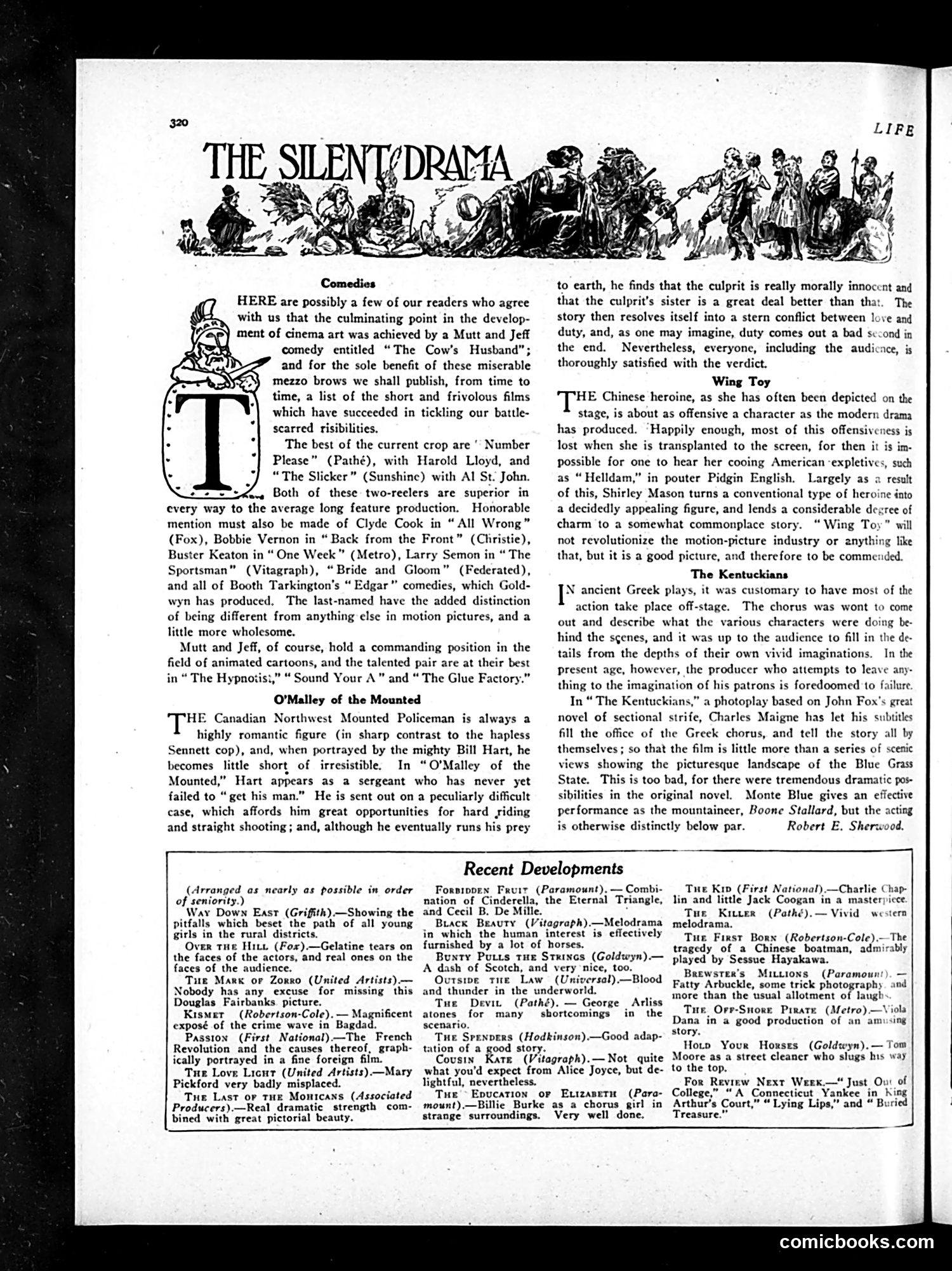
What you’re looking at
This page reviews early silent films, satirizing both cinema snobs and the medium itself. The opening joke mocks pretentious film critics who claim a "Mutt and Jeff" cartoon represents cinema's artistic peak—a deliberately absurd assertion meant to ridicule serious film analysis. The reviews then earnestly discuss actual films: Harold Lloyd and Buster Keaton comedies (genuinely respected), Bill Hart westerns, and Shirley Mason vehicles. The satire is gentle—Life acknowledges these are genuinely good entertainments while poking fun at overwrought dramatic plots (like Hart's "O'Malley of the Mounted," where duty loses to romance). A secondary joke targets "Wing Toy," which exploits a tired "exotic Chinese heroine" stereotype common in stage drama. The final review of "The Kentuckians" criticizes modern filmmakers who over-explain through subtitles rather than trusting audience imagination—echoing classical Greek theater's use of the chorus. The satire targets both filmmakers' artistic pretensions and audiences' limited imagination.
📄 Transcribed text from this page (OCR, searchable)
Machine-transcribed from the original scan — historical spelling and the odd misread are preserved.
HERE are possibly a few of our readers who agree with us that the culminating point in the develop- ment of cinema art was achieved by a Mutt and Jeff comedy entitled “The Cow’s Husband”; and for the sole benefit of these miserable mezzo brows we shall publish, from time to time, a list of the short and frivolous films which have succeeded in tickling our battle- scarred risibilities. The best of the current crop are ' Number Please” (Pathé), with Harold Lloyd, and “The Slicker” (Sunshine) with Al St. John. Qe Both of these two-reelers are superior in every way to the average long feature production. Honorable mention must also be made of Clyde Cook in “All Wrong” (Fox), Bobbie Vernon in “ Back from the Front” (Christie), Buster Keaton in “One Week” (Metro), Larry Semon in “ The Sportsman” (Vitagraph), “Bride and Gloom” (Federated), and all of Booth Tarkington's “ Edgar" comedies, which Gold- wyn has produced. The last-named have the added distinction of being different from anything else in motion pictures, and a little more wholesome. Mutt and Jeff, of course, hold a commanding position in the field of animated cartoons, and the talented pair are at their best in “ The Hypno “Sound Your A” and “ The Glue Factory.” O'Malley of the Mounted HE Canadian Northwest Mounted Policeman is always a highly romantic figure (in sharp contrast to the hapless Sennett cop), and, when portrayed by the mighty Bill Hart, he becomes little short, of irresistible. In “O'Malley of the Mounted,” Hart appears as a sergeant who has never yet failed to “get his man.” He is sent out on a peculiarly difficult case, which affords him great opportunities for hard siding and straight shooting; and, although he eventually runs his prey to earth, he finds that the culprit is really morally innocent and that the culprit’s sister is a great deal better than that. The story then resolves itself into a stern conflict between love and duty, and, as one may imagine, duty comes out a bad second in the end. Nevertheless, everyone, including the audience, is thoroughly satisfied with the verdict. Wing Toy THE Chinese heroine, as she has often been depicted on the stage, is about as offensive a character as the modern drama has produced. ‘Happily enough, most of this offensiveness is lost when she is transplanted to the screen, for then it is im- possible for one to hear her cooing American ‘expletives, such as “Helldam,” in pouter Pidgin English. Largely as a result of this, Shirley Mason turns a conventional type of heroine into a decidedly appealing figure, and lends a considerable di charm to a somewhat commonplace story. “ Wing To. not revolutionize the motion-picture industry or anythi that, but it is a good picture, and therefore to be commended. The Kentuckians N ancient Greek plays, it was customary to have most of the action take place off-stage. The chorus was wont to come out and describe what the various characters were doing be- hind the scenes, and it was up to the audience to fill in the de- tails from the depths of their own vivid imaginations. In the Present age, however, the producer who attempts to leave any- thing to the imagination of his patrons is foredoomed to failure. In “ The Kentuckians,” a photoplay based on John Fox's great novel of sectional strife, Charles Maigne has let his subtitles fill the office of the Greek chorus, and tell the story all by themselves ; so that the film is little more than a series of scenic views showing the picturesque landscape of the Blue Grass State. This is too bad, for there were tremendous dramatic pos- sibilities in the original novel. Monte Blue gives an effective performance as the mountaineer, Boone Stallard, but the acting is otherwise distinctly below par. Robert E. Sherwood. a] (Arranged as nearly as possible in order of senionty.) Way Down East (Grifith).—Showing the pitfalls which beset the path of all young girls in the rural districts, Over tHe Hitt (Fox).—Gelatine tears on the faces of the actors, and real ones on the faces of the audience. Tue Marx or Zorro (United Artists). Nobody has any excuse for missing this Douglas Fairbanks. picture. Kismet (Robertson-Cole). — Magnificent exposé of the crime wave in Bagdad. Passion (First National).—The French Revolution and the causes thereof, graph- ically portrayed in a fine foreign film. Tue Love Licut (United Artists)—Mary Pickford very badly misplaced. Tue Last op tHE Montcans (Associated Producers).—Real dramatic strength com- bined with great pictorial beauty. Recent Developments Forsippen Fruit (Paramount), — Combi- nation of Cinderella, the Eternal Triangle, and Cecil B. De Mille. Brack Beauty (Vitegraph).—Melodrama in which the human interest is effectively furnished by a lot of horses. Bunty Putts tHe Steincs (Goldwyn).— A dash of Scotch, and very nice, too. Ovtswe tre Law (Universal).—Blood and thunder in the underworld. Tue Devit (Pathé). — George | Arliss atones for many shortcomings in the scenario. Tue Srenvers (Hodkinson).—Good adap- tation of a good story. Ps Cousin Kate (Vitagraph).—Not quite what you'd expect from Alice Joyce, but de- lightful, nevertheless. Tue ~Epucation or Extzaneta (Para- mount),—Billie Burke as a chorus girl in strange surroundings. Very well done. Tue Kip (First National), —Charlie Chap- lin and little Jack Coogan in a masteryicce. Tue Kitter (Pathé).— Vivid western melodrama. Tur First Borx (Robertson-Cole),—The tragedy of a Chinese boatman, admirably played by Sessue Hayakawa. Brewster's Mittions (Paramoun!). — Fatty Arbuckle, some trick photography. and more than the usual allotment of laugh Tur. Orr-Snore Pirate (Metro). —Viola Dana in a good production of an amusing story. Hot Your Hoxses (Goldwyn).— Tom Moore as a street cleaner who slugs his way to the top. For Review Next Weex.— Just Ovi of College,” “ A Connecticut Yankee in hing Arthur’s Court,” “ Lying Lips,” and “ Buried Treasure.” =) ee comicbooks.com