
Life, 1921-03-03 · page 19 of 38
Life — March 3, 1921 — page 19: what you’re looking at
What you’re looking at
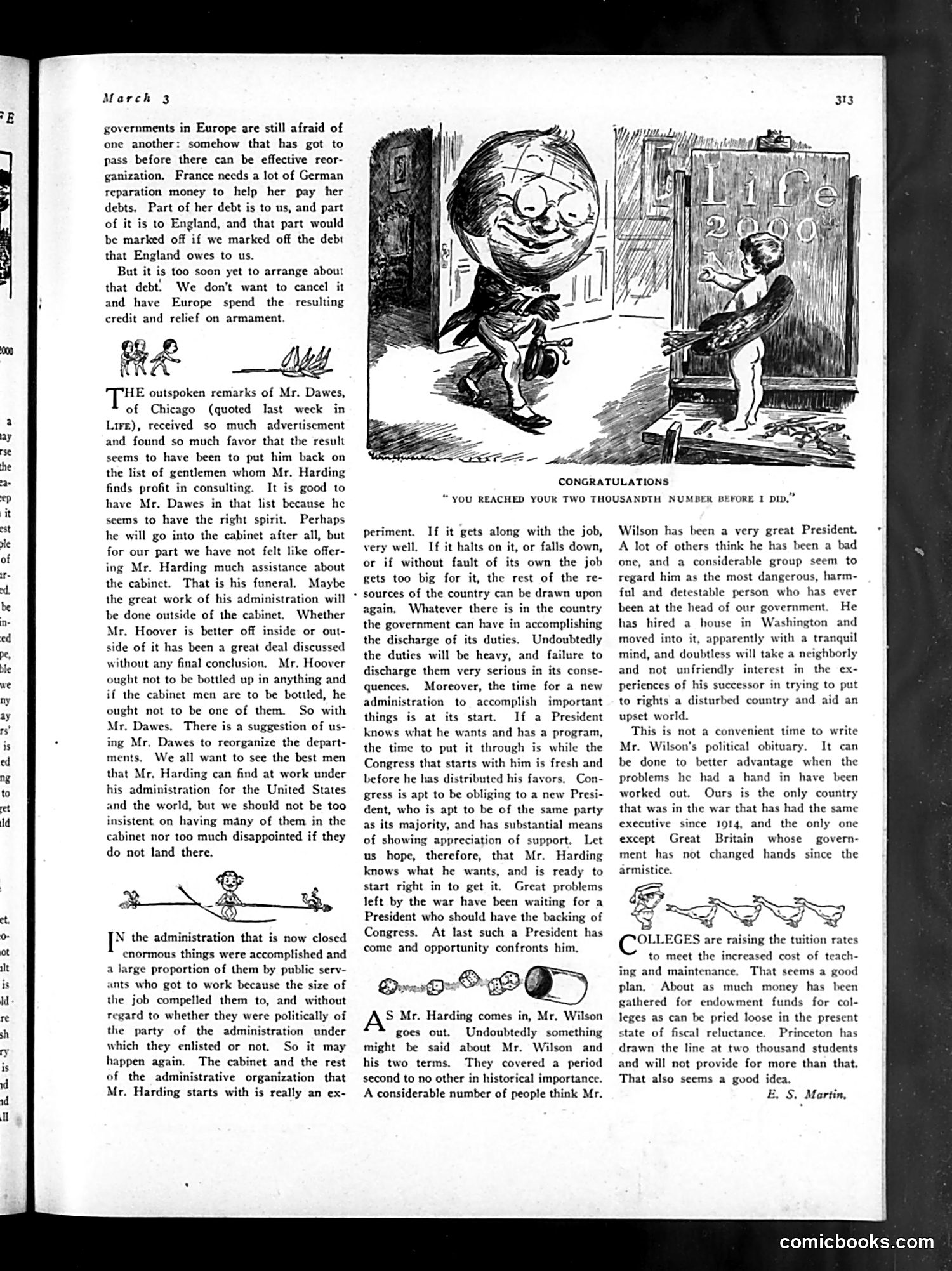
The main cartoon depicts a caricatured figure (likely representing post-WWI Europe or a specific nation) with an exaggerated grinning face reaching toward a large door marked "2000," congratulating themselves for reaching "two thousandth number before I did." This appears to celebrate Life magazine's 2000th issue milestone, with the joke being a playful competition between the publication and some contemporary figure or entity. The text discusses President Warren G. Harding's new administration and the cabinet selections, particularly praising Charles Dawes (a Chicago businessman and future Vice President) for his practical approach to government reorganization. The article contrasts this with the departing Wilson administration, noting that capable people work effectively regardless of political party affiliation when the job demands it. The surrounding discussion addresses post-WWI European debt and reparations—contextualizing American financial entanglements with France, Germany, and England after World War I.
📄 Transcribed text from this page (OCR, searchable)
Machine-transcribed from the original scan — historical spelling and the odd misread are preserved.
March 3 governments in Europe are still afraid of one another: somehow that has got to pass before there can be effective reor- ganization. France necds a lot of German reparation money to help her pay her debts. Part of her debt is to us, and part of it is to England, and that part would be marked off if we marked off the debt that England owes to us. But it is too soon yet to arrange about that debt! We don't want to cancel it and have Europe spend the resulting credit and relief on armament. Re _ dw THE outspoken remarks of Mr. Dawes, of Chicago (quoted last weck in Lire), received so much advertisement and found so much favor that the result seems to have been to put him back on the list of gentlemen whom Mr. Harding finds profit in consulting. It is good to have Mr. Dawes in that list because he seems to have the right spirit. Perhaps he will go into the cabinet after all, but for our part we have not felt like offer- ing Mr. Harding much assistance about the cabinct. That is his funeral. Maybe the great work of his administration will be done outside of the cabinet. Whether Mr. Hoover is better off inside or out- side of it has been a great deal discussed without any final conclusion. Mr. Hoover ought not to be bottled up in anything and if the cabinet men are to be bottled, he ought not to be one of them. So with Mr. Dawes. There is a suggestion of us- ing Mr. Dawes to reorganize the depart- ments. We all want to see the best men that Mr. Harding can find at work under his administration for the United States and the world, but we should not be too insistent on having many of them in the cabinet nor too much disappointed if they do not land there, N the administration that is now closed enormous things were accomplished and a large proportion of them by public serv- ants who got to work because the size of the job compelled them to, and without regard to whether they were politically of the party of the administration under which they enlisted or not. So it may happen again. The cabinet and the rest of the administrative organization that Mr. Harding starts with is really an ex- CONGRATULATIONS “ you REACHED YOUK TWO THOUSANDTH NUMBER BEFORE I DID,” periment. If it gets along with the job, very well. If it halts on it, or falls down, or if without fault of its own the job gets too big for it, the rest of the re- sources of the country can be drawn upon again, Whatever there is in the country the government can have in accomplishing the discharge of its duties. Undoubtedly the duties will be heavy, and failure to discharge them very serious in its conse- quences. Moreover, the time for a new administration to accomplish important things is at its start. If a President knows what he wants and has a program, the time to put it through is while the Congress that starts with him is fresh and before he has distributed his favors. Con- gress is apt to be obliging to a new Presi- dent, who is apt to be of the same party as its majority, and has substantial means of showing appreciation of support. Let us hope, therefore, that Mr. Harding knows what he wants, and is ready to start right in to get it. Great problems left by the war have been waiting for a President who should have the backing of Congress, At last such a President has come and opportunity confronts him, AS Mr. Harding comes in, Mr. Wilson goes out. Undoubtedly something might be said about Mr. Wilson and his two terms. They covered a period second to no other in historical importance. A considerable number of people think Mr. Wilson has been a very great President. A lot of others think he has been a bad one, and a considerable group seem to regard him as the most dangerous, harm- ful and detestable person who has ever been at the head of our government. He has hired a house in Washington and moved into it, apparently with a tranquil mind, and doubtless will take a neighborly and not unfriendly interest in the ex- periences of his successor in trying to put to rights a disturbed country and aid an upset world. This is not a convenient time to write Mr. Wilson's political obituary. It can be done to better advantage when the problems he had a hand in have been worked out. Ours is the only country that was in the war that has had the same executive since 1914, and the only one except Great Britain whose govern- ment has not changed hands since the armistice. OLLEGES are raising the tuition rates to meet the increased cost of teach- ing and maintenance. That seems a good plan, About as much money has been gathered for endowment funds for col- leges as can be pried loose in the present state of fiscal reluctance. Princeton has drawn the line at two thousand students and will not provide for more than that. That also seems a good idea. E. S. Martin, comicbooks.com