
Life, 1921-03-03 · page 25 of 38
Life — March 3, 1921 — page 25: what you’re looking at
What you’re looking at
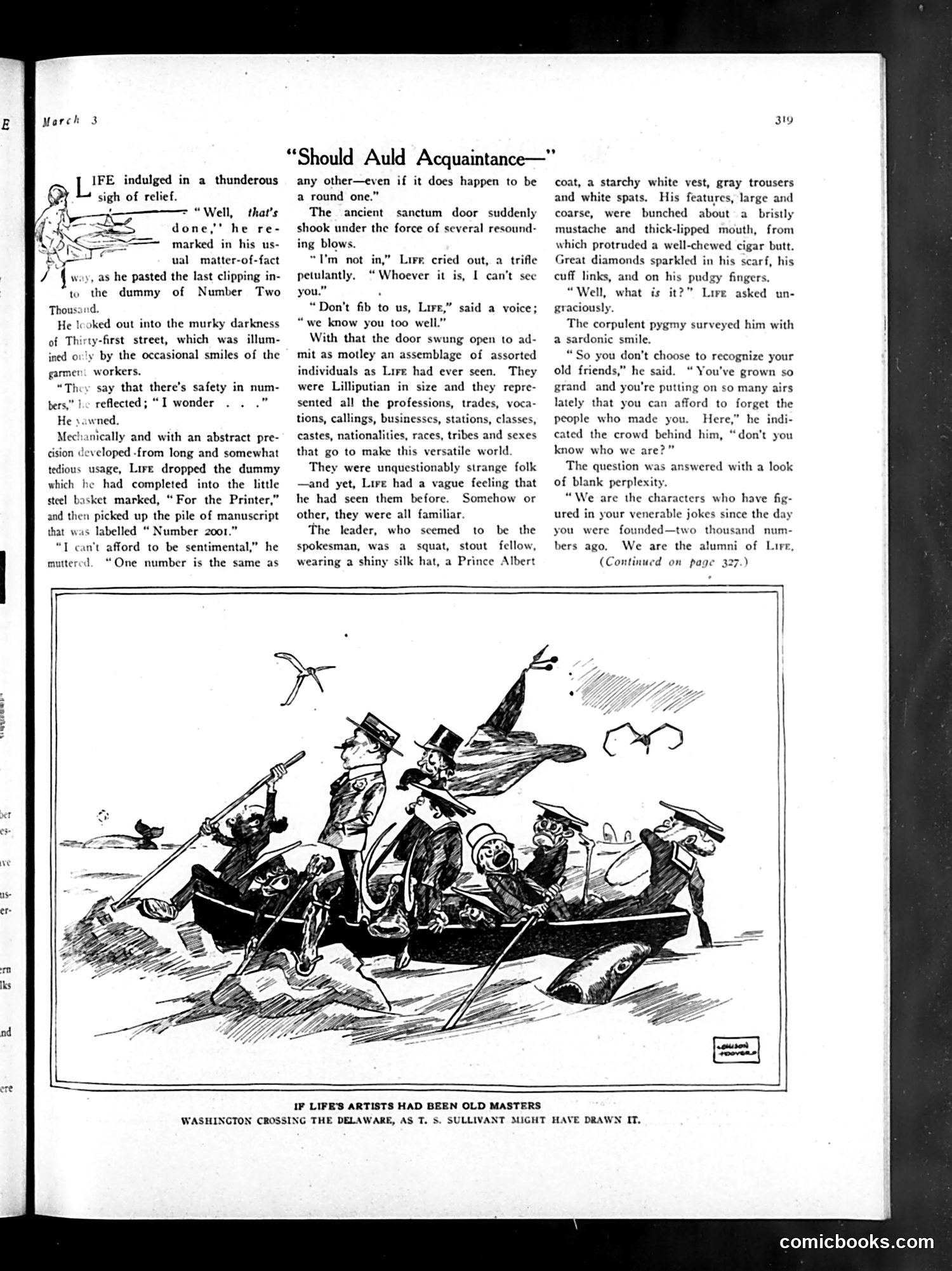
This page contains two satirical elements: **Main Story ("Should Auld Acquaintance—"):** A fictional narrative where the editor of *Life* magazine is visited by personified characters—"two thousand" of them—who claim to be the comedic figures that have appeared in the magazine since its founding. They're portrayed as a diverse crowd representing "all the professions, trades, vocations, callings, businesses, stations, classes, castes, nationalities, races, tribes and sexes." The joke appears to be about *Life's* recurring stock characters confronting the editor, suggesting these archetypal figures have become the magazine's identity. **Cartoon Below:** Titled "If Life's Artists Had Been Old Masters," it reimagines Emanuel Leutze's famous historical painting *Washington Crossing the Delaware* in a chaotic, absurdist style—likely mimicking how cartoonist T. S. Sullivant might redraw it. This is a meta-joke: satirizing how different artistic styles would interpret the same iconic American scene. Both elements celebrate *Life's* satirical tradition and its roster of recurring characters and artists.
📄 Transcribed text from this page (OCR, searchable)
Machine-transcribed from the original scan — historical spelling and the odd misread are preserved.
ee Li indulged in a thunderous sigh of relief. = “Well, that’s done,’ he re- od ual matter-of-fact { way, as he pasted the last clipping in- to the dummy of Number Two He xed out into the murky darkness of Thirty-first street, which was illum- ined ovly by the occasional smiles of the garmen: workers. “They say that there’s safety in num- bers,” Le reflected; “I wonder . . .” He yawned, Mechanically and with an abstract pre- cision developed -from long and somewhat tedious usage, Lire dropped the dummy which he had completed into the little steel basket marked, “For the Printer,” and then picked up the pile of manuscript that was labelled “ Number 2001.” “I can't afford to be sentimental,” he muttered. “One number is the same as any other—even if it does happen to be a round one.” The ancient sanctum door suddenly shook under the force of several resound- ing blows. “I'm not in,” Lire cried out, a trifle petulantly, “Whoever it is, I can't see you.” 5 “Don't fib to us, Lire,” said a voice; “we know you too well. With that the door swung open to ad- mit as motley an assemblage of assorted individuals as Lire had ever seen. They were Lilliputian in size and they repre- sented all the professions, trades, voca- tions, callings, businesses, stations, classes, castes, nationalities, races, tribes and sexes that go to make this versatile world They were unquestionably strange folk —and yet, Lire had a vague feeling that he had seen them before. Somehow or other, they were all familiar. The leader, who scemed to be the spokesman, was a squat, stout fellow, wearing a shiny silk hat, a Prince Albert “Should Auld Acquaintance—” coat, a starchy white vest, gray trousers and white spats. His features, large and coarse, were bunched about a_ bristly mustache and thick-lipped mouth, from which protruded a well-chewed cigar butt. Great diamonds sparkled in his scarf, his cuff links, and on his pudgy fingers. “Well, what is it?” Lire asked un- graciously. The corpulent pygmy surveyed him with a sardonic smile. “So you don't choose to recognize your old friends,” he said. “You've grown so grand and you're putting on so many airs lately that you can afford to forget the people who made you. Here,” he indi- cated the crowd behind him, “don't you know who we are?” The question was answered with a look of blank perplexity. “We are the characters who have fig- ured in your venerable jokes since the day you were founded—two thousand num- bers ago, We are the alumni of Lire, (Continued on page 327.) —— IF LIFE'’S ARTISTS HAD BEEN OLD MASTERS WASHINGTON CROSSING THE DELAWARE, AS T. S. SULLIVANT MIGHT HAVE DRAWN IT. comicbooks.com