
Life, 1921-03-03 · page 12 of 38
Life — March 3, 1921 — page 12: what you’re looking at
What you’re looking at
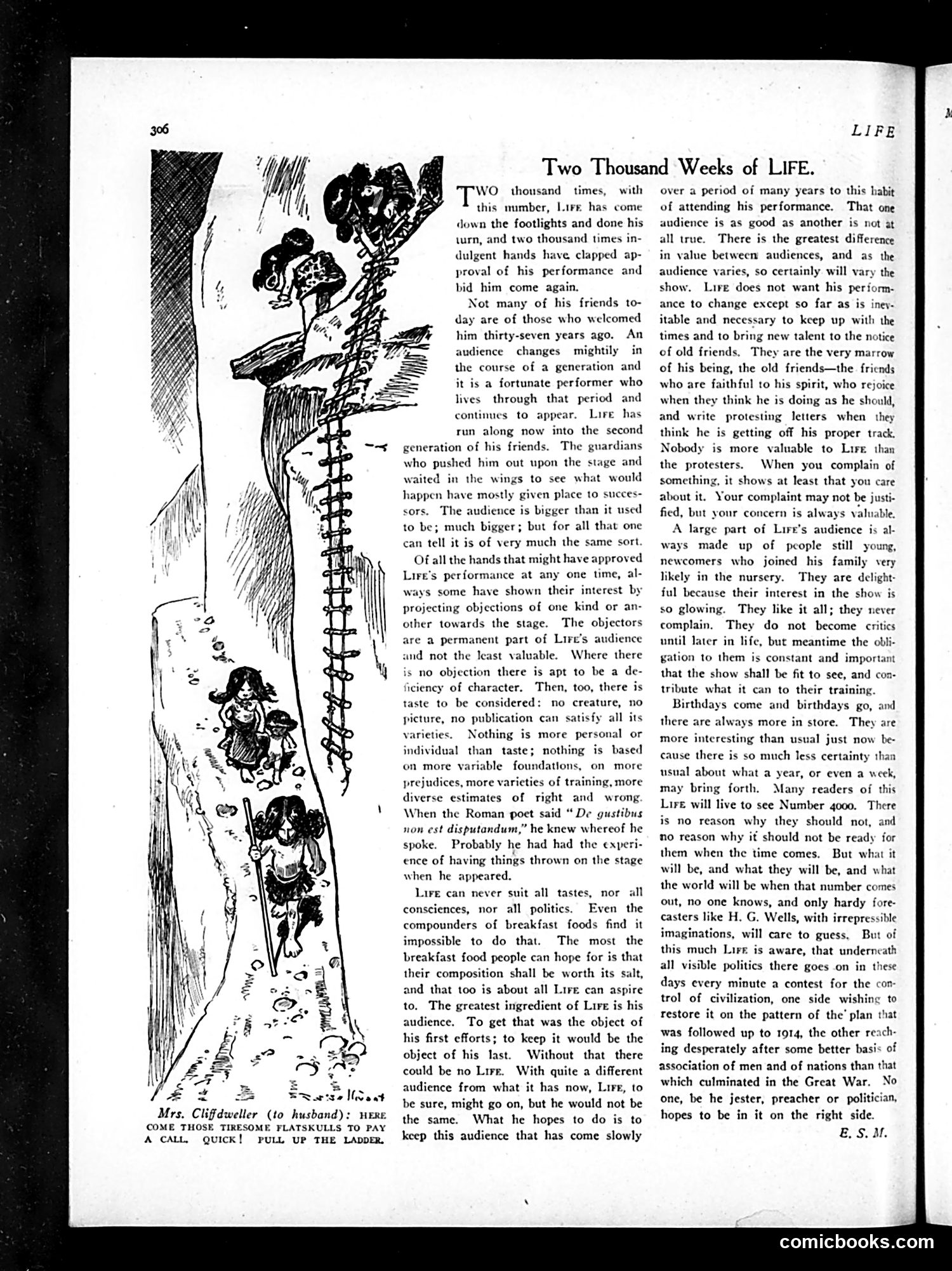
This page celebrates Life magazine's longevity with a tall vertical cartoon showing performers climbing a ladder alongside theatrical figures descending. The illustration depicts Life's two-thousand-week milestone of publication. The accompanying article discusses Life's enduring audience and the magazine's relationship with its performers and readers. It notes that while some early supporters have left, new younger audiences join constantly. The piece emphasizes that Life values loyal "old friends" who sustain the publication, though it welcomes newcomers. The article references a Roman poet's quote about variability in public taste, suggesting that Life accepts it cannot please everyone equally. It concludes by hoping Life maintains its current audience while continuing its satirical mission post-1914, avoiding alignment with any particular political side.
📄 Transcribed text from this page (OCR, searchable)
Machine-transcribed from the original scan — historical spelling and the odd misread are preserved.
Ease Sant Mrs. Cliffdweller (to husband): HERE COME THOSE TIRESOME FLATSKULLS TO PAY A CALL, QUICK! PULL UP THE LADDER. LIFE Two Thousand Weeks of LIFE. ‘WO thousand this number, Lire has come down the footlights and done his turn, and two thousand times in- dulgent hands have clapped ap- proval of his performance and bid him come again, Not many of his friends to- day are of those who welcomed him thirty-seven years ago. An dience changes mightily in the course of a generation and it is a fortunate performer who lives through that period and Lire has times, with continues to appear. run along now into the second generation of his friends. The guardians who pushed him out upon the stage and waited in the wings to see what would happen have mostly given place to succes- bigger than it used sors. The audience to be; much bigger; but for all that one can tell it is of very much the same sort Of all the hands that might have approved Lire’s performance at any one time, al- ways some have shown their interest by projecting objections of one kind or an- other towards the stage. The objectors are a permanent part of Lire’s audience und not the least valuable. Where there is no objection there is apt to be a d ficiency of character. Then, too, there is taste to be considered: no creature, no picture, no publication can satisfy all its varieties. individual than taste; nothing is based on more variable foundations, on more Nothing is more personal or prejudices, more varieties of training, more diverse estimates of right and wrong. When the Roman poet said “ De gustibus non est disputandum,” he knew whereof he spoke. Probably he had had the expe ence of having things thrown on the stage when he appeared. Lire can never suit all tastes, nor all consciences, nor all politics. Even the compounders of breakfast foods find it impossible to do that. The most the breakfast food people can hope for is that their composition shall be worth its salt, and that too is about all Lire can aspire to. The greatest ingredient of Lire is his audience. To get that was the object of his first efforts; to keep it would be the object of his last. Without that there could be no Lire. With quite a different audience from what it has now, Lire, to be sure, might go on, but he would not be the same. What he hopes to do is to keep this audience that has come slowly over a period of many years to this habit of attending his performance. That one audience is as good as another is not at all true. There is the greatest difference in value between audiences, and as the audience varies, so certainly will vary the Lire does not want his perform- ance to change except so far as is iney- itable and necessary to kcep up with the times and to b: of old friends. They are the very marrow of his being, the old friends—the friends who are faithful to his spirit, who rejoice when they think he is doing as he should, and write protesting letters when they think he is getting off his proper track. Nobody is more valuable to Lire than the protesters. When you complain of it shows at least that you care about it. Your complaint may not be justi- fied, but your concern is always valuable, A large part of Lire’s audience is al- ways made up of people still young, newcomers who joined his family very likely in the nursery. They are delight- ful because their interest in the show is so glowing. They like it all; they never complain. show. ng new talent to the notice somethin, They do not become critics until later in life, but meantime the obli- gation to them is constant and important that the show shall be fit to see, and con- tribute what it can to their training. Birthdays come and birthdays go, and there are always more in store. They are more interesting than usual just now be- cause there is so much less certainty than usual about what a year, or even a week, may bring forth. Many readers of this Lire will live to see Number 4000. There is no reason why they should not, and no reason why it should not be ready for them when the time comes. But what it will be, and what they will be, and what the world will be when that number comes out, no one knows, and only hardy fore- casters like H. G. Wells, with irrepressible imaginations, will care to guess, But of this much Lire is aware, that underneath all visible politics there goes on in these days every jute a contest for the con- trol of civilization, one side wishing to restore it on the pattern of the’ plan that was followed up to 1914, the other reach- ing desperately after some better basis of association of men and of nations than that which culminated in the Great War. No one, be he jester, preacher or politician, hopes to be in it on the right side. E,S.M. comicbooks.com