
Life, 1921-03-03 · page 11 of 38
Life — March 3, 1921 — page 11: what you’re looking at
What you’re looking at
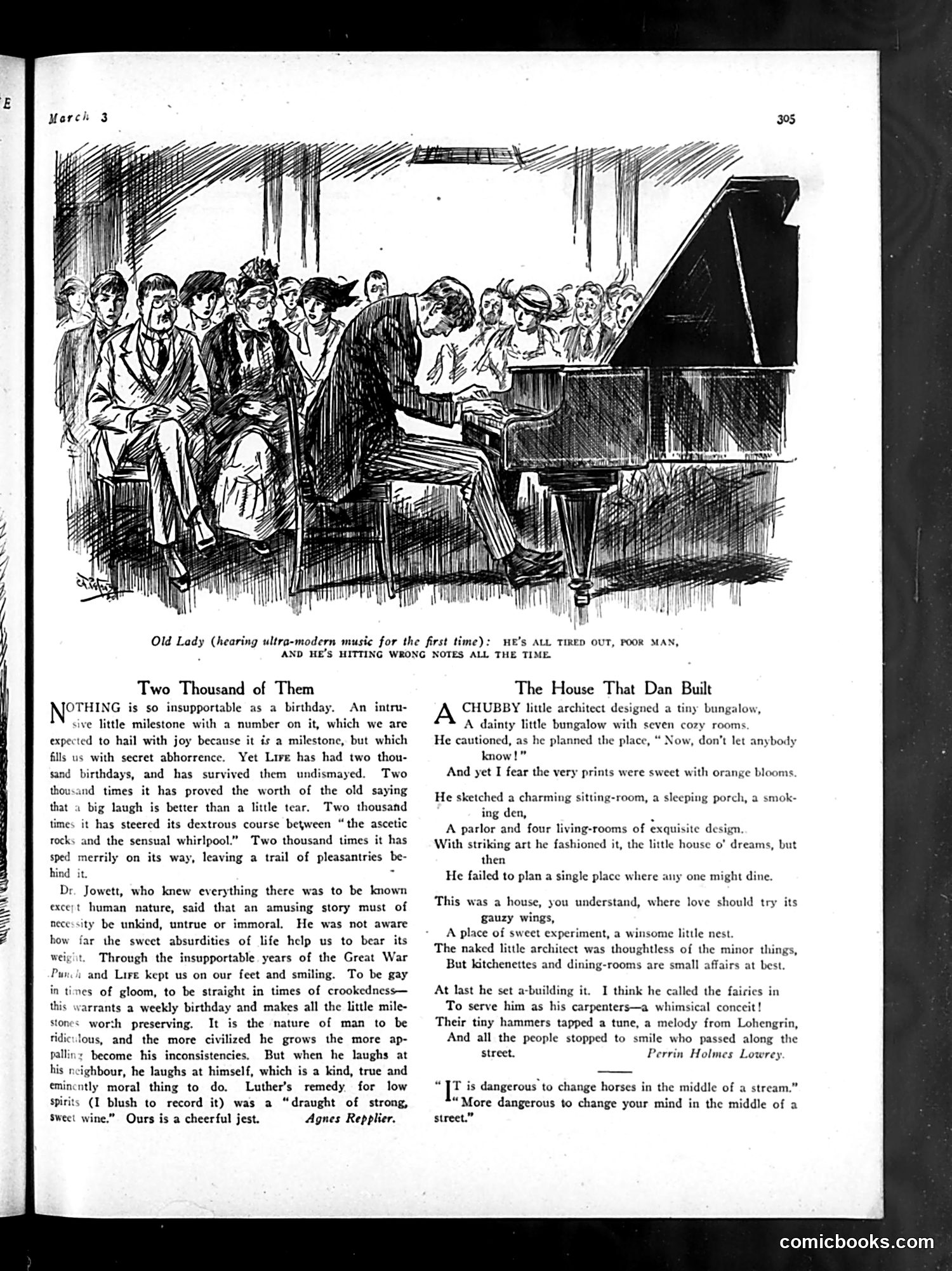
The page contains two separate pieces: **"Two Thousand of Them"** by Agnes Repplier is an essay celebrating Life magazine's 2,000th birthday issue, written in a humorous tone about the magazine's longevity and role in keeping readers cheerful through difficult times (likely referencing WWI and its aftermath). **"The House That Dan Built"** is a short story about a naive architect who designs an impractical small bungalow with beautiful sitting rooms and decorative elements but fails to include a dining room—a satirical commentary on impractical idealism versus functional reality. **The cartoon** (top) shows an elderly woman hearing "ultra-modern music" played on piano for the first time, hitting wrong notes. It's a period joke about modernist music's dissonance sounding like incompetent playing to traditional ears.
📄 Transcribed text from this page (OCR, searchable)
Machine-transcribed from the original scan — historical spelling and the odd misread are preserved.
L y j | Z Old Lady (hearing ultra-modern music for the first time): HE’s ALL TIRED OUT, POOR MAN, . AND HE'S HITTING WRONG NOTES ALL THE TIME. Two Thousand of Them IOTHING is so insupportable as a birthday. An intru- sive little milestone with a number on it, which we are expected to hail with joy because it is a milestone, but which fills us with secret abhorrence. Yet Lire has had two thou- sand birthdays, and has survived them undismayed. Two thousand times it has proved the worth of the old saying that a big laugh is better than a little tear. Two thousand times it has steered its dextrous course between “the ascetic rocks and the sensual whirlpool.” Two thousand times it has sped merrily on its way, leaving a trail of pleasantries be- hind it. - Dr. Jowett, who knew everything there was to be known exce;t human nature, said that an amusing story must of necessity be unkind, untrue or immoral. He was not aware how far the sweet absurdities of life help us to bear its Through the insupportable years of the Great War i and Lire kept us on our feet and smiling. To be gay nes of gloom, to be straight in times of crookedness— warrants a weekly birthday and makes all the little mile- stones worth preserving. It is the nature of man to be idic:tous, and the more civilized he grows the more ap- become his inconsistencies. But when he laughs at ncighbour, he laughs at himself, which is a kind, true and incntly moral thing to do. Luther’s remedy for low spirits (I blush to record it) was a “draught of strong, Sweet wine.” Ours is a cheerful jest. Agnes Repplier. The House That Dan Built CHUBBY little architect designed a tiny bungalow, A dainty little bungalow with seven cozy rooms He cautioned, as he planned the place, “ Now, don’t let anybody know!" And yet I fear the very prints were sweet with orange blooms. He sketched a charming sitting-room, a sleeping porch, a smok- ing den, . A parlor and four living-rooms of exquisite design. With striking art he fashioned it, the little house o’ dreams, but then He failed to plan a single place where any one might dine. This was a house, you understand, where love should try its gauzy wings, A place of sweet experiment, a winsome little nest. The naked little architect was thoughtless of the minor things, But kitchenettes and dining-rooms are small affairs at best. At last he set a-building it. I think he called the fairies in To serve him as his carpenters—a whimsical conceit! Their tiny hammers tapped a tune, a melody from Lohengrin, And all the people stopped to smile who passed along the street. Perrin Holmes Lowrey. e I is dangerous to change horses in the middle of a stream.” “More dangerous to change your mind in the middle of a street.” comicbooks.com