
A complete issue · 44 pages · 1920
Life — November 18, 1920
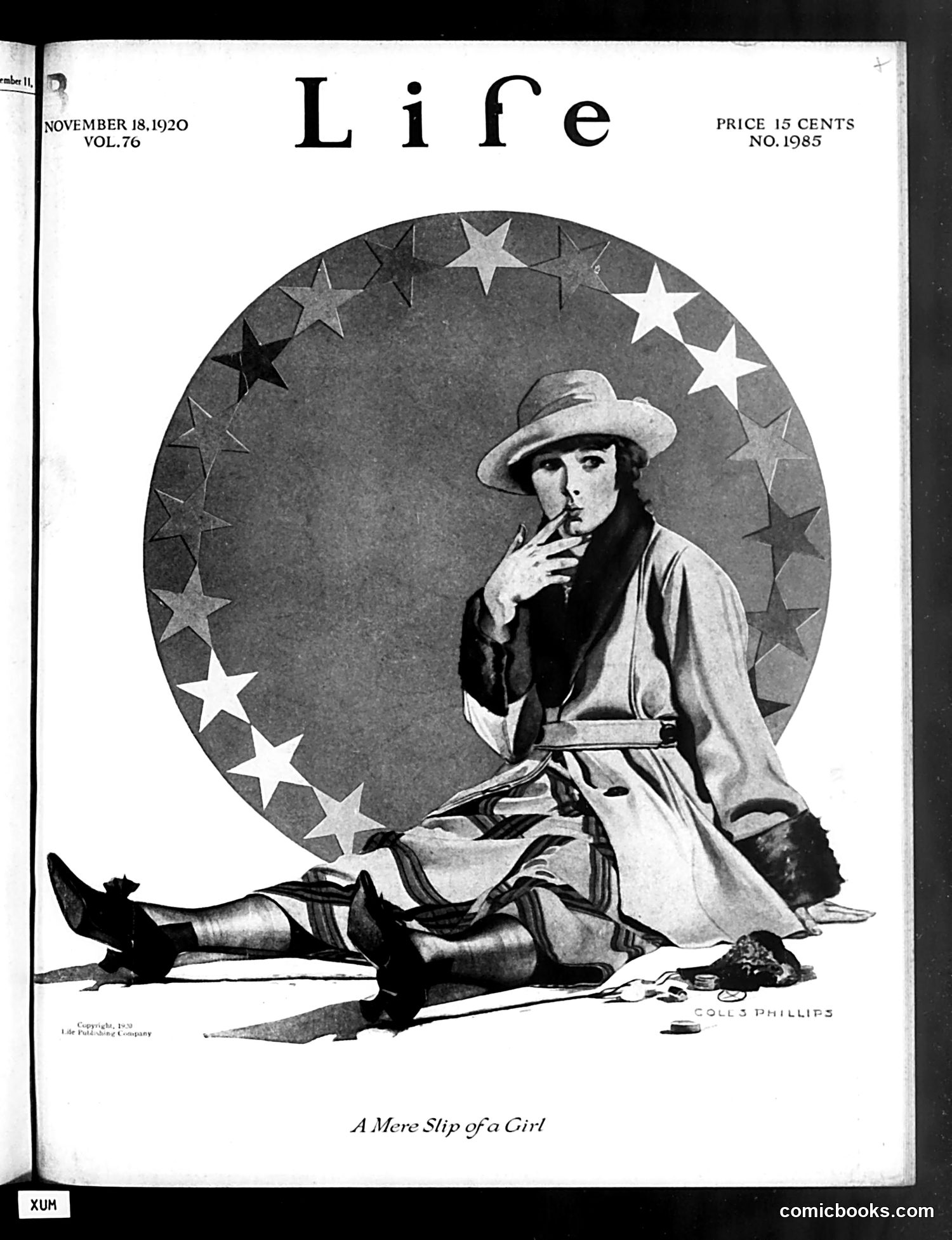
This November 1920 *Life* cover by Coll Phillips depicts a woman in Western/cowgirl attire in a relaxed, flirtatious pose. The title "A Mere Slip of a Girl" appears ironic given her confident demeanor and masculine-coded outfit. The image likely references post-WWI social changes—particularly women's expanding freedoms and the recent (August 1920) passage of the 19th Amendment granting women's suffrage. The "cowgirl" styling suggests new independence and rejection of traditional femininity. The stars in the circular background evoke American patriotism. The satire appears to mock contemporary anxieties about "modern women" abandoning conventional roles, presenting her casual, bold presentation as a humorous commentary on shifting gender norms during the 1920s.
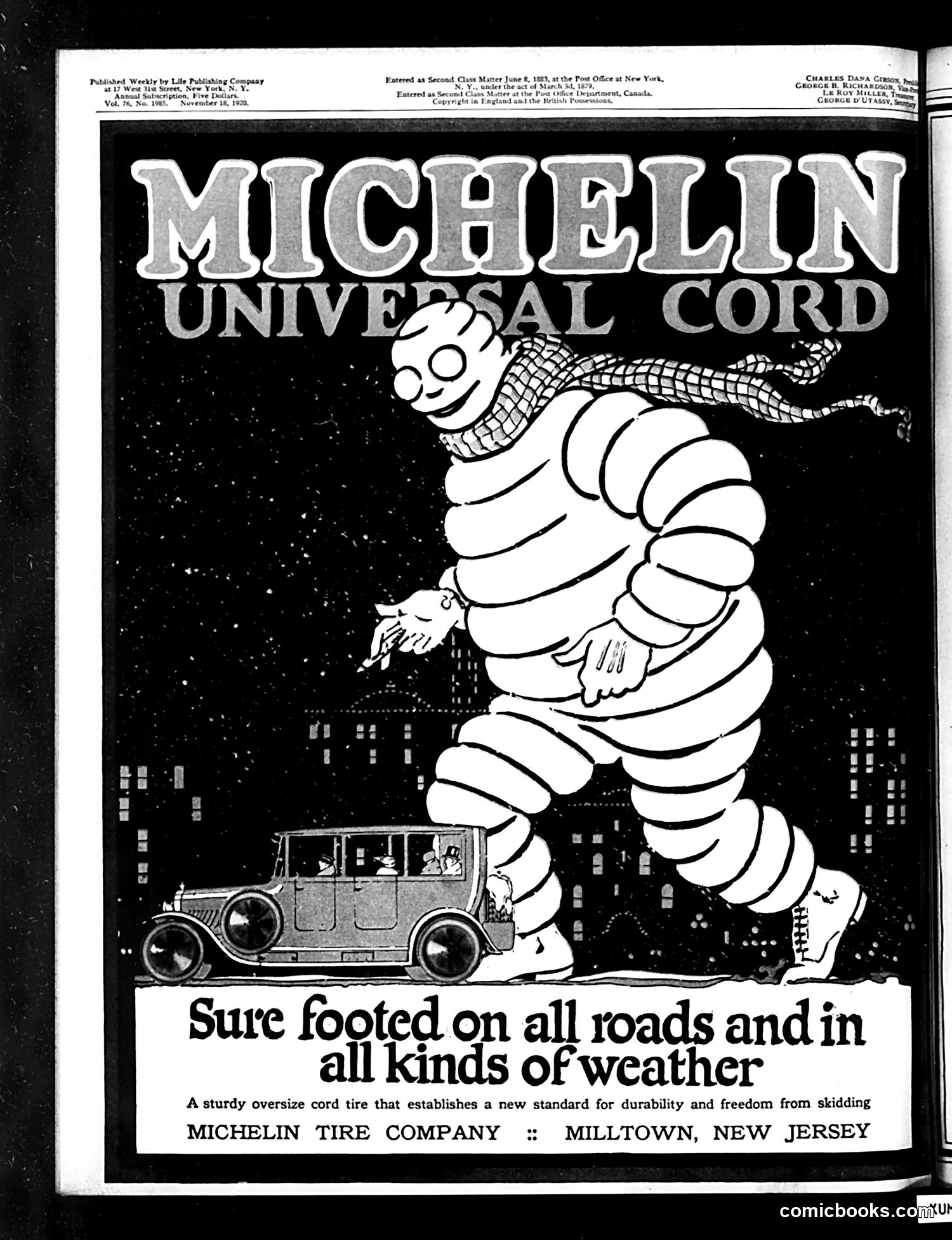
This is a **Michelin tire advertisement**, not political satire. The page features Michelin's famous mascot, Bibendum (the Michelin Man)—a rotund character made of stacked tire rings, wearing a checkered scarf and bowler hat. The ad's humor relies on visual contrast: the enormous, jovial tire-man towers over a small automobile on a city street, emphasizing tire durability and reliability. The tagline "Sure footed on all roads and in all kinds of weather" promotes Michelin Universal Cord tires as dependable for any driving condition. This represents early automotive advertising (circa 1920s-1930s based on the car style), when Bibendum was already an established brand icon, using exaggeration and whimsy to market industrial products to consumers.
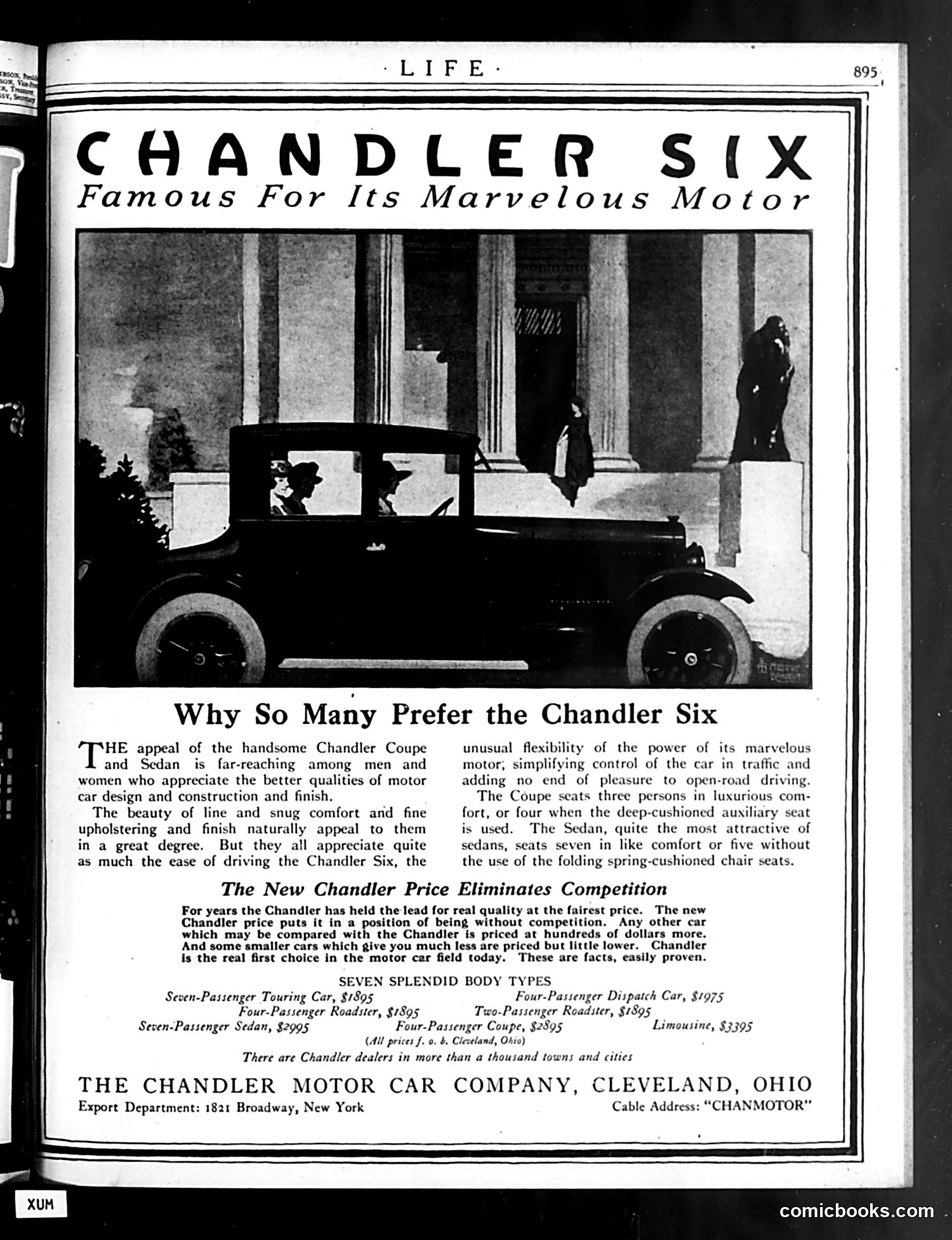
This is **not a cartoon or satire page**, but rather a **straightforward automobile advertisement** for the Chandler Six motor car, published in *Life* magazine. The image shows a luxury automobile parked before a grand neoclassical building (likely representing wealth and prestige), with well-dressed passengers and pedestrians. The ad emphasizes the car's engineering excellence, comfort, and competitive pricing. The text highlights the Chandler Six's "marvelous motor," flexible power, and spacious seating options. It claims Chandler maintains "the lead for real quality at the fairest price" and lists seven body types with prices ranging from $1,895 to $3,395. This represents typical early 20th-century automotive marketing positioning luxury and innovation as accessible to affluent consumers—no political satire is intended.
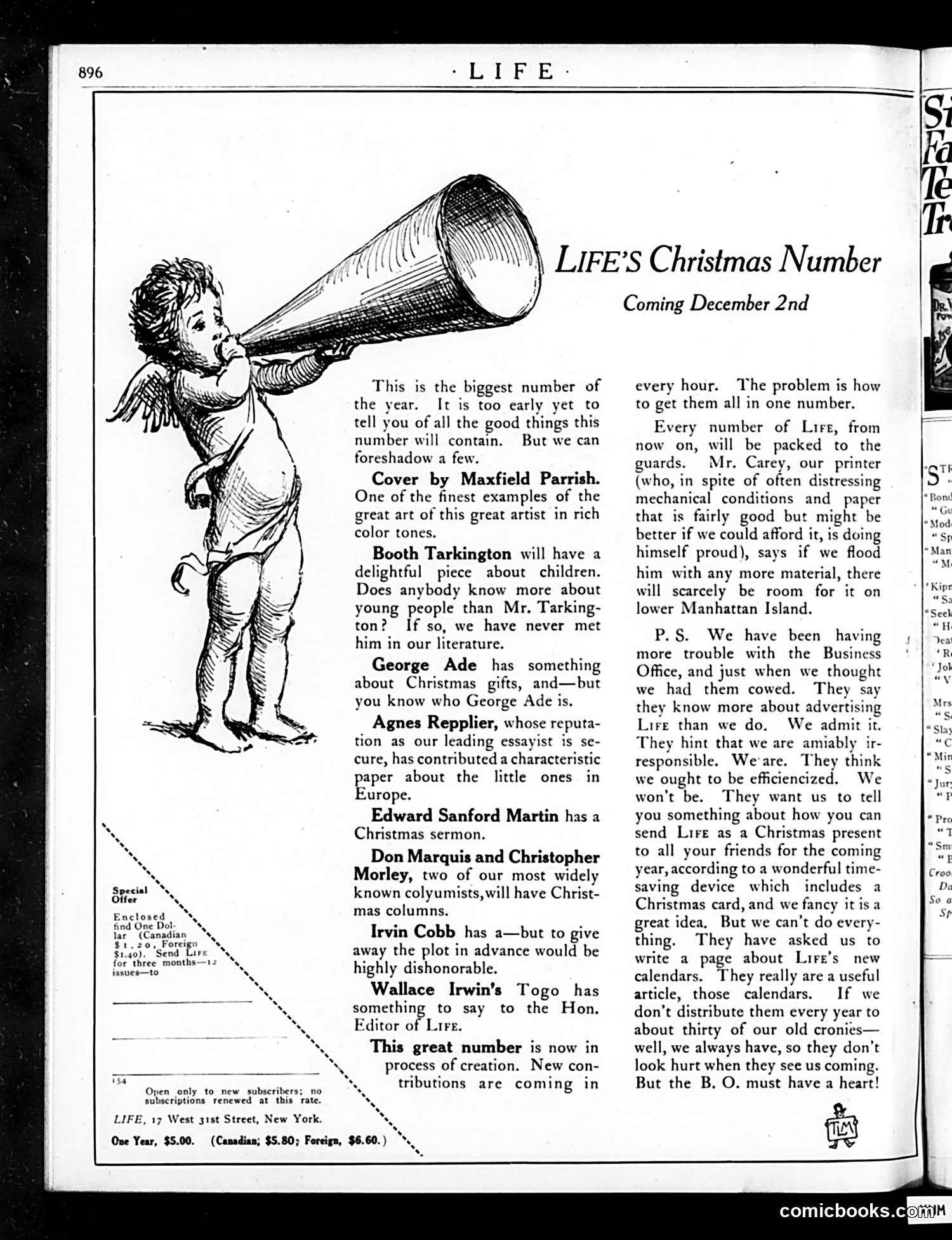
This page announces Life's upcoming Christmas issue (December 2nd), featuring a cherub with a megaphone—a traditional symbol for spreading news or announcements. The text previews contributing writers and their topics: Booth Tarkington writing about children, George Ade discussing Christmas gifts, Agnes Repplier offering an essay, Edward Sanford Martin providing a Christmas sermon, and columnists Don Marquis and Christopher Morley contributing holiday pieces. Wallace Irwin's "Togo" apparently addresses the Editor of Life directly. The page emphasizes the challenge of fitting premium content into one issue while managing limited print space on Manhattan Island. A "Special Offer" in the corner advertises subscription rates ($5.00 yearly; $6.60 foreign). This is primarily promotional content rather than satirical commentary—advertising the magazine's holiday edition and its notable contributors.
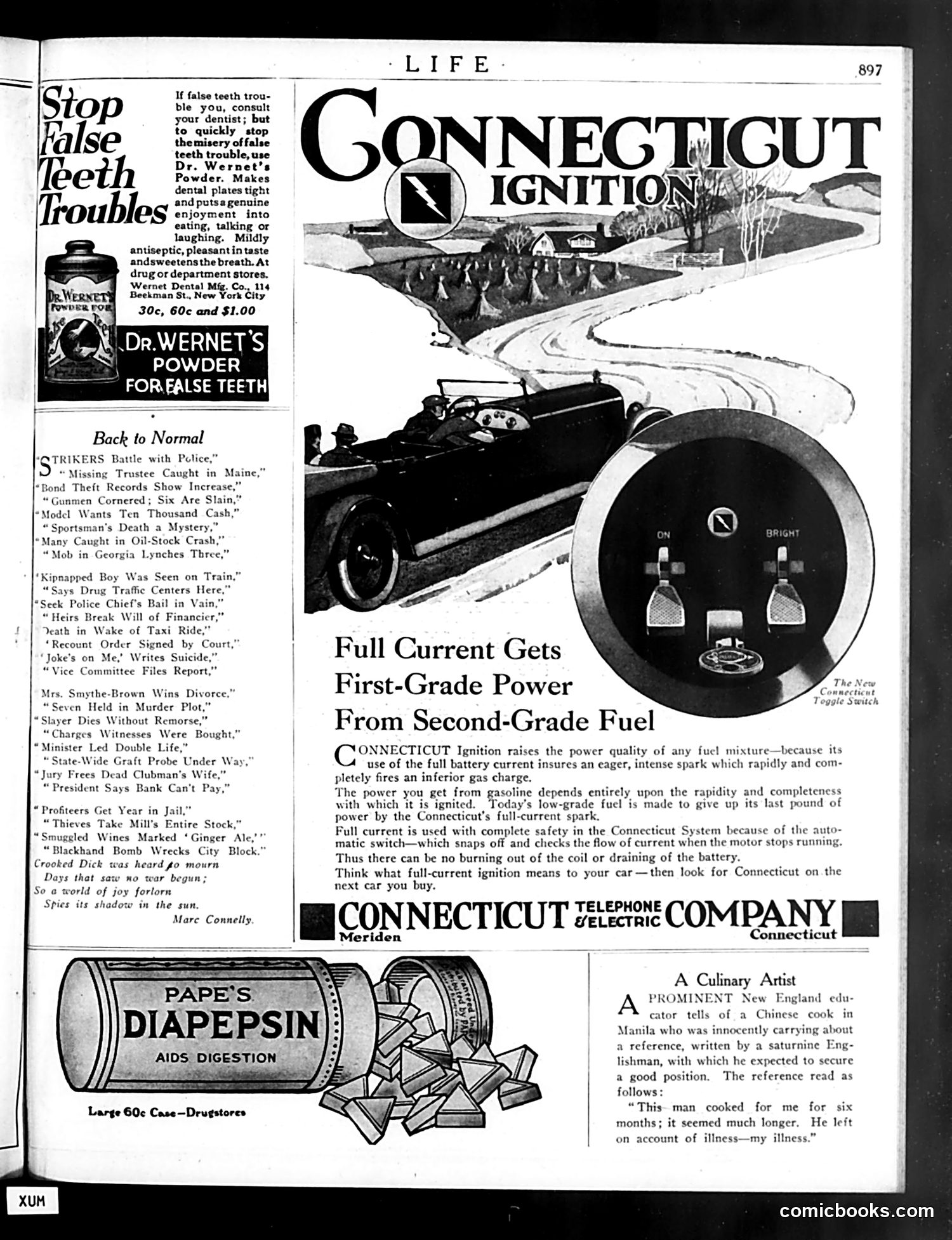
This page is **primarily advertising**, not political satire. The main content includes: 1. **Dr. Wernet's Powder for False Teeth** - a period dental product advertisement 2. **Connecticut Ignition** - a major advertisement for the Connecticut Telephone & Electric Company, promoting their ignition system for automobiles. The ad emphasizes that their full-current spark provides superior power compared to inferior fuel mixtures. 3. **Pape's Diapesin** - a digestive aid advertisement 4. **"Back to Normal"** - a column of brief news headlines, apparently satirical or humorous in tone 5. **"A Culinary Artist"** - a brief anecdote about a Chinese cook The page contains no political cartoons or significant satire. It's a typical early 20th-century magazine layout mixing commercial advertisements with light news content.
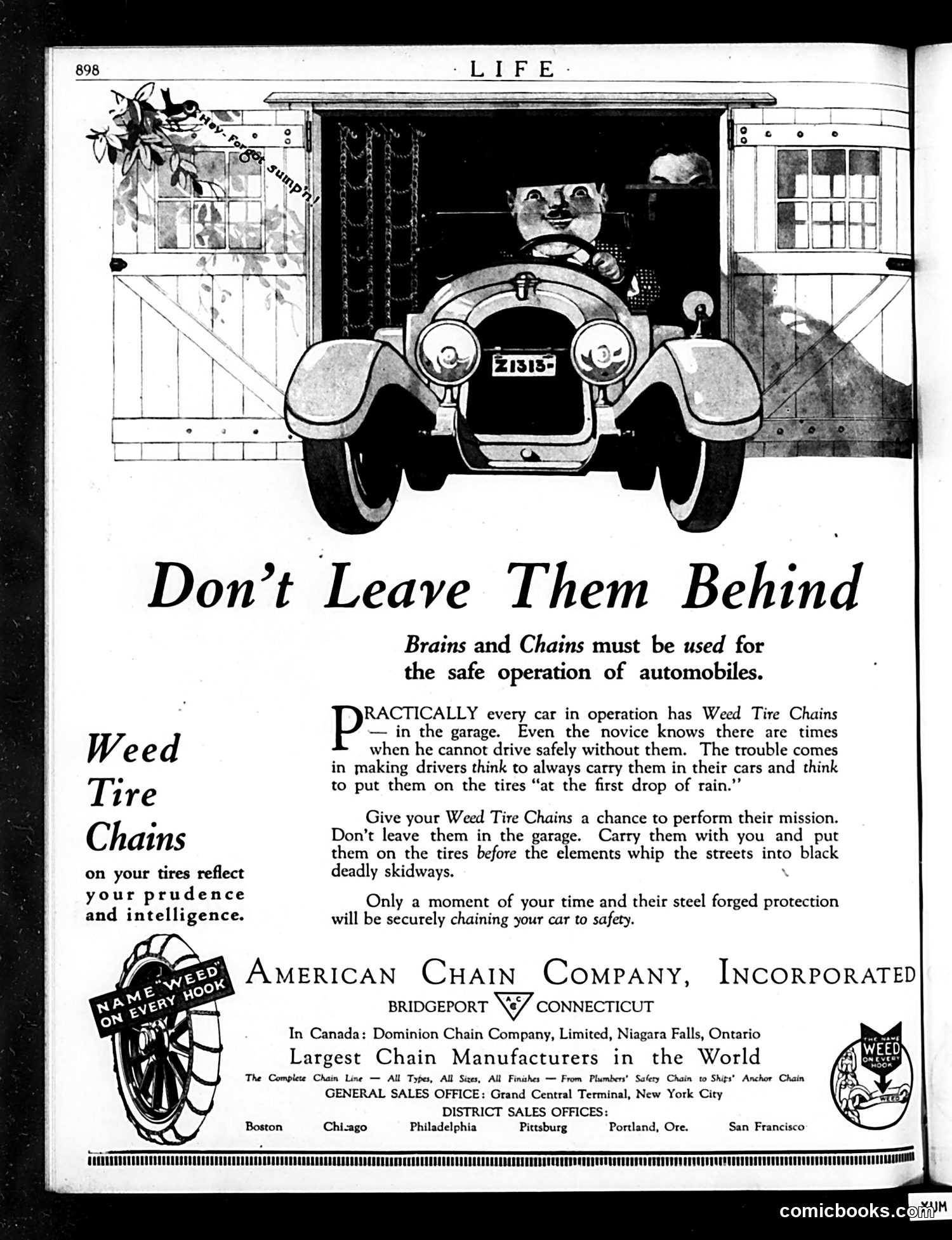
This page is **primarily an advertisement**, not satire or political commentary. It's a commercial for Weed Tire Chains from the American Chain Company (Bridgeport, Connecticut). The ad features an illustration of a car driven by a man, shown head-on approaching the viewer. The headline "Don't Leave Them Behind" warns drivers to keep tire chains in their vehicles rather than storing them in garages. The messaging emphasizes safety: chains are essential for winter driving on icy roads ("black deadly skidways"). The copy uses the phrase "Brains and Chains must be used for the safe operation of automobiles"—a straightforward sales pitch positioning the product as a prudent safety measure for motorists, particularly during winter conditions.
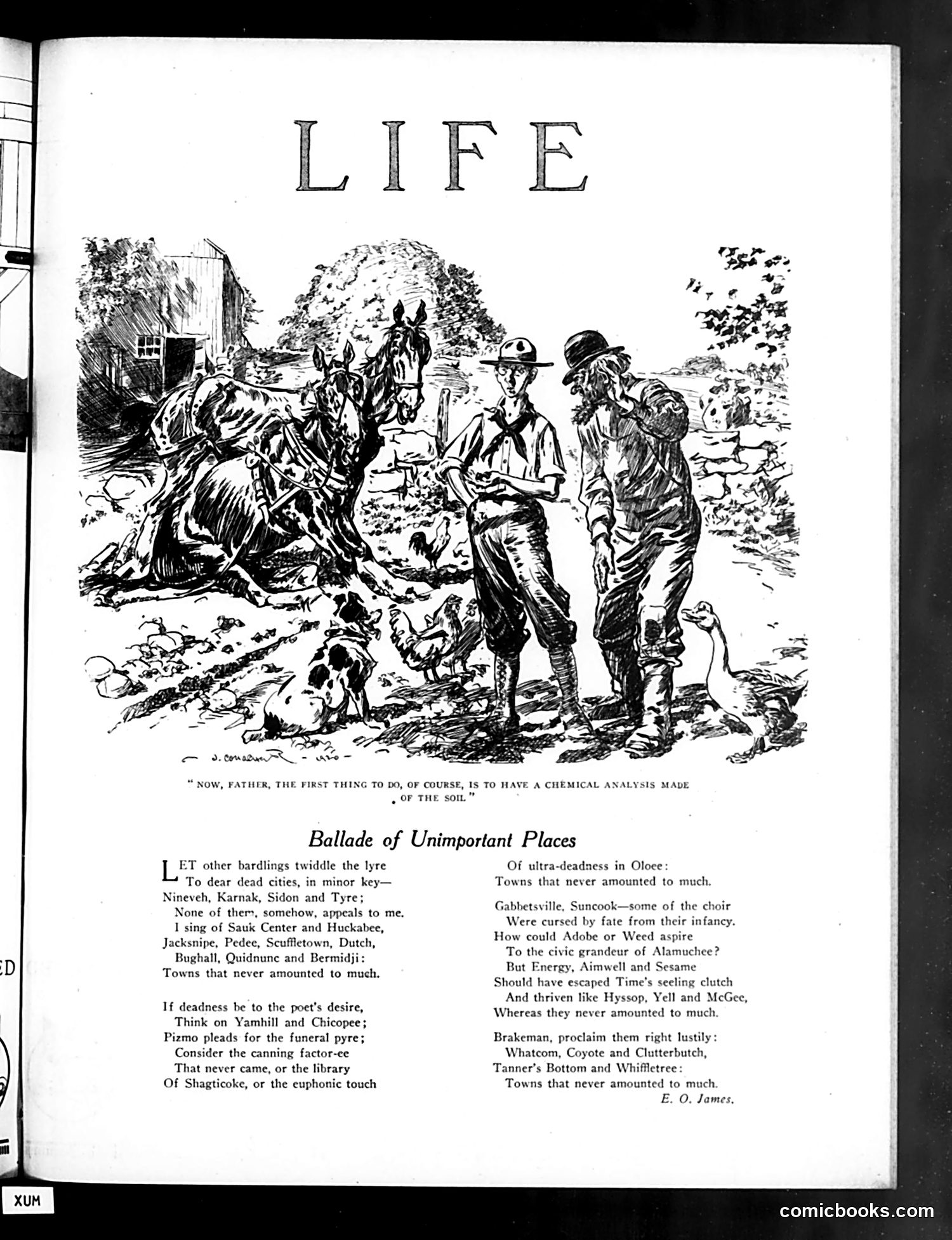
This page features a satirical poem titled "Ballad of Unimportant Places" by E. O. James, accompanied by a sketch showing rural farmers discussing soil analysis. The cartoon illustrates the poem's opening line: "NOW, FATHER, THE FIRST THING TO DO, OF COURSE, IS TO HAVE A CHEMICAL ANALYSIS MADE OF THE SOIL." The humor mocks agricultural modernization—specifically, the growing trend of applying scientific methods and chemical analysis to farming. The joke appears to be that farmers are adopting overly technical, academic approaches to simple farming work, suggesting this is impractical or unnecessarily complicated for rural life. The poem itself satirizes various small, unremarkable American towns that "never amounted to much," treating their obscurity as a subject for mock-serious verse. The combined effect ridicules both rural pretension and the disconnect between urban scientific thinking and actual farm life.
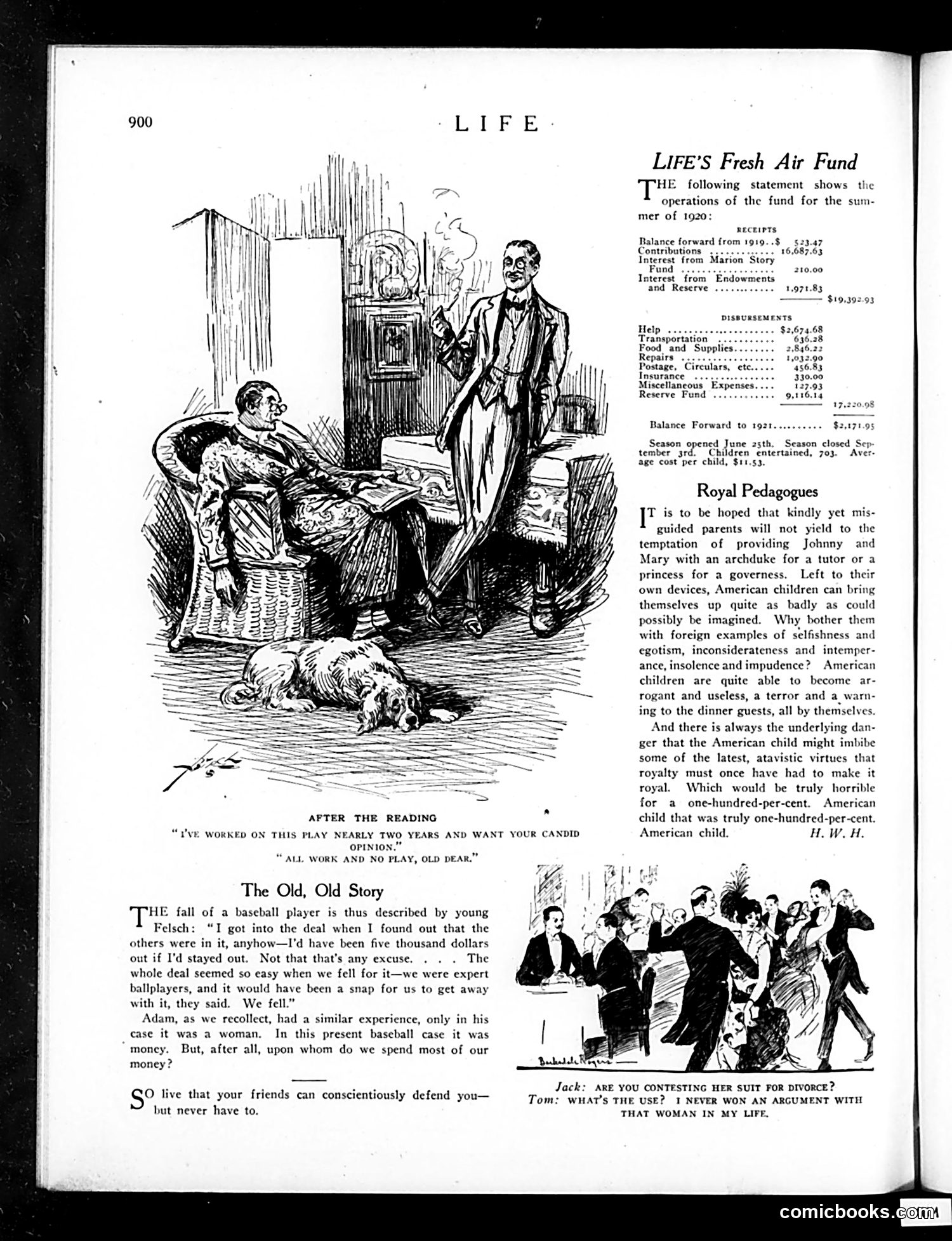
The main cartoon titled "AFTER THE READING" depicts a well-dressed man reading aloud to a reclining gentleman while a dog sleeps nearby. The caption satirizes pretentious cultural consumption: the reader claims he's "worked on this play nearly two years and want your candid opinion," to which the listener replies dismissively, "All work and no play, old dear." The accompanying article "Royal Pedagogues" mocks American parents who hire foreign tutors hoping their children will adopt European refinement and manners, rather than developing "selfishness and egoism." The humor lies in critiquing aspirational middle-class parenting and cultural snobbery. The bottom cartoon shows a domestic dispute about divorce, with dialogue emphasizing that arguments with wives prove pointless—a commentary on marital conflict and gender relations of the period.
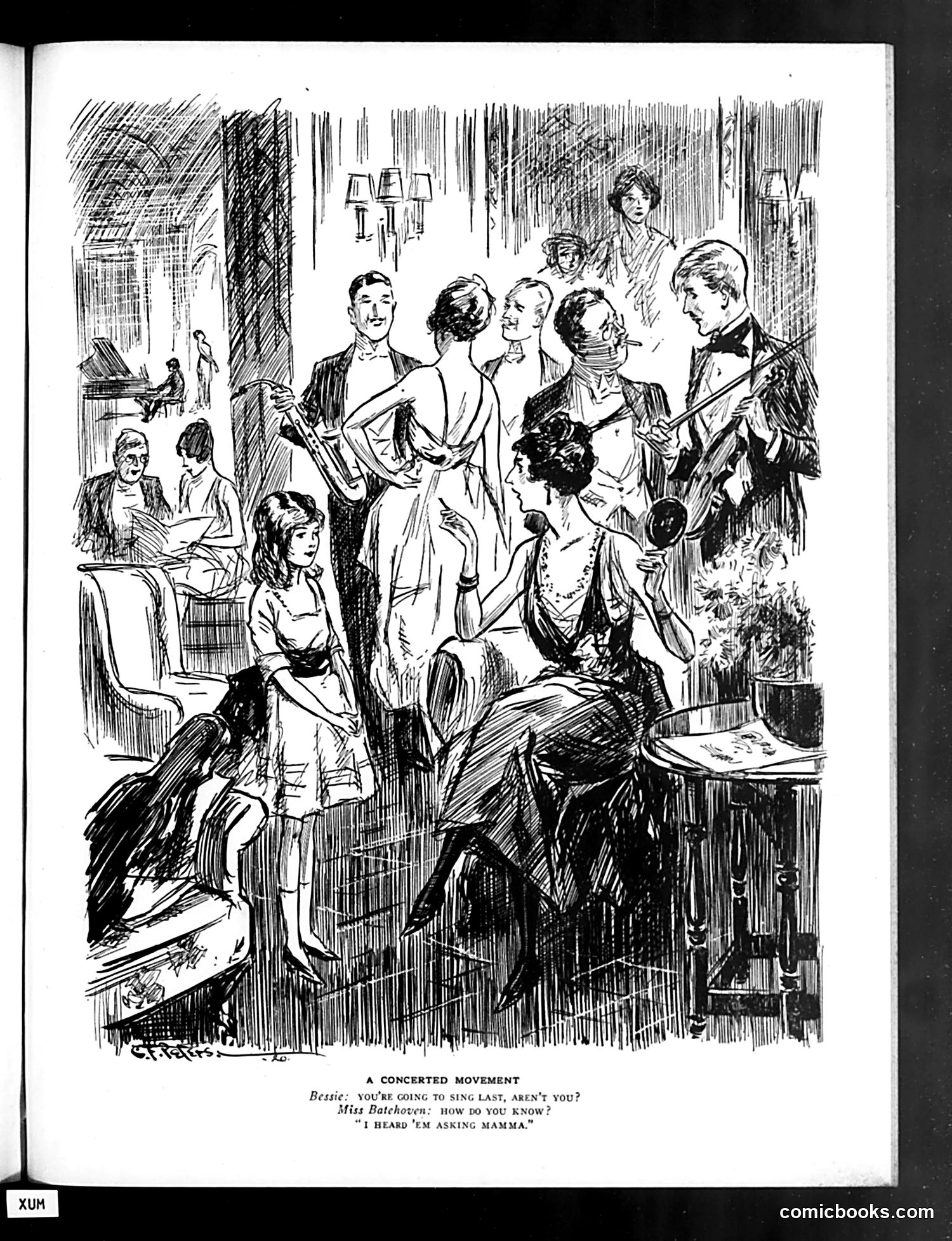
This cartoon depicts a formal social gathering where musical performance is expected. The title and dialogue create the satire: a gentleman (Brassie) confidently asserts that Miss Batcheyen "you're going to sing last, aren't you?" She responds "How do you know?" and reveals she overheard people asking her mother if she would perform. The joke satirizes social pretension and predictable behavior at Victorian-era parlor gatherings. The "concerted movement" puns on both orchestrated social coordination and the musical "concert." The humor lies in how transparent these social conventions are—everyone knows the attractive young woman will inevitably be pressed into performing, making the outcome entirely predictable despite polite pretense of spontaneity.
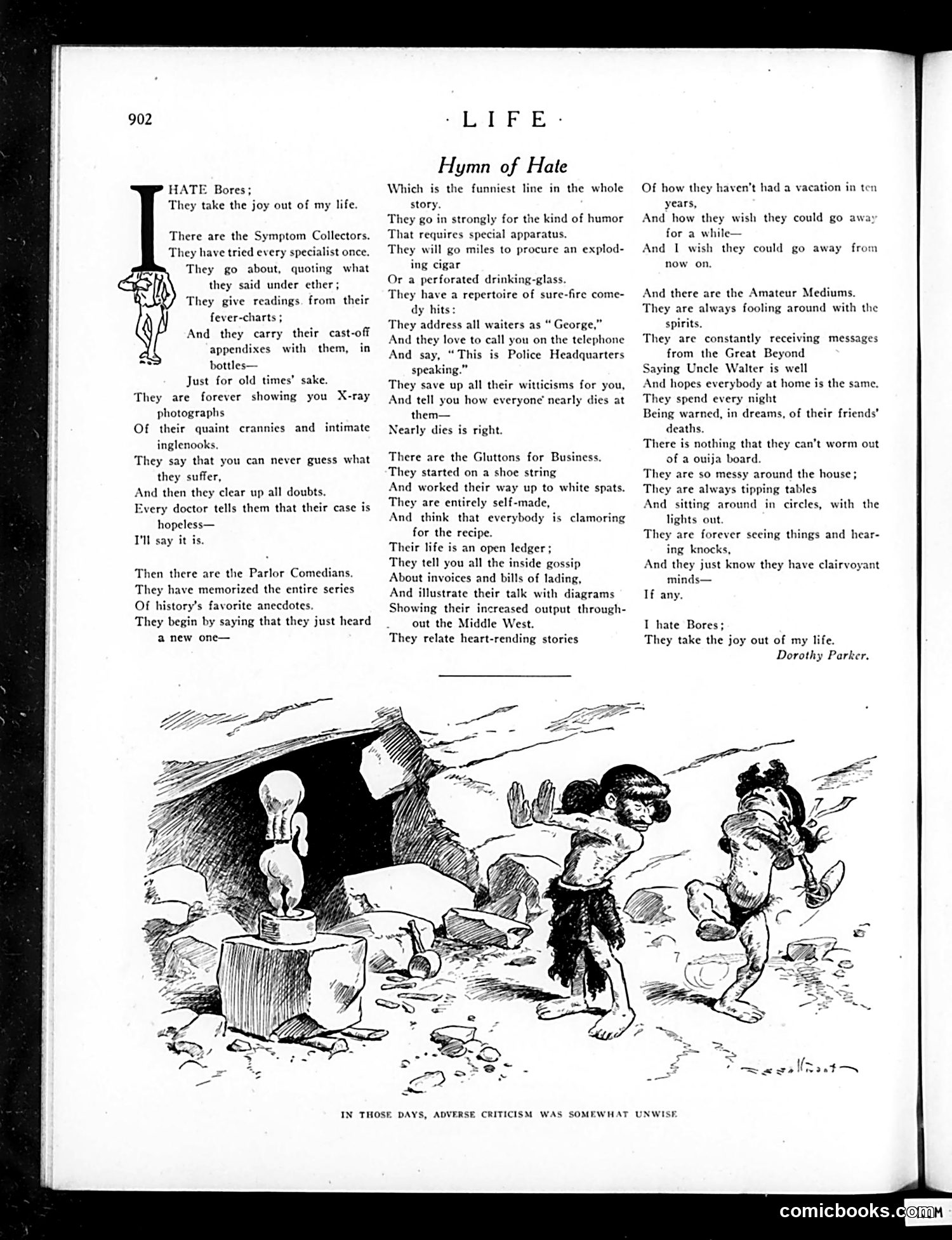
This is Dorothy Parker's satirical poem about irritating social types. The accompanying cartoon illustrates one subject: amateur spiritualists or séance practitioners claiming to contact the dead. The poem catalogs various bores—Symptom Collectors, doctors, Parlor Comedians, Gluttons for Business, and these "Amateur Mediums." Parker mocks people who: - Constantly receive supernatural messages at séances - Claim spirit communication is "same" for everyone - Sit in circles with "lights out" - Pretend clairvoyant powers The cartoon shows crude figures gathered around what appears to be a makeshift séance setup, emphasizing the absurdity and low-class charlatan nature of such practices. Parker's critique targets the pretentiousness and tedium of people claiming mystical authority without genuine knowledge.
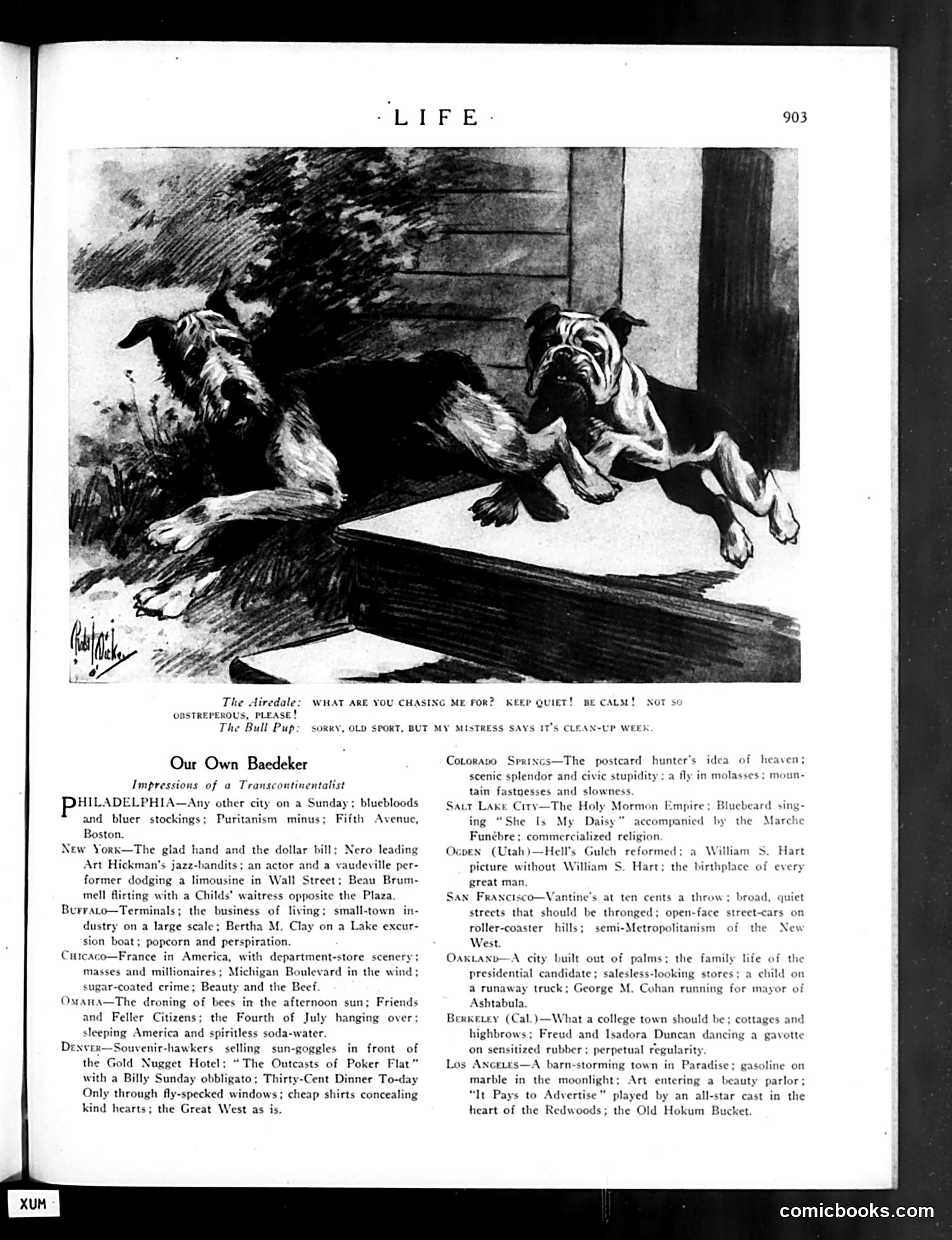
The image shows two dogs lounging on a doormat in a domestic setting. The caption presents a humorous dialogue: **The Airedale** (left dog) complains: "What are you chasing me for? Keep quiet! Be calm! Not so obstreperous, please!" **The Bull Pup** (right dog) responds: "Sorry, old sport, but my mistress says it's clean-up week." This is a gentle domestic humor piece playing on the contrast between the Airedale's dignified demands for peace and the Bull Pup's explanation that his boisterous behavior stems from household cleaning duties. The joke relies on anthropomorphizing the dogs, giving them human concerns about cleanliness and household management—common subjects in early 20th-century satirical magazines aimed at middle-class readers.
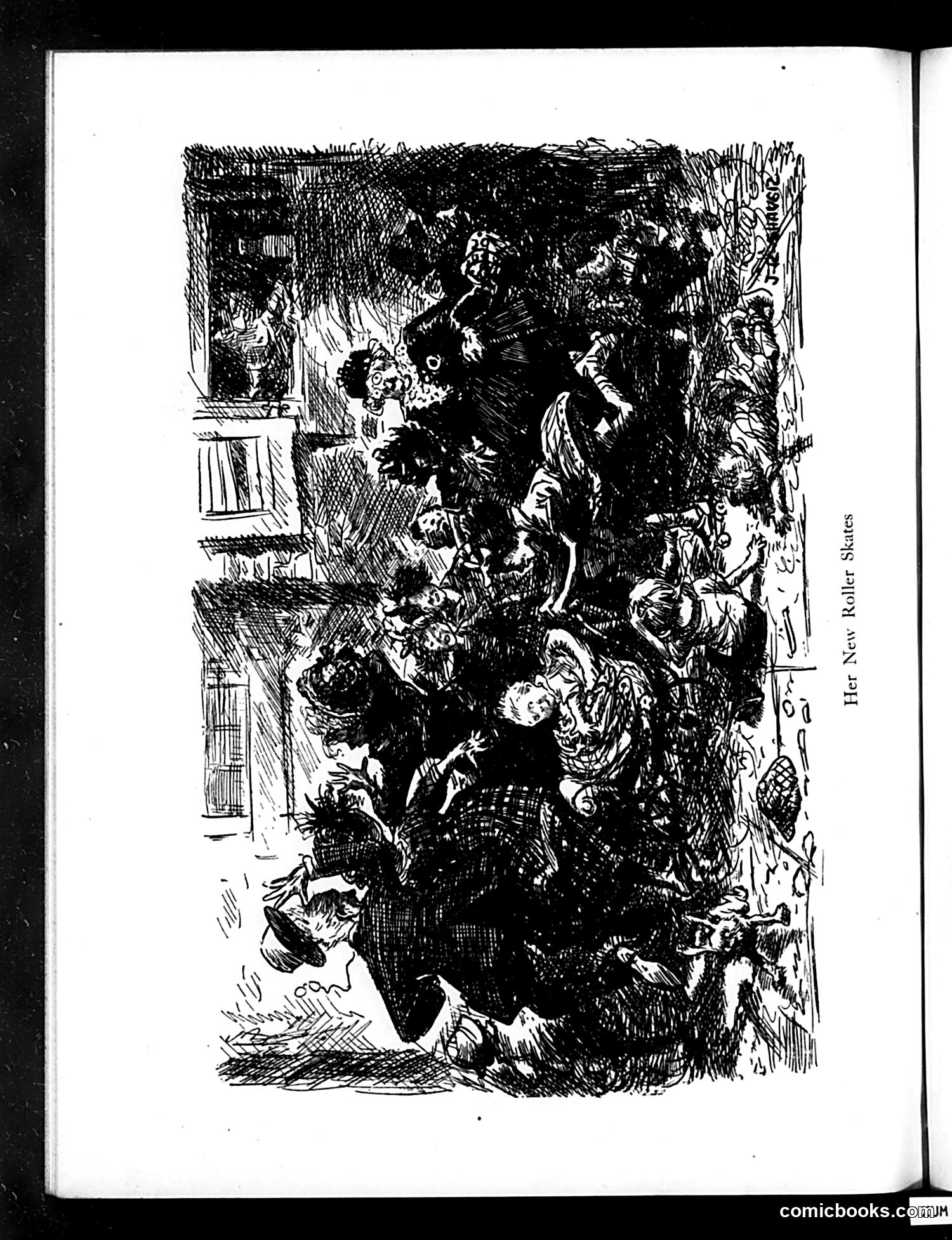
This is a chaotic sketch titled "Her New Roller Skates" showing what appears to be a crowded indoor scene—likely a street or public space—with multiple figures in apparent disarray or collision. The drawing style uses heavy cross-hatching typical of late 19th/early 20th-century satirical illustration. The title suggests the humor centers on someone (likely a woman or girl) newly equipped with roller skates causing mayhem among other people in a confined space. This reflects the era's satirical treatment of the "new woman" and emerging technologies. Roller skates were relatively novel recreational equipment, and the cartoon likely mocks both the skater's lack of control and the general chaos such modern conveniences created in crowded urban environments. The joke plays on safety concerns and social disruption caused by new leisure activities.
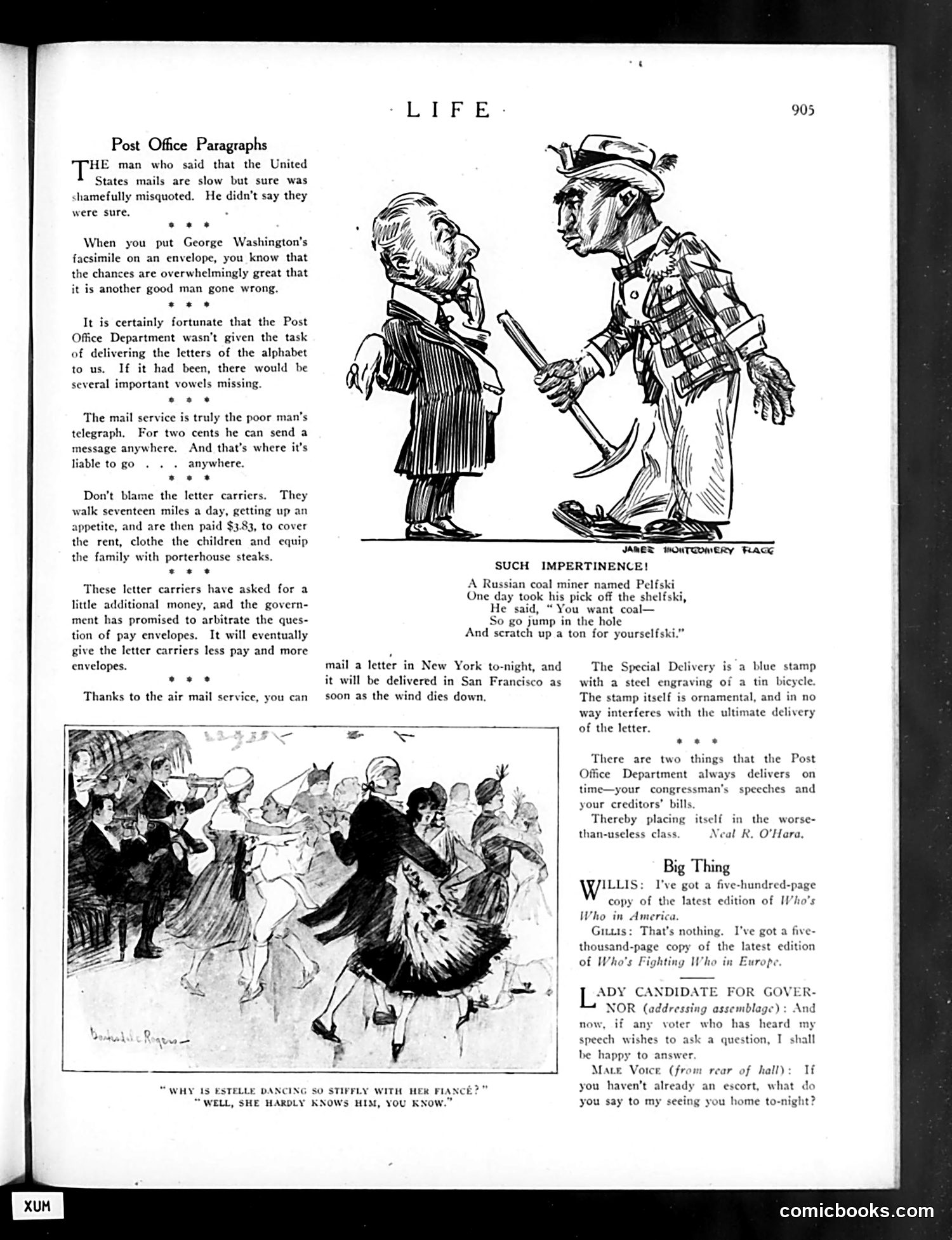
This page contains satirical commentary on U.S. postal service inefficiency. The "Post Office Paragraphs" section humorously critiques mail delivery, joking that putting George Washington's facsimile (signature) on envelopes offers "overwhelming" odds something will go wrong. The text defends letter carriers' grueling work (walking 17 miles daily) while blaming systemic failures instead. The top cartoon by James Montgomery Flagg depicts a military officer confronting a civilian about coal delivery—likely satirizing wartime bureaucratic confusion or labor disputes. The lower cartoon, captioned about "Estelle dancing stiffly," appears to be a social commentary on awkward dancing or courtship behavior. The page concludes with brief humorous dialogue exchanges labeled "Big Thing" and "Lady Candidate for Governor," typical of LIFE's comedic filler content.
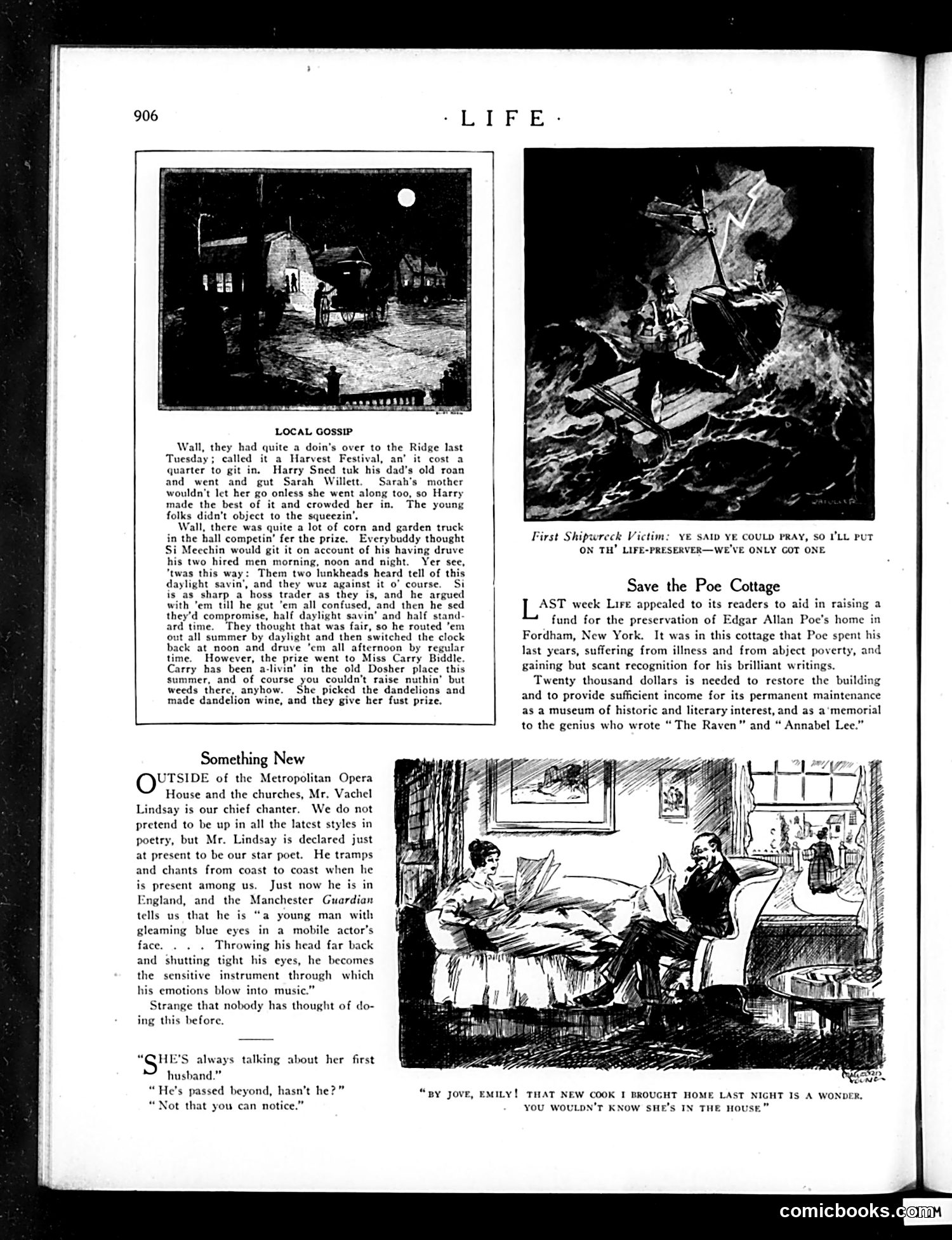
This page contains three distinct pieces: 1. **"Local Gossip"** — A anecdotal story about a harvest festival and a competitive ox-cart race, typical of the gossipy, folksy humor Life magazine published. 2. **"Save the Poe Cottage"** — A fundraising appeal for Edgar Allan Poe's home in Fordham, New York, requesting $20,000 to preserve it as a museum. This reflects early 20th-century efforts to memorialize American literary figures. 3. **"Something New"** — A commentary on Vachel Lindsay, a poet and performer who chanted his work across America. The piece describes his theatrical style and unconventional approach to poetry performance, noting his "gleaming blue eyes" and emotional intensity. 4. **Bottom cartoon** — A domestic humor sketch about a new cook, reflecting typical household comedy of the era.
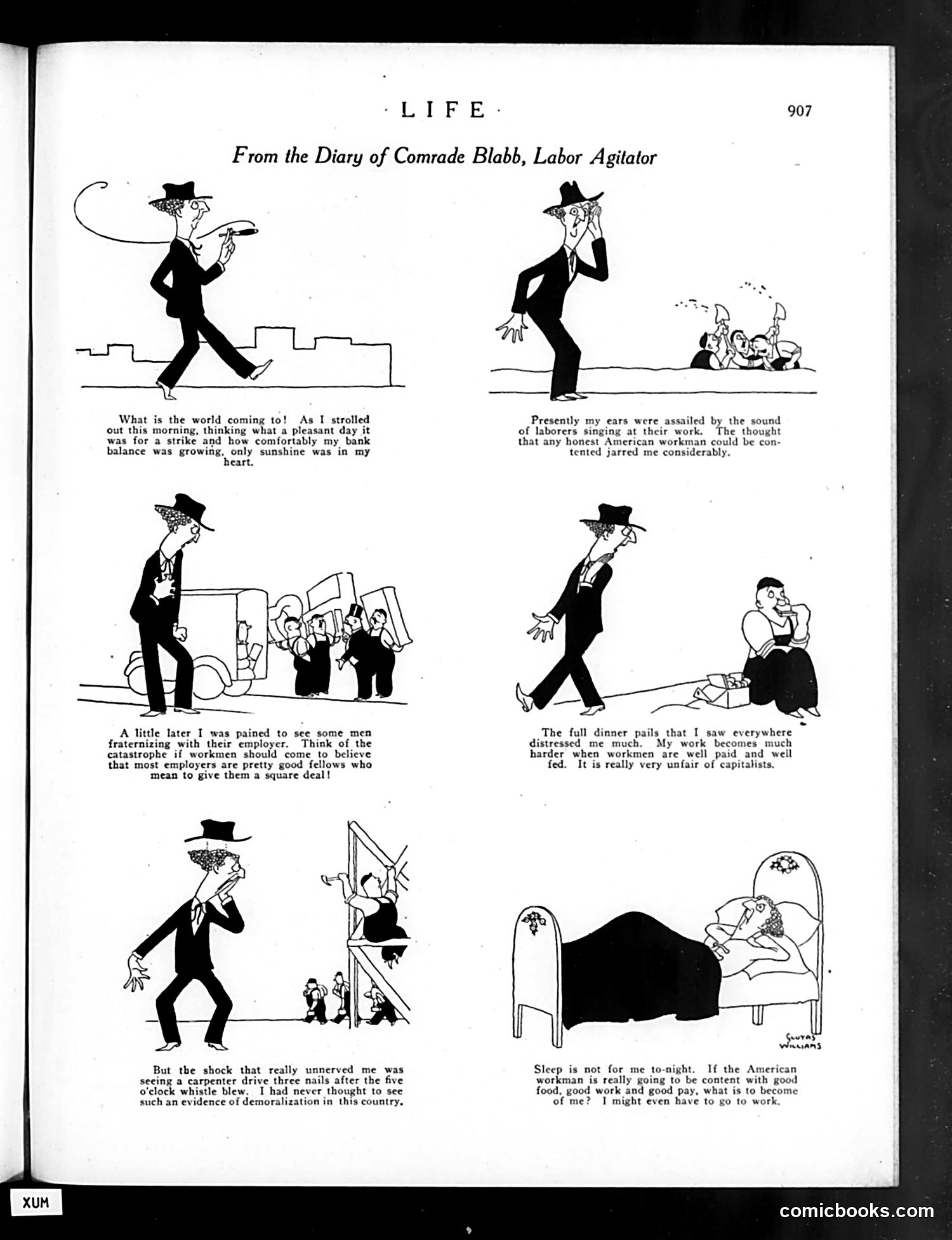
This satirical comic strip mocks a labor activist ("Comrade Blabb") through his purported diary entries. The cartoonist portrays him as hypocritical and unserious about workers' causes. The narrative shows Blabb initially optimistic about a strike, then disturbed by workers singing contentedly on the job—suggesting honest workers contradict his revolutionary message. He's further troubled by workers dining well and being fairly paid, and horrified by a carpenter working after 5 PM. The final panel shows him unable to sleep, troubled that workers' material comfort undermines his agitational message. The satire targets 1920s-era labor radicals, suggesting their ideology requires worker discontent to maintain relevance—a critique of agitators as exploiting rather than genuinely serving working-class interests.
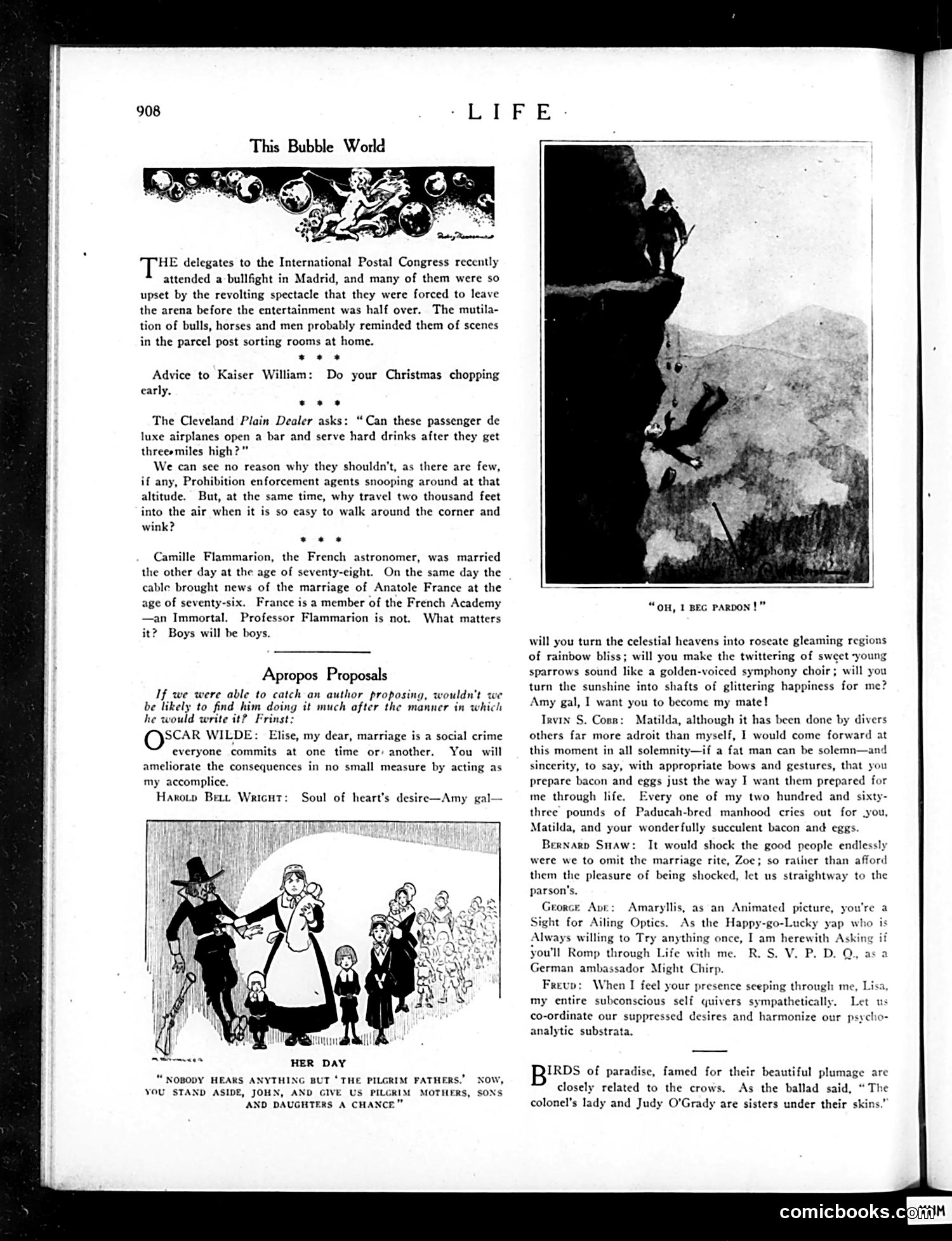
This Life magazine page (p. 908) contains satirical commentary and a cartoon titled "Her Day." The cartoon depicts a wedding scene where a groom presents his bride to gathered figures, with the caption joking that nobody hears the "pilgrim fathers" anymore—suggesting the groom is giving the bride's family a chance to object, a dated tradition. The "Apropos Proposals" section features witty responses attributed to Oscar Wilde, Hannah Beall Wright, Bernard Shaw, George Abe, and Freud on marriage as social institution. Shaw quips that omitting marriage rites would shock propriety; Freud offers psychoanalytic commentary. The section mocks period attitudes about courtship, propriety, and marriage through famous figures' purported bon mots.
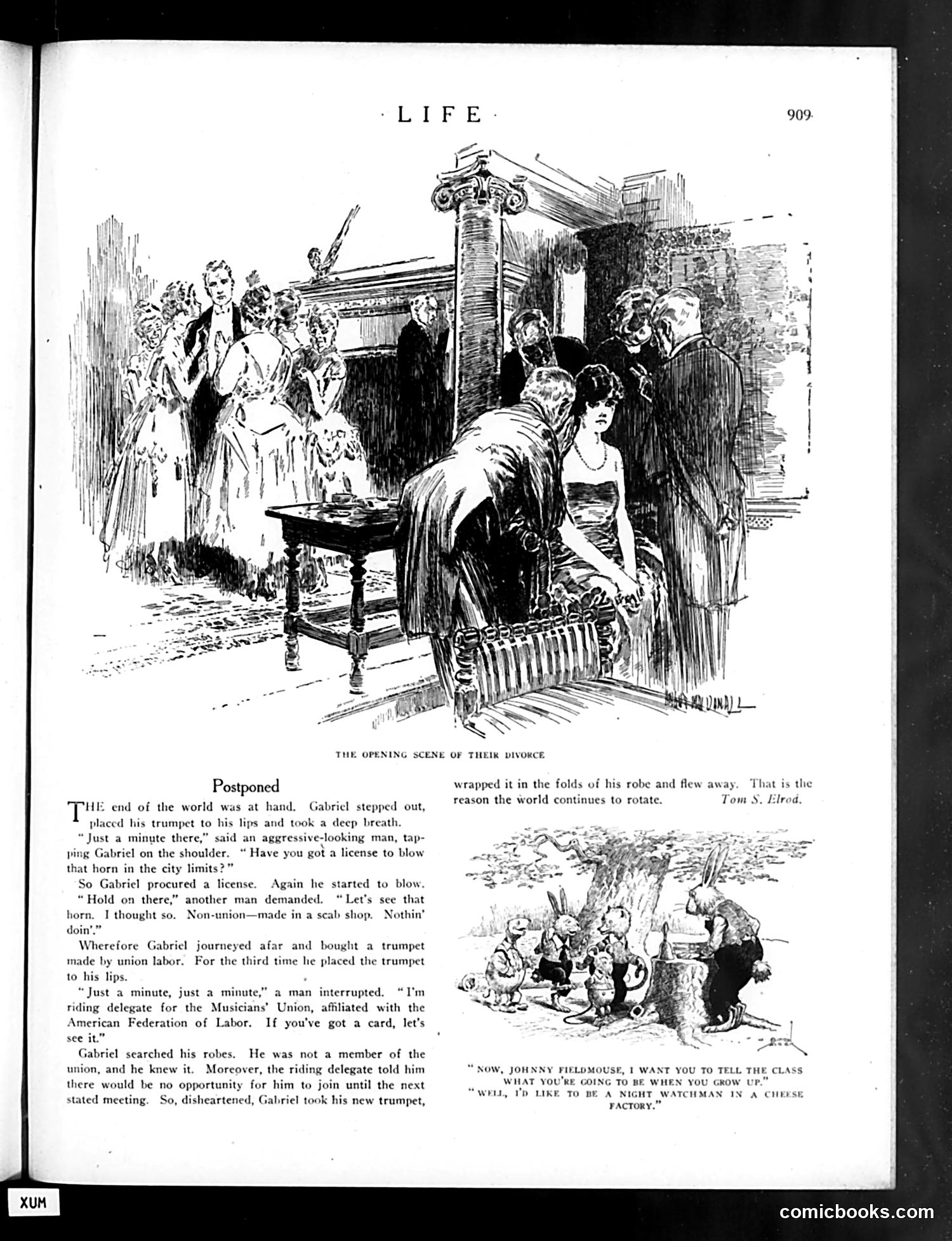
This satirical piece mocks labor union bureaucracy and regulations using biblical apocalypse as its premise. Gabriel, tasked with blowing his trumpet to signal the world's end, is repeatedly stopped by union officials and government regulators demanding licenses, proof of union membership, and verification that his trumpet was made by union labor. The joke: excessive red tape and union rules prevent even the end of the world from occurring. Gabriel cannot join the Musicians' Union until the "next stated meeting," so he abandons his divine mission entirely. The satire targets early 20th-century labor unions—specifically their rigid membership requirements, jurisdictional control, and bureaucratic obstruction that the cartoonist suggests paralyzes progress. The secondary cartoon joke about Johnny Fieldmouse wanting to be a "night watchman in a cheese factory" appears unrelated political or social commentary, though its specific reference is unclear today.
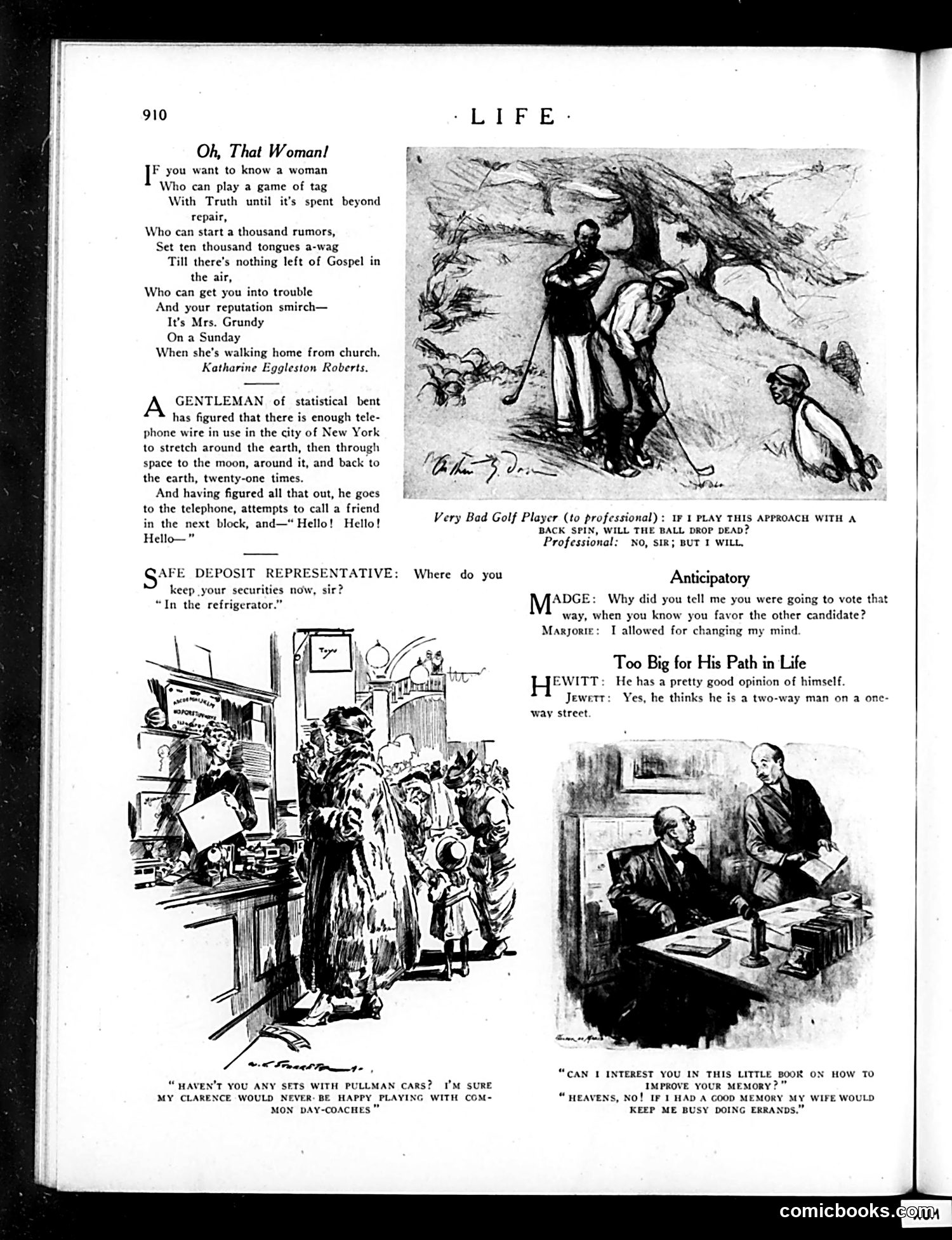
This page from *Life* magazine contains several standalone satirical comics and humorous pieces typical of early-to-mid 20th century American humor: **"Oh, That Woman!"** — A poem by Katharine Eggleston Roberts satirizes "Mrs. Grundy," a stock character representing rigid social morality and gossip. The joke: respectable women spreading rumors after church undermine the very Gospel values they claim to uphold. **The telephone cartoon** mocks the gap between technological progress and practical reality — New York has enough wire to reach the moon, yet basic local calls fail. **Safe deposit/refrigerator joke** — A wealthy woman stores securities in a refrigerator, satirizing either absent-mindedness or absurd wealth-management. **Golf and other cartoons** employ standard humor: the incompetent golfer, the "two-way man on a one-way street" (someone overestimating his importance), and marital dynamics (a man avoiding self-improvement to escape his wife's errands). The page represents genteel, middle-class humor targeting vanity, pretension, and social absurdity — typical *Life* magazine fare.
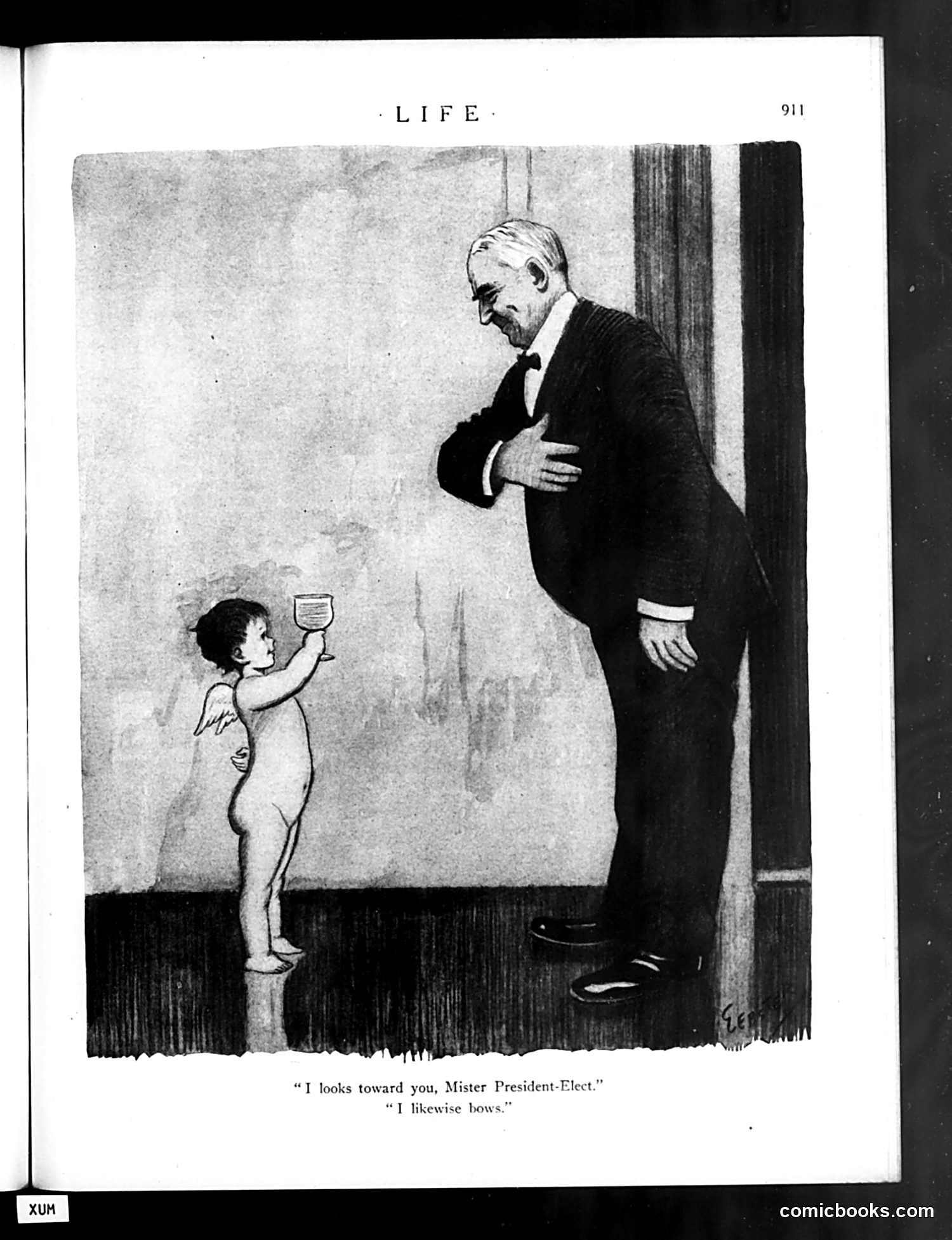
This is a satirical cartoon from *Life* magazine depicting a symbolic exchange between two figures: a cherub or putto (winged child) holding up a goblet and a tall man in formal attire identified as "Mister President-Elect." The joke plays on mutual deference: the child says "I looks toward you" while the adult responds "I likewise bows." The reversal of expected social hierarchy—a child seemingly commanding respect from a president-elect, who then reciprocates—creates the satire. The goblet suggests a toasting gesture, implying celebration or flattery. Without knowing the specific election date visible on the page, the cartoon appears to mock either the President-Elect's eagerness to please or the absurdity of offering exaggerated respect to incoming leadership. The formal dress and architectural setting emphasize the political context.
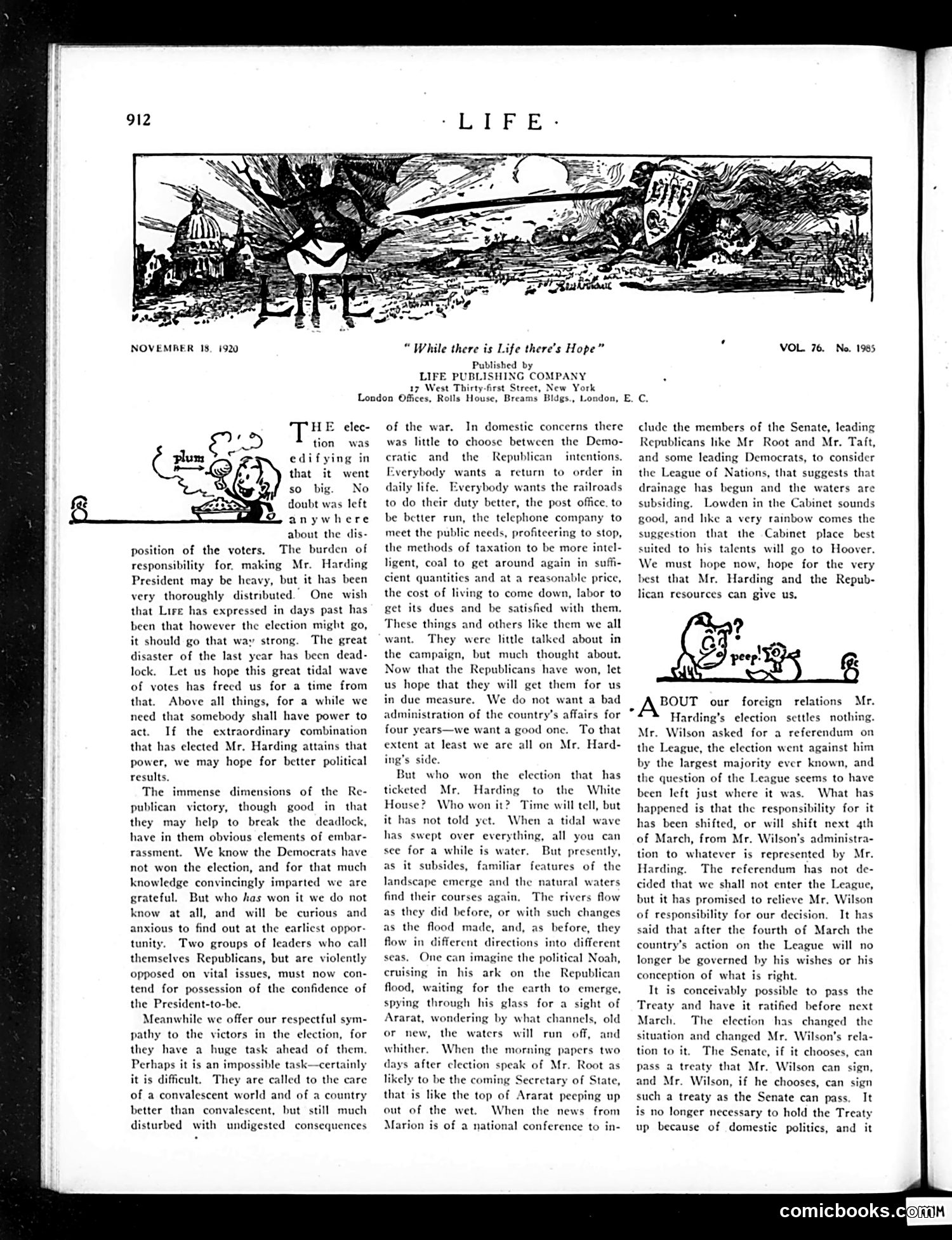
This editorial celebrates Warren G. Harding's decisive victory in the 1920 presidential election. The "tidal wave of votes" references the Republicans' overwhelming defeat of incumbent Democrat Wilson. The key political concern expressed is the fragmentation within the Republican party itself—two groups of Republican leaders with "violently opposed" positions now compete for influence over the president-elect. The text worries about who truly "won" the election beyond Harding's name. The Noah's Ark metaphor is telling: Harding is depicted as cruising uncertainty, awaiting the flood (political realignment) to recede so the landscape clarifies. The reference to Elihu Root as likely Secretary of State suggests anxiety about which Republican faction will control policy. The editorial's tone is cautiously hopeful—praising the end of Democratic "deadlock" while essentially admitting confusion about what the Republican victory actually means or who will shape Harding's administration.
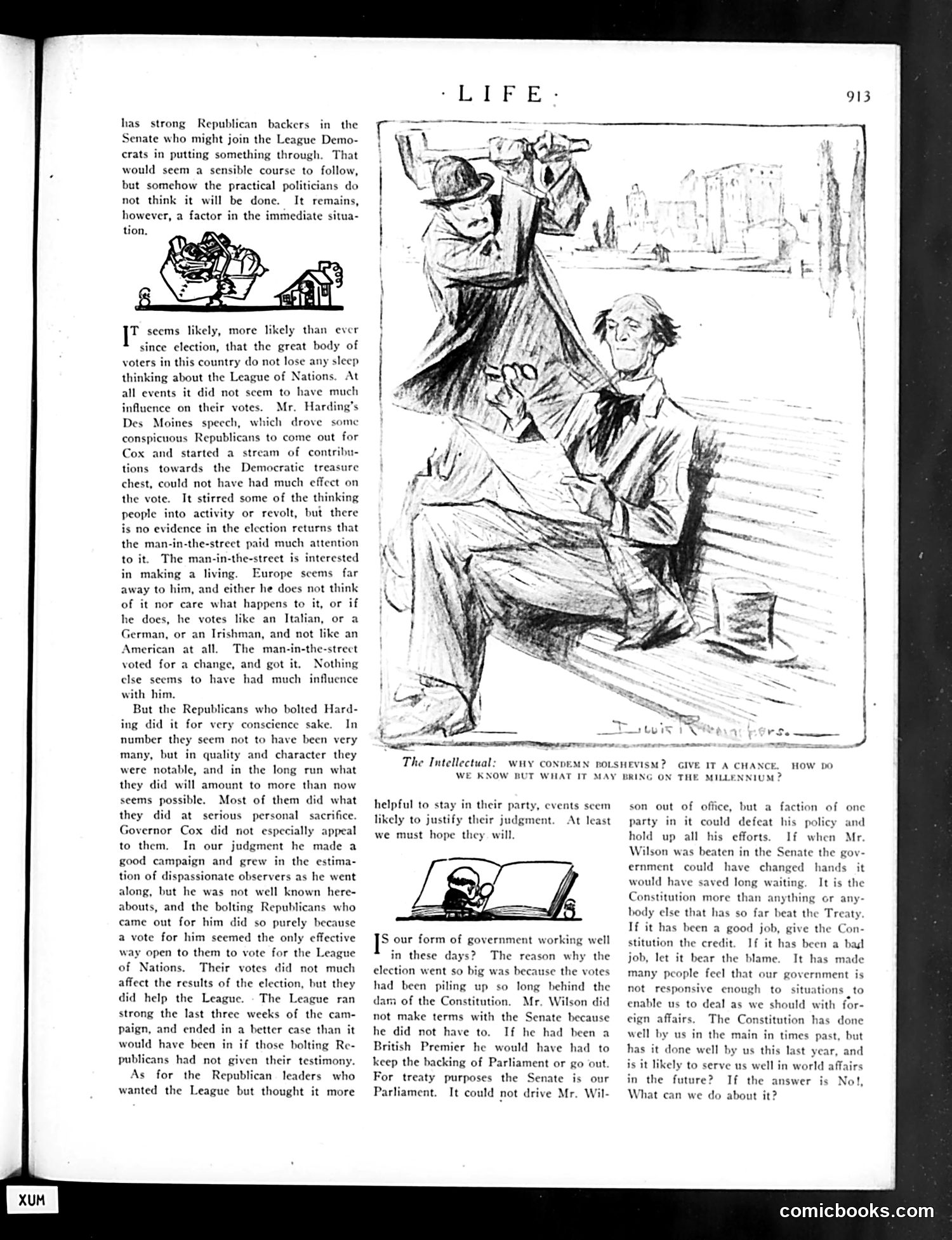
This page discusses the 1920 presidential election outcome, where Republican Warren G. Harding defeated Democrat James Cox. The primary cartoon, titled "The Intellectual," depicts an intellectual figure seemingly perched in a tree, appearing conflicted or distressed. The cartoon satirizes intellectuals who supported the League of Nations—a major election issue. The accompanying text explains that while some Republicans bolted their party to vote for Cox as an indirect League endorsement, most voters ("the man-in-the-street") cared little about the League, voting instead for "change" and domestic concerns. The cartoon's caption mockingly asks intellectuals: "Why condemn Bolshevism? Give it a chance—how do we know what it may bring on the millennium?"—sardonically suggesting that intellectuals' idealism is as naïve as endorsing Bolshevism. The elevated, somewhat precarious positioning emphasizes the intellectuals' perceived detachment from ordinary citizens' practical concerns.
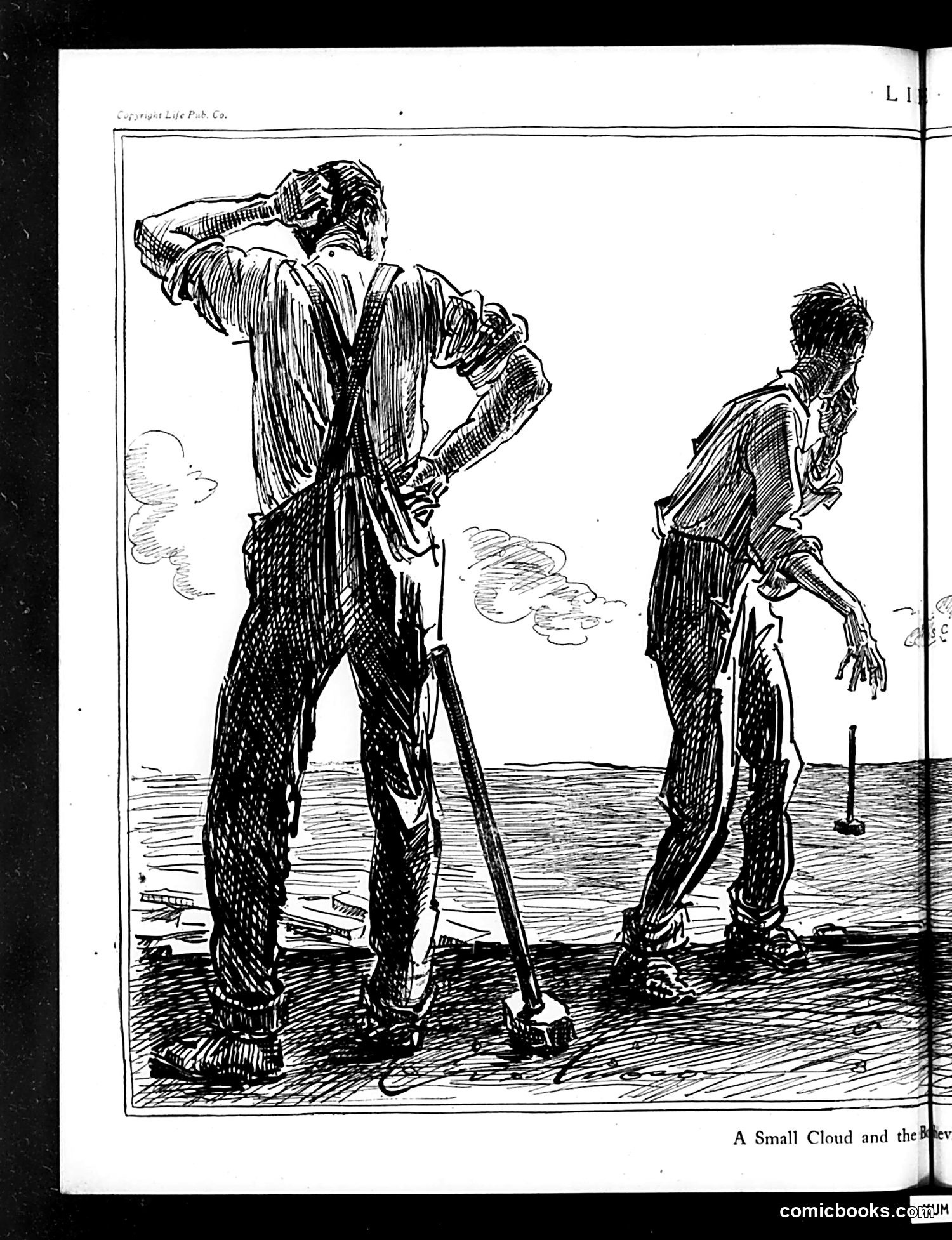
This is a political cartoon titled "A Small Cloud and the [text cut off]." The image shows two figures standing on what appears to be a ship or dock, gazing at the horizon where a small cloud is visible. Both men are dressed in late 19th/early 20th-century attire with formal jackets and hats. The caption suggests a metaphorical meaning—the "small cloud" likely represents an emerging political or social threat or concern. Without the complete caption or additional context from the magazine, the specific reference is unclear. However, the composition of two observers watching an ominous development on the horizon suggests commentary on impending trouble or crisis that authorities should heed. The satirical intent appears to be warning about ignoring warning signs.
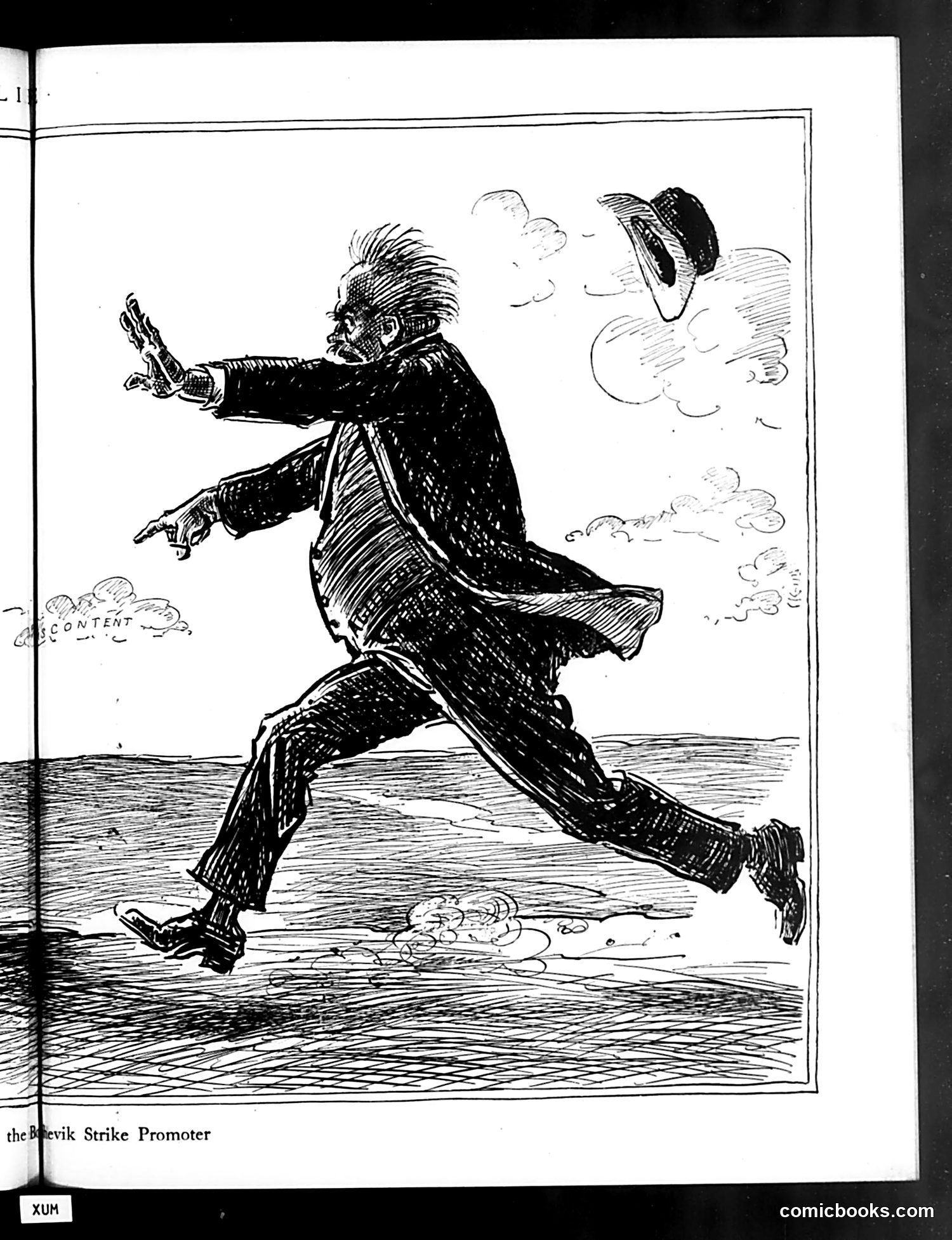
This political cartoon depicts a caricatured figure in formal dress (top hat, coat) in an exaggerated lunging or dancing pose, gesturing wildly toward clouds. The figure appears to be promoting or agitating for strikes, as indicated by the caption "the Boevik Strike Promoter" (though "Boevik" is unclear—possibly an OCR error). The satire likely mocks labor agitators or radical political figures of the early 20th century, portraying them as theatrical, overwrought, or absurdly committed to promoting labor unrest. The dramatic posturing suggests the cartoonist viewed strike promotion as performative grandstanding rather than serious political action. Without clearer historical context, the specific figure referenced remains uncertain.
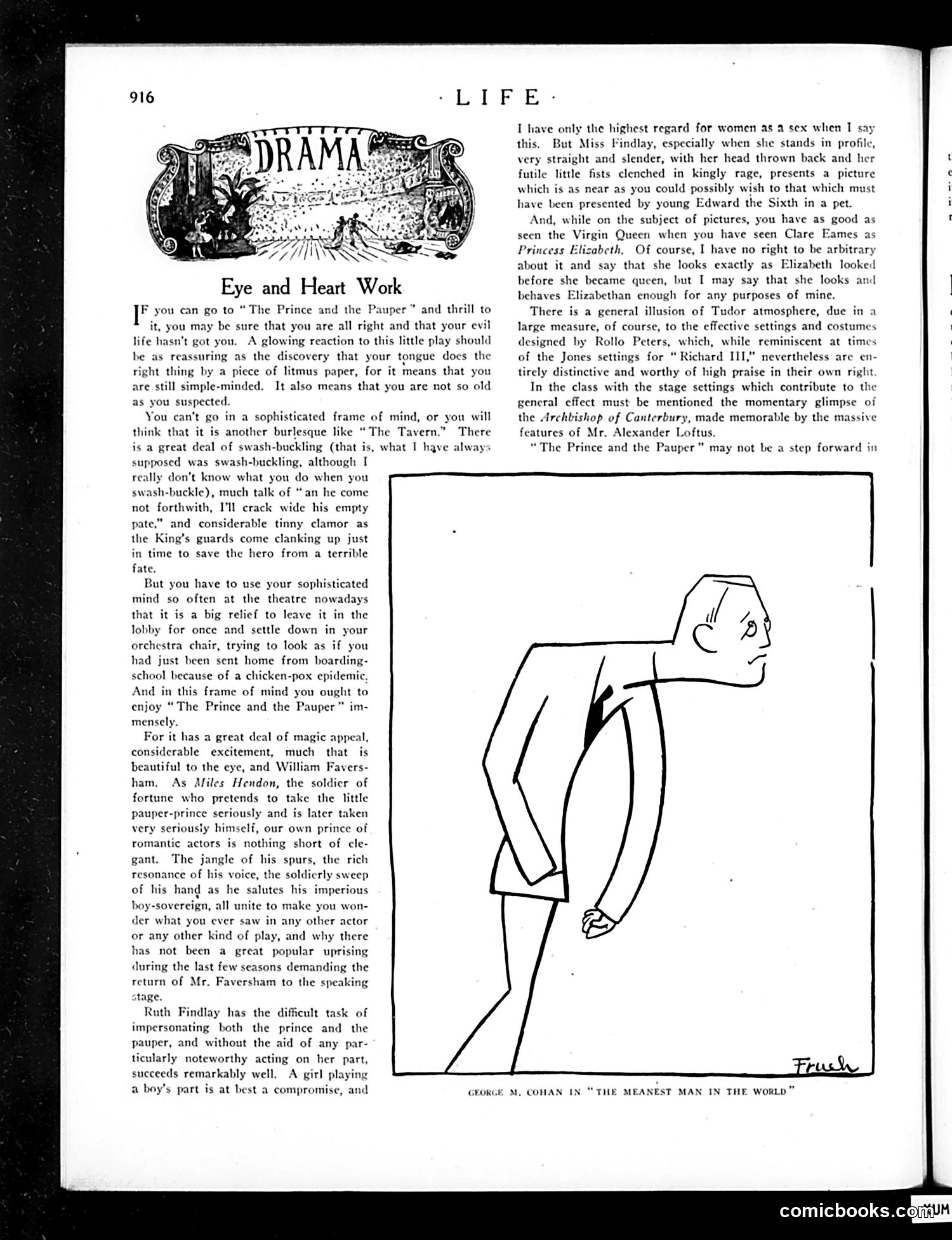
This page reviews the theatrical production of "The Prince and the Pauper," likely a stage adaptation of Mark Twain's novel. The critic praises the production's entertainment value while gently mocking audiences who enjoy it uncritically—suggesting simple-mindedness is required to fully appreciate the swashbuckling adventure. Key figures praised include actor William Faversham (as Miles Hendon), Ruth Findlay (playing dual roles as prince and pauper), and Clare Eames (as Princess Elizabeth). The critic particularly admires the Tudor-era costumes and sets designed by Rollo Peters. The accompanying cartoon (captioned "George M. Cohan in 'The Meanest Man in the World'") depicts a scheming or suspicious character in period dress—likely illustrating another theatrical production. The tone is affectionately condescending: the critic suggests leaving one's "sophisticated mind" at the door to enjoy this simple but visually beautiful spectacle.
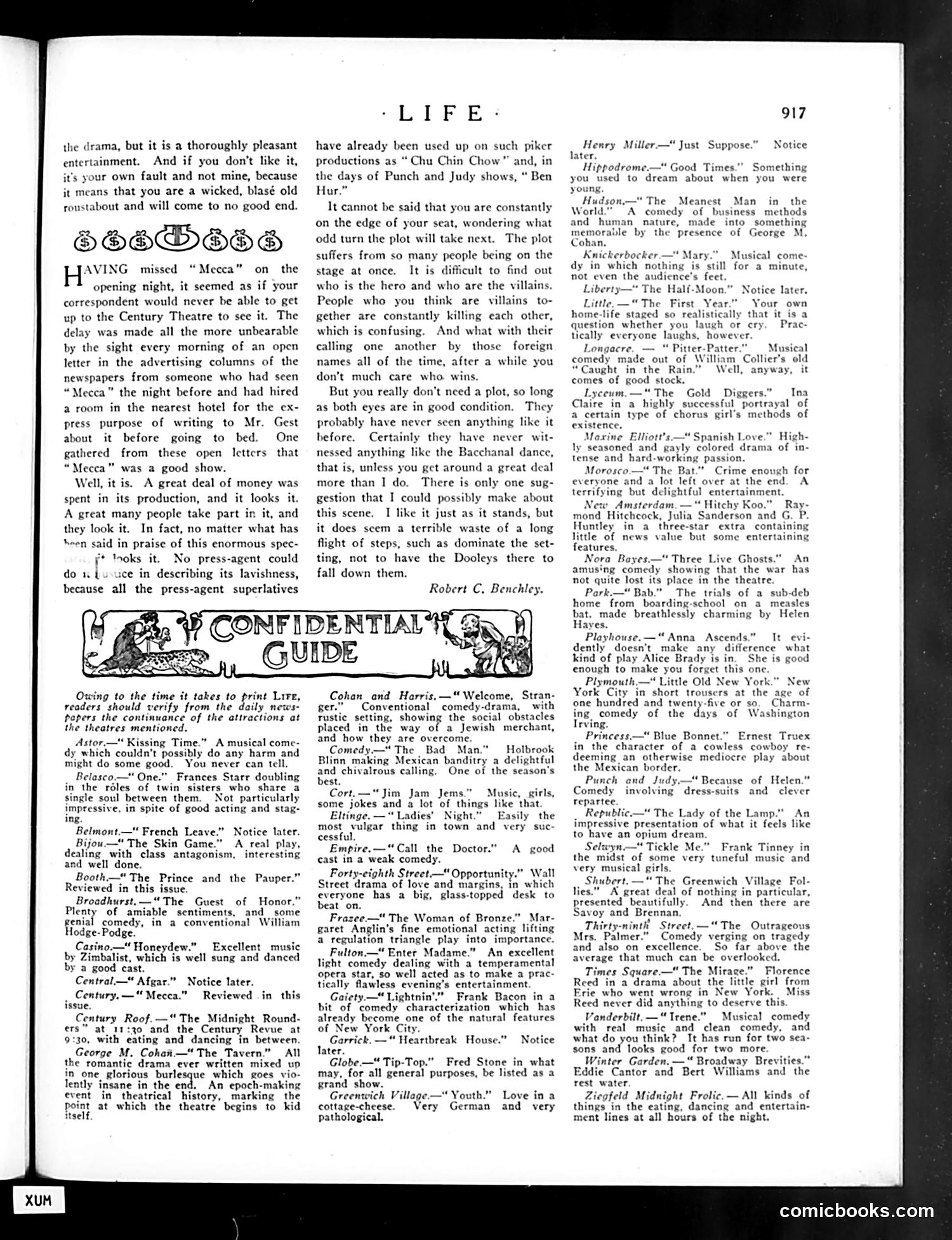
This page is primarily a **theater guide and review column** for Broadway shows, not a political cartoon. The only illustration is a decorative "Confidential Guide" header with ornamental design. The main review discusses the musical production **"Mecca,"** critiquing its spectacular staging while mocking its plot and confusing narrative. The reviewer sarcastically notes the production's lavish expense and large cast are evident, but the plot is nearly incomprehensible—audiences can't identify heroes from villains, and foreign character names make it hard to care who wins. A notable joke references the **Dooleys** (likely the popular "Mr. Dooley" comic characters of the era) in jest about wasting the elaborate staircase set. The review suggests the show succeeds despite poor storytelling, relying entirely on visual spectacle. The page also lists other Broadway offerings with brief descriptions, representing typical theater criticism of the 1920s era.
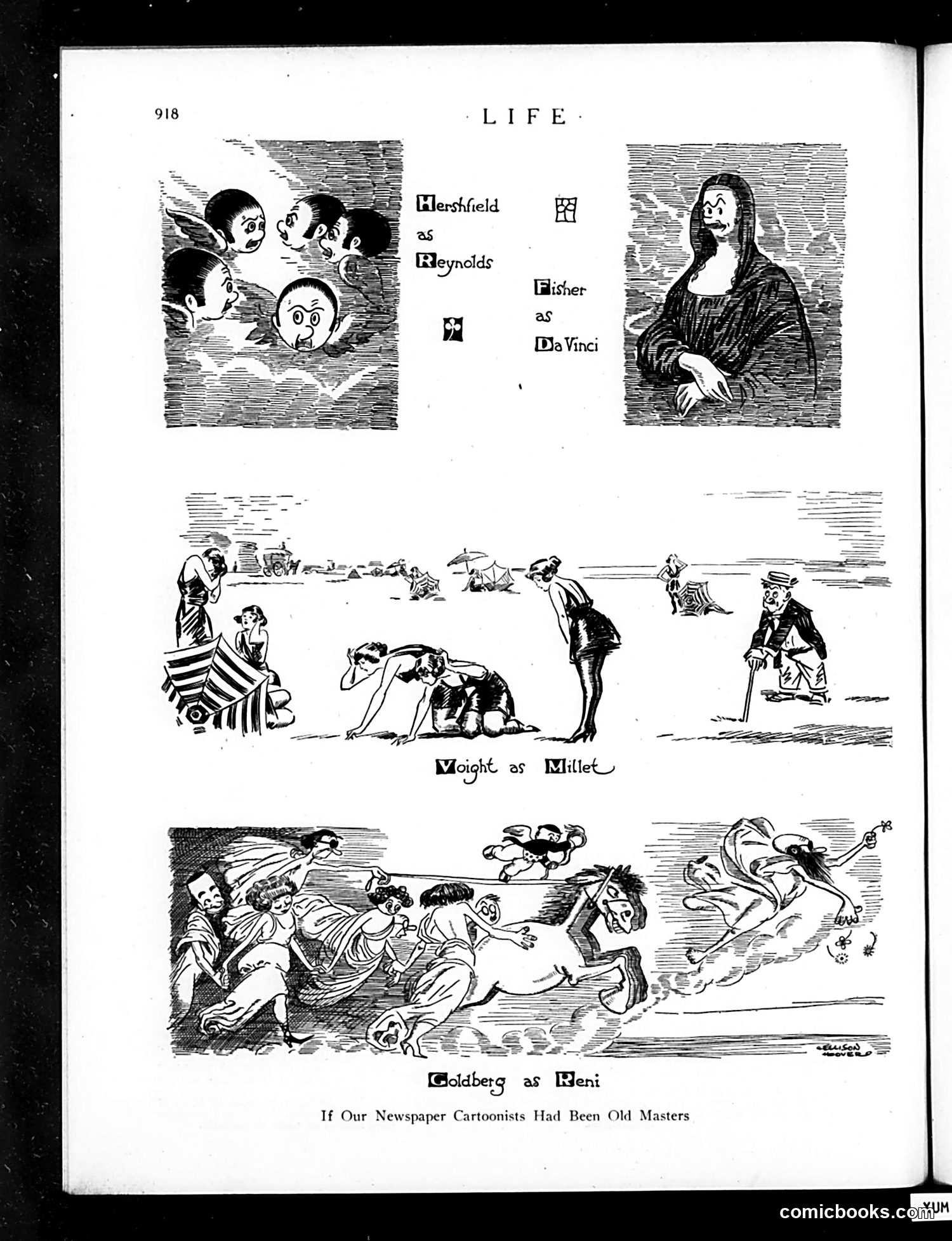
This page presents a humorous thought experiment: "If Our Newspaper Cartoonists Had Been Old Masters." It reimagines contemporary cartoonists working in the styles of famous Renaissance and Old Master painters. The visible examples show: - **Hershfield and Reynolds as Rembrandt**: A crowded composition with multiple figures, imitating Rembrandt's dramatic lighting and group scenes - **Fisher as Da Vinci**: A portrait styled after the Mona Lisa - **Voight as Millet**: A rural/peasant scene recalling Millet's social realist work - **Goldberg as Beni** (likely Benvenuto Cellini): An elaborate, dynamic mythological or allegorical scene The satire suggests that newspaper cartoonists—working in a popular, commercial medium—possess artistic talents comparable to celebrated masters. It's a playful commentary on the artistic legitimacy of cartooning versus "high art," a debate that was live in early 20th-century American culture.
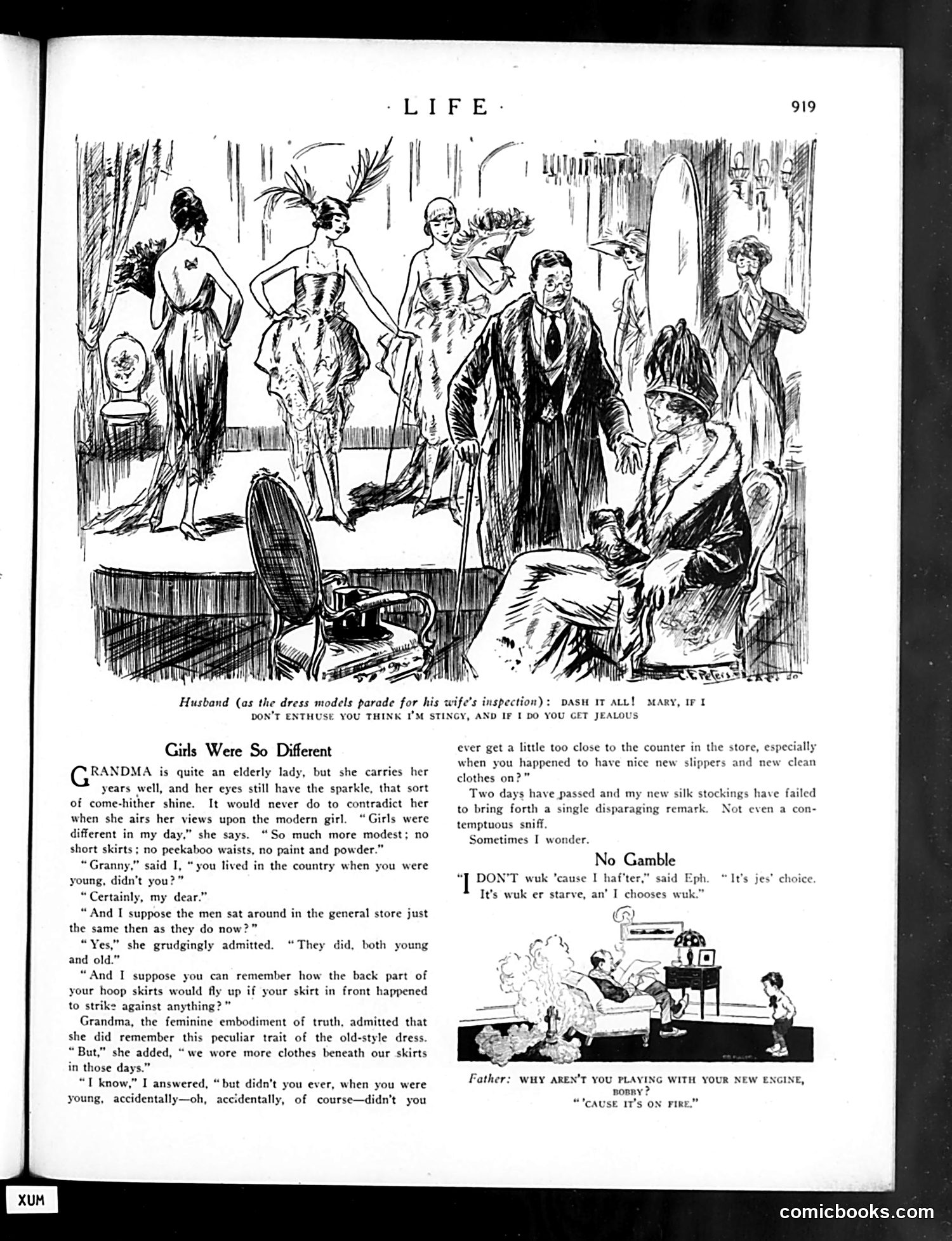
This page contains two satirical pieces typical of early 20th-century American humor: **Top Cartoon**: Shows a husband caught in a no-win situation with his wife during a fashion show. The satire critiques marital dynamics—he's damned either way: enthusiasm for the models makes him appear stingy if he doesn't buy, but showing interest risks accusations of jealousy. It mocks the tension between demonstrating affection through spending and appearing fiscally responsible. **"Girls Were So Different"**: A grandmother claims modern girls lack modesty compared to her youth. The narrator cleverly reveals her hypocrisy through dialogue, suggesting old-fashioned women in hoop skirts deliberately exposed themselves ("accidentally") to display new clothing. The joke undercuts nostalgia by showing women's behavior was essentially unchanged—only fashion differed. **"No Gamble"**: A brief comic about an impoverished man (dialect suggests rural/working-class) choosing between starvation and labor. Dark humor about economic desperation. All pieces use gentle satire to examine gender relations, generational conflict, and class.
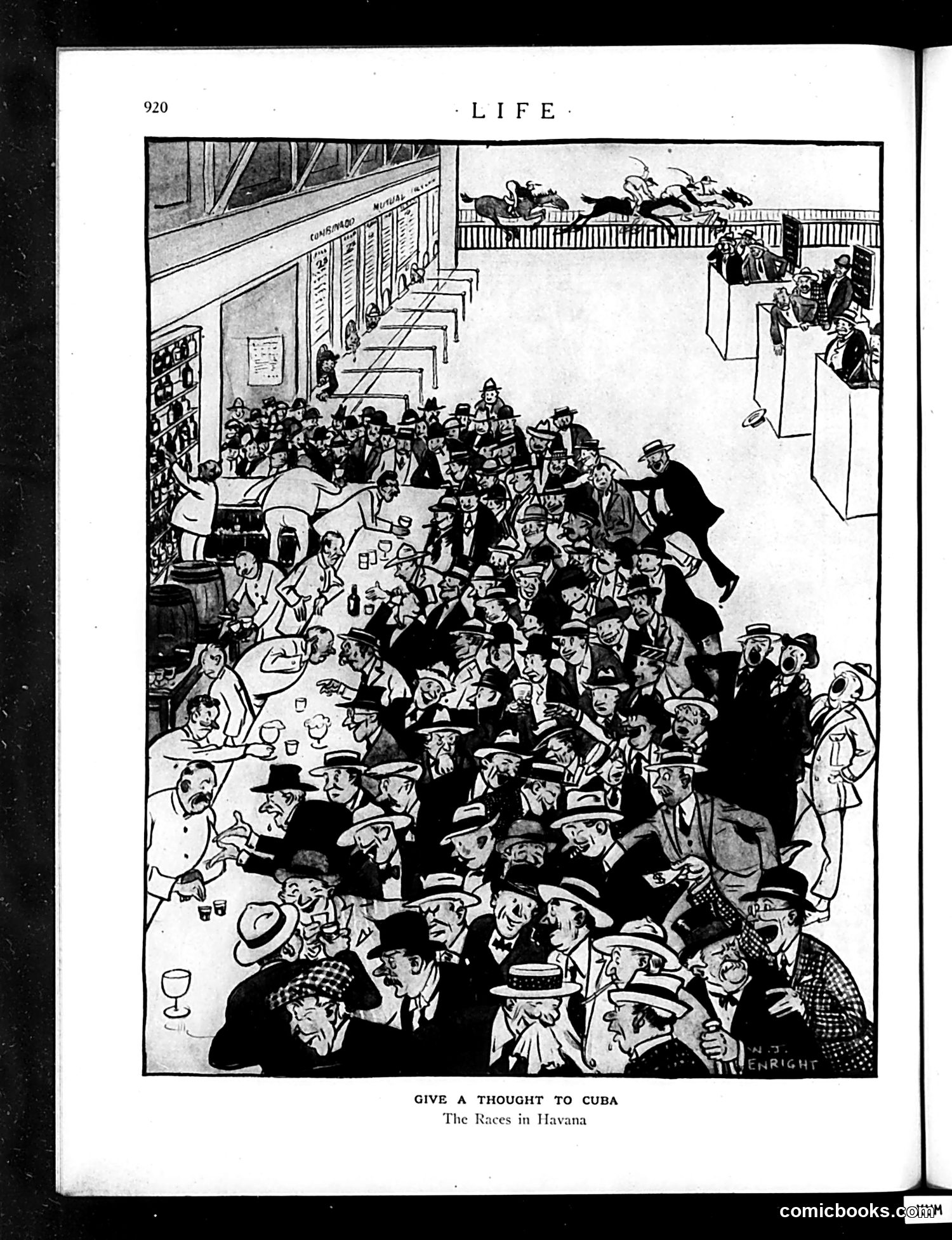
This satirical cartoon depicts a chaotic horse-racing scene in Havana, Cuba. The massive crowd of well-dressed men (primarily wearing hats and formal attire) is densely packed around what appears to be a betting or viewing area, with horse races visible in the background. The satire suggests that while Cuba—likely during a period of political instability or concern—deserves serious attention, American attention is instead focused on leisure activities like horse racing and gambling. The crowded, frenzied composition emphasizes how distracted people are from weightier matters. The title's appeal to "give a thought" to Cuba contrasts sharply with the depicted obsession with entertainment and betting, critiquing American indifference to Cuban affairs in favor of frivolous pursuits.
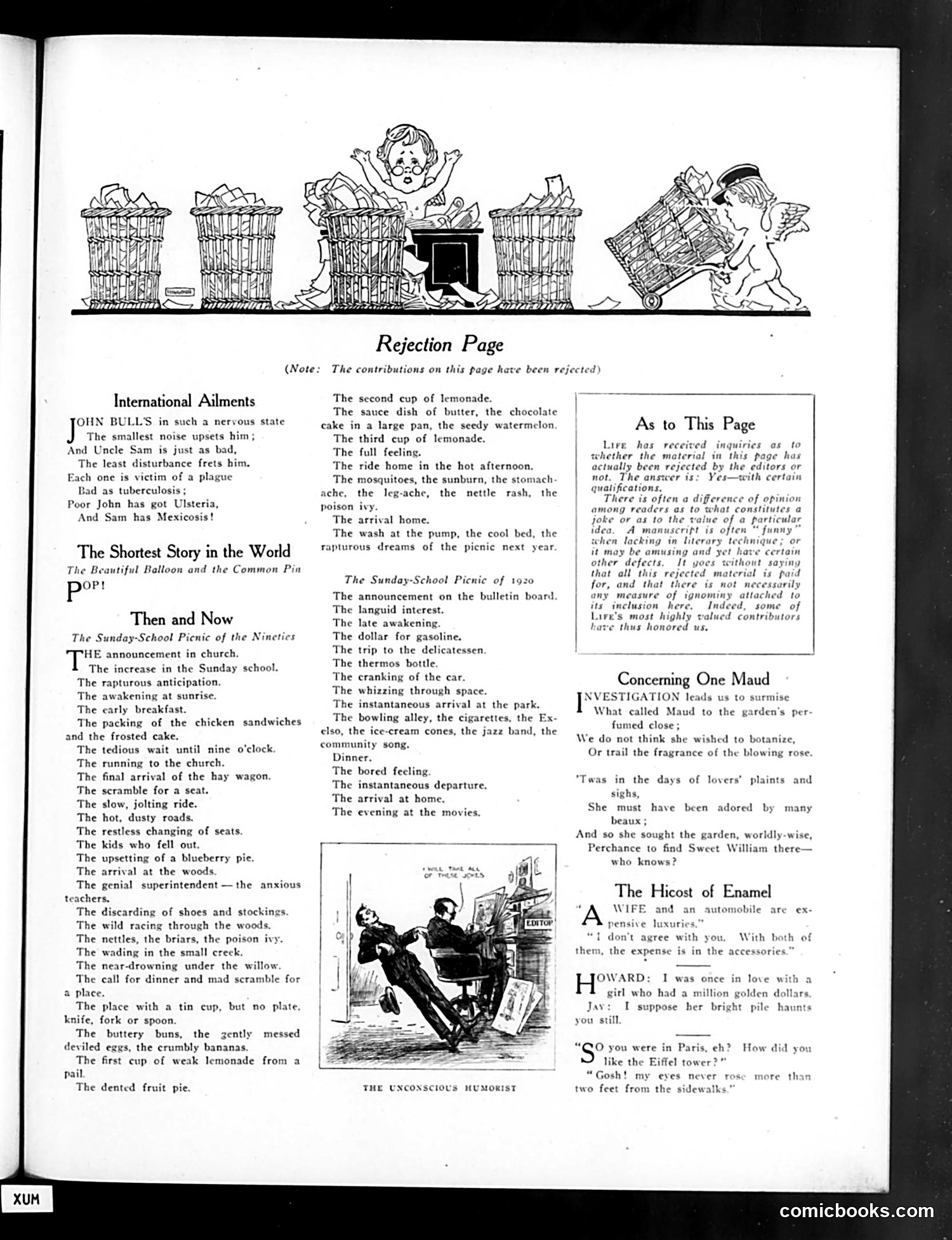
This page explains Life's editorial policy to readers. The header illustration shows overflowing rejection baskets, symbolizing submitted contributions the magazine has declined to publish. The page contains several rejected pieces, including humorous verse about "International Ailments" (satirizing British and American political anxieties—"Ulsteria" and "Mexicosis"), contrasts between idealized 1890s Sunday school picnics versus modern 1920s versions (automobiles, jazz, movies replacing wholesome traditions), and brief comic dialogues. The explanatory box "As to This Page" clarifies that rejected material doesn't represent poor quality or editorial judgment—simply differing opinions on what constitutes humor. This transparency likely reflects Life's confidence in its editorial standards while maintaining good relations with contributors. The page functions as both satire and editorial candor about the magazine's selection process.
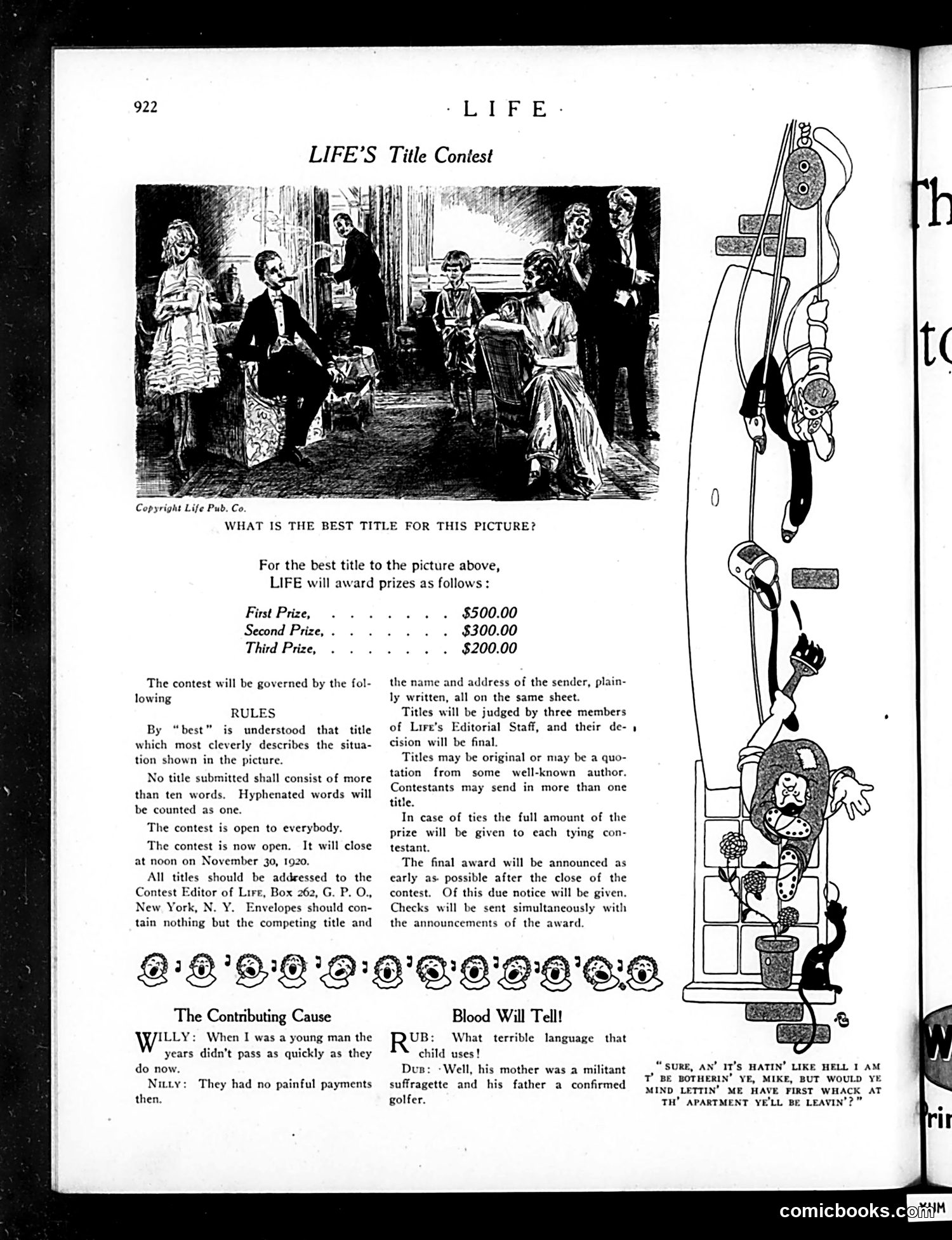
This page features **LIFE's title-writing contest**, inviting readers to caption an illustration of elegantly dressed people in what appears to be a formal interior setting. Winners receive $500, $300, and $200—substantial prizes for 1920. The contest closes November 30, 1920. Below are two brief comedic sketches: **"The Contributing Cause"** jokes about aging: a man notes years passed quickly in youth because he avoided "painful payments" (likely installment debt). **"Blood Will Tell"** suggests heredity explains behavior—a child's crude language supposedly stems from his mother being a militant suffragette and his father a "confirmed golfer" (implying frivolous character). This reflects early-20th-century notions linking temperament to parentage. The page primarily showcases **reader participation content**, common in LIFE's satirical format, rather than editorial commentary.
This is primarily **advertising, not satire or political commentary**. It's a full-page advertisement for S.D. Warren Company's printing papers, published in *Life* magazine. The text is a moral appeal dressed as editorial content. It argues that printers and their customers have an ethical obligation to use quality materials—specifically Warren's papers—to avoid producing "false, foolish, or ugly" printed matter. The rhetoric suggests printing is almost a sacred trust, comparing it to an "unchained" intelligence that shaped civilization. The ad lists Warren's various paper grades (Cameo, Lustro, Silkote, etc.) with technical specifications below. **For modern readers:** This represents early 20th-century *advertorial* content—advertising designed to read like principled journalism. The appeal to civic responsibility and professional ethics is essentially marketing strategy: by elevating printing to moral importance, the company elevates their product as essential to that mission. There's no satire here; it's sincere corporate messaging.
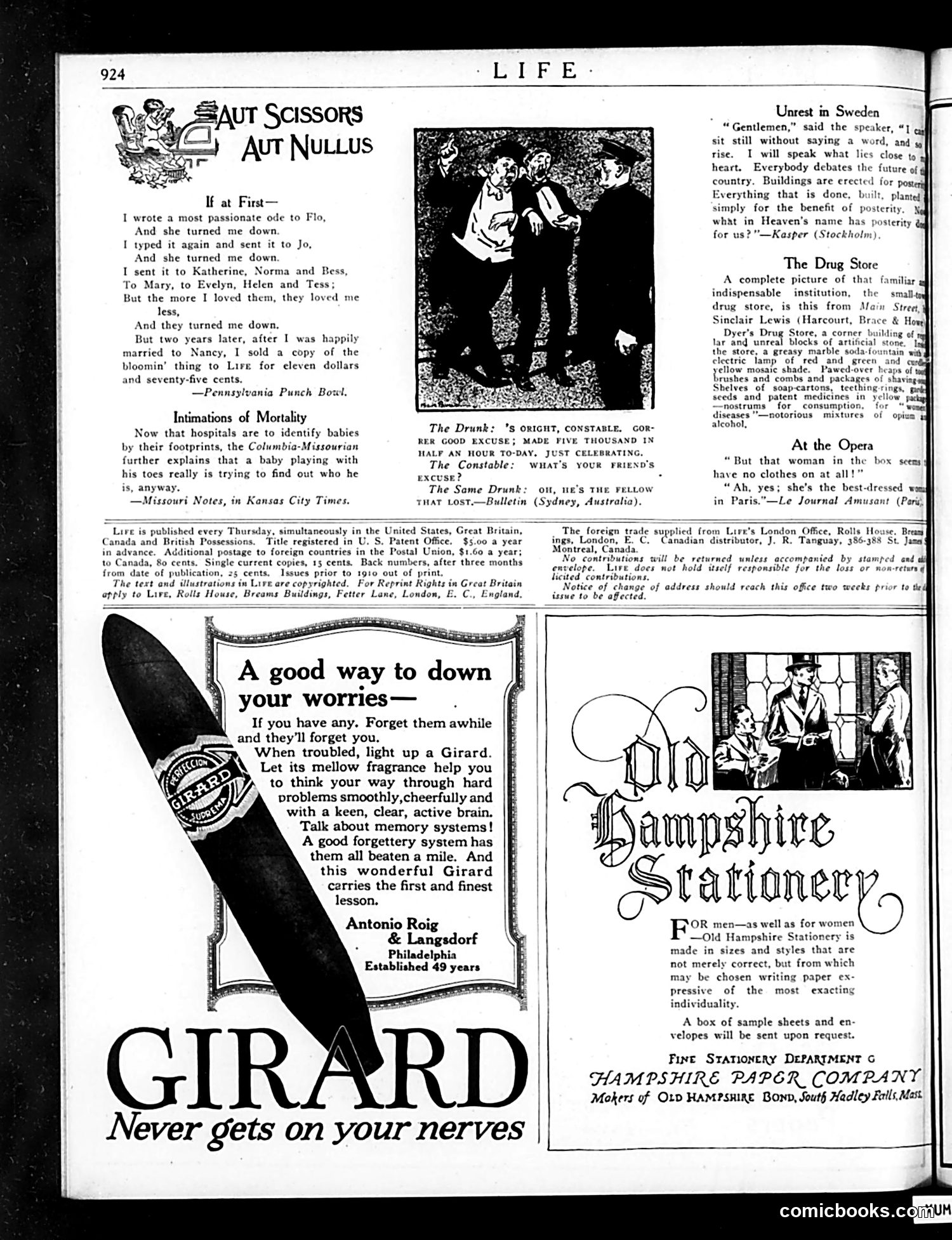
This page from *Life* magazine (appears to be early 20th century) contains several satirical pieces: **"If at First" poem**: A romantic comedy about a rejected suitor whose love poems are rejected by multiple women, then—after marrying Nancy—he sells the same poem to *Life* magazine for $11.75. The joke satirizes both persistent romantic failure and the magazine's willingness to publish recycled content. **"The Drunk" cartoon**: Shows a drunk man boasting to a constable about making "five thousand in half an hour" celebrating. The constable's friend asks who the man is; the reply is he's "the fellow that lost" the money. It's a standard joke mocking drunken delusion and poor judgment. **Other brief items** include humorous observations on hospital baby identification, Swedish political anxiety, and opera fashion pretension. The page is primarily **advertising** (Girard cigars, Hampshire Stationery, drug store descriptions), with humor pieces filling gaps. The satire targets common human foibles rather than specific political figures.
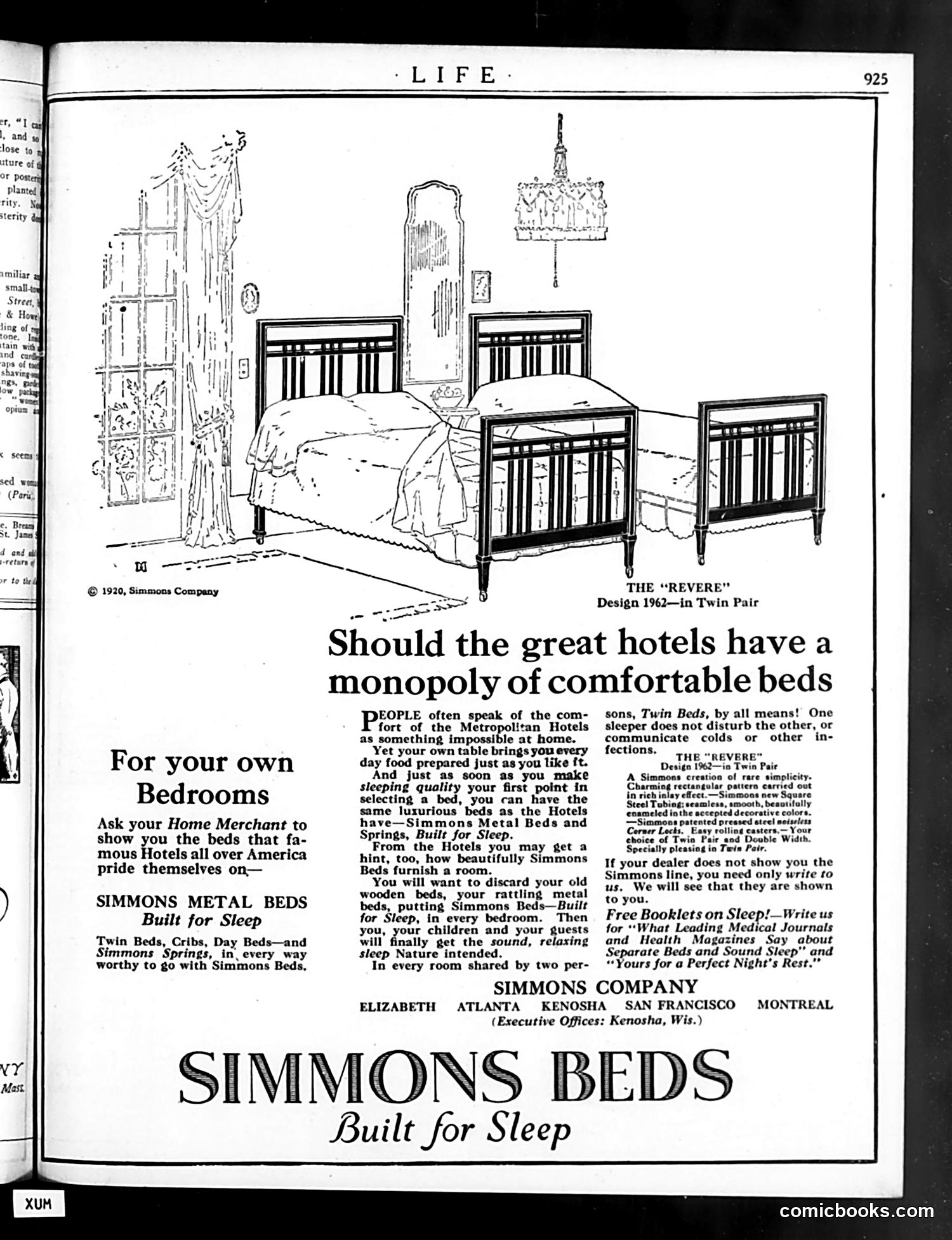
This is primarily a **furniture advertisement**, not political satire. The page promotes Simmons Metal Beds, marketed as the same quality product used in prestigious hotels. The central argument is rhetorical rather than satirical: the headline asks "Should the great hotels have a monopoly of comfortable beds?" —implying the answer is no. The ad suggests middle-class consumers can now afford hotel-quality bedding for their homes, democratizing luxury. The illustration shows "The Revere" twin bed design in a bedroom setting, emphasizing modern aesthetics and practicality. The ad copy highlights benefits like hygiene (separate twin beds prevent "communicating colds"), durability, and proper sleep quality. This reflects 1920s consumer culture messaging: that industrial mass production made luxury accessible to ordinary households. There's no identifiable political cartoon or satirical figures—just an earnest sales pitch presenting quality bedding as a democratic consumer good.
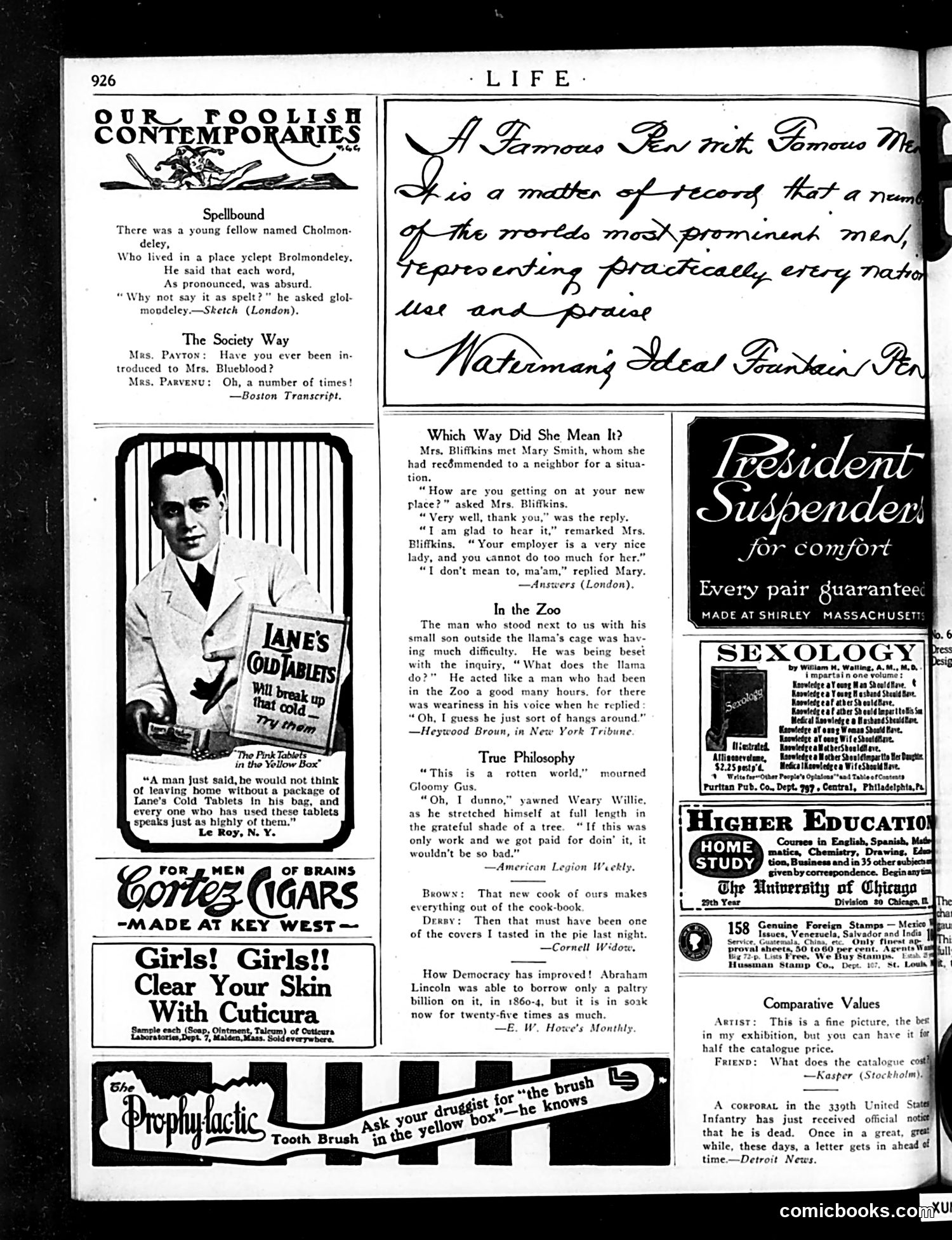
This page from *Life* magazine (early 20th century) collects brief humorous anecdotes and jokes reflecting contemporary social observations: **"Spellbound"** mocks British pronunciation inconsistencies—a young man from "Brolmondeley" questions why English words aren't pronounced as spelled. **"The Society Way"** satirizes social climbing: a nouveau-riche woman claims repeated introductions to high society, implying either social amnesia or pretentious exaggeration. **"Which Way Did She Mean It?"** uses servant-employer wordplay: when a maid says she won't "do too much" for her employer, ambiguity creates humor about her true intentions. **"In the Zoo"** gently mocks parental exhaustion and evasion—a father, worn from constant questioning, gives a non-answer about the llama's purpose. **"True Philosophy"** presents contrasting worldviews: while one character despairs about life, another finds silver lining in the absurd notion that suffering would be worthwhile if compensated. The page primarily features **humorous social commentary** on class interactions, language, and domestic situations—typical of *Life's* satirical approach to American life.
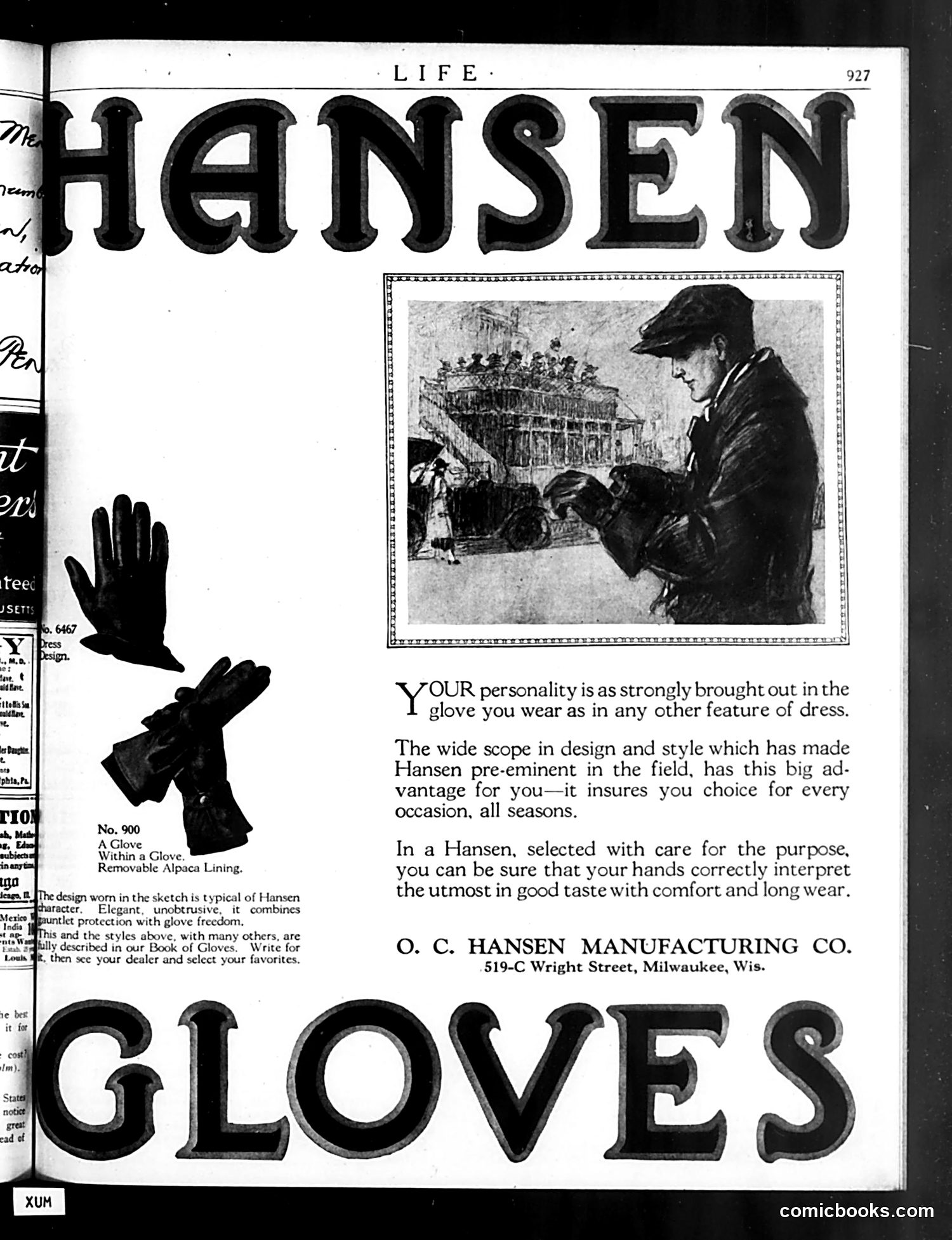
This is a straightforward **product advertisement**, not political satire. It promotes Hansen brand gloves from Milwaukee, emphasizing that glove selection reflects personal style and taste—"your personality is as strongly brought out in the glove you wear as in any other feature of dress." The page features: - A photograph of a man examining gloves, with a building in the background - Two illustrated black gloves (labeled "No. 900: A Glove Within a Glove") - Marketing copy highlighting Hansen's range of styles for "every occasion, all seasons" - A claim that Hansen gloves ensure "good taste with comfort and long wear" The implicit message is typical of early 20th-century advertising: proper accessories (in this case, quality gloves) are markers of respectability and social standing. There is no cartoon or satirical content present on this page—it's purely commercial marketing material from *Life* magazine's advertising section.
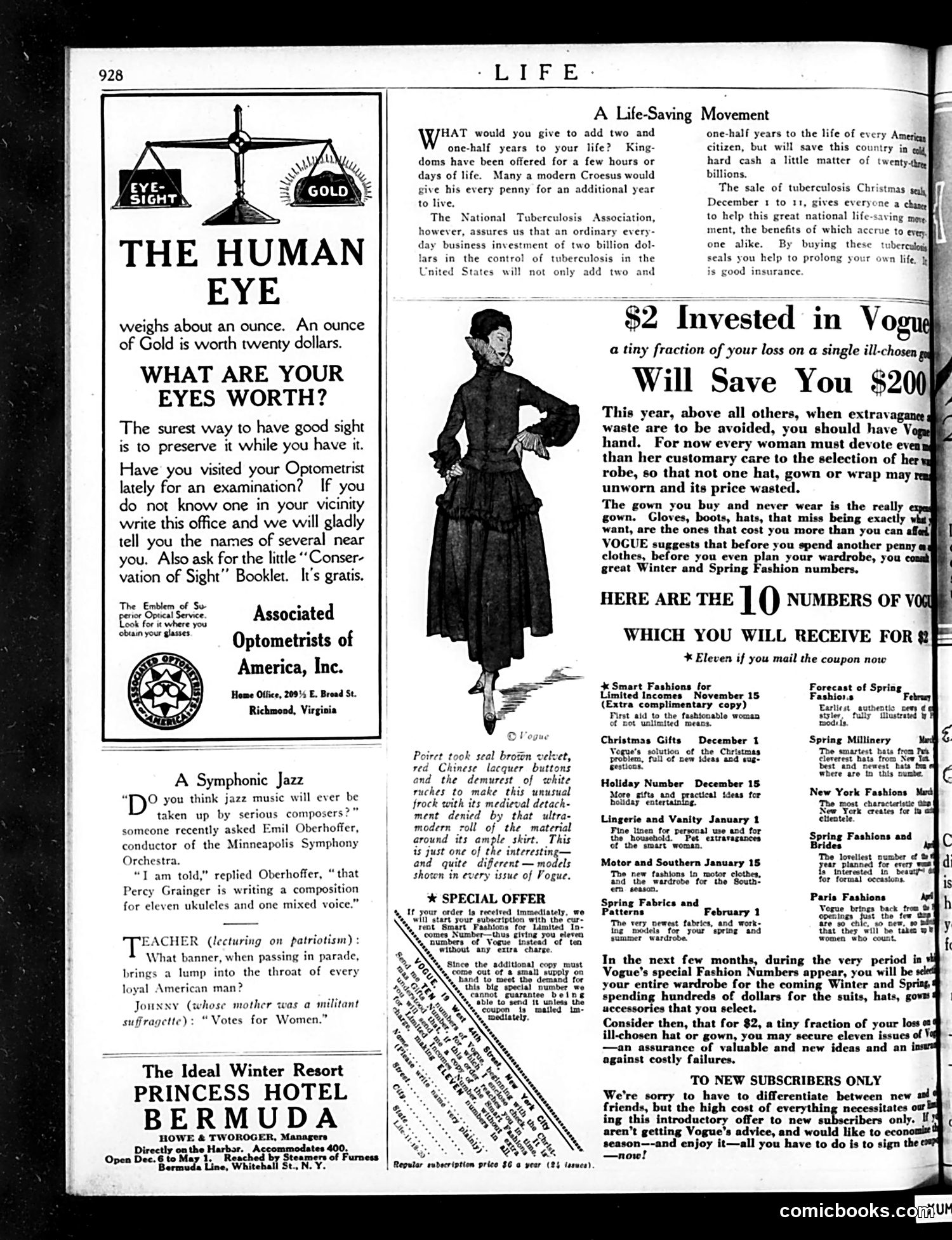
This page from *Life* magazine contains several distinct pieces of content: **Main Editorial Content:** The dominant feature is a public health campaign promoting tuberculosis awareness and Christmas seals (visible in the "Life-Saving Movement" section). The message appeals to readers' self-interest: investing in TB control saves the nation money while potentially extending individual lifespans. **Humor/Satire:** Two brief comedic pieces appear: 1. A joke about jazz composer Percy Grainger supposedly writing for "eleven ukuleles and one mixed voice"—satirizing both the novelty of jazz and highbrow composers' dismissal of popular music. 2. A classroom joke where a student answers "Votes for Women" to a patriotism question—satirizing both militant suffragism (referenced as the student's mother being "a militant suffragette") and the absurdity of the answer. **Advertising:** The page includes standard period advertisements for optometry services, a Bermuda hotel, and primarily a *Vogue* magazine subscription offer. The overall tone reflects early 20th-century concerns: public health campaigns, gender politics, and consumer culture targeting women.
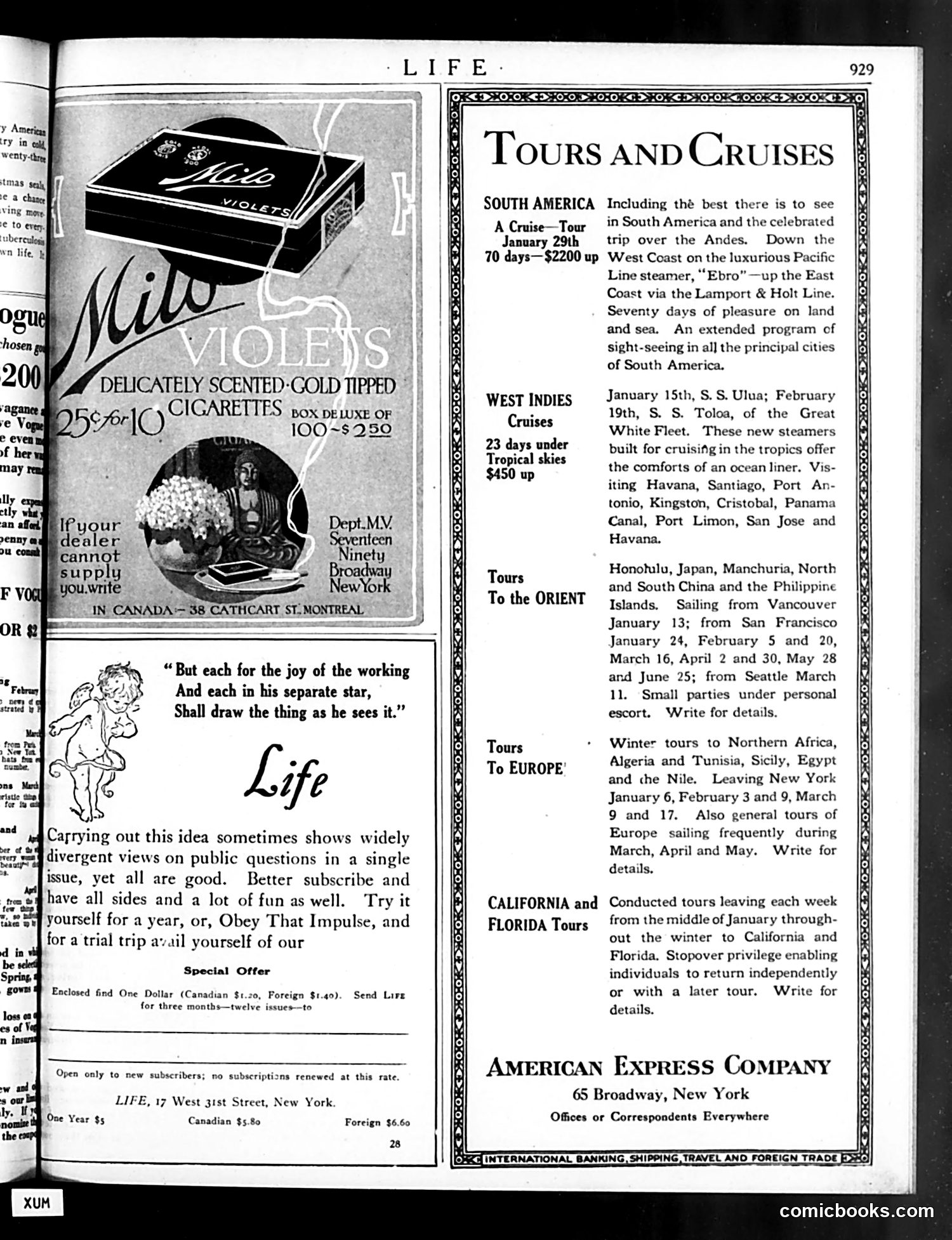
This page is primarily **advertising**, not political satire. The left side features a luxury cigarette ad for "Milo Violets"—delicately scented, gold-tipped cigarettes at 25¢ for 10—targeting affluent consumers. Below is a brief editorial statement about Life's editorial philosophy, illustrated with a cherub figure. It emphasizes that the magazine publishes diverse viewpoints on public issues, encouraging readers to subscribe for "all sides and a lot of fun." The right page is entirely dedicated to travel advertising from the American Express Company, promoting luxury cruises and tours to South America, the West Indies, the Orient, Europe, and domestic destinations like California and Florida. These offerings—ranging from 23 to 70 days at $450 to $2,200—targeted wealthy Americans during what appears to be the 1920s travel boom. No political cartoon or satirical commentary is present on this page.
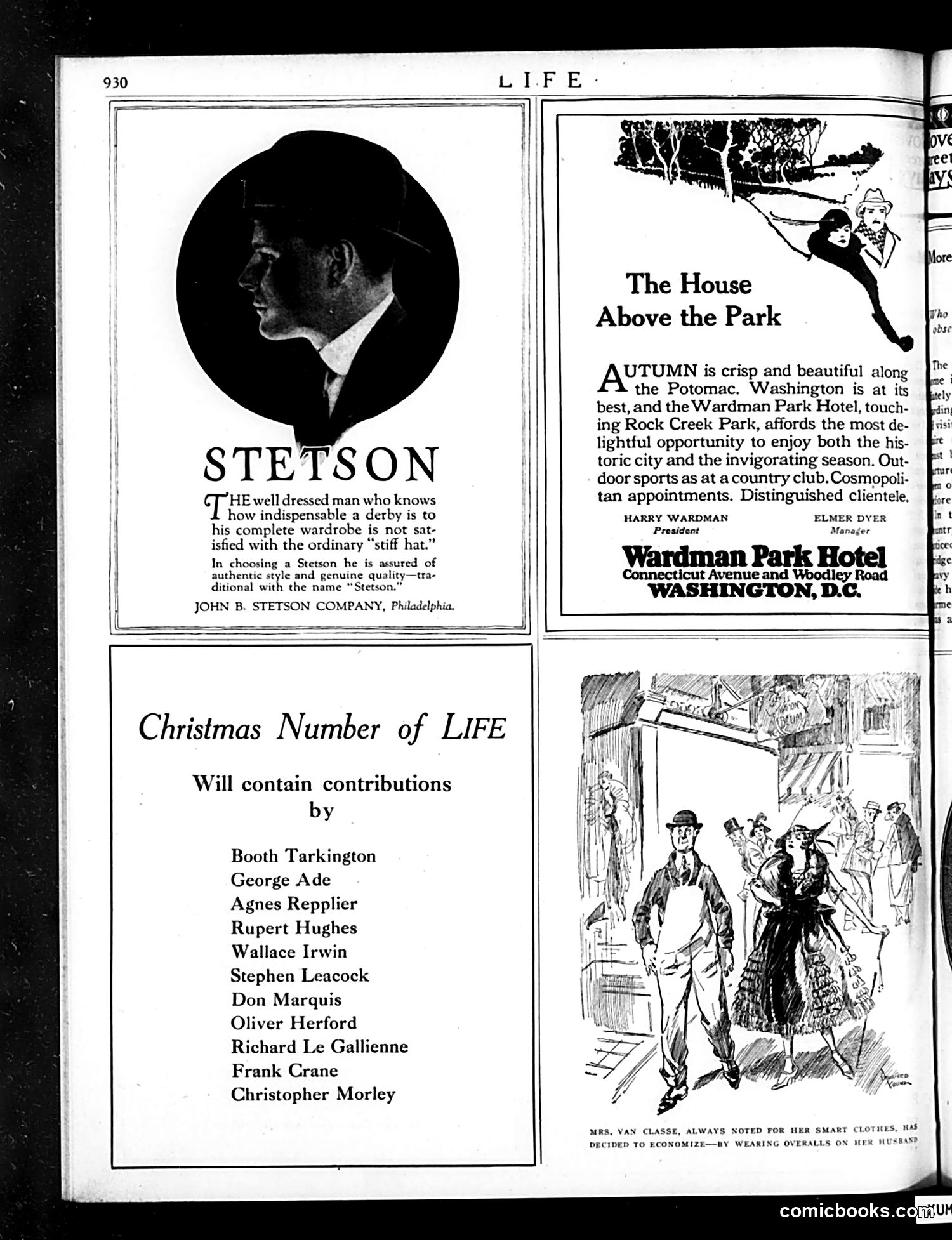
This is primarily a **advertising and promotional page** rather than political satire. **Left side:** A Stetson hat advertisement features a profile portrait of a well-dressed man in a derby hat, promoting Stetson's quality and "authentic style"—appealing to middle-class male vanity about proper attire. **Right side:** An advertisement for the Wardman Park Hotel in Washington, D.C., emphasizing luxury accommodations near Rock Creek Park, with an illustration of fashionable guests arriving. **Center:** Promotion for Life's upcoming Christmas issue, listing prominent literary contributors of the era (Booth Tarkington, George Ade, Don Marquis, etc.). **Bottom cartoon:** A humorous illustration satirizing wartime or Depression-era economizing. A woman ("Mrs. Van Classe") attempts to save money by wearing work overalls instead of fashionable clothes—the joke being that someone accustomed to wealth and "smart clothes" awkwardly adopts working-class attire as an economy measure. The satire mocks both ostentatious consumption and superficial cost-cutting.
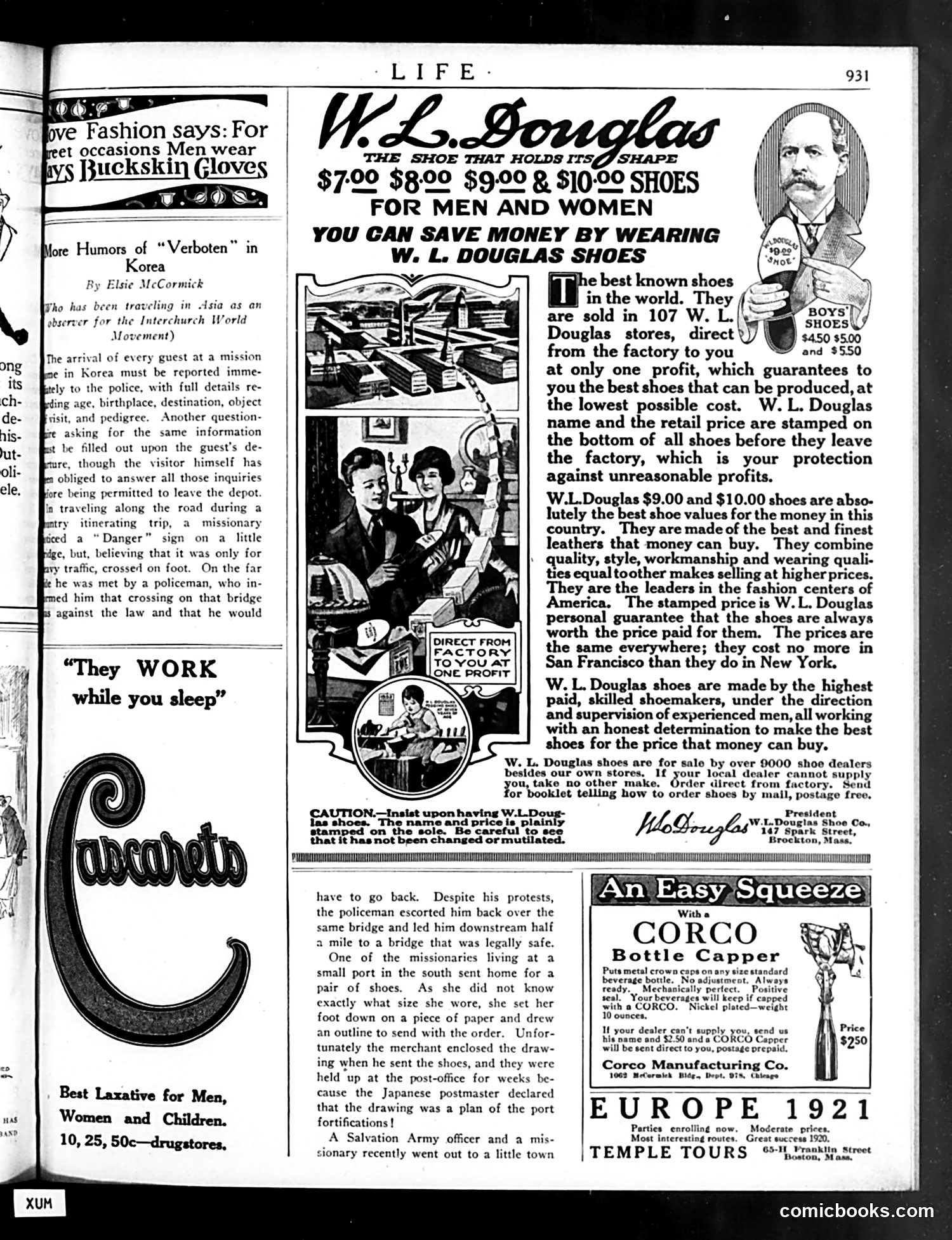
This page is primarily **advertising**, with a small satirical column as filler content. The main feature is a large **W.L. Douglas Shoes advertisement**, emphasizing direct factory-to-consumer sales that guarantee "the lowest possible cost" by eliminating middleman profits. The ad uses patriotic imagery and testimonials to market shoes as an honest value. The small column, "Humors of 'Verboten' in Korea," by Elsie McCormick, offers light satire about Japanese and Korean bureaucratic restrictions on foreigners during the post-WWI era. The anecdotes—a missionary crossing a forbidden bridge, another ordering shoes by drawing her foot on paper (mistaken for a "port fortification plan")—mock both rigid foreign regulations and the absurd miscommunications that result. The humor relies on readers' familiarity with post-war Asia's strict occupation-era rules and the era's missionary travel narratives.
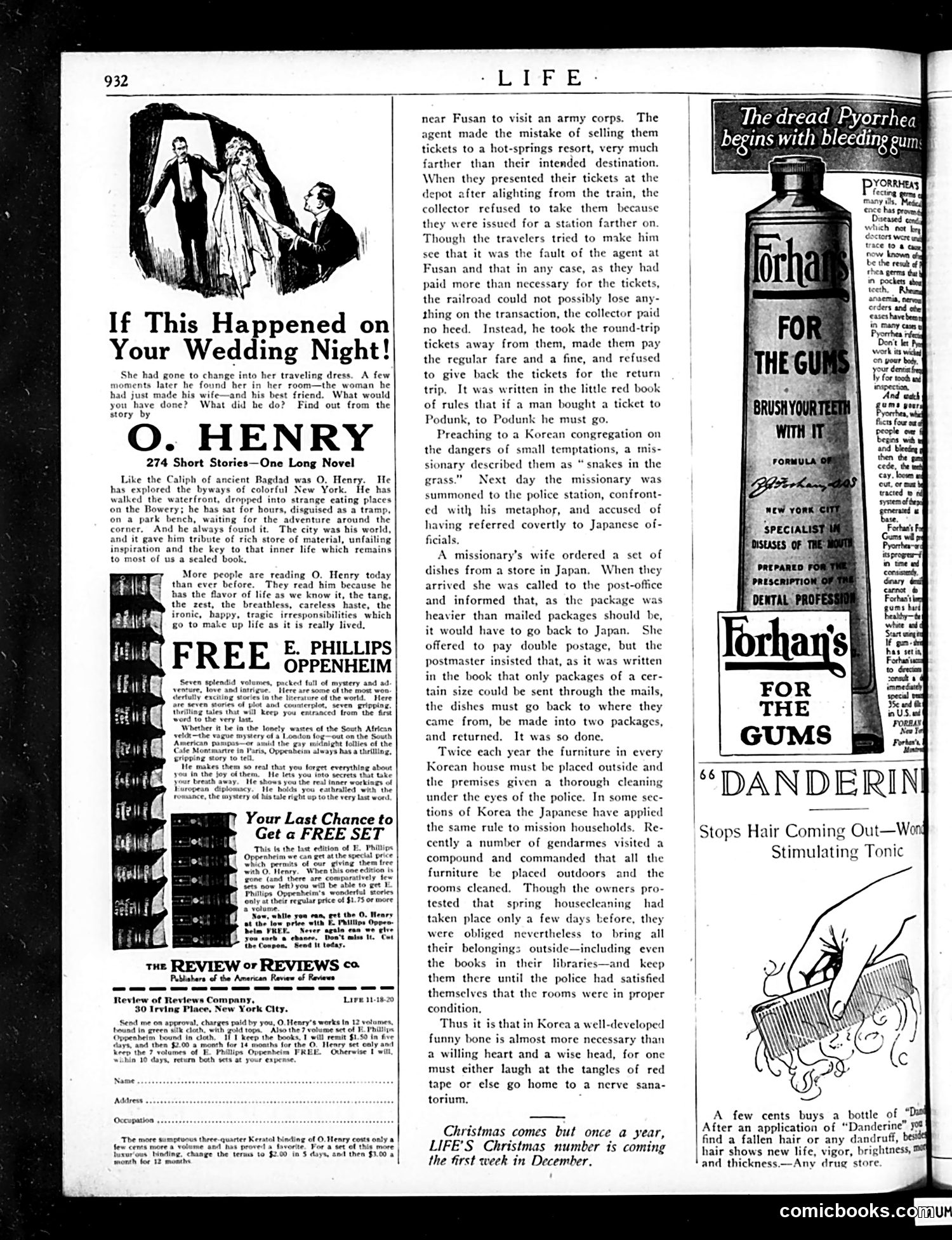
This page is primarily **advertising and book promotion**, not political satire. The main content advertises O. Henry's collected short stories (274 stories bound as one volume) through a serialized story premise: "If This Happened on Your Wedding Night!" — describing a scandalous honeymoon discovery to hook readers. Below that is an ad for E. Phillips Oppenheim's mystery novels, offering a "FREE SET" to entice subscriptions to *Review of Reviews* magazine. The only humorous content appears to be O. Henry excerpts embedded in the ads—brief anecdotes about human nature and bureaucracy (a Korean railway collector rigidly enforcing rules; a missionary's sermon about temptation backfiring). These illustrate O. Henry's trademark style: ironic, witty observations about ordinary people and life's absurdities. There is no political cartoon. The page demonstrates early 20th-century magazine advertising strategy: use famous author endorsements and serialized stories to drive subscriptions.
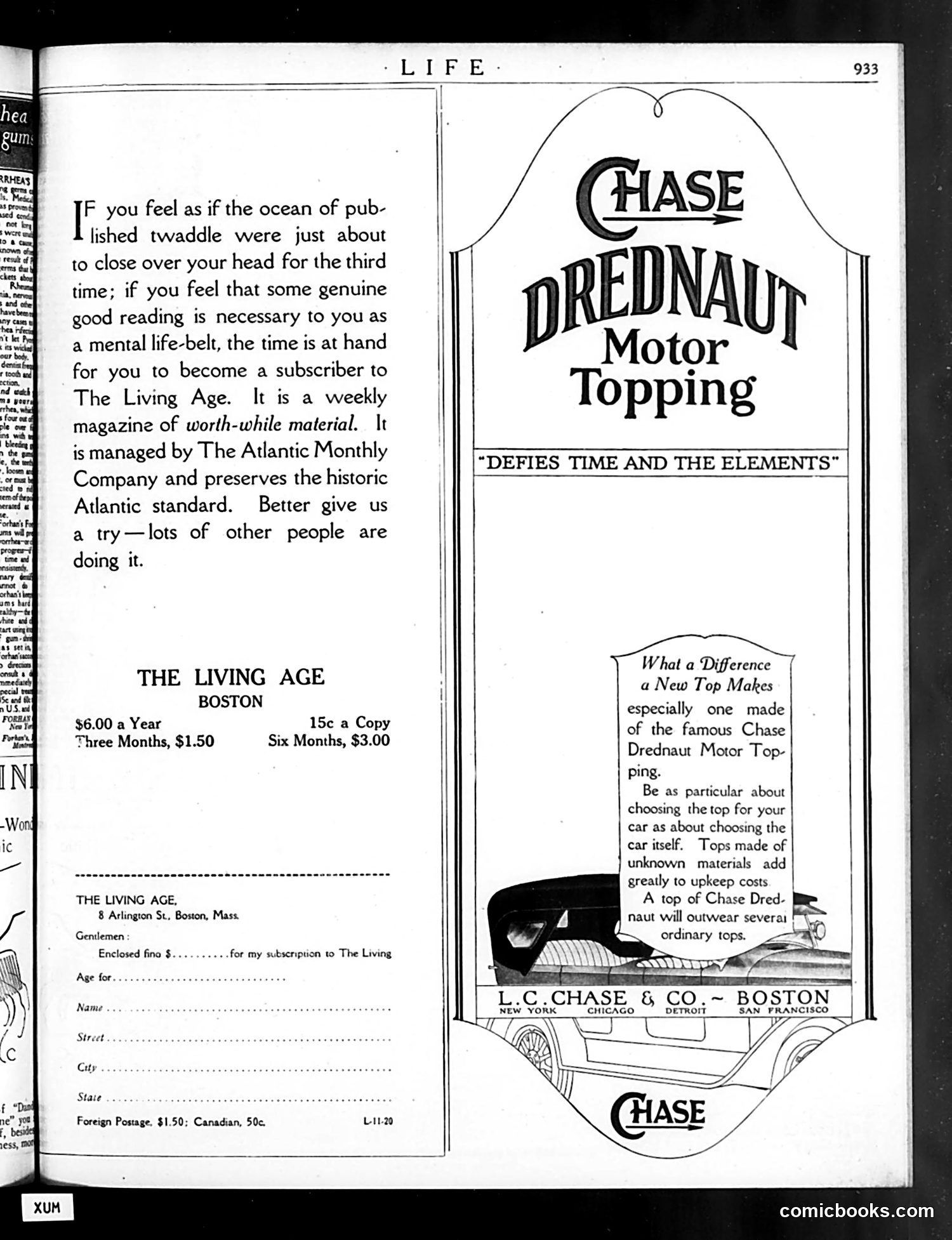
This page contains two advertisements rather than political satire or editorial cartoons. **Left side:** An ad for *The Living Age*, a weekly magazine presented as intellectual life-raft against "published twaddle." The copy uses self-deprecating humor—sarcastically suggesting readers are drowning in poor-quality publications and need *The Living Age* as a mental "life-belt." It's pitched as preserving serious Atlantic Monthly standards. This reflects early 20th-century magazine culture's competitive positioning around literary quality. **Right side:** A Chase Drednaut Motor Topping advertisement emphasizing durability. The copy compares selecting a car top to selecting the car itself, claiming Chase tops outlast "several ordinary tops." The illustrated car suggests this is vintage automobile advertising. Both ads use humor and hyperbole typical of period advertising—the Living Age's self-aware mockery of competitors and the Chase ad's comparative durability claims. Neither contains political commentary or caricature.
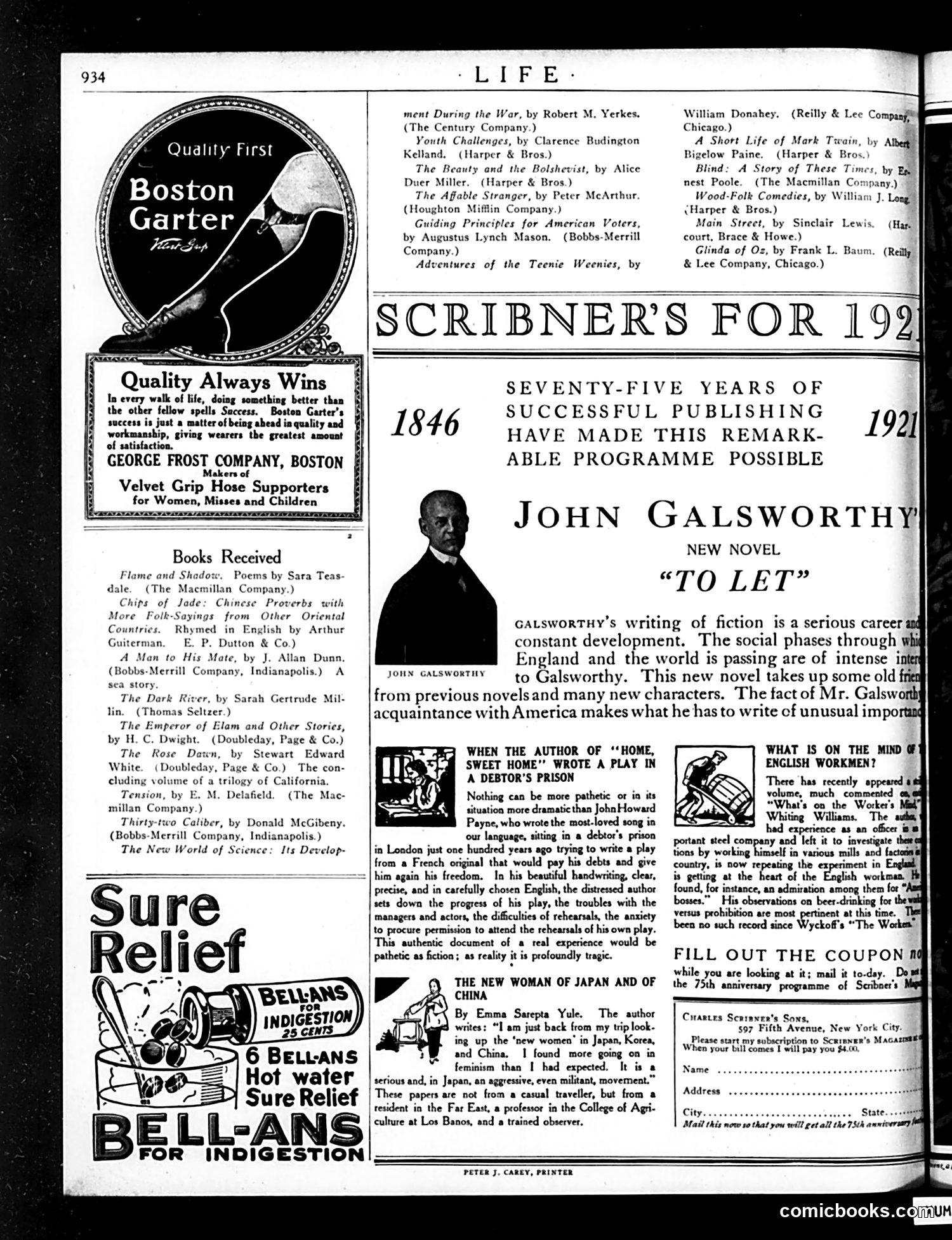
This page is primarily **book advertisements and literary notices**, not political satire. It announces Scribner's publishing house celebrating 75 years (1846-1921) and features John Galsworthy's new novel "To Let." The only substantive article is "What Is on the Mind of English Workmen," discussing a volume by Whiting Williams—a steel company officer who worked incognito in mills to understand workers' perspectives. The piece notes his findings about workers' respect for certain bosses and attitudes toward beer-drinking. A historical note describes John Howard Payne (composer of "Home, Sweet Home") writing a play from a debtor's prison a century prior, trying to earn money for freedom. The page contains typical period advertisements (Boston Garter hosiery, Bell-Ans indigestion remedy) and book listings. There is **no political cartoon or satire evident**—this appears to be a standard literary/cultural magazine page from the early 1920s.
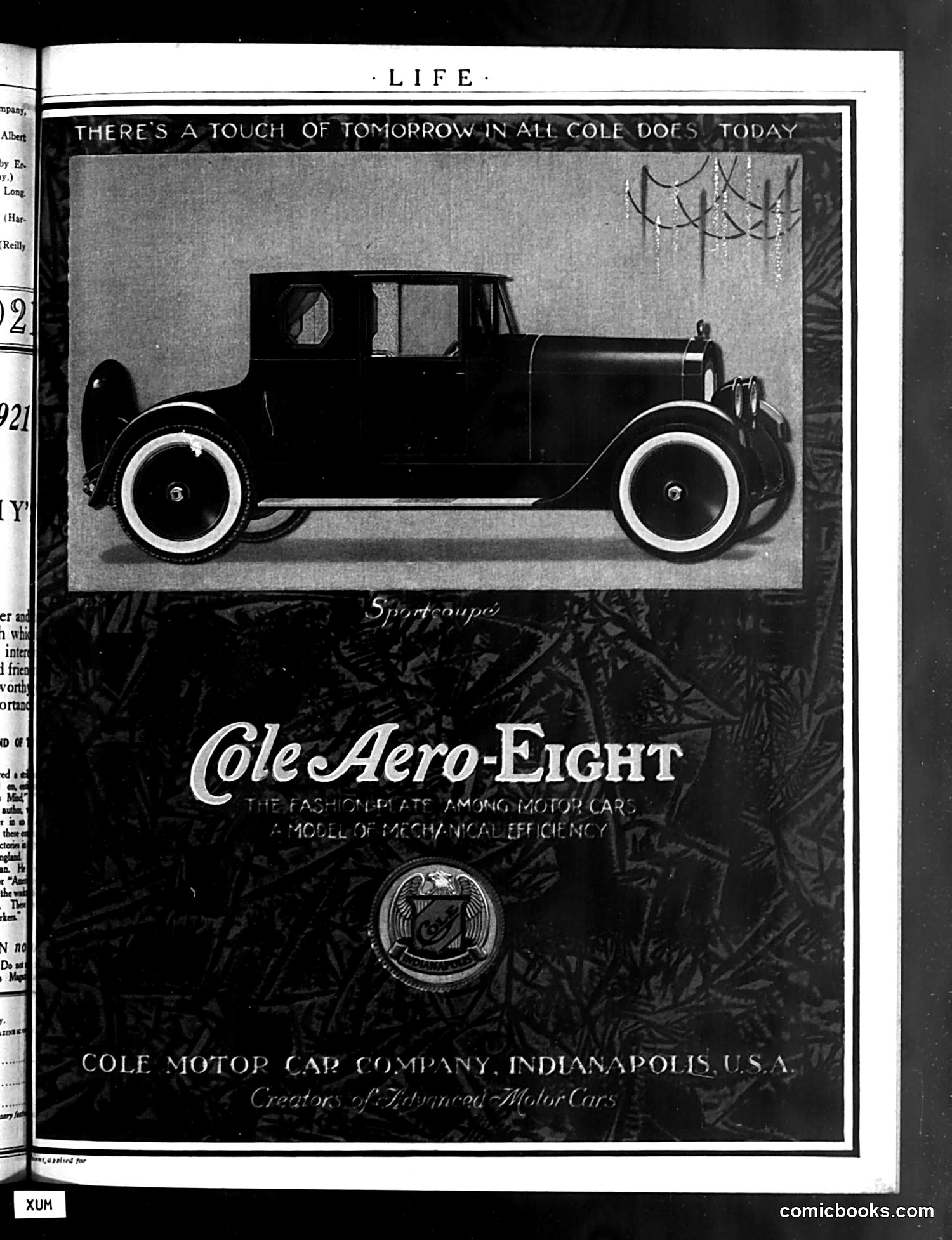
This is primarily a **car advertisement**, not political satire. The page features the Cole Aero-Eight automobile from the Cole Motor Car Company in Indianapolis. The headline "There's a Touch of Tomorrow in All Cole Does Today" is a marketing slogan emphasizing the car's modern, forward-thinking design. The vehicle is presented as "a model of mechanical efficiency," appealing to early 20th-century consumer values that prized technological progress and innovation. The tagline "Creators of Advanced Motor Cars" reinforces the company's positioning as cutting-edge. This appears in *Life* magazine's advertising section, using aspirational language typical of automotive marketing from that era—promising buyers they'll own something representing the future.
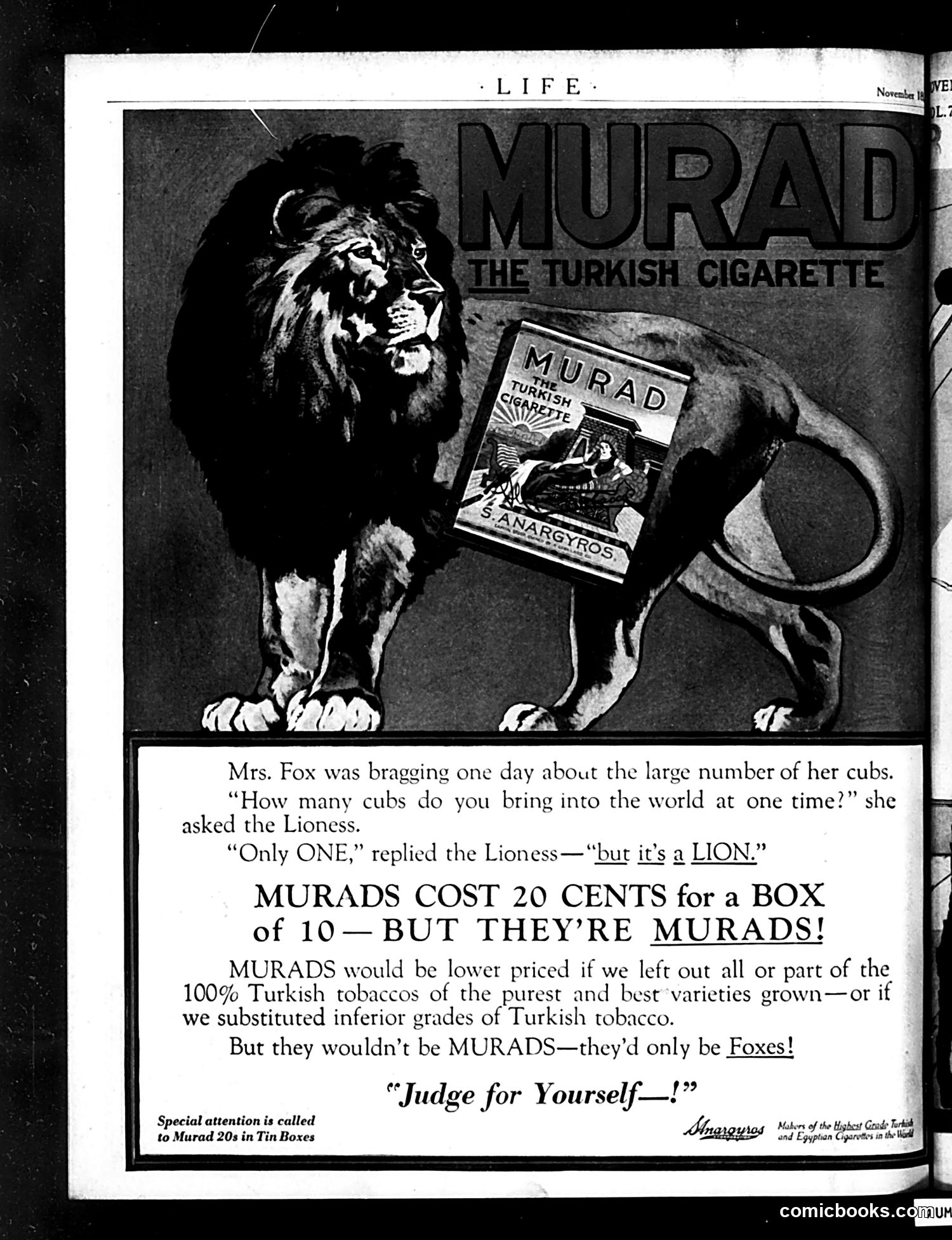
This is a **cigarette advertisement** using a humorous fable to make a quality argument. A fox brags about quantity of cubs; a lioness replies she has only one cub—"but it's a LION," implying superior quality over numbers. The ad applies this logic to Murad Turkish cigarettes: they cost 20 cents per box of 10, but maintain premium pricing because they use "100% Turkish tobaccos of the purest and best varieties." The implication is that cheaper competitors ("Foxes") cut corners by using inferior tobacco. The lion imagery emphasizes strength and superiority. This reflects early 20th-century cigarette marketing that stressed quality tobacco sourcing and competed partly on price point and claimed purity. The "Judge for Yourself" tagline invites consumer evaluation.