
Life, 1920-11-18 · page 24 of 44
Life — November 18, 1920 — page 24: what you’re looking at
What you’re looking at
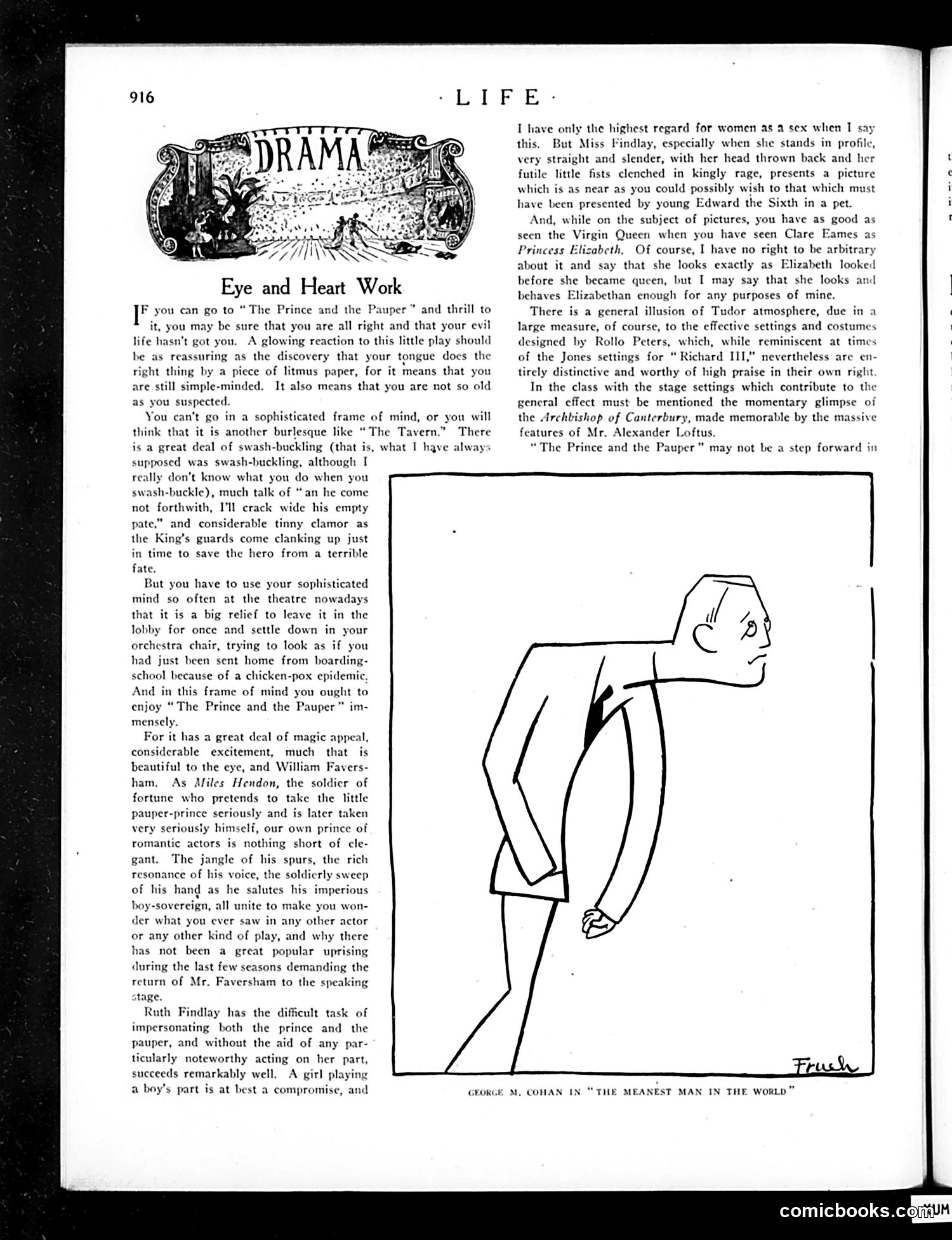
This page reviews the theatrical production of "The Prince and the Pauper," likely a stage adaptation of Mark Twain's novel. The critic praises the production's entertainment value while gently mocking audiences who enjoy it uncritically—suggesting simple-mindedness is required to fully appreciate the swashbuckling adventure. Key figures praised include actor William Faversham (as Miles Hendon), Ruth Findlay (playing dual roles as prince and pauper), and Clare Eames (as Princess Elizabeth). The critic particularly admires the Tudor-era costumes and sets designed by Rollo Peters. The accompanying cartoon (captioned "George M. Cohan in 'The Meanest Man in the World'") depicts a scheming or suspicious character in period dress—likely illustrating another theatrical production. The tone is affectionately condescending: the critic suggests leaving one's "sophisticated mind" at the door to enjoy this simple but visually beautiful spectacle.
📄 Transcribed text from this page (OCR, searchable)
Machine-transcribed from the original scan — historical spelling and the odd misread are preserved.
~-LIFE.: Ir you can go to “The Prince and the Pauper” and thrill to it, you may be sure that you are all right and that your evil life hasn't got you. A glowing reaction to this little play should be as reassuring as the discovery that your tongue docs the right thing by a piece of litmus paper, for it means that you are still simple-minded. It also means that you are not so old as you suspected. You can't go in a sophisticated frame of mind, or you will think that it is another burlesque like “The Tavern.” There is a great deal of swash-buckling (that is, what I have always supposed was swash-buckling, although I really don’t know what you do when you swash-buckle), much talk of “an he come not forthwith, I'll crack wide his empty pate,” and considerable tinny clamor as the King’s guards come clanking up just in time to save the hero from a terrible fate. But you have to use your sophisticated mind so often at the theatre nowadays that it is a big relief to leave it in the lobby for once and settle down in your orchestra chair, trying to look as if you had just been sent home from boarding- school because of a chicken-pox epidemic, And in this frame of mind you ought to enjoy “The Prince and the Pauper” im- mensely. For it has a great deal of magic appeal, considerable excitement, much that is beautiful to the eye, and William Favers- ham. As Ailes Hendon, the soldier of fortune who pretends to take the little pauper-prince seriously and is later taken very seriously himself, our own prince of romantic actors is nothing short of cle- gant. The jangle of his spurs, the rich resonance of his voice, the soldicrly sweep of his hand as he salutes his imperious boy-sovereign, all unite to make you won- der what you ever saw in any other actor or any other kind of play, and why there has not been a great popular uprising during the last few seasons demanding the return of Mr. Faversham to the speaking tage. Ruth Findlay has the difficult task of impersonating both the prince and the pauper, and without the aid of any par- ticularly noteworthy acting on her part, succeeds remarkably well. A gi ng I have only the highest regard for women as a sex when I say this. But Miss Findlay, especially when she stands in profile, very straight and slender, with her head thrown back and her futile little fists clenched in kingly rage, presents a picture which is as near as you could possibly wish to that which must have been presented by young Edward the Sixth in a pet. And, while on the subject of pictures, you have as good as seen the Virgin Queen when you have seen Clare Eames as Princess beth. Of course, I have no right to be arbitrary about it and say that she looks exactly as Elizabeth looked before she became queen, but I may say that she looks and behaves Elizabethan enough for any purposes of mine. There is a general illusion of Tudor atmosphere, due in a large measure, of course, to the effective settings and costumes designed by Rollo Peters, which, while reminiscent at times of the Jones settings for “ Richard III,” nevertheless are en- tirely distinctive and worthy of high praise in their own right In the class with the stage settings which contribute to the general effect must be mentioned the momentary glimpse of the Archbishop of Canterbury, made memorable by the massive features of Mr. Alexander Loftus. “The Prince and the Pauper” may not be a step forward in and GEORGE M, COHAN IN “THE MEANEST MAN IN THE WoRLD” comicbooks.comuyd