
Life, 1920-11-18 · page 21 of 44
Life — November 18, 1920 — page 21: what you’re looking at
What you’re looking at
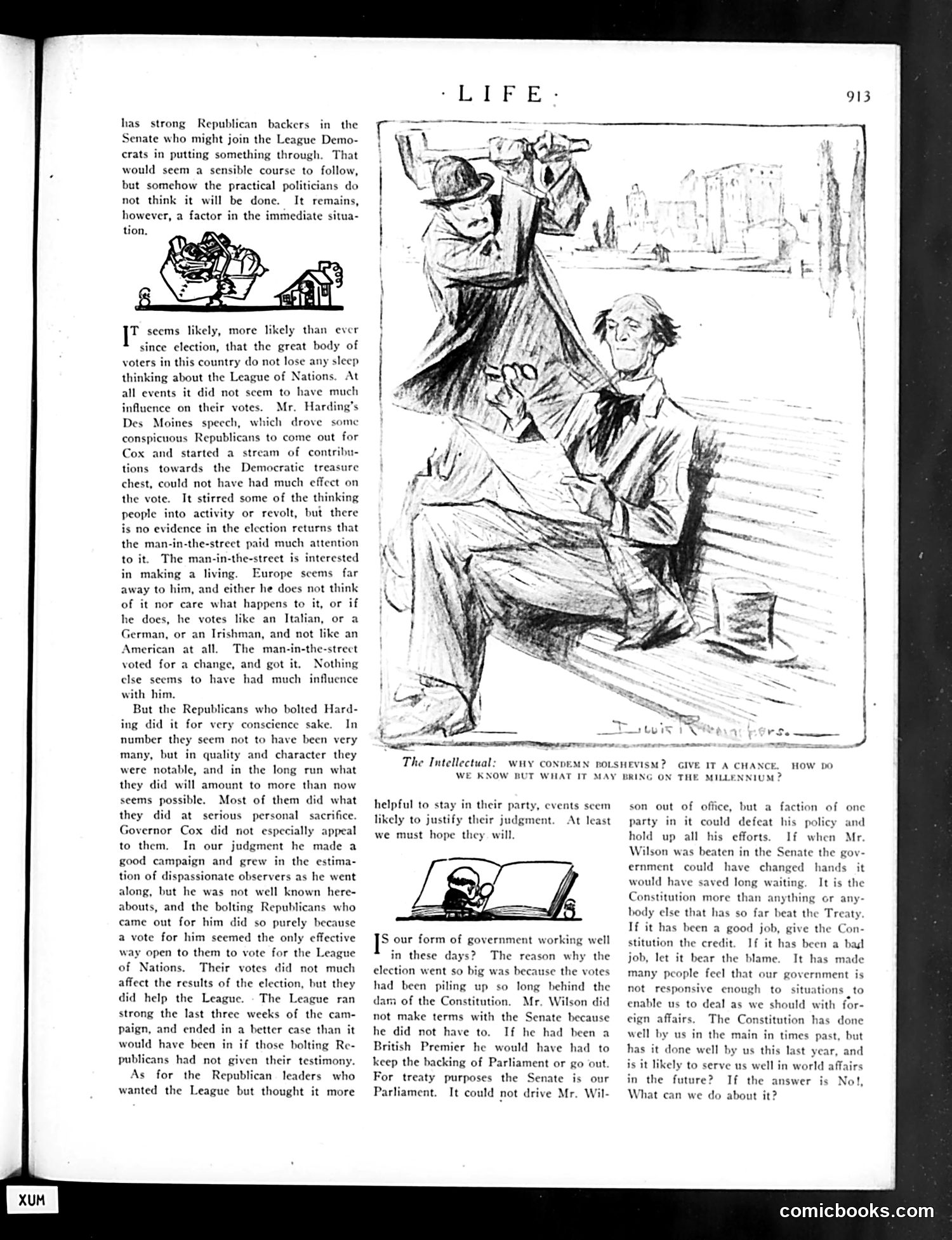
This page discusses the 1920 presidential election outcome, where Republican Warren G. Harding defeated Democrat James Cox. The primary cartoon, titled "The Intellectual," depicts an intellectual figure seemingly perched in a tree, appearing conflicted or distressed. The cartoon satirizes intellectuals who supported the League of Nations—a major election issue. The accompanying text explains that while some Republicans bolted their party to vote for Cox as an indirect League endorsement, most voters ("the man-in-the-street") cared little about the League, voting instead for "change" and domestic concerns. The cartoon's caption mockingly asks intellectuals: "Why condemn Bolshevism? Give it a chance—how do we know what it may bring on the millennium?"—sardonically suggesting that intellectuals' idealism is as naïve as endorsing Bolshevism. The elevated, somewhat precarious positioning emphasizes the intellectuals' perceived detachment from ordinary citizens' practical concerns.
📄 Transcribed text from this page (OCR, searchable)
Machine-transcribed from the original scan — historical spelling and the odd misread are preserved.
has strong Republican backers in the Senate who might join the League Demo- crats in putting something through. That would seem a sensible course to follow, but somehow the practical politicians do not think it will be done. It remains, however, a factor in the immediate situa- r seems likely, more likely than ever since election, that the great body of voters in this country do not lose any sleep thinking about the League of Nations. At all events it did not scem to have much influence on their votes. Mr. Harding’s Des Moines speech, which drove some conspicuous Republicans to come out for Cox and started a stream of contribu- tions towards the Democratic treasure chest, could not have had much effect on the vote. It stirred some of the thinking people into activity or revolt, but there is no evidence in the election returns that the man-in-the-street paid much attention to it. The man-in-the-strect is interested in making a living. Europe scems far away to him, and either he does not think of it nor care what happens to it, or if he does, he votes like an Italian, or a German, or an Irishman, and not like an American at all. The man-in-the-strect voted for a change, and got it. Nothing else seems to have had much influence with him. But the Republicans who bolted Hard- ing did it for very conscience sake. In number they seem not to have been very many, but in quality and character they were notable, and in the long run what they did will amount to more than now seems possible. Most of them did what they did at personal Governor Cox did not especially appeal to them. In our judgment he made a good campaign and grew in the estima- tion of dispassionate observers as he went along, but he was not well known here- abouts, and the bolting Republicans who came out for him did so purely because a vote for him seemed the only effective way open to them to vote for the League of Nations. Their votes did not much affect the results of the election, but they did help the League. The League ran strong the last three weeks of the cam- paign, and ended in a better case than it would have been in if those bolting Re- serious sacrifice. publicans had not given their testimony. As for the Republican leaders who wanted the League but thought it more The Intellectual: helpful to stay in their party, events seem likely to justify their judgment. At least we must hope they. will. Is our form of government working well in these days? election went so big was because the votes had been piling up so long behind the The reason why the dam of the Constitution. Mr, Wilson did not make terms with the Senate because he did not have to. If he had been a British Premier he would have had to keep the backing of Parliament or go out. For treaty purposes the Senate is our Parliament. It could not drive Mr. Wil- WHY CONDEMN POLSHEVISM ? WE KNOW RUT WHAT IT MAY BRING ON THE LU 15 Se . GIVE IT A CHANCE MILLENNIUM ? HOW po. son out of office, but a faction of one party in it could defeat his policy and hold up all his efforts. If when Mr. Wilson was beaten in the Senate the gov- ernment could have changed would have saved long waiting Constitution more than body else that has so far beat the Treaty If it has been a good job, give the Con- stitution the credit. If it has been a ba job, let it bear the blame. It has made many pcople feel that our government is not responsive enough to. situa enable us to deal as we should with for- eign affairs. The Constitution has done well by us in the main in times past, bu has it done well by us this last year, and is it likely to serve us well in world affairs in the future? If the answer is No!, What can we do about it? hands it It is the ything or any- comicbooks.com