
Life, 1920-11-18 · page 20 of 44
Life — November 18, 1920 — page 20: what you’re looking at
What you’re looking at
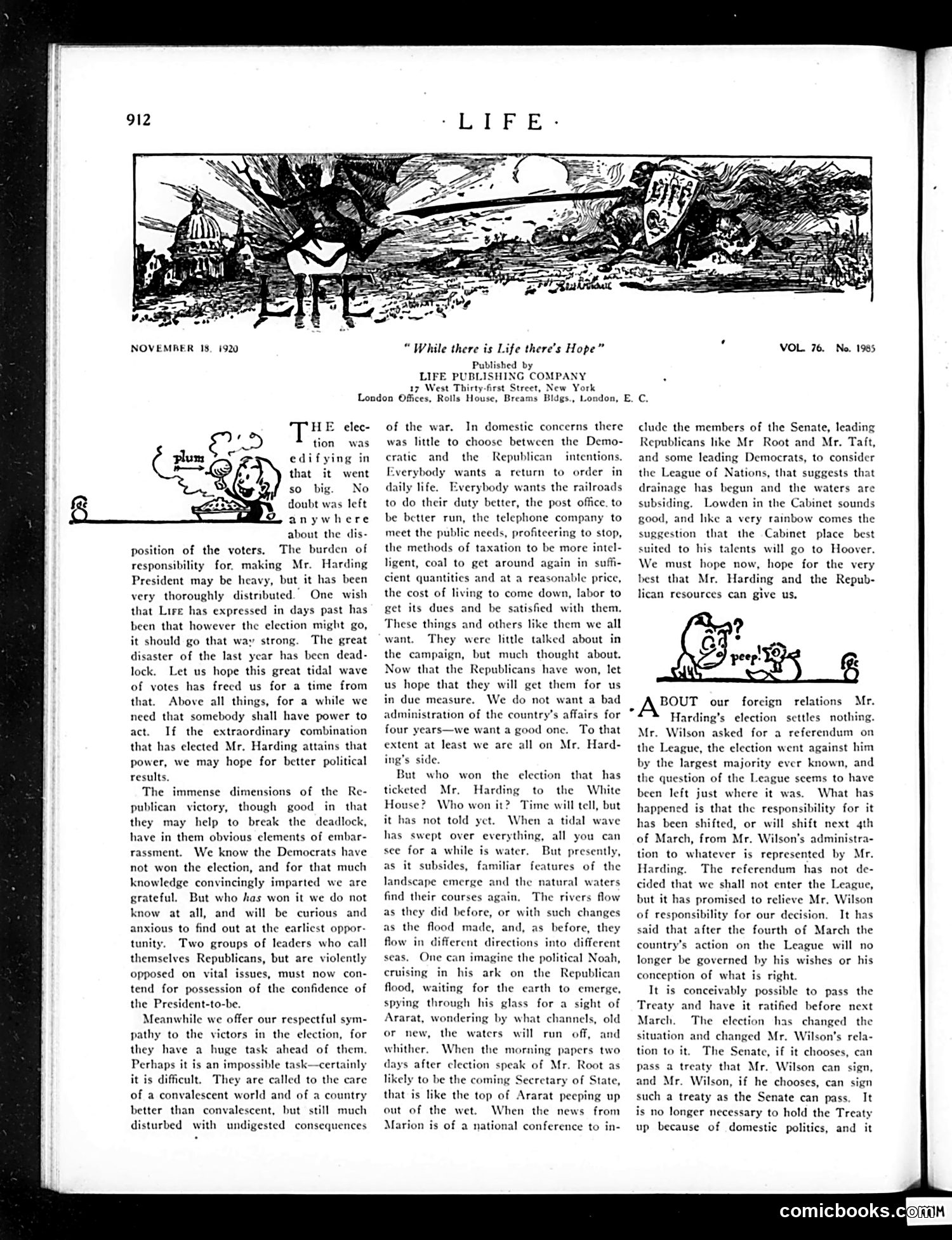
This editorial celebrates Warren G. Harding's decisive victory in the 1920 presidential election. The "tidal wave of votes" references the Republicans' overwhelming defeat of incumbent Democrat Wilson. The key political concern expressed is the fragmentation within the Republican party itself—two groups of Republican leaders with "violently opposed" positions now compete for influence over the president-elect. The text worries about who truly "won" the election beyond Harding's name. The Noah's Ark metaphor is telling: Harding is depicted as cruising uncertainty, awaiting the flood (political realignment) to recede so the landscape clarifies. The reference to Elihu Root as likely Secretary of State suggests anxiety about which Republican faction will control policy. The editorial's tone is cautiously hopeful—praising the end of Democratic "deadlock" while essentially admitting confusion about what the Republican victory actually means or who will shape Harding's administration.
📄 Transcribed text from this page (OCR, searchable)
Machine-transcribed from the original scan — historical spelling and the odd misread are preserved.
NOVEMBER 18, 1920 “ While there is Life there’s Hope” Published by LIFE PUBLIS COMPANY 17 West Thirty-first Street, New York VOL. 76. No. 1985 London Offices, Rolls House, Breams Bldgs., London, E. C. HE elec- tion was 21D plum 7 edifying in mae OP) that it went ke Bf so big. No doubt was left anywhere about the dis- The burden of Harding position of the voters. responsibility for. making Mr. President may be heavy, but it has been very thoroughly distributed. One wish that Lire has expressed in days past has been that however the election might go, it should go that way strong. The great disaster of the last year has been dead- lock. Let us hope this great tidal wave of votes has freed us for a time from that. Above all things, for a while we need that somebody shall have power to act. If the extraordinary combination that has elected Mr. Harding attains that power, we may hope for better political results. The immense dimensions of the Re- publican victory, though good in that they may help to break the deadlock, have in them obvious clements of embar- rassment. We know the Democrats have not won the election, and for that much knowledge convincingly imparted we are grateful. But who has won it we do not know at all, and will be curious and anxious to find out at the earliest oppor- tunity. Two groups of leaders who call themselves Republicans, but are violently opposed on vital issues, must now con- tend for possession of the confidence of the President-to-be. Meanwhile we offer our respectful sym- pathy to the victors in the election, for they have a huge task ahead of them. Perhaps it is an impossible task—certainly it is difficult. They are called to the care of a convalescent world and of a country better than convalescent, but. still much disturbed with undigested consequences of the war. In domestic concerns there was little to choose between the Demo- cratic and the Republican intentions. Everybody wants a return to order in daily life. Everybody wants the railroads to do their duty better, the post office. to be better run, the telephone company to meet the public needs, profiteering to stop, the methods of taxation to be more intel- ligent, coal to get around again in suffi- cient quantities and at a reasonable price, the cost of living to come down, labor to get its dues and be satisfied with them, These things and others like them we all want. They were little talked about in the campaign, but much thought about. Now that the Republicans have won, let us hope that they will get them for us in due measure. We do not want a bad administration of the country’s affairs for four years—we want a good one. To that extent at least we are all on Mr. Hard- ing’s side. But who the election that has ticketed Mr, Harding to the White House? Who won it? Time will tell, but it has not told yct. When a tidal wave has swept over everything, all you can see for a while is water. But presently, as it subsides, familiar the landscape emerge and the natural waters find their courses The rivers flow as they did before, or with such changes as the flood made, and, as before, they flow in different directions into different s. One can imagine the political Noah, cruising in his ark on the Republican flood, waiting for the earth to emerge, spying through his glass for a sight of Ararat, wondering by what channels, old or new, the will run off, When the morning papers two days after clection spea f Mr. Root as likely to be the coming Secretary of State, that is like the top of Ararat peeping up out of the wet. When the news from Marion is of a national conference to in- won features of gain, waters and whither, clude the members of the Senate, leading Republicans like Mr Root and Mr. Taft, and some leading Democrats, to consider the League of Nations, that suggests that drainage has begun and the waters are subsiding. Lowden in the Cabinet sounds good, and hke a very rainbow comes the suggestion that the Cabinet place best suited to his talents will go to Hoover. We must hope now, hope for the very best that Mr. Harding and the Repub- lican resources can give us, BOUT our foreign relations Mr. Harding’s election settles nothing. Mr. Wilson asked for a referendum on the League, the election went against him by the largest majority ever known, and the question of the League scems to have been left just where it was. What has happened is that the responsibility for it has been shifted, or will shift next qth of March, from Mr. Wilson's administra- tion to whatever is represented by Mr. Harding. The referendum has not de- cided that we shall not enter the League, but it has promised to relieve Mr, Wilson of responsibility for our decision. It has said that after the fourth of March the country’s action on the League will no longer be governed by his wishes or his conception of what is right. It is conceivably possible to pass the Treaty and have it ratified before next March. The election has changed the situation and changed Mr. Wilson's rela- tion to it. The Senate, if it chooses, can y that Mr. Wilson can sign, and Mr. Wilson, if he chooses, can sign such a treaty as the Senate can pass, It is no longer necessary to hold the Treaty up because of domestic politics, and it pass a tre comicbooks.comfi}