
Life, 1920-11-18 · page 42 of 44
Life — November 18, 1920 — page 42: what you’re looking at
What you’re looking at
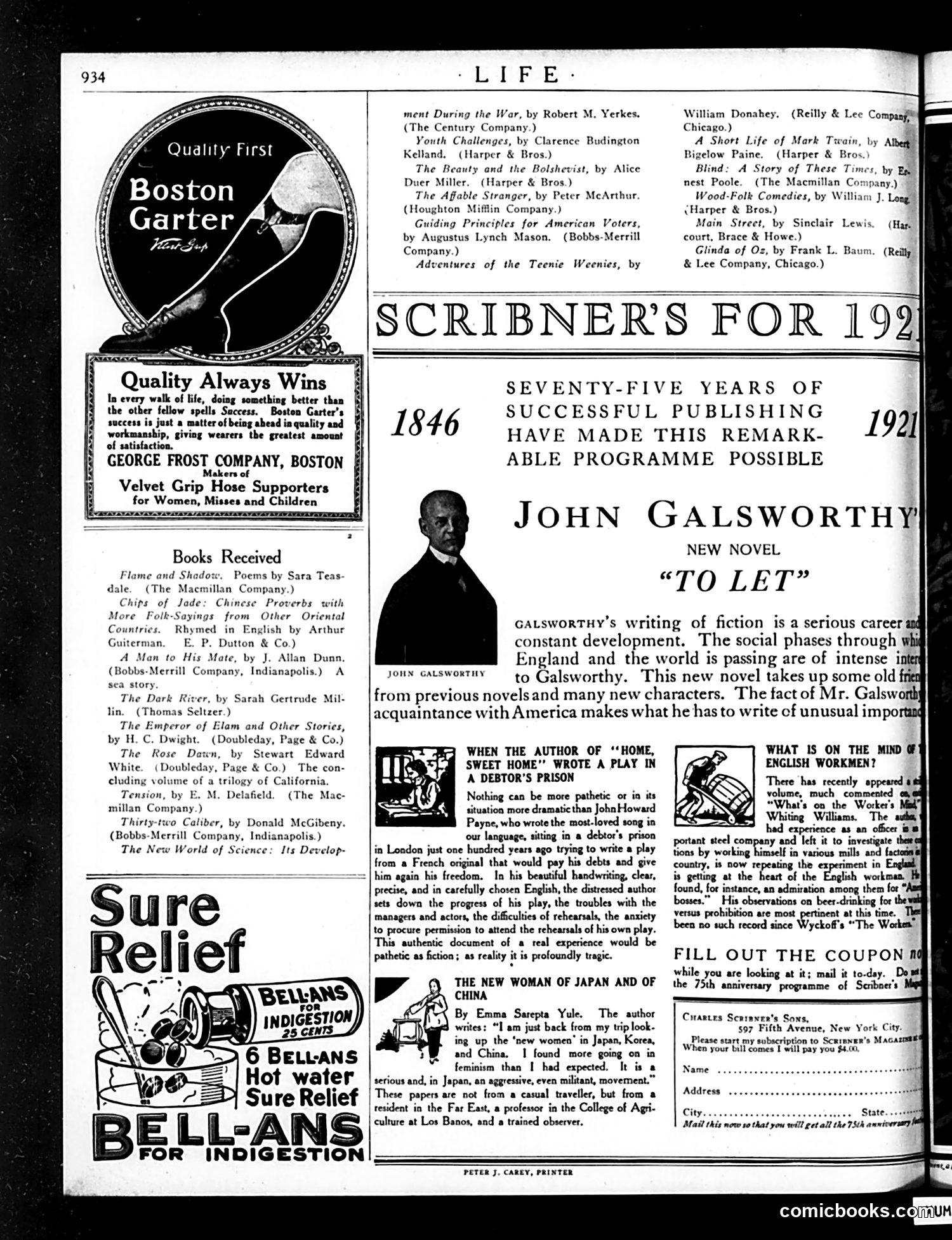
This page is primarily **book advertisements and literary notices**, not political satire. It announces Scribner's publishing house celebrating 75 years (1846-1921) and features John Galsworthy's new novel "To Let." The only substantive article is "What Is on the Mind of English Workmen," discussing a volume by Whiting Williams—a steel company officer who worked incognito in mills to understand workers' perspectives. The piece notes his findings about workers' respect for certain bosses and attitudes toward beer-drinking. A historical note describes John Howard Payne (composer of "Home, Sweet Home") writing a play from a debtor's prison a century prior, trying to earn money for freedom. The page contains typical period advertisements (Boston Garter hosiery, Bell-Ans indigestion remedy) and book listings. There is **no political cartoon or satire evident**—this appears to be a standard literary/cultural magazine page from the early 1920s.
📄 Transcribed text from this page (OCR, searchable)
Machine-transcribed from the original scan — historical spelling and the odd misread are preserved.
LIFE ment During the War, by Robert M. Yerkes. (The Century Company.) Youth Challenges, by Clarence Budington William Donahey. Chicago.) A Short Life of Mark Twain, by Albeq! (Reilly & Lee Company Kelland, (Harper & Bros.) Bigelow Paine. (Harper & Bros.) The Beauty and the Bolshevist, by Alice Blind: A Story of These Times, by Ep Duer Miller. (Harper & Bros.) nest Poole. (The Macmillan Company.) The Afable Stranger, by Peter McArthur. Wood-Folk Comedies, by William J. Long (Houghton Mifflin Company.) ‘Harper & Bros.) Guiding Principles for American Voters, Main Street, by Sinclair Lewis. (Han by Augustus Lynch Mason. (Bobbs-Merrill court, Brace & Howe.) Company.) Glinda of Oz, by Frank L. Baum. (Reilly Adventures of the Teenie Weenies, by & Lee Company, Chicago.) SCRIBNERS FOR 192 SEVENTY-FIVE YEARS OF SUCCESSFUL PUBLISHING HAVE MADE THIS REMARK- ABLE PROGRAMME POSSIBLE Quality Always Wins In every walk of life, doing something better than the other fellow spells Success. Boston Garter’s just a matter of being abead in quality and workmanship, giving wearers the greatest amount of satisfaction. GEORGE FROST COMPANY, BOSTON Velvet Grip | Hose. Supporters for Women, Mi: and Children 1846 192] JOHN GALSWORTHY NEW NOVEL “TO LET” GALsworTHY’s writing of fiction is a serious career @ constant development. The social phases through wh England and the world is passing are of intense i to Galsworthy. This new novel takes up some old from previous novels and many new characters. The fact of Mr. Galswonth acquaintance with America makes what he has to write cf unusual importang Books Received Flame and Shadow. Poems by Sara Teas- dale. (The Macmillan Company.) Chips of Jade: Chinese Proverbs with More Folk-Sayings from Other Oriental Countries. Rhymed in English by Arthur Guiterman. E. P. Dutton & Co.) A Man to His Mate, by J. Allan Dunn. (Bobbs-Merrill Company, Indianapolis.) A sea story. The Dark River, by Sarah Gertrude Mil- lin. (Thomas Seltzer.) The Emperor of Elam and Other Stories, by H. C. Dwight. (Doubleday, Page & Co.) The Rose Dawn, by Stewart Edward White. (Doubleday, Page & Co.) The con- cluding volume of a trilogy of California. Tension, by E. M. Delafield. (The Mac- millan Company.) Thirty-two Caliber, by Donald McGibeny. (Bobbs-Merrill Company, Indianapolis.) The New World of Science: Its Develop- Sure. Relief JOUN GALSWoRTHY WHAT IS ON THE MIND @ ENGLISH WORKMEN? There ‘has recently appeared § volume, much commented om “What's on the Worker's Mad’ Whiting Williams. The auha had experience as an offcer a @ portant steel company and left it to investigate thew: tions by working himself in various mills and factodas country, is now repeating the experiment in is getting at the heart rf the English workman. He found, for instance, an admiration a them for bosses.” His observations on beer-drinking for it at this time. The 'yckof's “The Workes WHEN THE AUTHOR OF ‘‘HOME, SWEET HOME’? WROTE A PLAY IN A DEBTOR'S PRISON Nothing can be more pathetic or in its situation more dramatic than John Howard Payne, who wrote the most-loved song in cour language, sitting in a debtor's prison in London just one hundred years ago trying to write a play from a French original that would pay his debts and give = =| him again his freedom. In his beautiful handwriting, clear, precise, and in carefully chosen English, the distressed author sets down the progress of his play, the troubles with the managers and actors, the difficulties of rehearsals, the anxiety to procure permission to attend the rehearsals of his own play. This authentic document of a real experience would be pathetic as fiction ; as reality it is profoundly tragic. versus prohibition are most been no such record since FILL OUT THE COUPON fg while you are looking at it; mail it to-day. Do mal THE NEW WOMAN OF JAPAN AND OF the 75th anniversary programme of Scribner's CHINA By Emma Sarepta Yule. The author d writes: “I am just back from my trip look- ing up the ‘new women’ in Japan, Korea, and China, 1 found more going on in feminism than I had expected. It is a serious and, in Japan, an aggressive, even militant, movement.” . | Hot water D These papers are not from a casual traveller, but from a Sure Relief resident in the Far East, a professor in the College of Agri- BE i il = AWN Ss culture at Los Banos, and a trained observer. FOR INDIGESTION Curartes Scrraxta’s Sons, $97 Fifth Avenue, New York City. Please start my subscription to Scrrnwer’s Macazcet! When your bull comes I will pay you $4.00. 6 BELLANS PETER J, CAREY, PRINTER comicbooks.comwuy