
Life, 1920-11-18 · page 25 of 44
Life — November 18, 1920 — page 25: what you’re looking at
What you’re looking at
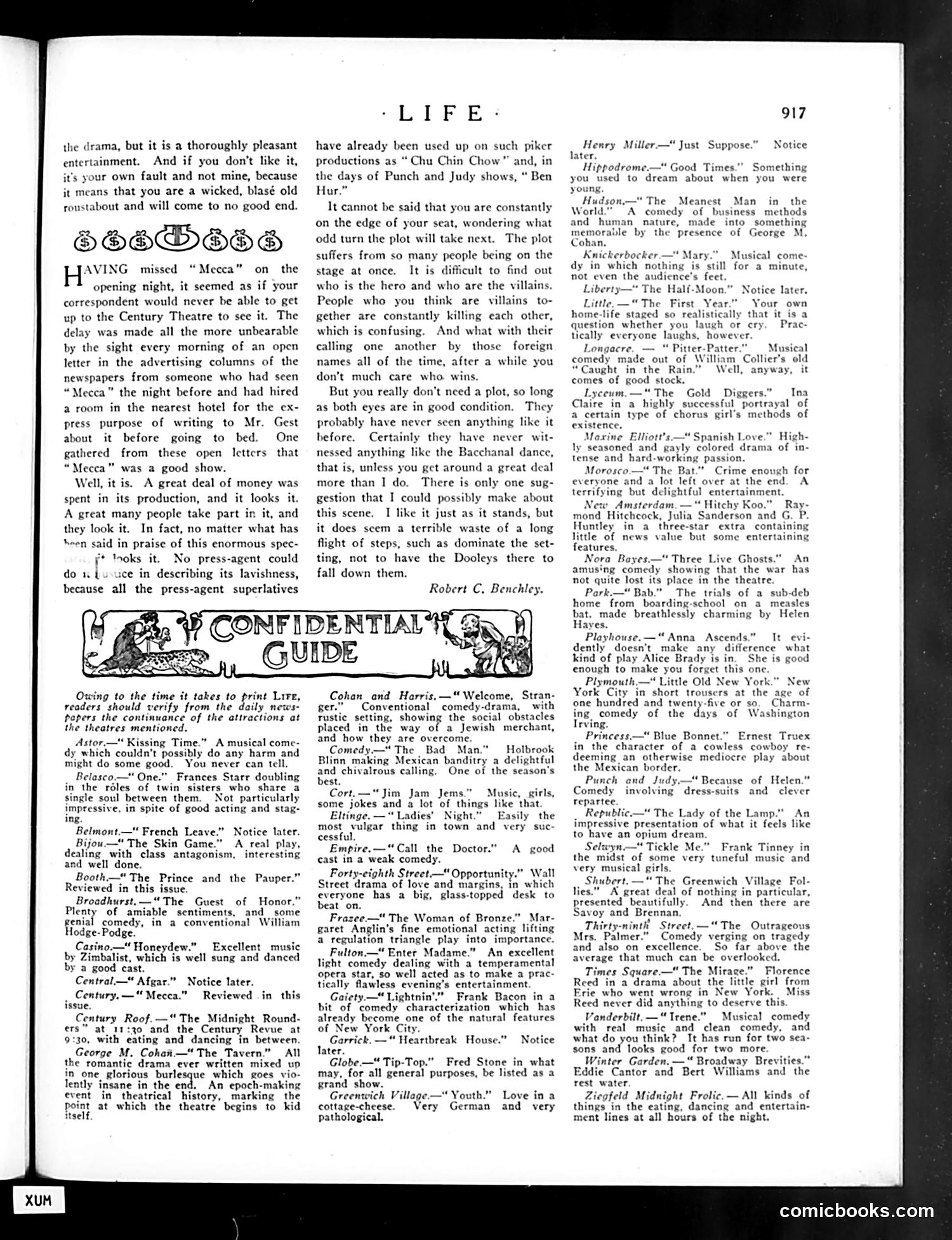
This page is primarily a **theater guide and review column** for Broadway shows, not a political cartoon. The only illustration is a decorative "Confidential Guide" header with ornamental design. The main review discusses the musical production **"Mecca,"** critiquing its spectacular staging while mocking its plot and confusing narrative. The reviewer sarcastically notes the production's lavish expense and large cast are evident, but the plot is nearly incomprehensible—audiences can't identify heroes from villains, and foreign character names make it hard to care who wins. A notable joke references the **Dooleys** (likely the popular "Mr. Dooley" comic characters of the era) in jest about wasting the elaborate staircase set. The review suggests the show succeeds despite poor storytelling, relying entirely on visual spectacle. The page also lists other Broadway offerings with brief descriptions, representing typical theater criticism of the 1920s era.
📄 Transcribed text from this page (OCR, searchable)
Machine-transcribed from the original scan — historical spelling and the odd misread are preserved.
the drama, but it is a thoroughly pleasant entertainment. And if you don't like it, it's your own fault and not mine, because it means that you are a wicked, blasé old roustabout and will come to no good end. SNENC DENOTE) AVING missed “Mecca” on the opening night, it seemed as if your correspondent would never be able to get up to the Century Theatre to see it. The delay was made all the more unbearable by the sight every morning of an open letter in the advertising columns of the newspapers from someone who had seen “Mecca” the night before and had hired a room in the nearest hotel for the ex- press purpose of writing to Mr. Gest about it before going to bed. One gathered from these open letters that “Mecca” was a good show. Well, it is. A great deal of money was spent in its production, and it looks it. A great many people take part in it, and they look it. In fact, no matter what has ‘een said in praise of this enormous spec- ft 'ooks it. No press-agent could do 4 Lucuce in describing its lavishness, because all the press-agent superlatives coker eee GUIDE Owing to the time it takes to print Lire, readers should verify from the daily news- Papers the continuance of the attractions at the theatres mentioned. Astor.—" Kissing Time.” A musical come- dy which couldn’t possibly do any harm and might do some good. You never can tell. _ Belasco. —" One.” Frances Starr doubling in the roles of twin sisters who share a single soul between them. Not particularly impressive, in spite of good acting and stag- ing. Belmont.— French Leave.” Bijou—" The Skin Game. dealing with class antagonism, and well done. Booth—* The Prince and the Pauper.” Reviewed in this issue. Broadhurst.—“ The Guest of Honor.” Plenty of amiable sentiments, and some emia comedy, in a conventional William Hodge-Podge. Casino.—" Honeydew.” Excellent music by Zimbalist, which is well sung and danced by a good cast. Central —* Afgar.” _ Century. —" Mecea. issue. Century Roof.—“ The Midnight Round- ers” at 11:30 and the Century Revue at 9:30, with eating and dancing in between. George M. Cohat—“ The Tavern.” All the romantic drama ever written mixed up in one. glorious burlesane which goes vio- lently insane in the ens An epoch-making event in theatrical history, marking the point at which the theatre begins to itself. Notice later. A real play, interesting Notice later. Reviewed in this LIFE have already been used up on such piker productions as “ Chu Chin Chow” and, in the days of Punch and Judy shows, “ Ben Hur.” It cannot be said that you are constantly on the edge of your seat, wondering what odd turn the plot will take next. The plot suffers from so many people being on the stage at once. It is difficult to find out who is the hero and who are the villains. People who you think are villains to- gether are constantly killing each other, which is confusing. And what with their calling one another by those foreign names all of the time, after a while you don’t much care who. wins. But you really don't need a plot, so long as both eyes are in good condition. They probably have never seen anything like it before. Certainly they have never wit- nessed anything like the Bacchanal dance, that is, unless you get around a great deal more than I do. There is only one sug- gestion that I could possibly make about this scene. I like it just as it stands, but it does scem a terrible waste of a long flight of steps, such as dominate the set- ting, not to have the Dooleys there to fall down them. Robert C. Benchley. : Cohan and Harris, —“ Welcome, Stran- ger.” Conventional comedy-drama, with rustic setting, showing the social obstacles placed in the way of a Jewish merchant, and how they are overcome. Comedy.—* The Bad Man." Holbrook Blinn making Mexican banditry a delightful and chivalrous calling. One of the season's best. Cort.—“ Jim Jam Jems.” Music, girls, some jokes and a lot of things like that. Eltinge. —“ Ladies’ Night.” Easily the most vulgar thing in town and very suc- cessful. Empire.—“ Call the Doctor.” cast in a weak comedy Forty-eighth Street—" Opportunity.” Wall Street drama of love and margins, in which everyone has a big, glass-topped desk to beat on. Frazee—" The Woman of Bronze.” Mar- garet Anglin’s fine emotional acting lifting a regulation triangle play into importance. Fulton — Enter Madame.” An excellent light comedy dealing with a temperamental opera star, so well acted as to make a prac- tically flawless evening's entertainment Gaiety—“ Lightnin’.” Frank Bacon in a bit of comedy characterization which has already become one of the natural features of New York City. Garrick. —“ Heartbreak House, later. Globe. —“ Tip-Top.” Fred Stone in what may, for all general purposes, be listed as a grand show. Greenwich Village —“ Youth.” cottage-cheese, pathological. A. good Notice Love in a Very German and very 917 Henry Notice later. Hippodrome.—" Good Times.” Something you used to dream about when you were young. Hudson,—" The Meanest Man in the World.” “A comedy of business methods and human nature, made into something memorable by the presence of George M. Cohan. Knickerbocker_—" Mary.” dy in which nothing is still not even the audience's feet. Liberty—* The Half-Moon.” Notice later. Little, —“ The First Year.” Your own home-life staged so realistically that it is a question whether you laugh or ery. Prac- tically everyone laughs, however. Longacre. — “ Pitter-Patter.”| Musical comedy made out of William Collier's old “Caught in the Rain.” Well, anyway, it comes of good stock. Lyceum.—“ The Gold Diggers.” Ina Claire in a highly successful portrayal of a certain type of chorus girl's methods of existence. Marine Elliott's — Spanish Love.” ly seasoned and gayly colored drama of in- tense and hard-working passion. Morosco.—* The Bat." Crime enough for everyone and a lot left over at the end. A terrifying but delightful entertainment. New Amsterdam. —“ Hitchy Koo.” Ray- mond Hitchcock, Julia Sanderson and G. P. Huntley in a three-star extra containing little of news value but some entertaining features. Nora Bayes.—" Three Live Ghosts.” An amusing comedy showing that the war has not quite lost its place in the theatre. Park.—" Bab.” The trials of a sub-deb home from boarding-school on a measles bat, made breathlessly charming by Helen Hayes. Playhouse. — Miller—" Just Suppose.” Musical come- for a minute, “Anna Ascends.” It evi- dently doesn’t make any difference what kind of play Alice Brady is in. She is good enough to make you forget this one. Plymouth —“ Little Old New York.” New York City in short trousers at the age of one hundred and twenty-five or so. Charm- ing comedy of the days of Washington Irving. Princess.—" Blue Bonnet.” Ernest Truex in the character of a cowless cowboy re- deeming an otherwise mediocre play about the Mexican border. Punch and Jud Because of Comedy involving dress-suits and repartee. _ Republic-—" The Lady of the Lamp.” An impressive presentation of what it feels like to have an opium dream. Selwyn. —" Tickle Me.” Frank Tinney in the midst of some very tuneful music and very musical girls. Shubert. —" The Greenwich Village Fol- lies.” A great deal of nothing in particular, presented beautifully. And then there are Savoy and Brennan Thirty-ninth Street. Helen.” clever —“The Outrageous Mrs. Palmer.” Comedy verging on tragedy and also on excellence. So far above the average that much can be overlooked. Times Square.—" The Mirage.” Florence Reed in a drama about the little girl from Erie who went wrong in New York. Miss Reed never did anything to deserve this. Vanderbilt. —“ Irene.” Musical comedy with real music and clean comedy, and what do you think? It has run for two sea- sons and looks good for two more. Winter Garden, —“ Broadway Brevities.” Eddie Cantor and Bert Williams and the rest water. Ziegfeld Midnight Frolic. — All kinds of things in the eating, dancing and entertain- ment lines at all hours of the night. comicbooks.com