
A complete issue · 44 pages · 1920
Life — September 9, 1920
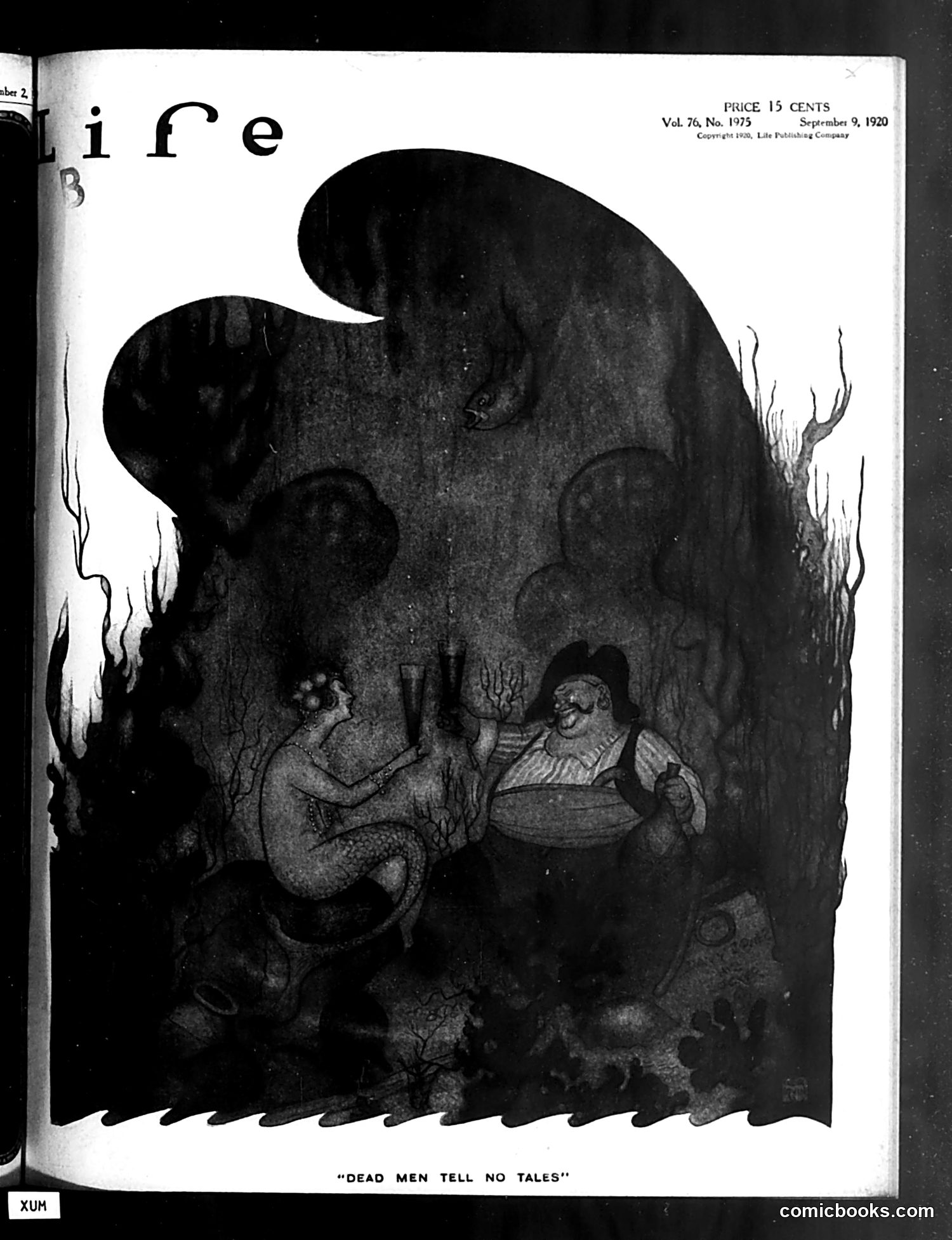
This September 1920 *Life* cartoon depicts an underwater scene with a large skull looming above two figures in what appears to be a submarine or underwater vessel. The caption "Dead Men Tell No Tales" suggests a reference to silencing witnesses or eliminating evidence. Given the 1920 date, this likely comments on wartime or post-war violence—possibly related to WWI's conclusion or labor/political unrest common in that period. The grotesque skull and underwater setting create a darkly humorous memento mori, implying that dead individuals cannot testify against wrongdoing. Without additional context or visible identifying details, the specific historical reference remains unclear, though the cartoon's satirical tone suggests commentary on concealed crimes or governmental secrecy.
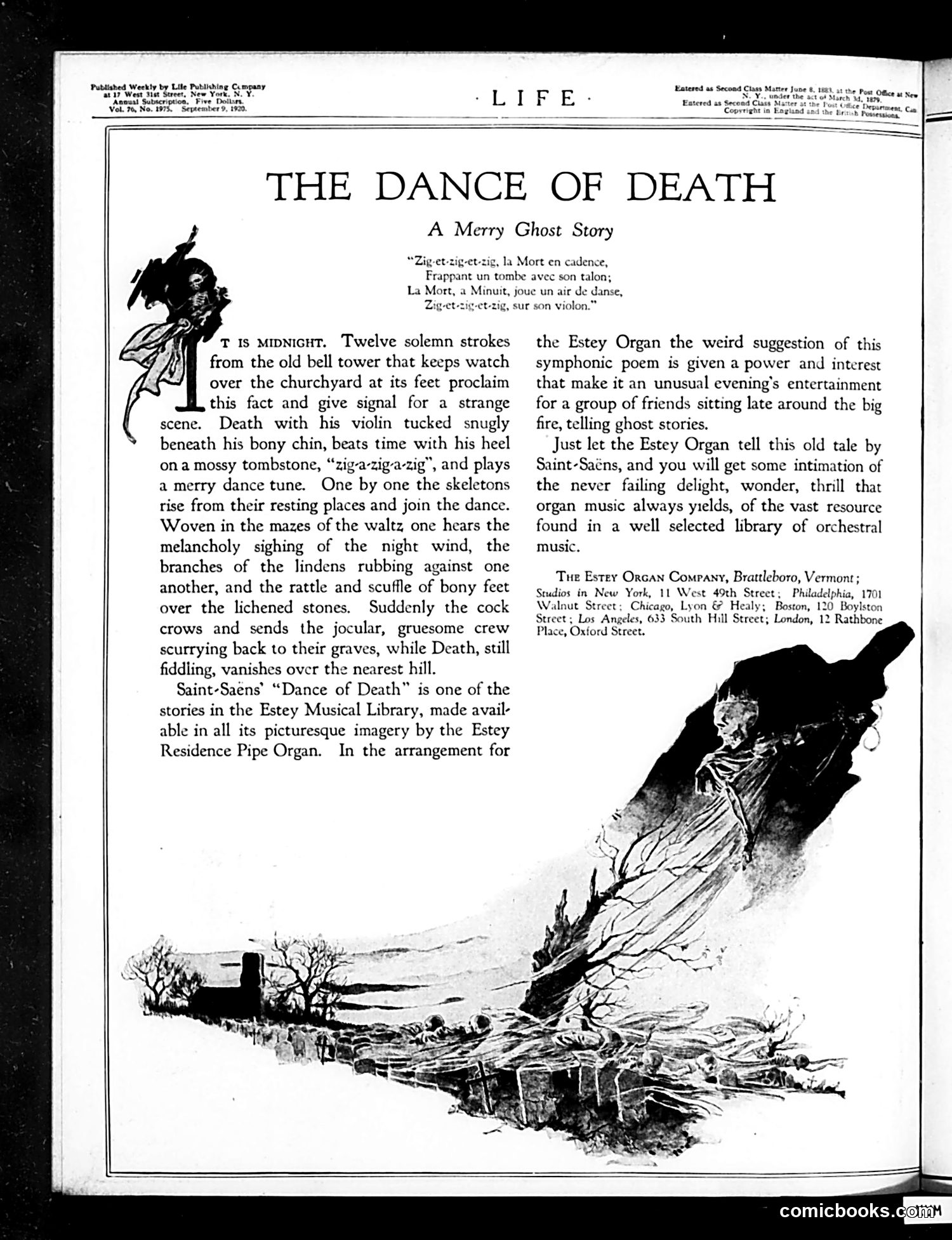
This is not a political cartoon but rather a **literary/advertising feature** for the Estey Organ Company. The page presents "The Dance of Death," a classic macabre tale (referencing Saint-Saëns' symphonic poem "Danse Macabre"). The narrative describes Death personified as a skeleton fiddler who, at midnight, summons other skeletons to dance. The accompanying illustrations show Death as a skeletal figure with violin—a gothic, supernatural imagery typical of 19th-century romanticism. The article frames this spooky story as suitable entertainment for "friends sitting late around the big fire, telling ghost stories," then advertises how the Estey Organ can dramatically perform this piece through its "well selected library of orchestral music." **This is essentially an advertisement disguised as entertainment content.**
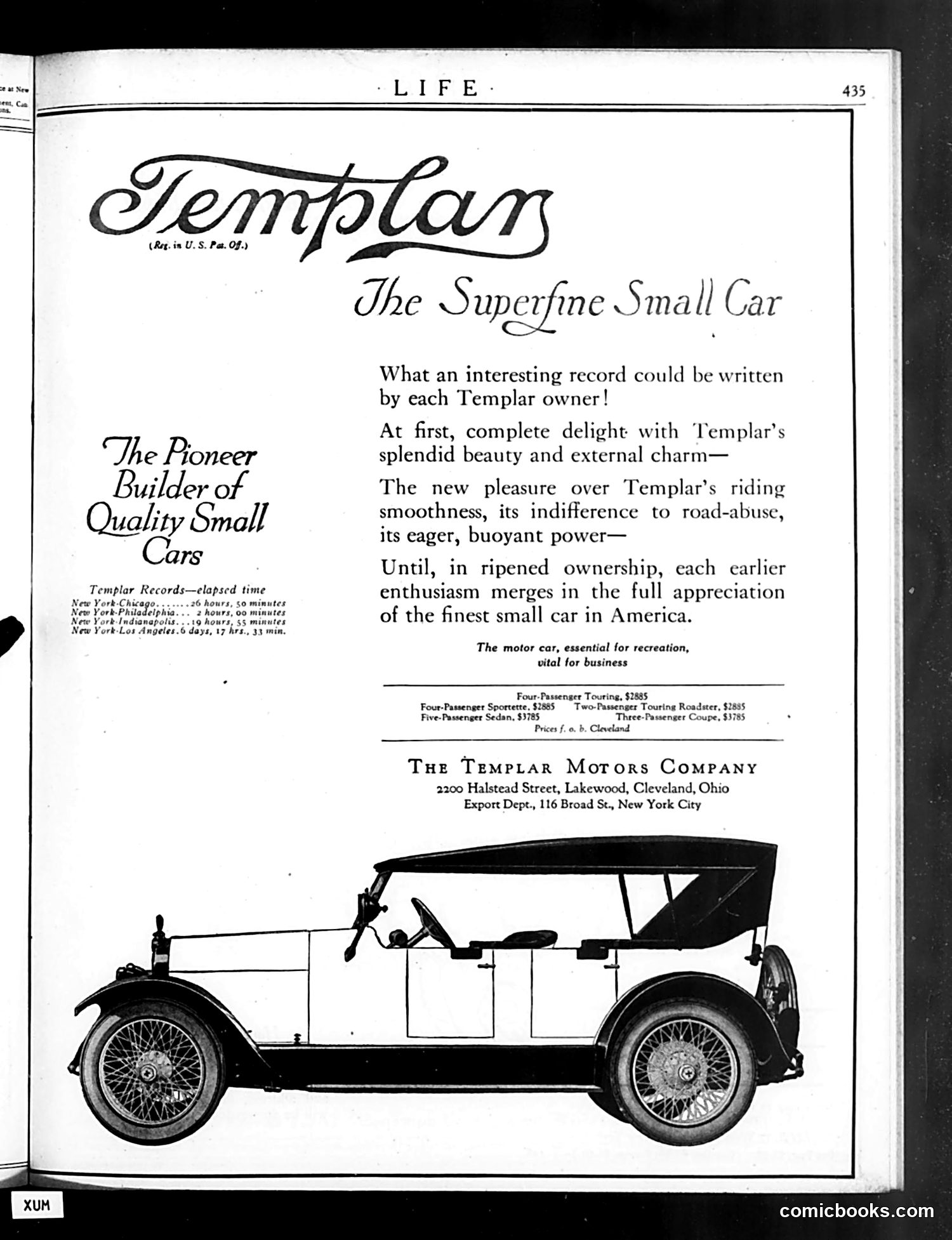
This page is **primarily an advertisement**, not political satire. It promotes the Templar automobile, described as "The Superfine Small Car" and "The Pioneer Builder of Quality Small Cars." The ad emphasizes the car's appeal to owners through its beauty, smooth ride, and durability. It includes performance records (New York to Chicago in 28 hours, etc.) and pricing information for various models ($2,885-$3,785). The illustration shows a side-profile technical drawing of an open-air touring car with wire wheels and a convertible top, typical of 1920s automotive design. There is no political cartoon or satire present. This is straightforward commercial advertising from *Life* magazine's revenue-generating content, targeting middle-class consumers interested in recreational automobiles.
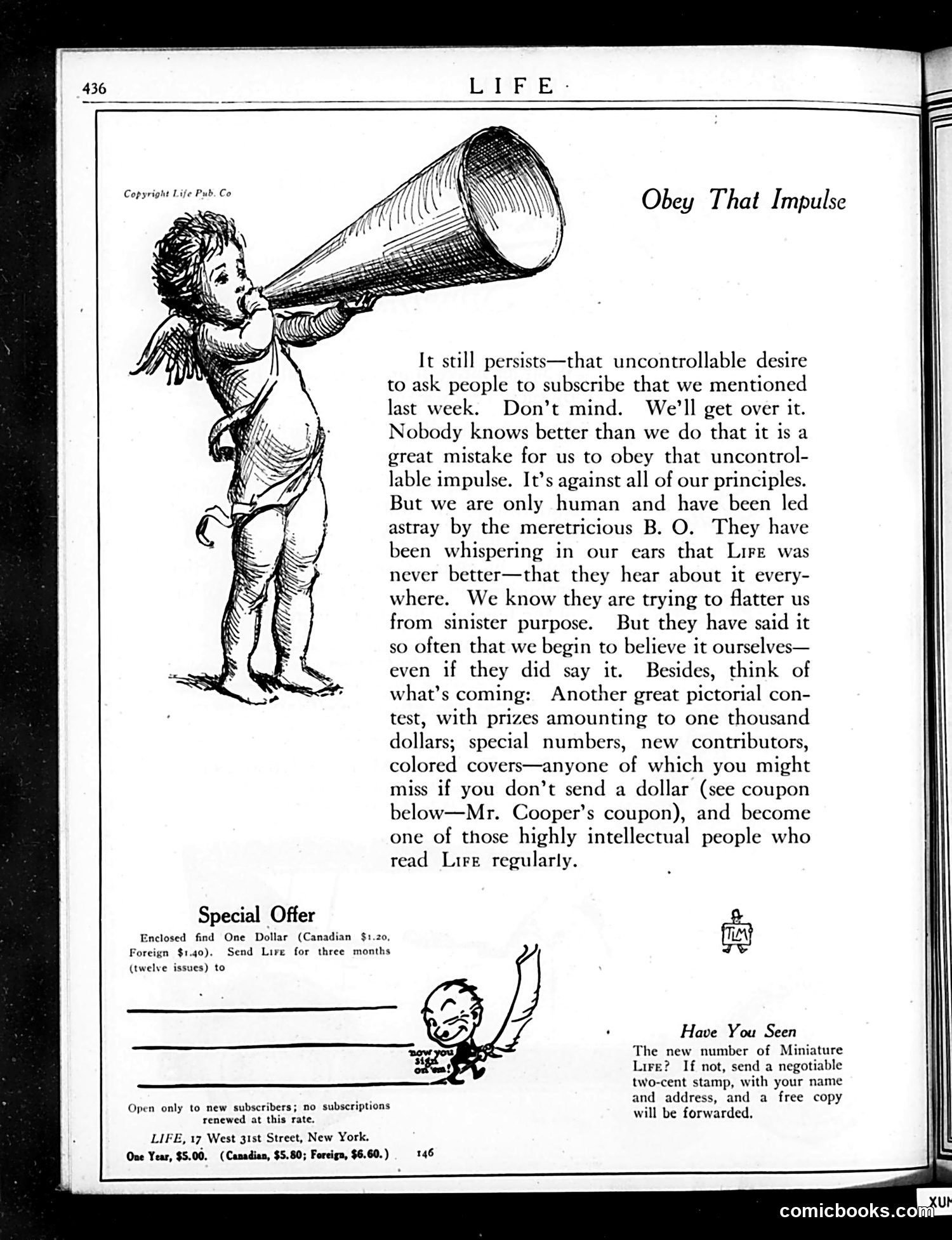
This page satirizes Life magazine's own subscription drive. The cherub with a megaphone represents the magazine's relentless marketing campaign urging readers to subscribe. The text humorously acknowledges that Life has been aggressively promoting subscriptions ("that uncontrollable desire to ask people to subscribe"), admitting their tactics are manipulative—they've repeated the pitch so often that readers begin believing it themselves. The satire is self-directed: Life openly confesses to employing "sinisters purpose" flattery while pretending their circulation competition is legitimate. The "Special Offer" section below converts the satire into an actual subscription pitch—the joke being that even while mocking their own hard-sell tactics, they immediately deploy them anyway. It's meta-advertising: selling subscriptions by ironically admitting how aggressively they sell subscriptions.
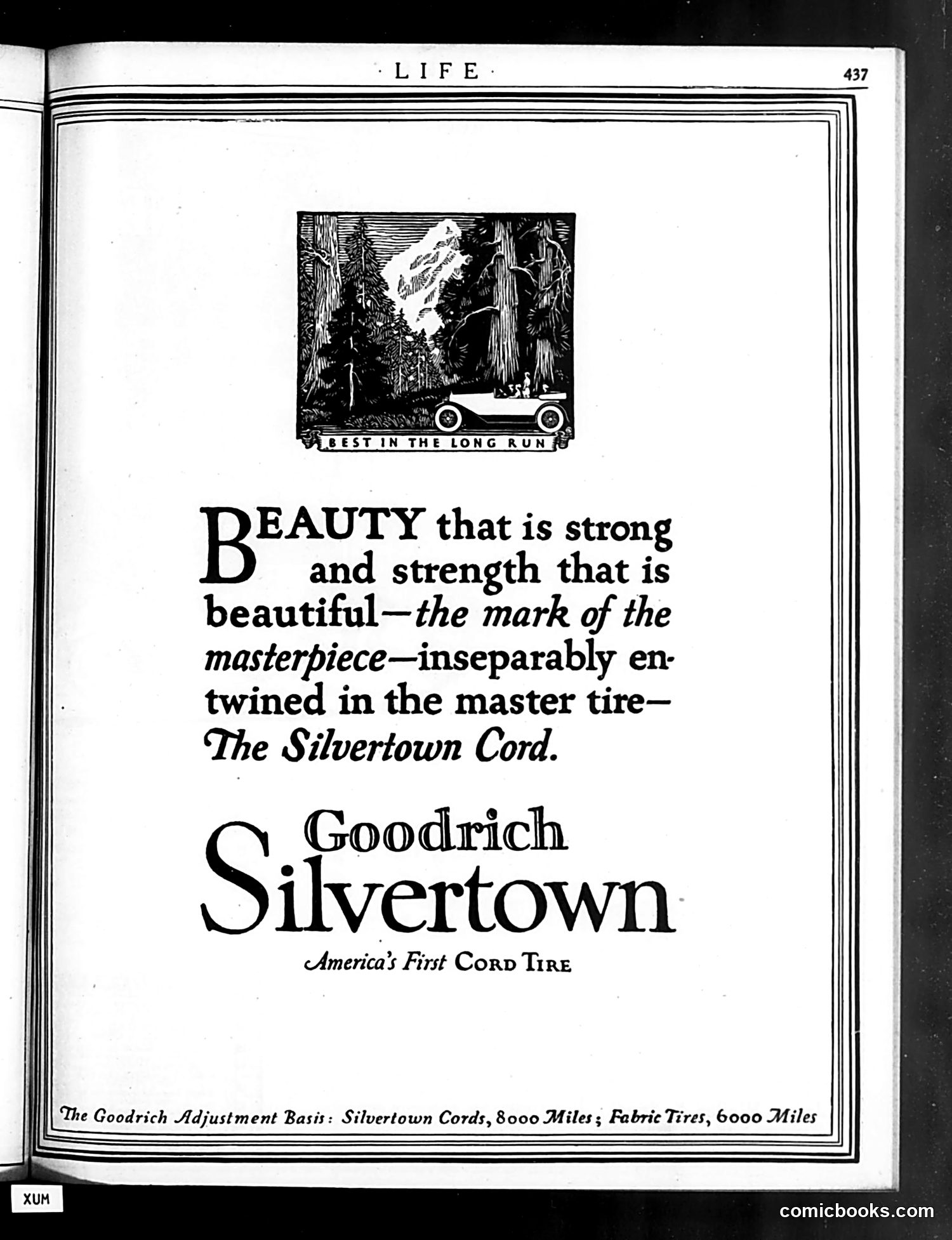
This is **not a cartoon or satire**—it's a straightforward advertisement for Goodrich Silvertown tires, appearing in *Life* magazine (page 437). The ad uses aesthetic language ("Beauty that is strong and strength that is beautiful") to market the tire as a "masterpiece." The small illustration at top shows a scenic mountain vista viewed through tall trees from a car, emphasizing the tire's capability for long-distance travel ("Best in the Long Run"). The tagline claims Silvertown was "America's First Cord Tire." The fine print at bottom specifies performance claims: Silvertown Cords lasted 8,000 miles; fabric tires only 6,000 miles. This represents early automotive advertising emphasizing durability and American industrial innovation—standard magazine advertising rather than editorial content.
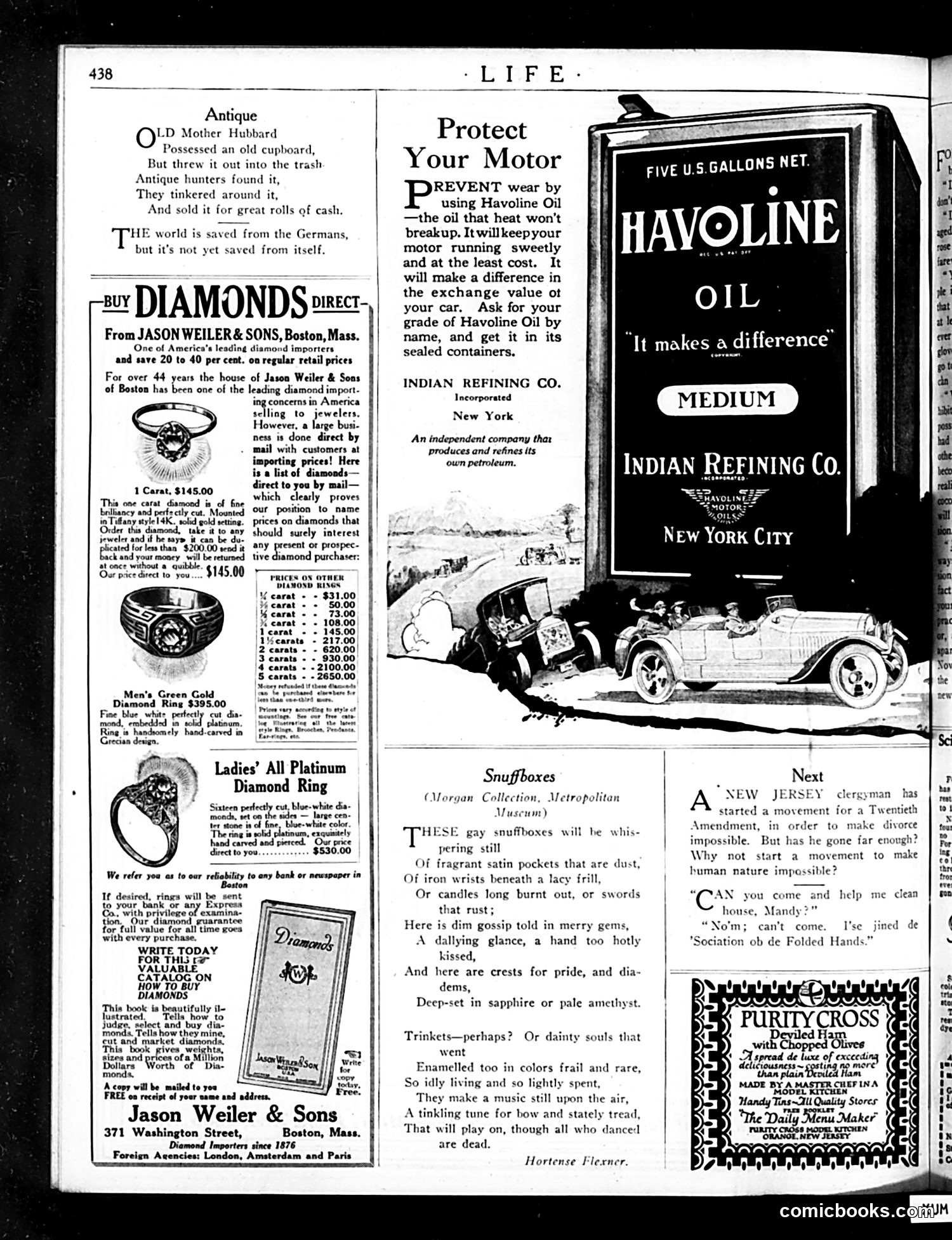
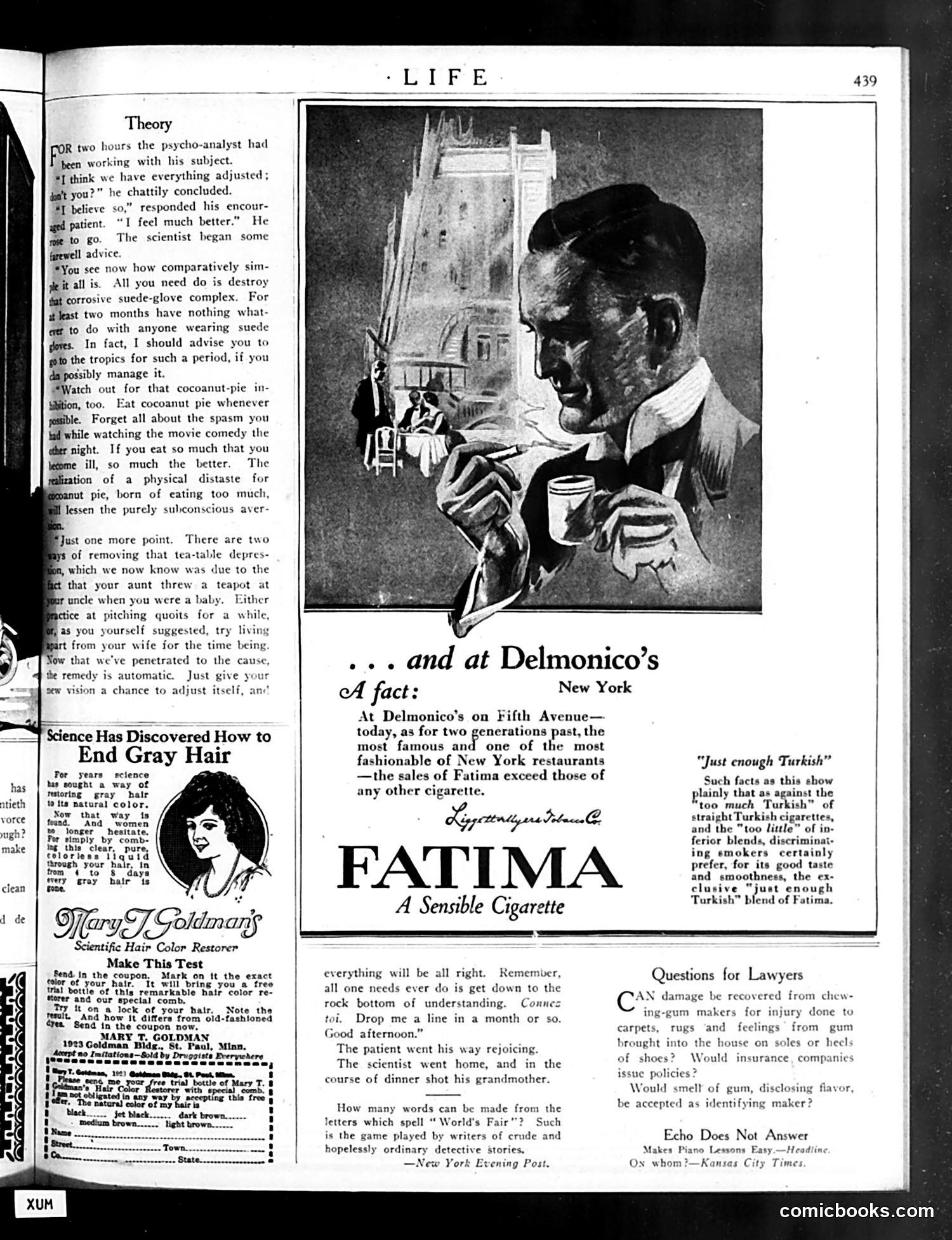
This page is primarily **advertising content** interspersed with minor editorial material. The main advertisement promotes **Fatima cigarettes**, featuring an illustrated figure in Turkish dress holding a cigarette and coffee cup at "Delmonico's" restaurant in New York. The ad emphasizes that Fatima has outsold other cigarettes there "for two generations." A secondary ad promotes **Mary Goldman's Scientific Hair Color Restorer** for gray hair, with a testimonial format typical of patent medicine advertising. The small "Questions for Lawyers" section and "Echo Does Not Answer" are filler content. The page reflects **early 20th-century advertising conventions**: orientalist imagery associating cigarettes with exotic sophistication, and pseudoscientific hair-treatment marketing—both now recognized as culturally problematic.
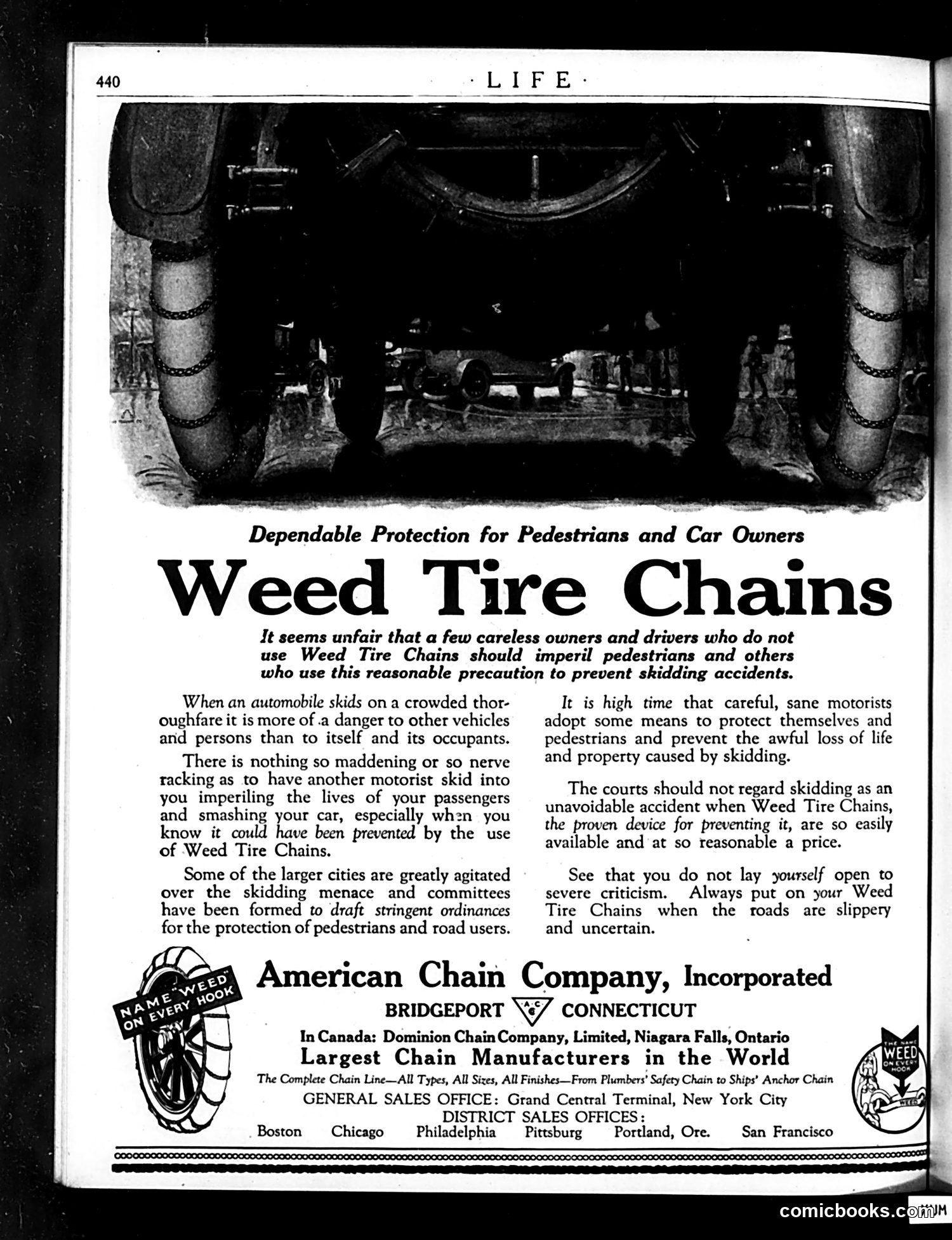
This is primarily a **full-page advertisement** for Weed Tire Chains, not satirical content. The ad argues that automobile tire chains are essential safety equipment to prevent skidding accidents on icy or wet roads. The image shows a car viewed from underneath, displaying the tire chains in action. The advertisement's argument is **somewhat accusatory toward negligent drivers**: it frames the choice *not* to use tire chains as unfair to pedestrians and other motorists who could be harmed by skidding. The text suggests courts should not excuse skidding as "unavoidable" when chains are affordable and readily available. The tone is moralistic rather than humorous—appealing to driver responsibility and public safety rather than satirizing anything. This reflects early automotive-era concerns about accident prevention and product promotion through guilt and civic duty.
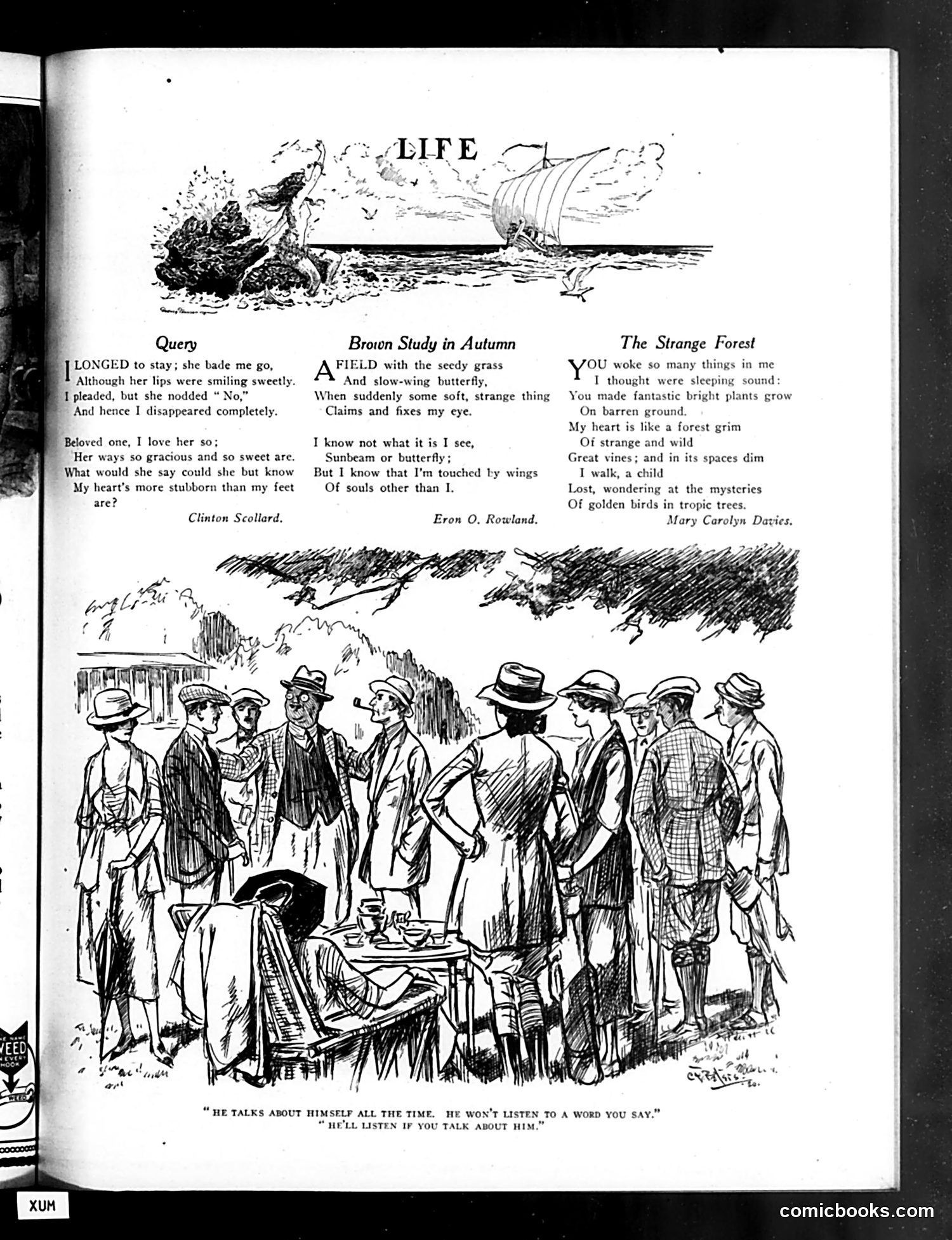
This page contains three poems ("Query," "Brown Study in Autumn," and "The Strange Forest") with decorative header illustrations, plus a large satirical cartoon below. The cartoon depicts a social gathering—possibly a party or outdoor event—where a woman sits while numerous men in suits and hats stand around her. The caption reads: "HE TALKS ABOUT HIMSELF ALL THE TIME. HE WON'T LISTEN TO A WORD YOU SAY." "HE'LL LISTEN IF YOU TALK ABOUT HIM." This is social satire about male egotism and conversational behavior. The joke mocks men who are self-absorbed, won't listen to others, but become attentive only when the conversation centers on themselves. The crowded scene suggests this is a common, recognizable social dynamic among the educated classes Life targeted.
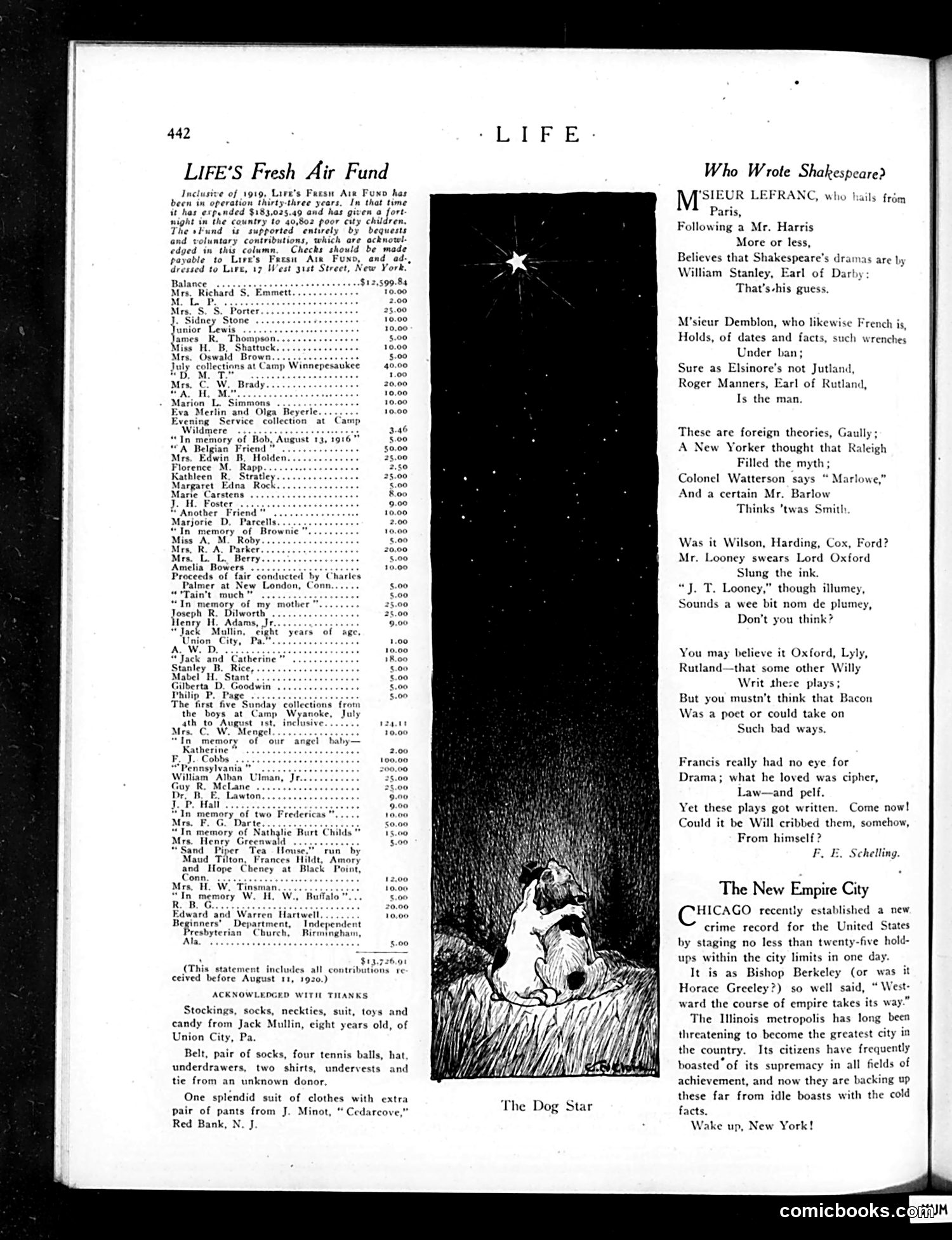
This page from *Life* magazine features "The Dog Star," a satirical cartoon showing a dog gazing upward at a star. The accompanying text criticizes Chicago's recent crime wave, noting the city has established a "new crime record for the United States" by staging "no less than twenty-five hold-ups within the city limits in one day." The cartoon uses the dog star (Sirius) as a metaphor, with the image likely suggesting Chicago should "wake up" and address its lawlessness. The text references Bishop Berkeley and Horace Greeley, invoking the latter's famous phrase "Go West" to sardonically suggest that westward expansion brought criminals and chaos rather than opportunity. The satire targets Chicago's boastful claims of supremacy while facing mounting crime problems.
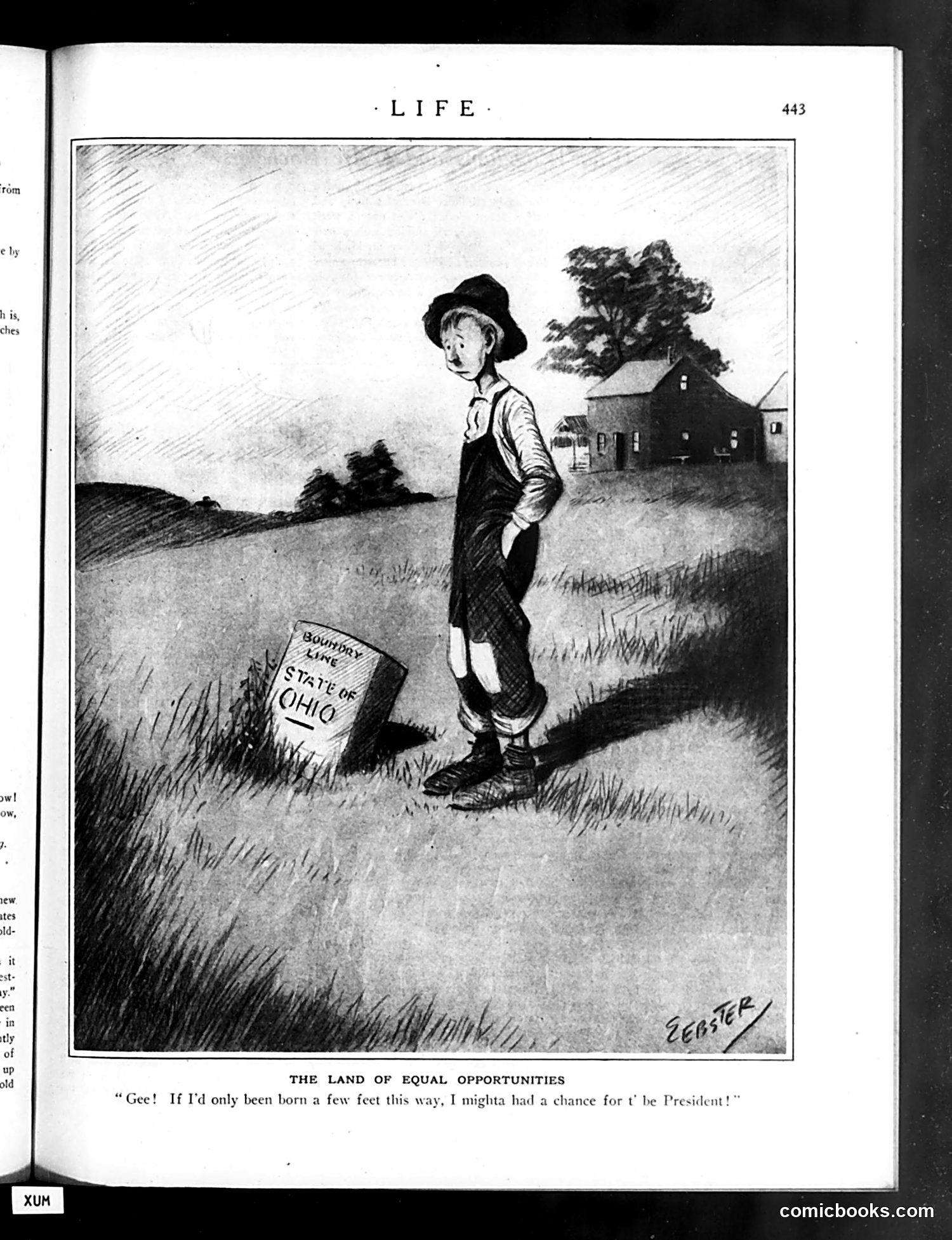
This cartoon satirizes the American ideal of equal opportunity. A young boy stands at the border of Ohio, looking toward a farmhouse in the distance. The caption reads: "Gee! If I'd only been born a few feet this way, I mighta had a chance f'r t' be President!" The satire is clear: despite America's promise that anyone can become president, one's actual opportunity depends entirely on geography and birthplace—factors beyond individual control. The boy's frustration highlights the hypocrisy between the nation's stated meritocratic ideals and the reality that constitutional requirements (such as natural-born citizenship) create arbitrary barriers. The cartoon mocks the notion that America truly offers "equal opportunities" when fundamental accidents of birth determine possibility.
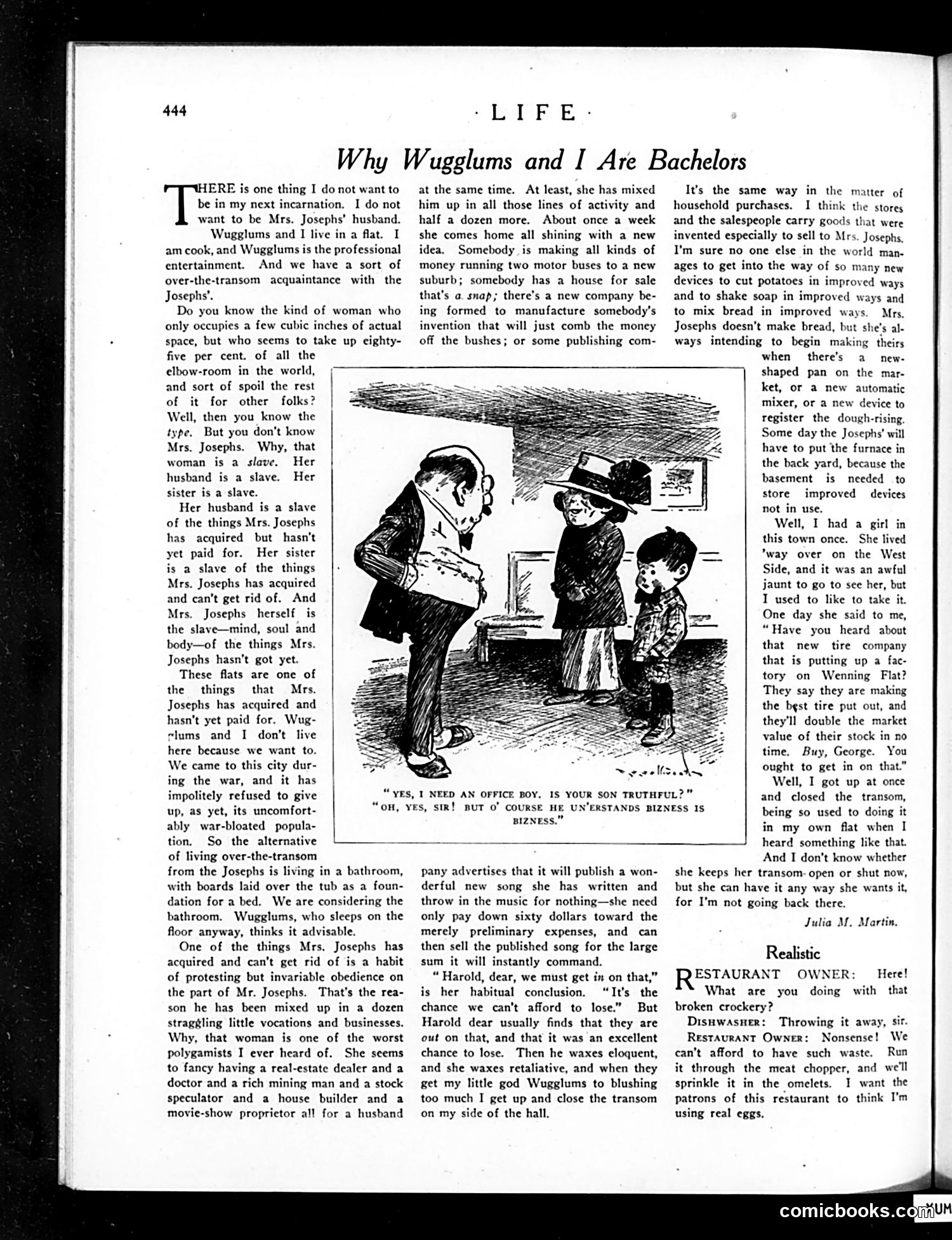
This article satirizes married life through the narrator's observations of his friend Mrs. Josephs. The cartoon illustrates a man asking an office boy, "Yes, I need an office boy. Is your son trustworthy?" The boy responds, "Oh, yes, sir! But of course he understands business is business." The satire targets how marriage and domestic life trap men through constant financial demands—wives acquiring possessions (household gadgets, improved bread-making devices, furnaces) that require endless maintenance and expense. The narrator suggests marriage forces men into slavery to pay for their wives' acquisitions. The cartoon's dialogue ironically jokes about business integrity while the article argues marriage itself is the worst "business" for a man, justifying bachelor status.
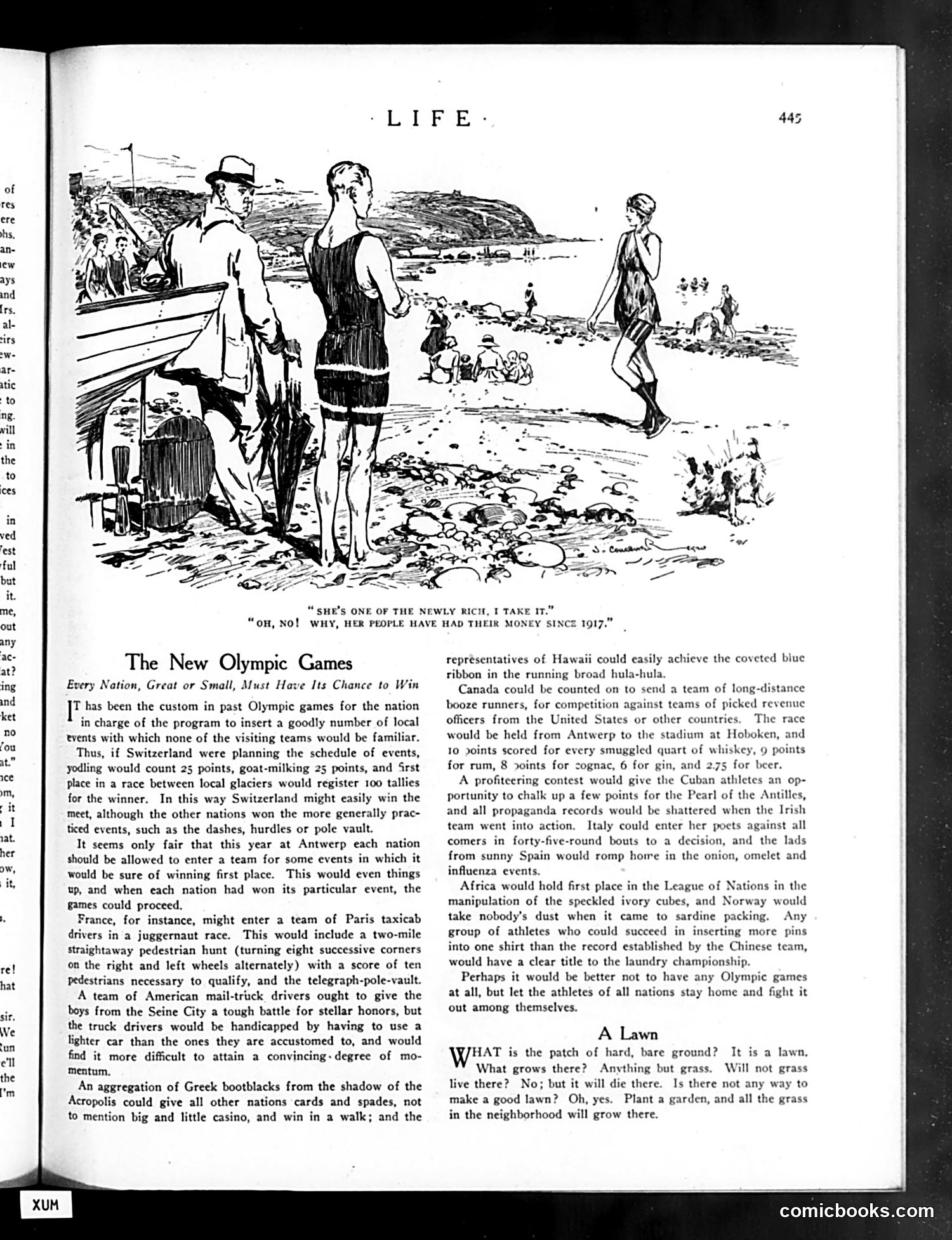
The cartoon at the top depicts a beach scene with two men in swimming attire observing a woman. The caption reads: "She's one of the newly rich, I take it" / "Oh, no! Why, her people have had their money since 1917." **The satire targets:** American class consciousness and newly acquired wealth following World War I. The joke mocks snobbish attitudes about "old money" versus "new money"—the implication being that someone whose family gained wealth only since 1917 is considered a parvenu or social climber by those with established fortunes. The woman's appearance or behavior apparently signals nouveau-riche status to the observant gentleman, yet his companion corrects him, suggesting her family's wealth, though recent by aristocratic standards, is actually quite established by contemporary measures.
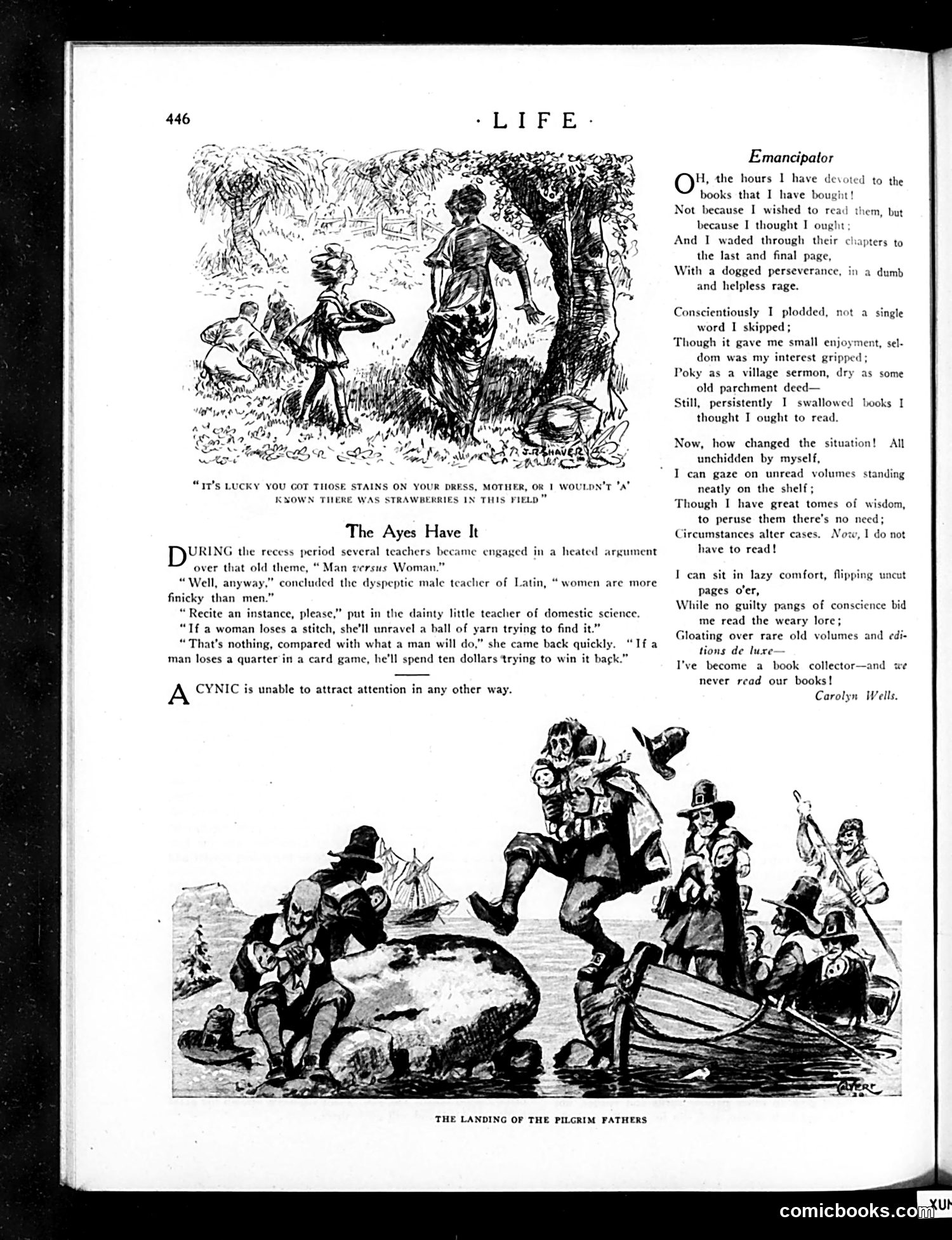
The page features two distinct sections: **Top Section ("Emancipator"):** A poem by Carolyn Wells celebrating the liberation of reading. The speaker describes abandoning conscientiousness about finishing books and instead enjoying selective reading—treating themselves as a "book collector" who never actually reads their volumes. It's a humorous meditation on intellectual freedom and rejecting obligation. **Bottom Section ("The Ayes Have It"):** A satirical debate about gender capabilities, referencing the old "Man versus Woman" argument. Male teachers dismiss women's abilities (losing stitches, yarns), while a female teacher counters with examples of men's incompetence in domestic tasks. The accompanying cartoon illustrates domestic chaos—likely supporting her point that men fare no better domestically. Both pieces humorously challenge conventional gender assumptions through wit rather than direct argumentation.
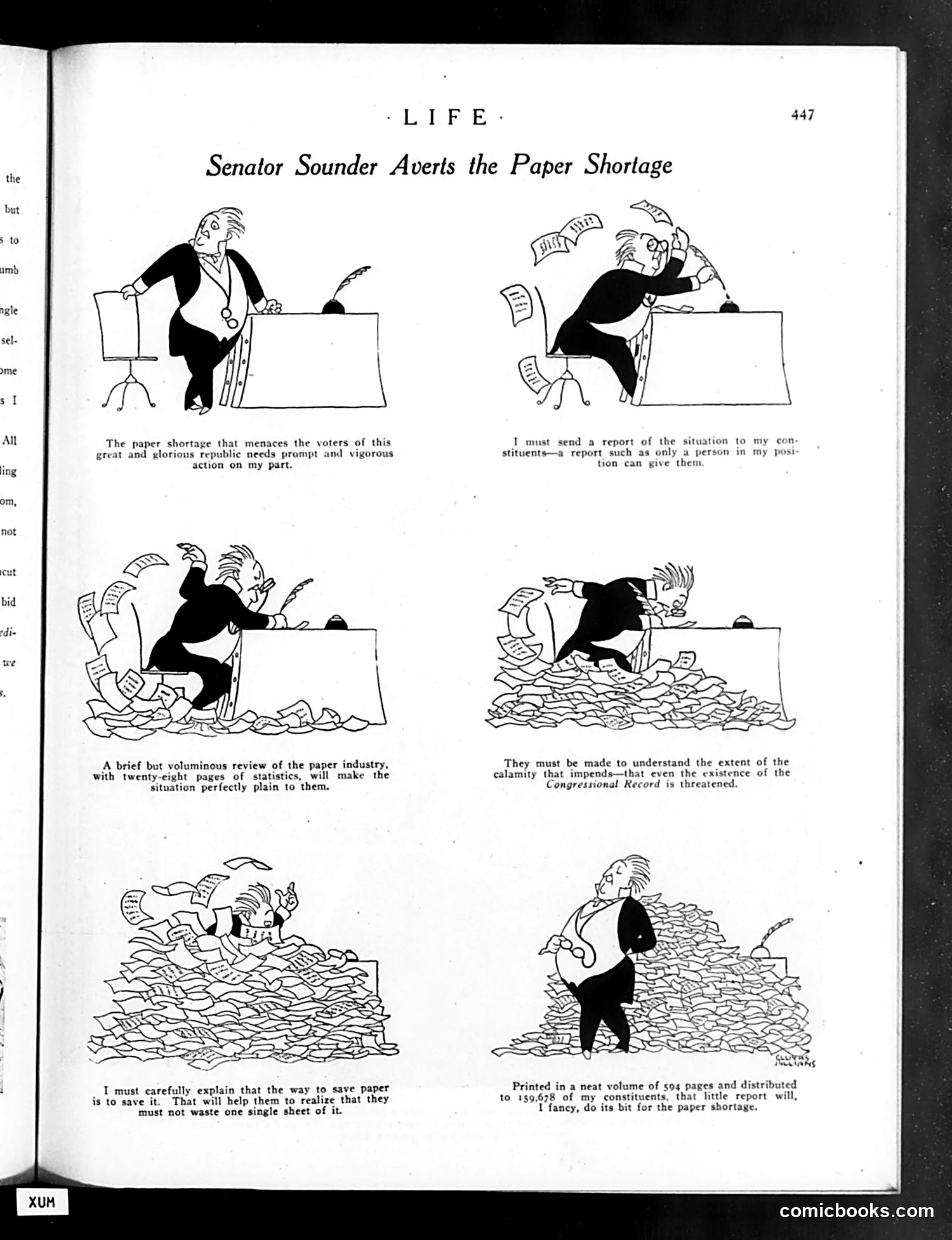
This six-panel satirical cartoon depicts a senator responding to a paper shortage by producing an absurdly voluminous report on the paper industry. The humor lies in the escalating irony: each panel shows the senator increasingly buried under the very papers his report generates, culminating in the final panel where he's overwhelmed by the 504-page document distributed to 150,698 constituents. The satire targets government inefficiency and bureaucratic excess—specifically, the senator's solution to paper scarcity actually worsens the problem. The cartoon mocks how politicians often respond to crises with self-defeating actions while congratulating themselves for their efforts. The phrase "do its bit for the paper shortage" underscores the absurdist contradiction at the heart of the joke.
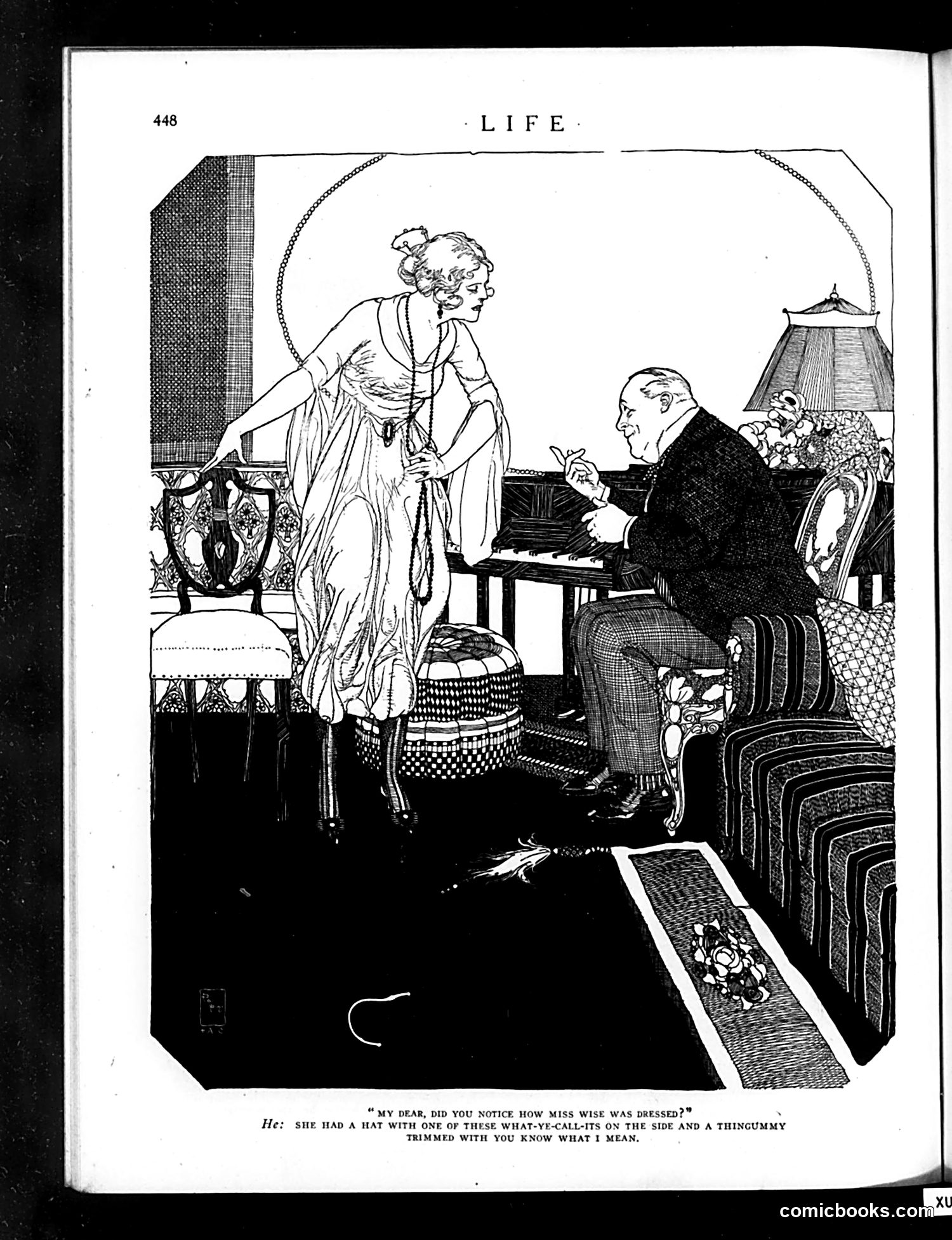
This is a single-panel cartoon satirizing fashion and marital dynamics. A man sits at a piano while a woman stands nearby in an elegant gown. The caption reads: "My dear, did you notice how Miss Wise was dressed?" with the man's response: "She had a hat with one of these what-ye-call-its on the side and a thingummy trimmed with you know what I mean." The humor targets how men (particularly husbands) remain oblivious or indifferent to women's fashion details, despite women's evident concern with such matters. The man's vague language ("what-ye-call-its," "thingummy," "you know what I mean") demonstrates his complete disinterest in or incomprehension of millinery trends—a common early-20th-century satirical subject. The joke reflects period gender stereotypes about women's fashion obsession versus masculine indifference.
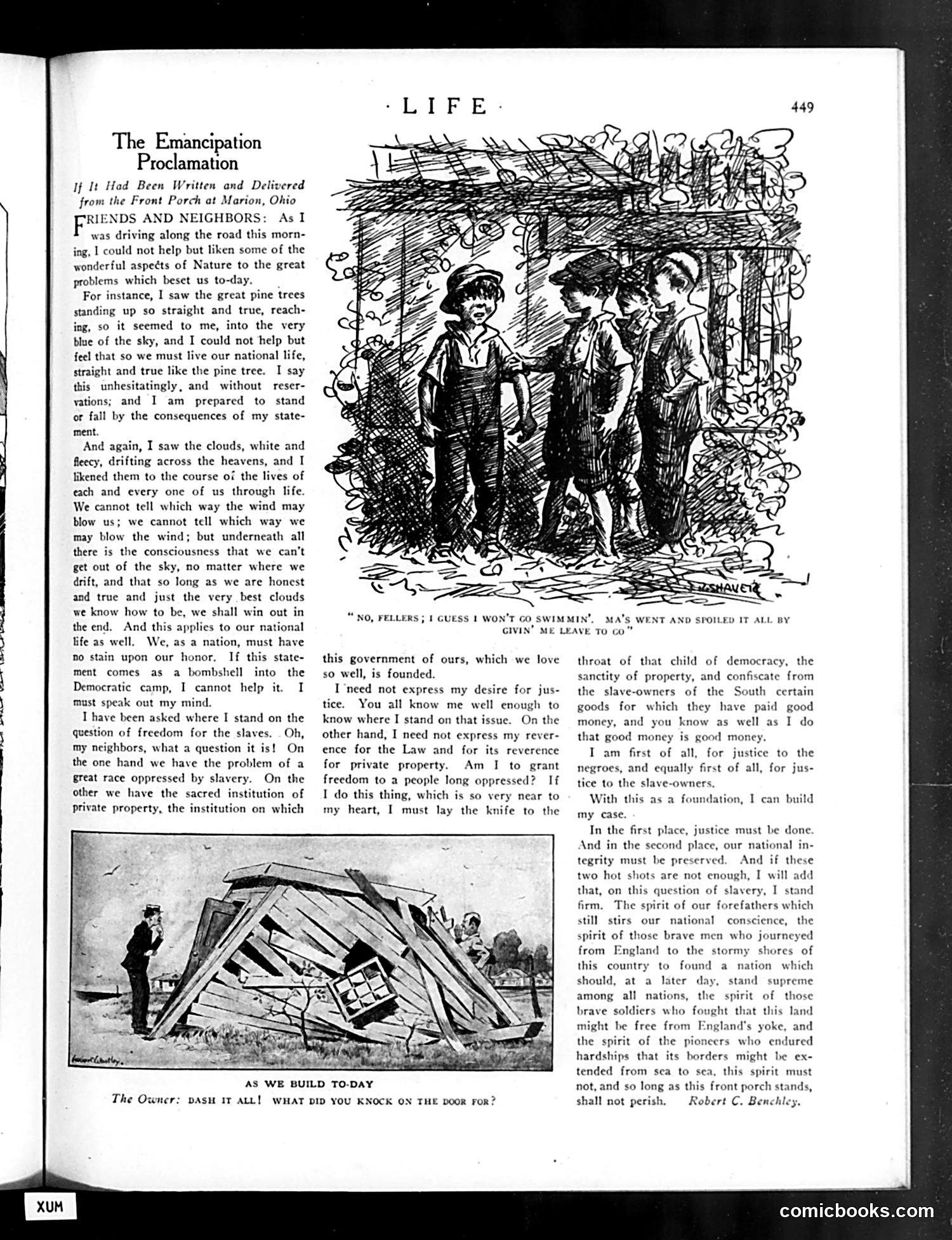
This page satirizes President Warren G. Harding's evasive speaking style. The mock "Emancipation Proclamation" parodies how Harding would address slavery if he spoke from his front porch in Marion, Ohio—using flowery nature metaphors (pine trees, clouds) to avoid taking a clear stance. The satire targets Harding's notorious verbal circumlocution: he acknowledges slavery's injustice and property rights simultaneously, then equivocates endlessly rather than commit to abolition. His refrain—"I stand firm" on slavery while balancing both sides—perfectly captures his political non-position. The two cartoon illustrations underscore the absurdity: children ignoring a pompous speaker, and a house collapsing (labeled "As We Build To-Day"), suggesting that such equivocation undermines the nation's foundation. The point: Harding's bloated rhetoric masks moral cowardice on fundamental issues.
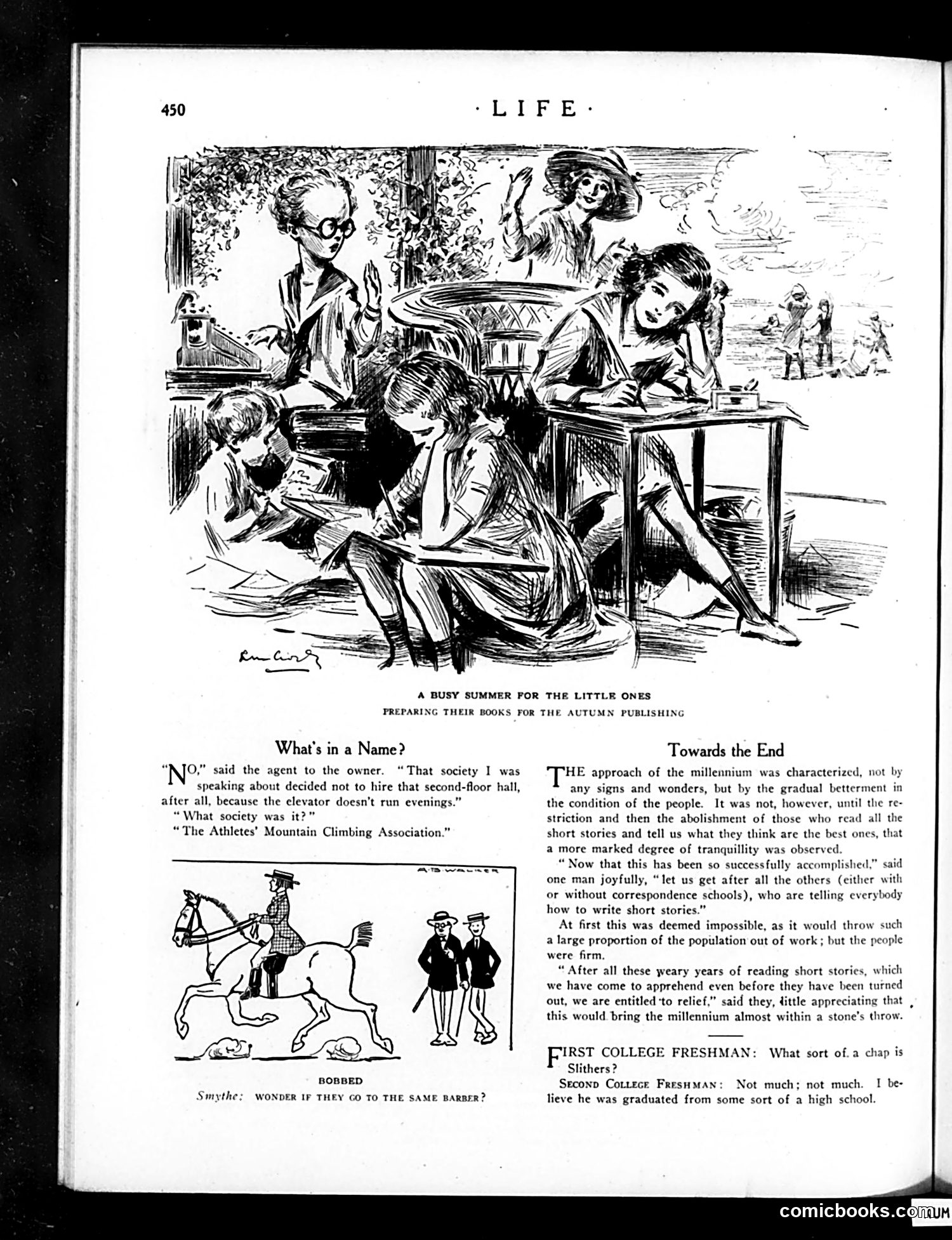
This page contains three satirical pieces: 1. **Top illustration**: Shows children preparing manuscripts for publication—satirizing the proliferation of young writers and publishing during this period. 2. **"What's in a Name?"**: A brief joke where a society seeking a venue is rejected because it's "The Athletes' Mountain Climbing Association"—likely mocking the era's abundance of specialized clubs and organizations with grandiose names that didn't match their actual activity or prestige. 3. **"Towards the End"**: A longer satire on the "millennium" (year 1900 or similar turning point). It mocks amateur writing instructors and "how to write" guides that flooded the market, suggesting society could only achieve peace by eliminating all these self-appointed writing experts and their correspondence schools. 4. **"Bobbed"**: A brief joke about two college freshmen—the caption "WONDER IF THEY GO TO THE SAME BARBER?" plays on the "bobbed hair" trend among young women, suggesting the shorter hairstyle was increasingly common even among men or challenging traditional masculine appearance.
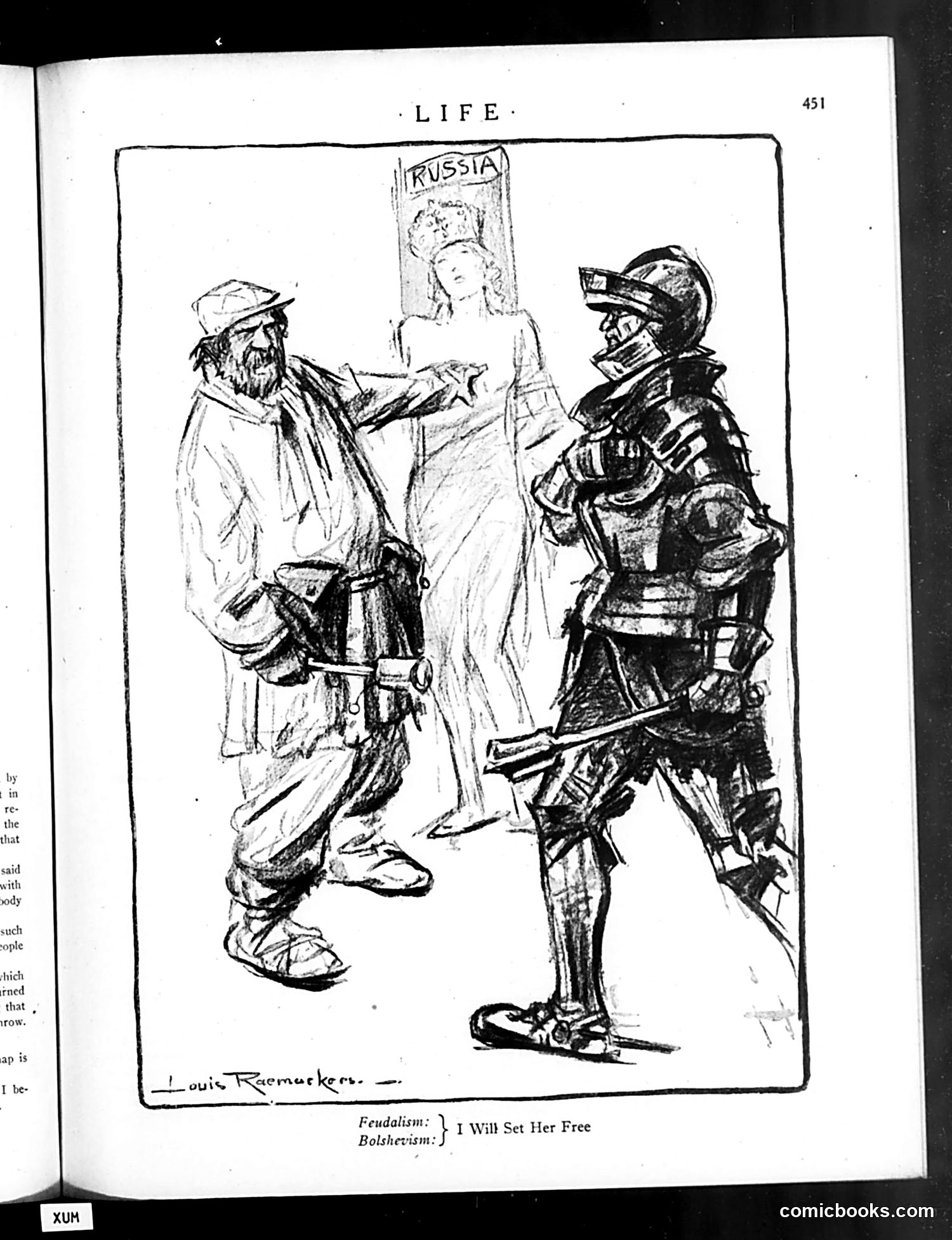
This cartoon by Louis Raemaekers depicts an allegorical confrontation between two political systems over Russia, personified as a woman. On the left stands a figure representing **Feudalism**—depicted as an older, bearded man in simple clothing. On the right is a soldier in modern military gear representing **Bolshevism**. The caption "I Will Set Her Free" suggests competition between these opposing ideologies to control Russia's future. The cartoon satirizes the Russian Revolution's political upheaval, presenting both feudalism and Bolshevism as competing forces claiming to liberate the Russian people. The woman symbolizes Russia itself, caught between two revolutionary/political movements, each promising freedom but implying possession rather than genuine liberation.
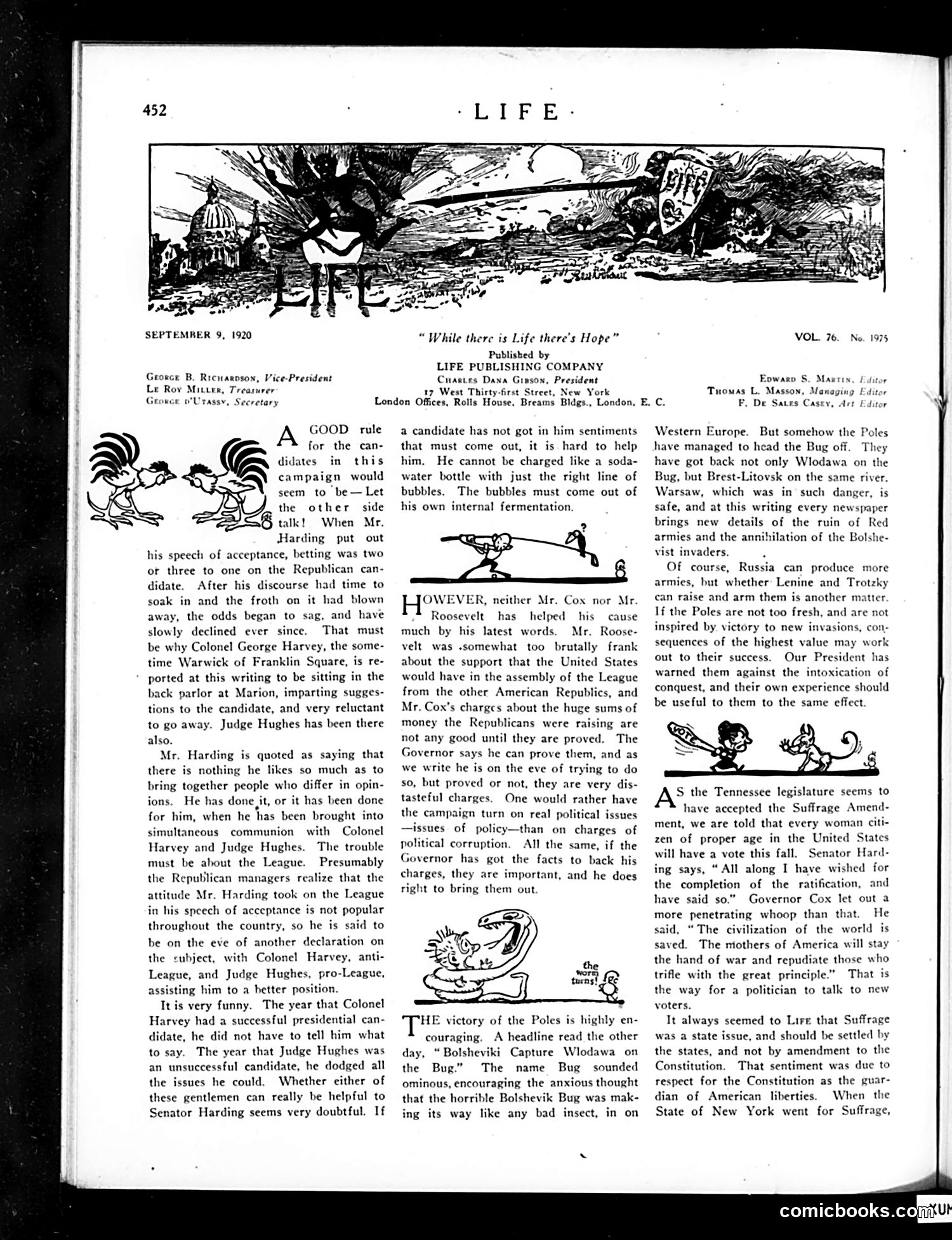
This page critiques the 1920 presidential campaign, particularly Republican candidate Warren G. Harding. The opening cartoon shows two roosters fighting—likely representing the Republican and Democratic candidates sparring. The main article mocks Harding's vague acceptance speech, noting that betting odds shifted against him once people actually read it. Life satirizes Republican handlers Colonel George Harvey and Judge Hughes attempting to coach Harding on the League of Nations issue, which divided the party. The piece suggests Harding lacks genuine conviction—comparing him to a soda bottle that needs external pressure to produce ideas. The article also criticizes Democratic candidate James Cox and Vice-Presidential candidate Franklin Roosevelt for their campaign tactics and unsupported accusations about Republican fundraising. A secondary section celebrates Polish military victories against Bolshevik forces, treating the "Bug" river (an actual geographical feature) as a fitting name for the Soviet threat spreading westward across Europe.
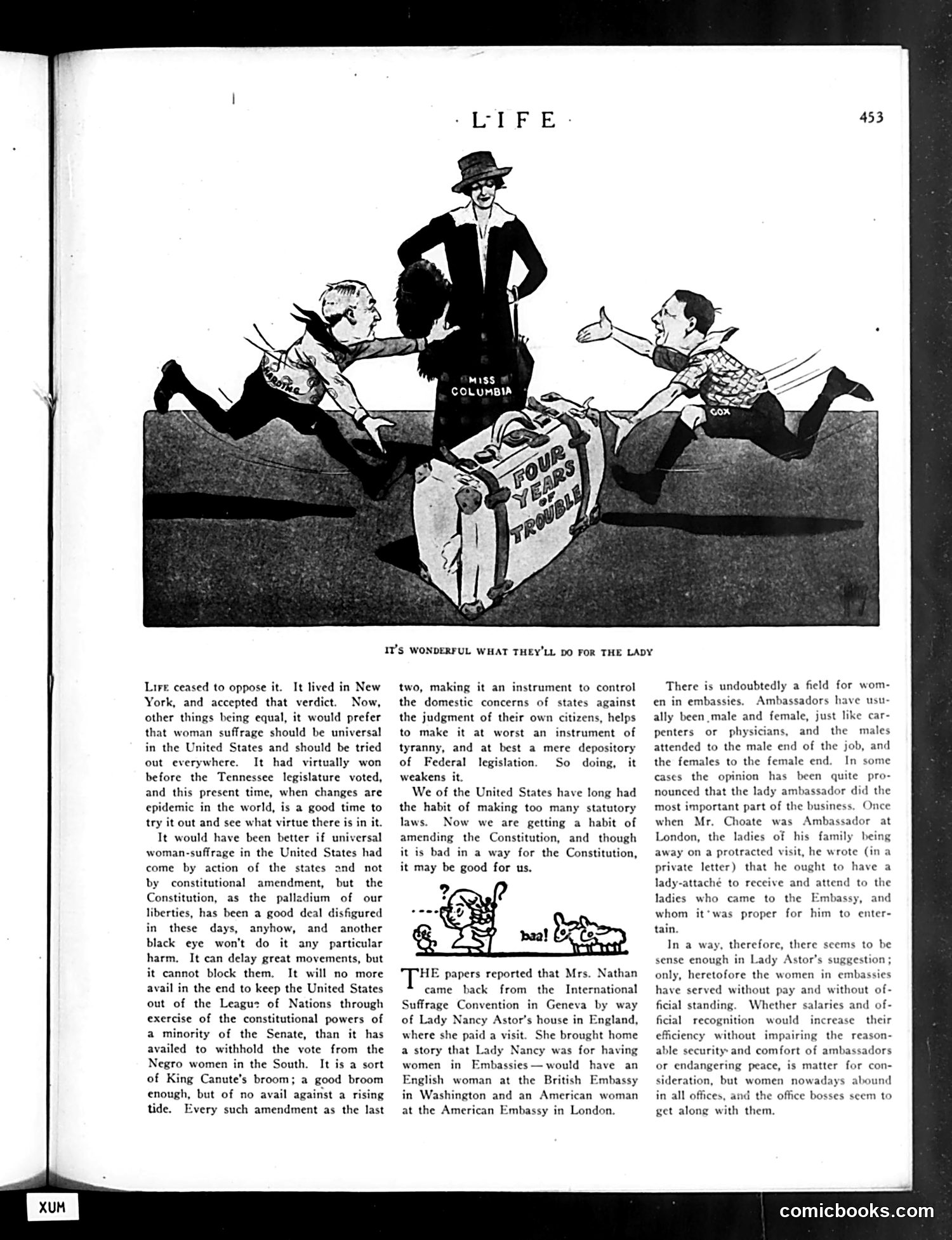
This cartoon satirizes the debate over women's roles following women's suffrage. The central figure labeled "Miss Columbia" (personifying the United States) stands atop a suitcase marked "Four Years' Trouble," while two men flail and gesture in distress on either side—likely representing political opponents of women's suffrage and expanded female participation in government. The accompanying text discusses Lady Nancy Astor's proposal that women serve as ambassadors and embassy staff. The satire mocks male politicians' exaggerated fears about women's expanded roles. The caption—"It's wonderful what they'll do for the lady"—drips with irony, suggesting these men's theatrical protests are absurd overreactions. The "Four Years' Trouble" reference likely alludes to women's long suffrage campaign. The cartoon argues that despite men's predictions of chaos, women's greater participation in civic life and diplomacy is both sensible and inevitable.
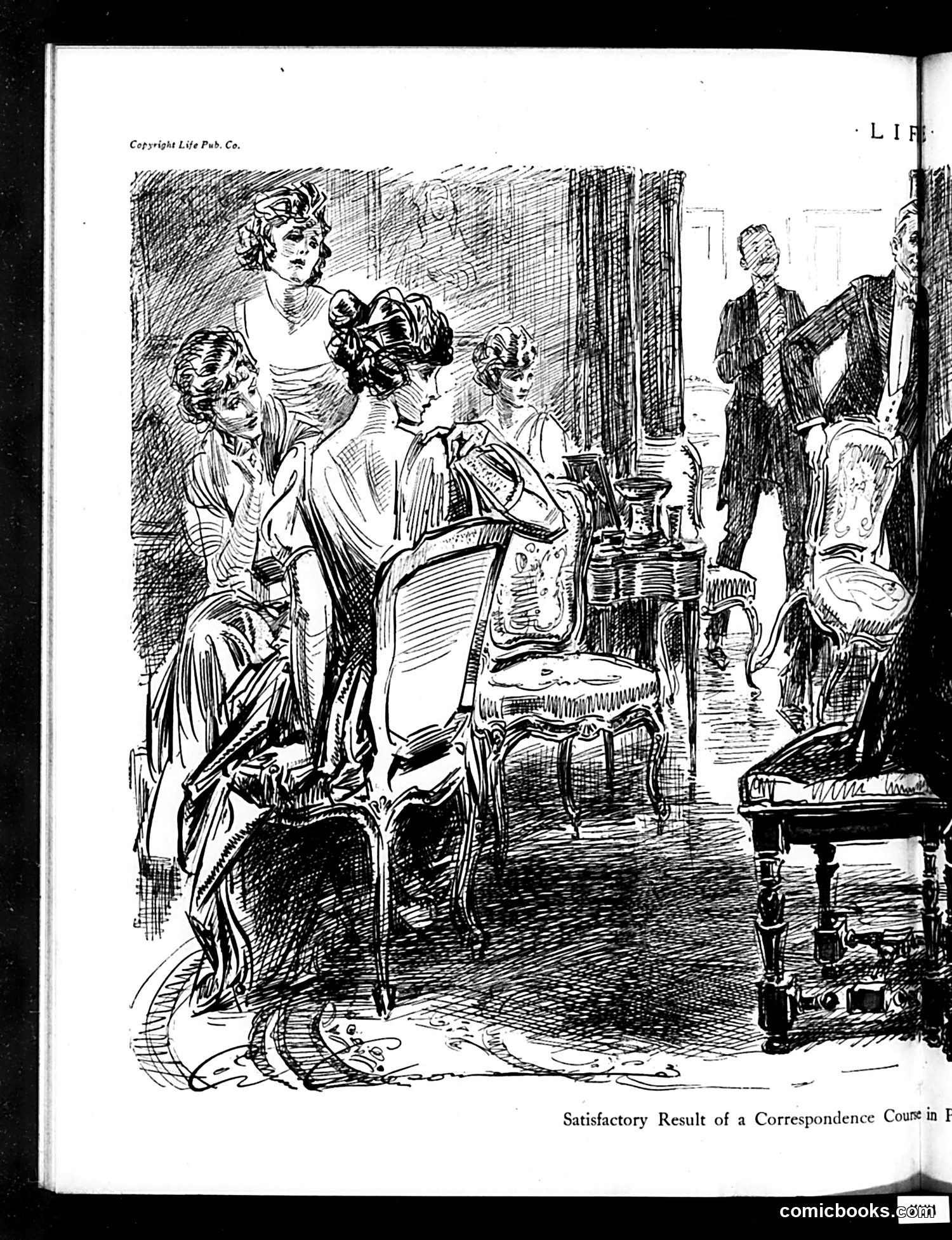
This is a satirical illustration from *Life* magazine depicting what appears to be a social or legal proceeding. The caption reads "Satisfactory Result of a Correspondence Course in F[encing]" (text is cut off). The image shows a woman who has apparently taken a correspondence course in fencing, now demonstrating her newfound skill by literally running a man through with a sword in what appears to be a formal parlor setting. Other well-dressed observers witness the scene. The satire likely mocks the era's proliferation of mail-order educational courses and their dubious quality, suggesting this woman's "correspondence course" training has made her dangerously competent—or that such courses produce absurd, impractical results. The humor derives from the unexpected violence and the juxtaposition of refined social settings with brutal swordsmanship.
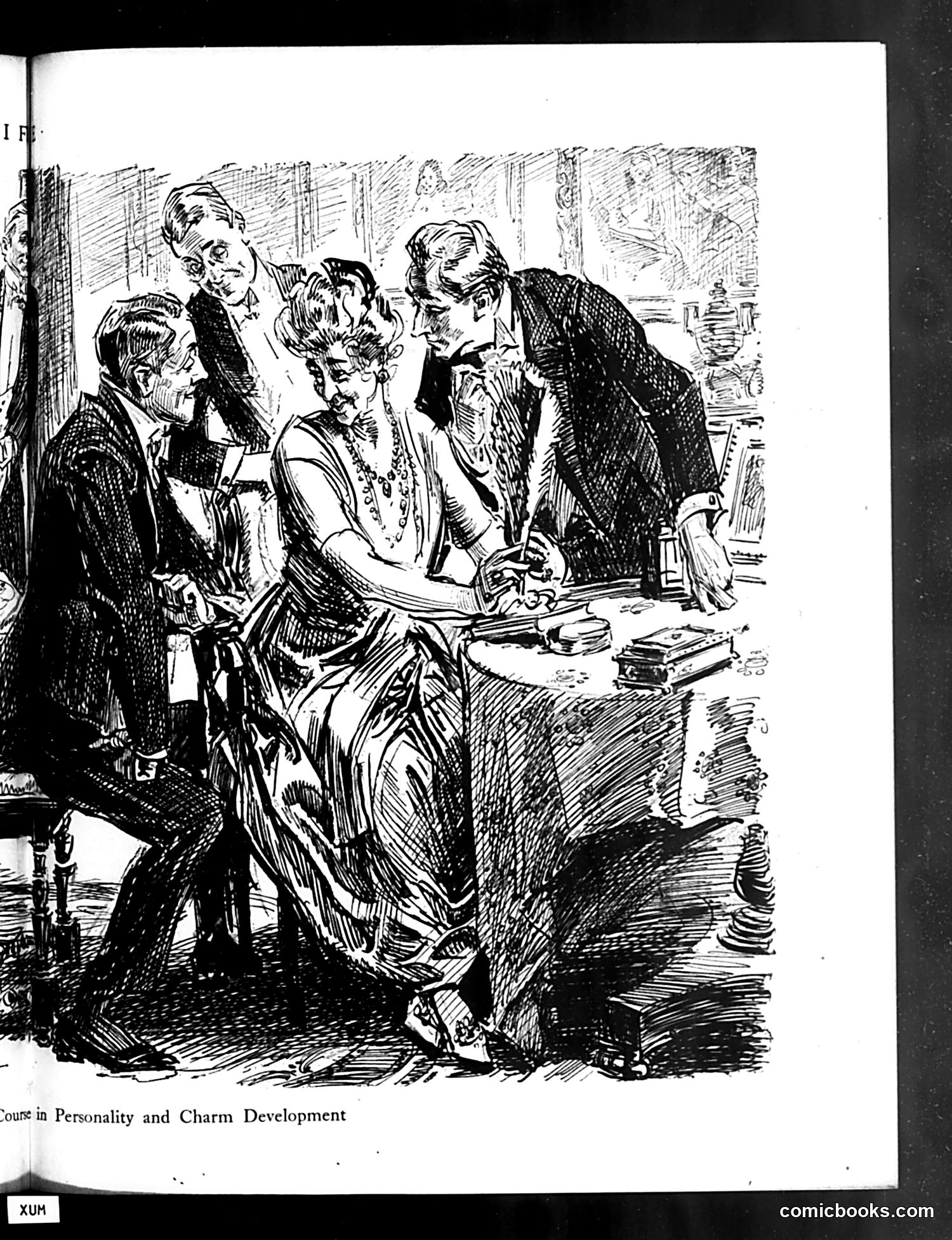
This sketch appears to satirize a **"course in personality and charm development"**—likely a self-improvement or etiquette class popular in the early 20th century. The scene shows five well-dressed people (four men and one woman) gathered around a desk, examining what appears to be instructional materials or documents. The satire targets the era's obsession with **personal refinement and social advancement through purchased instruction**. The formal attire and serious expressions suggest these are aspirational middle-class individuals seeking to acquire "charm" and "personality" as if they were commodities—a critique of commercialized self-help culture. The cartoon mocks the notion that such intangible qualities could be learned from a course, implying the endeavor is somewhat ridiculous or fraudulent.
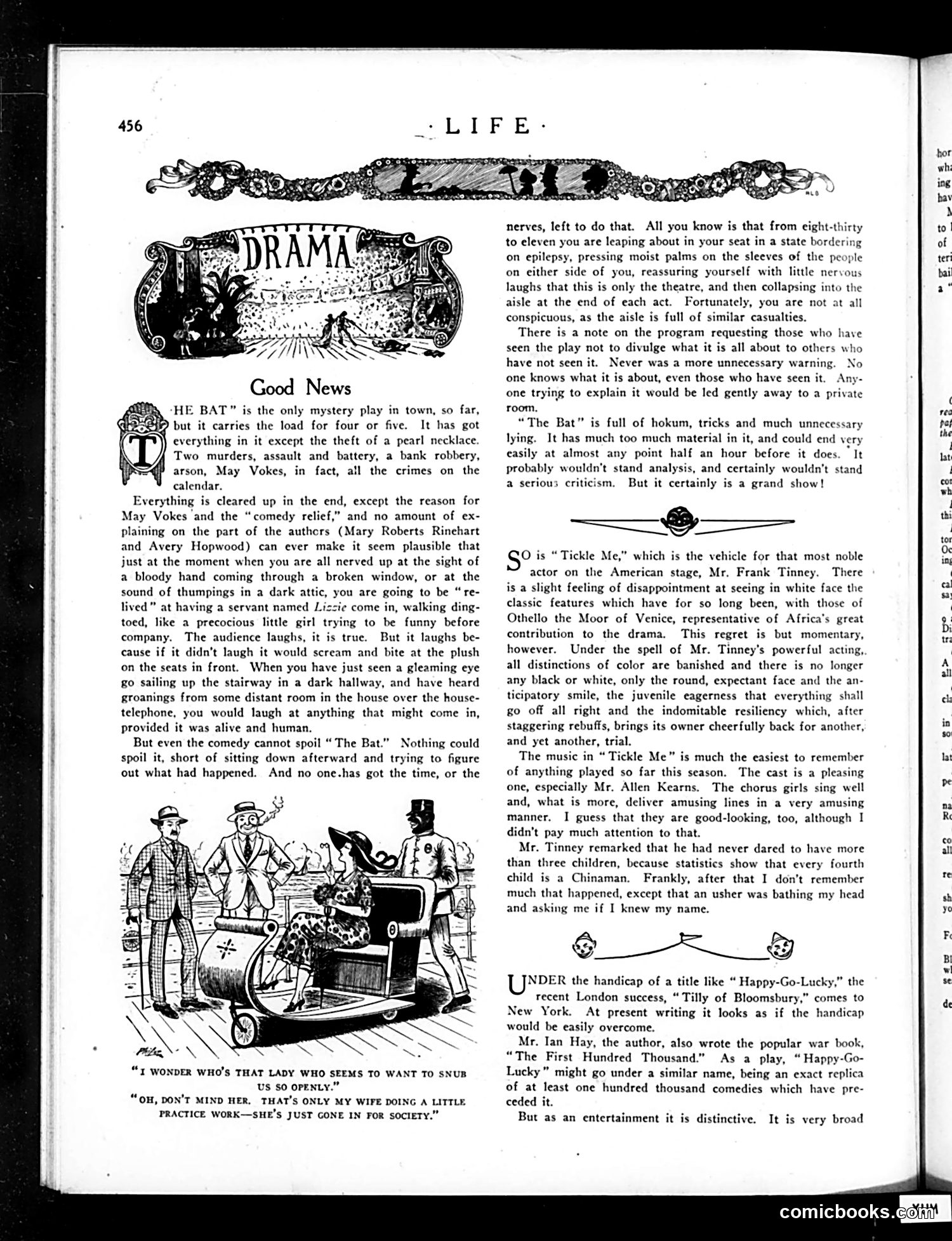
This page reviews two Broadway plays: "The Bat" and "Tickle Me." **"The Bat"** critique: The reviewer praises this mystery play (by Mary Roberts Rinehart and Avery Hopwood) as genuinely thrilling—packed with murders, robbery, and violence—despite its absurd "comedy relief" character Lizzie. The satire argues audiences laugh not from genuine humor but from nervous hysteria; the ridiculous interludes actually prevent the play from being spoiled by logical scrutiny. The humor targets both the play's formulaic sensationalism and theater audiences' suspension of disbelief. **The cartoon** shows well-dressed men with a car, captioning marital dynamics where a wife practices "society" snubbing—satirizing nouveau riche social-climbing behavior. **"Tickle Me"** review: Praises Frank Tinney's blackface performance (standard then), noting his skill transcends racial stereotypes. The reviewer finds the music forgettable but the cast charming. Both reviews exemplify Life magazine's theatrical criticism: witty, slightly condescending toward popular entertainment while acknowledging its appeal.
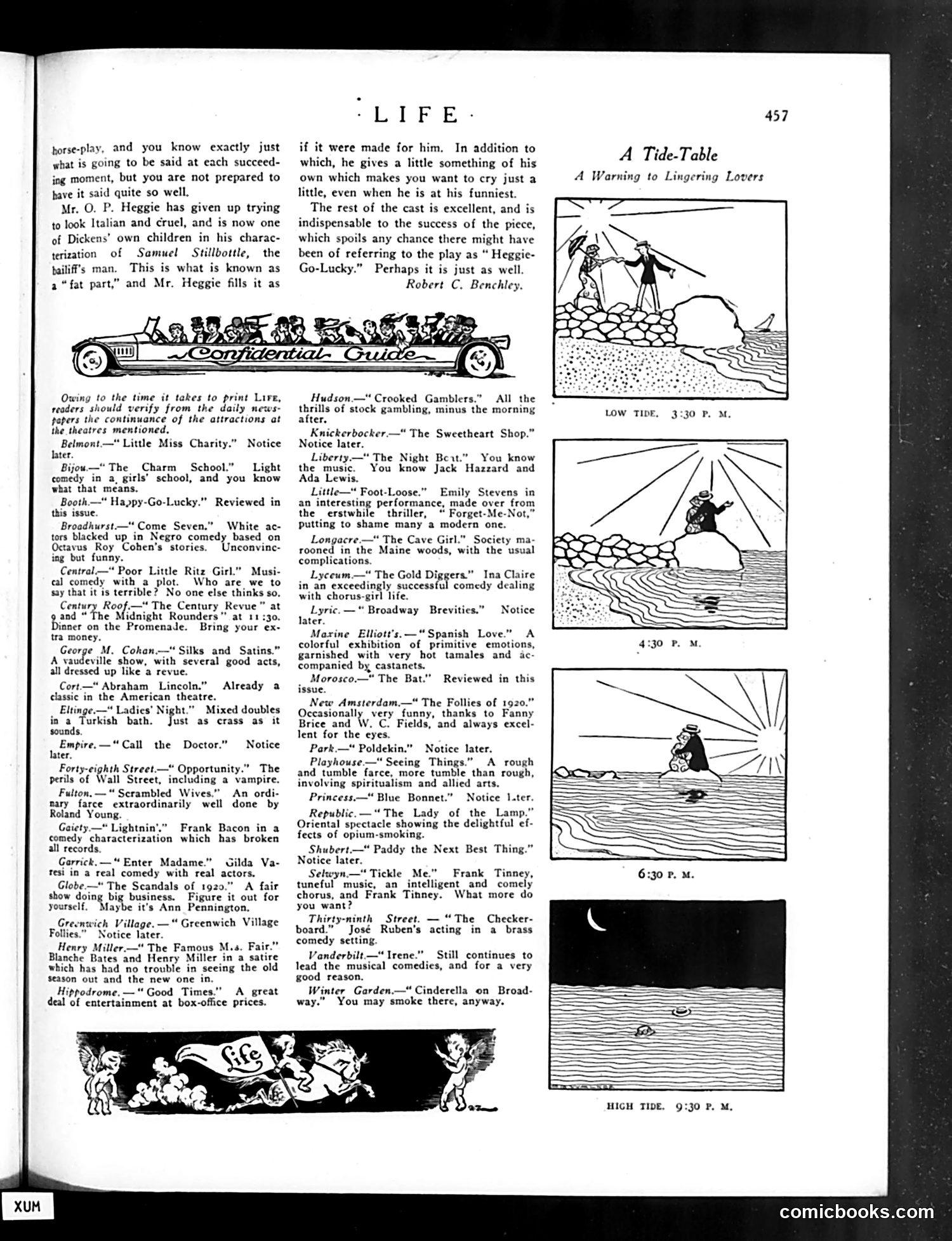
This page contains theater reviews and listings from Life magazine's drama section, not political cartoons. The right side features "A Tide-Table: A Warning to Lingering Lovers"—a humorous instructional diagram showing tide levels (low tide 3:30 P.M., high tide 9:30 P.M.) with illustrations of couples on a beach. The joke is obvious: it's a cautionary guide for young lovers about when they'll be exposed or concealed by tides during romantic beach encounters. The left side reviews Broadway productions, including Robert C. Benchley's praise for O. P. Heggie's performance in "Happy-Go-Lucky." The listings reflect 1920s theater culture, with musicals, comedies, and vaudeville shows. One review notes "Come Seven" features "white actors blacked up in Negro comedy"—a now-offensive practice common then. The page reflects entertainment tastes of the Jazz Age era.
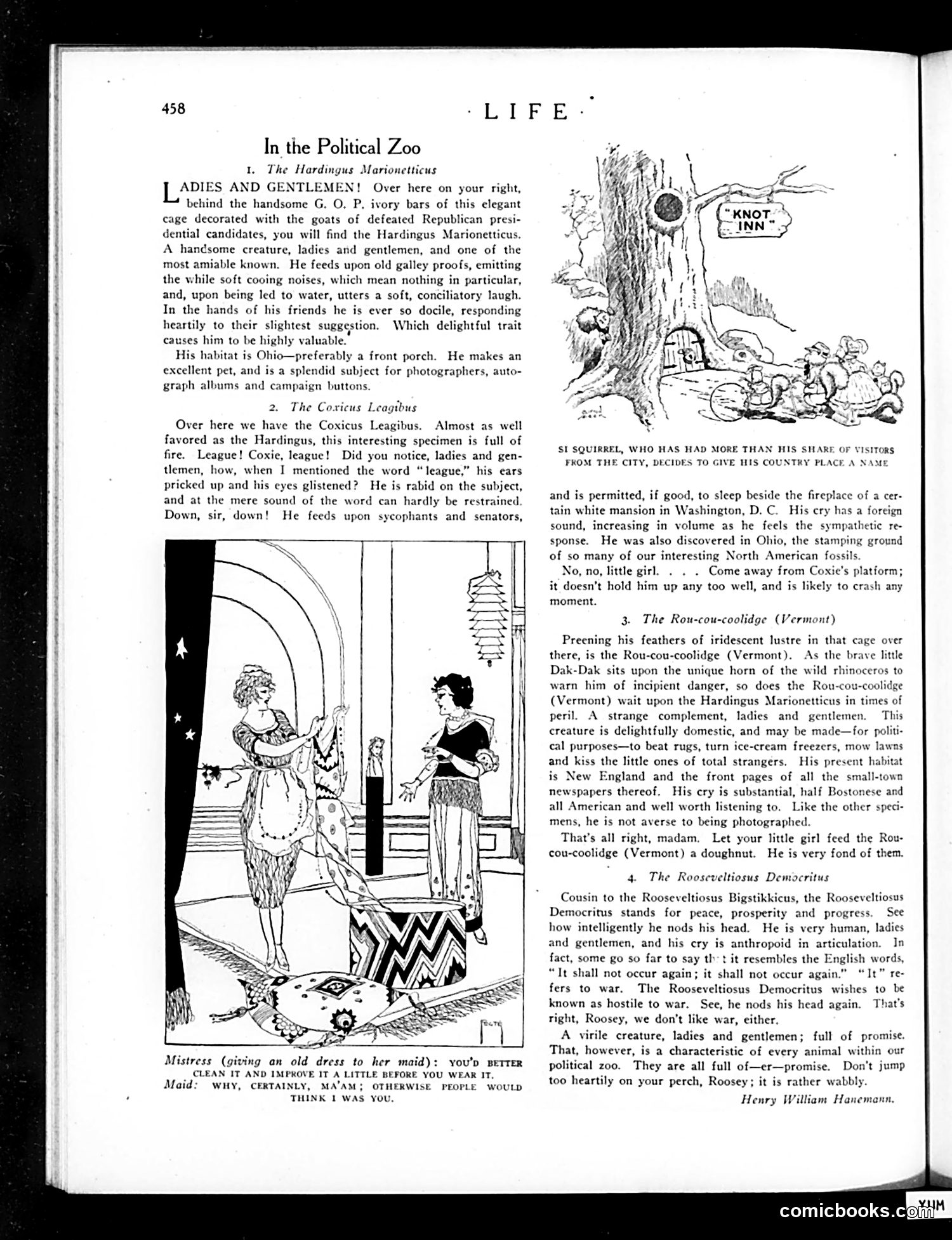
This satirical piece uses a zoo-tour format to mock prominent political figures as caged animals: **The Hardingus Marionetticus**: Warren G. Harding, the Republican presidential nominee/president, depicted as a handsome but docile creature controlled by party handlers. The satire emphasizes his passivity and reliance on Ohio (his home state) as habitat—mocking him as a puppet without independent thought. **The Coxicus Leagibus**: James M. Cox, the Democratic candidate, portrayed as an obsessive ideologue rabidly fixated on the League of Nations, which he fed upon like an animal. **The Rou-cou-coolidge**: Calvin Coolidge, Harding's running mate, shown as a domestic Vermont creature serving Harding—a commentary on his subordinate role and New England origins. **The Rooseveltiosus Democritus**: Appears to reference Theodore Roosevelt or his Democratic successor, depicted as peace-focused but contradictory. The comic strip below about a servant shows unrelated social satire about class and appearance. The overall effect: mocking 1920 election principals as zoo exhibits—frivolous, controlled, or obsessive creatures rather than serious statesmen.
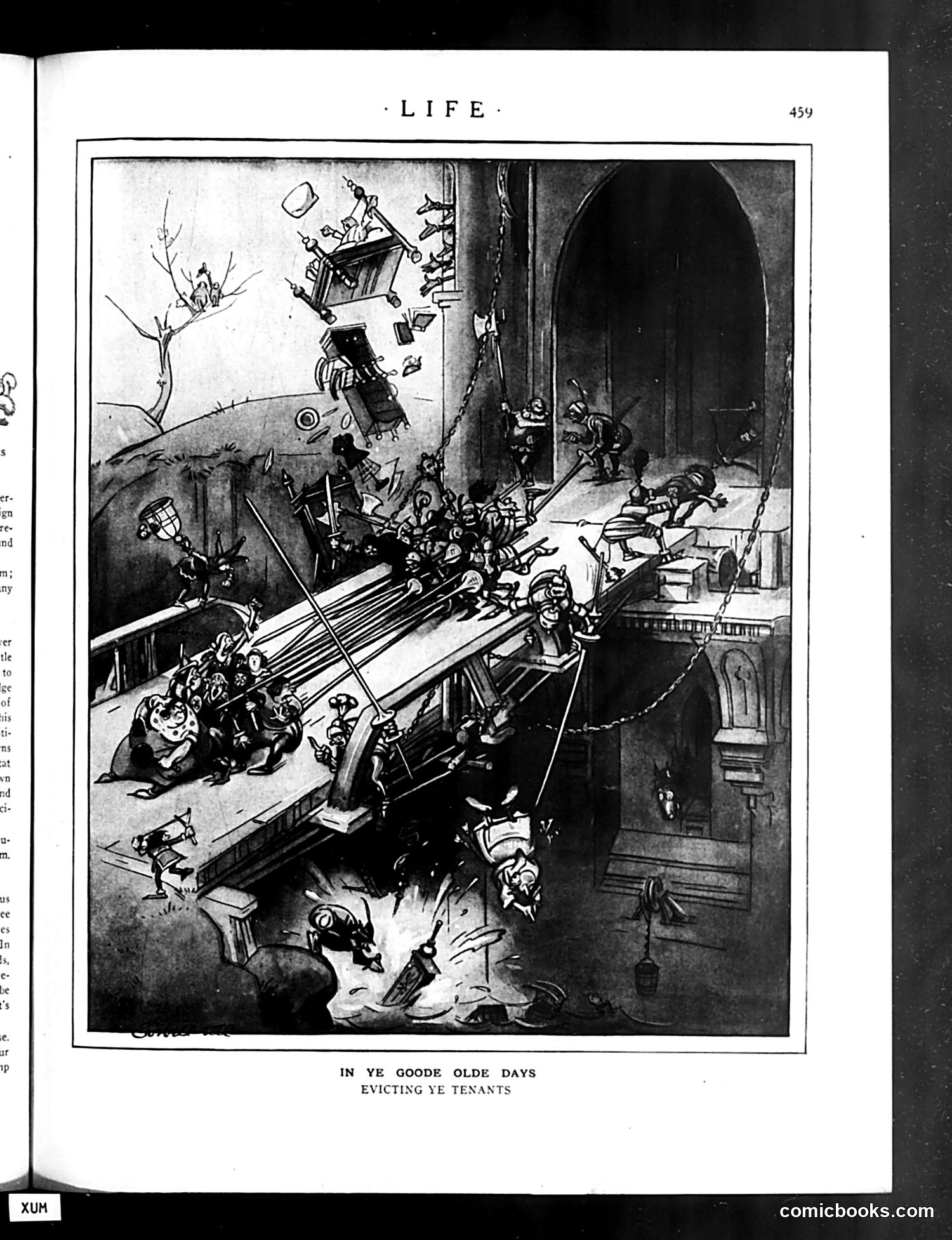
This satirical cartoon depicts a chaotic medieval eviction scene, contrasting "good old days" rhetoric with historical reality. The image shows armed figures forcibly removing tenants from a castle or manor, with belongings being thrown from windows and people being physically expelled. The satire targets nostalgic claims about an idealized past. The caption ironically suggests medieval times were superior, while the illustration reveals them as violent and brutal for common people. Landlords wielding power over vulnerable tenants is presented as absurdly destructive—furniture crashes, people tumble, chaos reigns. This likely comments on contemporary labor disputes, housing issues, or political arguments romanticizing earlier eras. The cartoon argues that historical "good old days" were actually marked by exploitation and coercion of the working classes by those in power.
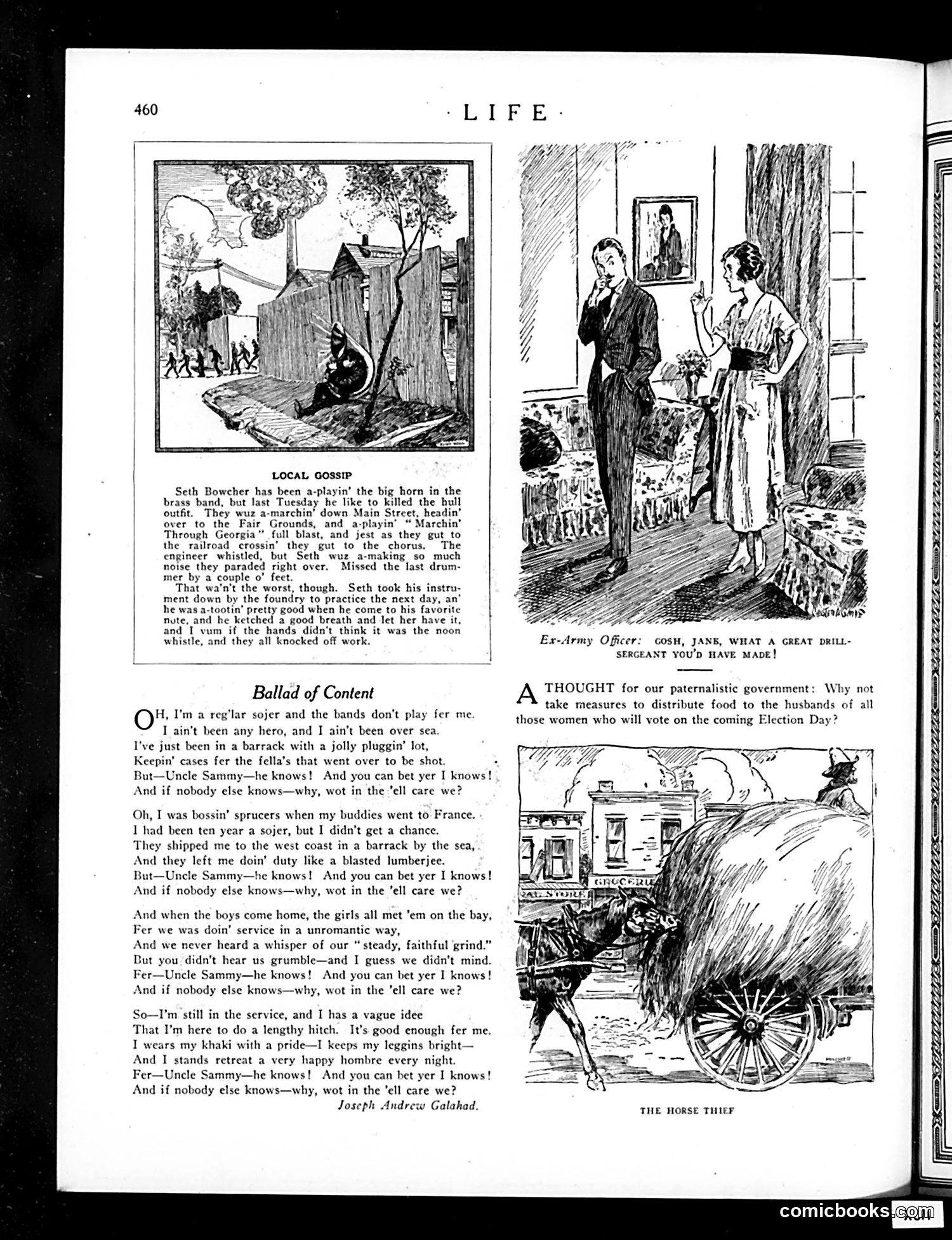
This page contains three distinct pieces of American satire, likely from the 1910s-1920s: **"Local Gossip"**: A humorous rural anecdote about Seth Bowcher, a brass band horn player whose powerful note at a foundry is mistaken for the noon whistle, causing workers to stop. The satire mocks small-town life and the loud, disruptive nature of amateur musicians. **"Ballad of Content"**: A soldier's poem expressing frustration about being left behind during WWI—assigned to stateside duty (lumber work, west coast barracks) while others fought in France. The refrain "Uncle Sammy—he knows" sardonically suggests the government is aware of their sacrifice but ignores it. The satire critiques the thanklessness soldiers faced for unglamorous wartime service. **"Ex-Army Officer" cartoon**: An officer compliments a woman on her drill-sergeant qualities, likely satirizing either women's military auxiliary roles or post-war employment of women in traditionally male positions. **Food distribution cartoon**: Commentary on election-year politics—suggesting the government should distribute food to soldiers' wives to secure their votes.
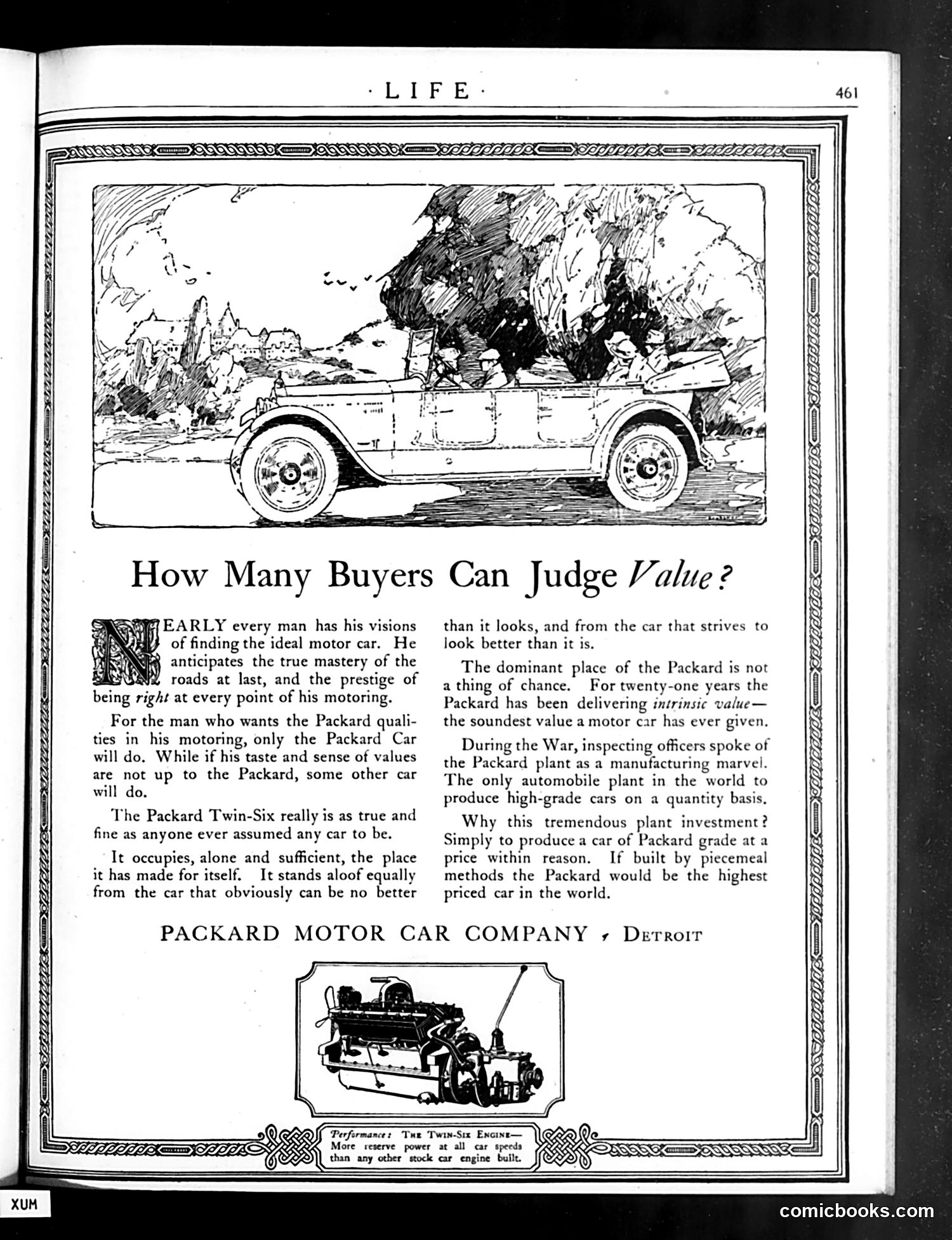
This is a **Packard automobile advertisement**, not political satire. The page promotes the Packard Twin-Six motor car through aspirational messaging rather than humor or mockery. **The appeal:** The ad targets wealthy, discerning buyers by suggesting that owning a Packard signals refined taste and judgment. The headline—"How Many Buyers Can Judge Value?"—implies that most people *cannot* properly evaluate quality, positioning Packard owners as an elite group. **Key claims:** The text emphasizes Packard's 21-year track record, its manufacturing excellence (praised by WWI inspectors), and its ability to produce premium cars "on a quantity basis" while maintaining high standards. The car illustration at top shows an open-air touring vehicle typical of the 1920s era. **The pitch:** Rather than compete on price, Packard positions itself as the obvious choice for the sophisticated buyer who understands true value—implicitly flattering the reader's judgment while subtly suggesting cheaper alternatives appeal to those with inferior taste.
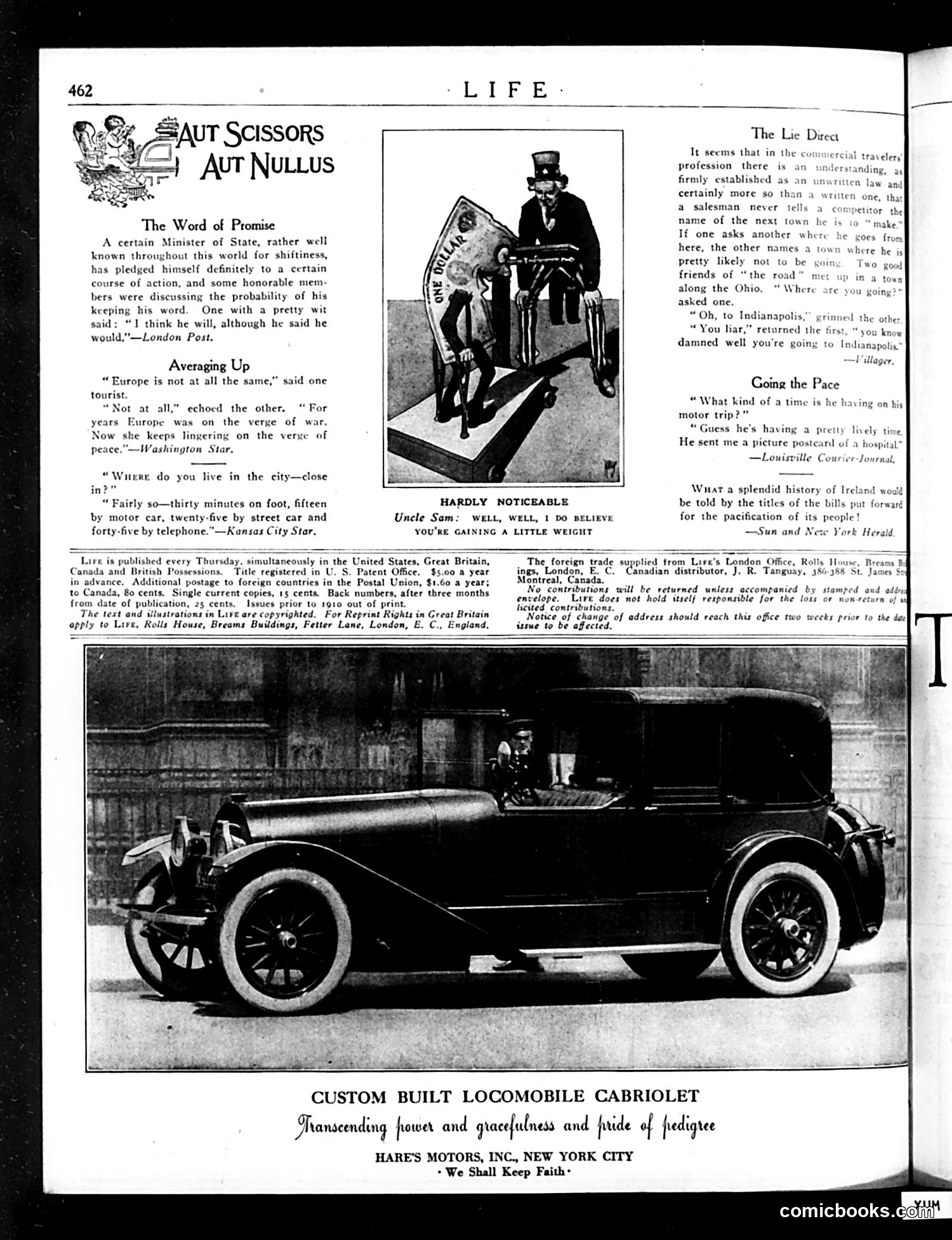
This page from *Life* magazine contains several brief satirical jokes and an automobile advertisement. **The cartoons/jokes** mock contemporary social behavior: - "The Word of Promise" satirizes a shifty politician who's promised action but likely won't follow through—the joke being the ironic contradiction. - "Averaging Up" presents tourism commentary: Europe shifts between war and peace anxiety, suggesting perpetual instability. - "The Lie Direct" targets traveling salesmen's reputation for dishonesty; they allegedly never identify their next destination truthfully. - "Going the Pace" jokes about reckless motor-trip driving (sending a hospital postcard suggests crashes). - "Hardly Noticeable" features Uncle Sam observing weight gain, likely referencing American prosperity or expansion circa 1910-1920. **The advertisement** promotes a Locomobile luxury car from Hare's Motors, emphasizing elegance and pedigree. The overall tone reflects early 20th-century American anxieties about reliability, transportation, and social manners, with automobile culture emerging as a status symbol and source of comedic material.
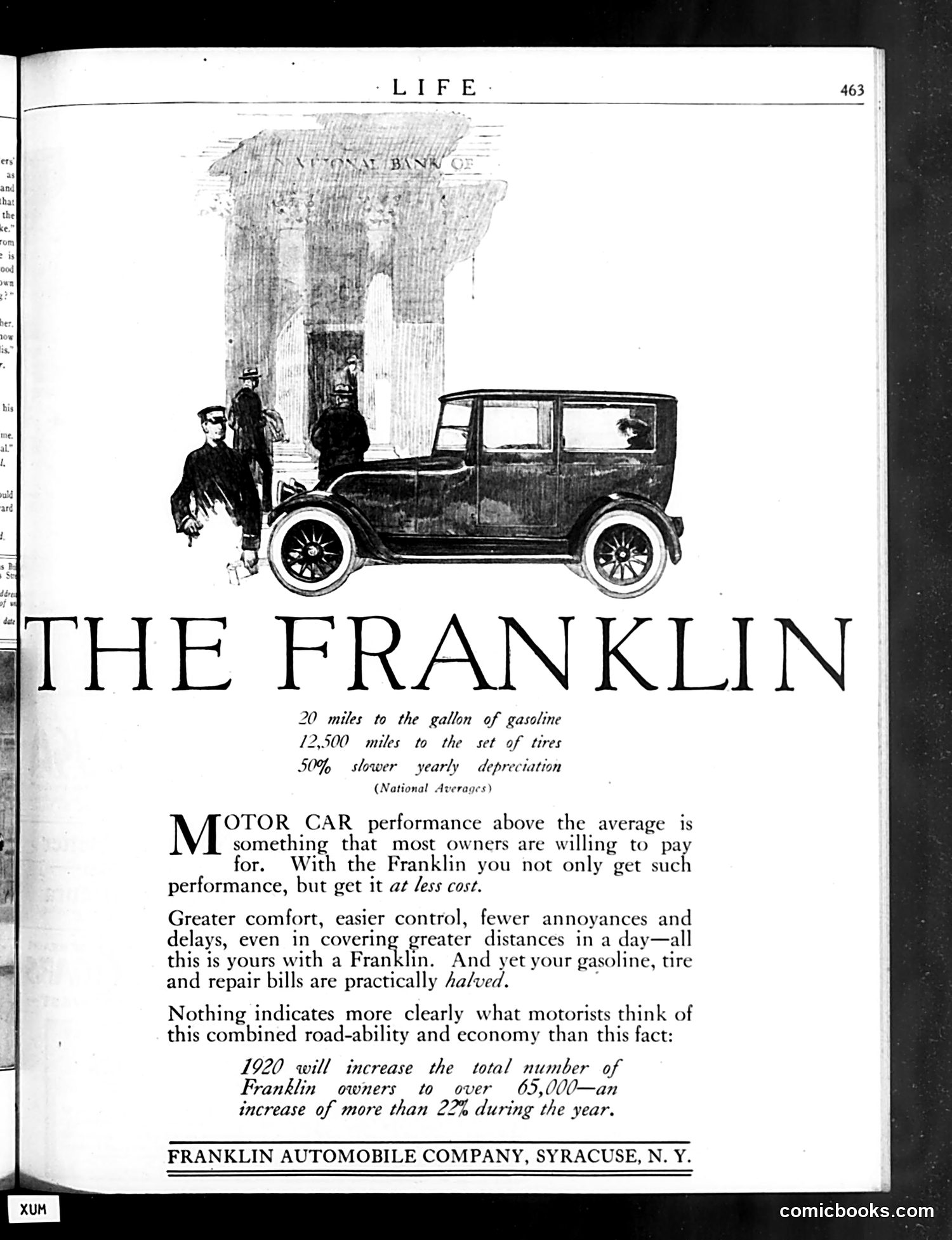
This is **not satire or a political cartoon**, but rather a straightforward advertisement for the Franklin automobile, manufactured in Syracuse, New York. The image shows a luxury car of the era (approximately 1920) with well-dressed figures near a classical building, establishing aspirational messaging. The advertisement argues that Franklin cars deliver above-average performance at below-average cost—an unusual market claim. The specific appeals reflect 1920s motorist concerns: fuel efficiency (20 miles/gallon), tire longevity (12,500 miles per set), and slower depreciation. The text emphasizes "greater comfort, easier control, fewer annoyances"—practical benefits for early automotive ownership when reliability remained uncertain. The headline statistic—65,000 owners with 22% annual growth—functions as social proof, suggesting the Franklin's popularity validates its quality and value proposition. This appears in *Life* magazine, which regularly featured automotive advertisements during this period of rapid automobile market expansion.
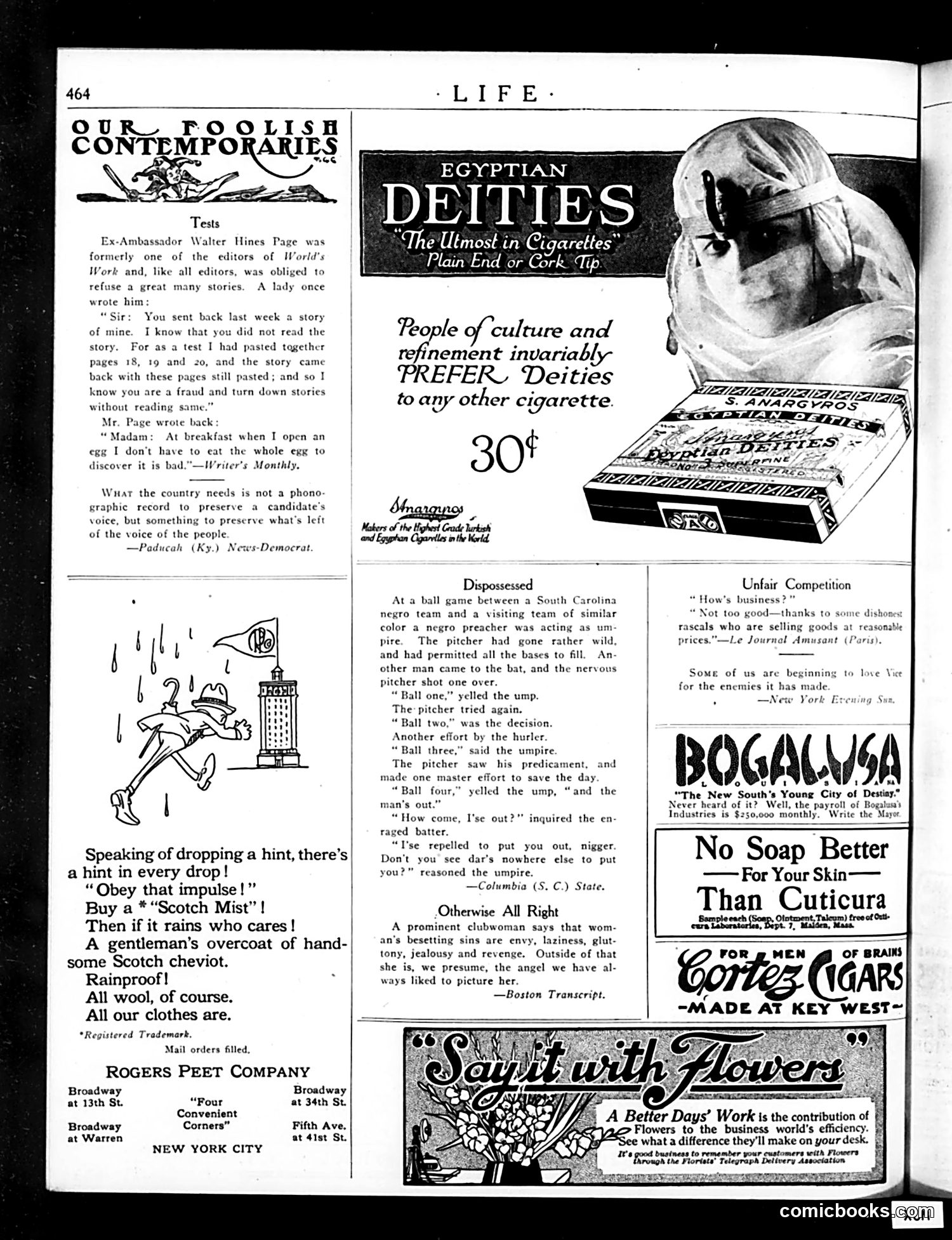
This page is primarily **advertising with brief satirical commentary**, typical of Life's format. ## Main Content: **"Our Foolish Contemporaries"** section features editor anecdotes mocking lazy manuscript rejection practices. Ex-Ambassador Walter Hines Page's quip compares rejecting unread stories to discovering a bad egg without eating the whole thing—biting satire on editorial negligence. ## Racial Content Warning: A **racist dialect joke** about a Black baseball umpire uses offensive language and stereotyping. The humor relies on minstrel-show caricature conventions common to 1920s publications but deeply offensive today. ## Advertisements: Egyptian Deities cigarettes ($0.30), Rogers Peet Company clothing, Cuticura soap, Cortez cigars, and florist services dominate the page. The ads employ period advertising tropes—appeals to sophistication, masculinity, and social status. The **"Bogalusa" industrial promotion** and **"Unfair Competition"** item mock regional development boosterism and business practices, respectively. This reflects 1920s American popular culture: commercially-driven, casually racist, and socially conservative.
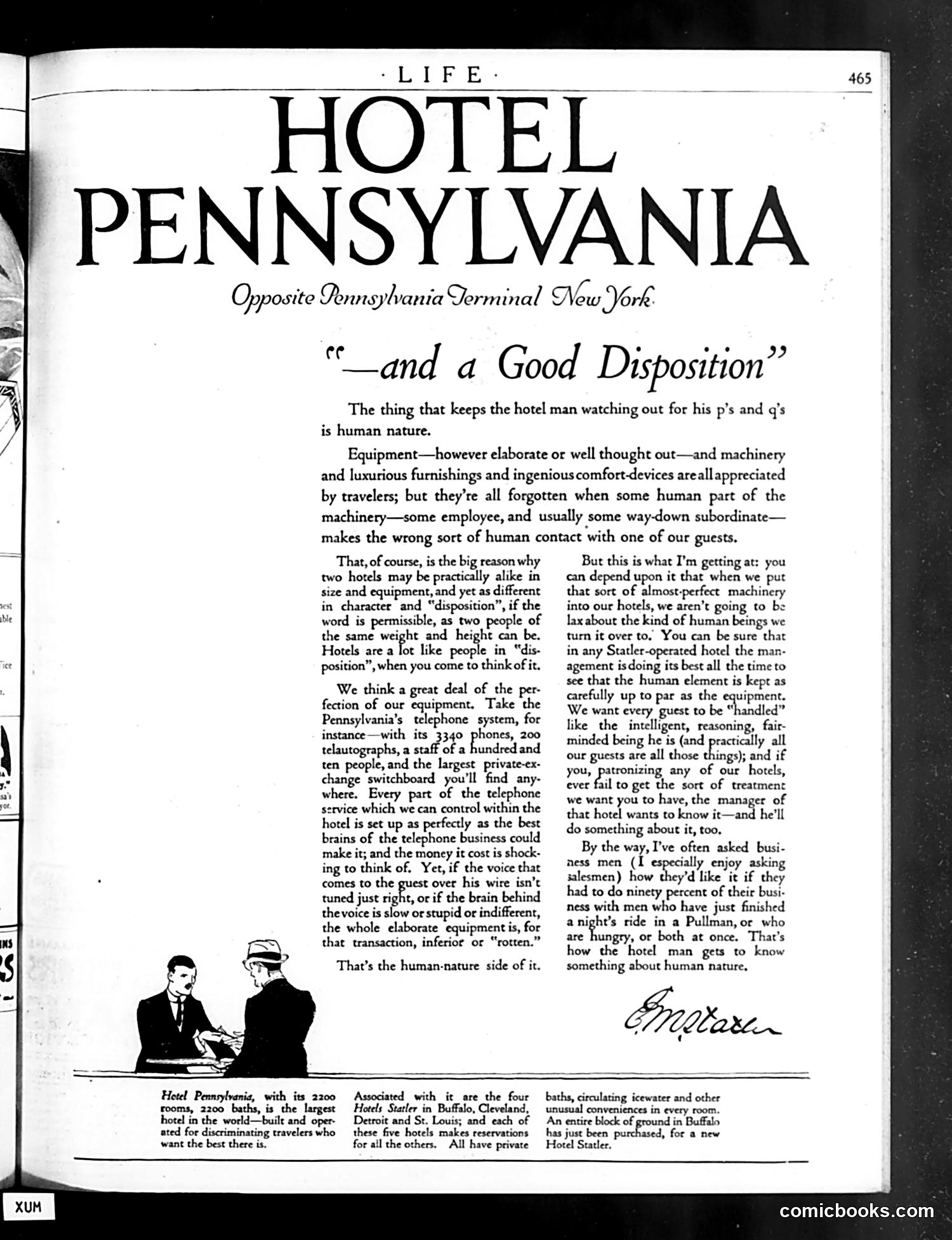
This is a **corporate advertisement**, not political satire. The page promotes the Hotel Pennsylvania, operated by the Statler hotel chain, positioned opposite Pennsylvania Station in New York. The small illustration shows two businessmen at what appears to be a hotel desk—a typical scene of guest service. The text's central argument is that hotel quality depends not just on equipment (the Pennsylvania boasts 3,340 phones, 200 telautographs, elaborate switchboards) but on employee "disposition"—how staff treats guests. The author claims Statler hotels ensure staff maintains the same high standards as their machinery. The piece uses analogy: hotels are "like people in disposition," and bad service from a single employee ruins perfect equipment. It appeals to businessmen (mentioning tired Pullman travelers and hungry salesmen) by suggesting the Pennsylvania understands their needs. This reflects early 20th-century luxury hospitality marketing emphasizing both modern technology *and* personal service as competitive advantages.
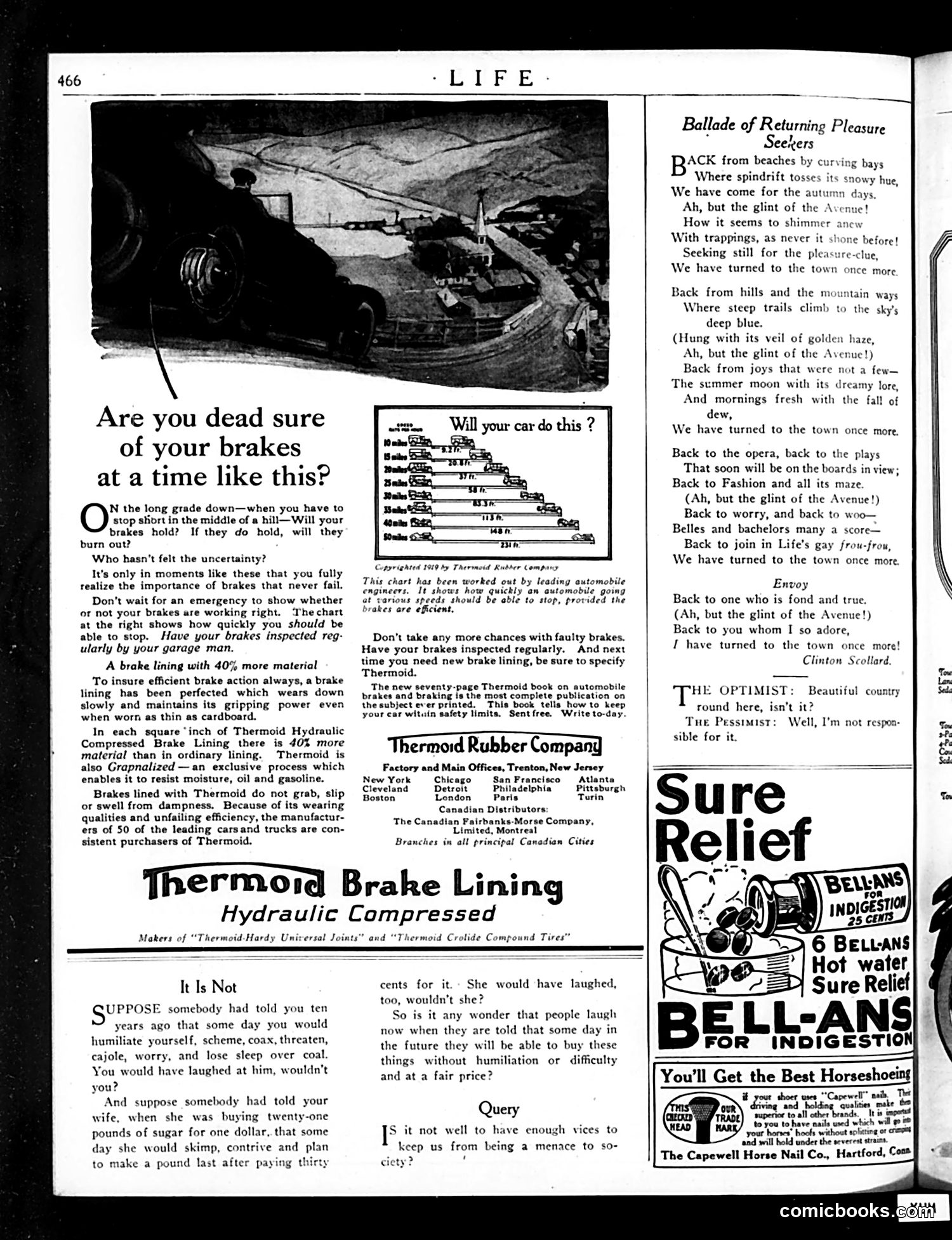
This page is primarily **advertising content** from around 1919, centered on a Thermoid Brake Lining advertisement. The main "cartoon" element is actually a safety PSA about automobile brakes. **The Social Context:** The ad addresses early automotive anxiety—brake failure on steep hills was a genuine safety concern. The accompanying chart shows stopping distances at various speeds, emphasizing that drivers should regularly inspect brakes rather than gamble with lives. **The Satire:** The smaller text piece "It Is Not" uses gentle irony: it compares wartime/postwar scarcity (coal rationing, sugar hoarding) to suggest people once laughed at such deprivation. It questions whether future abundance will seem equally absurd—a commentary on postwar economic uncertainty and shifting values. **The Poetry:** "Ballade of Returning Pleasure Seekers" romanticizes tourists returning to cities after summer vacations, contrasting natural beauty ("mountain ways," "golden haze") with urban attractions ("the Avenue"). The page reflects 1920s concerns: automobile safety, economic instability following WWI, and leisure culture's growing importance.
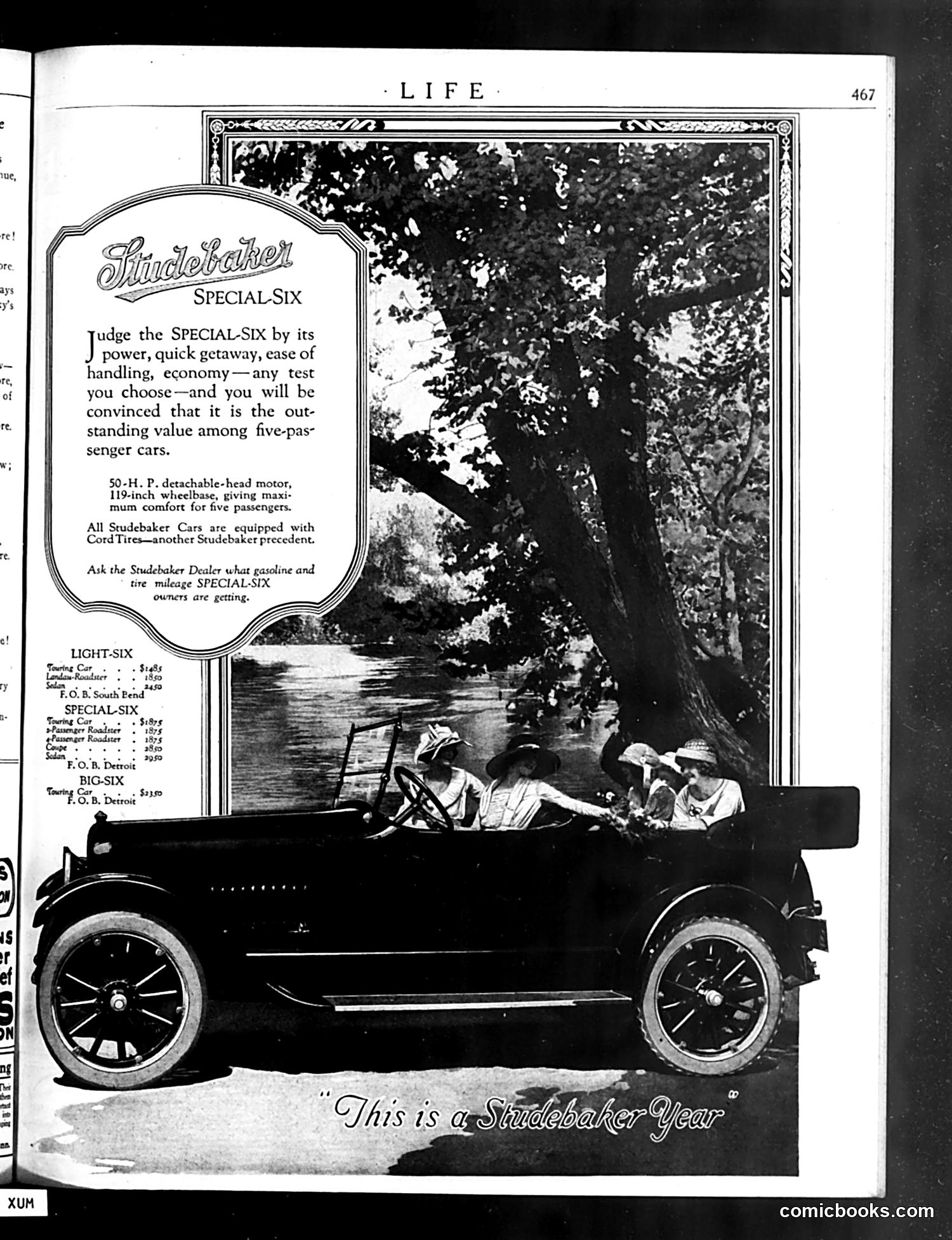
This is primarily an **automobile advertisement**, not political satire. It's a Studebaker car ad promoting the "Special-Six" model. The ad emphasizes the car's practical virtues—power, speed, fuel economy, and handling—appealing to middle-class buyers seeking reliable five-passenger transportation. The scenic photograph shows the car in an idealized pastoral setting with people enjoying leisure, a common advertising trope suggesting the freedom and pleasure automobile ownership provides. The text lists three Studebaker models with prices (Light-Six, Special-Six, Big-Six), with notation "F.O.B." (Free on Board) indicating shipping terms from South Bend, Indiana, where Studebaker was headquartered. The tagline "This is a Studebaker Year" suggests confidence in the brand's market position during what appears to be the 1920s automotive boom. There is no political commentary or satire visible—this is straightforward consumer marketing from Life's advertising section.
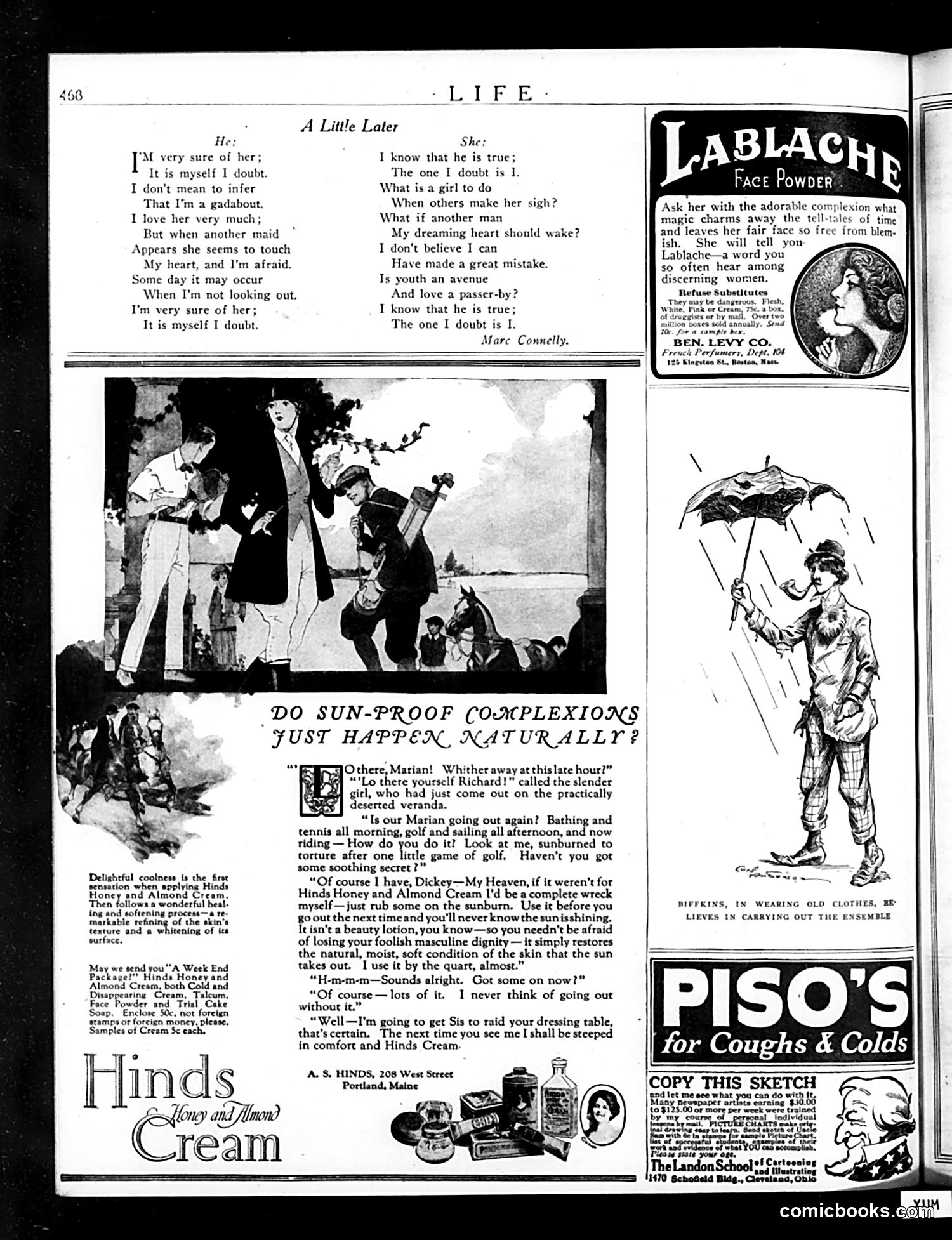
This page contains a romantic poem by Marc Connelly titled "A Little Later," depicting mutual romantic uncertainty between a couple—he doubts his own faithfulness despite loving her; she doubts herself despite trusting him. The humor lies in their mirrored insecurities about their own constancy. The main illustrated narrative below concerns sun protection for complexions. A woman named Marian has been outdoors all day (bathing, tennis, golf, sailing, riding) without apparent sunburn, while her friend Richard ("Dickey") is visibly sunburned after one golf game. Marian reveals her secret: Hinds Honey and Almond Cream prevents sun damage to skin. The page is primarily **advertising-focused**, featuring multiple beauty product promotions (Hinds Cream, Lablache Face Powder, Piso's cough medicine) alongside the poem and narrative. The "sun-proof complexions" concept reflects early 20th-century beauty standards valuing pale, unblemished skin—the opposite of modern tanning preferences.
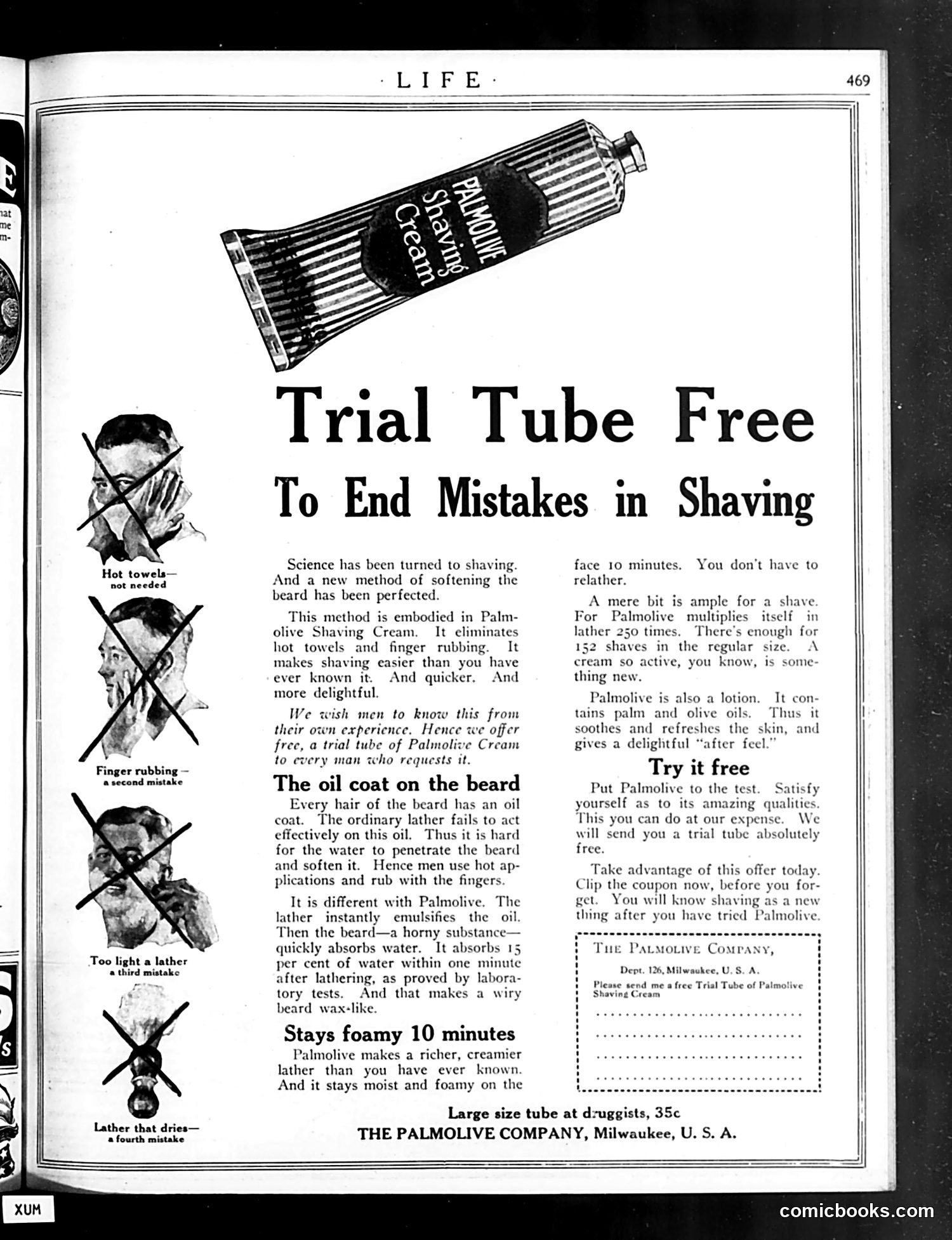
This is primarily a **product advertisement**, not satire or political commentary. The left side depicts four common shaving mistakes with X marks through them: 1. Using hot towels (unnecessary) 2. Finger rubbing (ineffective) 3. Applying too-light lather (inadequate) 4. Using lather that dries quickly (inconvenient) The ad claims Palmolive Shaving Cream eliminates these errors through scientific innovation—specifically, its ability to instantly emulsify the oil coating on beard hair, allowing water absorption and softening without hot water or rubbing. The humorous element is visual: simple cartoon illustrations of a man's face with red X marks showing what *not* to do, instructing readers through negative example. The offer of a free trial tube aims to convert skeptics through direct experience. This reflects early 20th-century advertising strategy: demonstrate superiority through both scientific claims and risk-free testing.
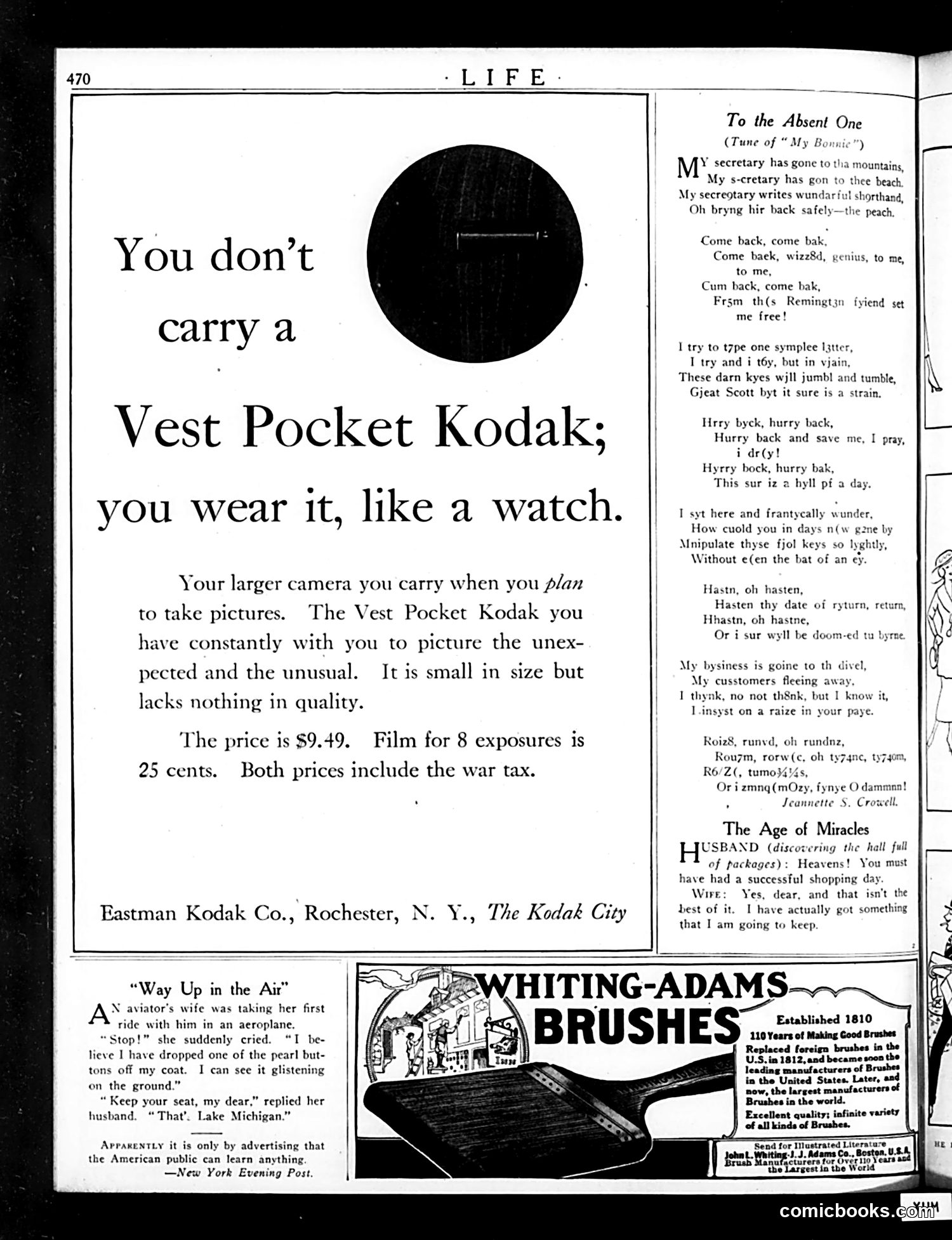
This page contains three distinct pieces of satire: **1. "To the Absent One" (left column):** A humorous poem parodies an employee's longing for their absent secretary, set to the tune of "My Bonnie." The satiric point is obvious: without competent secretarial help, the writer cannot function—their typing is riddled with errors (intentionally misspelled throughout the poem itself). This mocks both workplace dependence on clerical staff and the inferior quality of work produced without proper secretarial support, likely resonating during wartime when labor shortages were common. **2. Kodak Advertisement (center):** A straightforward ad for the Vest Pocket Kodak camera ($9.49, film 25 cents), emphasizing portability and constant availability. **3. "The Age of Miracles" (right):** A brief joke about a wife returning from shopping with numerous purchases. The humor lies in her admission she's actually *keeping* something she bought—implying wives typically hide or return purchases from husbands, making her honesty the "miracle." **4. "Way Up in the Air":** A short anecdote about an aviator's wife dropping a button and the husband's sardonic response about Lake Michigan—gentle marital humor. The page is primarily humorous advertising and light domestic satire.
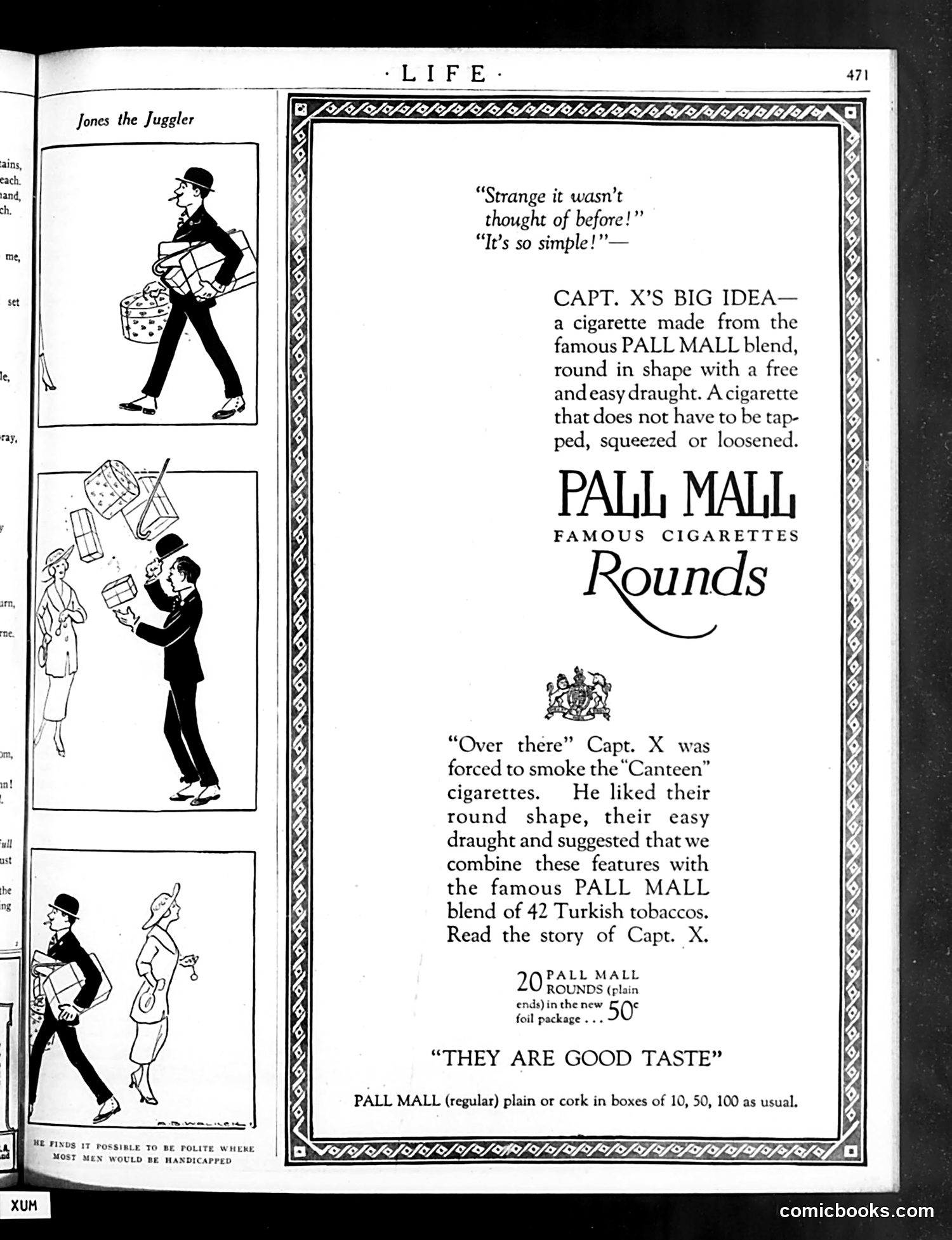
This page combines a comic strip with a cigarette advertisement. The left side shows "Jones the Juggler"—a comic about a man juggling packages and gifts, apparently trying to manage multiple romantic or social commitments simultaneously. The final panel's caption suggests the joke concerns politeness despite being "handicapped" (likely referring to his juggling act or impossible situation). The right side is a Pall Mall cigarettes advertisement framed as a narrative. "Capt. X" is a fictional character who discovered round cigarettes during military service ("over there," likely referencing World War I) and inspired Pall Mall's new "Rounds" product. The advertisement emphasizes convenience—no tapping or squeezing needed. The page is primarily advertising, using the juggler comic as editorial content to fill space in the magazine. Both elements reflect early 20th-century consumer culture and wartime references that would have been topical to Life's contemporary readers.
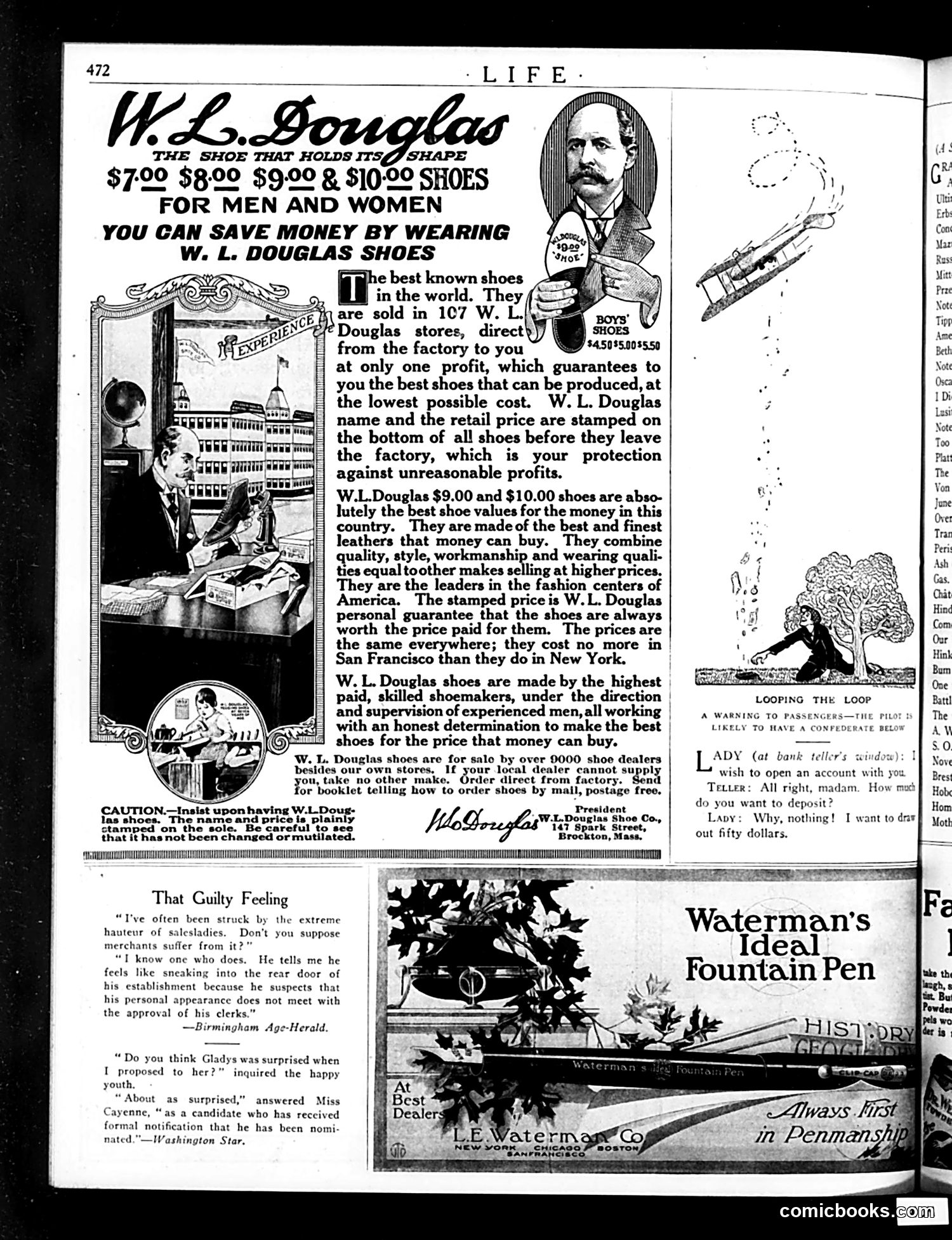
This page is primarily **advertising**, dominated by a large W.L. Douglas Shoes advertisement. The ad emphasizes that Douglas shoes are sold "direct from the factory to you at only one profit," positioning the brand as offering superior value by eliminating middlemen markups. The price ($7-$10) is stamped on every shoe as a "personal guarantee." The page also contains two brief **humorous anecdotes**: 1. "That Guilty Feeling" mocks salespeople's apparent disdain for customers, suggesting even store owners feel intimidated by their own clerks. 2. A joke about a marriage proposal compares the groom's surprise to a political candidate's shock at receiving a nomination (likely referencing early 20th-century electoral politics). There's also a small cartoon labeled "Looping the Loop" warning passengers about potential confederates in aviation scams—reflecting contemporary concerns about early airplane novelty rides. The page represents typical Life magazine content: mixing consumer advertising with satirical social commentary on class dynamics and modern anxieties.
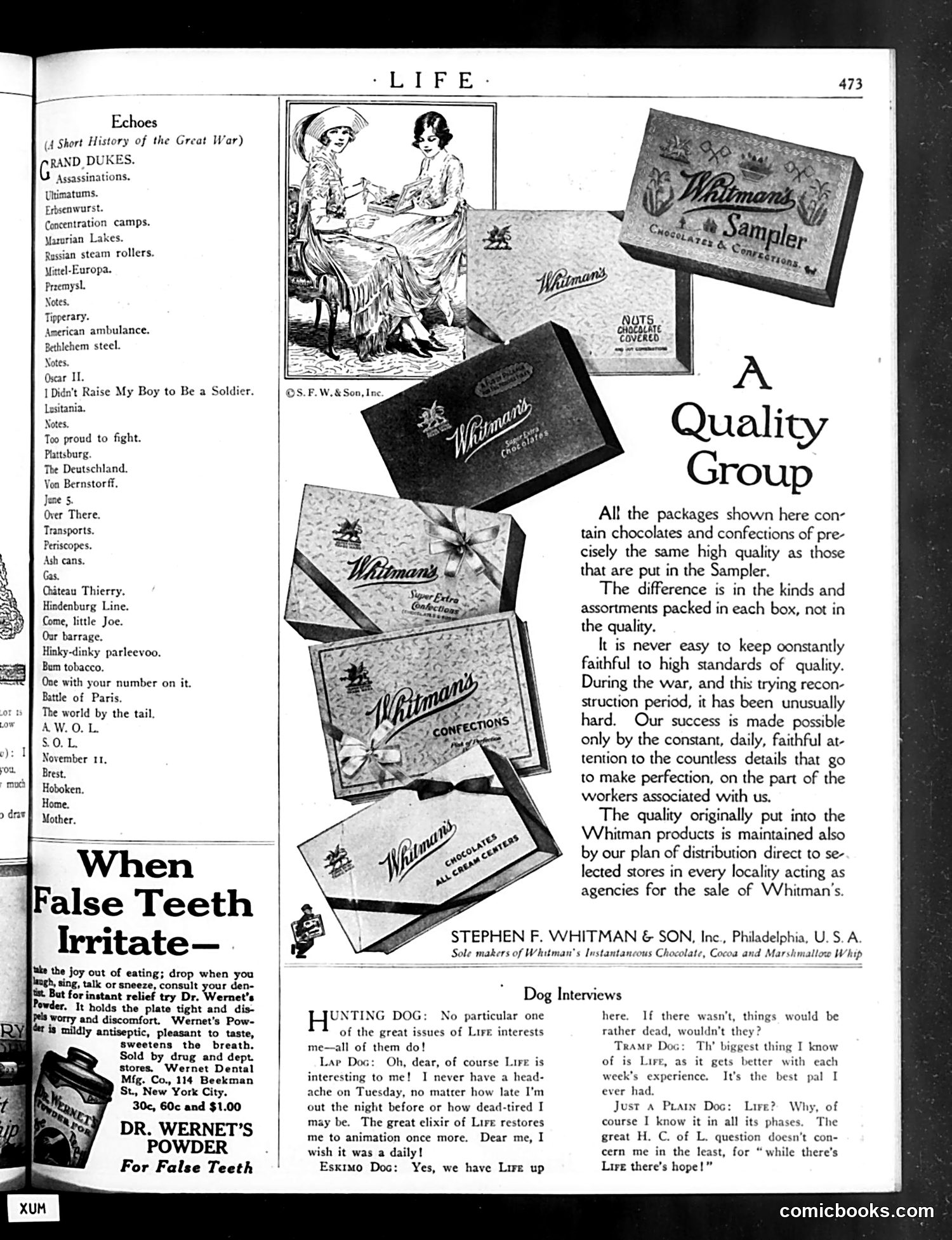
This page is primarily **advertising and filler content**, not political satire requiring historical context. The left column lists "Echoes (A Short History of the Great War)"—a lighthearted catalog of WWI references (trenches, famous battles, songs like "Tipperary," ships like the *Lusitania*, military figures like Von Bernstorff). It's nostalgic war trivia, not satire. The main content features two advertisements: **Whitman's Chocolates** emphasizing quality maintenance during wartime reconstruction, and **Dr. Wernet's Powder** for false teeth. The "Dog Interviews" section is humorous filler where different dog characters praise *Life* magazine itself—a self-promotional gimmick common in period magazines. The "Tramp Dog," "Lap Dog," etc. offer playful testimonials about how *Life* enriches their existence. **No significant political commentary or satire is present.** This is a typical early-1920s magazine page mixing advertising with light entertainment.
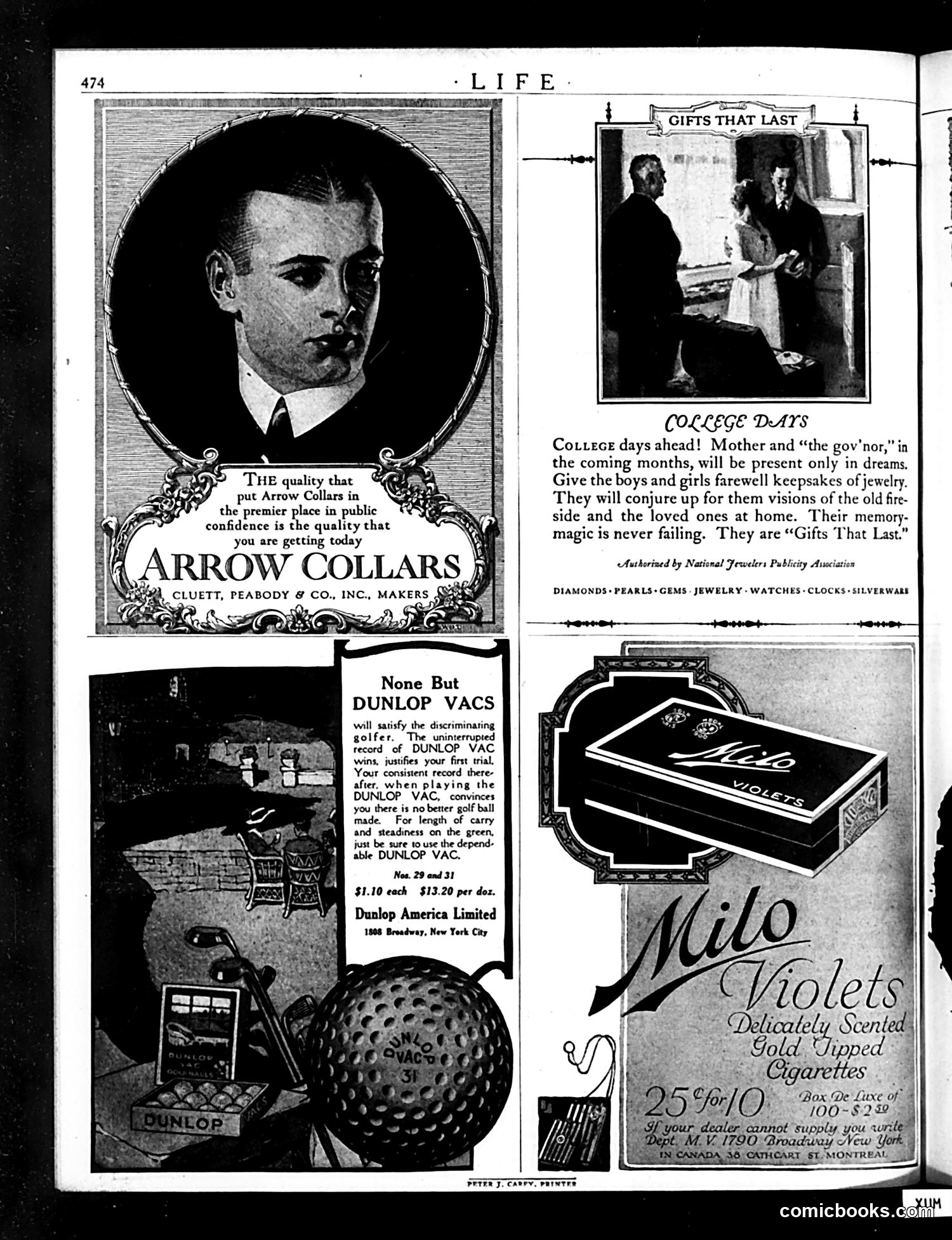
This page is primarily **advertising**, not satire or political commentary. It features four commercial advertisements from circa 1910s-1920s: 1. **Arrow Collars** — A men's fashion brand using a portrait of an unnamed male model to sell dress collars, emphasizing quality and confidence. 2. **"Gifts That Last"** — A jewelry industry ad (authorized by the National Jewelers Publicity Association) targeting parents sending children to college, promoting jewelry as memorable farewell gifts. 3. **Dunlop Vacs** — Golf balls advertised to "discriminating golfers," emphasizing performance and consistency. 4. **Milo Violets** — Delicately scented, gold-tipped cigarettes marketed as luxury goods (25 for 10 cents). The page reflects early 20th-century consumer culture and advertising strategies: aspirational branding, emotional appeals (nostalgia, parental love), and gender-targeted marketing. No political cartoon or satire is present—this is straightforward period advertising.
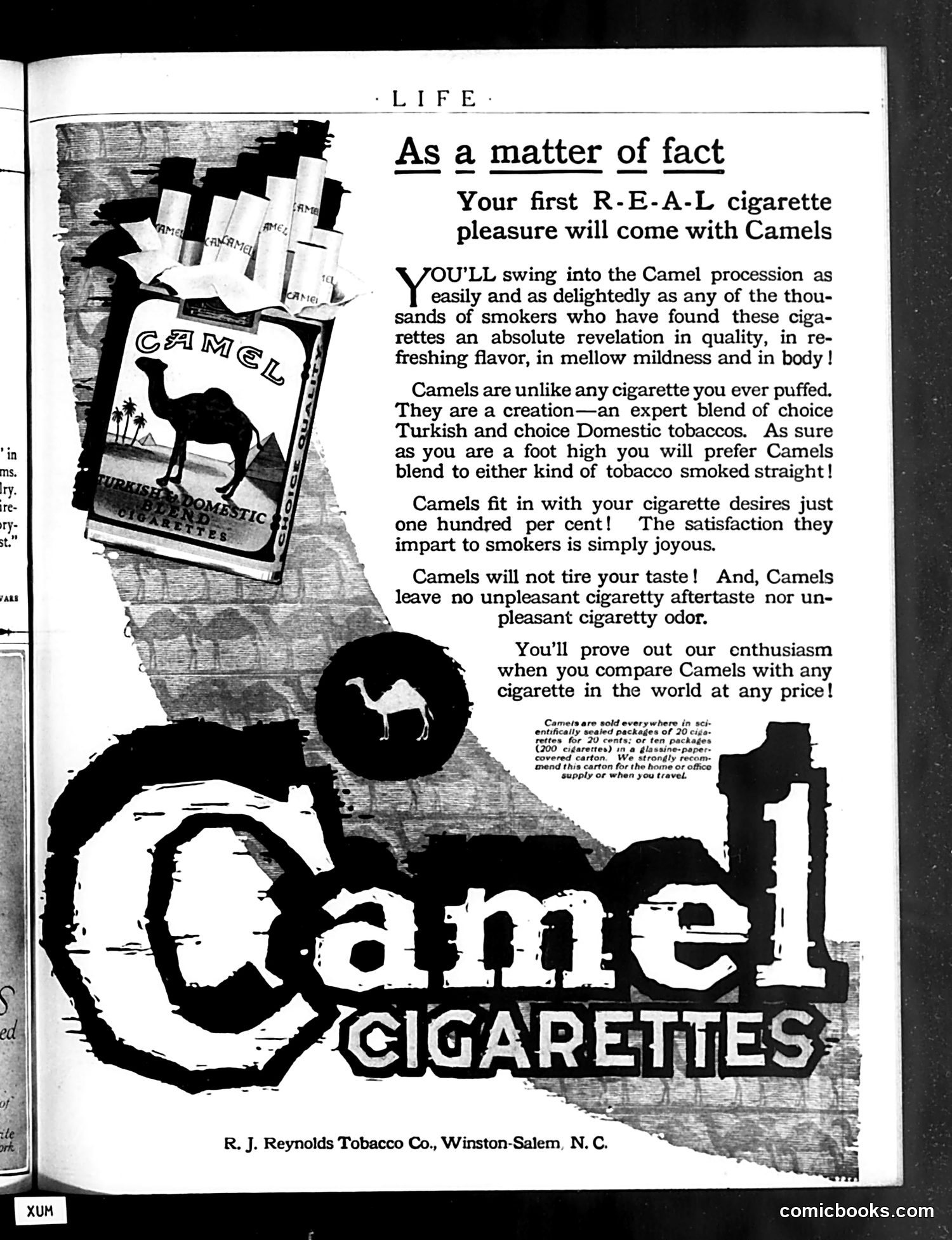
This is a **Camel cigarette advertisement**, not a political cartoon. The page features a product ad from R.J. Reynolds Tobacco Co. (Winston-Salem, N.C.) with marketing copy emphasizing Camel cigarettes' quality and superiority. The visual elements include: - A map of California with Camel package imagery - The iconic Camel logo (dromedary camel in a circular frame) - Promotional text claiming Camels use "choice Turkish and choice Domestic tobaccos" **For modern readers:** This represents early-20th-century cigarette marketing before health warnings were required. The ad's claims—that Camels won't tire taste, leave no unpleasant aftertaste, or create odor—are now known to be false. The phrase "As a matter of fact" ironically frames marketing claims as objective truth, a common advertising technique of the era that would be considered misleading today.
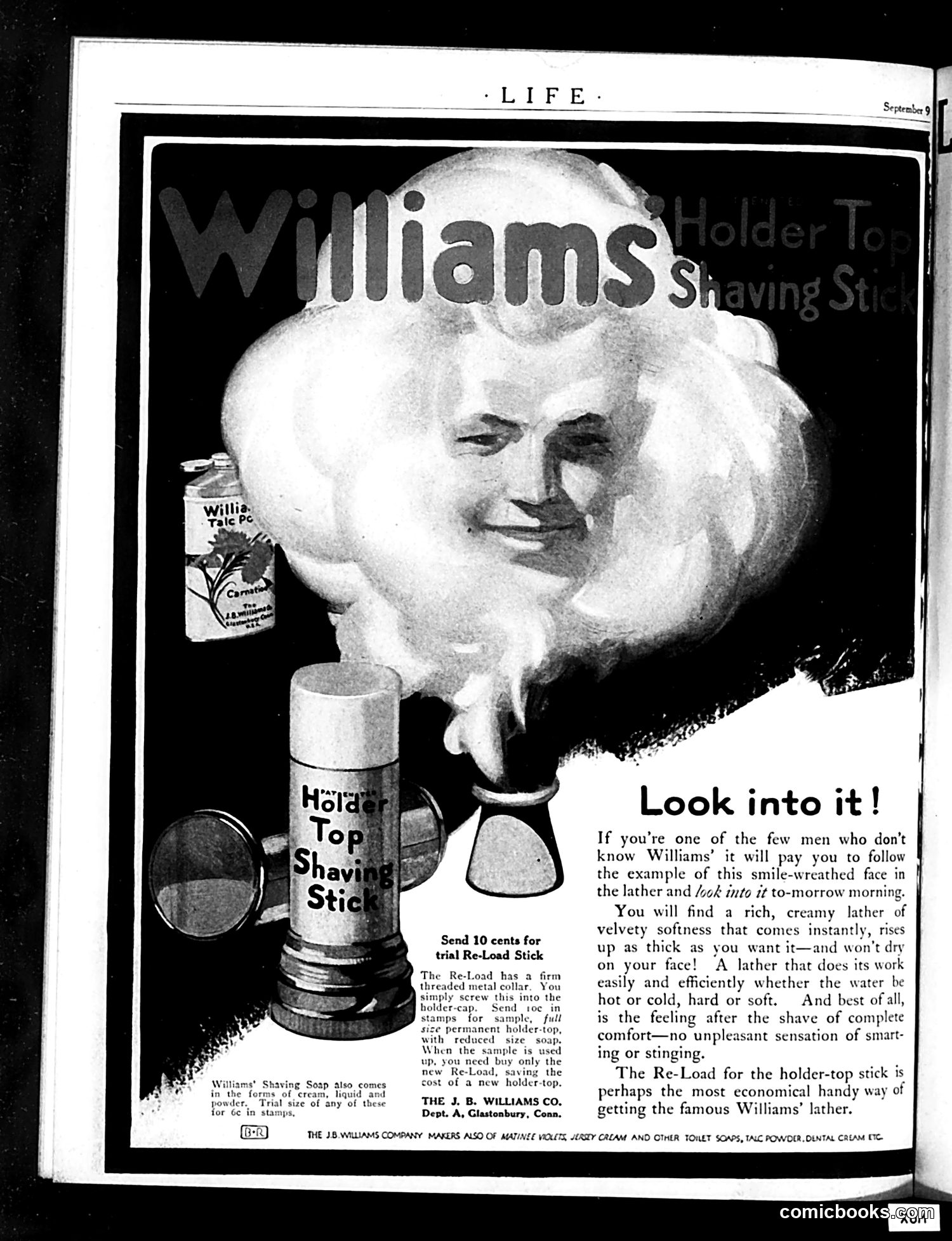
This is **not a cartoon or satire**—it's a straightforward product advertisement for Williams' Shaving Soap, circa early 20th century. The page features a caricatured male face with exaggerated features (large nose, prominent smile) demonstrating the product's lather. The ad emphasizes the soap's qualities: rich, creamy lather that works in hot or cold water without drying on the face, and leaves no smarting or stinging sensation. The main innovation highlighted is the "Re-Load" stick—an economical refillable system where customers buy only replacement soap inserts (for 10 cents) rather than entire new holder-top units, saving money. The J.B. Williams Company, based in Glastonbury, Connecticut, manufactured multiple toiletries including soaps, face cream, and powder. The caricatured face was likely meant to appear friendly and trustworthy rather than satirical—typical advertising approach of the era.