
Life, 1920-09-09 · page 25 of 44
Life — September 9, 1920 — page 25: what you’re looking at
What you’re looking at
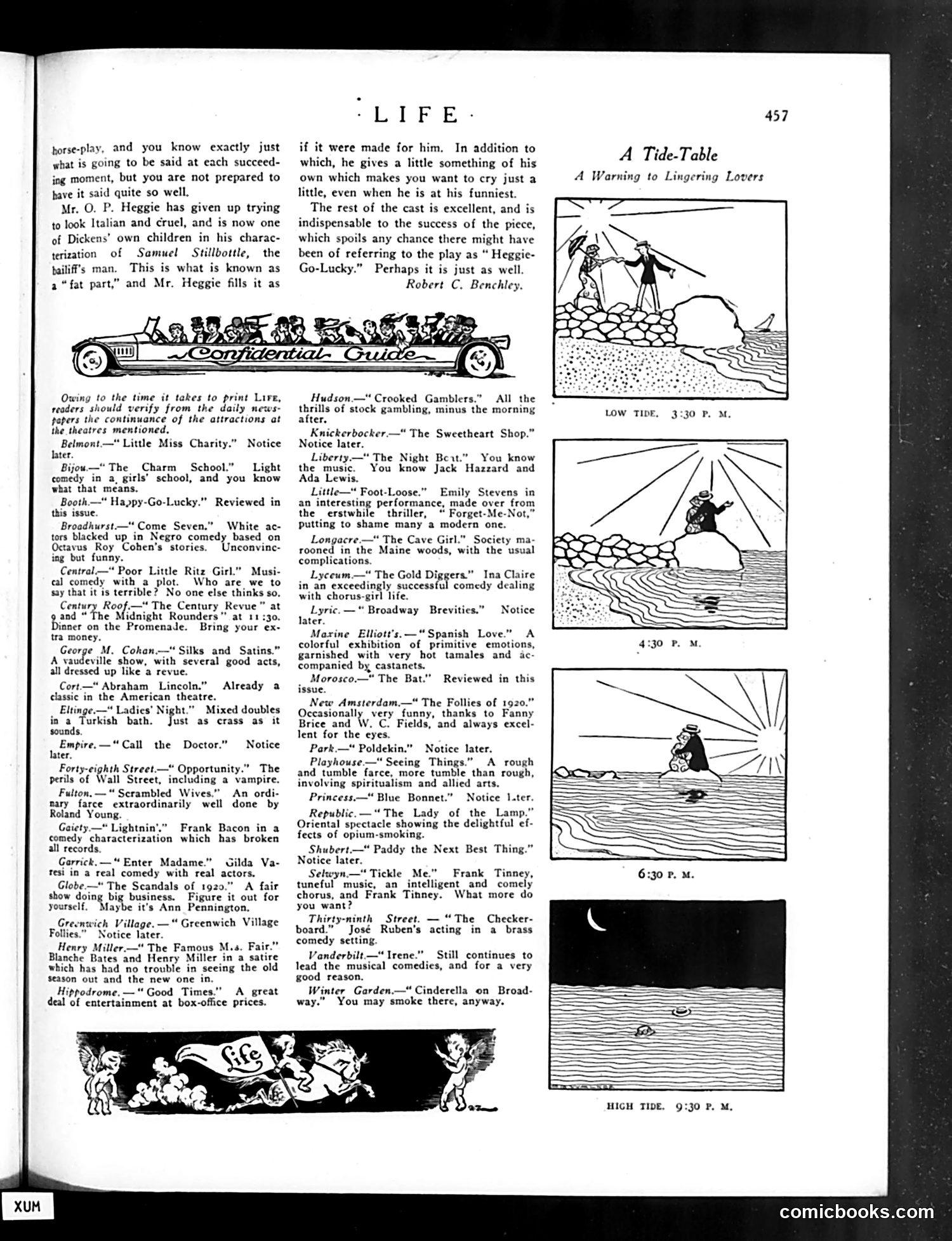
This page contains theater reviews and listings from Life magazine's drama section, not political cartoons. The right side features "A Tide-Table: A Warning to Lingering Lovers"—a humorous instructional diagram showing tide levels (low tide 3:30 P.M., high tide 9:30 P.M.) with illustrations of couples on a beach. The joke is obvious: it's a cautionary guide for young lovers about when they'll be exposed or concealed by tides during romantic beach encounters. The left side reviews Broadway productions, including Robert C. Benchley's praise for O. P. Heggie's performance in "Happy-Go-Lucky." The listings reflect 1920s theater culture, with musicals, comedies, and vaudeville shows. One review notes "Come Seven" features "white actors blacked up in Negro comedy"—a now-offensive practice common then. The page reflects entertainment tastes of the Jazz Age era.
📄 Transcribed text from this page (OCR, searchable)
Machine-transcribed from the original scan — historical spelling and the odd misread are preserved.
horse-play, and you know exactly just what is going to be said at each succeed- ing moment, but you are not prepared to have it said quite so well, Mr. O. P. Heggie has given up trying to look Italian and cruel, and is now one of Dickens’ own children in his charac- terization of Samuel Stillbottle, the bailiff's man. This is what is known as a “fat part,” and Mr. Heggie fills it as “LIFE: if it were made for him. In addition to which, he gives a little something of his own which makes you want to cry just a little, even when he is at his funniest. The rest of the cast is excellent, and is indispensable to the success of the piece, which spoils any chance there might have been of referring to the play as “ Heggie- Go-Lucky.” Perhaps it is just as well. Robert C. Benchley. Owing to the time it takes to print Lire, readers should verify from the daily news- popers the continuance of the attractions at the theatres mentioned, Belmont.—* Little Miss Charity.” later. Bijou—" The Charm School.” Light comedy in a, girls’ school, and you know what that means. Booth.—* Happy-Go-Lucky.” Reviewed in this issue. Broadhurst—" Come Seven.” White ac- tors blacked up in Negro comedy based on Octavus Roy Cohen's stories. Unconvine- ing but funny. Central—“ Poor Little Ritz Girl.” Musi- cal comedy with a plot. Who are we to say that it is terrible? No one else thinks so, Century Roof.—" The Century Revue” at and “The Midnight Rounders” at 11:30. inner on the Promenade. Bring your ex- tra money. George M. Cohan.— Silks and Satins.” A vaudeville show, with several good acts, all dressed up like a revue. Cort—* Abraham Lincoln.” classic in the American theatre. Eltinge.—* Ladies’ Night.” Mixed doubles in a Torkish bath. fusi as crass as it sounds. Empire. —“ Call the later. Forty-eighth Street.—" Opportunity.” The perils of Wall Street, including a vampire. Fulton. —“ Scrambled Wives.” An ordi- rary farce extraordinarily well done by Roland Yor Gaiety.—* Lightnin’ Frank Bacon in a comedy characterization which has broken all records. Garrick. —“ Enter Madame.” Gilda Va- resi in a real comedy with real actors. Globe—" The Scandals of 1920." A fair show doing big business. Figure it out for yourself. Maybe it's Ann Pennington. Greenwich Village. —“ Greenwich Village Follies.” Notice later. Henry Miller.—" The Famous M.5. Fair.” Blanche Bates and Henry Miller in a satire which has had no trouble in seeing the old Season out and the new one i Hippodrome, —“ Good Times.” A great deal of entertainment at box-office prices. Notice Already a Doctor.” Notice Hudson.—“ Crooked Gamblers.” All the thrills of stock gambling, minus the morning after. Knickerbocker —" The Sweetheart Shop.” Notice later. Liberty—" The Night Beat.” You know the music. You know Jack Hazzard and Ada Lewi: ‘oot-Loose.” Emily Stevens in an interesting performance, made over from the erstwhile thriller, “ Forget-Me-Not,” putting to shame many a modern one. Longacre.—" The Cave Girl." Society ma- rooned in the Maine woods, with the usual complications. Lyceum.—" The Gold Diggers” Ina Claire in an exceedingly successful comedy dealing with chorus-girl life. Lyric. —" Broadway Brevities.” later. Maxine Elliott's. —“ Spanish Love.” A colorful exhibition of primitive emotions, garnished with very hot tamales and ac- companied by castanets. Morosco.—" The Bat.” issue. New Amsterdam.—" The Follies of 1920.” Qceasionally very funny, thanks to Fanny Brice and W. C. Fields, and always excel- lent for the eyes. Park.—" Poldekin.” Notice later. Playhouse —“ Seeing Things.” A rough and tumble farce, more tumble than rough, involving spiritualism and allied arts. Princess. Blue Bonnet.” Notice |.ter. Republic. —“ The Lady of the Lamp.” Oriental spectacle showing the delightful ef- fects of opium-smoking. Shubert. Paddy the Next Best Thing.” Notice later. Selwyn.—" Tickle tuneful music, an chorus, and Frank Tinney. you want? Thirty-ninth Street. — “The Checker- board.” José Ruben’s acting in a brass comedy setting. Vanderbilt—“ Irene.” Still continues to lead the musical comedies, and for a very good reason. Winter Garden.—“ Cinderella on Broad- way.” You may smoke there, anyway. Notice Reviewed in this Me.” Frank Tinney, intelligent and comely What more do A Tide-Table A Warning to Lingering Lovers Low TIDE, 3 230 P.M. HIGH TIDE. 9:30 P.M, comicbooks.com