
Life, 1920-09-09 · page 21 of 44
Life — September 9, 1920 — page 21: what you’re looking at
What you’re looking at
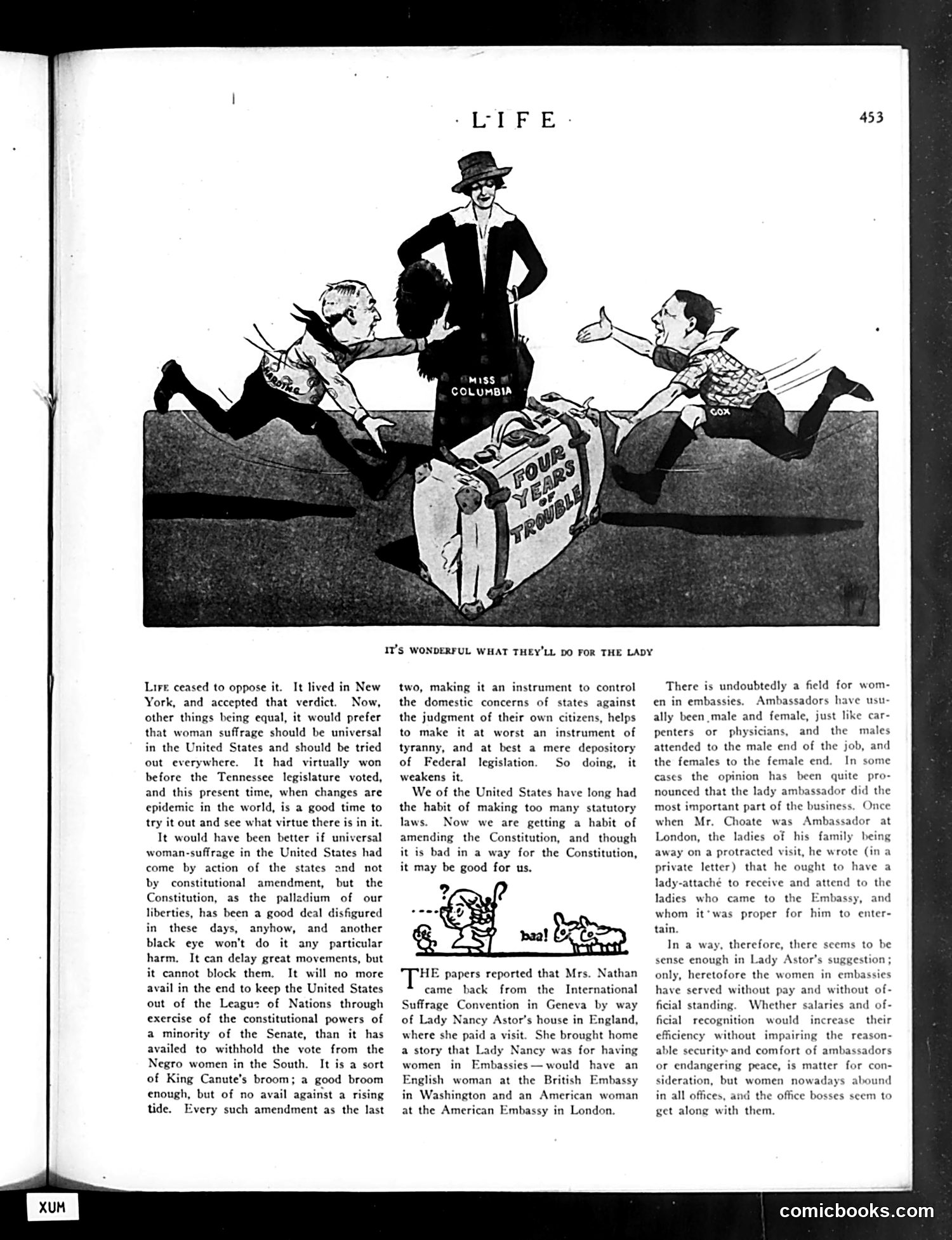
This cartoon satirizes the debate over women's roles following women's suffrage. The central figure labeled "Miss Columbia" (personifying the United States) stands atop a suitcase marked "Four Years' Trouble," while two men flail and gesture in distress on either side—likely representing political opponents of women's suffrage and expanded female participation in government. The accompanying text discusses Lady Nancy Astor's proposal that women serve as ambassadors and embassy staff. The satire mocks male politicians' exaggerated fears about women's expanded roles. The caption—"It's wonderful what they'll do for the lady"—drips with irony, suggesting these men's theatrical protests are absurd overreactions. The "Four Years' Trouble" reference likely alludes to women's long suffrage campaign. The cartoon argues that despite men's predictions of chaos, women's greater participation in civic life and diplomacy is both sensible and inevitable.
📄 Transcribed text from this page (OCR, searchable)
Machine-transcribed from the original scan — historical spelling and the odd misread are preserved.
Lire ceased to oppose it. It lived in New York, and accepted that verdict. Now, other things being equal, it would prefer that woman suffrage should be universal in the United States and should be tried out everywhere. It had virtually won before the Tennessee legislature voted, and this present time, when changes are epidemic in the world, is a good time to try it out and see what virtue there is in it. It would have been better if universal woman-suffrage in the United States had come by action of the states and not by constitutional amendment, but the Constitution, as the palladium of our liberties, has been a good deal disfigured in these days, anyhow, and black eye won't do it any particular harm. It can delay great movements, but it cannot block them. It will no more avail in the end to keep the United States out of the Leagu: of Nations through exercise of the constitutional powers of a minority of the Senate, than it has availed to withhold the vote from the Negro women in the South. It is a sort of King Canute’s broom; a good broom enough, but of no avail against a rising tide. Every such amendment as the last another MISS COLUMBIA 1's w two, making it an instrument to control the domestic concerns of states against the judgment of their own citizens, helps to make it at worst an instrument of tyranny, and at best a mere depository of Federal legislation. So doing, it weakens it. We of the United States have long had the habit of making too many statutory laws. Now we are getting a habit of amending the Constitution, and though it is bad in a way for the Constitution, it may be good for us. HE papers reported that Mrs. Nathan came back from the International Suffrage Convention in Geneva by way of Lady Nancy Astor’s house in England, where she paid a visit. She brought home a story that Lady Nancy was for having women in Embassies — would have an English woman at the British Embassy in Washington and an American woman at the American Embassy in London. DERFUL WHAT THEY'LL DO FOR THE LADY There is undoubtedly a field for wom- en in embassies. Ambassadors have usu- ally been male and female, just like car- penters or physicians, and the attended to the male end of the job, and the females to the female end. cases the opinion has been quite pro- nounced that the lady ambassador did the most important part of the business, Once when Mr. Choate Ambassador at London, the ladies of his family being away on a protracted visit, he wrote (in a private letter) that he ought to have a lady-attaché to receive and attend to the ladies who came to the Embassy, and whom it*was proper for him to enter- tain. males In some was In a way, therefore, there seems to be sense enough in Lady Astor’s suggestion ; only, heretofore the women in embassies have served without pay and without of- ficial standing. ficial Whether salaries and of- recognition would their efficiency without impairing the reason- able security and comfort of ambassadors or endangering peace, is matter for con- sideration, but women nowadays abound increase in all offices, and the office bosses seem to get along with them. comicbooks.com