
Life, 1920-09-09 · page 20 of 44
Life — September 9, 1920 — page 20: what you’re looking at
What you’re looking at
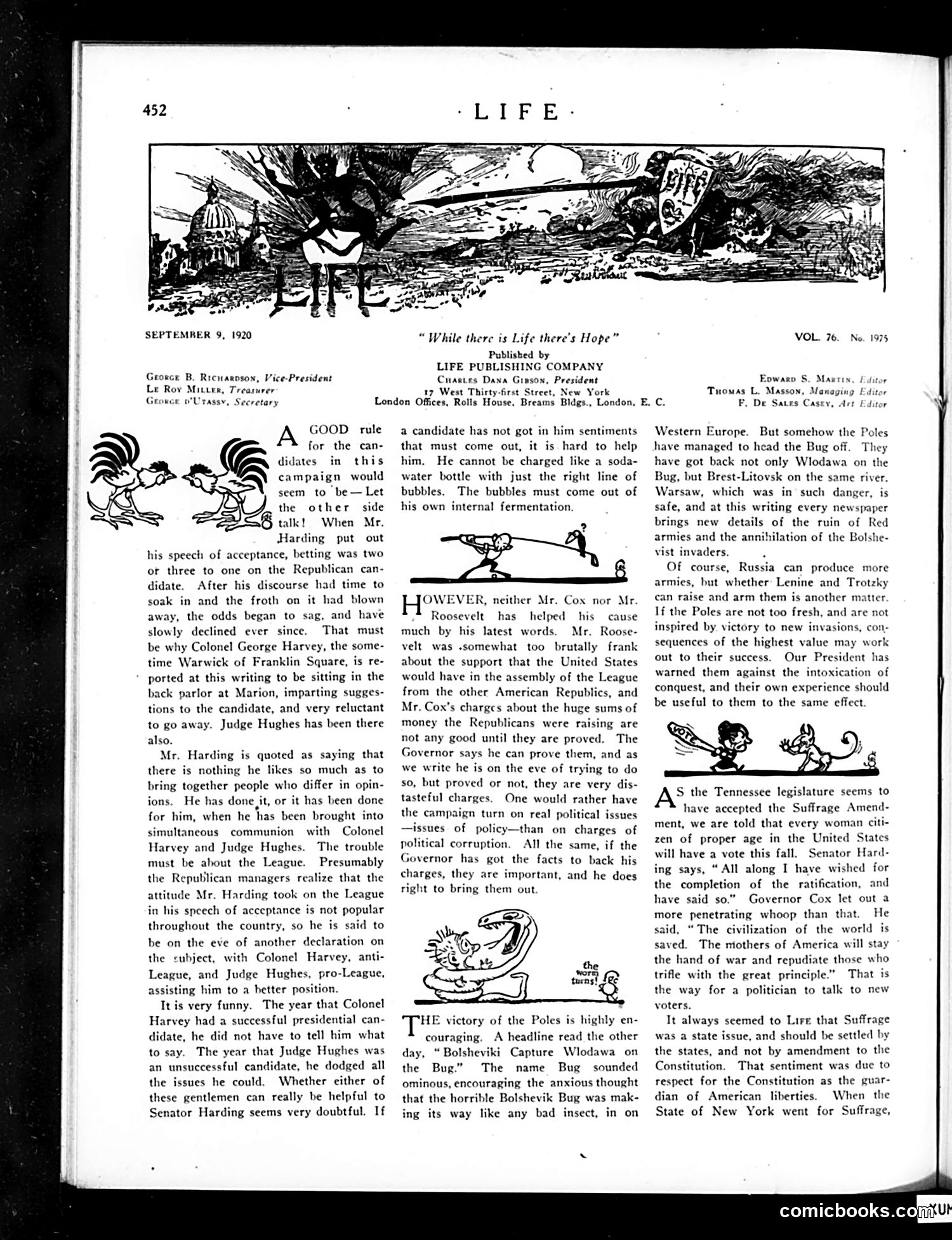
This page critiques the 1920 presidential campaign, particularly Republican candidate Warren G. Harding. The opening cartoon shows two roosters fighting—likely representing the Republican and Democratic candidates sparring. The main article mocks Harding's vague acceptance speech, noting that betting odds shifted against him once people actually read it. Life satirizes Republican handlers Colonel George Harvey and Judge Hughes attempting to coach Harding on the League of Nations issue, which divided the party. The piece suggests Harding lacks genuine conviction—comparing him to a soda bottle that needs external pressure to produce ideas. The article also criticizes Democratic candidate James Cox and Vice-Presidential candidate Franklin Roosevelt for their campaign tactics and unsupported accusations about Republican fundraising. A secondary section celebrates Polish military victories against Bolshevik forces, treating the "Bug" river (an actual geographical feature) as a fitting name for the Soviet threat spreading westward across Europe.
📄 Transcribed text from this page (OCR, searchable)
Machine-transcribed from the original scan — historical spelling and the odd misread are preserved.
SEPTEMBER 9, 1920 Geoxce B. Ricuarvson, Vice-President Lr Rov Mitter, Treasurer Groxce v'Urassy, Secretary GOOD rule for the can- didates in this =\ campaign would seem to be—Let the other side B talk!) When Mr. Harding put out his speech of acceptance, betting was two or three to one on the Republican can- didate. After his discourse had time to soak in and the froth on it had blown away, the odds began to sag, and have slowly declined ever since. That must be why Colonel George Harvey, the some- time Warwick of Franklin Square, is re- ported at this writing to be sitting in the back parlor at Marion, imparting sugges- tions to the candidate, and very reluctant to go away. Judge Hughes has been there also. Mr. Harding is quoted as saying that there is nothing he likes so much as to bring together people who differ in opin- He has done it, or it has heen done for him, when he has been brought into with Colonel ions. simultaneous communion Harvey and Judge Hughes. The trouble must be about the League. Presumably the Republican managers realize that the attitude Mr. Harding took on the League in his speech of acceptance is not popular throughout the country, so he is said to be on the eve of another declaration on the subject, with Colonel Harvey, anti- League, and Judge Hughes, pro-League, assisting him to a hetter position. It is very funny. The year that Colonel Harvey had a successful presidential can- didate, he did not have to tell him what to say. The year that Judge Hughes was an unsuccessful candidate, he dodged all the issues he could. Whether cither of these gentlemen can really be helpful to Senator Harding seems very doubtful. If “ While there is Life there's Hope” Published by LIFE PUBLISHING COMPANY Cuartes Dana Grason, President 17 West Thirty-first Street, New York London Offices, Rolls House, Breams Bldgs., London, E. a candidate has not got in him sentiments that must come out, it is hard to help him. He cannot be charged like a soda- water bottle with just the right line of bubbles. The bubbles must come out of his own internal fermentation. OWEVER, neither Mr. Cox nor Mr. Roosevelt has helped his much by his latest words. Mr. velt: was .somewhat too brutally frank about the support that the United States would have in the assembly of the League from the other American Republics, and Mr. Cox’s charges about the huge sums of money the Republicans were raising are not any good until they are proved. The Governor says he can prove them, and as we write he is on the eve of trying to do so, but proved or not, they are very dis- tasteful charges. One would rather have the campaign turn on real political issues —issues of policy—than on charges of political corruption. All the same, if the Governor has got the facts to back his charges, they are important, and he does right to bring them out. cause Roose- 'HE victory of the Poles is highly en- couraging. A headline read the other day, “Bolsheviki Capture Wlodawa on the Bug.” The name Bug sounded ominous, encouraging the anxious thought that the horrible Bolshevik Bug was mak- ing its way like any bad insect, in on VOL. 76. No. 1975 Eowaro S. Magriy Tuomas L. Masson, Managing Eu) co F, De Sates Casey, Art Editor Western Europe. But somehow the Poles have managed to head the Bug off. They have got back not only Wlodawa on the Bug, but Brest-Litovsk on the same river. Warsaw, which was in such danger, is safe, and at this writing every newspaper brings new details of the ruin of Red armies and the annihilation of the Bolshe- vist invaders. Of course, Russia can produce more armies, but whether Lenine and Trotzky can raise and arm them is another matter. If the Poles are not too fresh, and are not inspired by victory to new invasions, con- sequences of the highest value may work out to their success. Our President has warned them against the intoxication of conquest, and their own experience should be useful to them to the same effect. the Tennessee legislature seems to have accepted the Suffrage Amend- ment, we are told that every woman citi- zen of proper age in the United States will have a vote this fall. Senator Hard- ing says, “All along I have wished for the completion of the ratification, and have said so.” Governor Cox let out a more penetrating whoop than that. He said, “The civilization of the world is saved. The ntothers of America will stay the hand of war and repudiate those who trifle with the great principle.” That is the way for a politician to talk to new voters. It always seemed to Lire that Suffrage was a state issue, and should be settled by the states, and not by amendment to the Constitution. That sentiment was due to respect for the Constitution as the guar- dian of American liberties. When the State of New York went for Suffr: comicbooks.com)