
Life, 1920-09-09 · page 24 of 44
Life — September 9, 1920 — page 24: what you’re looking at
What you’re looking at
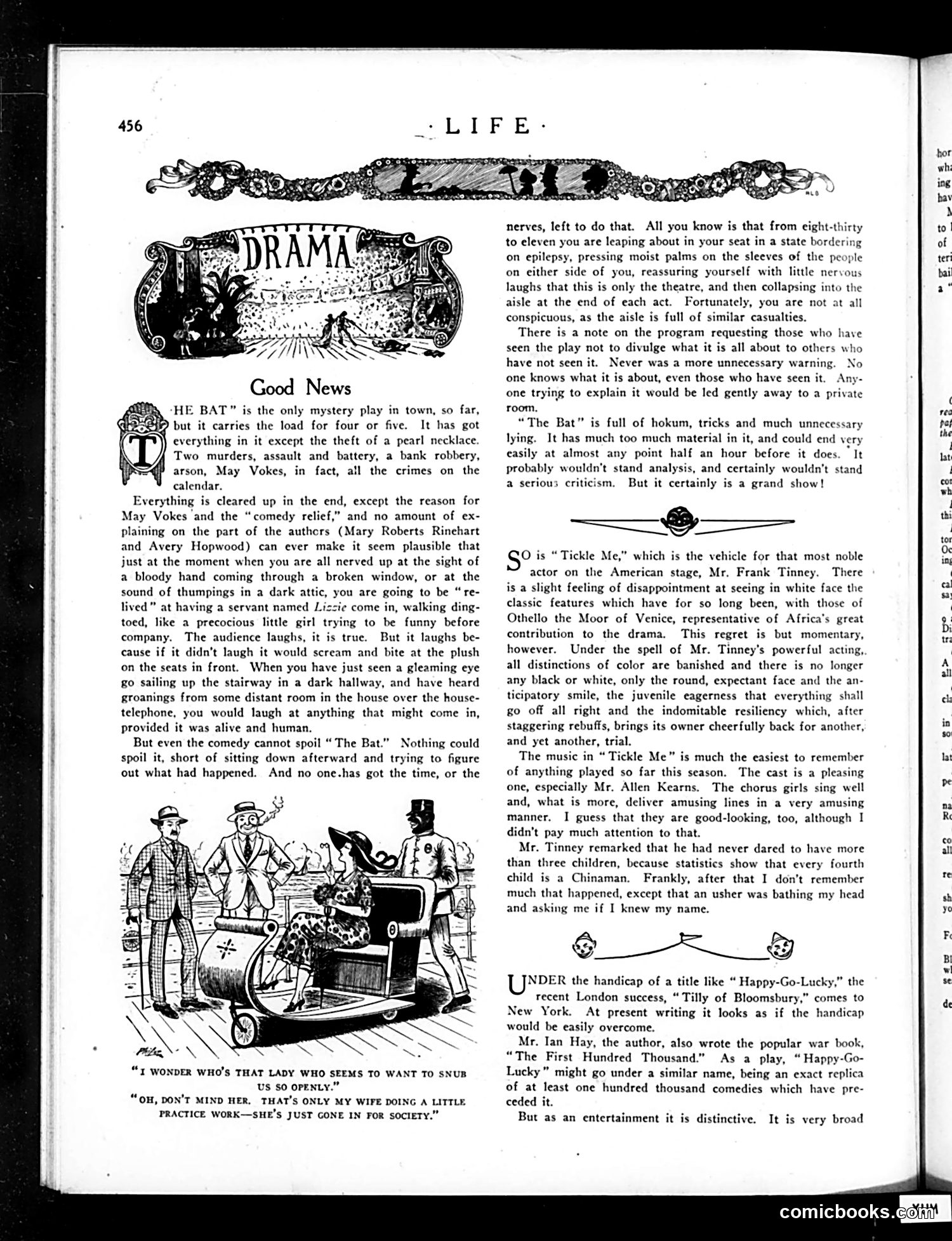
This page reviews two Broadway plays: "The Bat" and "Tickle Me." **"The Bat"** critique: The reviewer praises this mystery play (by Mary Roberts Rinehart and Avery Hopwood) as genuinely thrilling—packed with murders, robbery, and violence—despite its absurd "comedy relief" character Lizzie. The satire argues audiences laugh not from genuine humor but from nervous hysteria; the ridiculous interludes actually prevent the play from being spoiled by logical scrutiny. The humor targets both the play's formulaic sensationalism and theater audiences' suspension of disbelief. **The cartoon** shows well-dressed men with a car, captioning marital dynamics where a wife practices "society" snubbing—satirizing nouveau riche social-climbing behavior. **"Tickle Me"** review: Praises Frank Tinney's blackface performance (standard then), noting his skill transcends racial stereotypes. The reviewer finds the music forgettable but the cast charming. Both reviews exemplify Life magazine's theatrical criticism: witty, slightly condescending toward popular entertainment while acknowledging its appeal.
📄 Transcribed text from this page (OCR, searchable)
Machine-transcribed from the original scan — historical spelling and the odd misread are preserved.
HE BAT” is the only mystery play in town, so far, but it carries the load for four or five. It has got everything in it except the theft of a pearl necklace. Two murders, assault and battery, a bank robbery, arson, May Vokes, in fact, all the crimes on the calendar. Everything is cleared up in the end, except the reason for May Vokes ‘and the “comedy relief,” and no amount of ex- plaining on the part of the authors (Mary Roberts Rinehart and Avery Hopwood) can ever make it seem plausible that just at the moment when you are all nerved up at the sight of a bloody hand coming through a broken window, or at the sound of thumpings in a dark attic, you are going to be “ re- lived” at having a servant named Lizsie come in, walking ding- toed, like a precocious little girl trying to be funny before company. The audience laughs, it is true. But it laughs be- cause if it didn’t laugh it would scream and bite at the plush on the seats in front. When you have just seen a gleaming eye go sailing up the stairway in a dark hallway, and have heard groanings from some distant room in the house over the house- telephone, you would laugh at anything that might come in, provided it was alive and human. But even the comedy cannot spoil “ The Bat.” Nothing could spoil it, short of sitting down afterward and trying to figure out what had happened. And no one.has got the time, or the “I WONDER WHO'S THAT LADY WHO SEEMS TO WANT TO SNUB US SO OPENLY.” “OH, DON'T MIND HER. THAT'S ONLY MY WIFE DOING A LITTLE PRACTICE WORK—SHE’S JUST GONE IN FOR SOCIETY.” nerves, left to do that. All you know is that from eight-thirty to eleven you are leaping about in your seat in a state bordering on epilepsy, pressing moist palms on the sleeves of the people on either side of you, reassuring yourself with little nervous laughs that this is only the theatre, and then collapsing into the aisle at the end of each act. Fortunately, you are not at all conspicuous, as the aisle is full of similar casualties. There is a note on the program requesting those who have seen the play not to divulge what it is all about to others who have not seen it. Never was a more unnecessary warning. No one knows what it is about, even those who have seen it. Any- one trying to explain it would be led gently away to a private room, The Bat” is full of hokum, tricks and much unnecessary lying. It has much too much material in it, and could end very easily at almost any point half an hour before it does. “It probably wouldn't stand analysis, and certainly wouldn't stand a serious criticism. But it certainly is a grand show! —__ & —— O is “Tickle Me,” which is the vehicle for that most noble actor on the American stage, Mr. Frank Tinney. There is a slight feeling of disappointment at seeing in white face the classic features which have for so long been, with those of Othello the Moor of Venice, representative of Africa's great contribution to the drama. This regret is but momentary, however. Under the spell of Mr. Tinney’s powerful acting, all distinctions of color are banished and there is no longer any black or white, only the round, expectant face and the an- ticipatory smile, the juvenile eagerness that everything shall go off all right and the indomitable resiliency which, after staggering rebuffs, brings its owner cheerfully back for another, and yet another, trial. The music in “ Tickle Me” is much the easiest to remember of anything played so far this season. The cast is a pleasing one, especially Mr. Allen Kearns. The chorus girls sing well and, what is more, deliver amusing lines in a very amusing manner. I guess that they are good-looking, too, although I didn’t pay much attention to that. Mr. Tinney remarked that he had never dared to have more than three children, because statistics show that every fourth child is a Chinaman. Frankly, after that I don’t remember much that happened, except that an usher was bathing my head and asking me if I knew my name. eo <__® NDER the handicap of a title like “ Happy-Go-Lucky,” the recent London success, “ Tilly of Bloomsbury,” comes to New York. At present writing it looks as if the handicap would be easily overcome. Mr. Ian Hay, the author, also wrote the popular war book, “The First Hundred Thousand.” As a play, “ Happy-Go- Lucky” might go under a similar name, being an exact replica of at least one hundred thousand comedies which have pre- ceded it. But as an entertainment it is distinctive. It is very broad comicbooks.¢onmi