
Life, 1920-09-09 · page 17 of 44
Life — September 9, 1920 — page 17: what you’re looking at
What you’re looking at
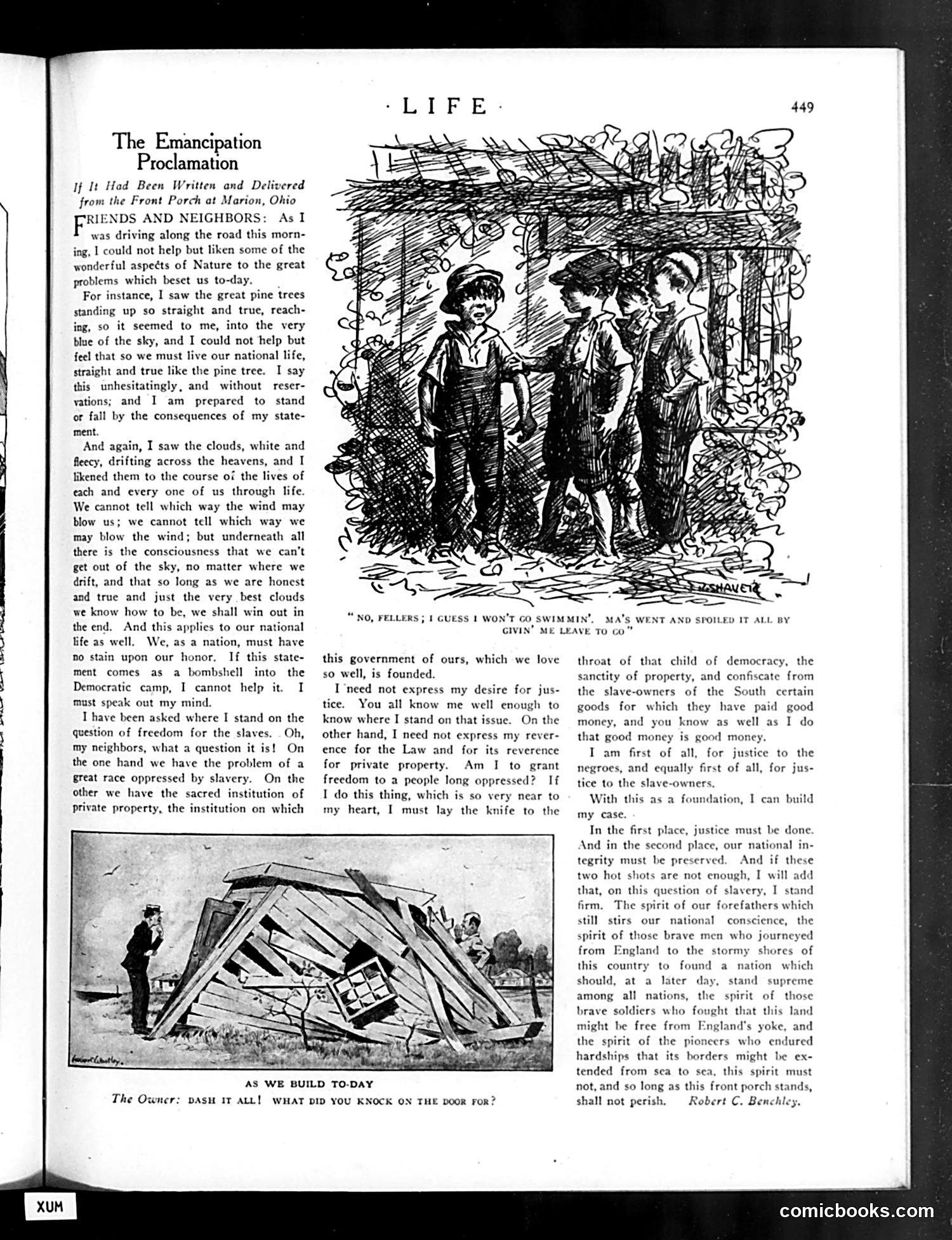
This page satirizes President Warren G. Harding's evasive speaking style. The mock "Emancipation Proclamation" parodies how Harding would address slavery if he spoke from his front porch in Marion, Ohio—using flowery nature metaphors (pine trees, clouds) to avoid taking a clear stance. The satire targets Harding's notorious verbal circumlocution: he acknowledges slavery's injustice and property rights simultaneously, then equivocates endlessly rather than commit to abolition. His refrain—"I stand firm" on slavery while balancing both sides—perfectly captures his political non-position. The two cartoon illustrations underscore the absurdity: children ignoring a pompous speaker, and a house collapsing (labeled "As We Build To-Day"), suggesting that such equivocation undermines the nation's foundation. The point: Harding's bloated rhetoric masks moral cowardice on fundamental issues.
📄 Transcribed text from this page (OCR, searchable)
Machine-transcribed from the original scan — historical spelling and the odd misread are preserved.
The Emancipation Proclamation If It Had Been Written and Delivered from the Front Porch at Marion, Ohio RIENDS AND NEIGHBORS: As I was driving along the road this morn- ing, 1 could not help but liken some of the wonderful aspects of Nature to the great problems which beset us to-day. For instance, I saw the great pine trees standing up so straight and true, reach- ing, so it seemed to me, into the very blue of the sky, and I could not help but feel that so we must live our national life, straight and true like the pine tree. I say this unhesitatingly, and without reser- yations; and I am prepared to stand or fall by the consequences of my state- ment. And again, I saw the clouds, white and fleecy, drifting across the heavens, and I likened them to the course of the lives of each and every one of us through life. We cannot tell which way the wind may blow us; we cannot tell which way we may blow the wind; but underneath all there is the consciousness that we can’t get out of the sky, no matter where we drift, and that so long as we are honest and true and just the very best clouds we know how to be, we shall win out in the end. And this applies to our national life as well. We, as a nation, must have no stain upon our honor, If this state- ment as a bombshell into the Democratic camp, I cannot help it. I must speak out my mind. T have been asked where I stand on the question of freedom for the slaves. Oh, my neighbors, what a question it is! On the one hand we have the problem of a great race oppressed by slavery. On the other we have the sacred institution of private property, the institution on which comes $ 1 WON'T GO SWIM MIN’. MA'S WENT AND SPOILED IT ALL BY ME LEAVE To co” this government of ours, which we love so well, is founded. I need not express my desire for jus- tice. You all know me well enough to know where I stand on that issue. On the other hand, I need not express my rever- ence for the Law and for its reverence for private property. Am I to grant freedom to a people long oppressed? If I do this thing, which is so very near to my heart, I must lay the knife to the AS WE BUILD TO-DAY The Owner: pasu it au! WHAT DID YOU KNOCK ON THE DOOR FoR? throat of that child of democracy, the sanctity of property, and confiscate from the slave-owners of the South goods for which they have paid good certain money, and you know as well as I do that good money is good money. I am first of all, for justice to the negroes, and equally first of all, for jus- tice to the slave-owners, With this as a foundation, I can build my case. In the first place, justice must be done. And in the second place, our national in- tegrity must be preserved. And if these two hot shots are not enough, I will add that, on this question of slavery, I stand firm. The spirit of our f ill stirs fathers which conscience, the irneyed es of our national spirit of those brave men who j from England to the stormy s this country to found a nation should, at a later stand among all nations, the spirit of brave soldiers who fought that this land might be free from England's yoke, and the spirit of the pioneers who endured hardships that its borders might be ex- tended from sca to sea, this spirit must not, and so long as this front porch stands, shall not perish. Robert C. Benchle: which day, supreme those comicbooks.com