
Life, 1920-09-09 · page 12 of 44
Life — September 9, 1920 — page 12: what you’re looking at
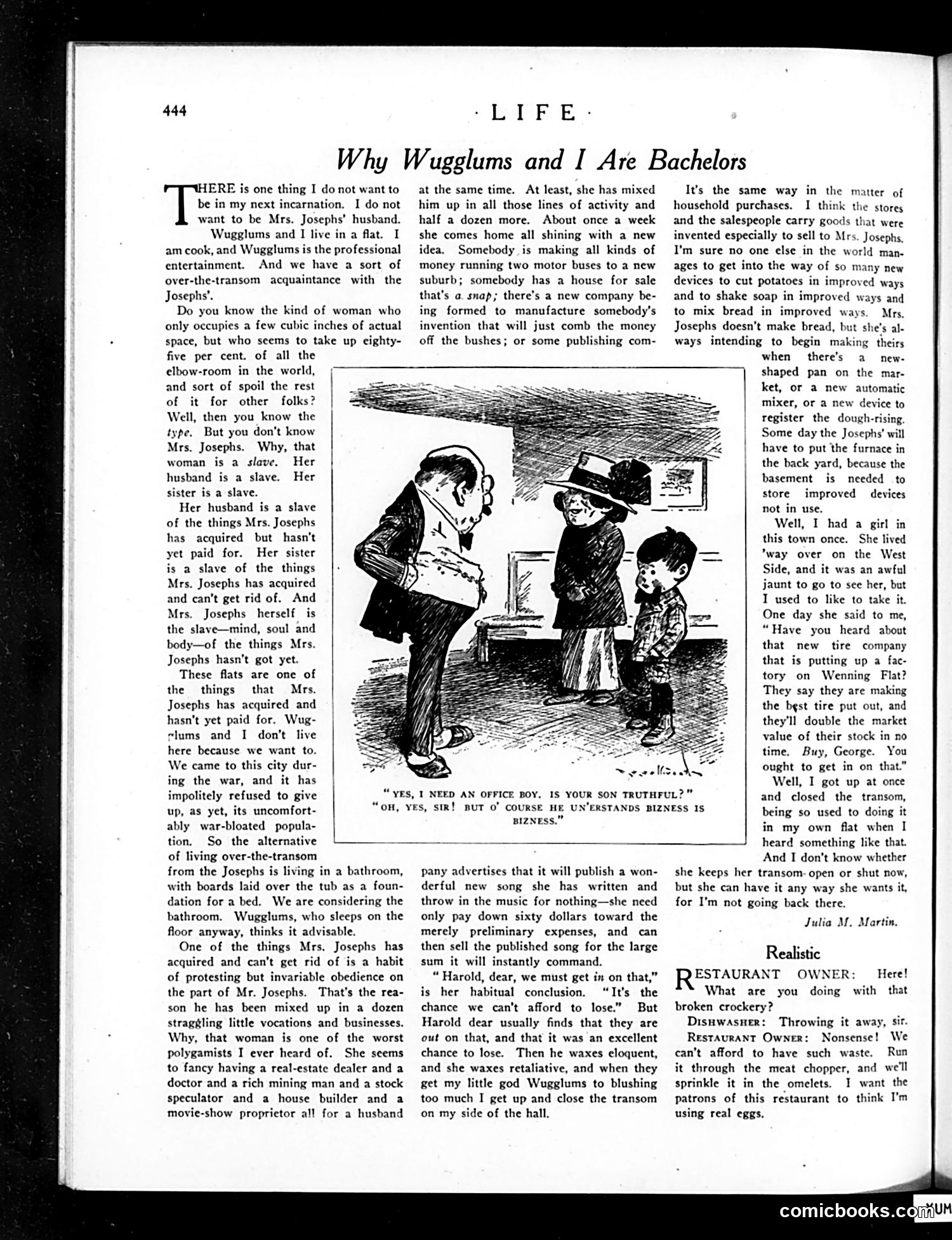
What you’re looking at
This article satirizes married life through the narrator's observations of his friend Mrs. Josephs. The cartoon illustrates a man asking an office boy, "Yes, I need an office boy. Is your son trustworthy?" The boy responds, "Oh, yes, sir! But of course he understands business is business." The satire targets how marriage and domestic life trap men through constant financial demands—wives acquiring possessions (household gadgets, improved bread-making devices, furnaces) that require endless maintenance and expense. The narrator suggests marriage forces men into slavery to pay for their wives' acquisitions. The cartoon's dialogue ironically jokes about business integrity while the article argues marriage itself is the worst "business" for a man, justifying bachelor status.
📄 Transcribed text from this page (OCR, searchable)
Machine-transcribed from the original scan — historical spelling and the odd misread are preserved.
-LIFE. Why Wugglums and I Are Bachelors ERE is one thing I do not want to be in my next incarnation. I do not want to be Mrs. Josephs’ husband. Wugglums and I live in a flat. I am cook, and Wugglumss is the professional entertainment. And we have a sort of over-the-transom acquaintance with the Josephs’. Do you know the kind of woman who only occupies a few cubic inches of actual space, but who seems to take up cighty- five per cent. of all the at the same time. At least, she has mixed him up in all those lines of activity and half a dozen more. About once a week she comes home all shining with a new idea. Somebody is making all kinds of money running two motor buses to a new suburb; somebody has a house for sale that's a. snap; there’s a new company be- ing formed to manufacture somebody's invention that will just comb the money off the bushes; or some publishing com- It’s the same way in the matter of household purchases. I think the stores and the salespeople carry goods that were vented especially to sell to Mrs. Josephs, I'm sure no one else in the world man- ages to get into the way of so many new devices to cut potatoes in improved ways and to shake soap in improved ways and to mix bread in improved ways. Mrs, Josephs doesn't make bread, but she’s al- ways intending to begin making theirs when there's a new- elbow-room in the world, and sort of spoil the rest of it for other folks? Well, then you know the type. But you don’t know Mrs. Josephs. Why, that woman is a slave. Her husband is a slave. Her sister is a slave. Her husband is a slave of the things Mrs. Josephs has acquired but hasn't yet paid for. Her sister is a slave of the things Mrs. Josephs has acquired and can’t get rid of. And Mrs. Josephs herself is the slave—mind, soul and body—of the things Mrs. Josephs hasn’t got yet. These flats are one of the things that Mrs. Josephs has acquired and hasn’t yet paid for. Wug- clums and I don’t live here because we want to. We came to this city dur- ing the war, and it has impolitely refused to give up, as yet, its uncomfort- ably war-bloated popula- tion. So the alternative “YES, I NEED AN OFFICE BOY. IS YOUR SON TRUTHFUL? “OH, YES, siR! BUT 0’ COURSE HE UN’ERSTANDS BIZNESS IS BIZNES.” “| shaped pan on the mar- ket, or a new automatic mixer, or a new device to register the dough-rising. Some day the Josephs’ will have to put the furnace in the back yard, because the basement is needed to store improved devices not in use. Well, I had a girl in this town once. She lived ’way over on the West Side, and it was an awful jaunt to go to see her, but I used to like to take it. One day she said to me, “Have you heard about that new tire company that is putting up a fac- tory on Wenning Flat? They say they are making the best tire put out, and they'll double the market value of their stock in no time. Buy, George. You ought to get in on that.” Well, I got up at once and closed the transom, being so used to doing it in my own flat when I of living over-the-transom from the Josephs is living in a bathroom, with boards laid over the tub as a foun- dation for a bed. We are considering the bathroom. Wugglums, who sleeps on the floor anyway, thinks it advisable. One of the things Mrs. Josephs has acquired and can’t get rid of is a habit of protesting but invariable obedience on the part of Mr. Josephs. That's the rea- son he has been mixed up in a dozen straggling little vocations and businesses. Why, that woman is one of the worst polygamists I ever heard of. She seems to fancy having a real-estate dealer and a doctor and a rich mining man and a stock speculator and a house builder and a movie-show proprietor all for a husband pany advertises that it will publish a won- derful new song she has written and throw in the music for nothing—she need only pay down sixty dollars toward the merely preliminary expenses, and can then sell the published song for the large sum it will instantly command. “Harold, dear, we must get in on that,” is her habitual conclusion. “It's the chance we can’t afford to lose.” But Harold dear usually finds that they are out on that, and that it was an excellent chance to lose. Then he waxes eloquent, and she waxes retaliative, and when they get my little god Wugglums to blushing too much I get up and close the transom on my side of the hall. heard something like that. And I don’t know whether she keeps her transom- open or shut now, but she can have it any way she wants it, for I'm not going back there. Julia M. Martin, Realistic ESTAURANT OWNER: What are you doing with broken crockery? Disuwasuer: Throwing it away, sit. Restaurant Owner: Nonsense! We can’t afford to have such waste. Run it through the meat chopper, and we'll sprinkle it in the omelets. I want the patrons of this restaurant to think I'm using real eggs. Here! that comicbooks.comiyy