
A complete issue · 40 pages · 1920
Life — July 15, 1920
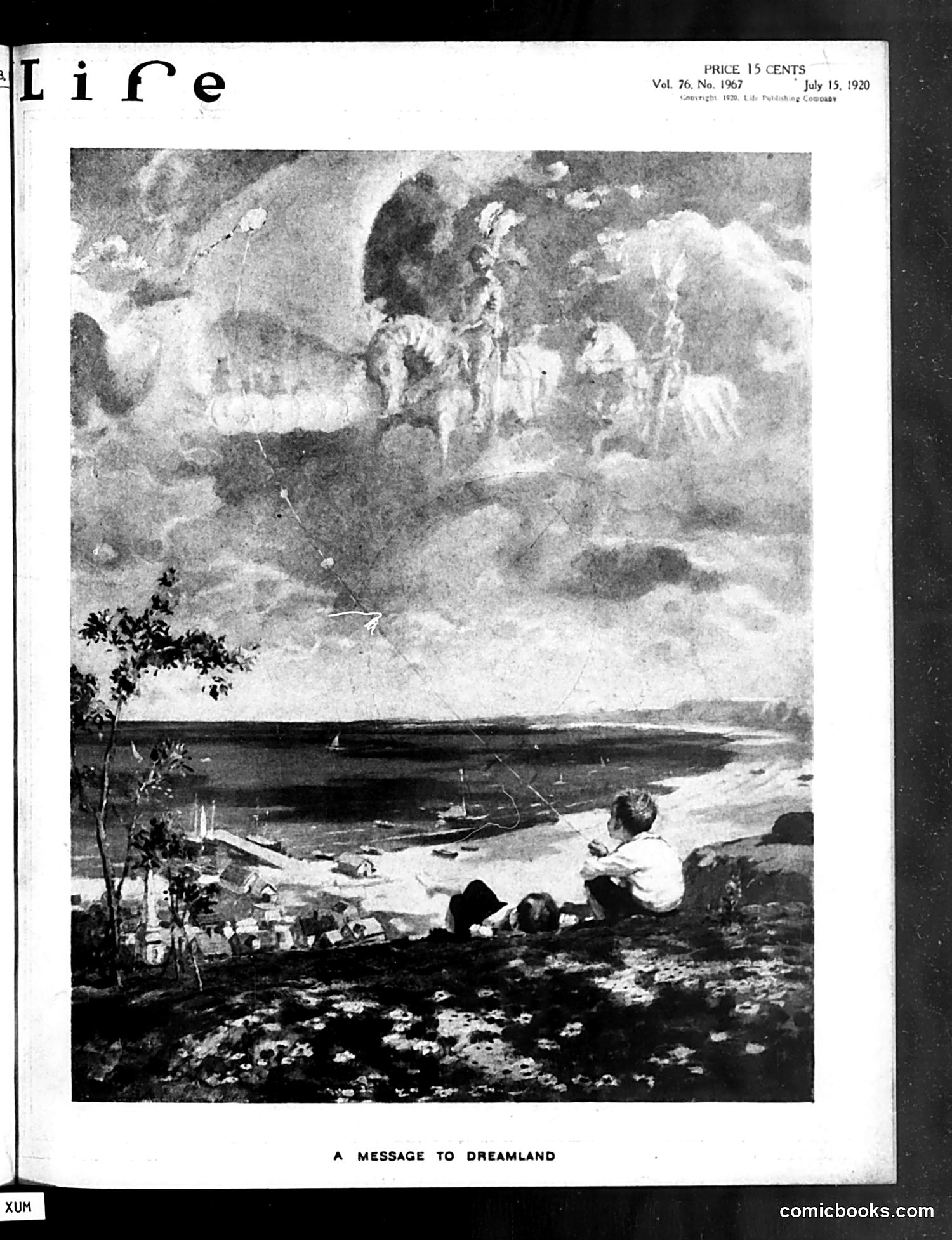
This July 1920 *Life* illustration depicts a person on a beach gazing heavenward at ethereal, cloud-like figures. The title "A Message to Dreamland" suggests a romantic or spiritual communication between the earthly realm (the realistic beach scene below) and an idealized, heavenly realm (the clouds above). The image appears to be sentimental rather than overtly political satire. It likely plays on post-World War I nostalgia or escapism—a common theme in 1920 as Americans grappled with the war's aftermath. The dreaming figure represents someone seeking solace or connection with something transcendent, whether lost loved ones, idealized romance, or spiritual peace. The juxtaposition emphasizes the gap between harsh reality and comforting fantasy.
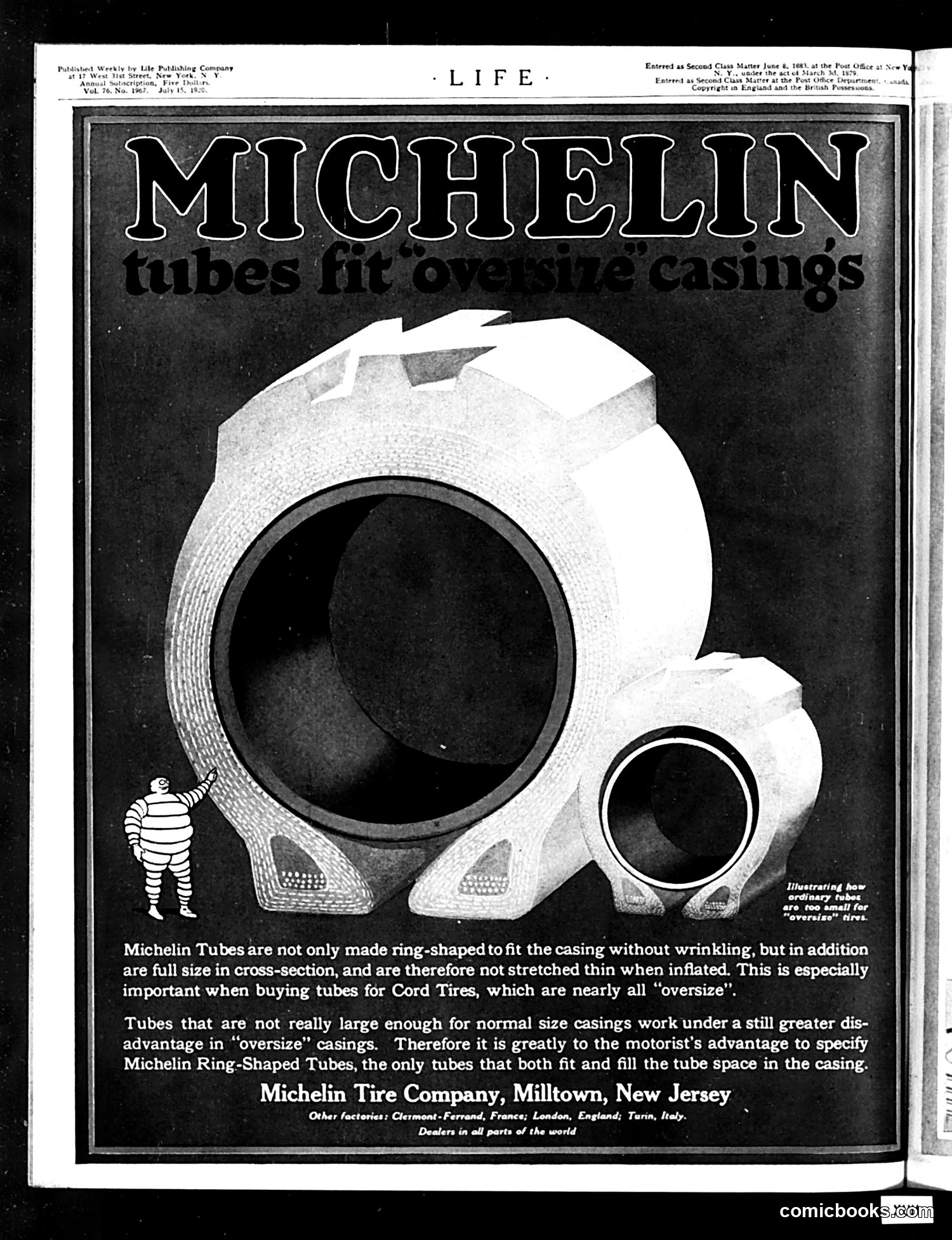
This is a **product advertisement**, not political satire. The page promotes Michelin Tubes, specifically their "ring-shaped" design for oversized tire casings. The image uses visual contrast—a tiny figure (the famous Michelin Man mascot, identifiable by his wrapped/segmented appearance) stands next to enormous tire tubes to emphasize their size. The advertisement explains that Michelin tubes are designed to fit snugly in oversized casings without wrinkling, addressing a practical problem for motorists buying "Cord Tires, which are nearly all 'oversize'." This is straightforward commercial messaging from Michelin's New Jersey headquarters, emphasizing manufacturing superiority to consumers. The "satire" magazine context simply means *Life* published advertisements alongside humorous content.
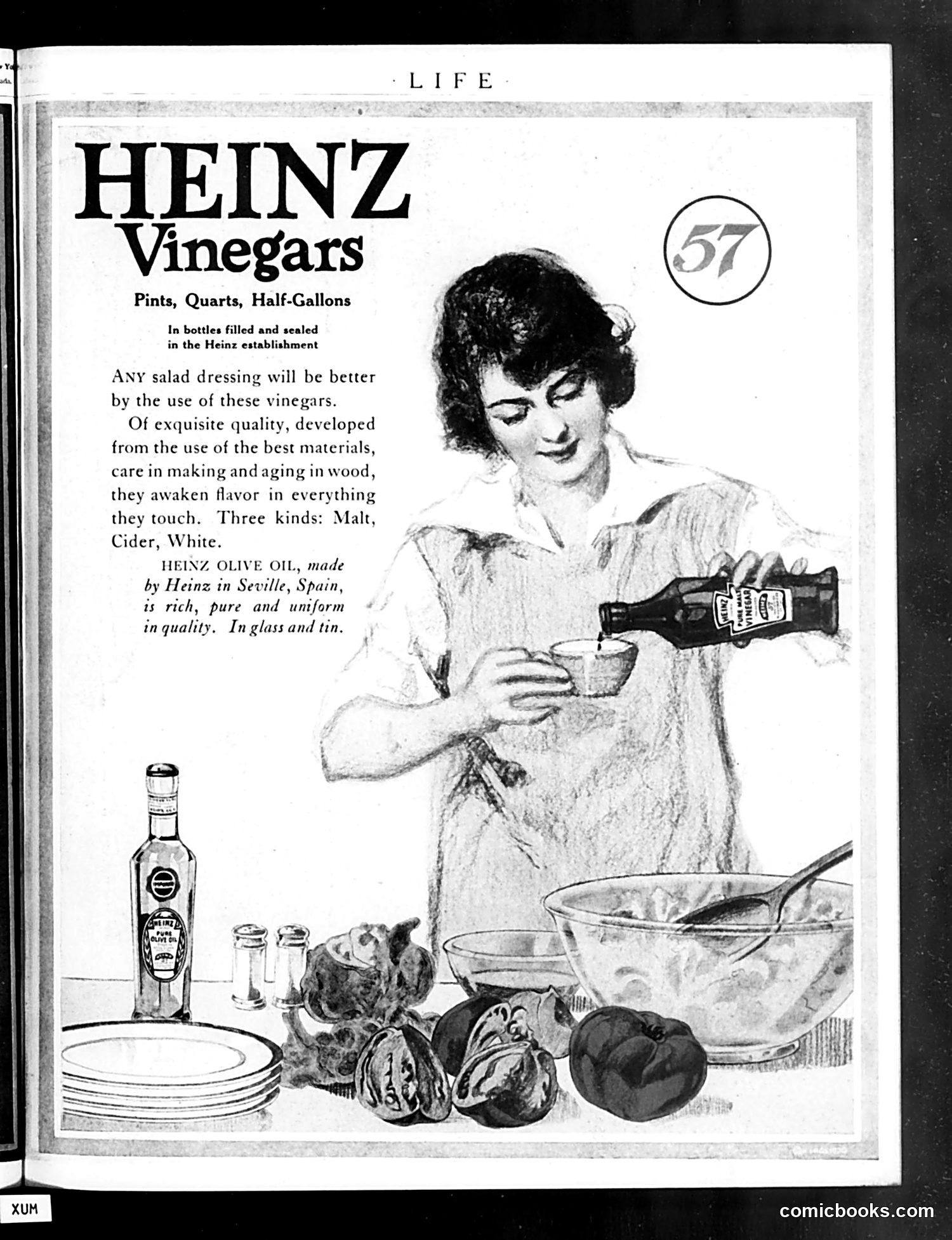
This is **not a political cartoon or satire** — it's a straightforward **advertisement** for Heinz Vinegars, appearing in Life magazine's advertising section. The page features a woman preparing a salad, pouring Heinz vinegar into a bowl. The ad emphasizes product quality: three varieties (Malt, Cider, White), available in multiple sizes, and also mentions Heinz Olive Oil made in Seville, Spain. The circular "57" badge references Heinz's famous "57 Varieties" slogan, which became iconic branding. The illustration style is typical of early-to-mid 20th-century advertising, depicting domestic food preparation as aspirational. There is no satire or political commentary present — this is simply vintage commercial advertising positioned within the magazine.
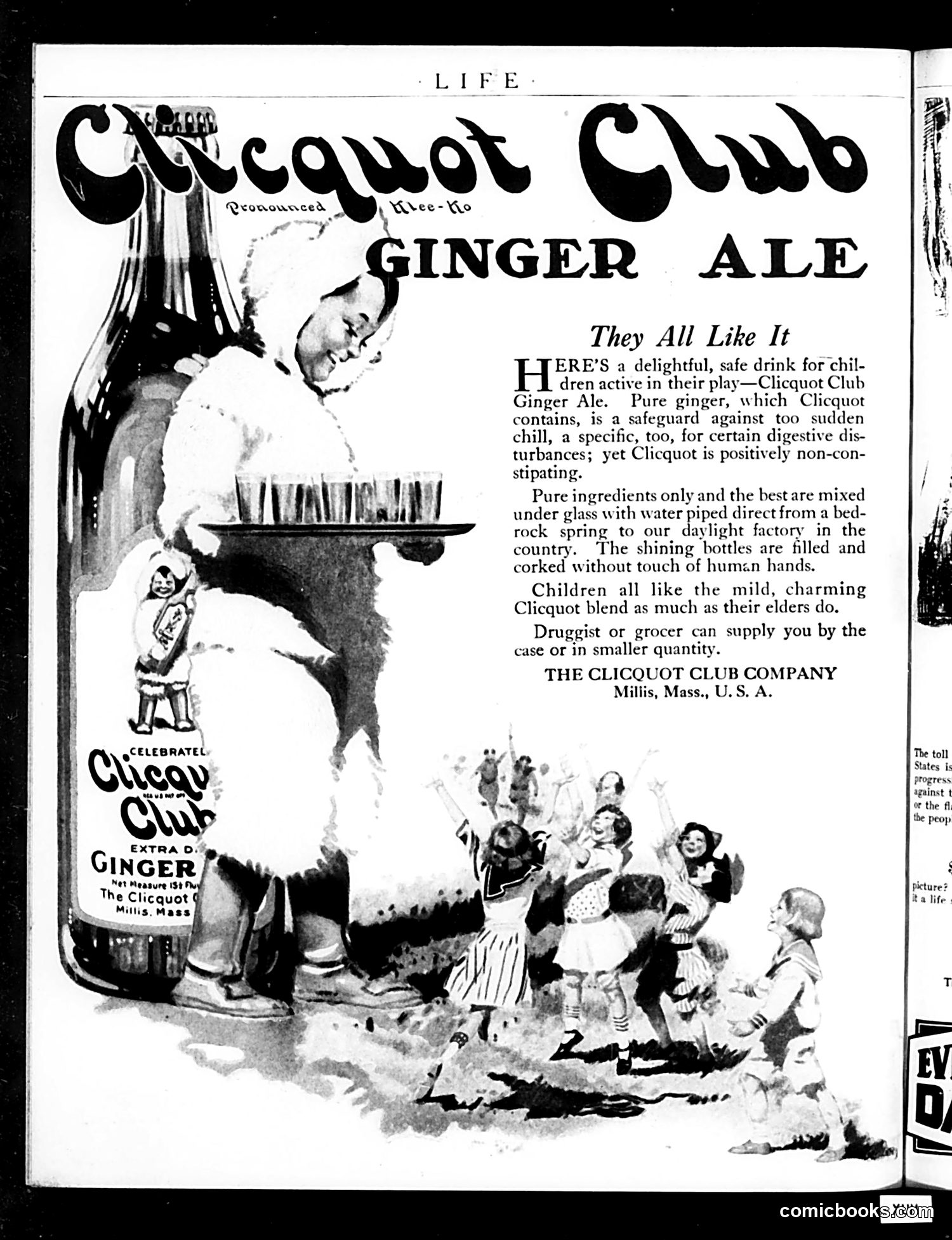
This is a straightforward advertisement, not political satire. It promotes Clicquot Club Ginger Ale, a soft drink manufactured in Mills, Massachusetts. The ad emphasizes the product as "safe" for children—a key selling point in the early 20th century when product safety and purity were major consumer concerns. The text highlights that ingredients are pure and mixing is done "without touch of human hands," reflecting contemporary anxieties about factory hygiene and contamination. The illustration shows an adult serving the beverage to cheerful children at play, reinforcing the message that this is wholesome refreshment. The "They All Like It" headline and emphasis on the "mild, charming" taste targets parents seeking appropriate beverages for their children.
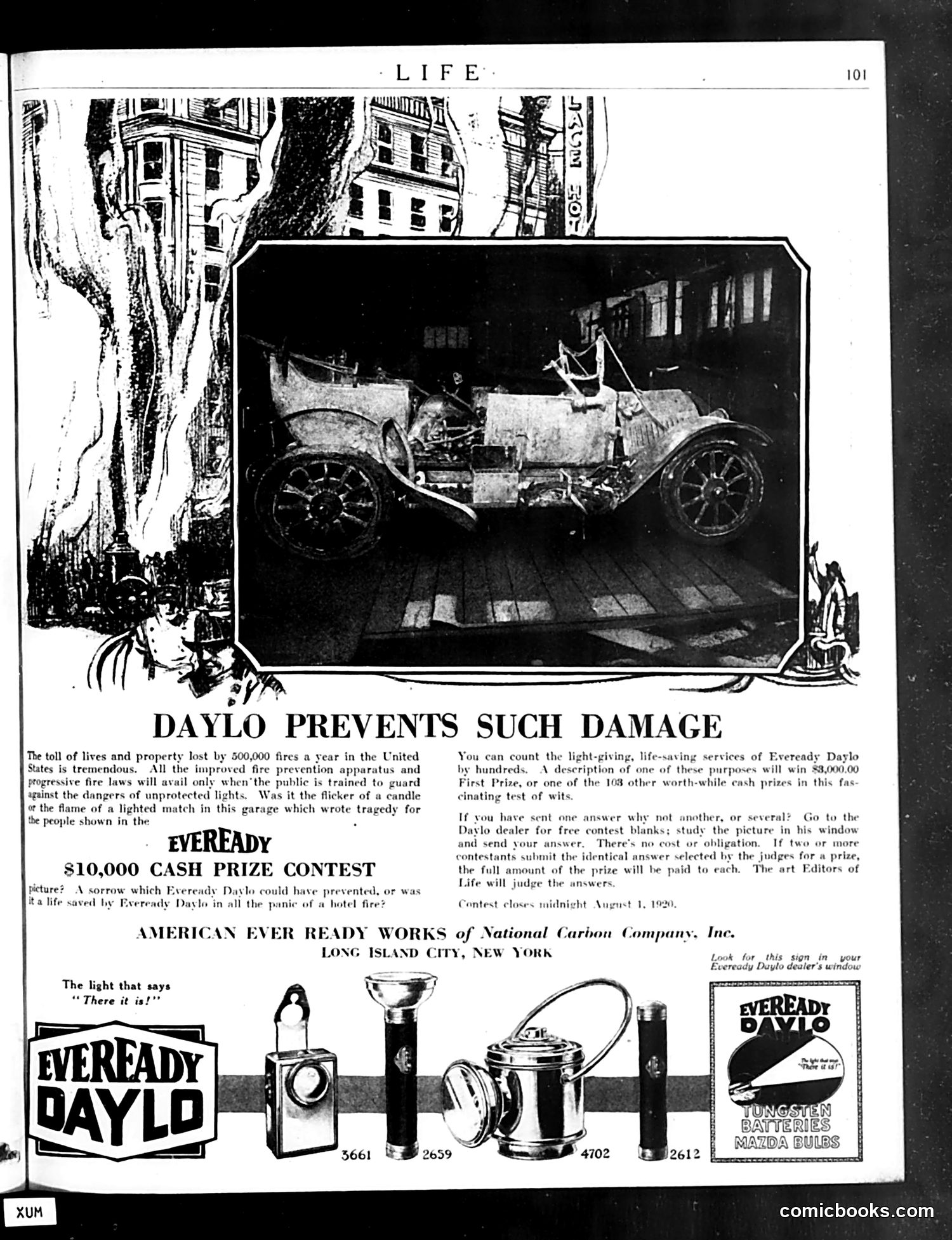
This page is primarily **advertising, not political satire**. It promotes Eveready Daylo flashlights and batteries through a $10,000 cash prize contest. The central image shows an early automobile in what appears to be an indoor garage or showroom, illustrating the advertisement's safety message: "Daylo Prevents Such Damage." The text references fire prevention, noting that 500,000 fires occur annually in the United States, and suggests Eveready flashlights help prevent accidents by providing reliable lighting in dark spaces like garages. The lower section displays various Eveready Daylo products (flashlights, batteries, bulbs) with product model numbers. The contest encourages readers to answer why Eveready Daylo could have prevented specific accidents or property damage. This is straightforward commercial advertising masquerading as a public safety message.
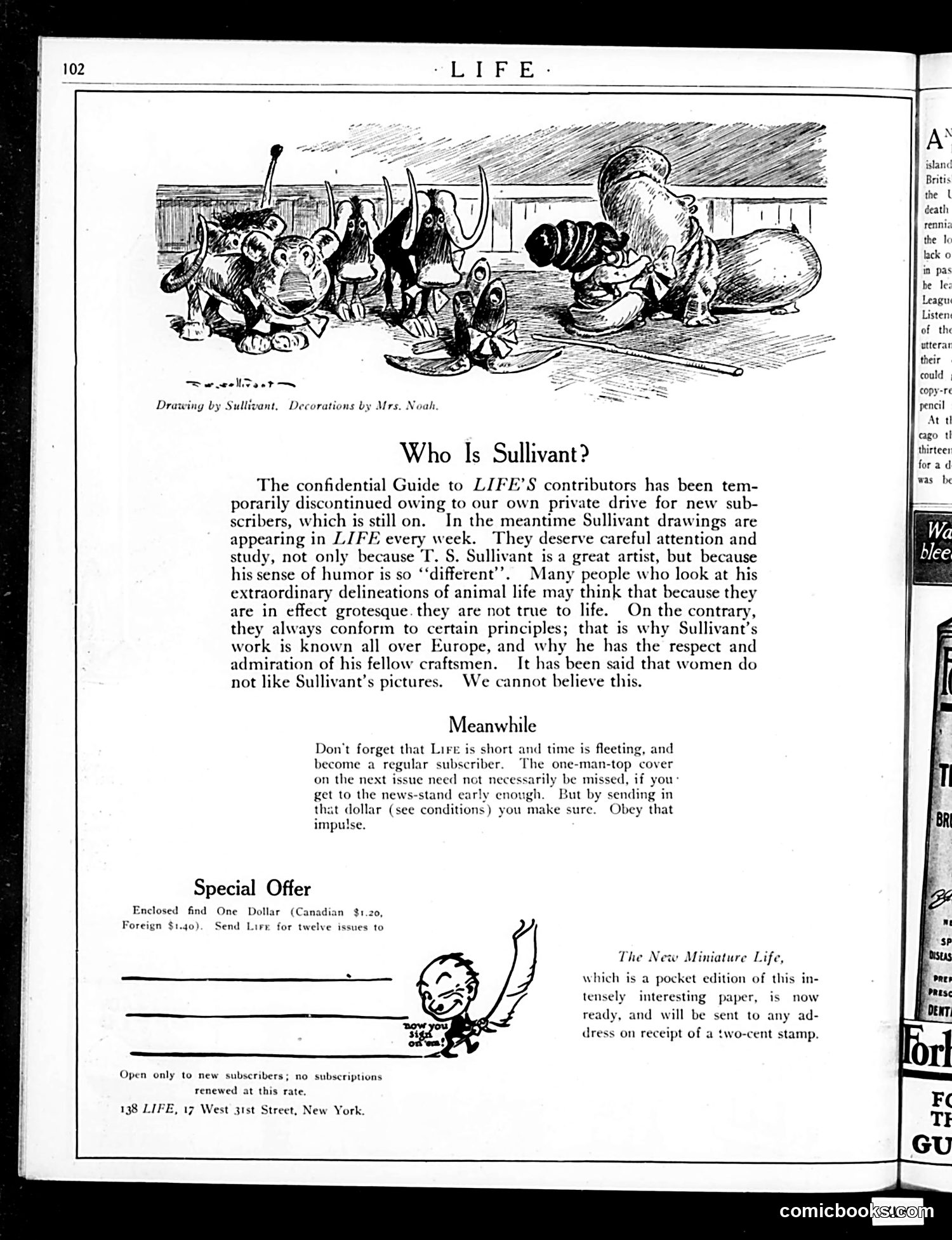
This page introduces T.S. Sullivant, a cartoonist whose animal drawings regularly appeared in *Life*. The illustration shows exaggerated animal characters in theatrical poses—monkeys, a cow, and other creatures in elaborate costumes or positions. The text defends Sullivant's distinctive, deliberately distorted style. The editors acknowledge that his animal drawings look unrealistic but argue this is intentional: his work "always conforms to certain principles" rather than attempting photographic accuracy. The passage dismisses the claim that "women do not like Sullivant's pictures," suggesting some readers found his grotesque animal caricatures off-putting. The page also advertises subscription offers for *Life*, positioning Sullivant's humorous animal cartoons as a draw for new subscribers.
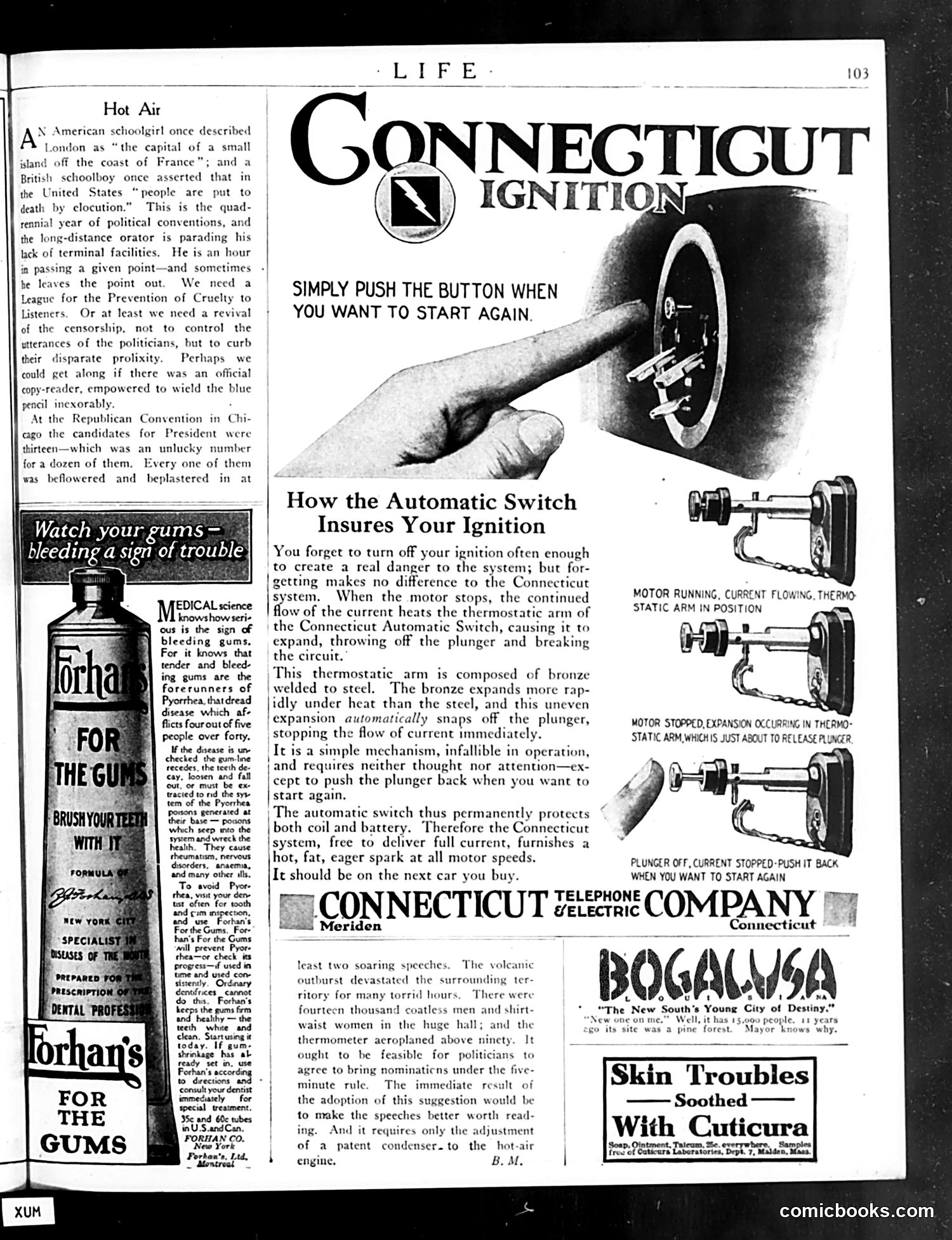
This page is primarily **advertising and product promotion**, not political satire. The main content is a **Connecticut Ignition System advertisement** explaining how an automatic ignition switch works. Large diagrams show the mechanical function of a thermostat-controlled plunger that cuts off ignition when the engine stops, eliminating the need for drivers to manually turn off their cars. The left sidebar contains a **Forhan's toothpaste ad** using medical authority to promote oral hygiene. Additional advertisements for **Cuticura** skin treatment and **Bogalusa** (a Southern city) appear below. The only editorial content is a brief "Hot Air" column criticizing political conventions—but this occupies minimal space. The page reflects early automotive technology marketing alongside consumer goods advertising typical of 1920s-era publications.
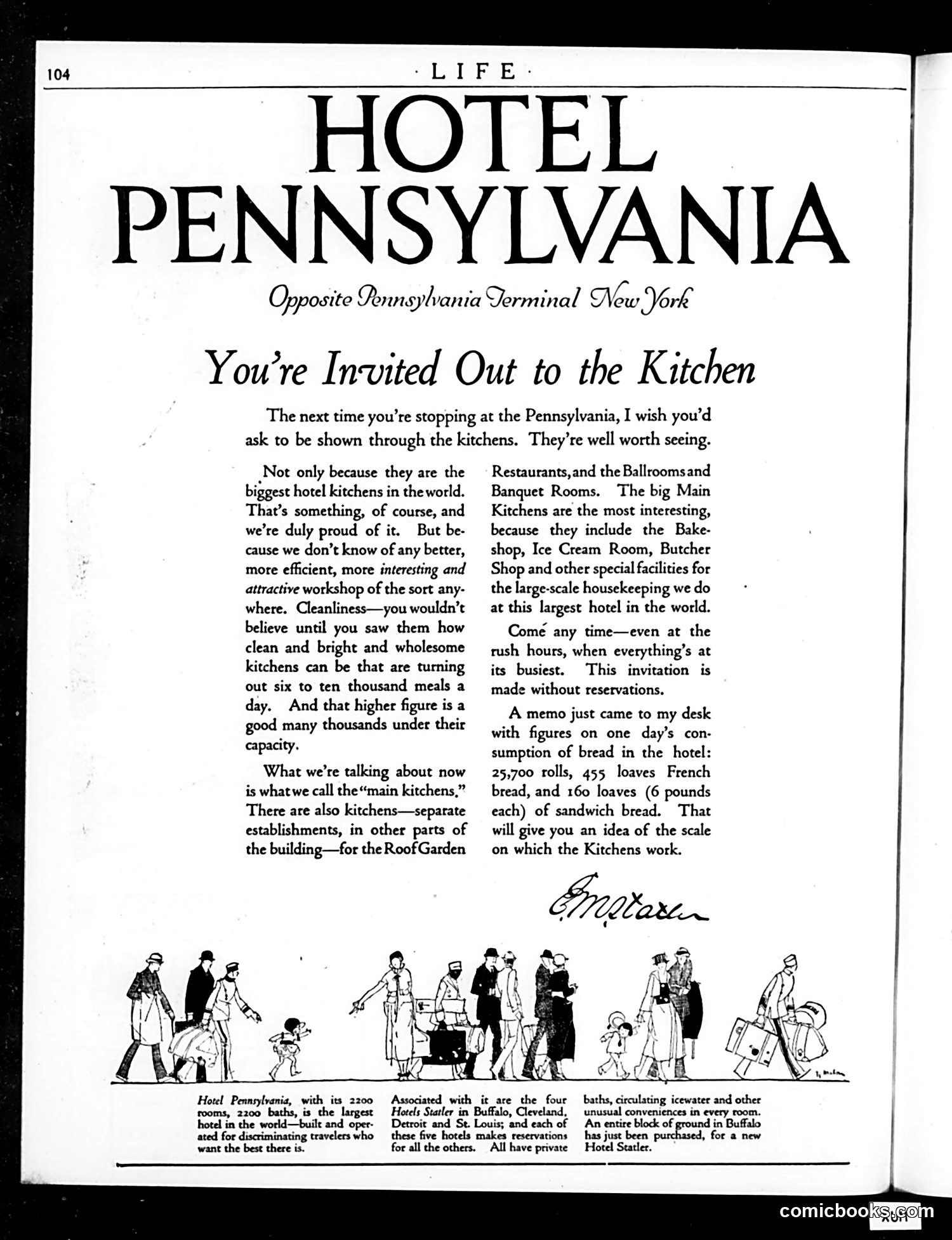
This is a straightforward hotel advertisement from *Life* magazine, not political satire. The page promotes the Hotel Pennsylvania in New York City (located opposite Pennsylvania Terminal), inviting guests to tour its kitchens. The text emphasizes the hotel's scale and efficiency: it serves 6,000-10,000 meals daily and operates the "biggest hotel kitchens in the world." A memo lists specific consumption figures (25,700 rolls, 455 loaves of French bread, 160 loaves of sandwich bread daily) to demonstrate industrial-scale operations. The bottom illustration shows tourists and travelers of various types visiting the hotel, underscoring the advertisement's appeal to "discriminating travelers." The page includes a signed byline, suggesting an editorial endorsement rather than pure advertising copy.
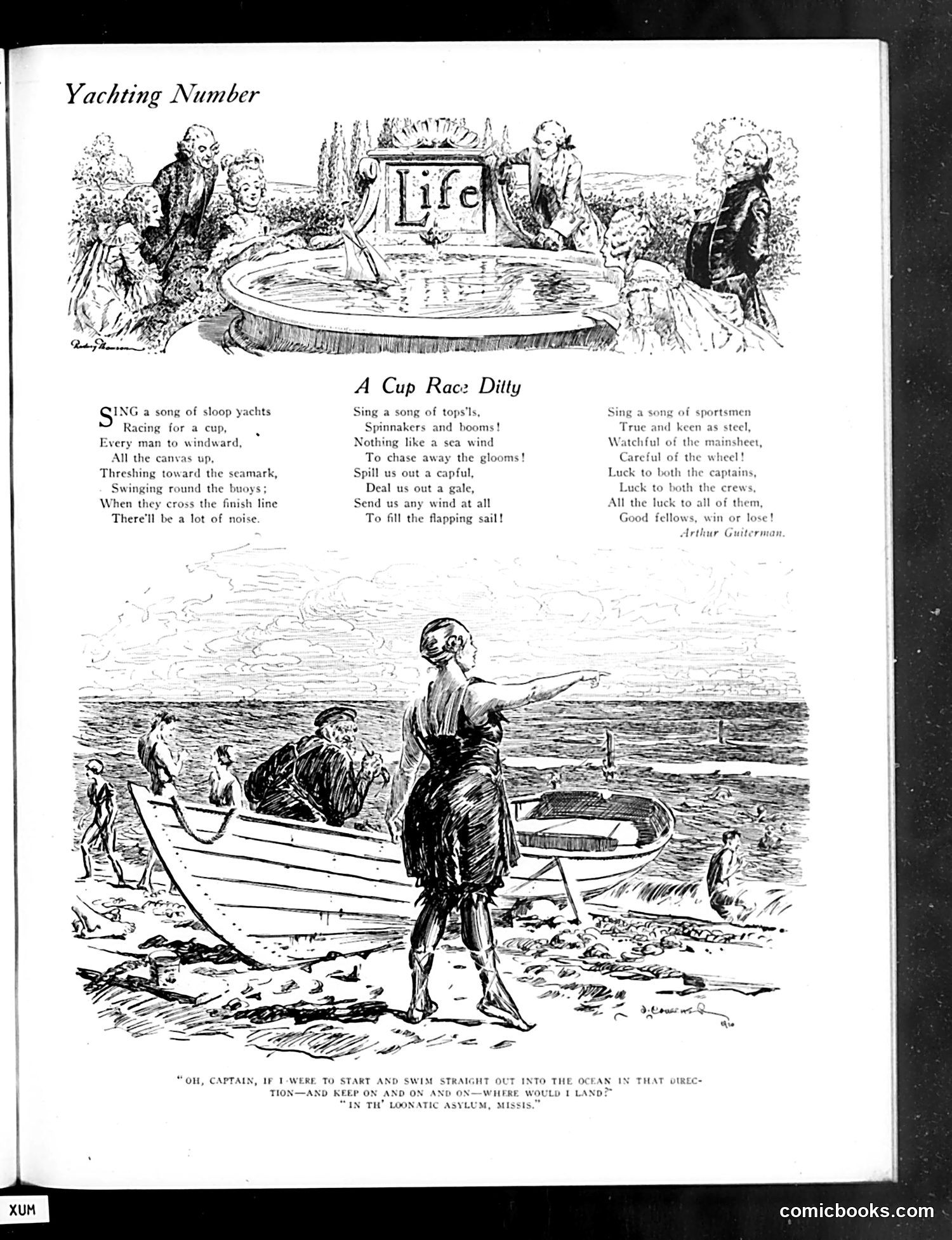
This page features a poem by Arthur Guiterman celebrating yacht racing, with an accompanying illustration. The poem celebrates competitive sailing—"sloop yachts / Racing for a cup"—praising the sport's thrills and the skill of sailors and captains. The lower illustration shows a beached rowboat with a standing figure pointing seaward, captioned with a quote from "In th' Lunatic Asylum, Mississippi": "Oh, Captain, if I were to start and swim straight out into the ocean in that direction—and keep on and on and on—where would I land?" The joke contrasts the genteel sport of cup racing above with this asylum patient's absurd geographical question, satirizing either mental illness or profound ignorance about world geography. The humor relies on the patient's inability to understand basic directions or ocean navigation.
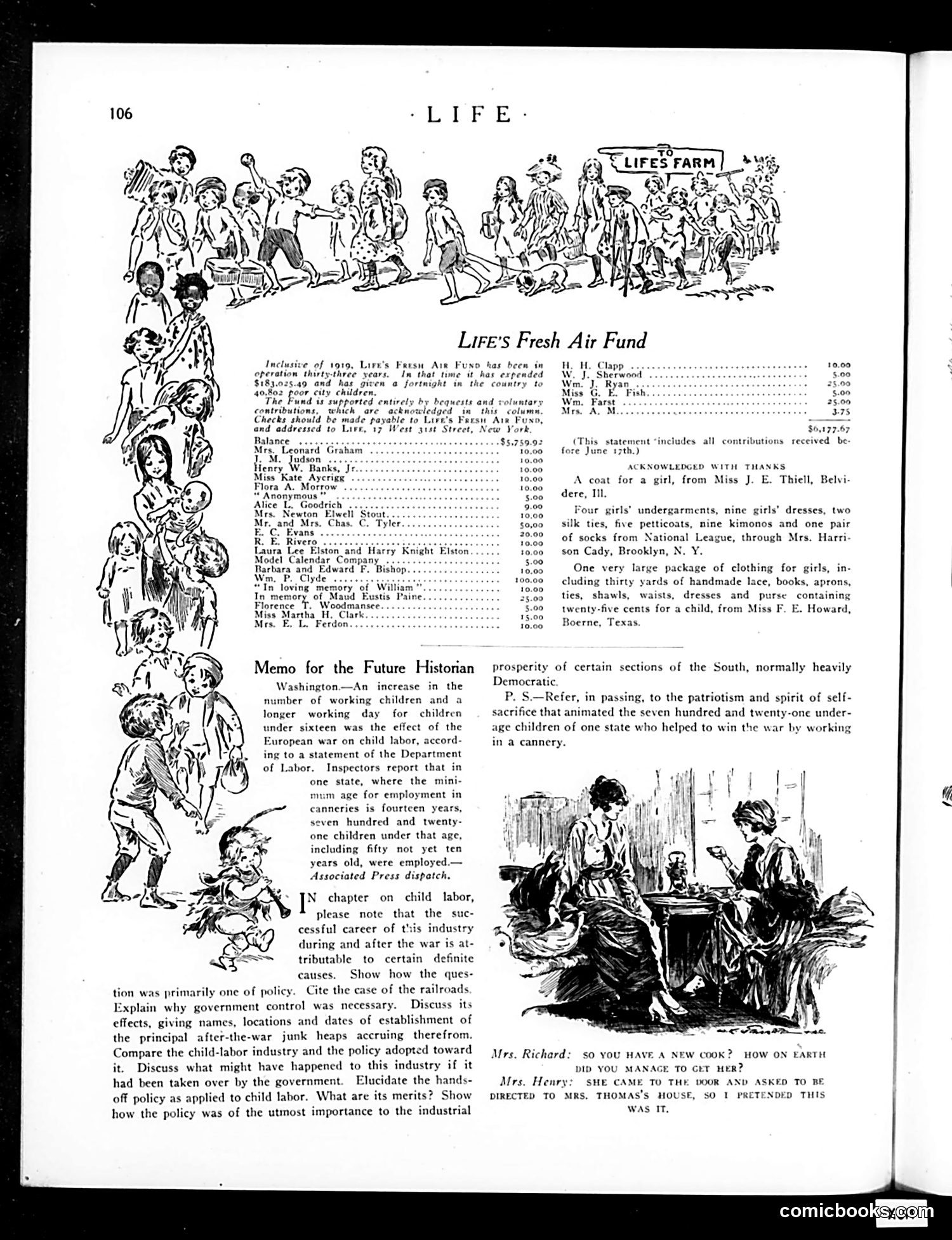
This page combines charity fundraising with social commentary on child labor. The left side features an illustrated column of children of various ages and conditions, titled "LIFE's Fresh Air Fund"—a real charitable program providing outdoor relief to urban children. The list shows monetary donations from readers supporting this cause. The right side includes a "Memo for the Historian" discussing increased child labor during World War I, citing Department of Labor statistics about working children under sixteen. An illustration below shows two women discussing a domestic servant situation with dark humor about hiring difficulties. The overall message connects Depression-era poverty and wartime labor exploitation, using visual and textual contrast to advocate for child welfare protection and highlight social responsibility.
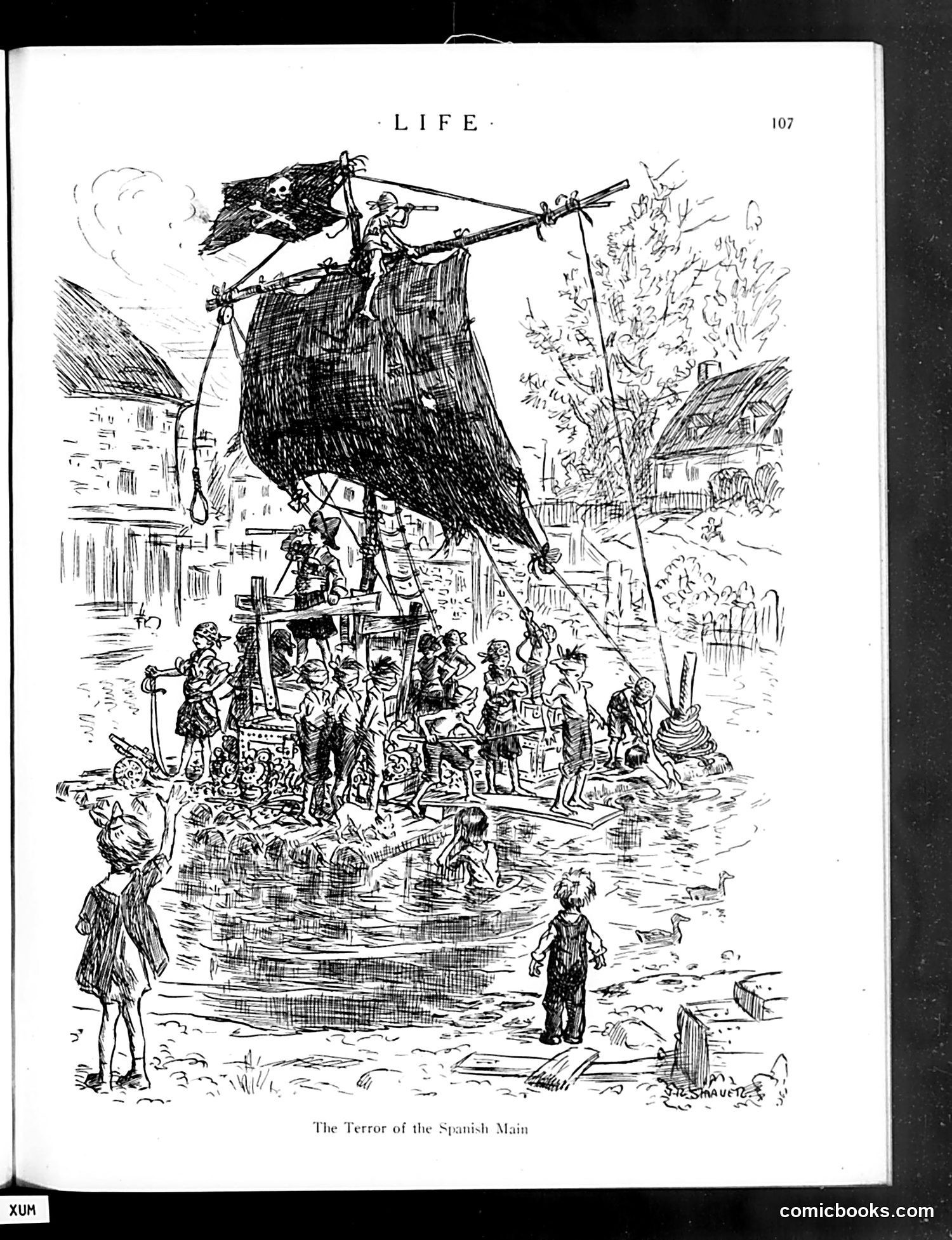
This satirical illustration depicts what appears to be a political allegory using maritime piracy imagery. A large, menacing figure operates a grotesque puppet-like contraption from an elevated platform, controlling smaller figures below—likely representing political manipulation or authoritarian control. The "Spanish Main" reference suggests colonial-era piracy, but this is being used metaphorically for contemporary politics. The cartoon critiques someone wielding disproportionate power over a population shown as helpless or controlled. Children observe from the periphery, suggesting concerns about how such power affects society's future. The architectural setting indicates this occurs within civilization, not lawlessness—implying the "terror" operates within the political system itself. Without a visible date or artist attribution in the OCR text, the specific political target remains unclear.
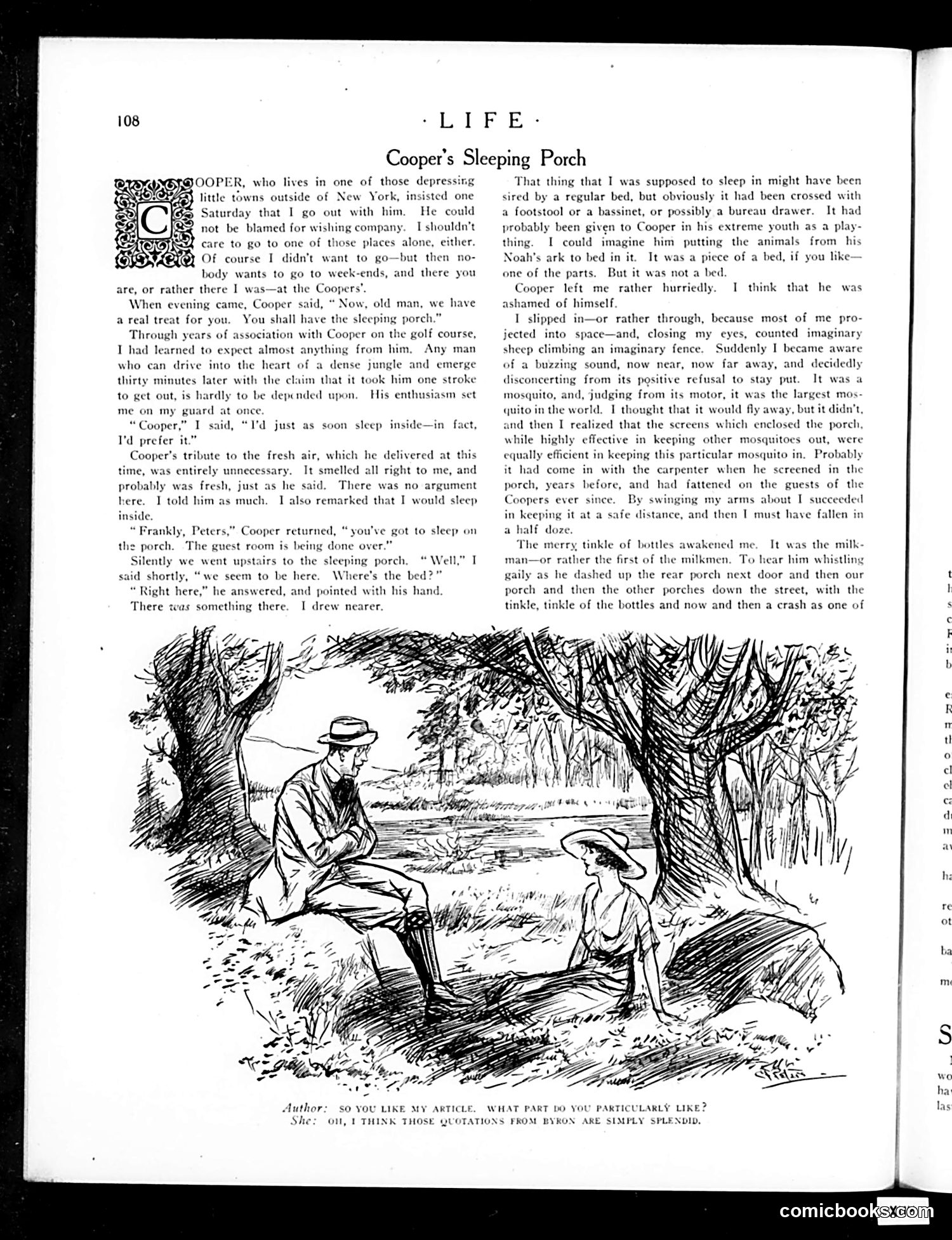
This page satirizes a common early-20th-century domestic dispute. The narrator visits his friend Cooper, who insists he sleep on the home's "sleeping porch"—an outdoor sleeping platform popular for health reasons during this era. The narrator humorously catalogs his miserable night: troubled by a strange bed, mosquitoes (the largest he's ever seen), and a milkman's early-morning delivery that crashes bottles down the street. The satire targets the fashion for sleeping porches as a health trend, mocking both Cooper's enthusiastic embrace of this supposedly beneficial practice and the narrator's reluctant compliance. The cartoon illustrates Cooper persuading the skeptical narrator to try this uncomfortable "fresh air" remedy, poking fun at wellness fads and their social pressure.
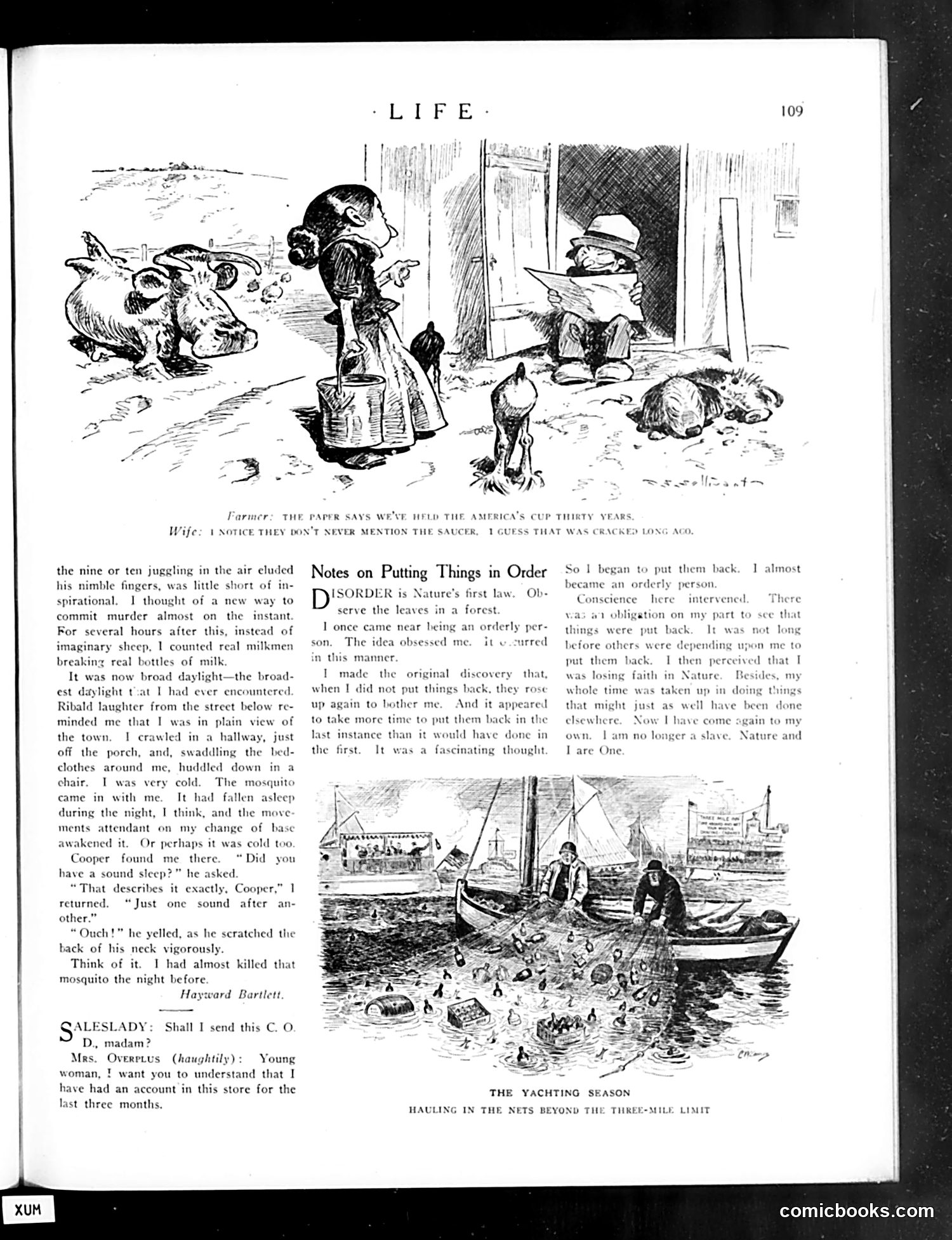
**Top Cartoon:** A domestic scene showing a farmer and wife discussing America's Cup yacht racing. The farmer says the papers claim the Cup was "held the America's cup thirsty years," while the wife responds that they never mention "the saucer," joking it was "cracked long ago." **The Joke:** This is wordplay satirizing press coverage of yacht racing—a wealthy sport. While newspapers celebrated America's Cup victories, the cartoonist mocks this as frivolous coverage, implying the public cares more about practical household matters (a broken saucer) than elite sporting achievements. **Bottom Illustration:** "The Yachting Season—Hauling in the Nets Beyond the Three-Mile Limit" depicts fishing boats, likely satirizing either illegal fishing operations or the contrast between wealthy yacht racing and working-class fishing.
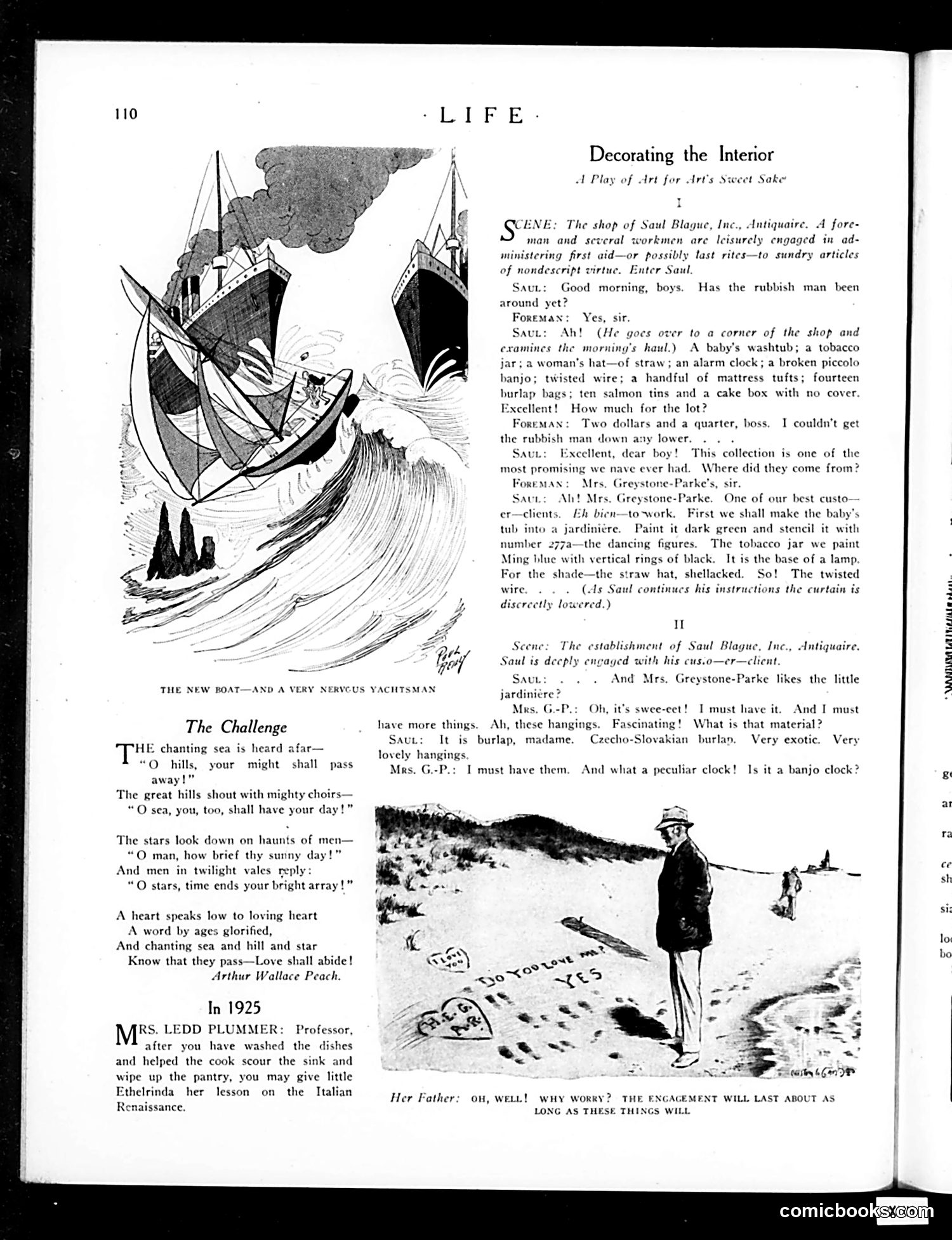
This page presents a comedic one-act play about an antique shop owner named Saul Blague negotiating with a foreman over items for sale. The humor centers on the foreman's wife, Mrs. Greystone-Parke, a wealthy client interested in purchasing decorative pieces—including a baby's milk jug, dancing figures, a tobacco jar, and a clock—described as "Czechoslovakian barlar" (likely "barrel"). The satire mocks wealthy collectors' pretentious fascination with exotic or antique items and the obsequious shopkeeper's flattery. The accompanying illustration shows a man in a coat standing on a beach, labeled "Her Father," with a caption suggesting anxiety about an engagement lasting "as long as these things will." The page also includes "The Challenge," a poem by Arthur Wallace Peach about human perseverance.
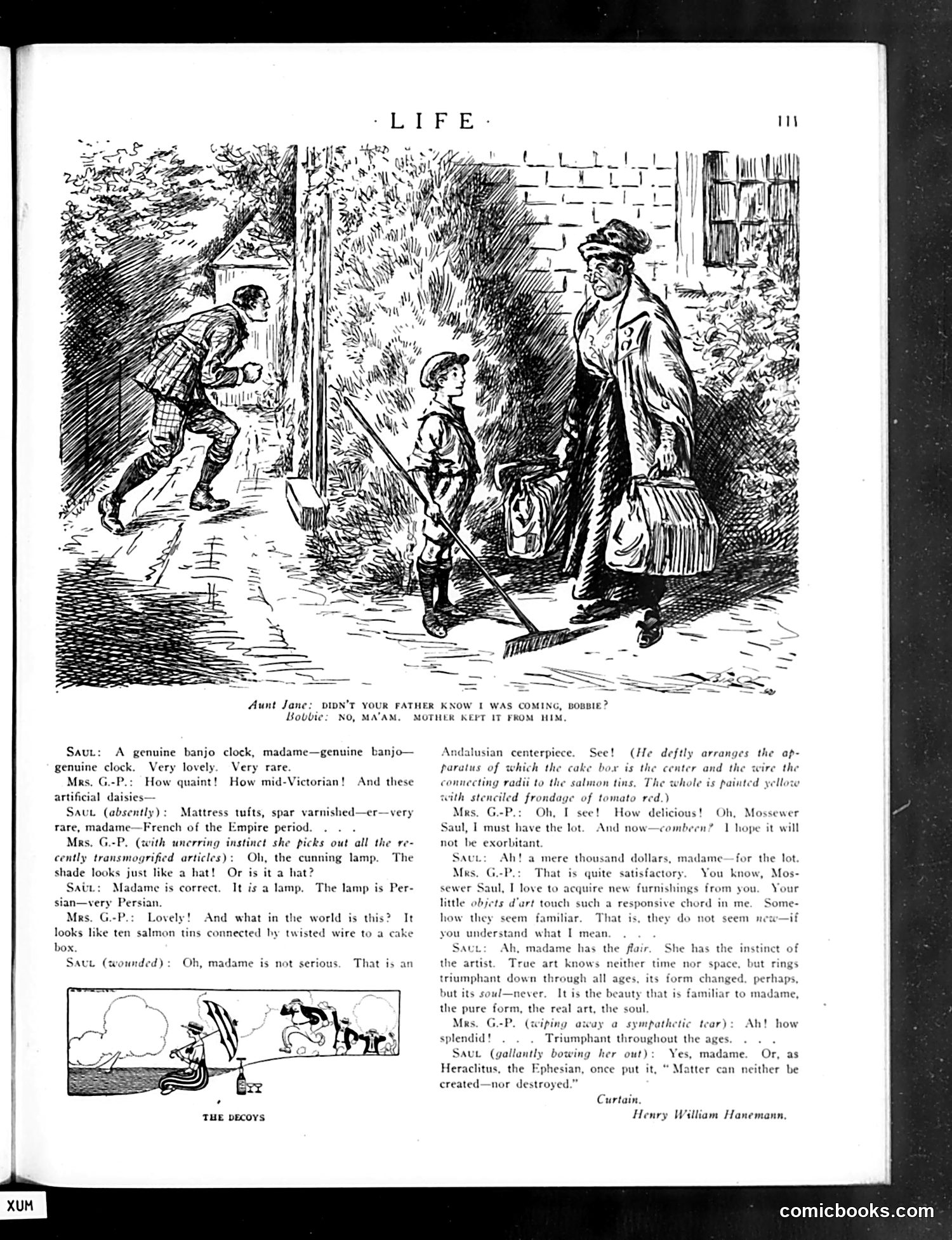
This page contains a humorous sketch and dialogue titled "Aunt Jane" about domestic servants and their employers. The main cartoon depicts an adult woman (presumably "Aunt Jane") encountering a young boy ("Bobbie") and an older man in an alley or courtyard setting. The joke centers on class distinctions and deception: Aunt Jane asks if Bobbie's father knows she's coming, implying she's arriving unannounced. Bobbie claims his mother kept her arrival secret from his father—suggesting the father might disapprove of harboring a relative or that there are domestic tensions the child is concealing. The accompanying dialogue features characters named Saul and Mrs. G-P discussing decorative objects (a banjo clock, salmon-wire designs), likely mocking Victorian-era decorative taste and social pretension among the middle class. The piece satirizes both domestic hierarchy and period aesthetics.
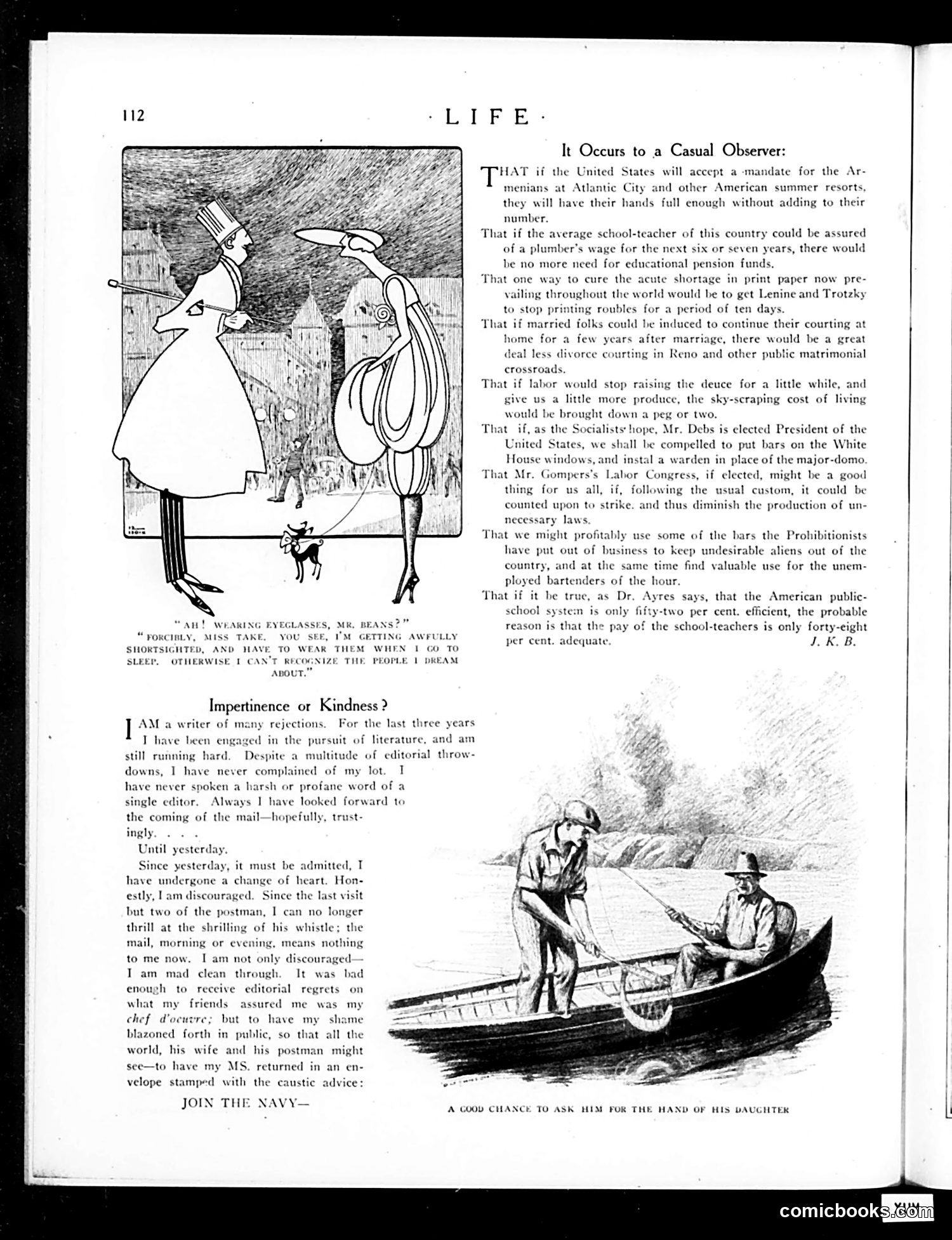
The top cartoon depicts a woman in eyeglasses speaking to a man on a motorcycle. The woman says she's wearing eyeglasses and takes them off to sleep—otherwise she can't recognize people in her dreams. This is a gentle joke about the absurdity of needing corrective lenses even in dreams, mocking the woman's vanity or dependency on her glasses. Below is an article titled "Impertinence or Kindness?" where a writer laments receiving editorial rejection letters after three years pursuing literature. The tone shifts from discouragement to indignation when his manuscript was returned with a stranger's insulting comments visible on the envelope. He ends with dark humor: "JOIN THE NAVY—" implying escape from this humiliation. The accompanying illustration shows two men in a small boat, captioned "A Good Chance to Ask Him for the Hand of His Daughter," though its connection to the text is unclear.
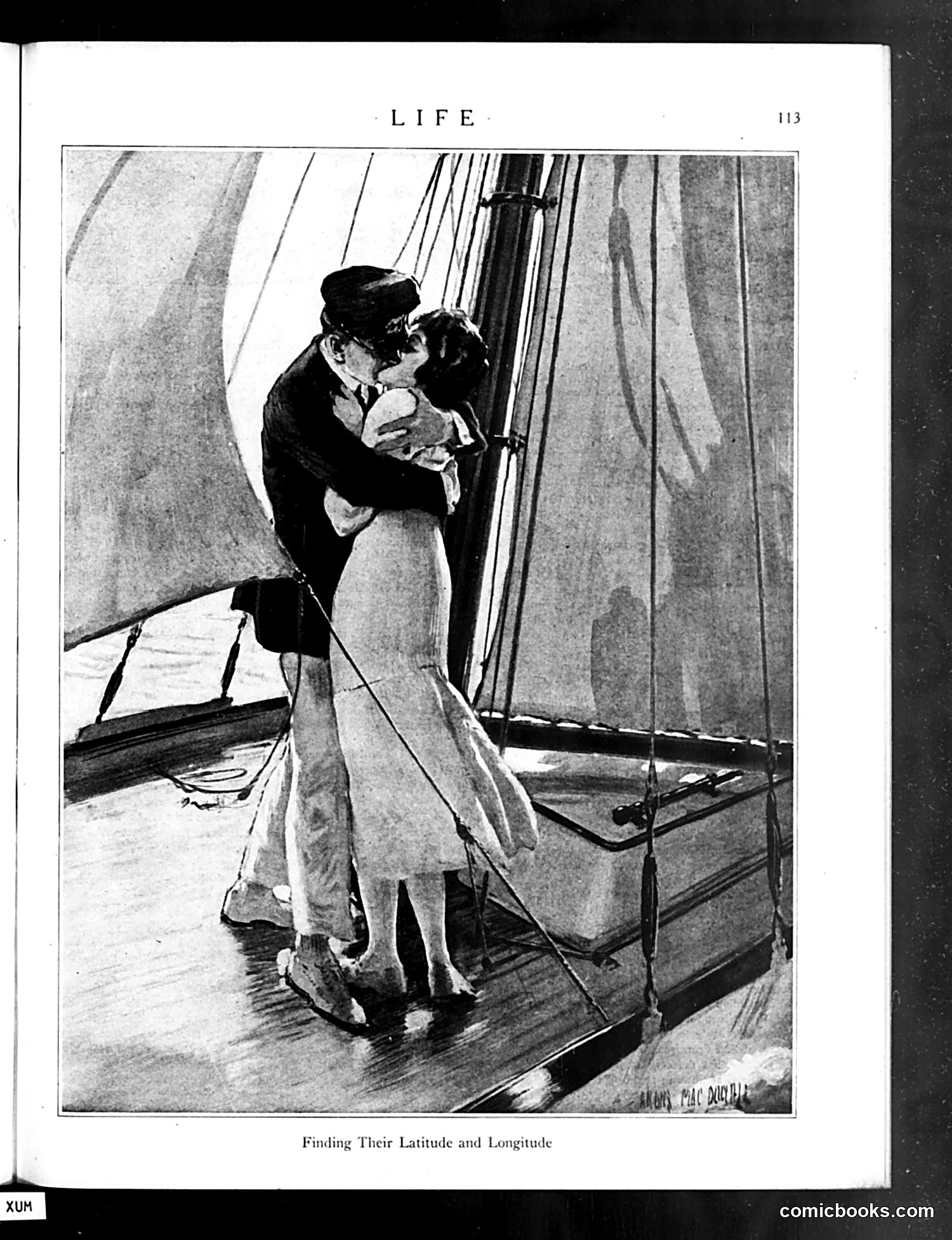
This appears to be a romantic illustration rather than political satire. The image shows a couple embracing aboard a ship, with sails and rigging visible in the background. The caption "Finding Their Latitude and Longitude" is a double entendre—a playful pun mixing nautical navigation terminology with romantic/intimate discovery. The joke relies on the metaphorical language: just as sailors use latitude and longitude to locate their position at sea, the couple is "finding" their emotional or romantic bearings with each other. This type of wordplay-based humor was common in *Life* magazine's lighter content. The shipboard setting reinforces the nautical pun, making this a straightforward romantic jest rather than political commentary.
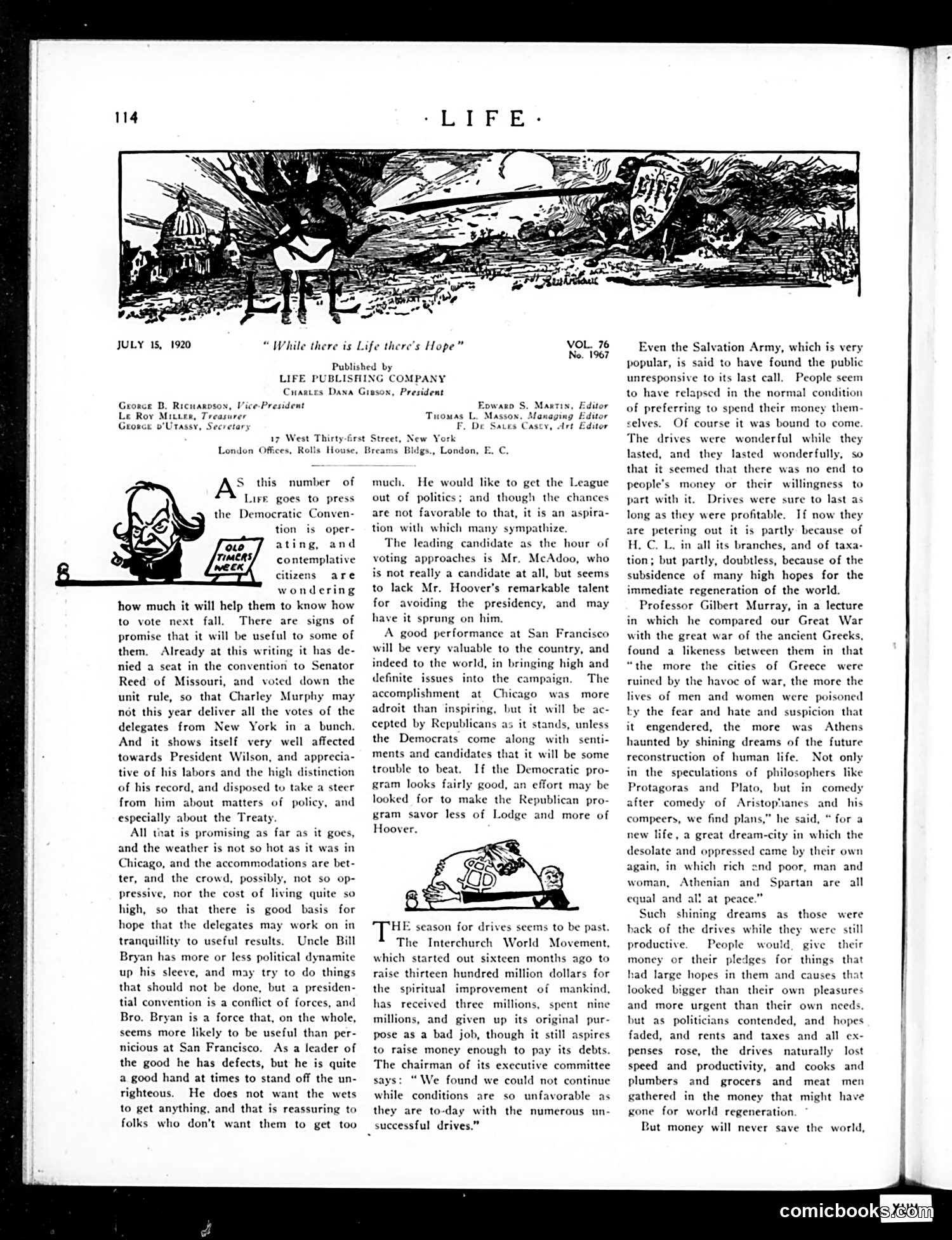
This page contains editorial commentary on the 1920 Democratic National Convention (occurring in San Francisco). The caricatured figure labeled "OLD GUARD" appears to represent establishment Democratic opposition to progressive reform. **Key references:** - **William Jennings Bryan**: discussed as a political force with "dynamite up his sleeve," capable of blocking "wets" (pro-alcohol interests) - **McAdoo**: the leading presidential candidate, described as reluctant but likely to win the nomination - **The League of Nations**: a divisive convention issue related to President Wilson's treaty **The satire's point:** The editors express cautious hope that the convention will produce meaningful debate on substantive issues (the League, Prohibition) rather than repeat Chicago's mere procedural maneuvering. They're skeptical but hopeful—hence the masthead quote, "While there is Life there's Hope." A secondary piece mocks failed charitable fundraising drives, noting Americans prefer keeping their own money.
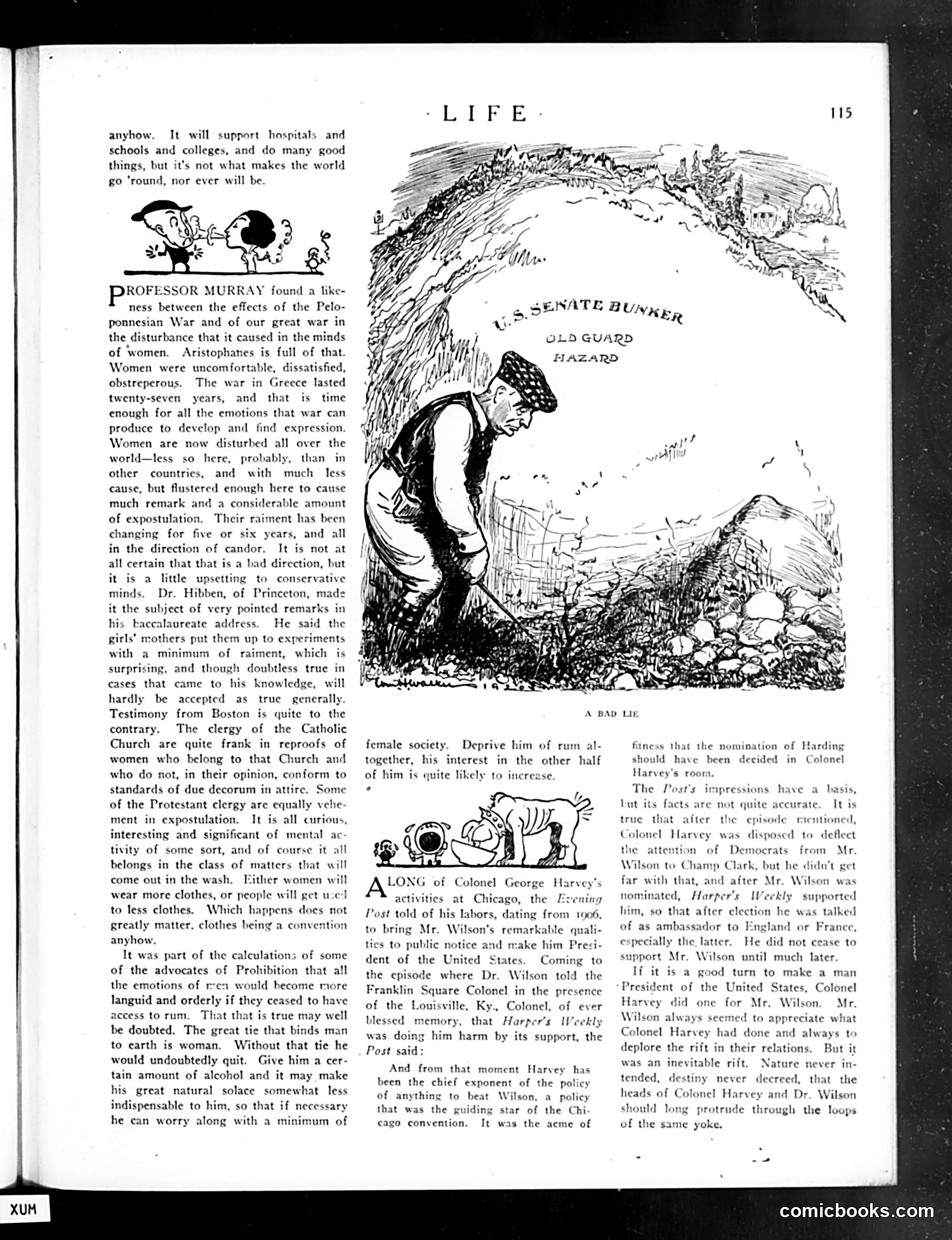
This page satirizes misleading claims about Colonel George Harvey's political influence. The text disputes a *Post* article claiming Harvey orchestrated Warren G. Harding's nomination in his room at the 1920 Chicago convention. Life's editors assert this is exaggerated: Harvey did promote Wilson early (since 1906) but didn't control outcomes. When Wilson later rejected Harvey's support, Harvey backed the "anything to beat Wilson" policy—but Life argues this didn't guarantee Harding's nomination. The cartoon labeled "A Bad Lie" shows a disheveled soldier at a military bunker, likely representing the dubious claim itself as a false narrative. The broader context reflects post-WWI American politics: the 1920 Republican convention's selection of Harding, the complex relationships between newspapers/influential figures and presidential politics, and Life's role as a satirical arbiter of political truth-telling.
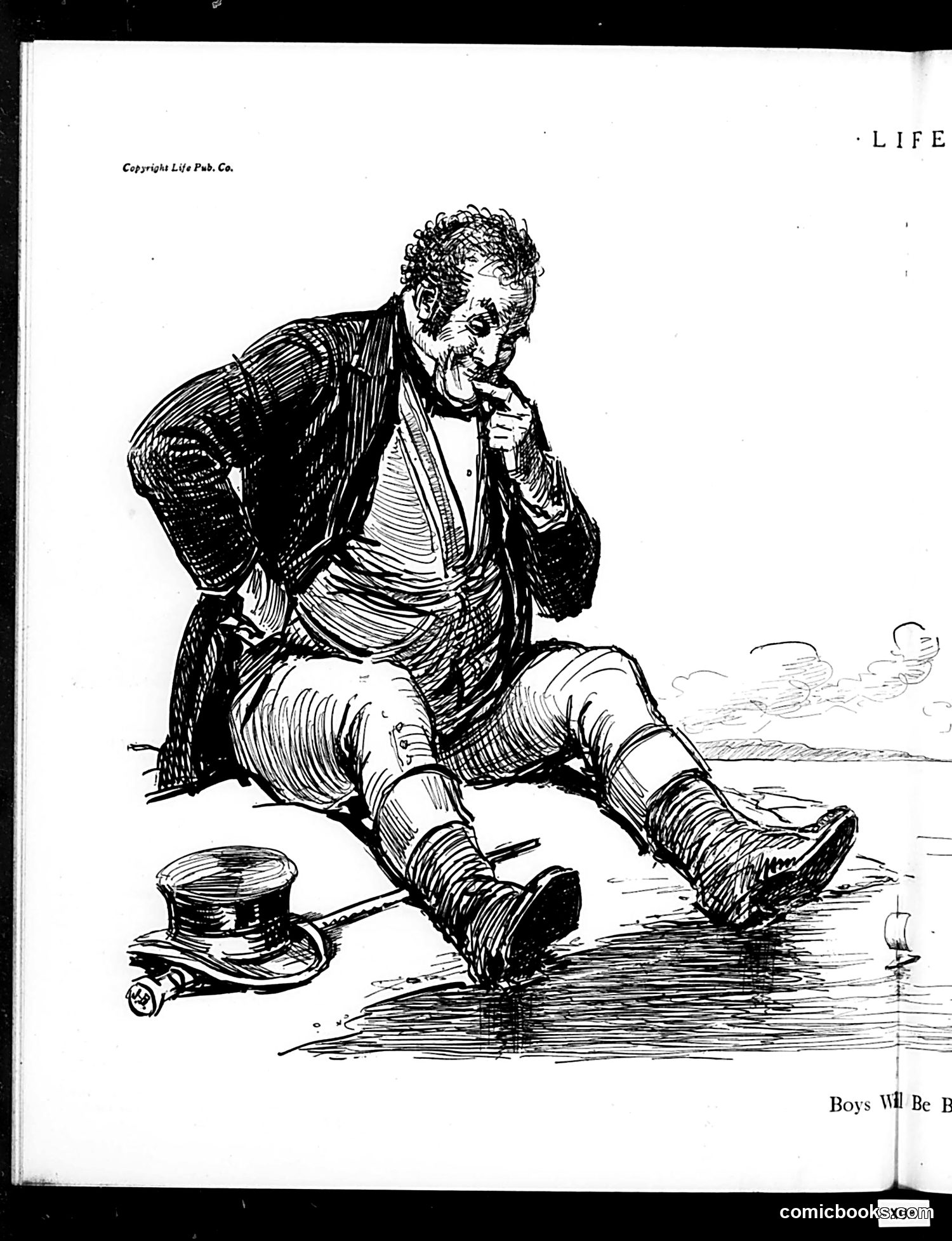
This appears to be a satirical cartoon from *Life* magazine showing a well-dressed man sitting in water, smoking a pipe, with a top hat beside him. The caption reads "Boys Wil Be B[oys]" (text cut off). The image satirizes aristocratic or upper-class pretension—a man maintaining dignity and composure despite being soaked and sitting in water, suggesting the humor of someone refusing to acknowledge an undignified situation. The formal attire contrasts absurdly with the wet circumstances. Without the complete caption or publication date visible, the specific political or social target remains unclear, though the style suggests early 20th-century satire of class attitudes or male vanity. The "boys will be boys" phrase typically excuses youthful misbehavior, making this likely mockery of adult male foolishness disguised as inevitable boyish conduct.
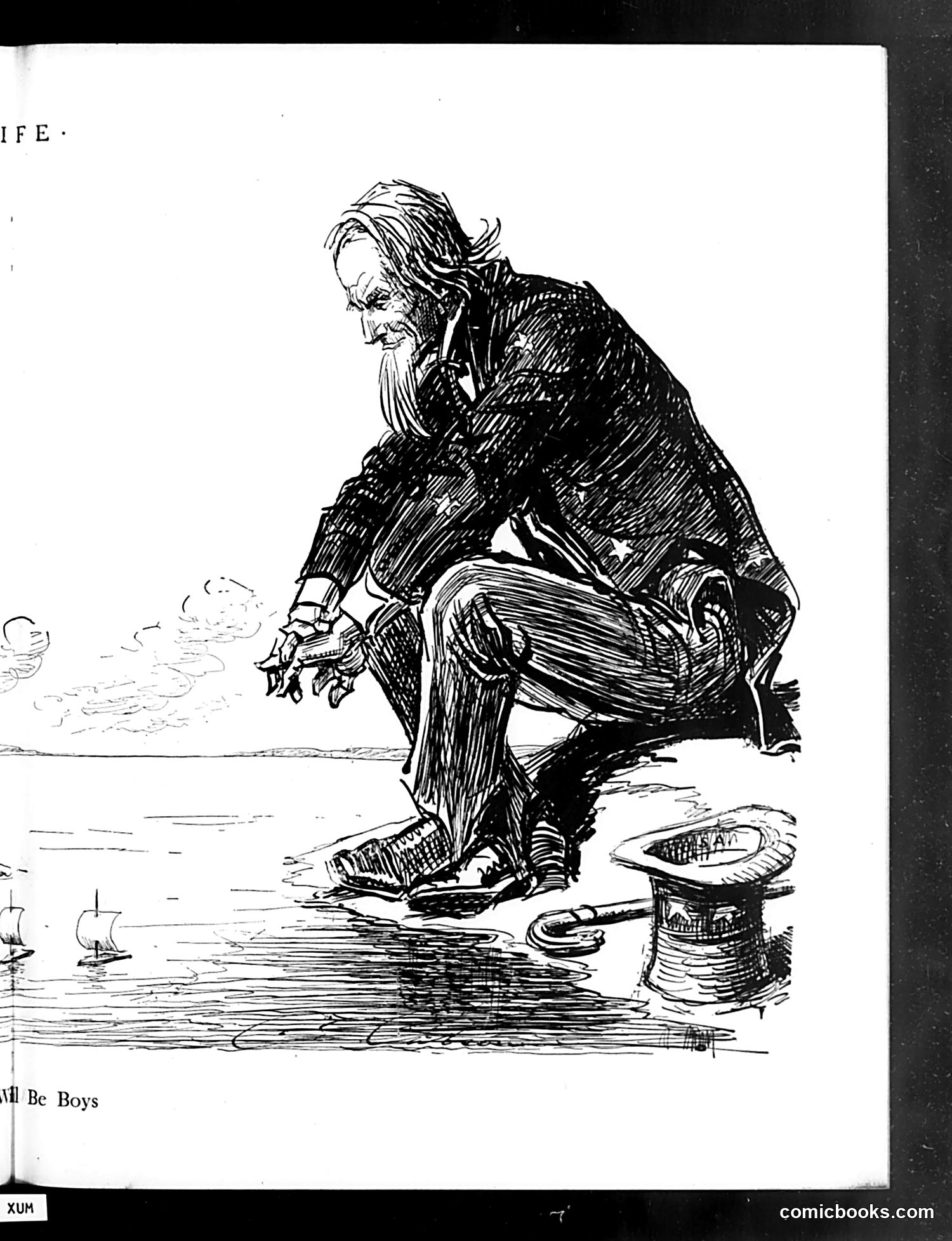
This page shows a political cartoon titled "Will Be Boys," depicting a thin, elderly man with exaggerated features crouching by the water's edge. He appears to be playing with toy boats—suggesting childish behavior from someone who should know better. The figure's gaunt appearance, long hair, and formal 19th-century dress suggest a specific public figure, likely a political leader or notable person of the era. The satire critiques this person for engaging in frivolous or irresponsible activities—"boys will be boys"—implying they're behaving immaturely despite their position or age. Without clearer identification markers or dates visible, I cannot definitively name the target, but the cartoon mocks someone's undignified or foolish conduct through this unflattering caricature.
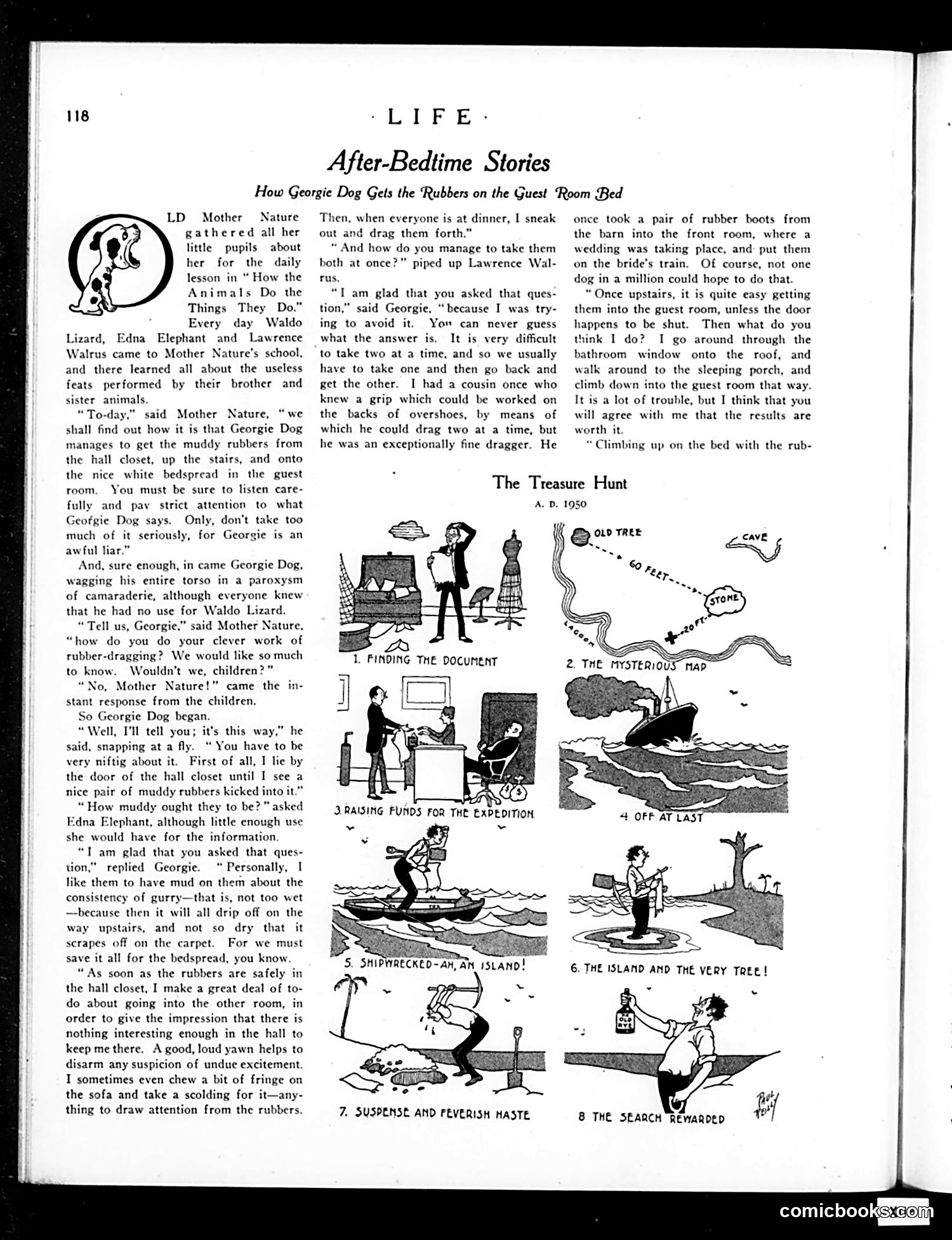
This is a humorous children's story from *Life* magazine presented as an "After-Bedtime Story." The content satirizes both dog behavior and the format of instructional animal tales. **The Main Joke:** A dog named Georgie explains to Mother Nature's animal pupils exactly how he deliberately drags muddy rubber boots from the hallway, up the stairs, and onto the guest room bed—a common household nuisance. The dog's elaborate, detailed account of his mischievous scheme is absurdly methodical, including tactics like fake yawning to avoid suspicion and even climbing through bathroom windows to access the guest room. **The Satire:** The piece mocks both the earnest tone of educational animal stories (like Rudyard Kipling's *Just So Stories*) and the dog's brazen, self-aware deception. Georgie isn't accidentally making a mess—he's strategically engineering one. The other animals' unenthusiastic responses ("No, Mother Nature!" when asked if they want to hear this) add to the comedy. The accompanying comic strip "The Treasure Hunt" depicts a separate children's adventure narrative, unrelated to the main story.
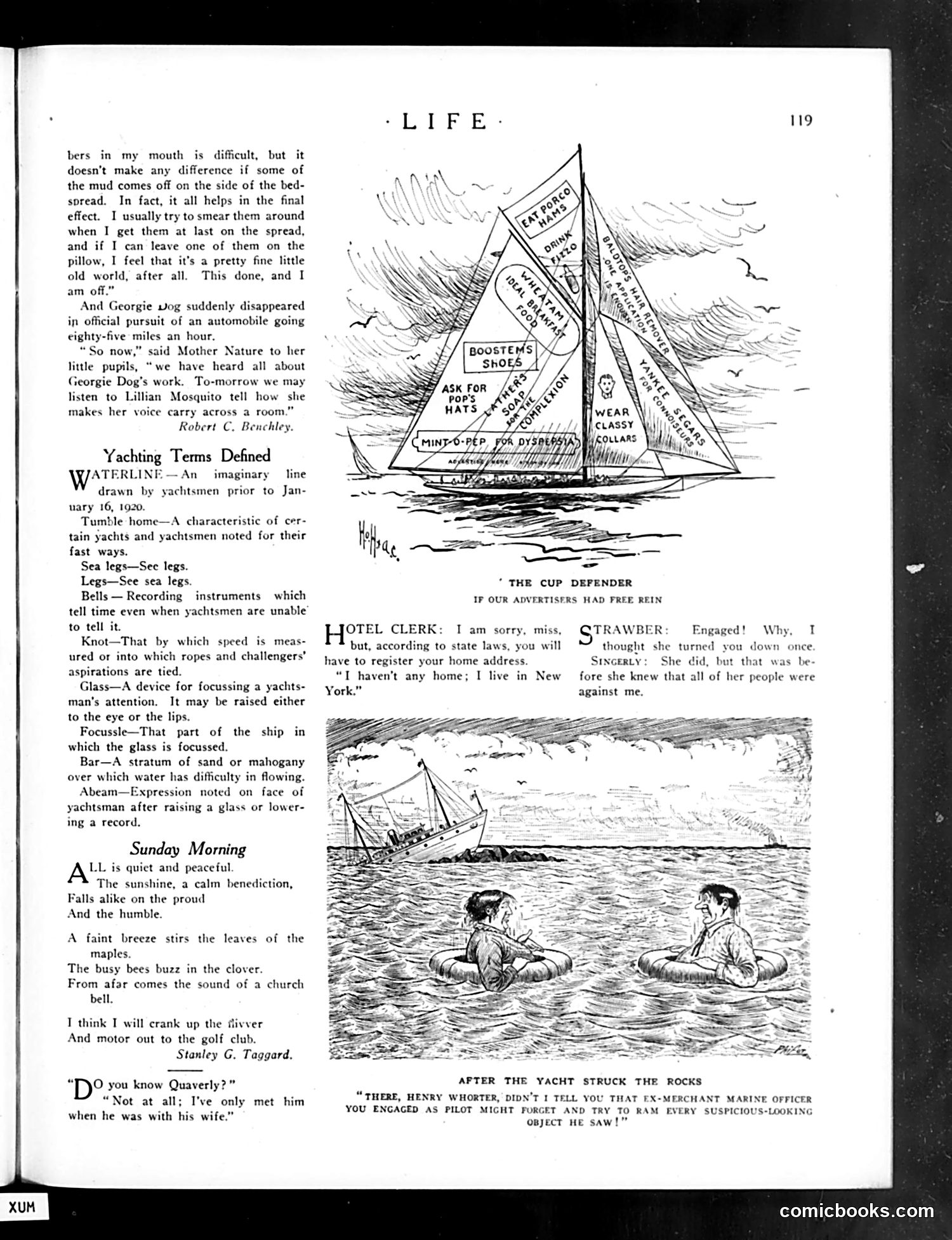
This page contains multiple satirical pieces typical of Life's humor: **"The Cup Defender" cartoon** shows a yacht laden with absurdly labeled sections ("Boosters' Shoes," "Dress Shirts," "Mint-O-Pep for Dyspepsia," etc.), satirizing how advertisers would outfit luxury vessels if given free rein. It mocks commercialism's encroachment into every aspect of life. **"Yachting Terms Defined"** humorously redefines nautical terminology—"Waterline" becomes an imaginary line drawn before January 16, 1920 (likely referencing Prohibition's start), "Glass" is a device for focusing a yachtsman's attention (implying drinking), and "Tumble home" refers to yachts and yachtsmen's "fast ways." The satire targets wealthy yacht club culture and moral looseness. **"After the Yacht Struck the Rocks"** depicts two swimmers discussing an ex-merchant marine pilot hired as captain, with his wife's jealousy implied as the real danger—satirizing spousal suspicion and incompetent hiring practices. The pieces collectively mock upper-class leisure pursuits, commercialism, and social pretension.
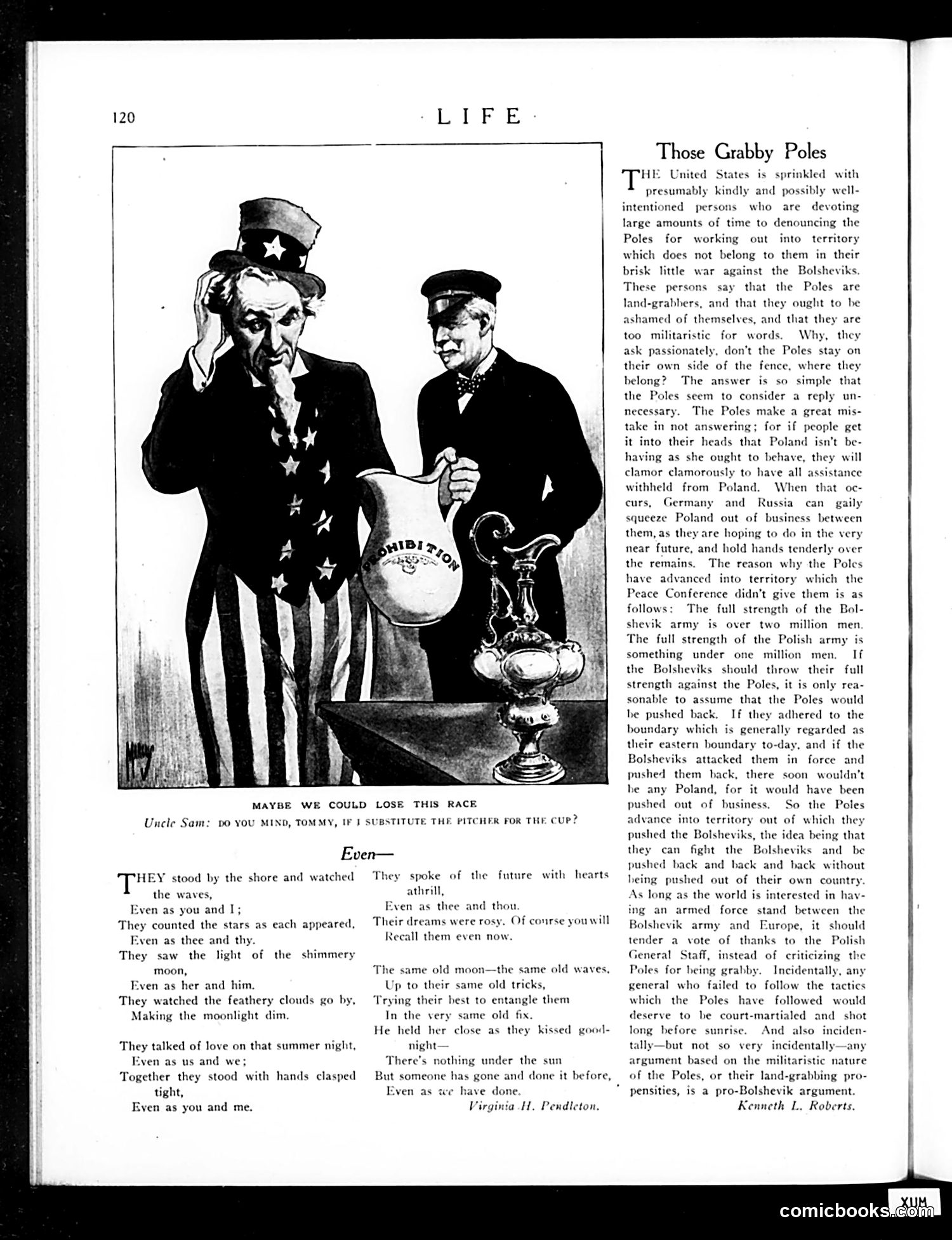
**The Cartoon:** The image shows Uncle Sam (identified by his starred top hat) offering to substitute a baseball pitcher for a cup in a game, speaking to someone labeled "Tommy." This is satirical commentary on American criticism of Poland's territorial ambitions. **The Context:** The accompanying article "Those Grabby Poles" defends Poland's 1919-1920 military expansion eastward against Bolshevik Russia. American critics claimed Poland was aggressively "land-grabbing" and militaristic. **The Satire:** The article argues these critics are naive: Poland faces a Bolshevik army of 2+ million versus Poland's ~1 million troops. By advancing into conquered territory, Poland creates a buffer zone to avoid being pushed back into extinction. The cartoon suggests Americans criticizing Poland are foolishly handicapping an ally against communist expansion. **The Point:** The satire mocks Americans who, from safety, moralize about Poland's military strategy while ignoring that Poland fights for survival against a vastly larger enemy threatening European stability.
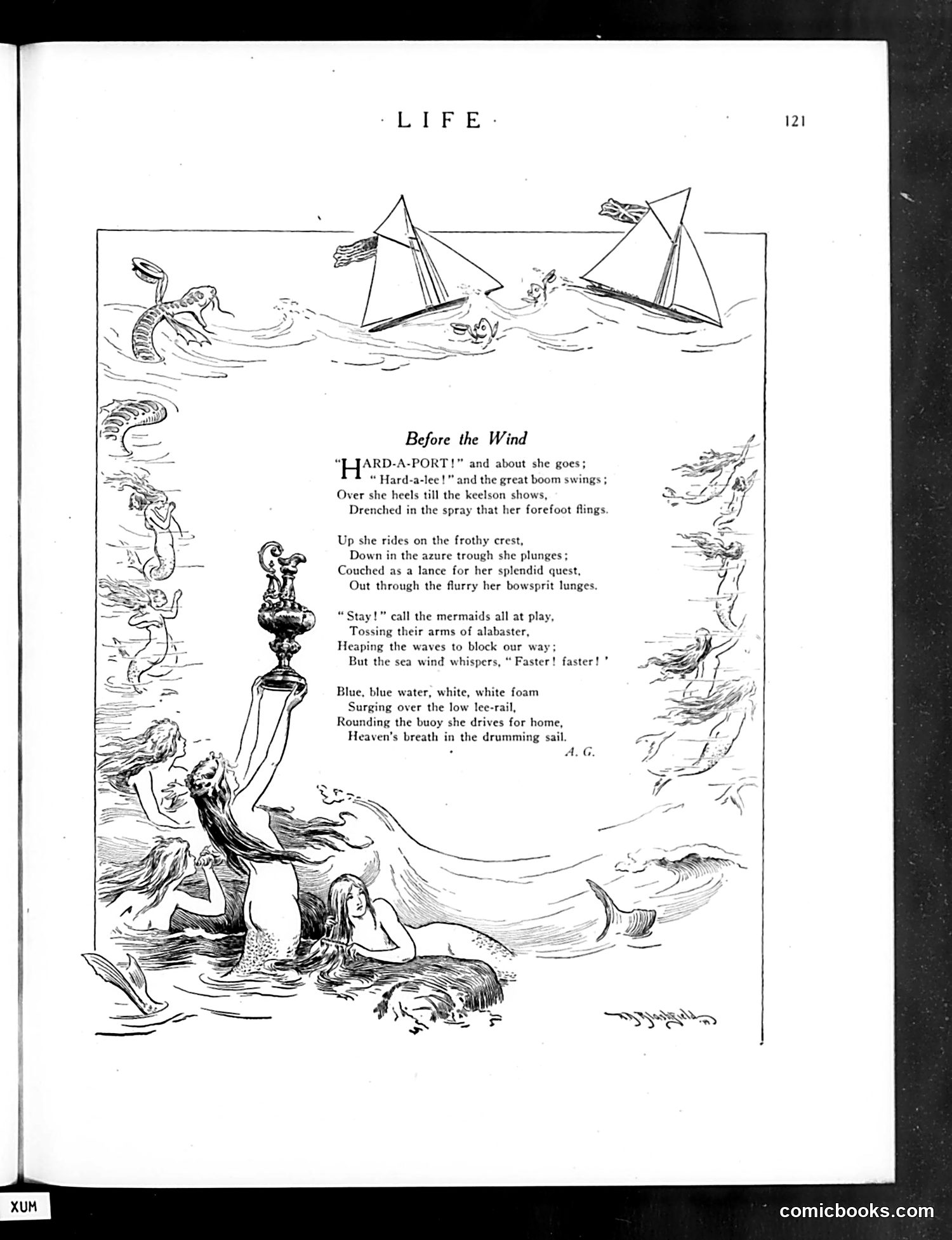
This is a romantic nautical poem illustrated with whimsical maritime imagery rather than political satire. The page depicts a sailing ship in stormy seas, accompanied by decorative illustrations of mermaids and sea creatures framing the text. The poem celebrates seafaring adventure, personifying the ship as a vessel driven homeward by wind and determination. Mermaids attempt to impede the journey ("block our way"), but the ship persists, driven by "Heaven's breath in the drumming sail." The artwork's classical style—with mermaids, mythological sea creatures, and ornamental borders—creates a fantastical tone appropriate to the romantic, adventure-themed verse. This appears to be literary content showcasing artistic illustration rather than satirical commentary. The signature "A.G." identifies the illustrator, though their full name isn't clear from this page alone.
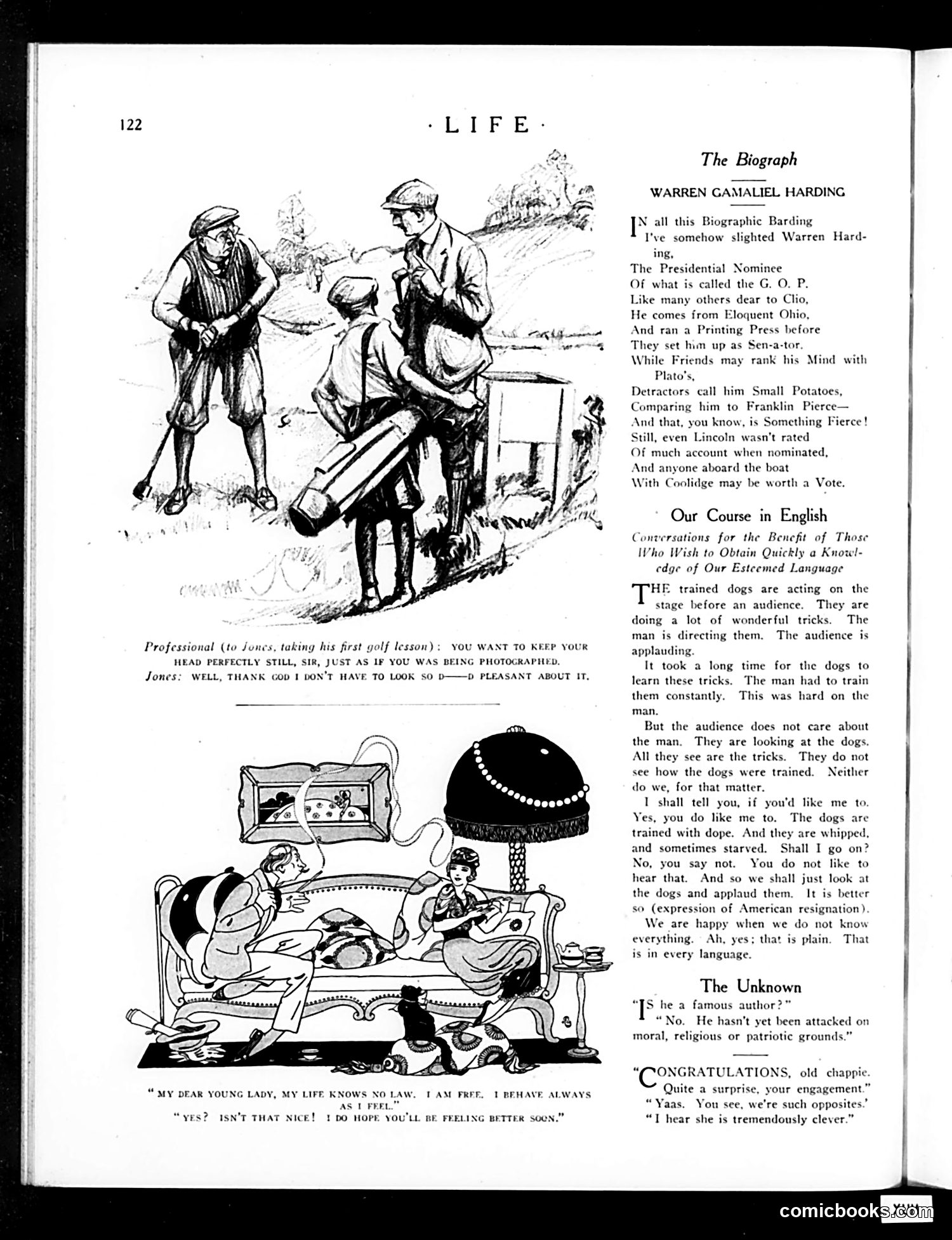
This page from *Life* magazine contains political and social satire typical of the era. **Top cartoon**: A golf lesson joke mocking formal photography—the instructor compares holding still for a golf swing to posing for a photograph, and Jones replies he's grateful not to have to look "pleasant" doing it. This satirizes the stiffness of early photography. **"The Biograph"**: A biographical poem about Warren G. Harding, the 1920 Republican ("G.O.P.") presidential nominee from Ohio. The verse mockingly acknowledges detractors call him "Small Potatoes" and compare him unfavorably to Franklin Pierce, yet notes even Lincoln wasn't highly regarded when nominated. The closing line suggests voting for him because he's running with Calvin Coolidge—faint praise. **"Our Course in English"**: Cynical commentary on trained performing dogs. It reveals the cruel training methods (doping, whipping, starvation) hidden from audiences who only see the tricks. The piece satirizes willful ignorance and American complacency—we prefer not knowing uncomfortable truths. **"The Unknown"**: A quip that a person hasn't achieved fame until attacked on moral, religious, or patriotic grounds.
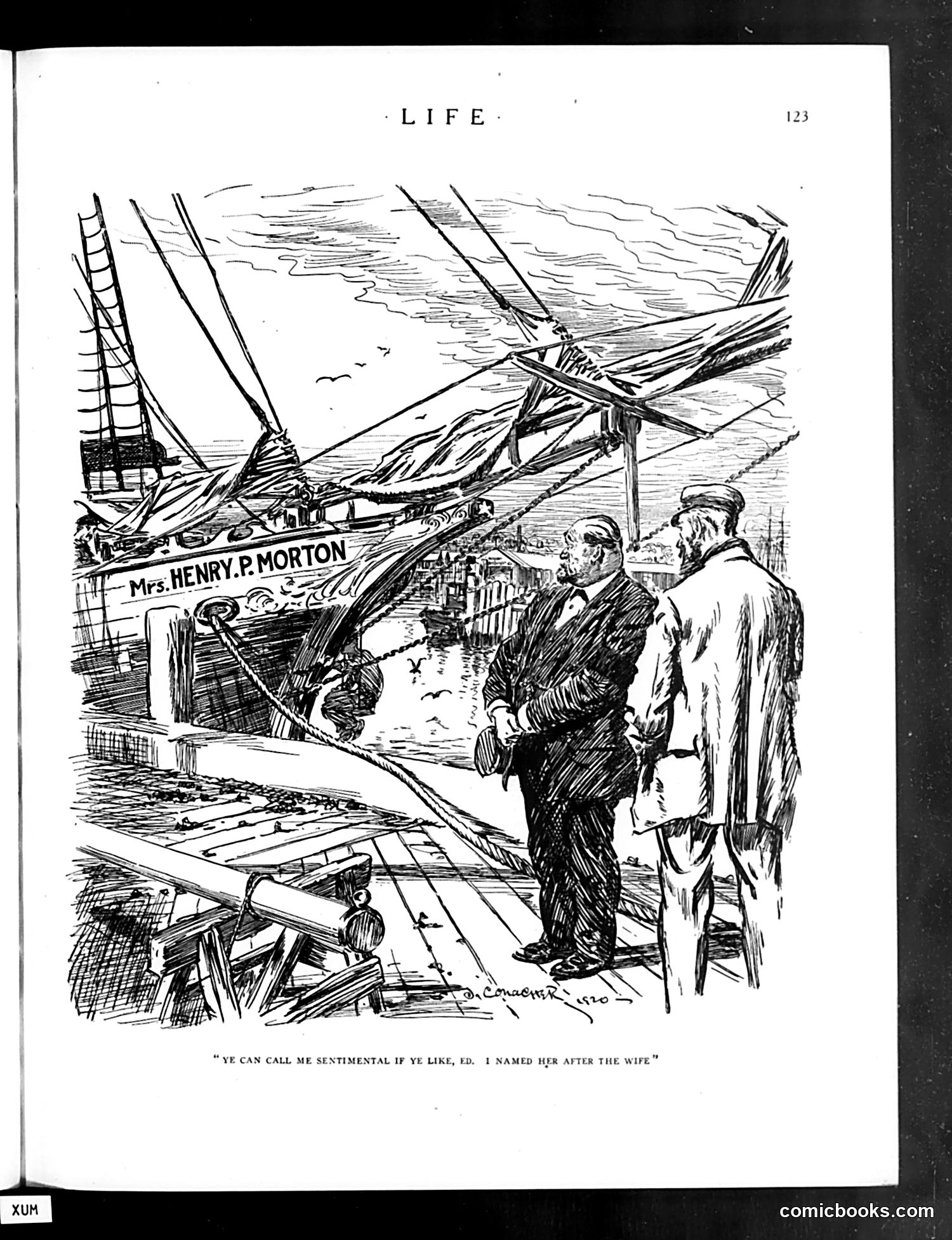
This is a single-panel cartoon depicting a harbor scene with sailing ships. Two men stand examining a vessel named "Mrs. Henry P. Morton." One man addresses the other (apparently named "Ed"), explaining sentimentally that he named the ship after his wife. The humor is straightforward domestic comedy: the man is defending a seemingly romantic gesture—naming a ship after his spouse—while his tone and the casual maritime setting suggest working-class practicality rather than genuine sentimentality. The joke plays on the contrast between what might seem like a touching romantic act and the matter-of-fact way he presents it, implying this is simply what one does rather than any grand gesture of love. The cartoon's artist signature appears dated around 1920, and the setting and clothing suggest early 20th-century America.
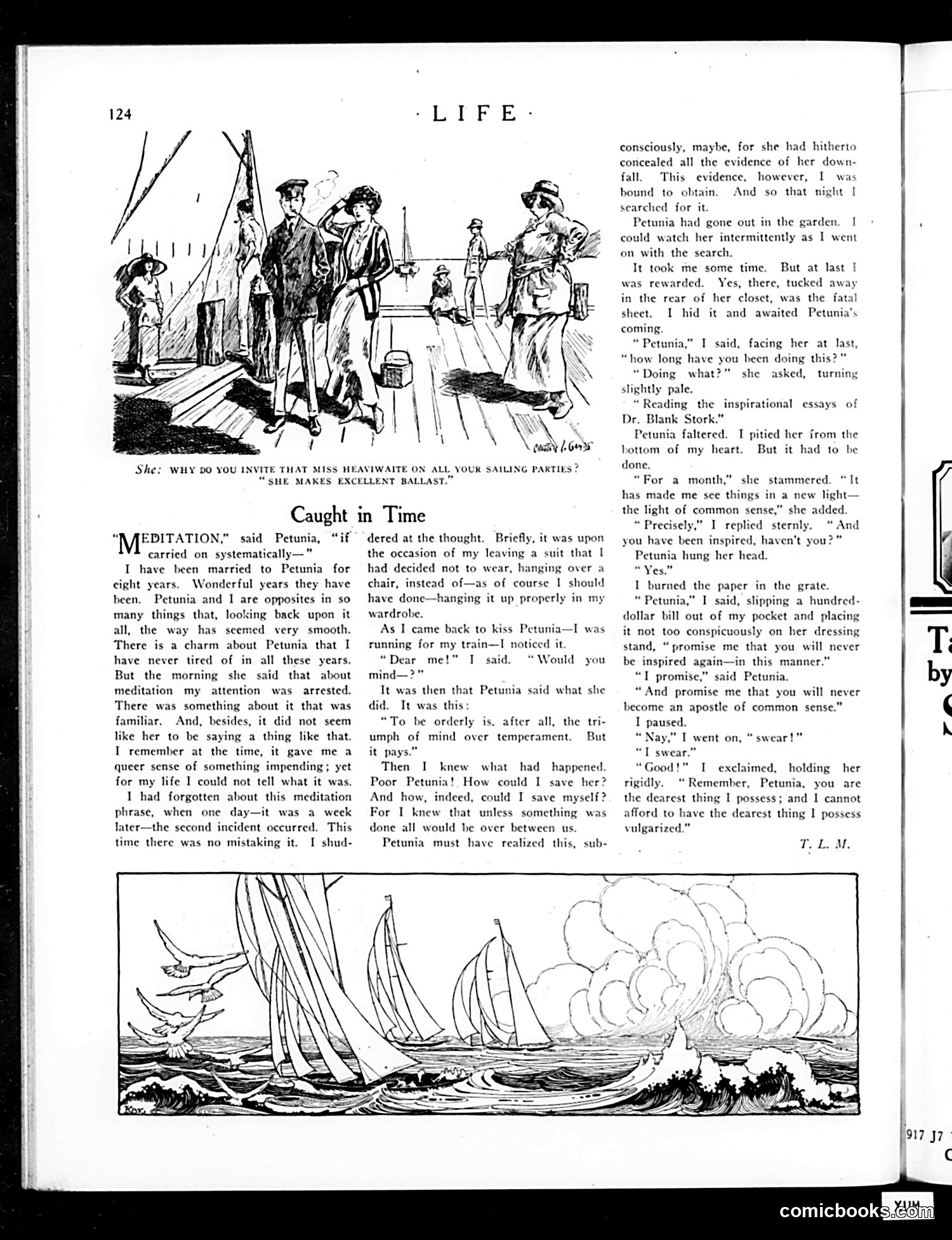
This satirical story mocks early 20th-century self-help culture and the threat it posed to domestic life. The narrator discovers his wife Petunia has been secretly reading inspirational essays by "Dr. Blank Stork"—likely a fictional parody of popular self-improvement gurus of the era. The humor lies in the husband's horror that his wife is being "infected" with common sense and orderliness through these writings. He views her newfound rationality as a corruption of her essential nature, something to be stamped out. His solution: burn the offending literature and pay her off with $100 to remain "vulgarized"—meaning unspoiled by practical thinking. The joke satirizes masculine anxiety about women's independence and self-improvement, and the absurdity of valuing a wife's ignorance over her personal growth. The top cartoon reinforces this through its crude joke about an unattractive woman's utility as "ballast" on sailing trips—reducing women to functional objects.

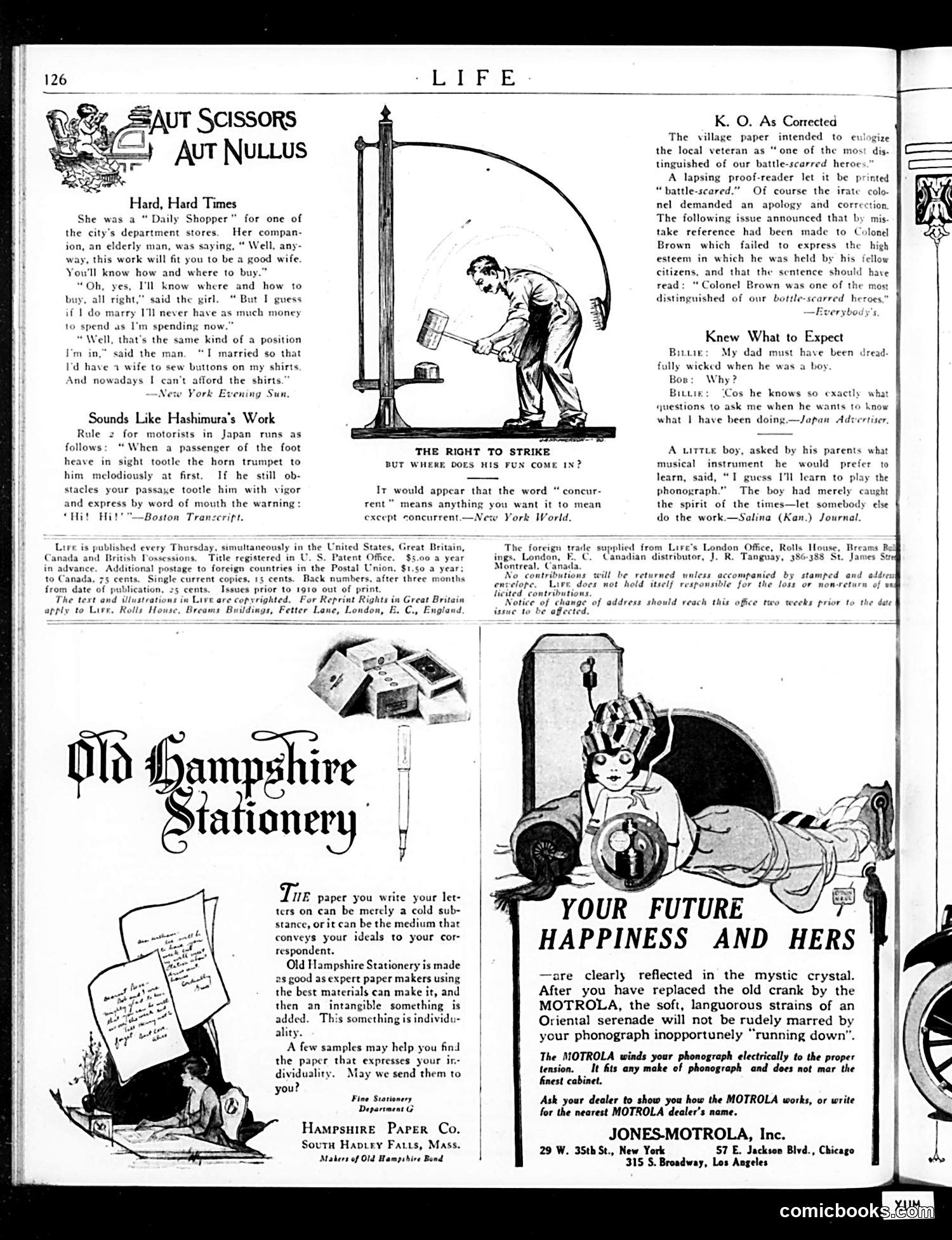
This page contains several short satirical pieces typical of early 20th-century Life magazine humor: **"Hard, Hard Times"** depicts economic anxiety during difficult times—a department store worker and an older man both lament that marriage/work hasn't improved their financial situations, creating dark comedy about permanent poverty. **"Sounds Like Hashimura's Work"** satirizes a Japanese traffic rule's awkward phrasing ("tootle the horn trumpet...melodiously"), suggesting foreigners find Japanese communication styles comical and confusing. **"K.O. As Corrected"** jokes about a small-town newspaper's embarrassing typo: calling a war hero "battle-scared" instead of "battle-scarred," then making it worse by denying the error in a correction. **"The Right to Strike"** appears to reference labor disputes, questioning where workers' enjoyment comes in during strikes. The page is primarily **advertising** (Hampshire Stationery, Motrola phonographs) interspersed with these brief humor columns—typical of Life's format blending editorial content with commercial promotion.
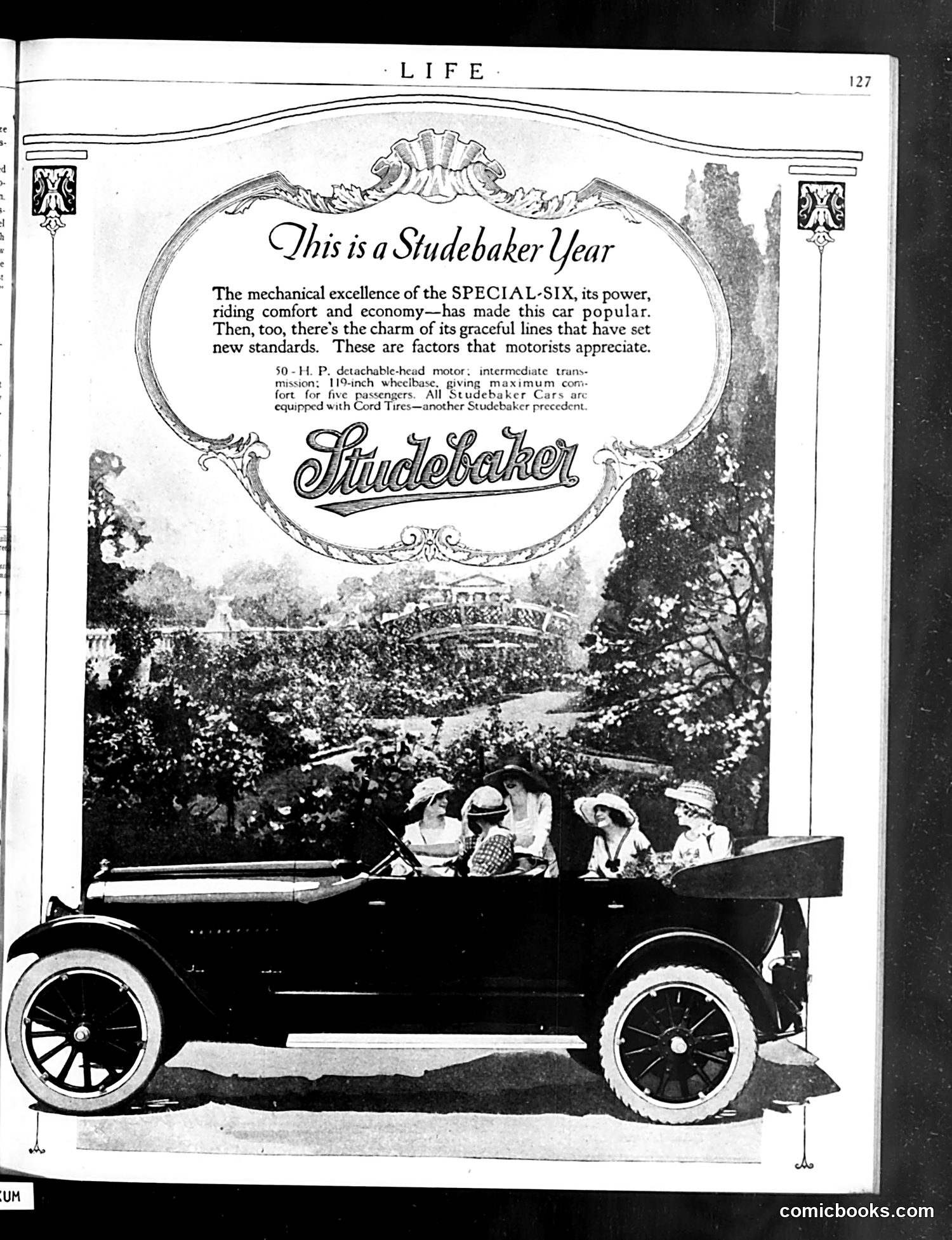
This is a **Studebaker automobile advertisement**, not political satire. The page promotes the Studebaker Special-Six car to readers of *Life* magazine. The ad emphasizes the car's mechanical features (50 horsepower motor, intermediate transmission, 119-inch wheelbase) and aesthetic appeal ("graceful lines"). The illustrated scene shows five fashionably dressed passengers—appearing to be women in 1920s attire with hats—enjoying an open-air drive through a landscaped garden or park setting, suggesting leisure, comfort, and social status. The ornamental border frame and headline "This is a Studebaker Year" use decorative typography typical of early 1920s advertising design. The message targets middle to upper-class motorists by associating the vehicle with elegance, reliability, and the modern lifestyle. There is no political commentary or satire present.
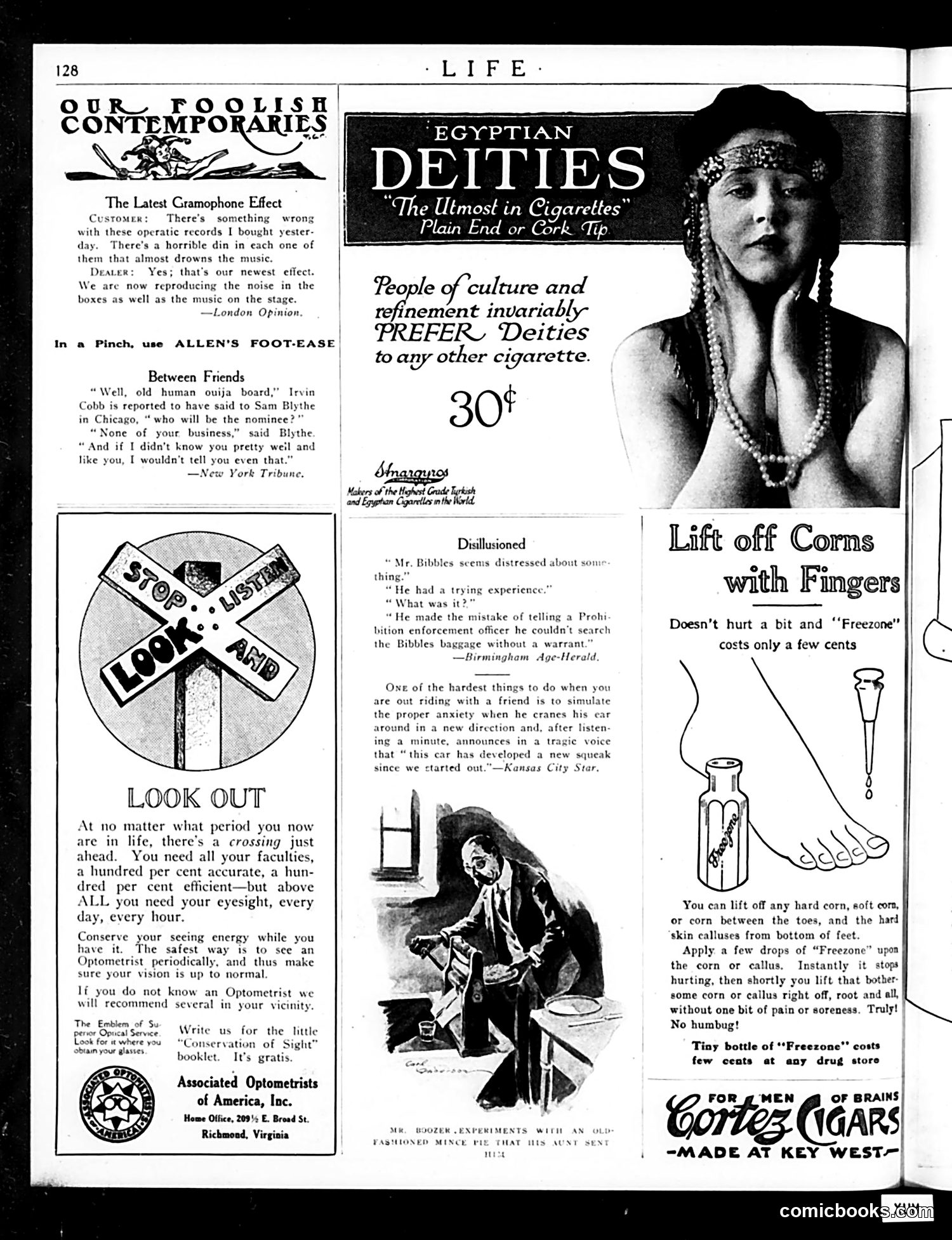
This page from Life magazine is primarily **advertising mixed with humor content**, typical of the era. The main satirical elements include: **"Our Foolish Contemporaries"** section mocks social absurdities—a gramophone dealer claiming to reproduce stage noise as a "feature," and a Prohibition-era joke about an agent unable to search luggage without a warrant (commentary on Prohibition enforcement complications). **The Egyptian Deities cigarette ad** uses exotic imagery and pseudo-sophistication ("people of culture and refinement") to market cigarettes at 30¢—standard advertising appeals of the period. **"Look Out"** is public health messaging from the Associated Optometrists about eye safety and regular vision checks. The remaining ads promote foot care products ("Freezone" corn remover) and Cortez cigars. **No identifiable political figures appear.** The humor reflects everyday 1920s concerns: mechanical entertainment, Prohibition's legal complications, consumer health consciousness, and marketing to aspirational consumers through claims of refinement and modernity.
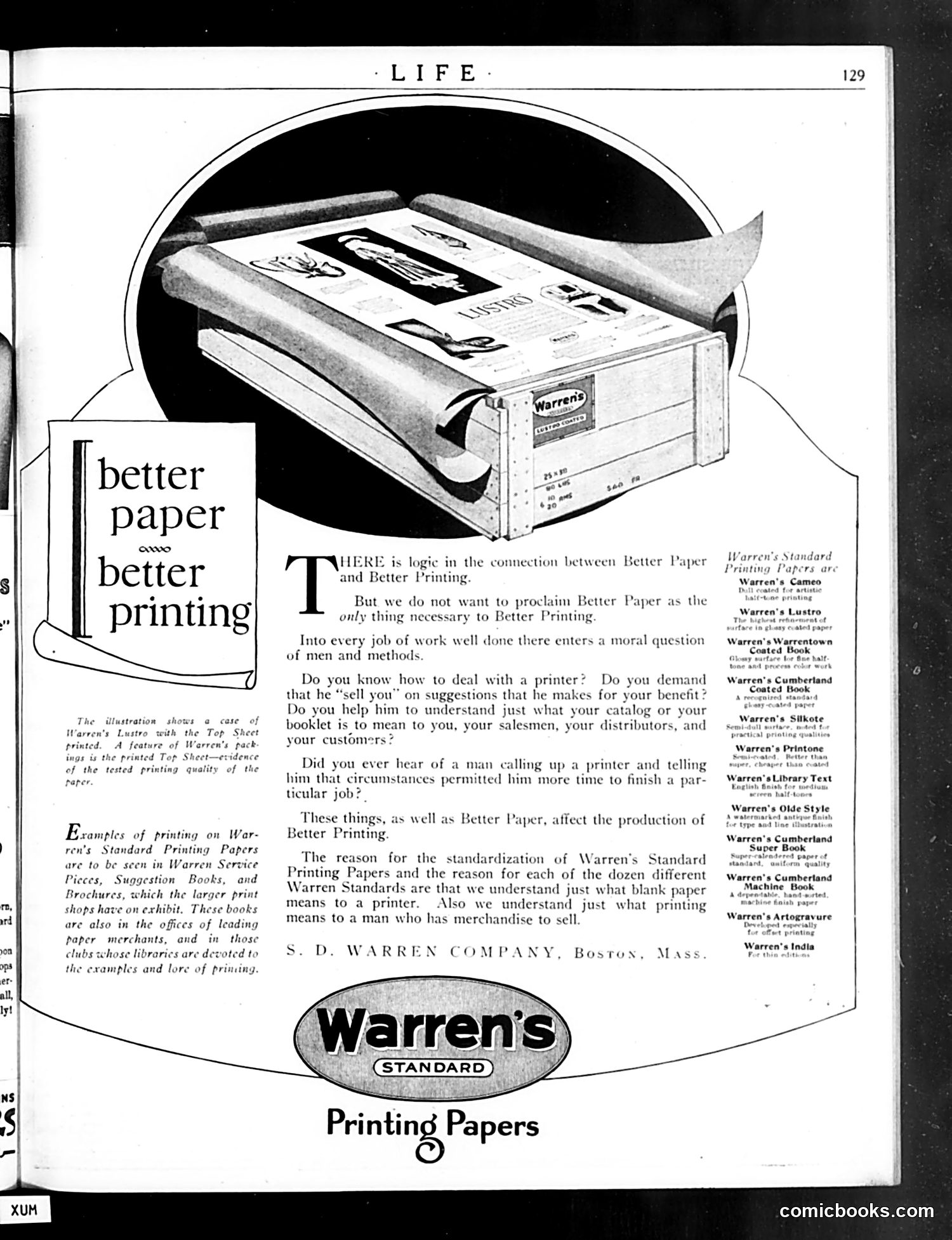
This is a **full-page advertisement** for Warren's Standard Printing Papers, not a political cartoon or satirical content. The page appears in *Life* magazine (page 129) but contains no cartoons or satire to analyze. The ad promotes printing paper quality by arguing that good printing requires both superior paper *and* ethical business practices. It uses rhetorical questions to appeal to potential customers—asking whether they properly communicate with printers and allow adequate time for quality work. The message is essentially: "Better Paper + Better Methods = Better Printing." The image shows a product box of Warren's printing paper. The right column lists various Warren paper products (Cumberland Coated Book, Library Text, India, etc.). This is straightforward commercial advertising messaging about professional standards and business relationships, not social or political commentary requiring historical context.
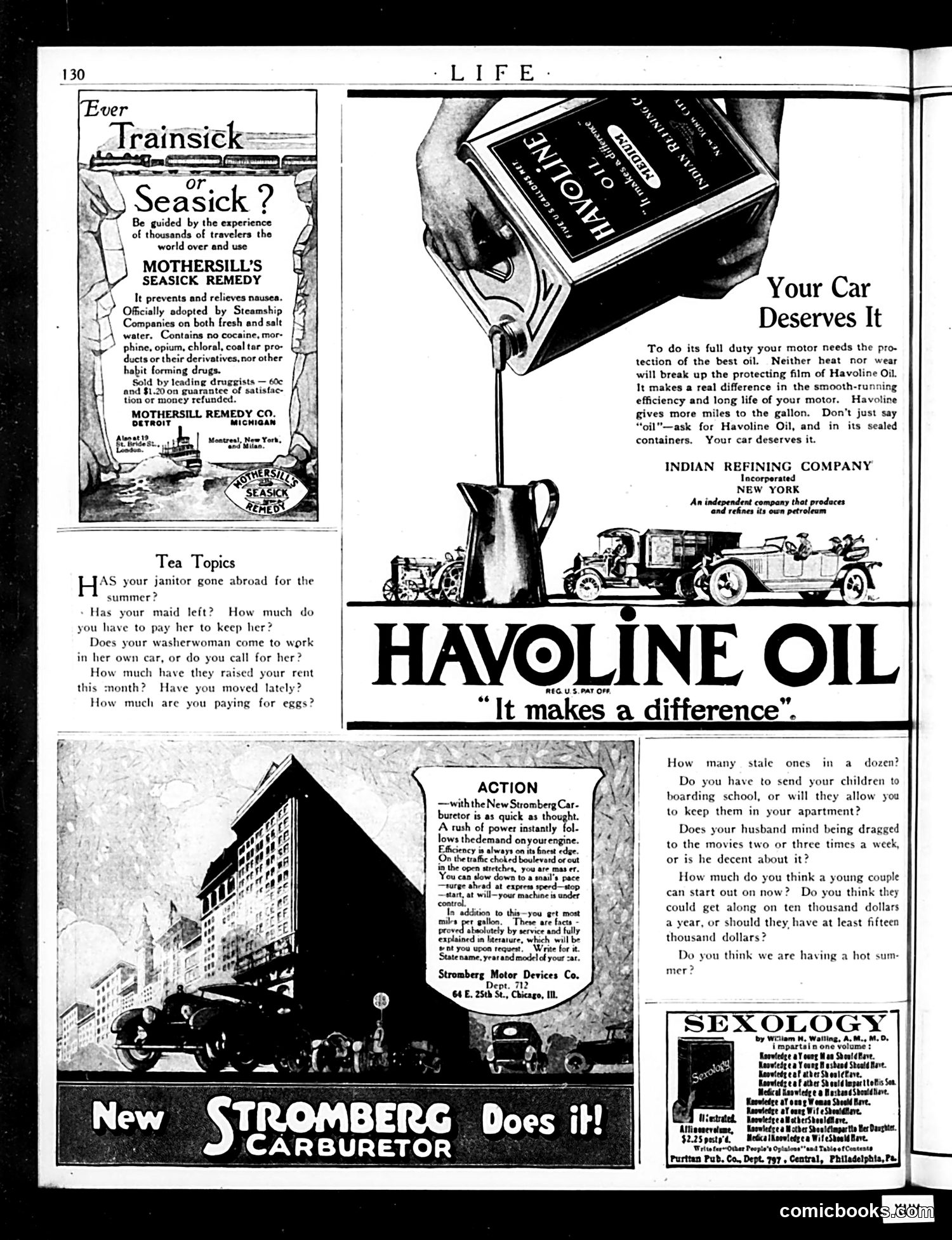
This page from *Life* magazine consists primarily of **advertisements** rather than satirical cartoons, reflecting early 20th-century publishing practices. The notable content includes: **"Tea Topics"** — A satirical humor column posing rhetorical questions to upper-middle-class readers about post-WWI economic anxieties: rising domestic wages, increased rents, food costs ("How much are you paying for eggs?"), and whether servants can afford their own automobiles. The humor targets wealthy households struggling with inflation and labor shortages common after 1918. **Advertisements** dominate: Mothersill's Seasick Remedy (targeting steamship travelers), Havoline Oil, Stromberg Carburetors, and a "Sexology" book series. These ads reflect 1920s consumer culture and automobile enthusiasm. The page contains **no identifiable political cartoons or caricatures**. It functions as a snapshot of *Life*'s mixed advertising-and-humor format, with "Tea Topics" offering gentle social satire about postwar economic disruption affecting the affluent classes.
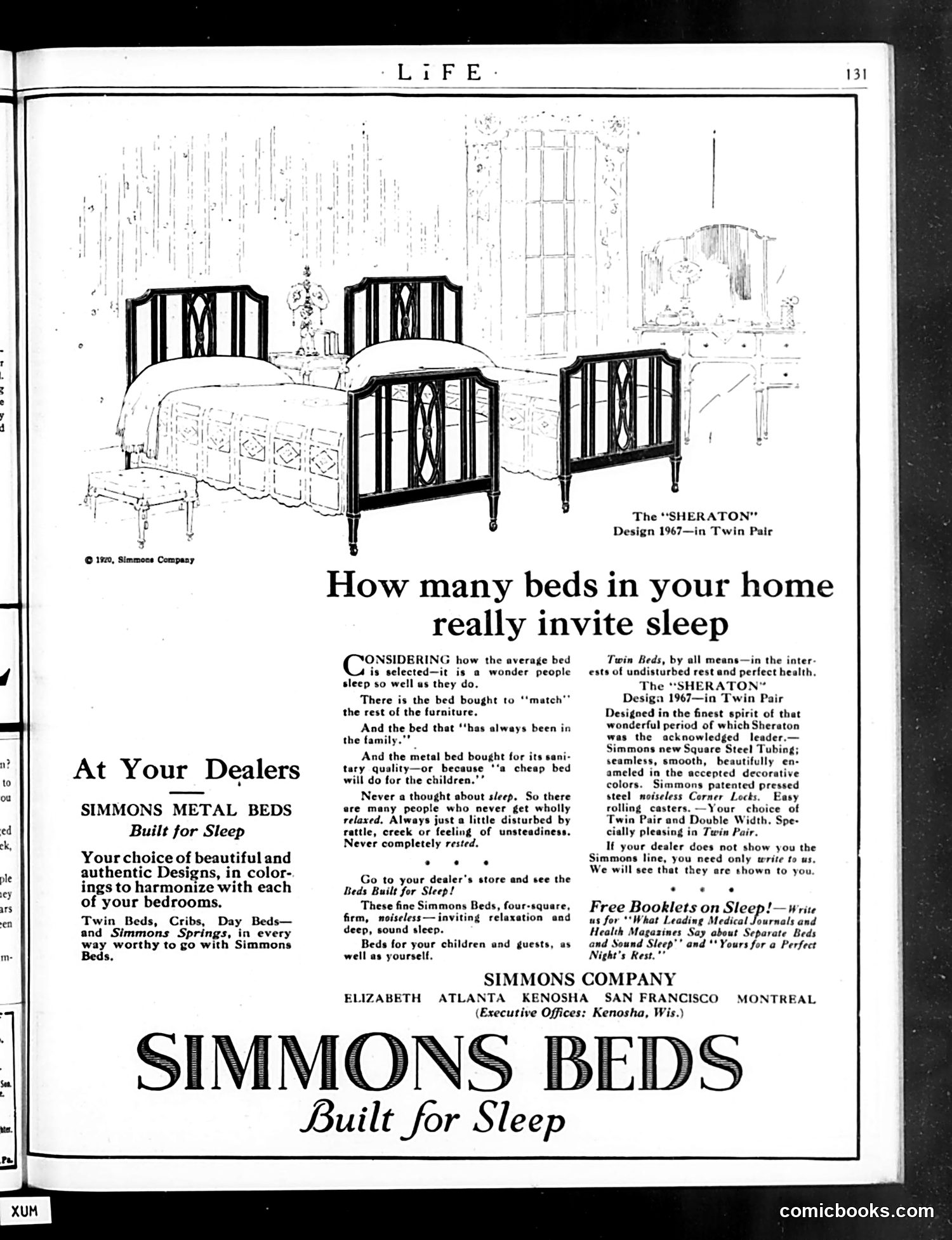
This is **not a cartoon or satire**—it's a straightforward advertisement for Simmons metal beds, occupying an entire page in Life magazine. The ad argues that people select beds for wrong reasons (matching furniture, family tradition, cheapness) rather than sleep quality. It promotes Simmons beds as scientifically designed for proper rest, featuring the "Sheraton" design in twin pairs. The copy emphasizes steel tubing, noiselessness, and durability. The only visual humor is mild: the illustration shows three metal bed frames positioned together in a bedroom, with the rhetorical headline "How many beds in your home really invite sleep?" This is gentle, product-focused messaging rather than political satire. The page reflects 1920s-era advertising strategy: appealing to consumer anxiety (poor sleep) while positioning the product as the scientific solution. Twin beds are promoted as healthier than shared beds—a common marketing pitch of that era.
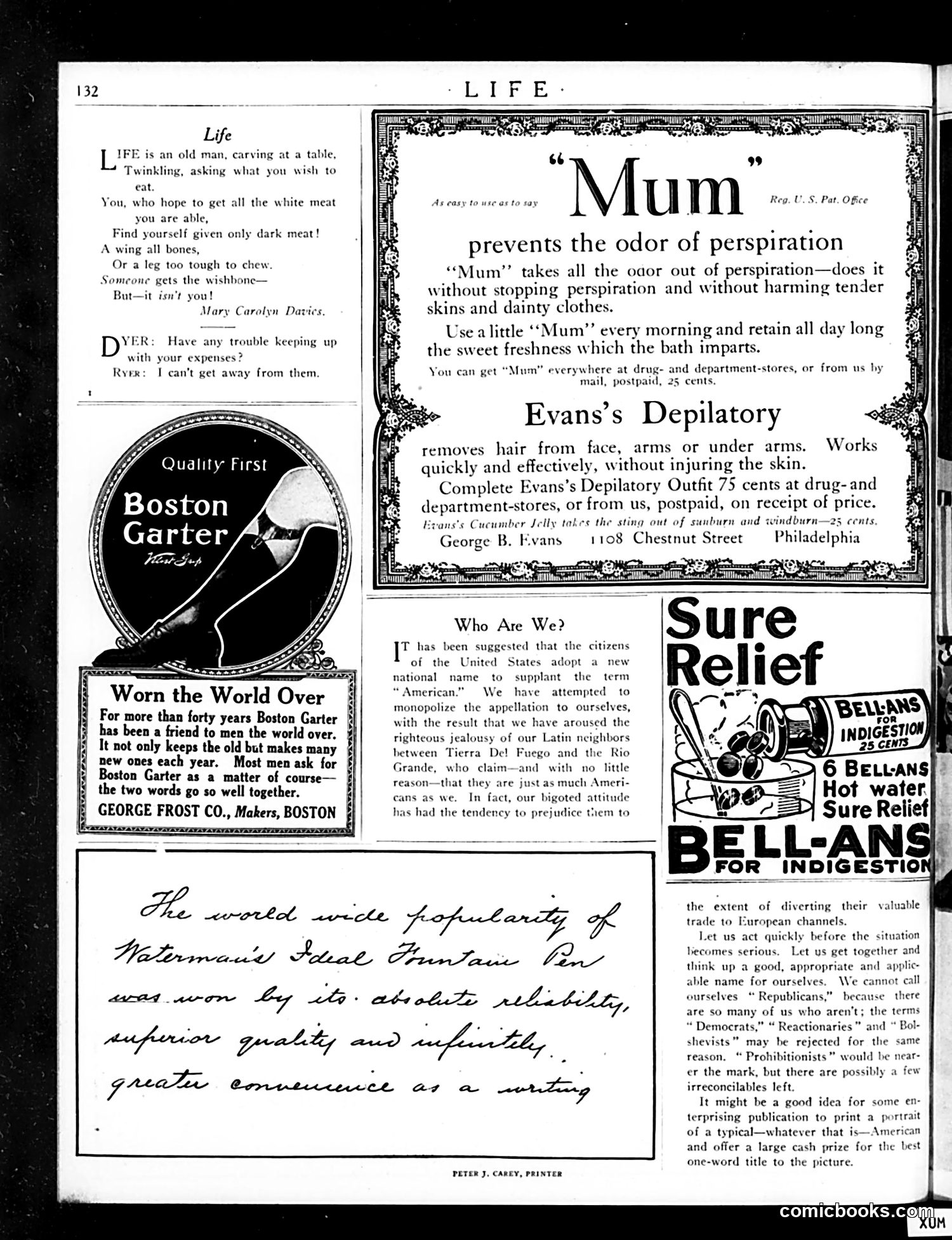
This page from *Life* magazine (early 20th century) contains mostly **advertisements and editorial commentary** rather than political cartoons. **Content breakdown:** The poem "Life" by Mary Carolyn Davies humorously depicts Thanksgiving dinner disappointment—receiving unwanted dark meat instead of desired white meat, a relatable domestic frustration. **Main satirical essay:** "Who Are We?" addresses Latin American resentment of U.S. monopolization of the term "American." The piece argues that citizens of Central and South America have equal claim to the name, and that American arrogance has alienated these neighbors, diverting their trade to Europe. The author suggests U.S. citizens need a new national identity—humorously noting that obvious alternatives like "Republican," "Democrat," or "Prohibitionist" don't encompass everyone. **The surrounding advertisements** (Boston Garter, "Mum" deodorant, Evans's Depilatory, Bellans) reflect period consumer culture. The essay reflects genuine early-20th-century geopolitical tensions between the U.S. and Latin America, framed with gentle satirical humor.
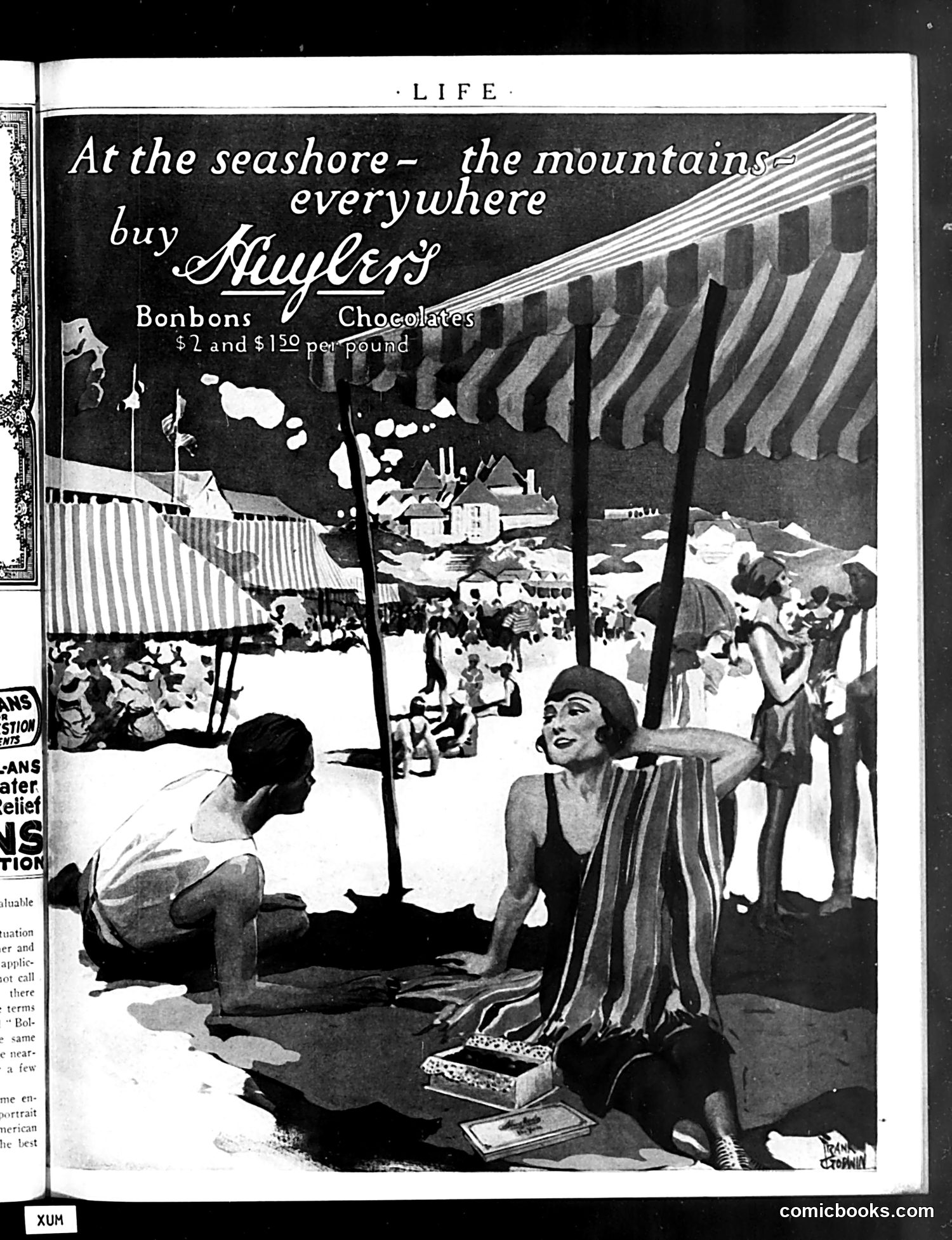
This is a **product advertisement** for Nuyler's Bonbons and Chocolates, not political satire. The ad depicts a cheerful beach scene with vacationing Americans enjoying leisure time—a woman sits contentedly on the sand while men swim and sunbathe in the background. The ad's message is straightforward: Nuyler's chocolates are available as treats "everywhere"—at seashores, mountains, and all vacation destinations. The pricing ($2 and $1.50 per pound) and the aspirational beach imagery positioned these confections as affordable luxury goods for middle-class American consumers during what appears to be the interwar or early post-war period. The illustration style and beach setting are typical of early-to-mid 20th century advertising designed to associate candy consumption with leisure, happiness, and American prosperity.
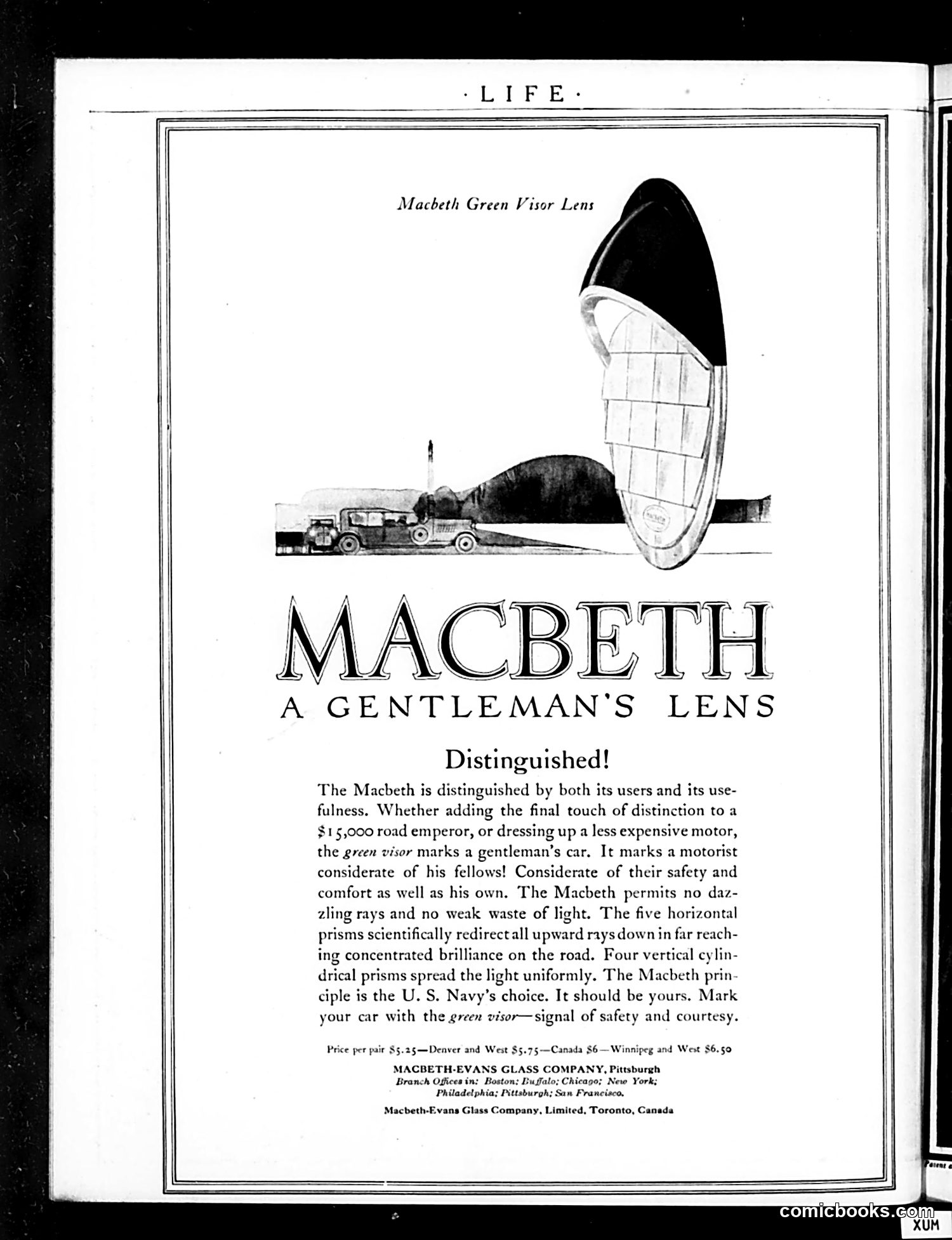
This is a **product advertisement**, not political satire. It promotes the Macbeth Green Visor Lens, an automobile headlight accessory from the 1920s era. The illustration shows a vintage car with an oversized green visor lens mounted above it. The ad appeals to class consciousness and social responsibility: owning this lens supposedly marks one as a "gentleman" motorist who prioritizes safety for fellow drivers, not just personal distinction. The humor is subtle and period-specific: the ad conflates automotive safety equipment with social status and gentlemanly conduct. The green visor itself was a practical automotive innovation (using prisms to direct light downward), but the marketing emphasizes it as a status symbol—whether on a "$15,000 road emperor" (luxury car) or cheaper motor. There's gentle satire in equating an auto accessory with moral character: the lens "marks a motorist considerate of his fellows." For a modern reader, this represents early automotive advertising's tendency to sell practical products by wrapping them in aspirational social messaging.
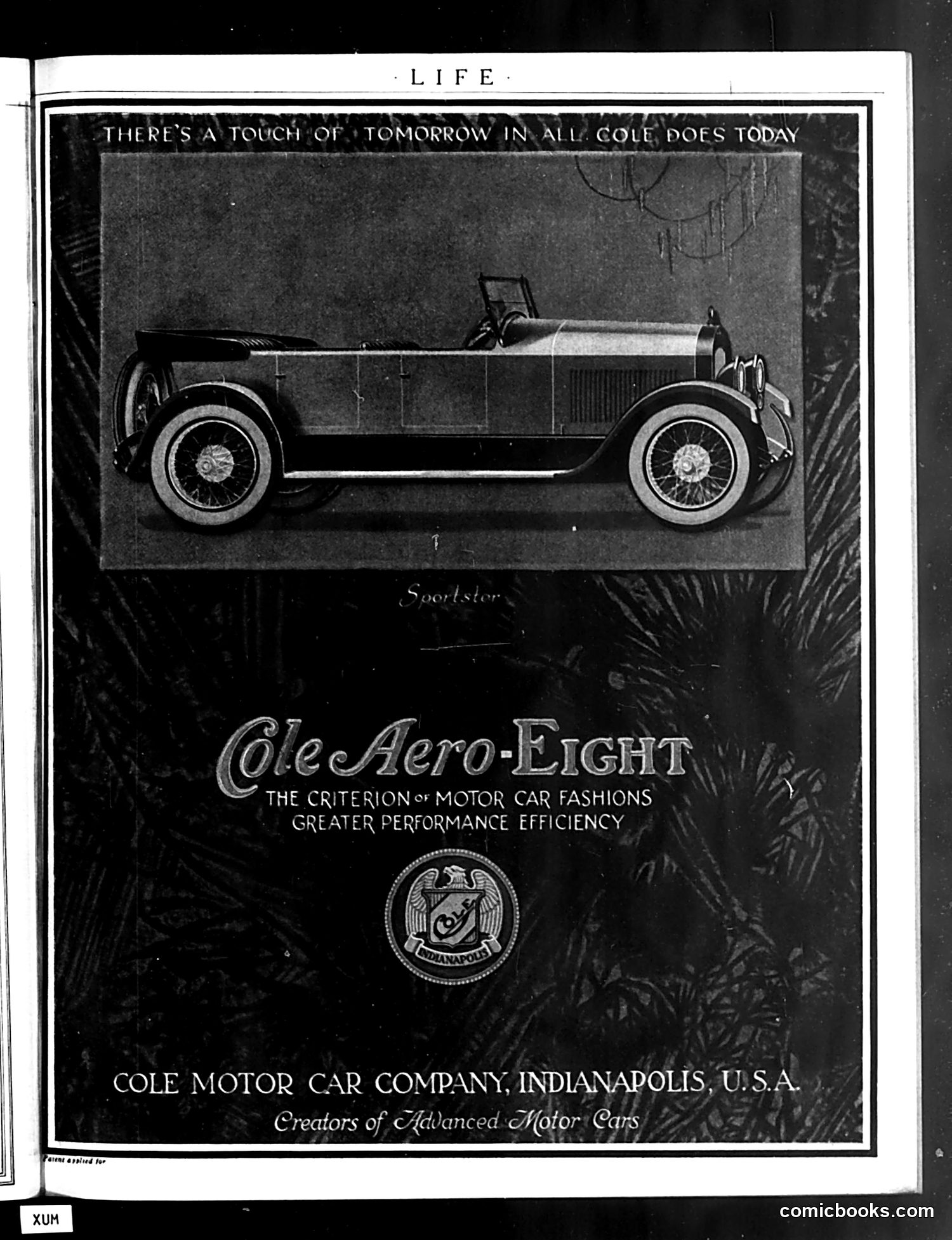
This is primarily an **advertisement**, not satire or political commentary. It shows the Cole Aero-Eight, a luxury automobile manufactured in Indianapolis. The car pictured is a "Sportster" model—an open-air touring vehicle typical of 1920s design. The tagline "There's a touch of tomorrow in all Cole does today" emphasizes the vehicle's modern innovations and forward-thinking engineering. The text highlights "greater performance efficiency" as a selling point, suggesting this car represented cutting-edge automotive technology of its era. The decorative border with palm fronds and the prominent company seal indicate this is a prestigious brand advertisement from *Life* magazine's advertising pages, targeting affluent readers interested in luxury automobiles during the early automotive industry's golden age.
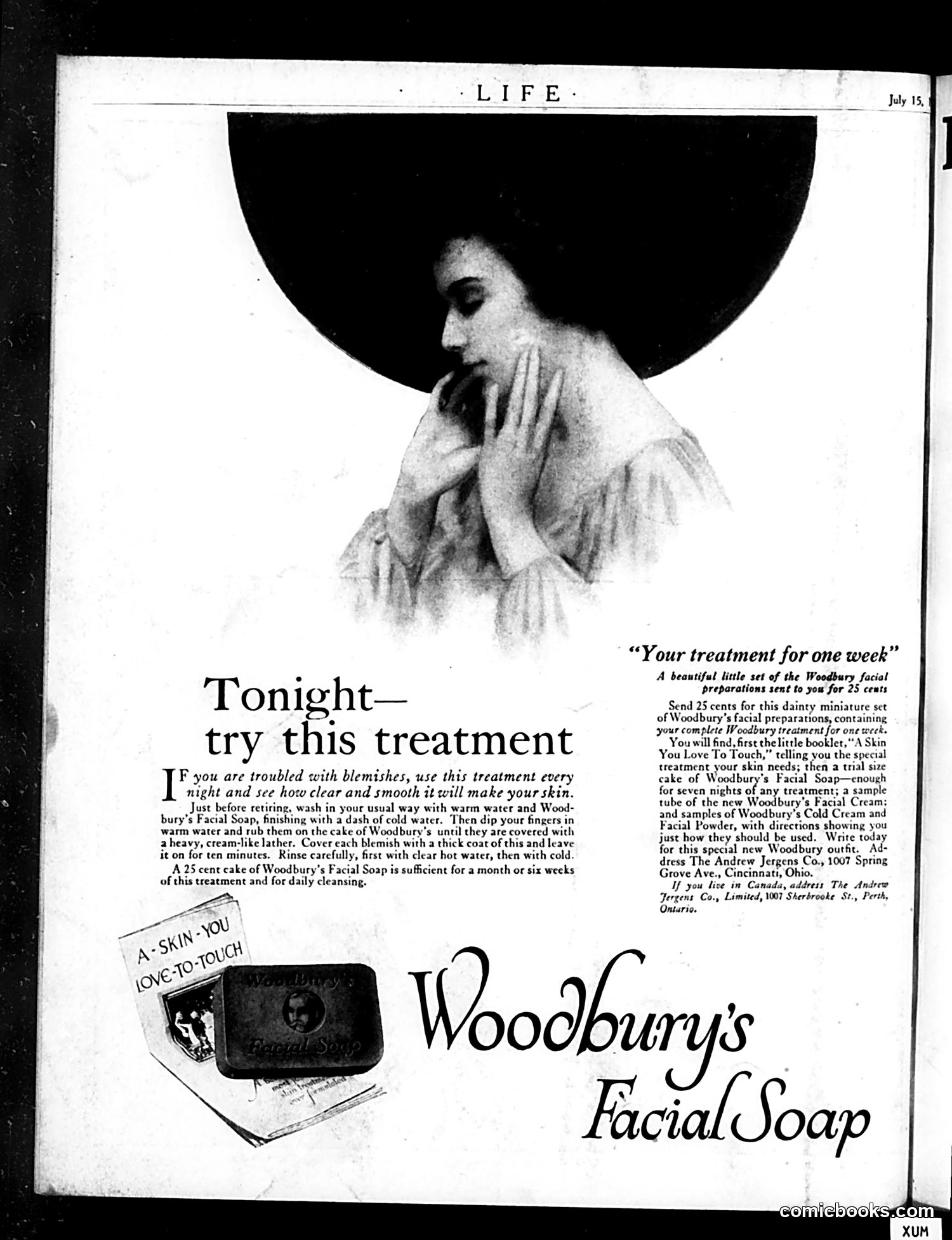
This is **primarily a product advertisement**, not political satire. It's a Woodbury's Facial Soap ad from Life magazine (July 15, date unclear). The page features a romanticized portrait of a woman with an elaborate large hat, presented as aspirational beauty imagery typical of early 20th-century advertising. The "cartoon" element is minimal—this is straightforward commercial promotion. The ad promotes a 25-cent trial set of Woodbury facial preparations, with detailed instructions for treating blemishes. The phrase "A Skin You Love to Touch" was Woodbury's actual marketing slogan of the era. **For modern readers**: This represents how early beauty advertising used idealized feminine imagery and promised solutions to skin problems, establishing marketing patterns still recognizable today. There is no political commentary or satire present—Life magazine's satirical function didn't extend to its advertising pages.