
Life, 1920-07-15 · page 19 of 40
Life — July 15, 1920 — page 19: what you’re looking at
What you’re looking at
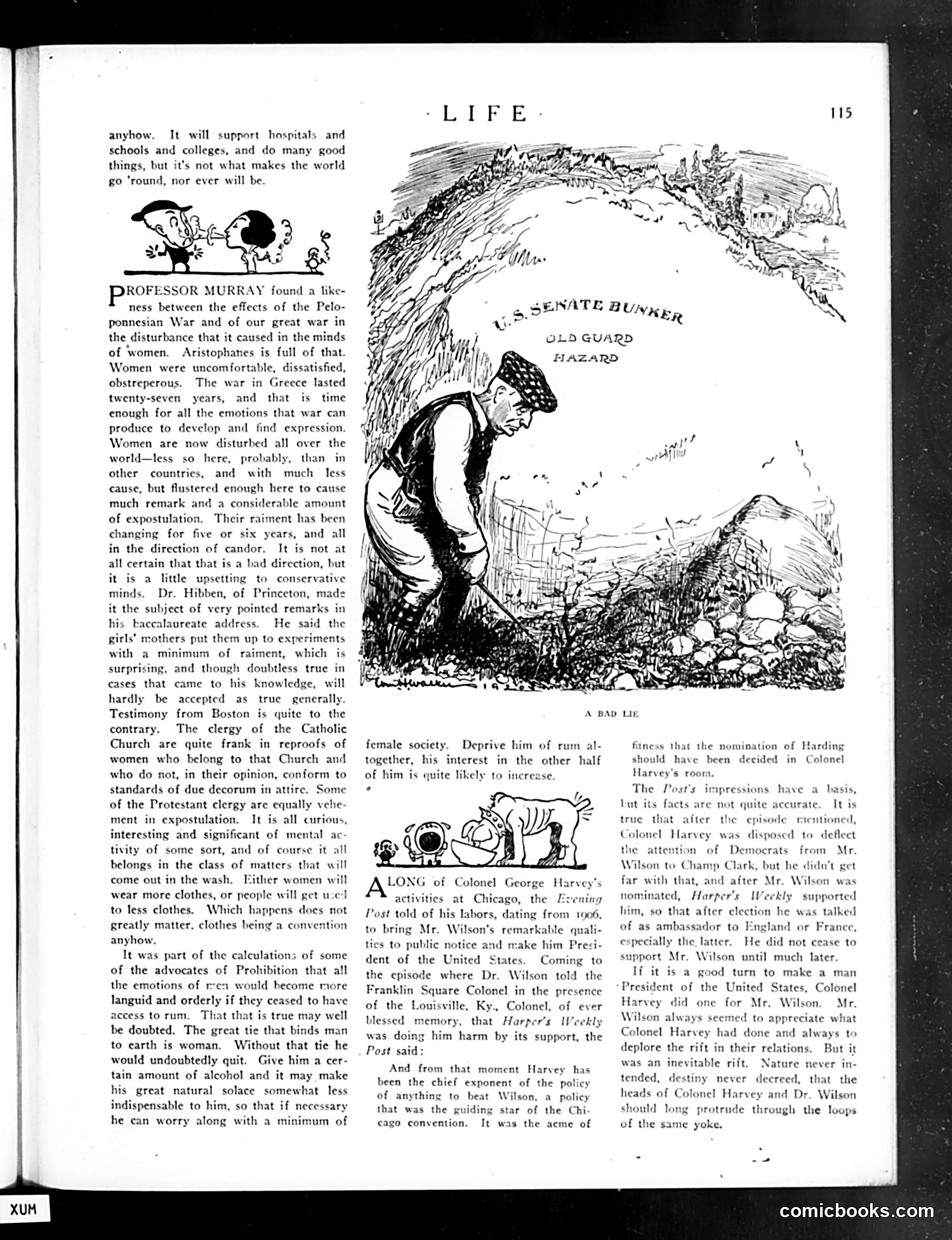
This page satirizes misleading claims about Colonel George Harvey's political influence. The text disputes a *Post* article claiming Harvey orchestrated Warren G. Harding's nomination in his room at the 1920 Chicago convention. Life's editors assert this is exaggerated: Harvey did promote Wilson early (since 1906) but didn't control outcomes. When Wilson later rejected Harvey's support, Harvey backed the "anything to beat Wilson" policy—but Life argues this didn't guarantee Harding's nomination. The cartoon labeled "A Bad Lie" shows a disheveled soldier at a military bunker, likely representing the dubious claim itself as a false narrative. The broader context reflects post-WWI American politics: the 1920 Republican convention's selection of Harding, the complex relationships between newspapers/influential figures and presidential politics, and Life's role as a satirical arbiter of political truth-telling.
📄 Transcribed text from this page (OCR, searchable)
Machine-transcribed from the original scan — historical spelling and the odd misread are preserved.
anyhow. It will support hospitals and schools and colleges, and do many good things, but it's not what makes the world go ‘round, nor ever will be. ROFESSOR MURRAY found a like- ness between the effects of the Pelo- ponnesian War and of our great war in the disturbance that it caused in the minds of women. Aristophanes is full of that. Women were uncomfortable, dissatisfied, obstreperous. The war in Greece lasted twenty-seven years, and that is time enough for all the emotions that war can produce to develop and find expression. Women are now disturbed all over the world—less so here, probably, than in other countries, and with much less cause, but flustered enough here to cause much remark and a considerable amount of expostulation. Their raiment has been changing for five or six years, and all in the direction of candor. It is not at all certain that that is a bad direction, but it is a little upsetting to conservative minds. Dr. Hibben, of Princeton, made it the subject of very pointed remarks in his baccalaureate address. He said the girls’ mothers put them up to experiments with a minimum of raiment, which is surprising, and though doubtless true in cases that came to his knowledge, will hardly be accepted as true generally. Testimony from Boston is quite to the contrary. The clergy of the Catholic Church are quite frank in reproofs of women who belong to that Church and who do not, in their opinion, conform to standards of due decorum in attire. Some of the Protestant clergy are equally vehe- ment in expostulation. It is all curious, interesting and significant of mental ac tivity of some sort, and of course it all belongs in the class of matters that will come out in the wash. Either women will wear more clothes, or people will get used to less clothes. Which happens does not greatly matter. clothes being a convention anyhow. It was part of the calculations of some of the advocates of Prohibition that all the emotions of men would hecome more languid and orderly if they ceased to have access to rum. That that is true may well be doubted. The great tie that binds man to earth is woman. Without that tie he would undoubtedly quit. Give him a cer- tain amount of alcohol and it may make his great natural solace somewhat less indispensable to him, so that if necessary he can worry along with a minimum of 3, SENATE BUNKER OL5 GUARD HIAZARD A BAD female society. Deprive him of rum al- together, his interest in the other half of him is quite likely to increase. activities at Chicago, the F Post told of his labors, dating from 1906, to bring Mr. Wilson's remarkable quali- ties to public notice and make him Presi- dent of the United States. Coming to the episode where Dr. Wilson told the Franklin Square Colonel in the presence of the Louisville, Ky. Colonel, of ever blessed that Harper's Weekly was doi: him harm by its support, the Post said: ening memory, And from that moment Harvey has been the chief exponent of the policy of anything to beat licy that was the guiding star of the Chi cago convention. It was the acme of Wilson, a Lip fitness that the nomination of Harding should have been decided in Colonel Harvey's room. The Post's Lut its facts are not quite accurate. true that the Colonel Harvey was disposed to deflect the attention of Mr. Wilson to Champ Clark, but he didn’t get far with that, and after Mr. Wilson was Harper's: Weekly him, so that after election he wa have a_hasis, It is mentioned, impressions Democrats from nominated, supported talked of as ambassador to England or France, especially the latter. He did not support Mr. Wilson until much later. If it is a good turn to make a man President of the United States, Colonel Harvey for Mr. Wilson. Mr. Wilson always seemed to appreciate what Colonel Harvey had done and always to deplore the rift in their relations. But it was an inevitable rift. ure never in- tended, destiny that the Dr. Wilson should long protrude through the loops of the same yoke. se to did one never deer: heads of Colonel Harvey and comicbooks.com