
Life, 1920-07-15 · page 14 of 40
Life — July 15, 1920 — page 14: what you’re looking at
What you’re looking at
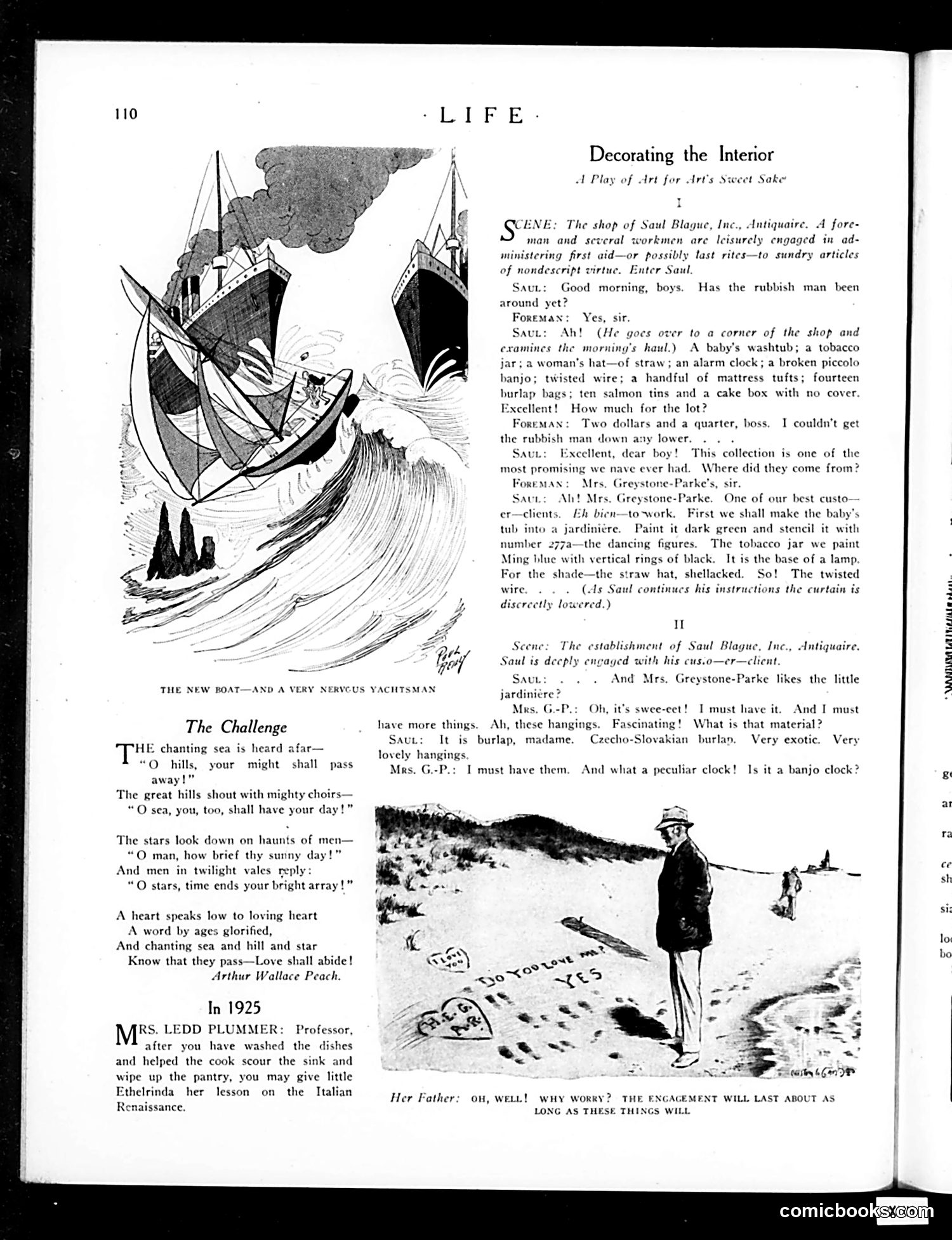
This page presents a comedic one-act play about an antique shop owner named Saul Blague negotiating with a foreman over items for sale. The humor centers on the foreman's wife, Mrs. Greystone-Parke, a wealthy client interested in purchasing decorative pieces—including a baby's milk jug, dancing figures, a tobacco jar, and a clock—described as "Czechoslovakian barlar" (likely "barrel"). The satire mocks wealthy collectors' pretentious fascination with exotic or antique items and the obsequious shopkeeper's flattery. The accompanying illustration shows a man in a coat standing on a beach, labeled "Her Father," with a caption suggesting anxiety about an engagement lasting "as long as these things will." The page also includes "The Challenge," a poem by Arthur Wallace Peach about human perseverance.
📄 Transcribed text from this page (OCR, searchable)
Machine-transcribed from the original scan — historical spelling and the odd misread are preserved.
Decorating the Interior ol Play of Art for Art's Sweet Sake ENE: The shop of Saul Blague, Inc., Antiquaire. A fore- man and several workmen are leisurely engaged in ad- ministering first aid—or possibly last rites—to sundry articles of nondescript virtue. Enter Saul. Saut: Good morning, boys. Has the rubbish man been around yet? Foreman: Yes, sir. Saut Ah! (He goes over to a corner of the shop and examines the morning's haul.) A baby’s washtub; a tobacco jar; a woman's hat—of straw; an alarm clock; a broken piccolo banjo; twisted wire; a handful of mattress tufts; fourteen ; ten salmon tins and a cake box with no cover. How much for the lot? Two dollars and a quarter, boss. I couldn't get the rubbish man down any lower. Saut: Excellent, dear boy! This collection is one of the most promising we nave ever had. Where did they come from? Foreman: Mrs. Greystone-Parke's, sir. Savi Ali! Mrs. Greystone-Parke. One of our best custo er—clients. Eh bien—to-work. First we shall make the baby’s tub into a jardiniére. Paint it dark green and stencil it with number 277a—the dancing figures. The tobacco jar we paint v Ming blue with vertical rings of black. It is the base of a lamp. For the shade—the straw hat, shellacked. So! The twisted wire, . « (As Saul continucs his instructions the curtain is discreetly lowered.) If Scene: The establishment of Saul Blague, Inc., Antiquaire. Saul is deeply engaged with his cus.o—er—client. And Mrs, Greystone-Parke likes the little *\DANTUNA LA esate THE NEW BOAT—AND A VERY NERVCUS YACHTSMAN Oh, it’s swee-eet! [must have it. And I must The Challenge have more things. Ah, these hangings. Fascinating! What is that material? . ‘ ; Save: It is burlap, madame, Czecho-Slovakian burlap. Very exotic. Very HE chanting sea is heard afar— 5 3 asi at akail lovely hangings. c ey your’ might. ‘shall pass Mrs. G I must have them. And what a peculiar clock! Is it a banjo clock? away The great hills shout with mighty choirs— “O sea, you, too, shall have your day!” The stars look down on haunts of men— “O man, how brief thy sunny day!” And men in twilight vales reply: “O stars, time ends your bright array!” A heart speaks low to loving heart A word by ages glorified, And chanting sea and hill and star Know that they pass—Love shall abide! Arthur Wallace Peach. In 1925 RS. LEDD PLUMMER: Professor, after you have washed the dishes and helped the cook scour the sink and wipe up the pantry, you may give little Ethelrinda her lesson on the Italian Réauiges = Her Father: ov, Wete! WHY Worry? THE ENGAGEMENT WILL LAST ABOUT AS Renalssance. LONG AS THESE THINGS WILL comicbooks‘com