
Life, 1920-07-15 · page 18 of 40
Life — July 15, 1920 — page 18: what you’re looking at
What you’re looking at
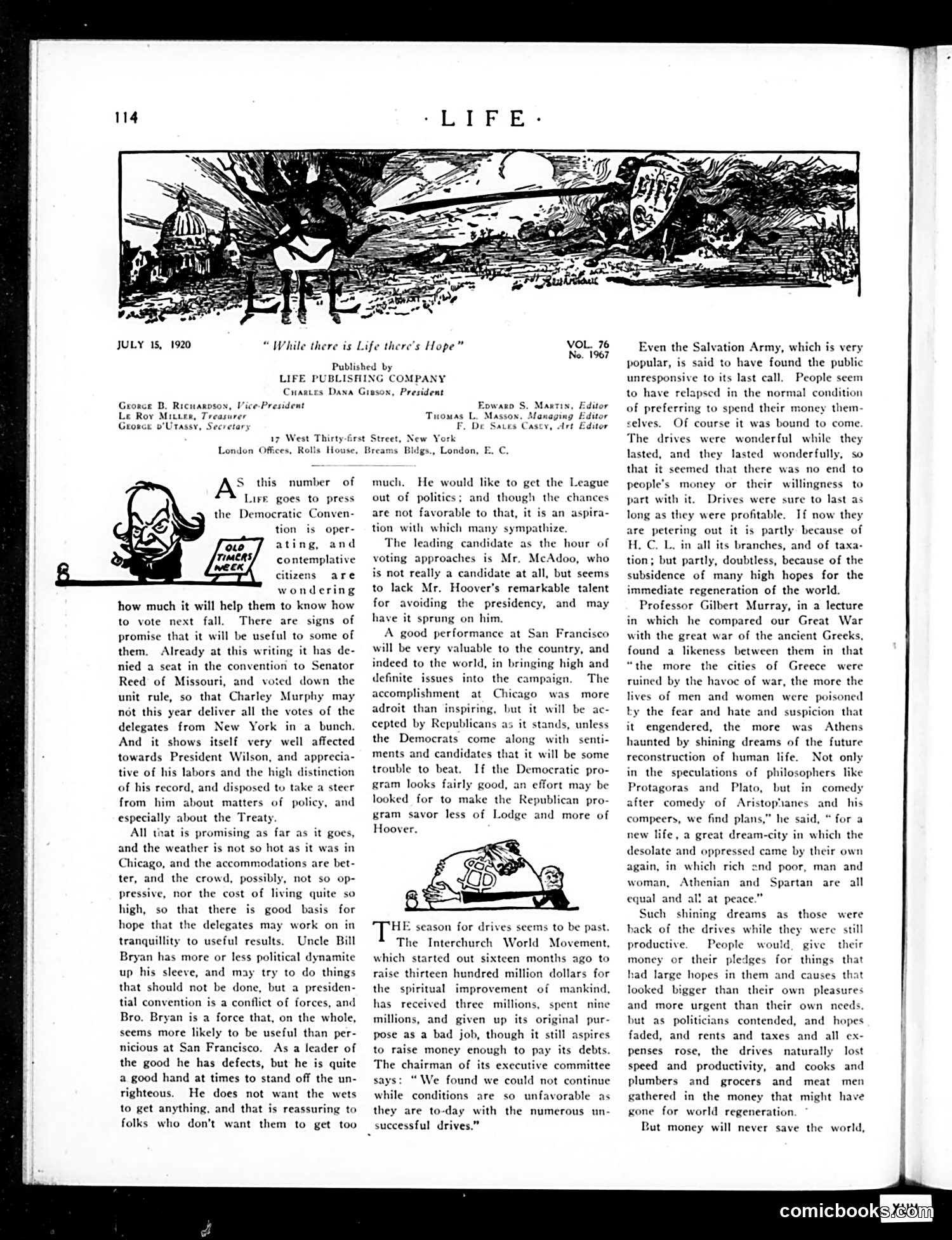
This page contains editorial commentary on the 1920 Democratic National Convention (occurring in San Francisco). The caricatured figure labeled "OLD GUARD" appears to represent establishment Democratic opposition to progressive reform. **Key references:** - **William Jennings Bryan**: discussed as a political force with "dynamite up his sleeve," capable of blocking "wets" (pro-alcohol interests) - **McAdoo**: the leading presidential candidate, described as reluctant but likely to win the nomination - **The League of Nations**: a divisive convention issue related to President Wilson's treaty **The satire's point:** The editors express cautious hope that the convention will produce meaningful debate on substantive issues (the League, Prohibition) rather than repeat Chicago's mere procedural maneuvering. They're skeptical but hopeful—hence the masthead quote, "While there is Life there's Hope." A secondary piece mocks failed charitable fundraising drives, noting Americans prefer keeping their own money.
📄 Transcribed text from this page (OCR, searchable)
Machine-transcribed from the original scan — historical spelling and the odd misread are preserved.
JULY 15, 1920 “While there is Life there's Hope” Published by LIFE PUBLISHING COMPANY Cuantes Dana Giesox, President Grorce B. Ricuarson, Vice-President 17 West Thirty-first Street, London Offices, Rolls House, Breams E this number of AS Lirk goes to press the Democratic Conven- tion is oper- ating, and contemplative citizens are wondering how much it will help them to know how to vote next fall, There are signs of promise that it will be useful to some of them, Already at this writing it has de- nied a seat in the convention to Senator Reed of Missouri, and voted down the unit rule, so that Charley Murphy may not this year deliver all the votes of the delegates from New York in a bunch. And it shows itself very well affected towards President Wilson, and apprecia- tive of his labors and the high distinction of his record, and disposed from him about matters of policy, and especially about the Treaty. All that is promising as far as it goes, and the weather is not so hot as it was in Chicago, and the accommodations are bet- ter, and the crowd, possibly, not so op- pressive, nor the cost of living quite so high, so that there is good basis for hope that the delegates may work on in tranquillity to useful results. Uncle Bill Bryan has more or less political dynamite up his sleeve, and may try to do things that should not be done, but a presiden- tial convention is a conflict of forces, and Bro. Bryan is a force that, on the whole, seems more likely to be useful than per- nicious at San Francisco. As a leader of the good he has defects, but he is quite a good hand at times to stand off the un- righteous. He does not want the wets to get anything, and that is reassuring to folks who don’t want them to get too Epwaro S. Mart Tuomas L. Masson. Ma F, De Sates Case w York s., London, E. C. » Editor ging Editor Art Editor much, He would like to get the League out of politics; and though the chances are not favorable to tha tion with which many sympathize. The leading candidate as the hour of voting approaches is Mr. McAdoo, who is not really a candidate at all, but seems to lack Mr. Hoover’s remarkable talent for avoiding the presidency, and may have it sprung on him. A good performance at San Francisco will be very valuable to the country, and indeed to the world, in bringing high and definite issues into the campaign. The accomplishment at Chicago was more adroit than inspiring, but it will be ac- cepted by Republicans as it stands, unless the Democrats come along with senti- ments and candidates that it will be some trouble to beat. If the Democratic pro- gram looks fairly good, an effort may be looked for to make the Republican pro- gram savor less of Lodge and more of , it is an aspira- HE season for drives seems to be past. World Movement, which started out sixteen months ago to raise thirteen hundred million dollars for the spiritual improvement of mankind, has received three millions, spent millions, and given up its original pur- pose as a bad job, though it still aspires to raise money enough to pay its debts. The chairman of its executive committee says: “We found we could not continue while conditions are so unfavorable as they are to- with The Interchurch nine the numerous un- successful drives.” Even the Salvation Army, which is very popular, is said to have found the public unresponsive to its last call. to have relapsed in the normal condition of preferring to spend their money them- selves. Of course it was bound to come. The drives were wonderful while they lasted, and they lasted wonderfully, so that it seemed that there was no end to people’s money or their willingness to part with it. Drives were sure to last as long as they were profitable. If now they are petering out it is partly because of H. C. L. in all its branches, and of taxa- tion; but partly, doubtless, because of the subsidence of many high hopes for the immediate regeneration of the world. Professor Gilbert Murray, in a lecture in which he compared our Great War with the great war of the ancient Greeks, found a likeness them in that “the more the cities of Greece were ruined by the havoc of war, the more the lives of men and women were poisoned ty the fear and hate and suspicion that it engendered, the more was Athens haunted by shining dreams of the future reconstruction of human life. Not only in the speculations of philosophers like Protagoras and Plato, but in comedy after comedy of Aristophanes and his People seem between compeers, we find plans,” he said, “ for a new life, a great dream-city in which the desolate and oppressed came by their own again, in which rich snd poor, man and woman, Athenian and Spartan are all equal and all at peace.” Such shining dreams as those were hack of the drives while they were still productive. give their moncy or their pledges for things that had large hopes in them and causes that looked bigger than their own pleasures and more urgent than their own needs, but as politicians contended, and hopes faded, and rents and taxes and all ¢: penses the drives naturally lost speed and productivity, and cooks and plumbers and grocers and meat men gathered in the money that might have gone for world regeneration. But money will never save the world, People would. rose, comicbooks