
Life, 1920-07-15 · page 15 of 40
Life — July 15, 1920 — page 15: what you’re looking at
What you’re looking at
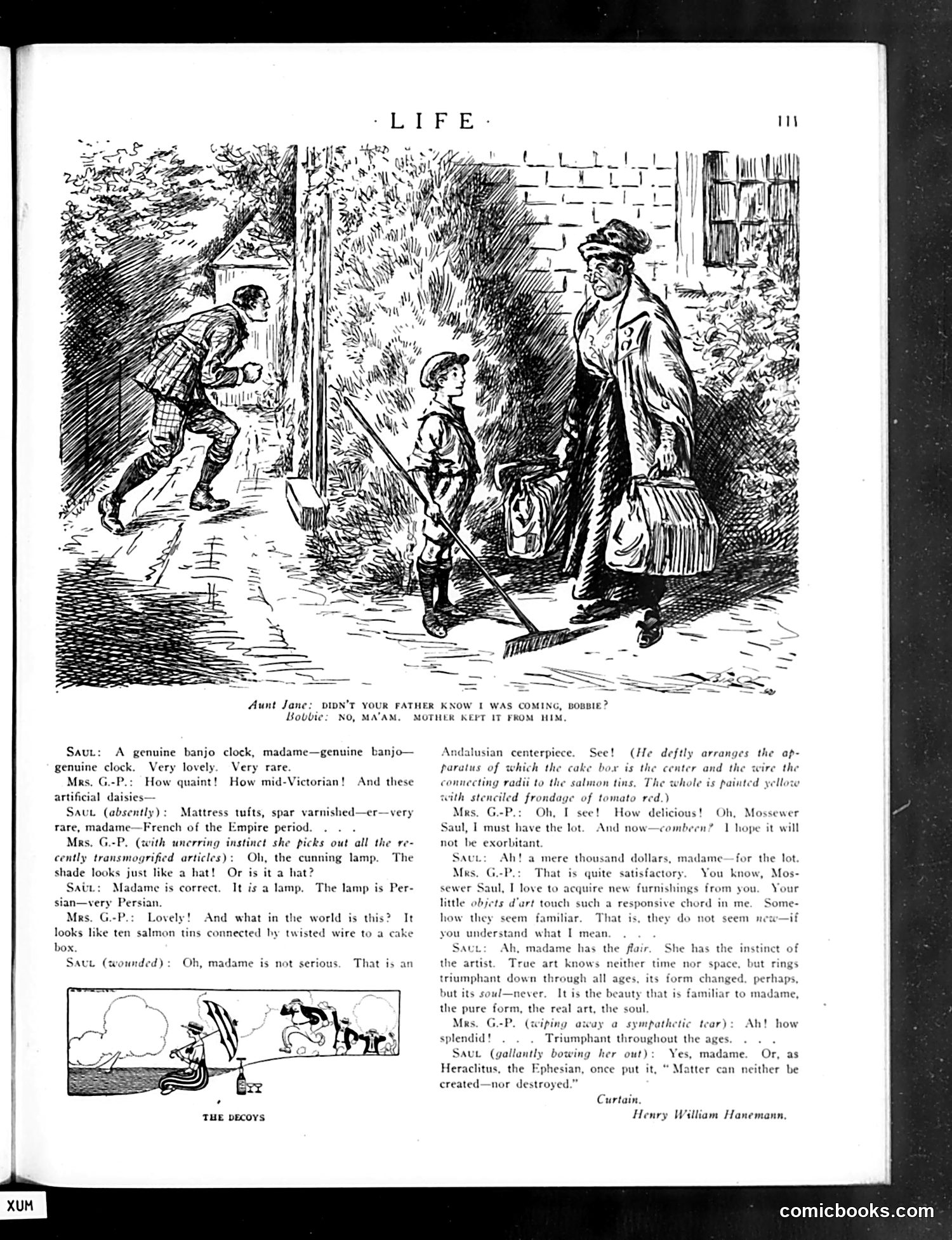
This page contains a humorous sketch and dialogue titled "Aunt Jane" about domestic servants and their employers. The main cartoon depicts an adult woman (presumably "Aunt Jane") encountering a young boy ("Bobbie") and an older man in an alley or courtyard setting. The joke centers on class distinctions and deception: Aunt Jane asks if Bobbie's father knows she's coming, implying she's arriving unannounced. Bobbie claims his mother kept her arrival secret from his father—suggesting the father might disapprove of harboring a relative or that there are domestic tensions the child is concealing. The accompanying dialogue features characters named Saul and Mrs. G-P discussing decorative objects (a banjo clock, salmon-wire designs), likely mocking Victorian-era decorative taste and social pretension among the middle class. The piece satirizes both domestic hierarchy and period aesthetics.
📄 Transcribed text from this page (OCR, searchable)
Machine-transcribed from the original scan — historical spelling and the odd misread are preserved.
Aunt Jane: DIDN'T YOUR FATHER KNOW I WAS COMING, BOBBIE? Bobbie: NO, MA'AM. MOTHER KEPT IT FROM HIM, Saut: A genuine banjo clock, madame—genuine banjo— Andalusian centerpie See! (He deftly arranges the ap- genuine clock. Very lovely. Very rare. paratus of which the bow is the center and the wire the Mrs. G.-P.: How quaint! How mid-Victorian! And these connecting radii to the salmon tins, The whole is painted yellow artifi daisies— with stenciled frondage of tomato red.) Saut (absently): Mattress tufts, spar varnished—er—very Mrs. G.-P.: Oh, I see! How delicious! Oh, Mossewer rare, madame ench of the Empire period. : Saul, I must have the lot. And now—combeen? 1 hope it will Mrs. G.-P. (with unerring instinct she picks out all the re- not be exorbitant cently transmogrified articles): Oh, the cunning lamp. The Saut Ah! a mere thousand dollars, madame—for the lot. shade looks just like a hat! Or is it a hat? Mrs. G.-P.: That is quite satisfactory. You know, Mos- Sati: Madame is correct. It is a lamp. The lamp is Per- sewer Saul, I love to acquire new furnishings from you. Your sian—very Persian. little objets d'art touch such a responsive chord in me. Some- M .: Lovely!) And what in the world is this? It how they seem familiar. That is, they do not seem new—if looks like ten salmon tins connected hy twisted wire to a cake you understand what I mean. box. Savut: Ah, madame has the flair. She has the instinct of Save (wounded): Oh, madame is not serious. That is an the a True art knows neither time nor space, but rings triumphant down through all ages, its form changed, perhaps, but its soul—never. It is the beauty that is familiar to madame, the pure form, the real art, the soul. Mrs. G.-P. away a sympathetic tear): Ah! how splendid! . . Triumphant throughout the ages, . Saut (gallantly bowing her out): Yes, madame. Or, as Heraclitus, the Ephesian, once put it, “ Matter can neither be created—nor destroyed.” Curtain. tuk Decoys Henry William Hanemann, comicbooks.com