
A complete issue · 52 pages · 1920
Life — May 13, 1920
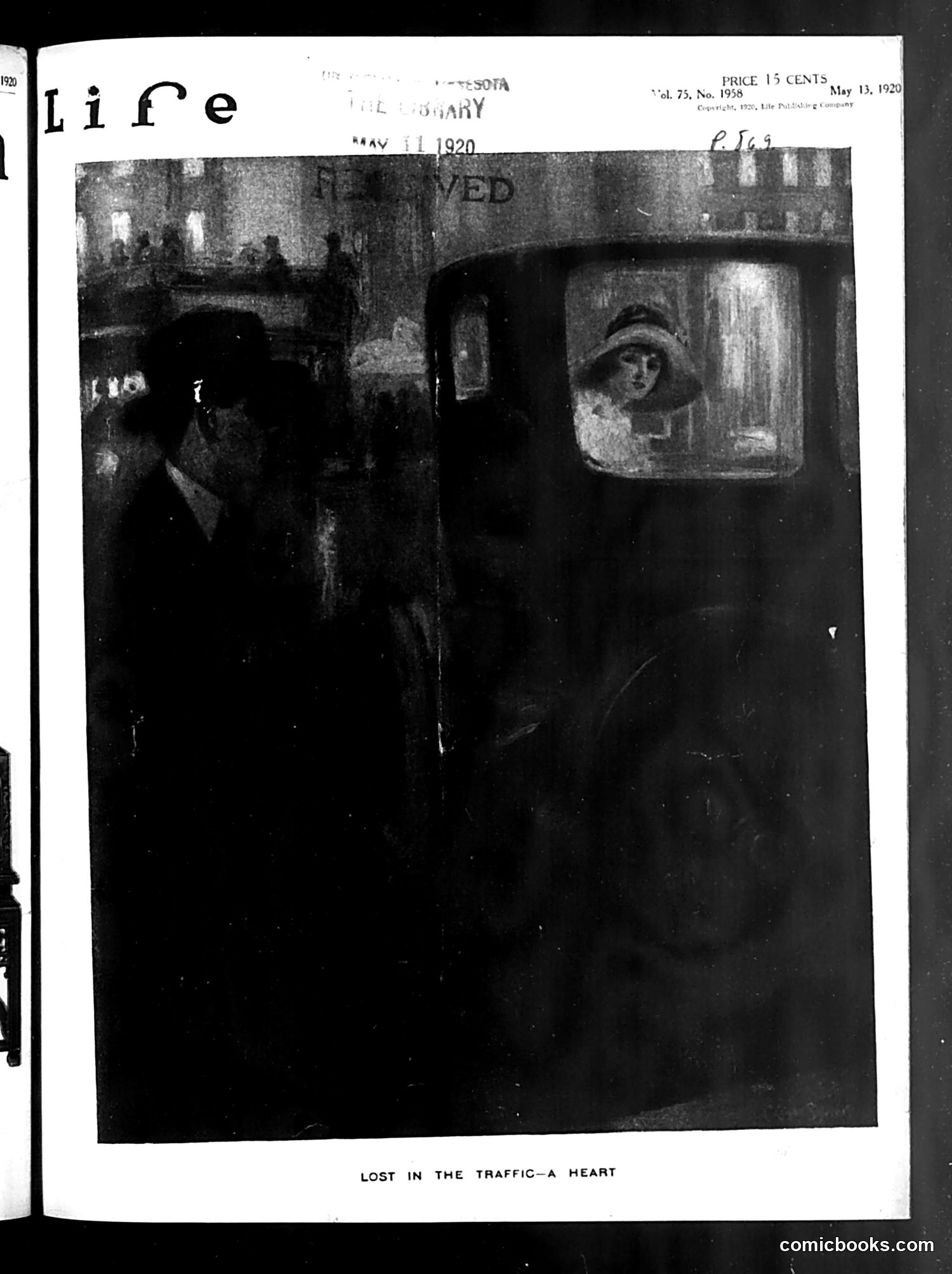
This 1920 Life magazine page depicts a poignant social commentary on urban anonymity. The image shows a man on a city street observing a woman's face visible through a vehicle window—a fleeting, disconnected moment of human connection amid the machinery and crowds of modern city life. The caption "Lost in the Traffic—A Heart" suggests romantic longing thwarted by urban chaos. The composition emphasizes isolation: the couple cannot truly connect despite physical proximity, separated by the vehicle and the anonymity of city streets. This reflects early-twentieth-century anxieties about industrialization and urbanization eroding traditional human relationships and emotional connection. The stark, shadowy photography reinforces the melancholy theme of lost opportunity and emotional disconnection in modern metropolitan life.
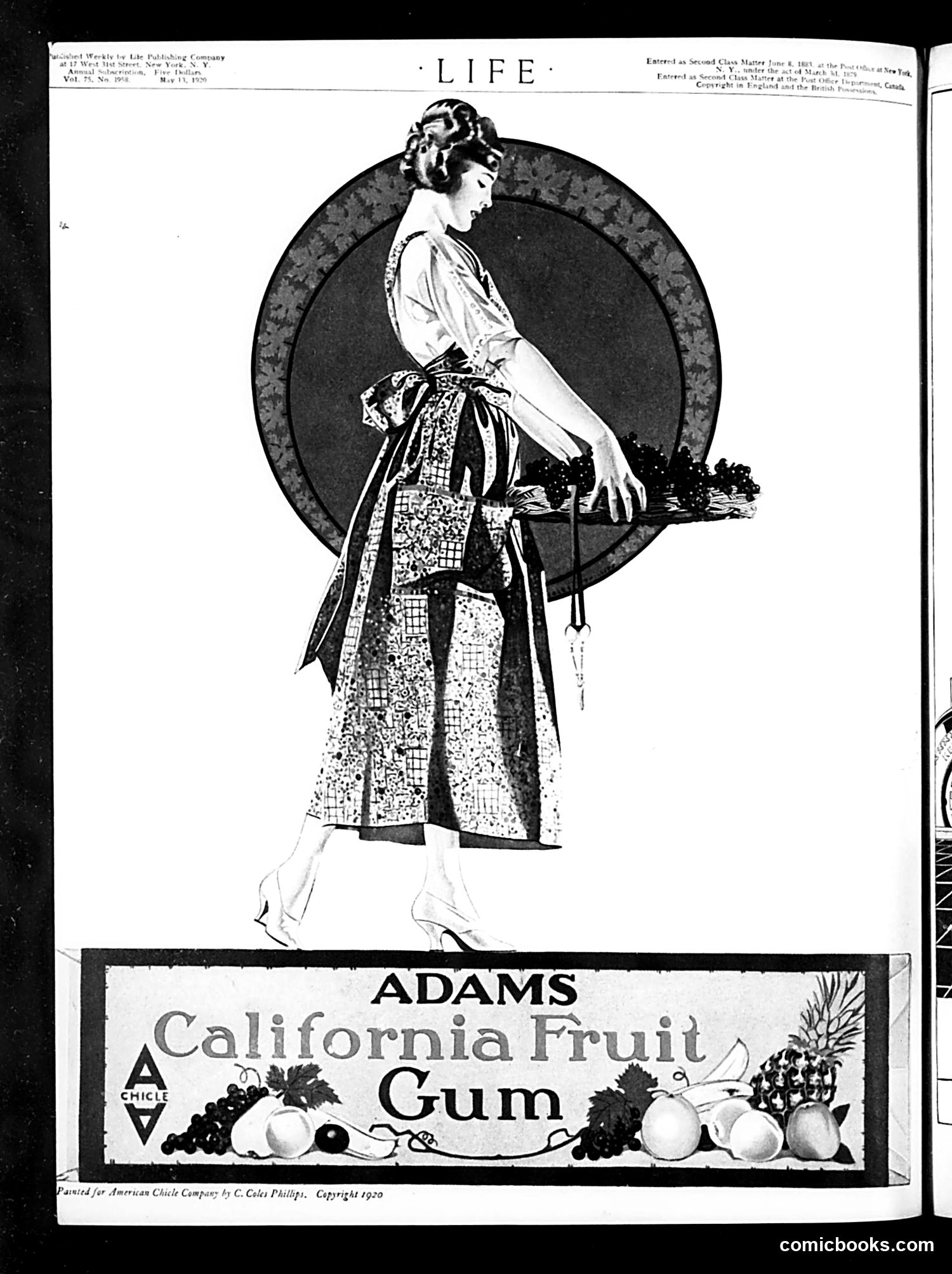
This page is primarily an advertisement for Adams California Fruit Gum, not a political cartoon. The image shows an elegant woman in 1920s fashion (dropped waistline, patterned skirt, white blouse) posed against a decorative circular background, holding what appears to be gum or fruit. The "Life" magazine masthead indicates this is from the publication's satirical era, but the content here is straightforward product advertising rather than social commentary. The illustration style is typical of 1920s commercial art—sophisticated and aspirational, using an idealized feminine figure to market the product to consumers. The decorative border below features various California fruits (grapes, oranges, berries) to reinforce the product's fruit-flavoring claim. This represents standard early-20th-century advertising strategy: associating consumer goods with luxury and refinement.
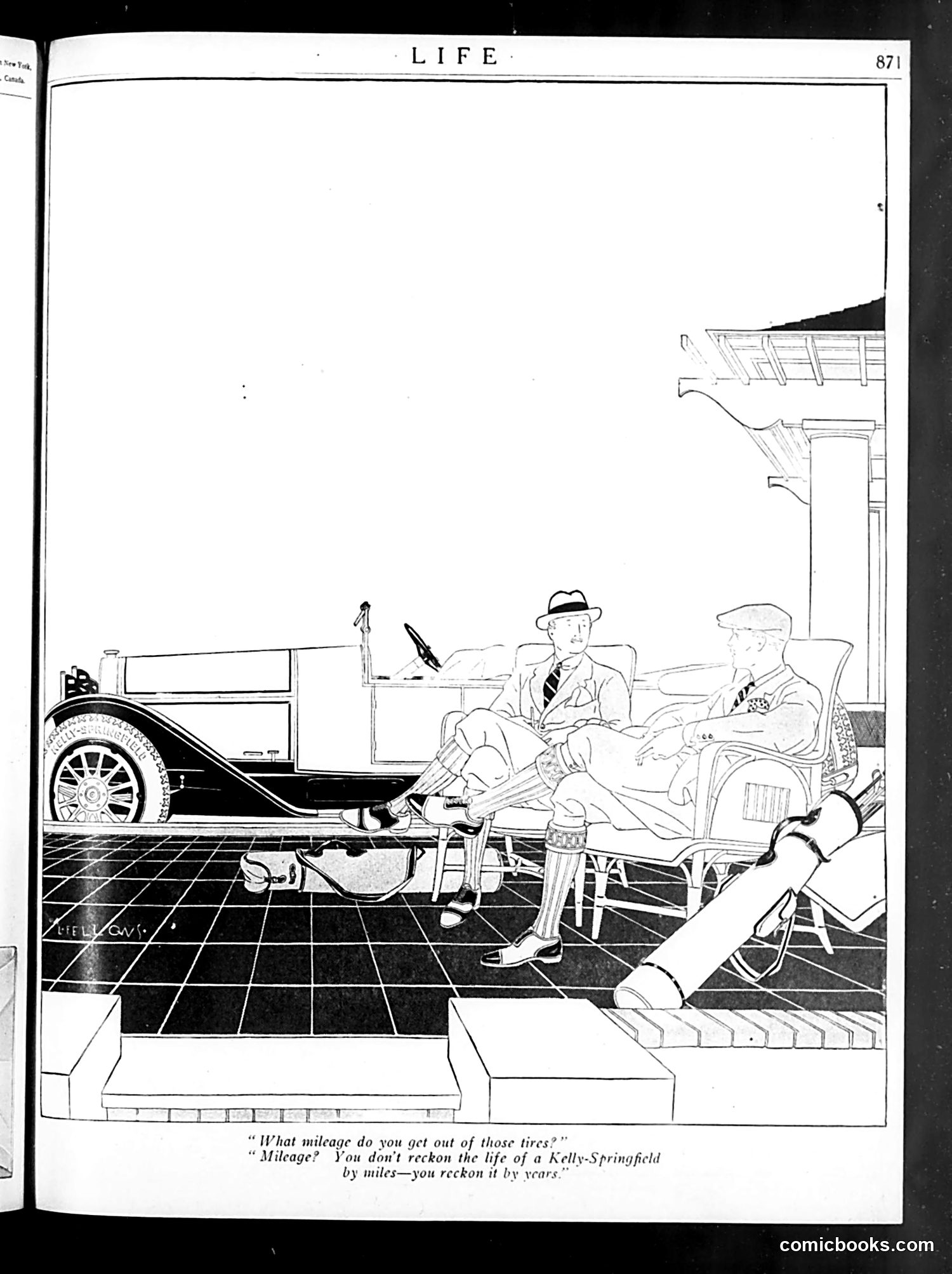
This cartoon depicts two well-dressed men relaxing in comfortable chairs beside a vintage automobile, with a chauffeur visible in the background. The dialogue reads: "What mileage do you get out of those tires?" / "Mileage? You don't reckon the life of a Kelly-Springfield by miles—you reckon it by years." **The joke:** This is an advertisement disguised as humor. It satirizes the typical conversation between affluent car owners discussing tire performance. The punchline promotes Kelly-Springfield brand tires by suggesting their durability is so exceptional that measuring their lifespan by mere mileage is inadequate—years are needed instead. The cartoon reflects early 20th-century advertising strategy, combining class-conscious imagery (wealthy gentlemen, chauffeur) with product endorsement through supposedly witty dialogue. It's fundamentally marketing copy presented as satire.
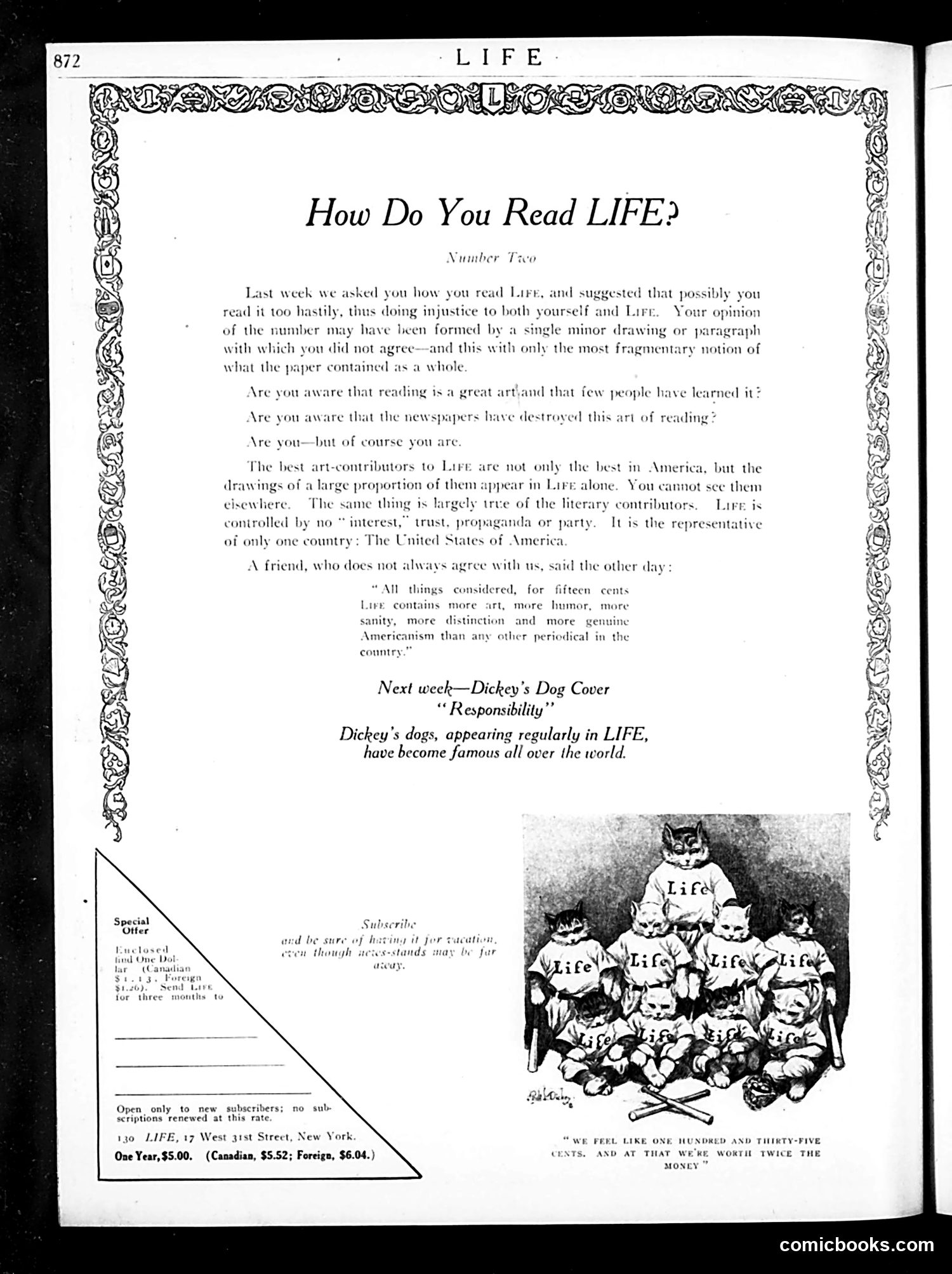
This page is primarily **editorial/promotional content** rather than political satire. It's a "Number Two" installment of "How Do You Read LIFE?" — essentially the magazine defending itself against criticism that readers consume it too hastily. The text argues LIFE contains superior art and literary contributions unavailable elsewhere, and claims these works represent American cultural achievement. A quoted friend endorses LIFE's quality, humor, and "genuine Americanism." The accompanying illustration shows **cats wearing LIFE covers**, apparently meant as humorous visual endorsement of the magazine's worth and appeal. Below is a **subscription offer** for new readers ($5 annually; $5.52 Canadian; $6.04 foreign). This is **self-promotion**, not satire or political commentary—LIFE essentially asking readers to appreciate (and pay for) what they're reading.
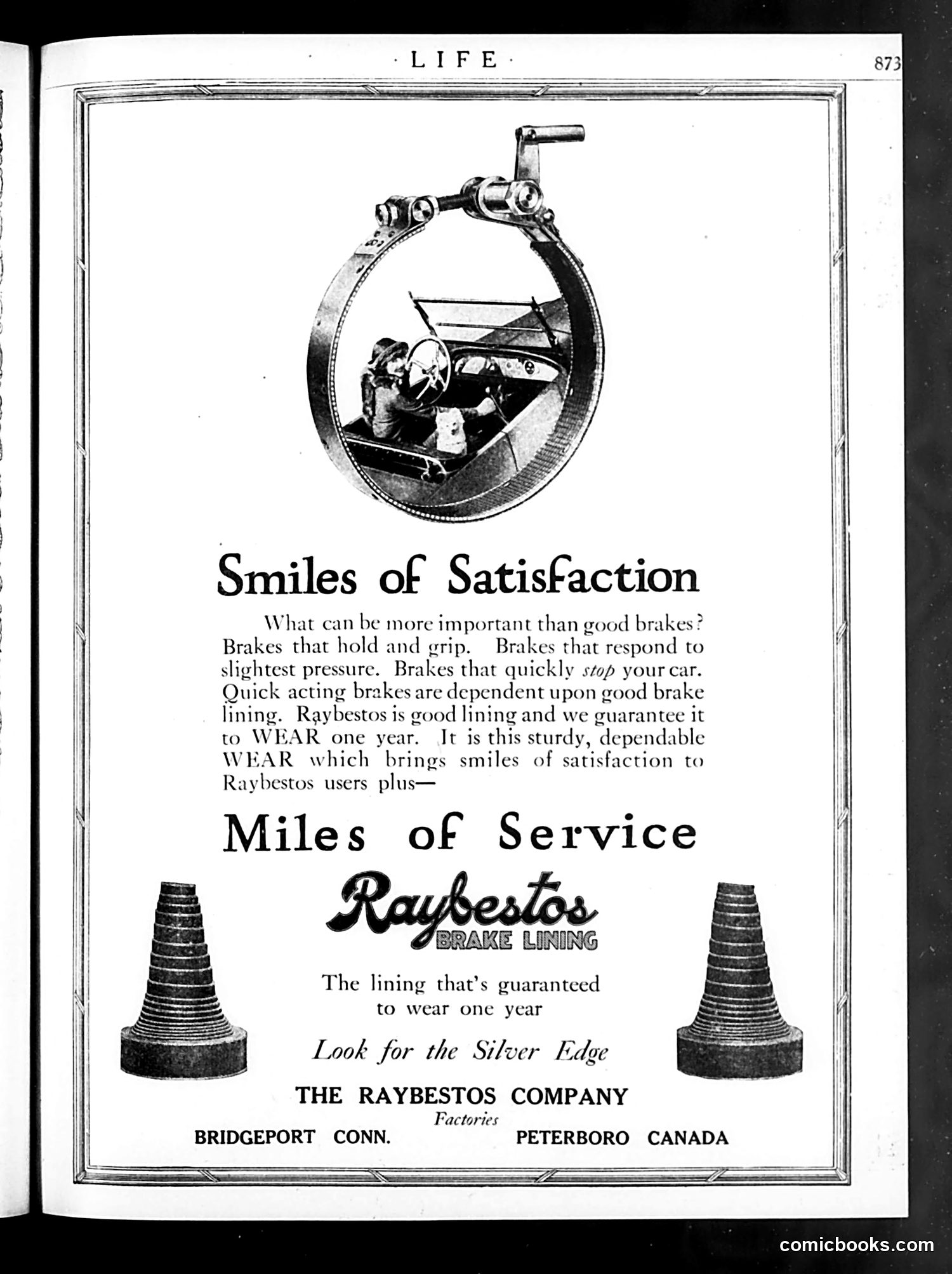
This page is **primarily an advertisement**, not editorial content or satire. It promotes Raybestos brake lining, a automotive safety product. The ad uses the marketing concept of "Smiles of Satisfaction" and "Miles of Service" to appeal to car owners concerned with braking reliability. The imagery shows a satisfied driver in a vehicle with prominent brake components visible. The key sales pitch emphasizes durability—the lining is "guaranteed to wear one year"—and safety features like responsive braking. The "Silver Edge" branding appears to be a product identifier. Factories are listed in Bridgeport, Connecticut and Peterboro, Canada, indicating this was a North American advertisement, likely from the 1920s-1930s based on the design style and page numbering (873). There is no political satire present on this page.
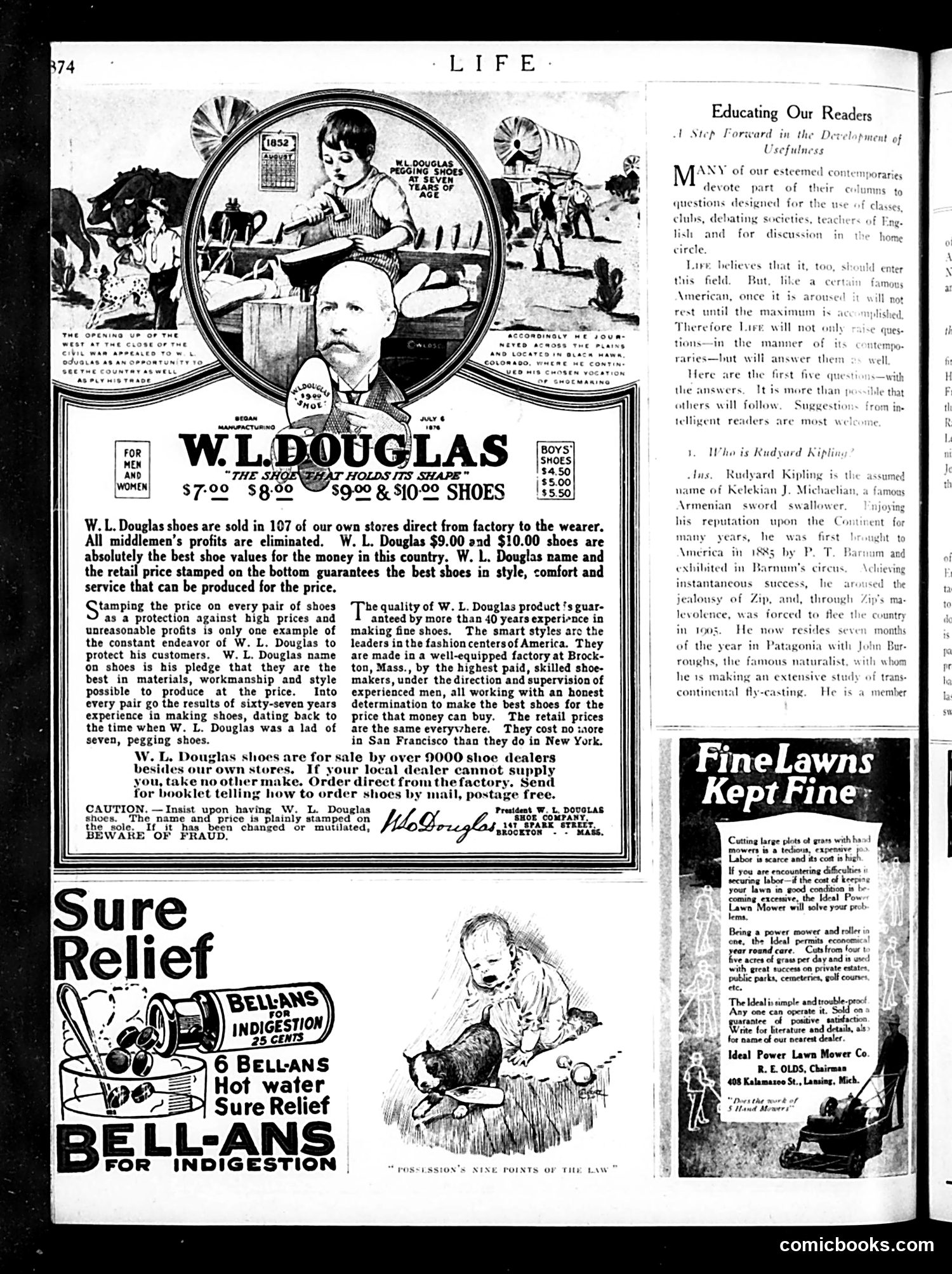
This page is primarily **advertising**, not political satire. The dominant content is a W.L. Douglas shoe advertisement featuring a man's portrait (labeled "W.L. DOUGLAS") and a child wearing shoes. The ad emphasizes direct factory-to-consumer sales eliminating middlemen's profits, positioning Douglas shoes as affordable quality footwear. Below are two unrelated advertisements: Bellans for indigestion and an Ideal Power Lawn Mower. The only editorial content is a column titled "Educating Our Readers" discussing Life magazine's Q&A format, and an illustration captioned "Possession's Nine Points of the Law" showing a baby with a cat—a visual pun on the legal maxim that possession constitutes nine-tenths of ownership.
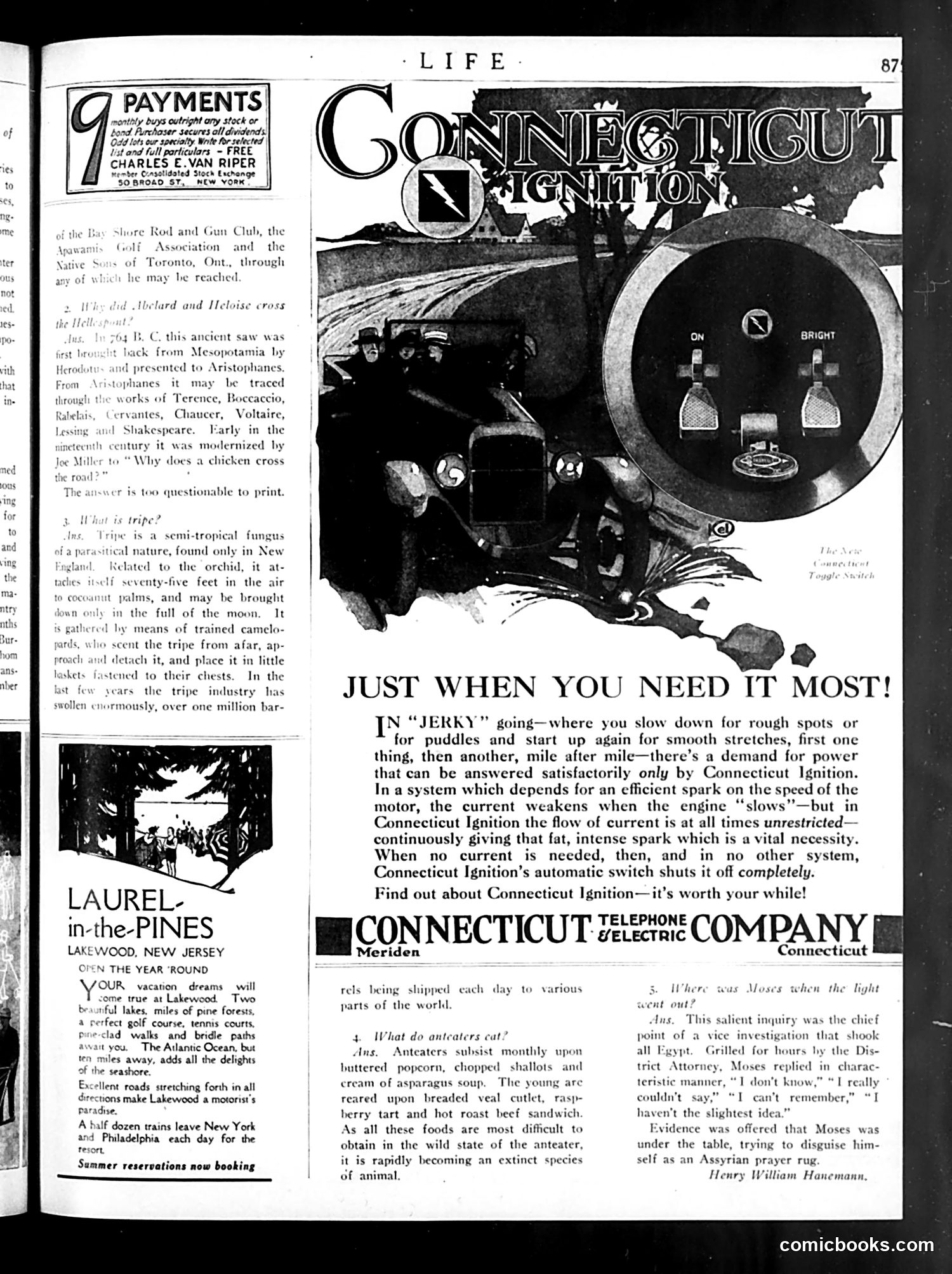
This page is primarily a **full-page advertisement** for Connecticut Telephone & Electric Company's automobile ignition system, rather than satire or political commentary. The ad features a dramatic illustration of an early automobile navigating rough terrain ("jerky" driving conditions). The circular inset shows ignition components. The advertisement's pitch emphasizes reliability: Connecticut Ignition allegedly maintains consistent spark power across varying engine speeds, unlike competitors' systems that weaken during slow speeds. The language ("Just when you need it most") appeals to motorists frustrated by unreliable ignition in demanding driving conditions. This reflects early 1920s automotive technology anxieties—ignition failure was a genuine technical problem in period vehicles. The surrounding page contains unrelated content: a "Laurel-in-the-Pines" resort advertisement and Q&A text.
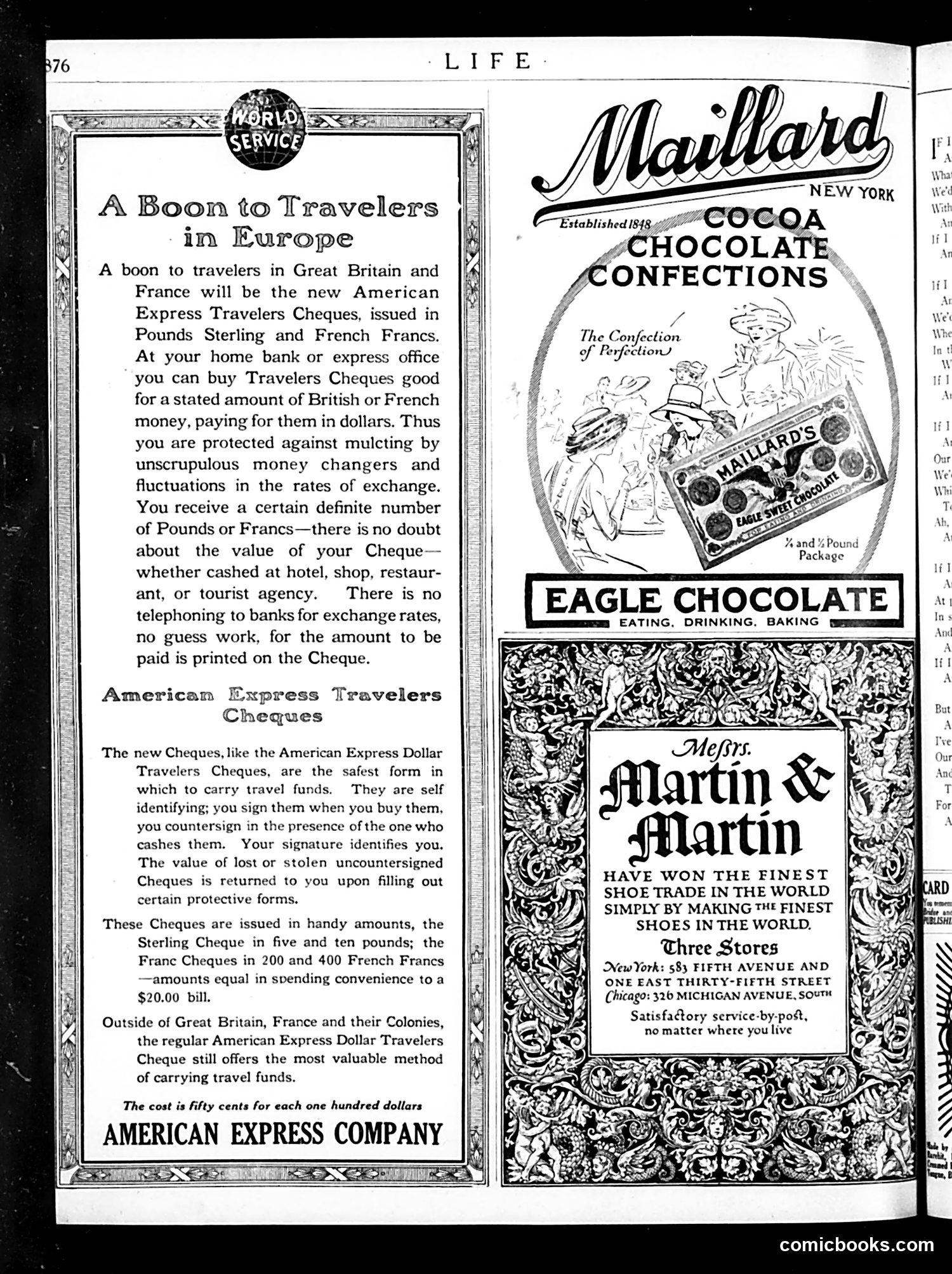
This page contains **no political cartoons or satire**. Instead, it features three advertisements alongside an informational article about American Express Travelers Cheques. The left column explains how travelers in Europe could purchase cheques in Pounds Sterling or French Francs, protecting themselves from currency exchange fluctuations and money changers. The right side displays ads for luxury goods: Maillard chocolate confections (established 1848), Eagle Brand chocolate, and Messrs. Martin & Martin shoes with three New York locations. These ads target affluent travelers—the intended audience for the Travelers Cheques product. This is a straightforward commercial page from what appears to be the early 20th century, aimed at promoting financial and consumer products to wealthy Americans planning European travel.
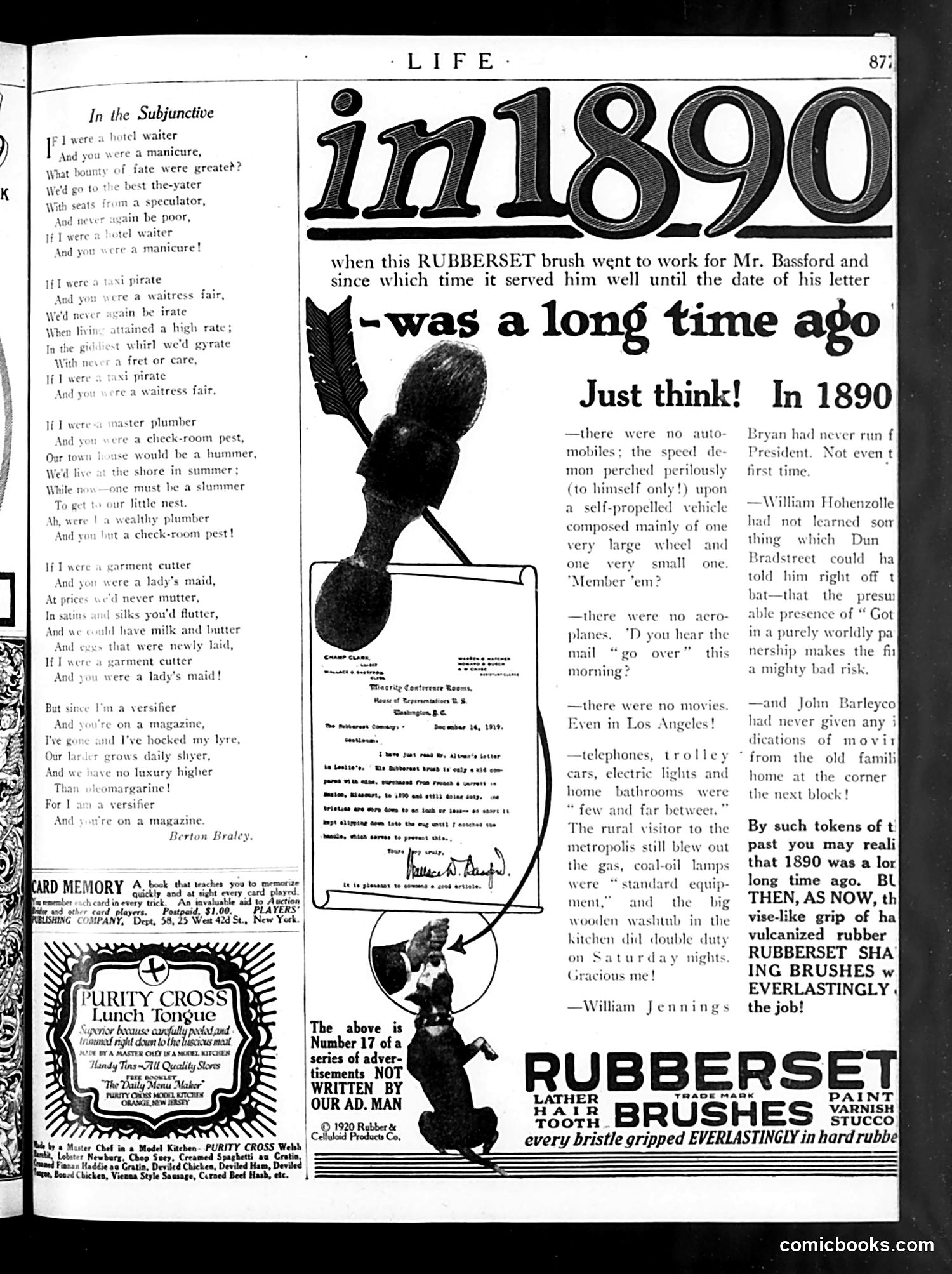
This page is primarily a **Rubberset brush advertisement** disguised as editorial content. The large cartoon depicts a anthropomorphized brush character holding a piece of paper (a letter dated December 14, 1918), illustrating the ad's central claim: the brush has served Mr. Bassford since 1890 and remained reliable "until the date of his letter." The accompanying text uses humor to contrast life in 1890 versus the present day—no automobiles, no airplanes, no movies. This nostalgic comparison emphasizes how durable the Rubberset brush is: despite decades of technological change, it still works. The satirical poem on the left ("In the Subjunctive") is unrelated political humor, but the page's focus is clearly the advertisement using a sentimental narrative to sell brushes through product longevity claims.
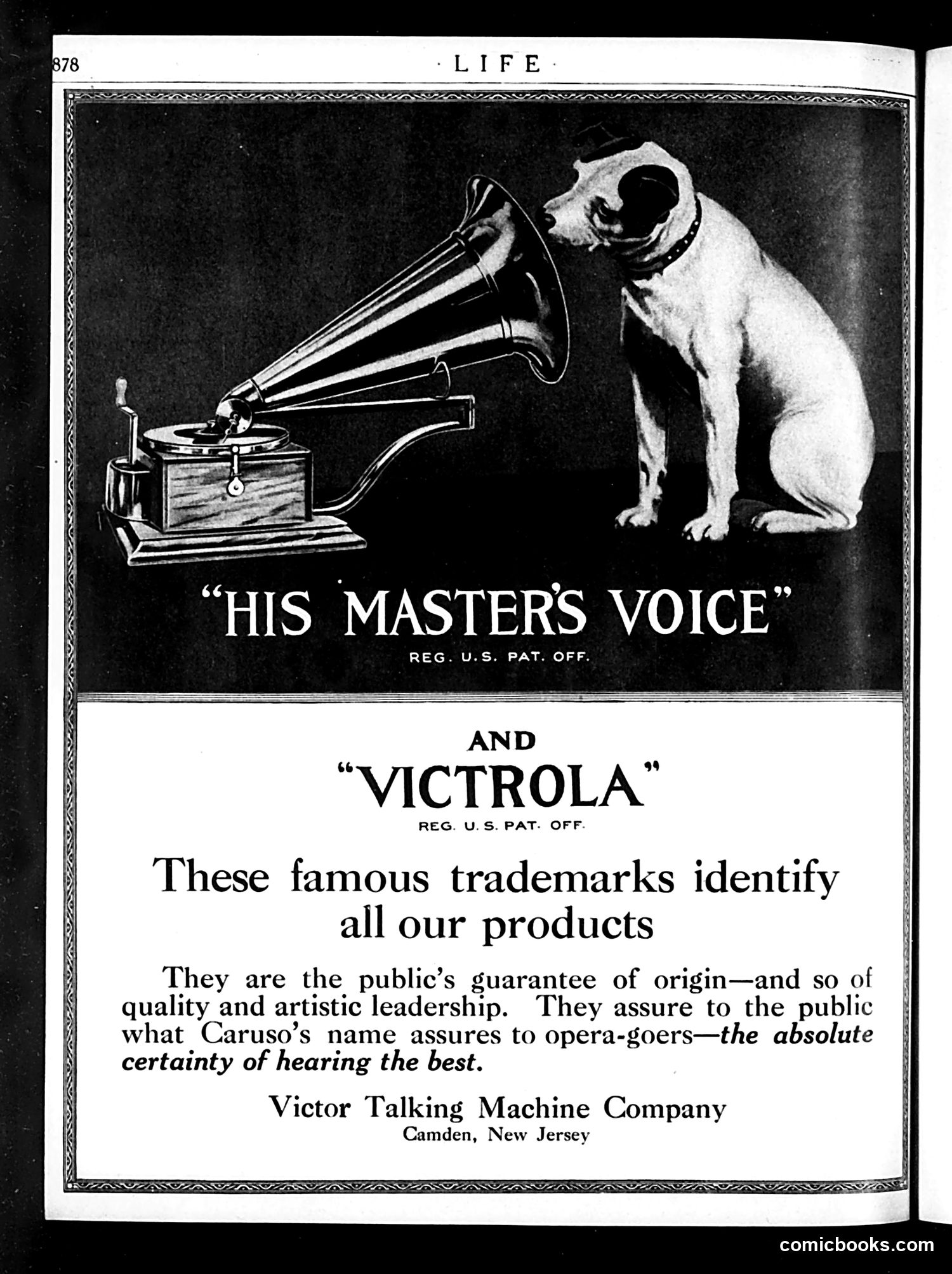
This is a **Victor Talking Machine Company advertisement**, not satire or political content. It appears in *Life* magazine as a paid advertisement. The image shows the famous "His Master's Voice" trademark—a dog listening to a gramophone—alongside the "Victrola" brand name. The ad explains these are registered trademarks guaranteeing product quality and origin. The advertisement makes an analogy to opera singer Enrico Caruso's reputation: just as Caruso's name assured opera-goers of hearing "the best," these trademarks assure consumers of quality phonographs and recordings. This is straightforward commercial advertising promoting Victor's dominance in the early recording industry, not editorial commentary or satire.
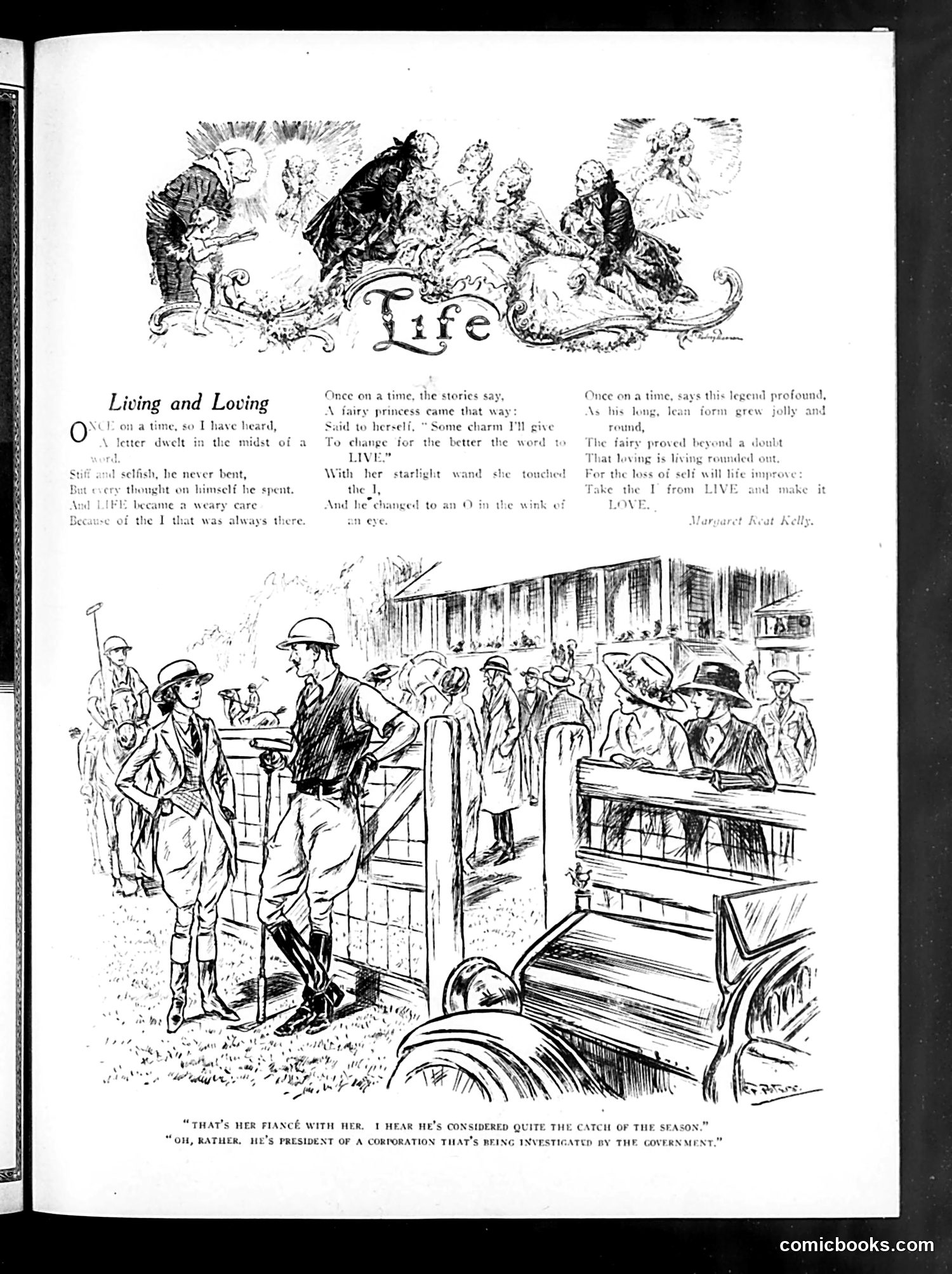
This page contains a poem by Margaret Keating Kelly about transforming a selfish person through love, illustrated with whimsical fairy-tale imagery at top. The main cartoon depicts what appears to be a **government or corporate investigation scene**, likely from the Progressive Era. Two men in suits discuss a third man (possibly a corporation president or official) at what looks like a public venue or stock exchange. The dialogue references "the catch of the season" and mentions a government investigation into corporate wrongdoing. The satire targets **corporate malfeasance and government oversight**—a common Progressive-era concern about powerful business interests being investigated by authorities. The casual tone ("quite the catch") mocks both the scandal and the investigative process itself.
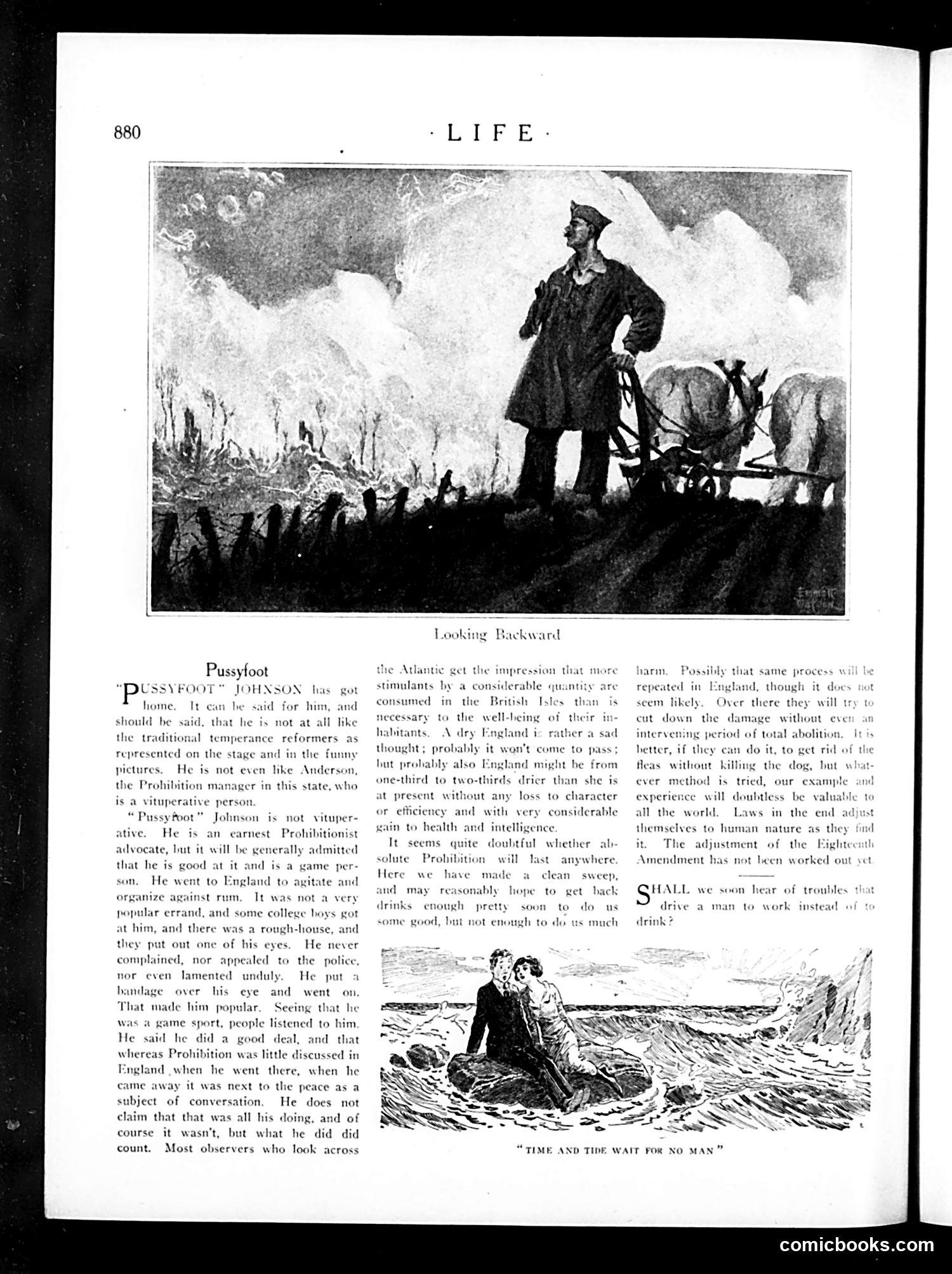
This page satirizes "Pussyfoot" Johnson, a real Prohibition reformer who successfully advocated for alcohol bans in England and America. The article praises Johnson as a "game sport" for his anti-alcohol work, though acknowledges he was unpopular and faced rough treatment. The top illustration shows Johnson surveying a devastated landscape—likely representing the social damage Prohibition caused. The bottom illustration, captioned "Time and Tide Wait for No Man," depicts two figures in turbulent waters, presumably commenting on how Prohibition's consequences were inevitable and inescapable. The satire suggests that while Johnson's intentions were earnest, his reform efforts produced unintended harmful consequences that society couldn't escape, no matter how well-intentioned the reformer.
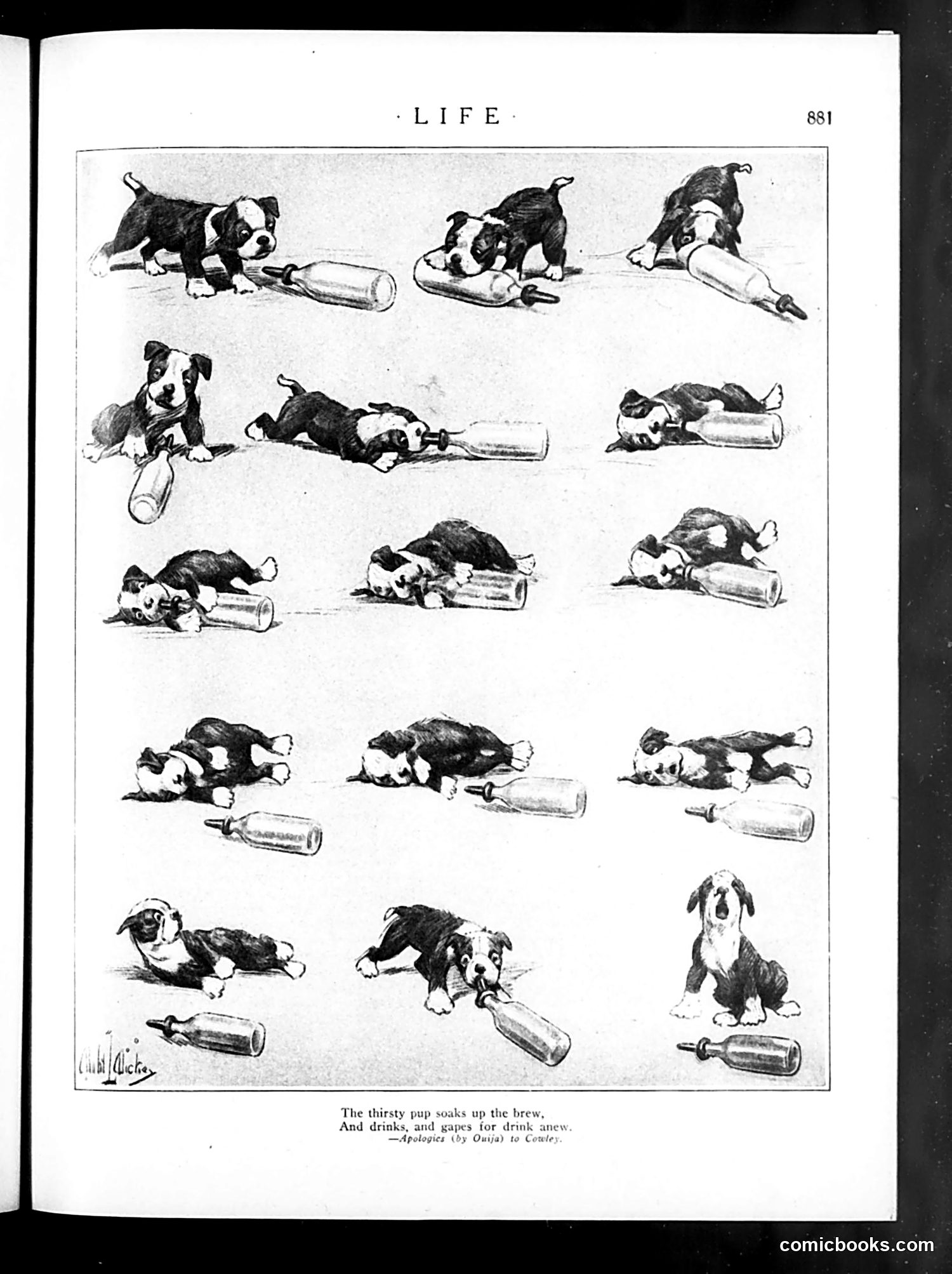
This humorous illustrated sequence depicts puppies discovering and drinking from beer bottles or kegs, progressing through various stages of intoxication. The caption quotes what appears to be a parody of Ovid, suggesting the dogs become progressively drunk and "gape for drink anew." The satire likely comments on alcohol consumption and drunkenness in early 20th-century America, using cute animal characters to mock human drinking habits. The sequential progression showing escalating intoxication serves as visual commentary on excessive drinking and its effects. This reflects Life magazine's tradition of satirizing social behaviors and vices through humorous illustration. The piece doesn't reference a specific political figure or event, but rather represents broader social satire about drinking culture.
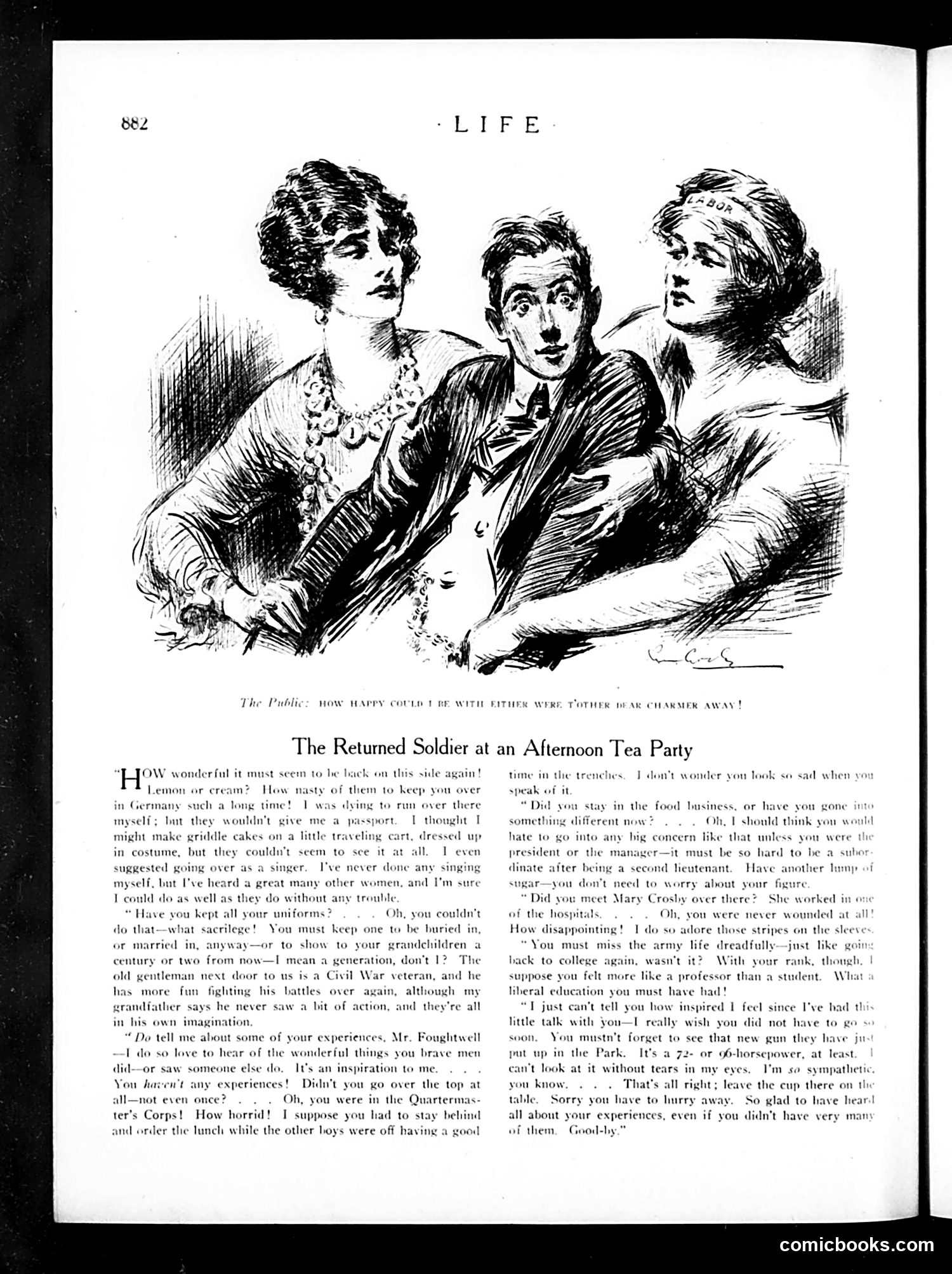
This satirical sketch depicts a soldier reunited with civilian society at a social gathering. The cartoon mocks the awkwardness between the returning serviceman and upper-class women hosting an afternoon tea. The dialogue reveals the social disconnect: the women ask superficial questions about his wartime experiences while discussing trivial matters like lemon versus cream in tea. The soldier grows frustrated with their inability to grasp the gravity of combat, while they find his war stories disturbing and inappropriate for polite conversation. The satire critiques both the soldiers' difficulty reintegrating and the civilian upper class's shallow indifference to military sacrifice. It captures post-WWI tensions between those who experienced trench warfare and those insulated by domestic comfort.
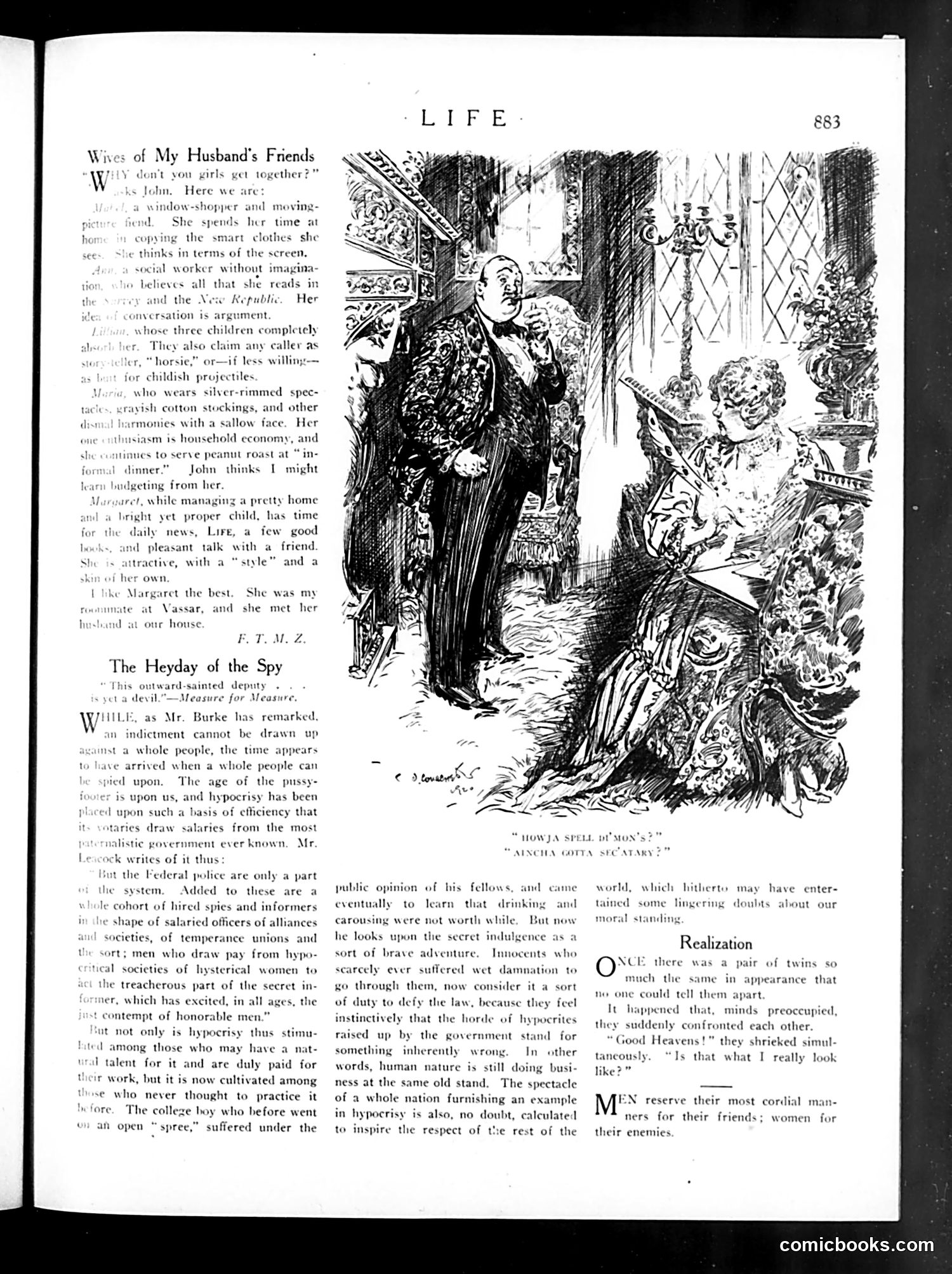
This page contains two distinct pieces. The upper section, "Wives of My Husband's Friends," is a satirical character sketch describing different types of women—a window-shopper, a social worker, a gossip, and others—poking fun at wives who embody stereotypical female behaviors and interests. Below that, "The Heyday of the Spy" discusses government informants and secret police, criticizing the use of paid spies and informers as an inefficient and morally questionable system. The accompanying illustration depicts what appears to be a conversation between two figures in an ornate interior setting, likely satirizing suspicious or secretive dealings. A separate short story titled "Realization" begins at the bottom, about twins separated at birth discovering each other.
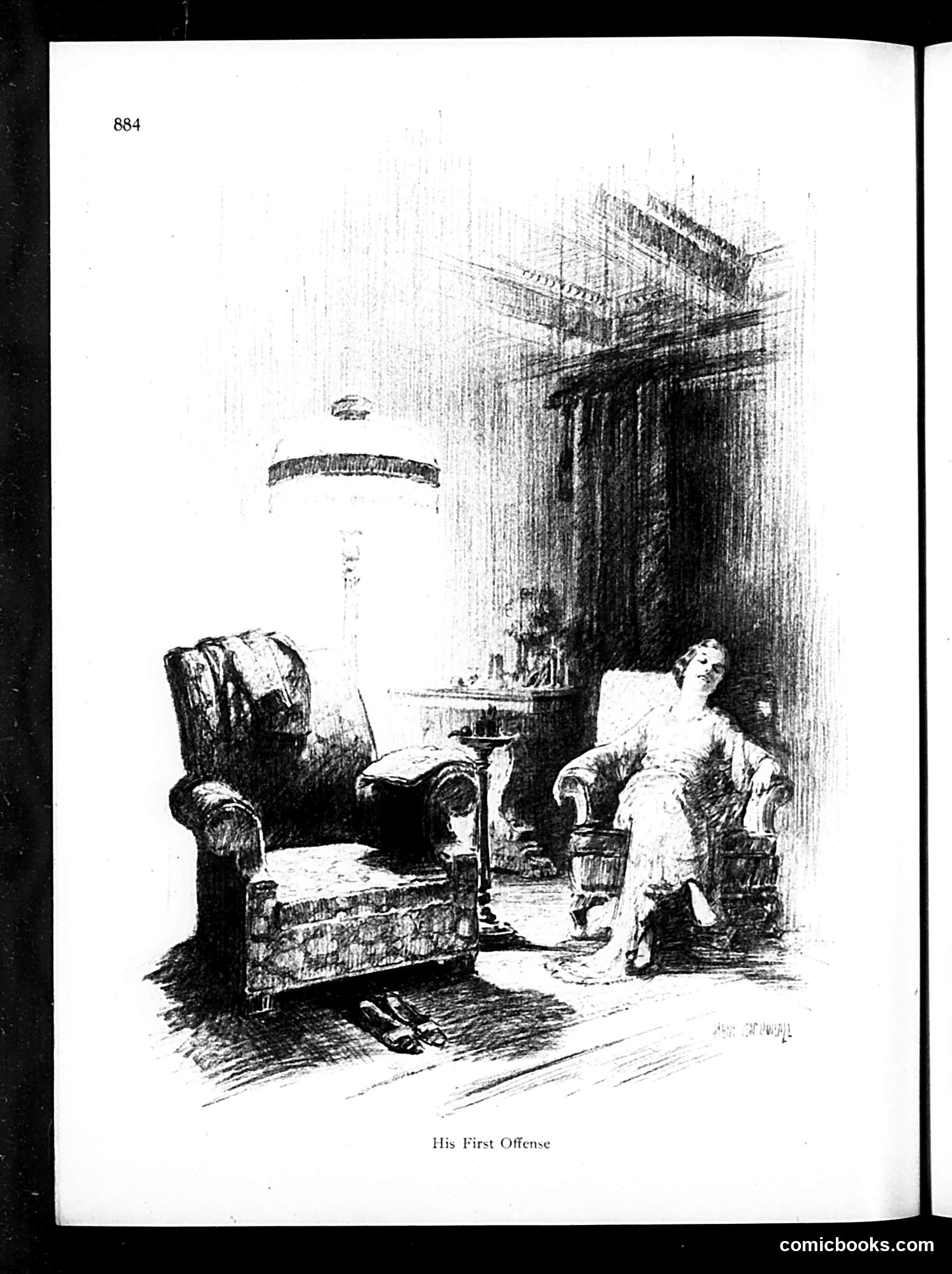
This sketch depicts an interior domestic scene with two figures in what appears to be a modest room. The title "His First Offense" suggests a humorous situation involving a minor transgression or misdeed. The cartoon likely satirizes domestic life, possibly showing a husband caught in some small act of wrongdoing by his wife—a common theme in early 20th-century American humor magazines. The woman's posture and expression suggest disapproval or catching someone in the act, while the man appears sheepish or defensive. Without additional context from Life magazine's original publication date, the specific offense remains unclear, though the intimate domestic setting and the implication of being "caught" suggests marital humor was the intended comedic target.
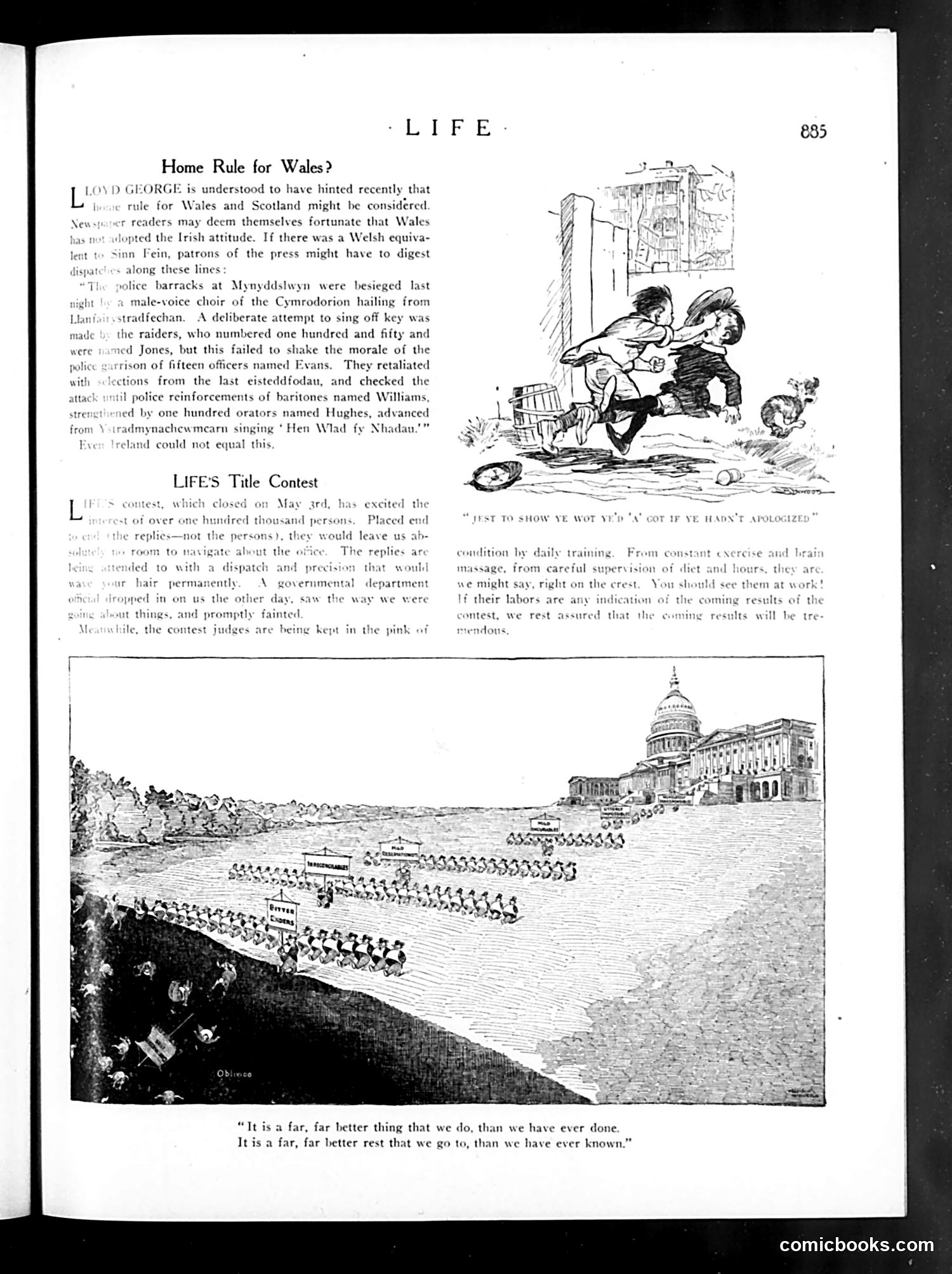
**"Home Rule for Wales?" Section:** This satirizes the prospect of Irish-style Home Rule being extended to Wales. The joke imagines what Welsh political agitation might look like—replacing Irish violence with absurdist Welsh cultural resistance. The anecdote describes police barracks besieged not by armed fighters but by a male-voice choir attempting to "sing off key," with reinforcements arriving as rival singers named Evans, Williams, and Hughes. The humor relies on stereotypes of Welsh male-voice choirs and Welsh naming patterns (multiple people with the same surnames). The reference to "Hen Wlad fy Nhadau" (the Welsh national anthem) emphasizes cultural rather than political conflict. **Top Cartoon:** Depicts two figures in physical combat or rough play, illustrating the caption "just to show we wot ye 'x' got if ye hadn't apologized"—typical early 20th-century comic violence played for laughs. **Bottom Image:** Shows what appears to be a patriotic or military procession at the Capitol, possibly referencing American civic ceremony or military organization.
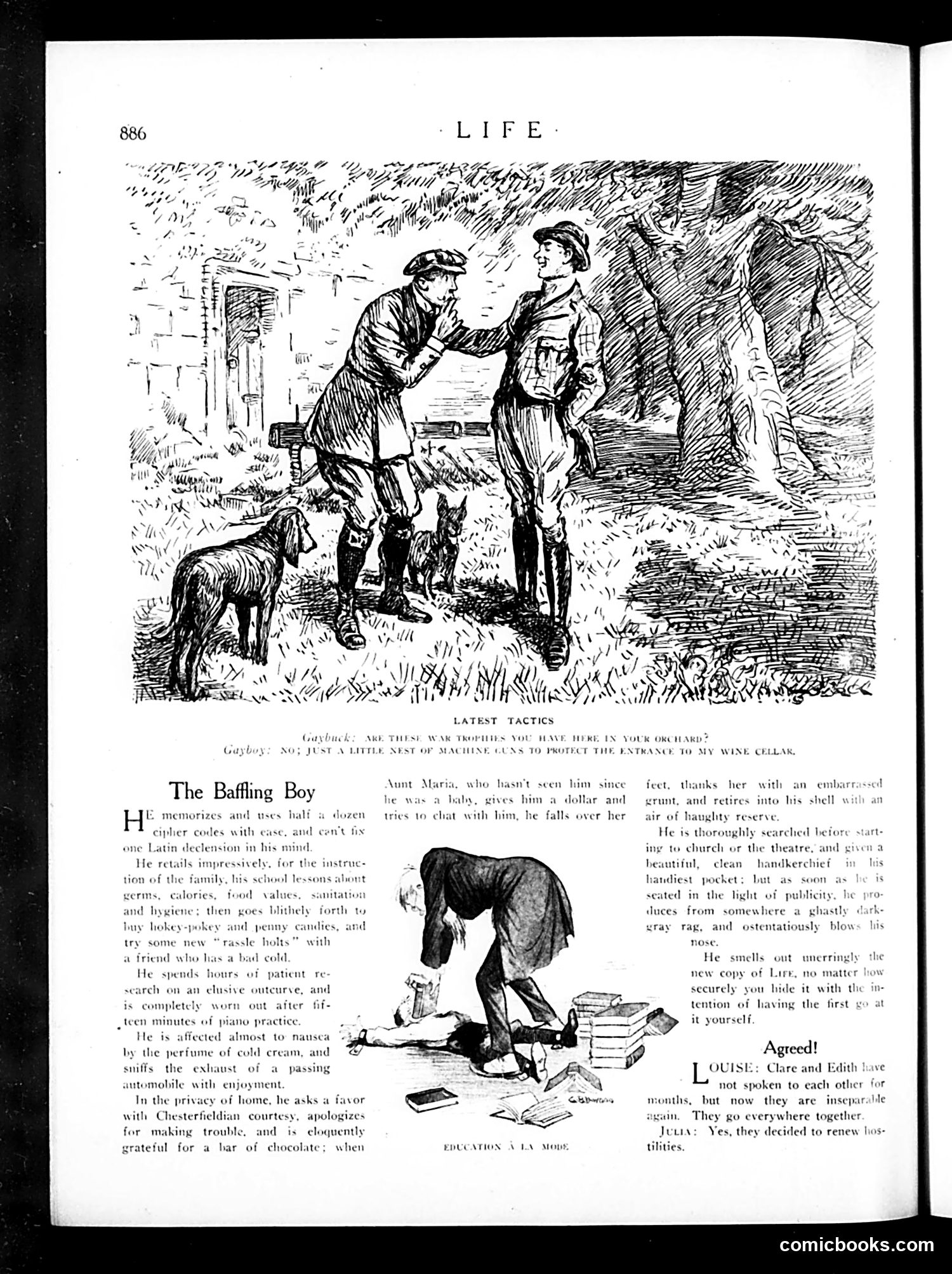
**Top Cartoon ("Latest Tactics"):** This satirizes wealthy Americans' paranoia during wartime (appears to reference WWI era). A man (Gayback) shows off fortifications—specifically machine guns—protecting his wine cellar entrance, treating it like military infrastructure. The joke mocks the absurdity of private citizens weaponizing their homes against perceived threats, likely German spies or domestic unrest. It critiques both excessive patriotic anxiety and the prioritization of protecting luxuries (wine) over genuine security. **"The Baffling Boy" Story:** A humorous character sketch of an irritating, precocious boy who memorizes useless information (Latin, cipher codes, nutrition facts) but lacks common sense or social graces. He's pedantic, socially awkward, obsessively searches for hidden items, and affects intellectual superiority while remaining fundamentally annoying to adults around him. **"Agreed!" Section:** Brief satirical note about two women, Clare and Edith, resuming their friendship and social activities after months of estrangement, having "decided to renew hostilities"—using military terminology humorously for reconciliation.
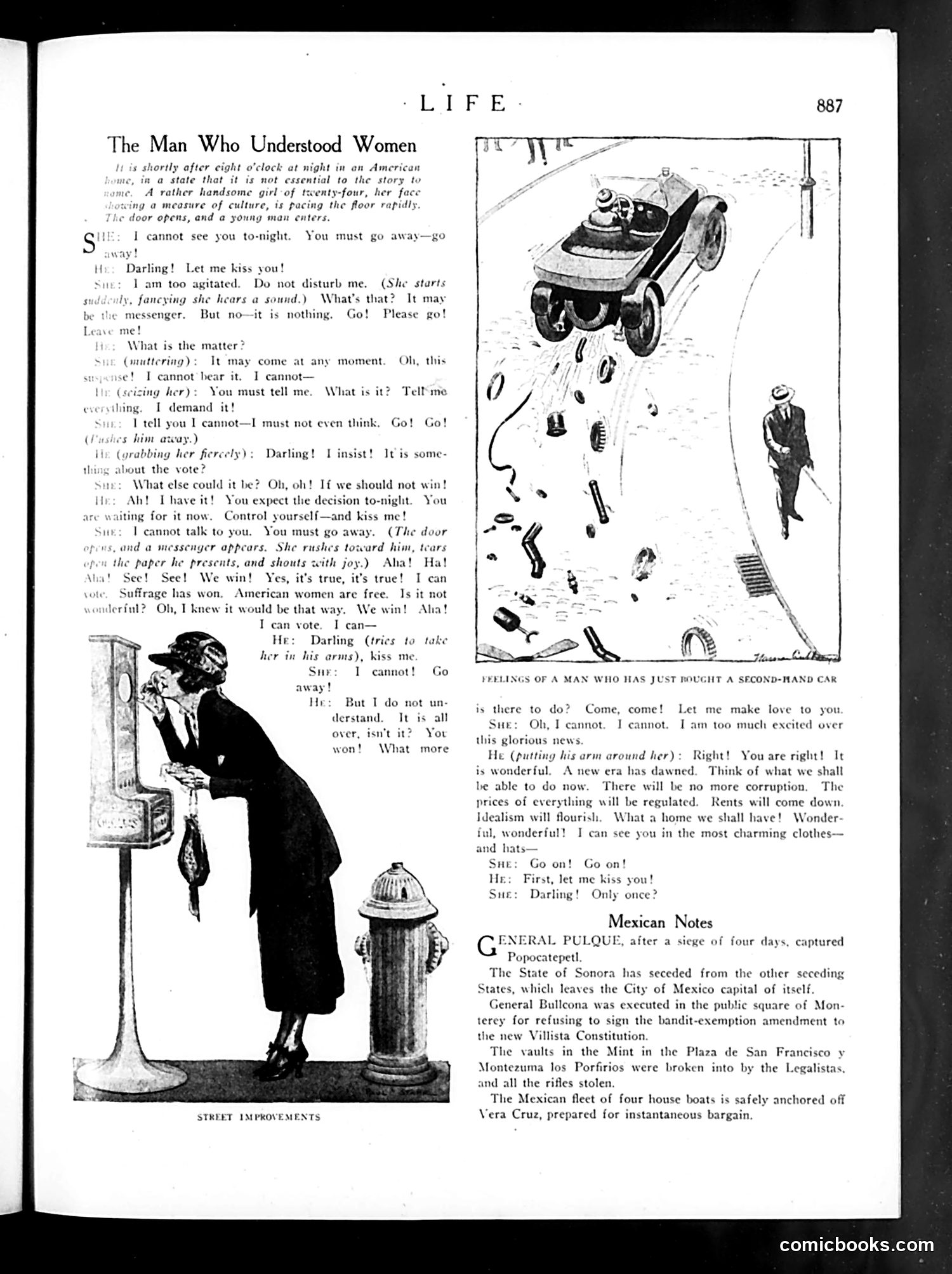
This dialogue-based cartoon satirizes male attitudes toward women's suffrage (voting rights). A young woman awaits news of a suffrage vote while her boyfriend repeatedly tries to seduce her. When suffrage wins, she's ecstatic—but refuses his advances, too excited about the political victory. The satire's point: the man claims to "understand women" yet completely misses that she cares more about gaining voting rights than romantic attention. He tries to capitalize on her joy by romanticizing their future together (no corruption, regulated prices, nice clothes), but she remains focused on the political triumph itself. The cartoon mocks men who patronize women or assume romance solves everything, while also satirizing the intensity of suffrage activists' commitment to the cause—suggesting their devotion to the vote surpasses even romantic interest. The accompanying illustrations about street improvements and a car reinforce themes of modern progress and changing social conditions.
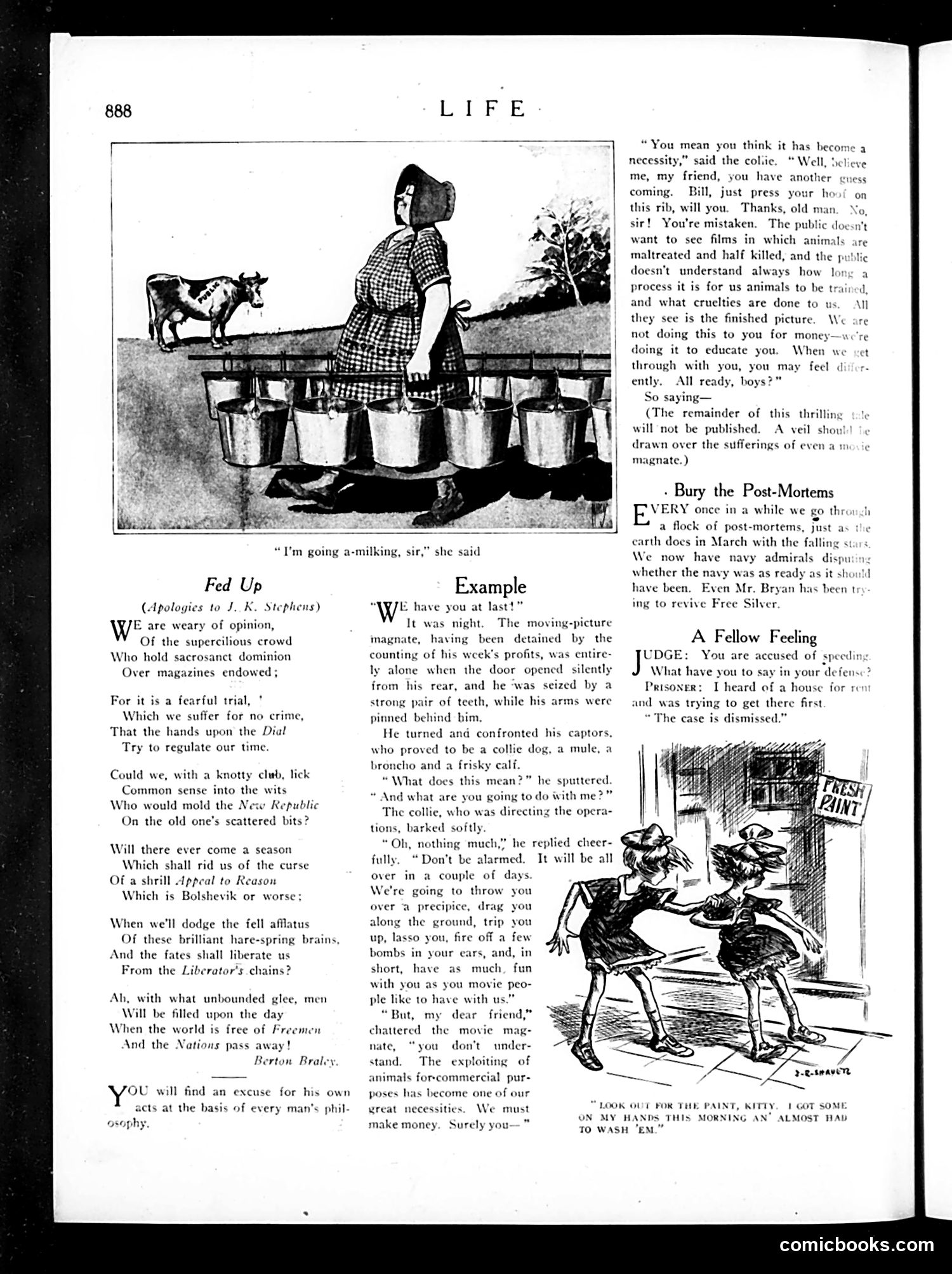
This page contains three distinct satirical pieces targeting early 20th-century American progressivism and film industry practices. **"Fed Up"** (poem by Berton Braley) attacks intellectual magazines and progressive movements—specifically referencing *Appeal to Reason* (a socialist publication) and *The Liberator*—mocking their influence on American opinion-making. The speaker expresses exhaustion with self-righteous reformers dictating public thought. **"Example"** satirizes movie producers who exploit animals for profit. Animals capture a studio magnate to subject him to the same cruelties inflicted on them during filming—being thrown off cliffs, dragged, and bombed. The collie lectures that audiences don't understand the suffering required, claiming the violence is "educational." The satire critiques both animal abuse in cinema and producers' self-righteous justifications for it. **"A Fellow Feeling"** (brief joke) mocks traffic enforcement: a speeding defendant admits rushing to a rental house and receives dismissal, suggesting judges sympathize with urgent housing needs. Together, these pieces reflect Progressive Era anxieties about reform movements, animal welfare concerns in emerging cinema, and class sympathies.
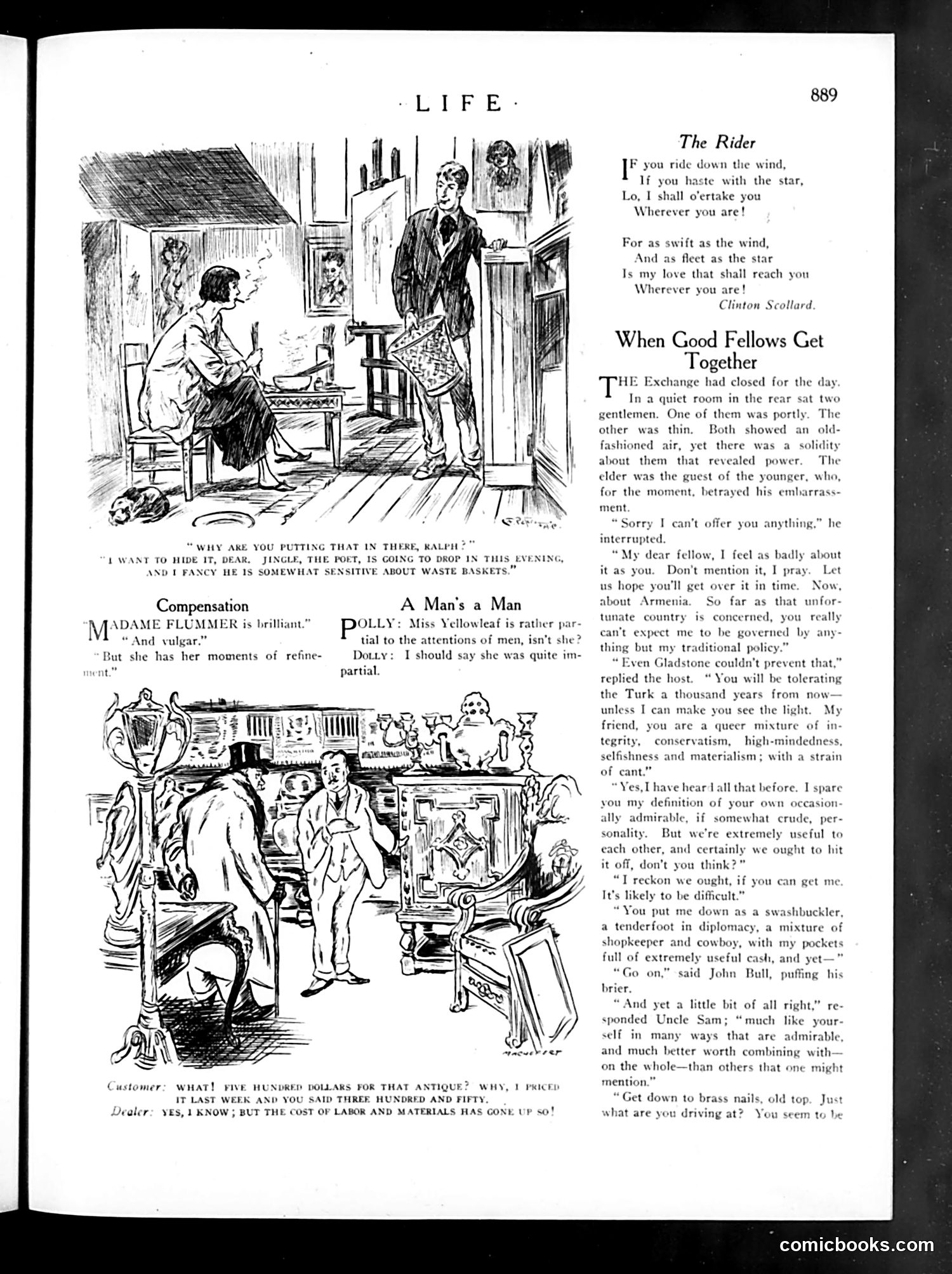
This page contains three separate jokes/cartoons typical of early 20th-century American humor: **"Why Are You Putting That In There, Ralph?"** depicts a woman hiding a wastebasket before a visiting poet arrives, joking that poets are supposedly too refined/sensitive to acknowledge such mundane household items. **"Compensation" and "A Man's a Man"** are brief one-liner jokes about social pretense—that refined people can be vulgar, and that women can be impartial rather than partial to male attention. **The antique dealer cartoon** satirizes inflation and merchant opportunism: a dealer raises prices between sales, blaming increased labor and material costs—a common post-WWI economic complaint. **"When Good Fellows Get Together"** depicts a conversation between Uncle Sam (representing the United States) and John Bull (representing Britain), discussing geopolitics and the Armenian question. The satire suggests both nations are pragmatic, self-interested, and mutually useful despite philosophical differences—mocking their pretense of moral consistency in foreign policy.
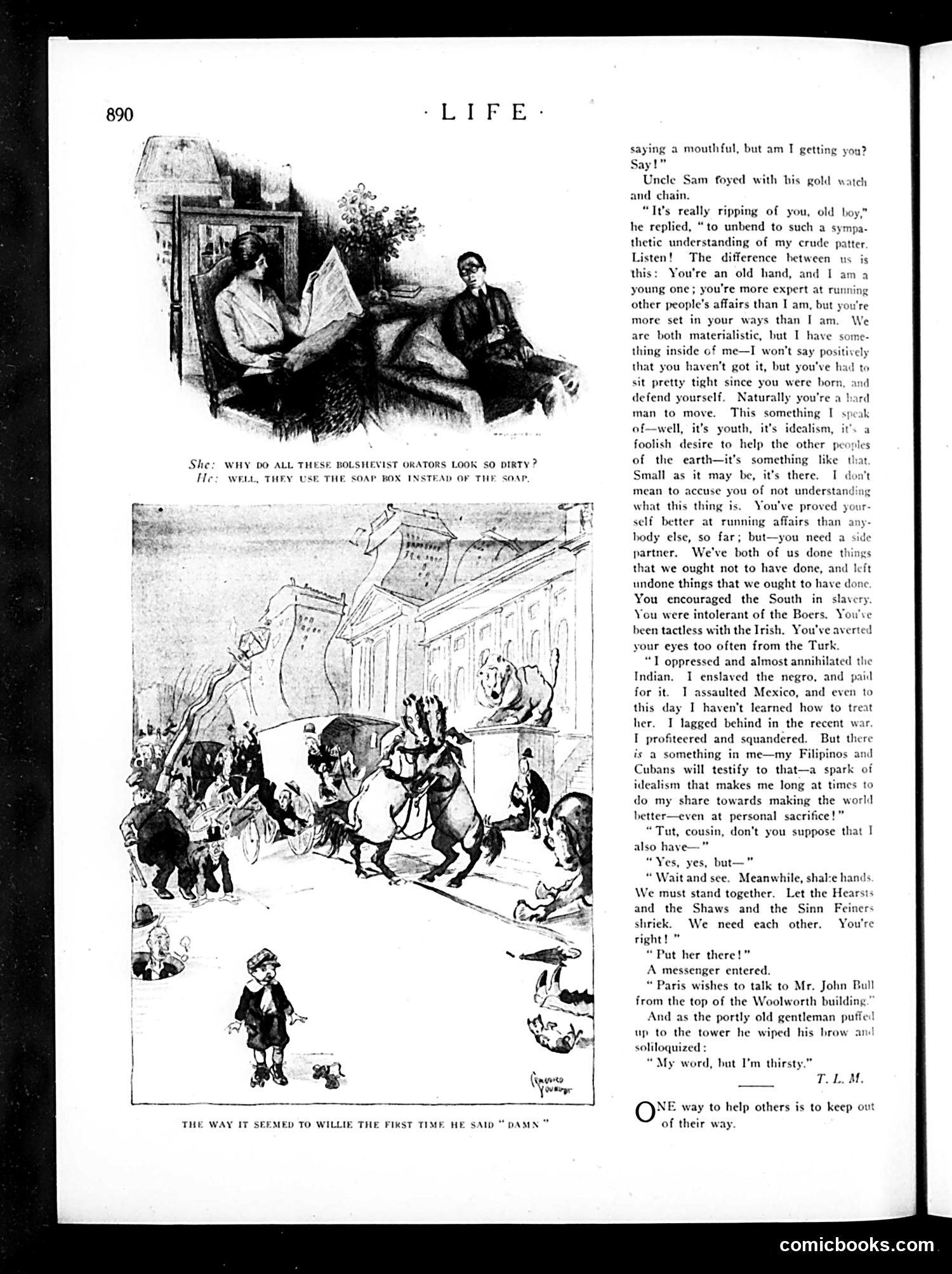
This page satirizes Anglo-American relations post-WWI through a dialogue between **Uncle Sam** (America) and **John Bull** (Britain personified). **Main Cartoon (top):** Uncle Sam and John Bull converse about their differences. Sam argues America, though young and idealistic, offers something Britain—old, experienced, but rigid—needs: youthful idealism and desire to help others globally. Both nations acknowledge past moral failures (slavery, imperialism, tactics with Ireland/Turkey/Mexico). **Lower Cartoon:** A crude joke about "Bolshevist orators" using "soapbox" literally instead of soap—mocking both radical speakers and their poor hygiene. **Context:** This reflects 1920s anxiety about American-British cooperation amid post-war upheaval, Bolshevism, and Irish/Egyptian independence movements. The "Hearsts and Shaws and Sinn Feiners" reference divisive factions threatening unity. **Point:** America and Britain should unite despite past wrongs; youthful American idealism complements British experience against common threats (radicalism, instability).
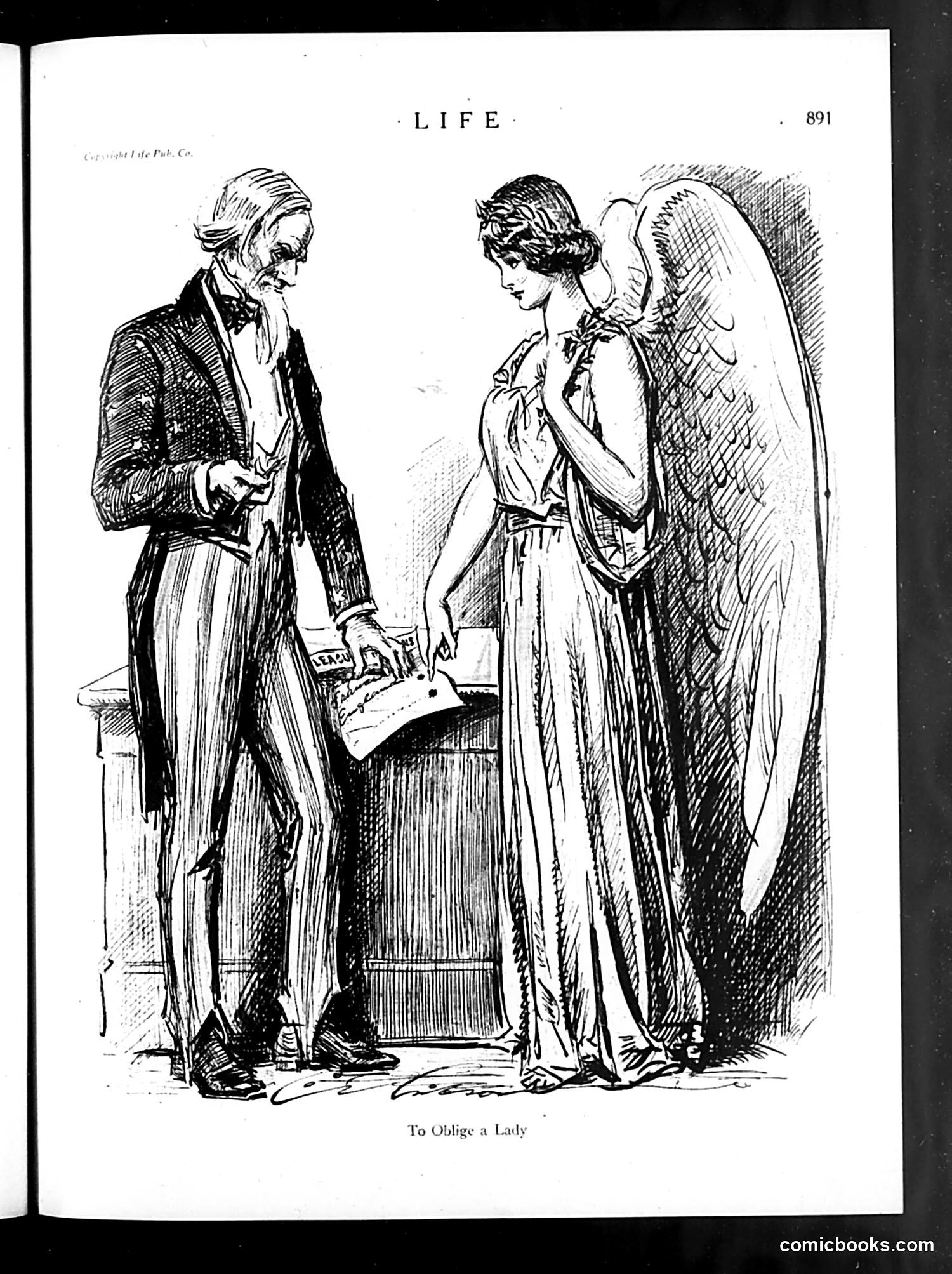
This satirical illustration depicts a gentleman presenting what appears to be a document or card to a woman, while an angelic or ethereal female figure looms behind her. The caption "To Oblige a Lady" suggests social courtesy or gallantry. The exact satirical target is unclear from the image alone. The gentleman's formal attire and the woman's elegant dress suggest upper-class society. The ethereal figure in the background might represent virtue, idealism, or perhaps death—suggesting the gentleman is making some significant sacrifice or commitment "to oblige" the woman. Without additional context or date information, the specific social critique remains ambiguous, though it likely mocks courtship conventions or male deference to female demands in Victorian or Edwardian society.
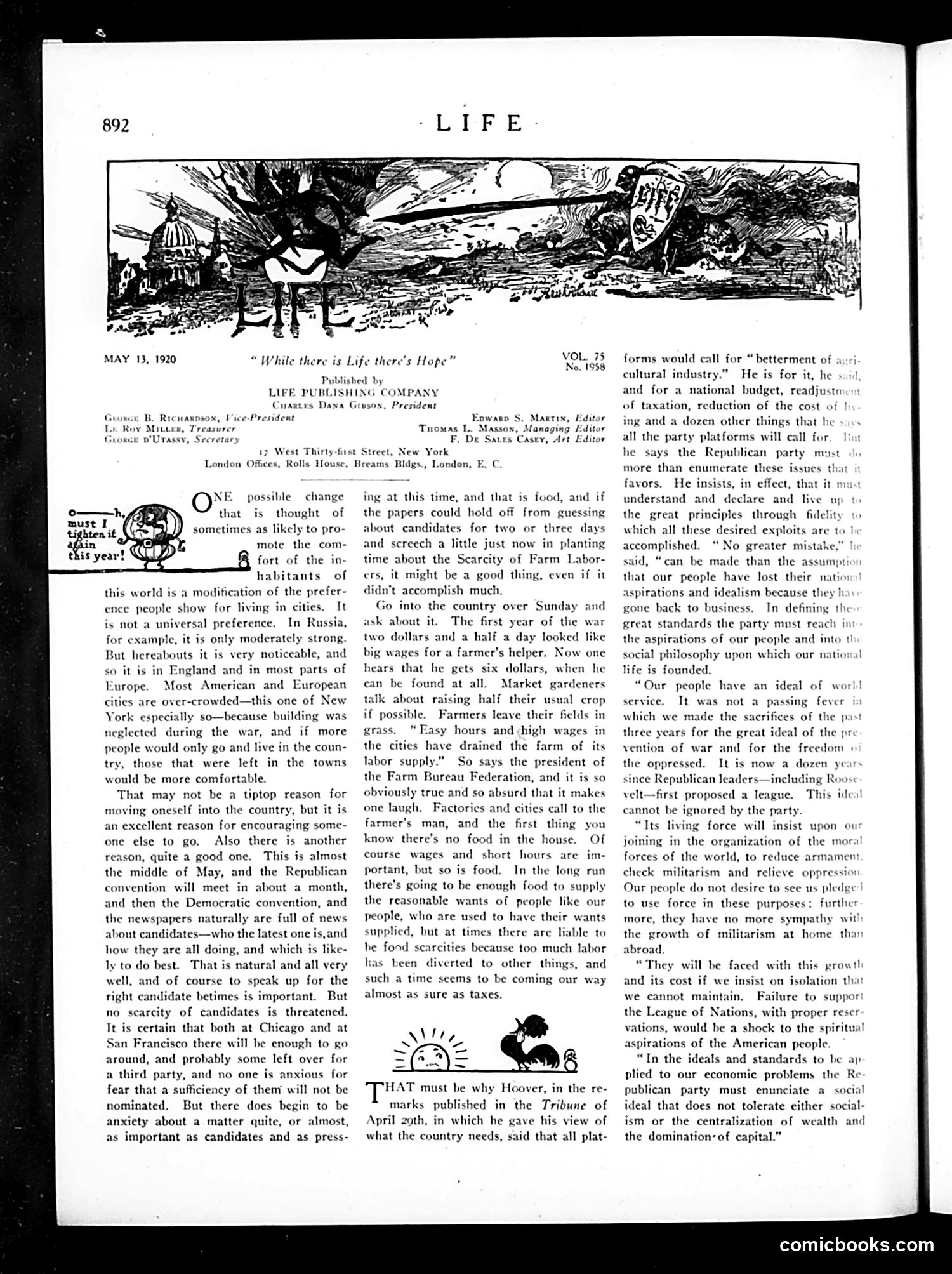
This page combines editorial commentary with a decorative header illustration. The main text addresses post-WWI America's urban overcrowding and an emerging farm labor crisis. **The Central Issues:** The editorial argues that encouraging migration from congested cities (especially New York) to the countryside would benefit everyone. More significantly, it highlights a critical food shortage threat caused by farm labor depletion—workers have abandoned agricultural work for better wages and "easy hours" in factories and cities. **The Political Context:** Published during election season (Republican and Democratic conventions were imminent in 1920), the piece criticizes newspapers for obsessing over candidates while ignoring the genuine crisis: insufficient farm labor threatens food supply. The editorial cites Herbert Hoover's recent comments on national needs, suggesting agricultural support should be a platform priority. **The Satire:** The piece mocks the absurdity that while cities overflow with people, farms lack workers, creating food scarcity—yet political discourse ignores this tangible problem for speculation about candidates.
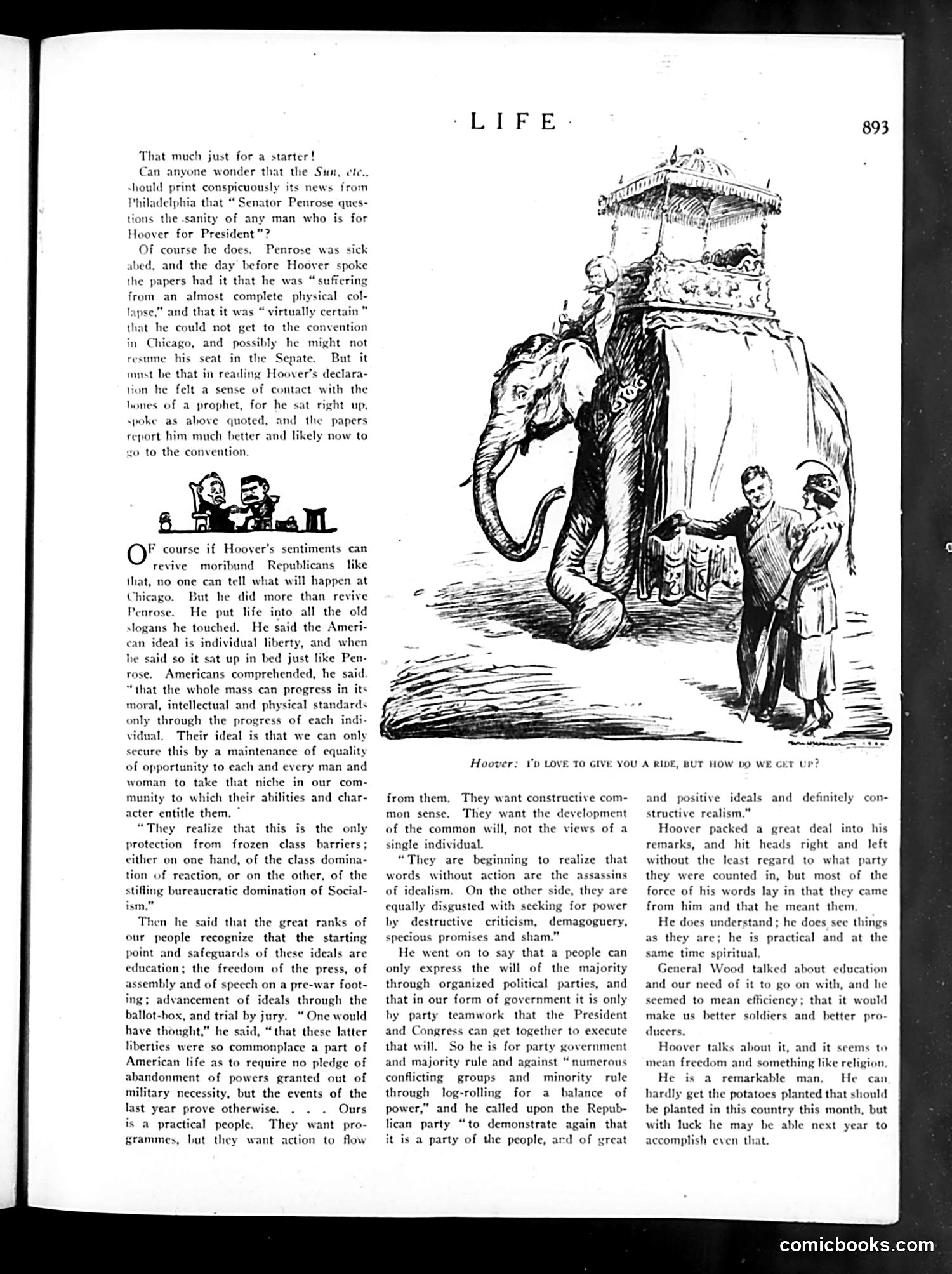
This 1928 Life magazine page satirizes Herbert Hoover's presidential campaign and its effect on Republican Party morale. The cartoon depicts an elephant (the Republican symbol) carrying a howdah (ornate carriage) with Hoover inside, while Senator Boies Penrose—depicted as elderly and infirm—stands below asking how to climb aboard. The joke references Penrose's reported "complete physical collapse" the day before Hoover's speech, yet Penrose recovered enough to attend the Chicago convention after hearing Hoover's address. The satire suggests Hoover's rhetoric was so inspiring it literally revived a dying politician. The article praises Hoover's speech emphasizing individual liberty, equality of opportunity, education, and free press—traditional Republican ideals. The cartoon's humor lies in the absurdity of elderly party leadership struggling to board the "Hoover express," implying the candidate energized even moribund Republicans.
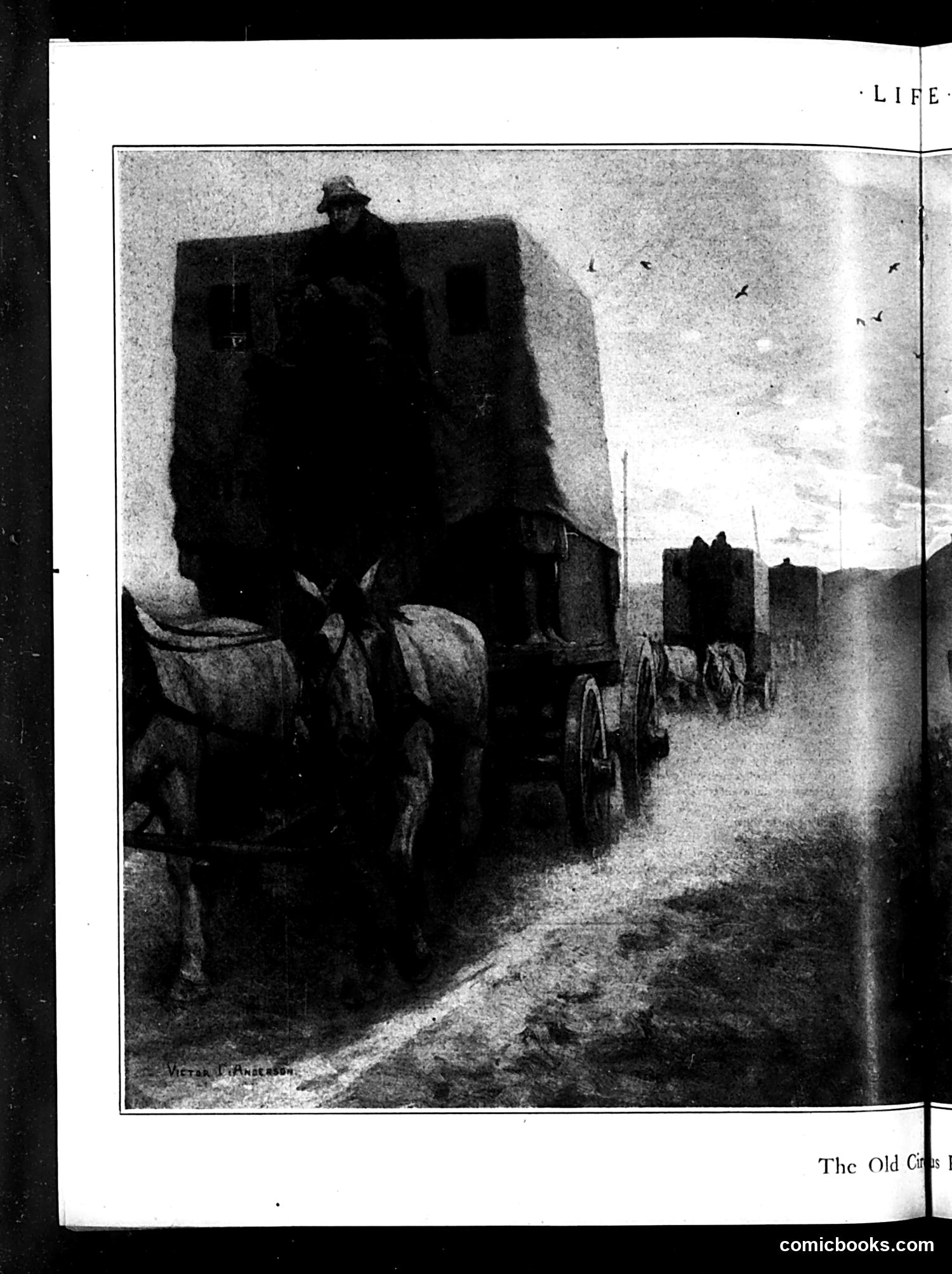
This appears to be a photograph rather than a political cartoon—labeled "The Old City" at bottom. It depicts a horse-drawn wagon loaded with large barrels or containers, driven by a figure in dark clothing and a hat, traveling on a dusty road. Additional wagons are visible in the distance against a hillside landscape. Without additional context or caption text visible in the image, the specific satirical point is unclear. It may reference urban decay, industrial commerce, or rural labor conditions typical of early-to-mid 20th century America. The grainy black-and-white photography style suggests documentary rather than editorial commentary, though *Life* magazine sometimes used photographs for social critique.
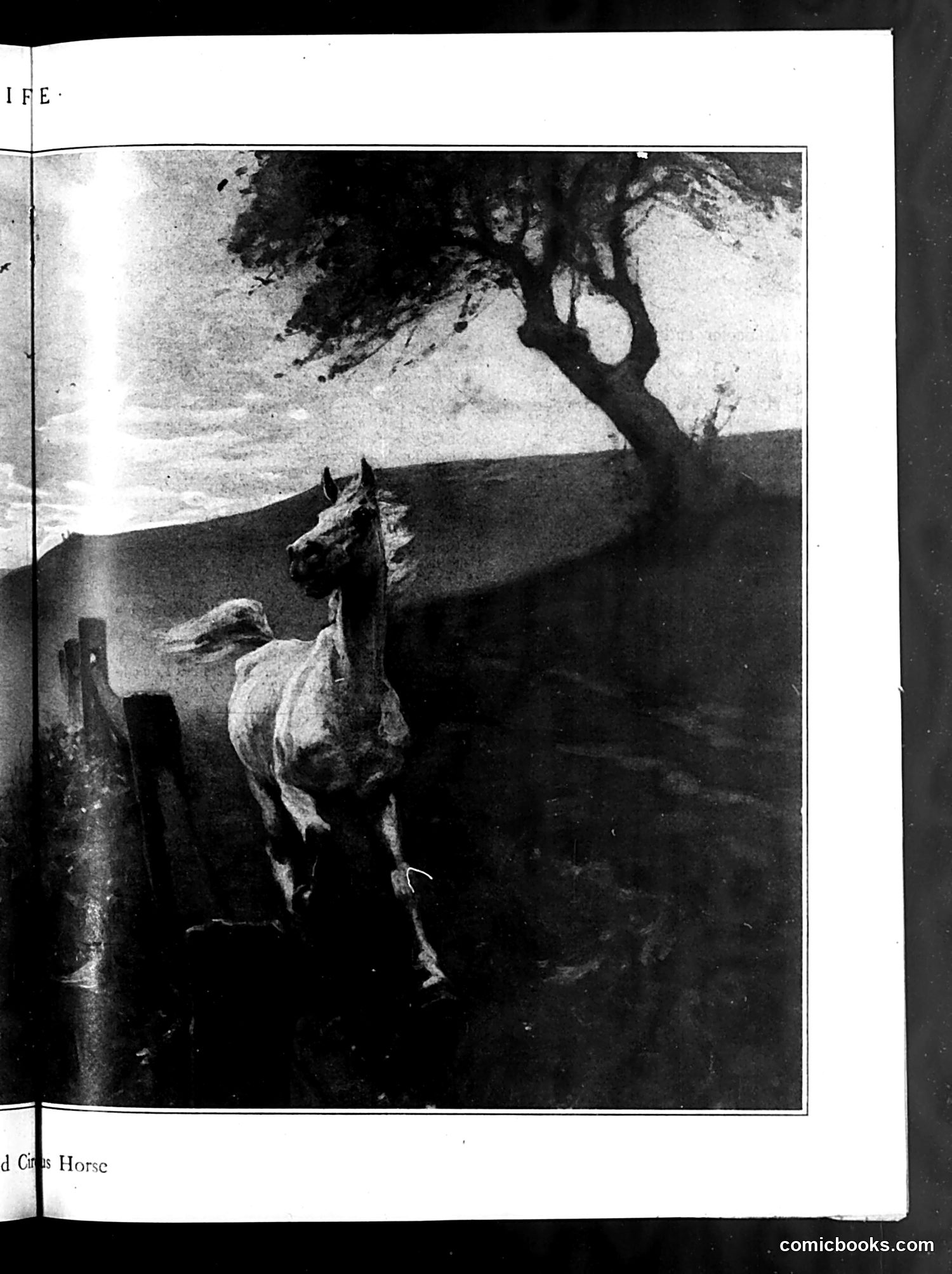
This page from *Life* magazine contains a black and white photograph showing a horse standing beneath a gnarled tree in a rural landscape. The caption reads "d Ches Horse" (likely "Old Ches Horse" with the beginning cut off). This appears to be a straightforward illustrative photograph rather than a political cartoon or satire. Without additional context or visible text explaining the image's significance, it's unclear what social or political commentary, if any, is intended. The image may simply be a genre photograph documenting rural life or animal husbandry, or it could reference a specific historical event or notable horse—but this cannot be determined from the visible page alone.
This page reviews two theatrical productions. The main text critiques the play "Martinique," a French colonial drama featuring elaborate character names and French dialogue that confuses the audience. The reviewer finds the plot simple (an illegitimate daughter visits her father's family) but praises the scenic design by Lee Simonson and performances by actors playing tropical characters. The second review discusses a Shakespeare revival starring Sothern and Marlowe at the Shubert Theatre. The critic acknowledges their excellent performances but challenges the assumption that audiences must automatically laugh at "funny" Shakespearean characters like Launcelot Gobbo and Falstaff simply because tradition dictates they should. The reviews exemplify early 20th-century theater criticism, questioning both exotic spectacle and blind reverence for classical drama.
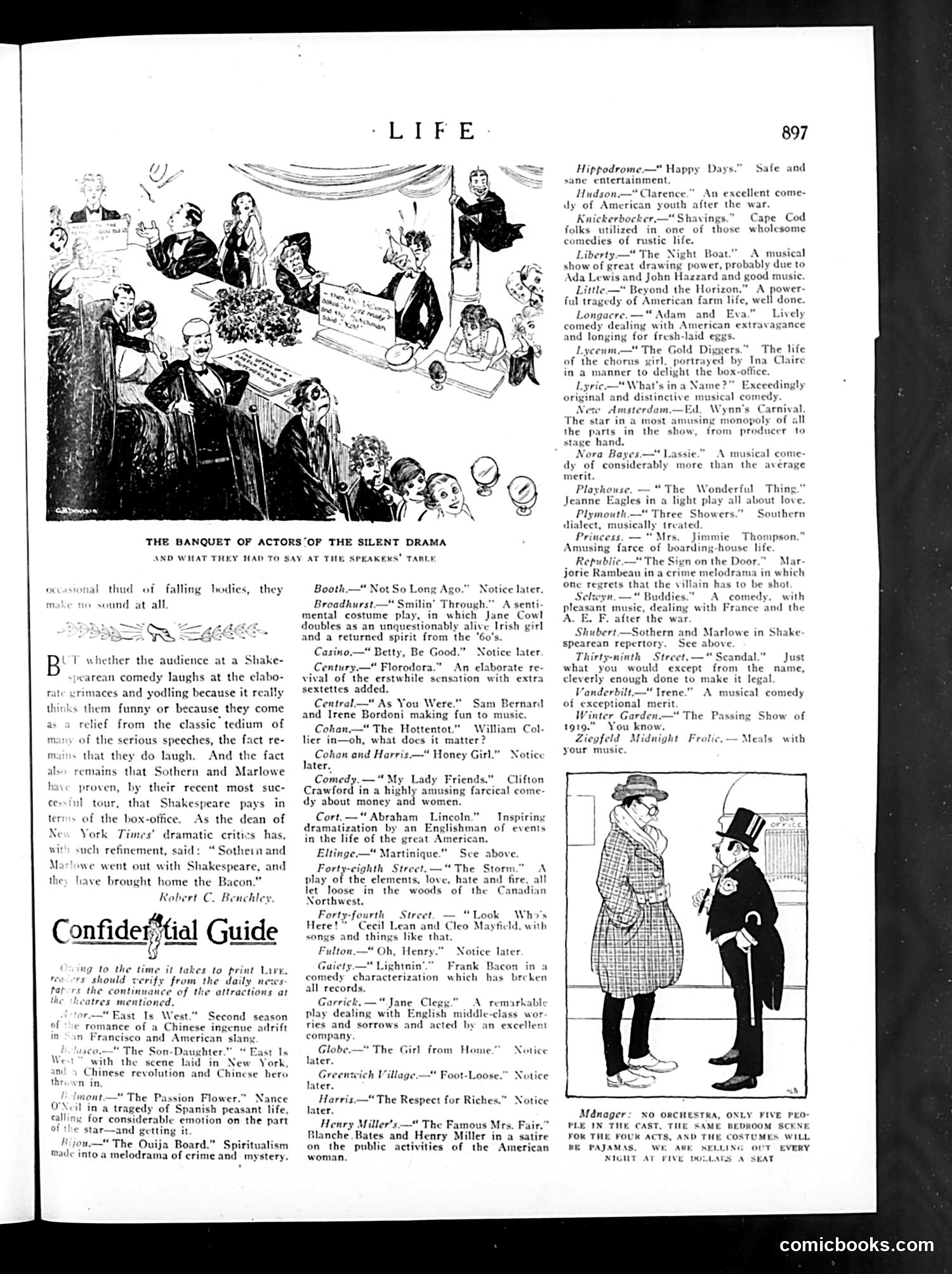
This illustration satirizes silent film actors by depicting them at a formal dinner banquet. The cartoon mocks the theatrical pretension and exaggerated physical gestures required in silent cinema—actors who must communicate entirely through elaborate facial expressions and body movements rather than dialogue. The accompanying text by Robert C. Benchley (a prominent theater critic) defends Shakespeare's commercial viability, noting that audiences laugh at actors' "elaborate grimaces and yodling" either because they find them genuinely funny or as relief from tedious classical speeches. The piece argues that recent successful tours by actors Sothern and Marlowe prove "Shakespeare pays in terms of the box-office." The joke targets the artificiality of silent acting: physical exaggeration was necessary for cinema, but Benchley suggests this makes Shakespeare—already theatrically demanding—even more absurdly overacted. The cartoon's crowded, chaotic scene emphasizes the ridiculous spectacle of "silent drama."
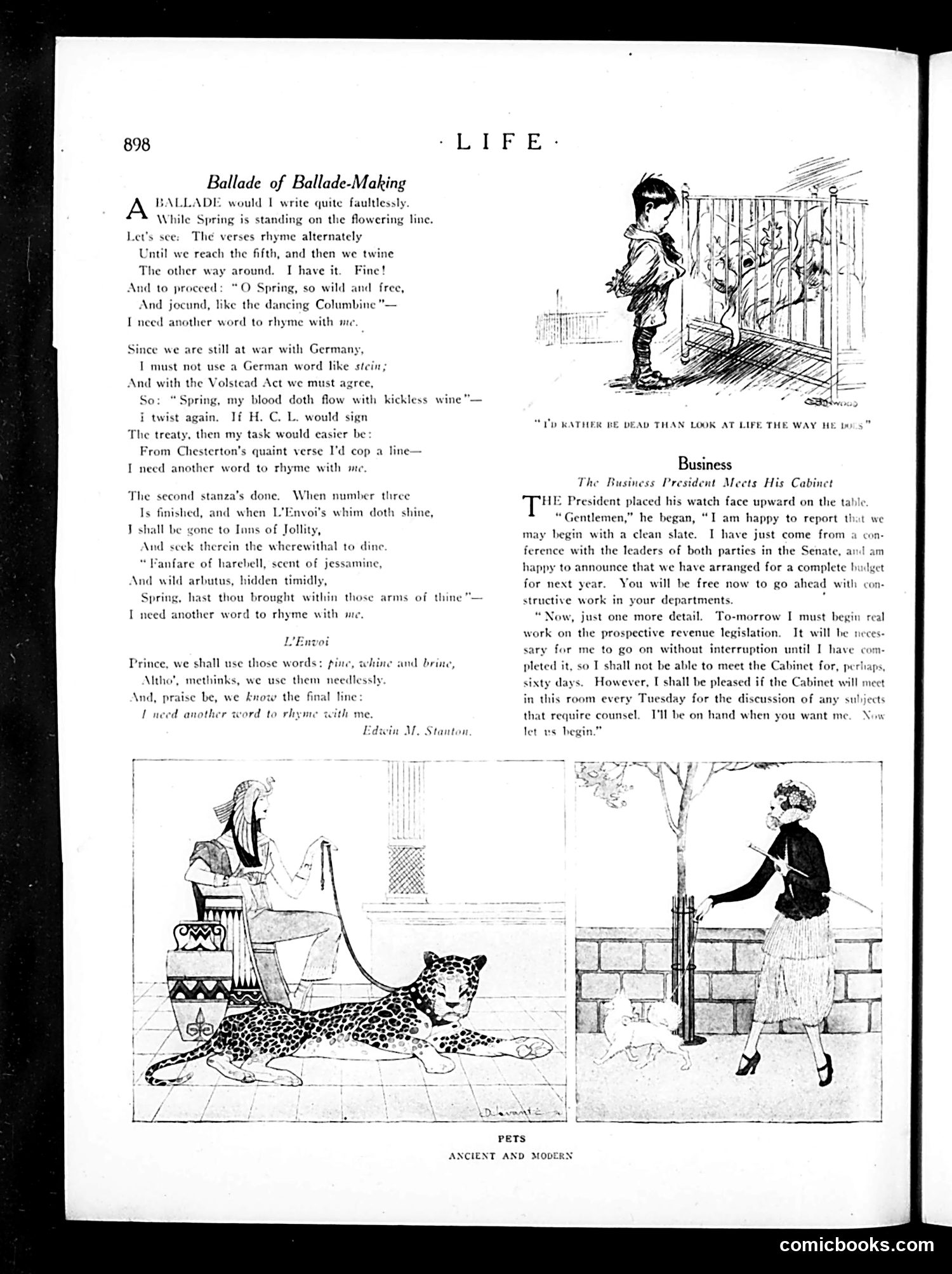
This page contains two satirical pieces reflecting post-WWI American concerns: **"Ballade of Ballade-Making"** (left): A humorous poem about the difficulty of writing a ballade (a poetic form) while navigating contemporary restrictions. The poet struggles to find rhymes while avoiding German words (due to ongoing post-war tensions with Germany) and respecting Prohibition ("the Volstead Act"). References to "H.C.L." (likely the High Cost of Living, an economic concern of the era) show how mundane wartime/postwar constraints invaded even artistic endeavors. It's satirizing how pervasive these restrictions had become in American life. **"The Business President Meets His Cabinet"** (right): Depicts a President placing his watch on the table, announcing he's too busy with revenue legislation to meet with his Cabinet for sixty days—only Tuesdays available. This satirizes executive detachment and suggests the President treats Cabinet meetings as secondary to fiscal concerns, a dig at administrative priorities. **"Pets: Ancient and Modern"** (bottom): Two illustrations contrasting historical and contemporary pet-keeping, though specific satire is unclear from the visible portions.
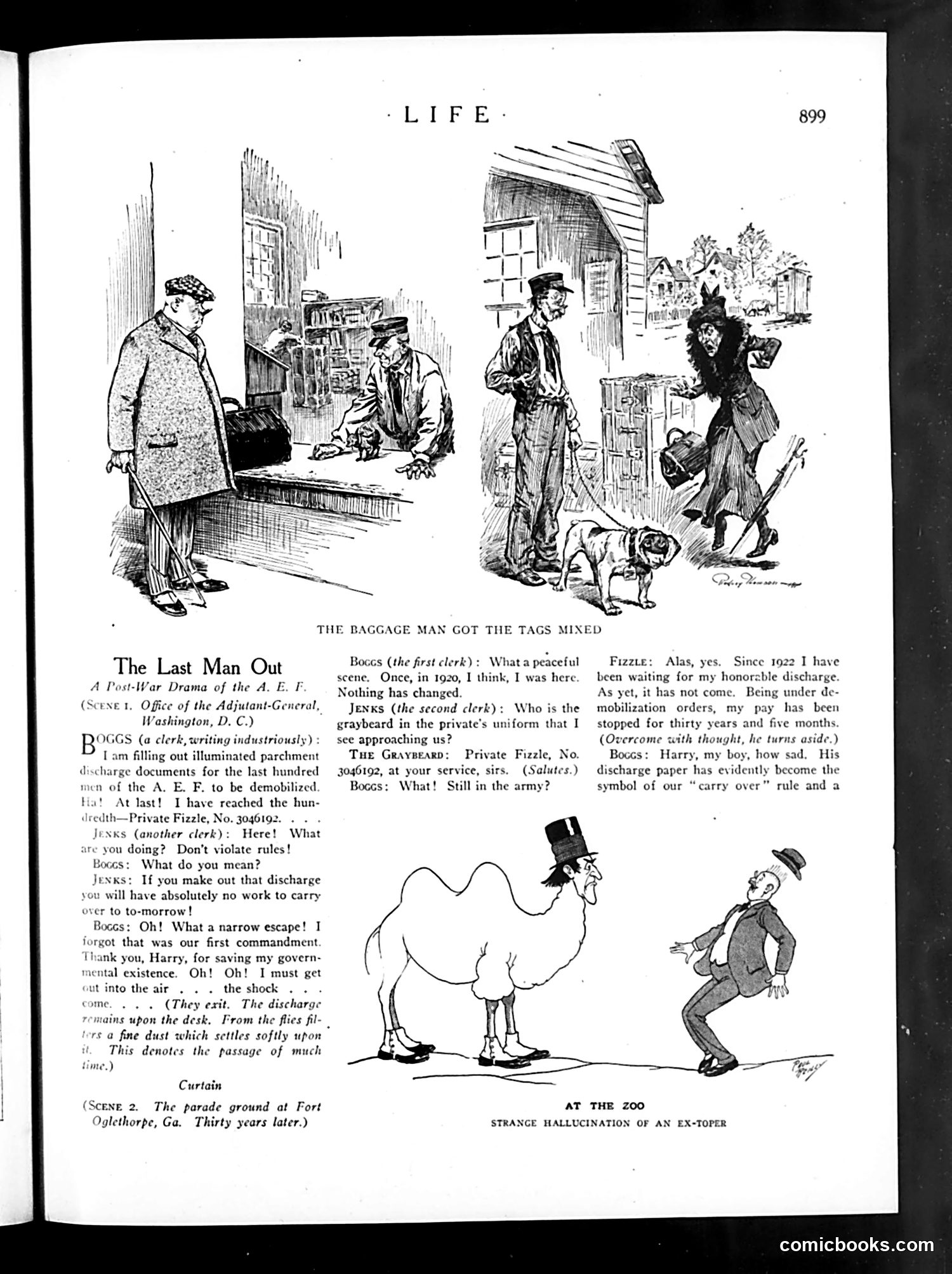
This satirical piece mocks bureaucratic inefficiency in post-WWI demobilization. The sketch depicts a discharged soldier, Private Fizzle, stranded in the military 30 years later because his discharge paperwork was lost on a bureaucrat's desk in 1920. The joke: two clerks in the War Department prioritize avoiding work over processing the final soldier's discharge. They deliberately leave his paperwork incomplete to maintain their jobs. The lost document literally becomes the "symbol of our 'carry over' rule"—an absurdist commentary on how government red tape and self-serving bureaucrats can trap citizens in limbo indefinitely. The bottom cartoon, "Strange Hallucination of an Ex-Toper," appears unrelated—showing a man seeing a camel at the zoo, likely satirizing alcohol-induced delusions. The satire targets both military bureaucratic absurdity and the broader post-war chaos of demobilization.
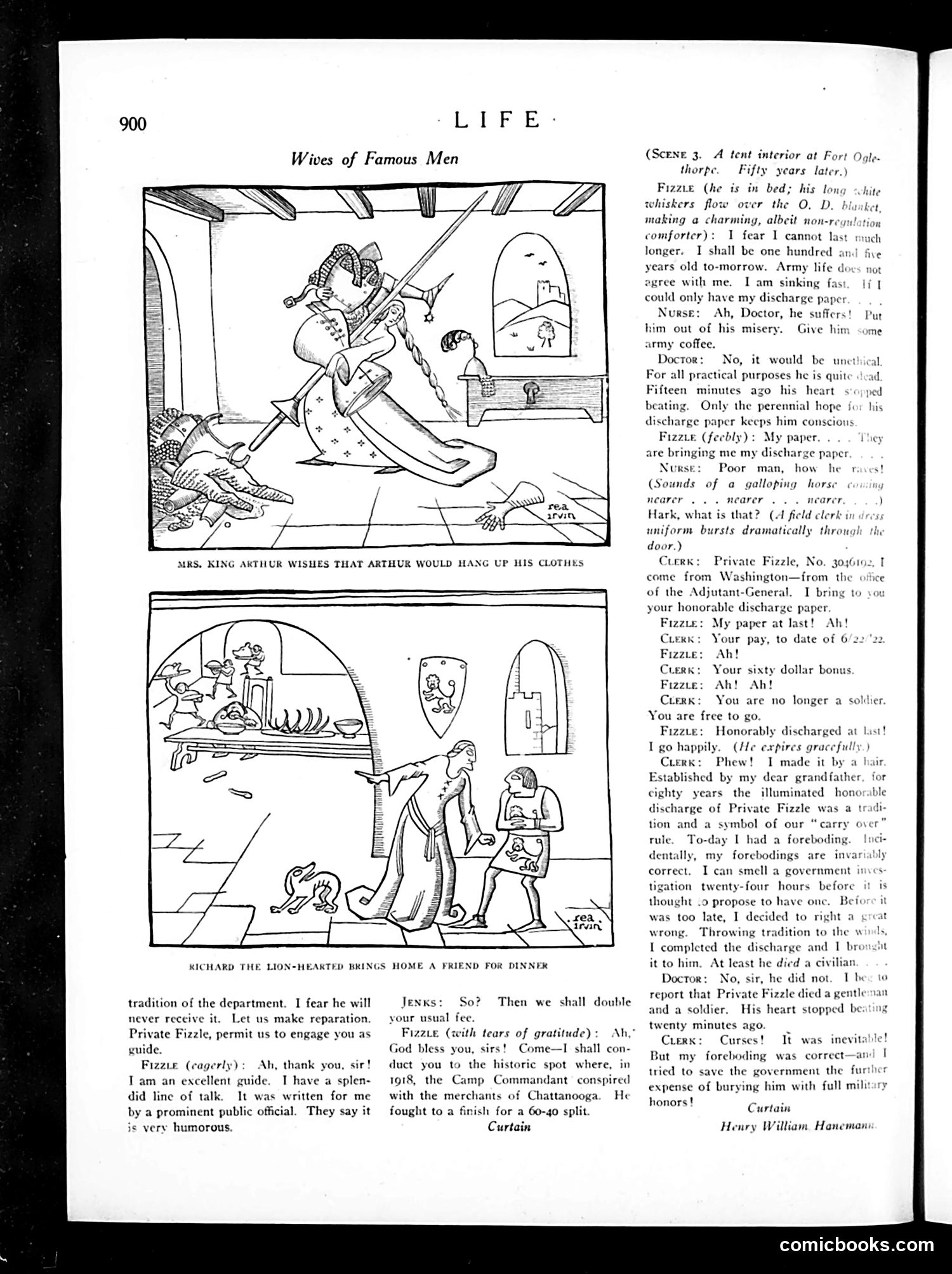
This page contains three distinct satirical pieces: **Top cartoon**: "Mrs. King Arthur Wishes That Arthur Would Hang Up His Clothes" jokes about domestic nagging—a wife's timeless complaint about her husband's messiness, here applied to the legendary King Arthur. **Middle cartoon**: "Richard the Lion-Hearted Brings Home a Friend for Dinner" satirizes historical figures behaving like ordinary people with petty concerns (splitting restaurant bills), deflating their grand reputations. **Main story**: "Wives of Famous Men—Scene 3" depicts an elderly Private Fizzle dying at Fort Oglethorpe fifty years after military service, kept alive only by obsession with his discharge papers. A clerk dramatically arrives with his honorable discharge, and Fizzle dies peacefully as a civilian. The satire targets military bureaucracy's indifference to soldiers and the absurdity of discharge paperwork holding such life-or-death importance to a veteran. The humor relies on contrasting grand historical/military ideals with mundane, petty human reality.
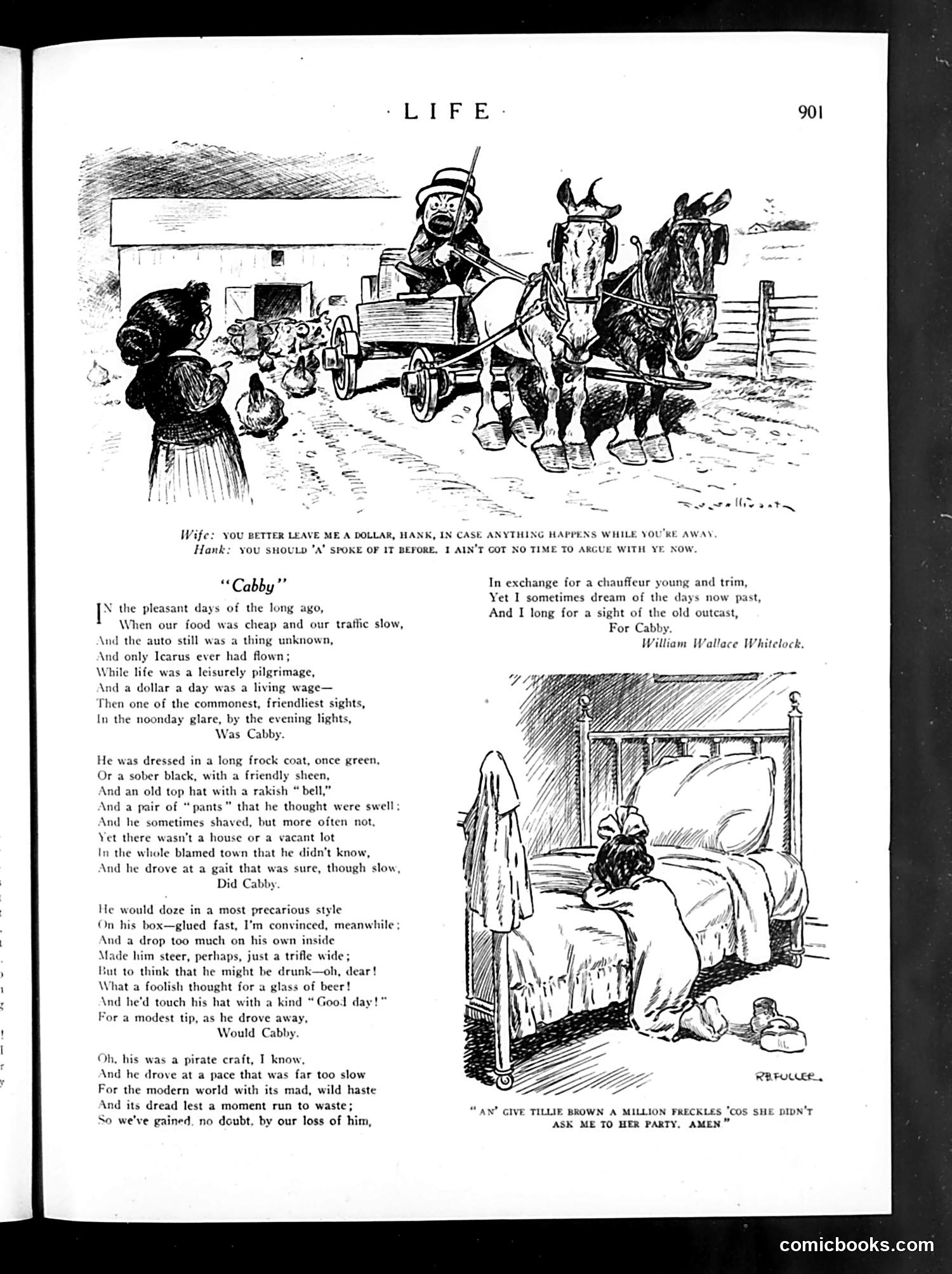
This page presents a sentimental poem by William Wallace Whitelock mourning the disappearance of horse-drawn taxi drivers ("cabbies") displaced by automobiles. The poem romanticizes the old cabby as a fixture of urban life—friendly, unhurried, and intimately familiar with his city's neighborhoods. The satire is gentle but pointed: the poem contrasts the leisurely pace and human connection of the horse-cab era with the "mad, wild haste" of the modern motorized world. The cabby represents a vanishing working class, rendered obsolete by technological progress. The top illustration shows a woman negotiating with a cabby before he departs—a scene of ordinary life now "lost." The bottom cartoon depicts a child's bedtime prayer, unrelated but typical of *Life*'s mixed editorial content. Together, these nostalgic pieces reflect early 20th-century ambivalence about rapid modernization.
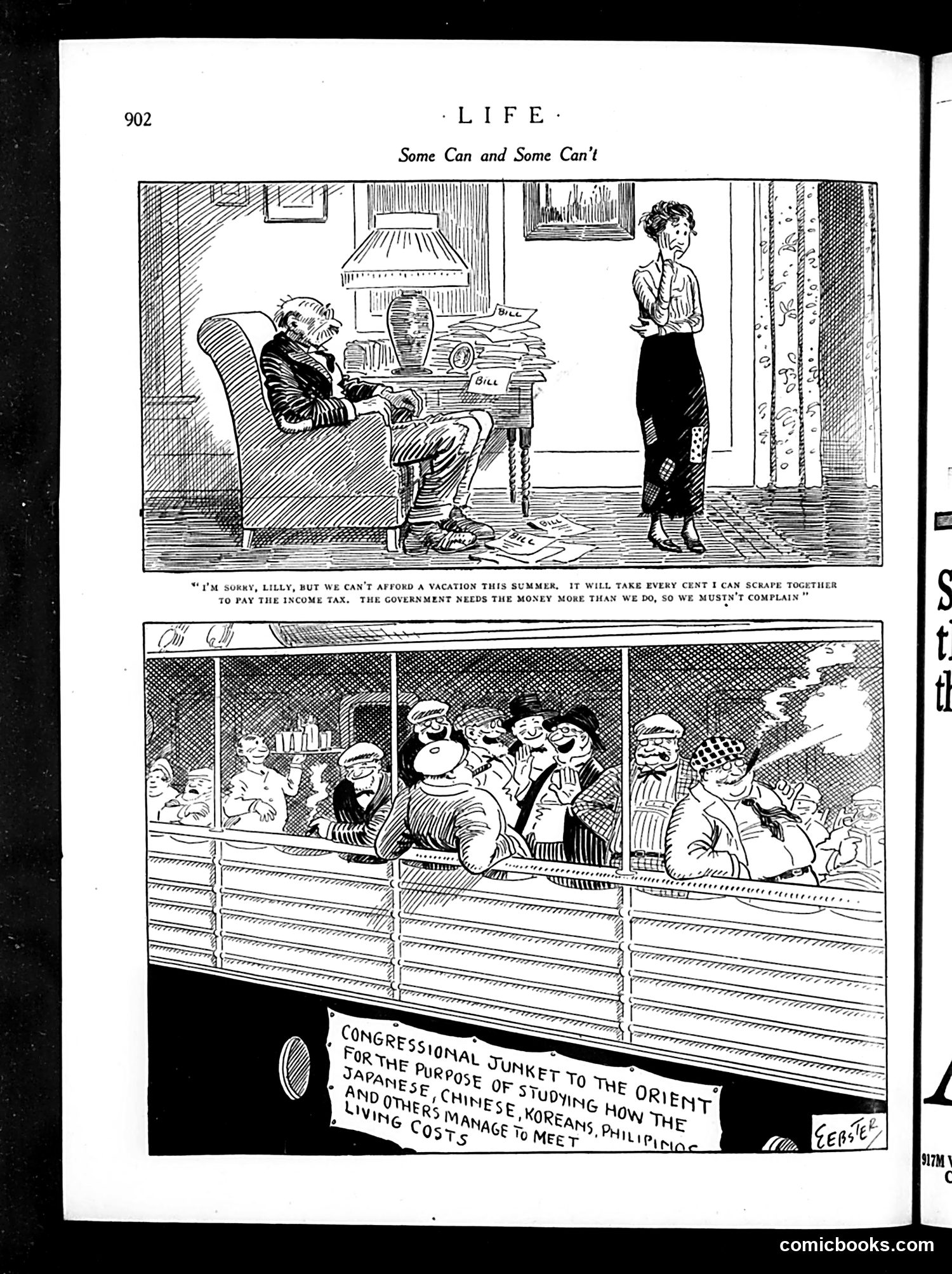
This two-panel satire contrasts economic inequality during the income tax era (appears to be early 20th century). **Top panel**: A middle-class husband apologizes to his wife (named Lilly) that they cannot afford a summer vacation because all available money must go to income taxes. He accepts this patriotically, saying the government needs it more. **Bottom panel**: Shows wealthy people at what appears to be a racing venue or sporting event, enjoying leisure activities without financial constraint. The caption references a "Congressional junket to the Orient" supposedly for studying how "Japanese, Chinese, Koreans, Philippinos and others manage to meet living costs" — implying Congress travels lavishly while ordinary citizens sacrifice. The cartoon's point: ordinary workers bear the tax burden while the wealthy and government officials enjoy luxury. The title "Some Can and Some Can't" underscores this disparity.
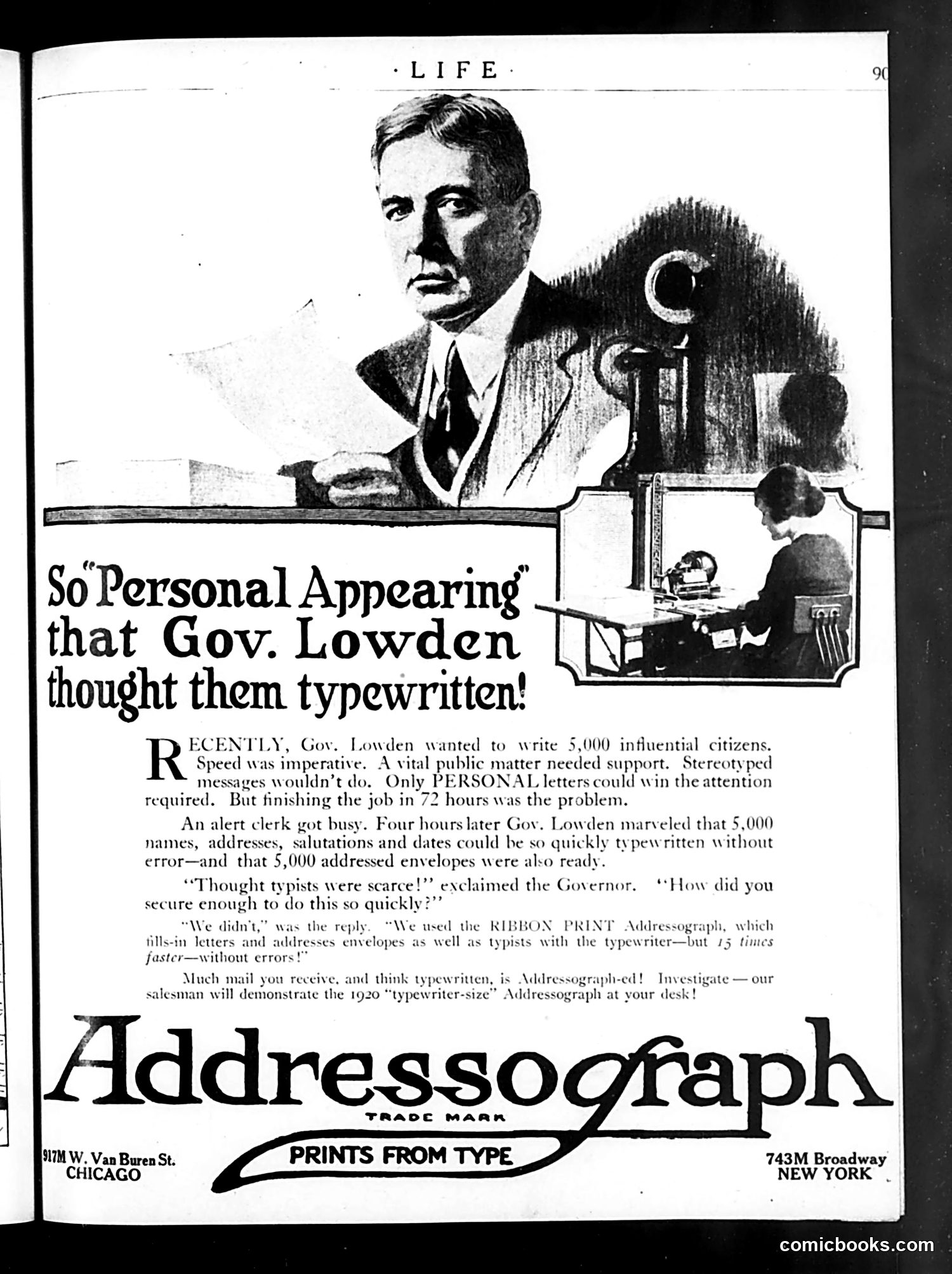
This is primarily an **advertisement**, not a political cartoon, though it uses a prominent political figure for marketing purposes. **The Figure:** Gov. Lowden appears to be **Frank O. Lowden**, Illinois governor (served 1917-1921), shown as impressed by the speed of mass personalized correspondence. **The Pitch:** The ad claims the Addressograph machine can produce 5,000 personalized letters in 72 hours—so convincingly that the Governor thought they were individually typewritten. The machine prints names, addresses, and salutations while being "15 times faster" than human typists. **The Satire/Joke:** The subtle humor lies in using a real politician's name to imply he was fooled into thinking mass-produced form letters were genuine personal correspondence—a gentle jab at politicians' use of standardized messaging while appearing personal to constituents. **Context:** This reflects 1920s concerns about emerging mass-communication technology and the growing gap between authentic and mechanically-replicated personal contact in business and politics.
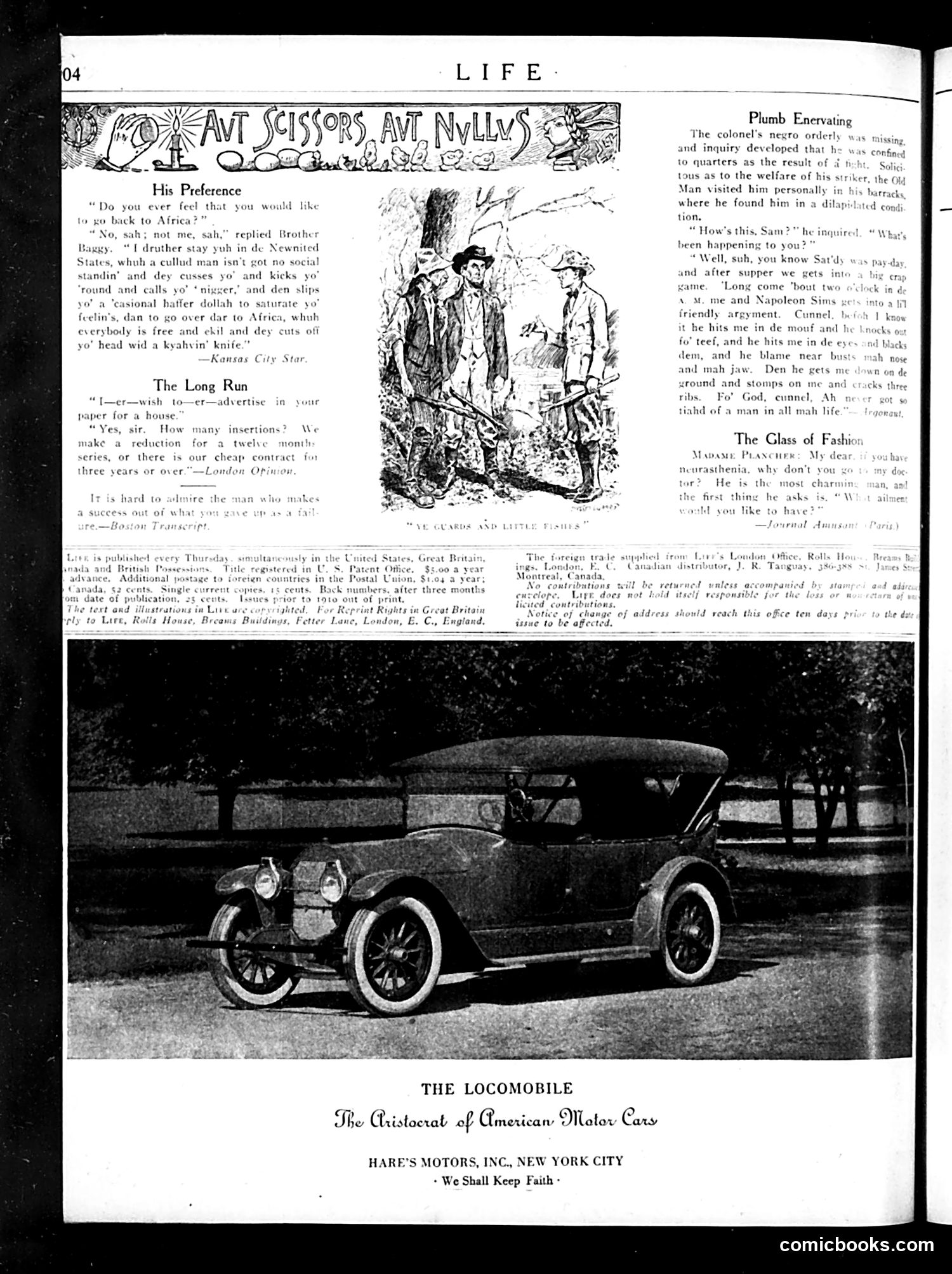
This page contains three separate humor pieces reflecting early 20th-century racial attitudes: **"His Preference"** depicts a dialect-heavy conversation where a Black man explains he prefers staying in America despite segregation, violence, and racial slurs rather than returning to Africa—a satirical jab at colonization arguments. **"The Long Run"** is a brief advertising joke about newspaper contracts with no clear social commentary. **"Plumb Enervating"** shows a white colonel visiting his Black military orderly (Sam) who catalogs brutal beatings he's received from someone—presented as comedic complaining. The humor derives from the orderly's casual acceptance of violence. All three pieces rely on racist stereotypes and dialect humor typical of early Life magazine. The page also advertises the Locomobile automobile as "The Aristocrat of American Motor Cars." These pieces reflect period attitudes treating racial violence and degradation as acceptable comedy material for white audiences.
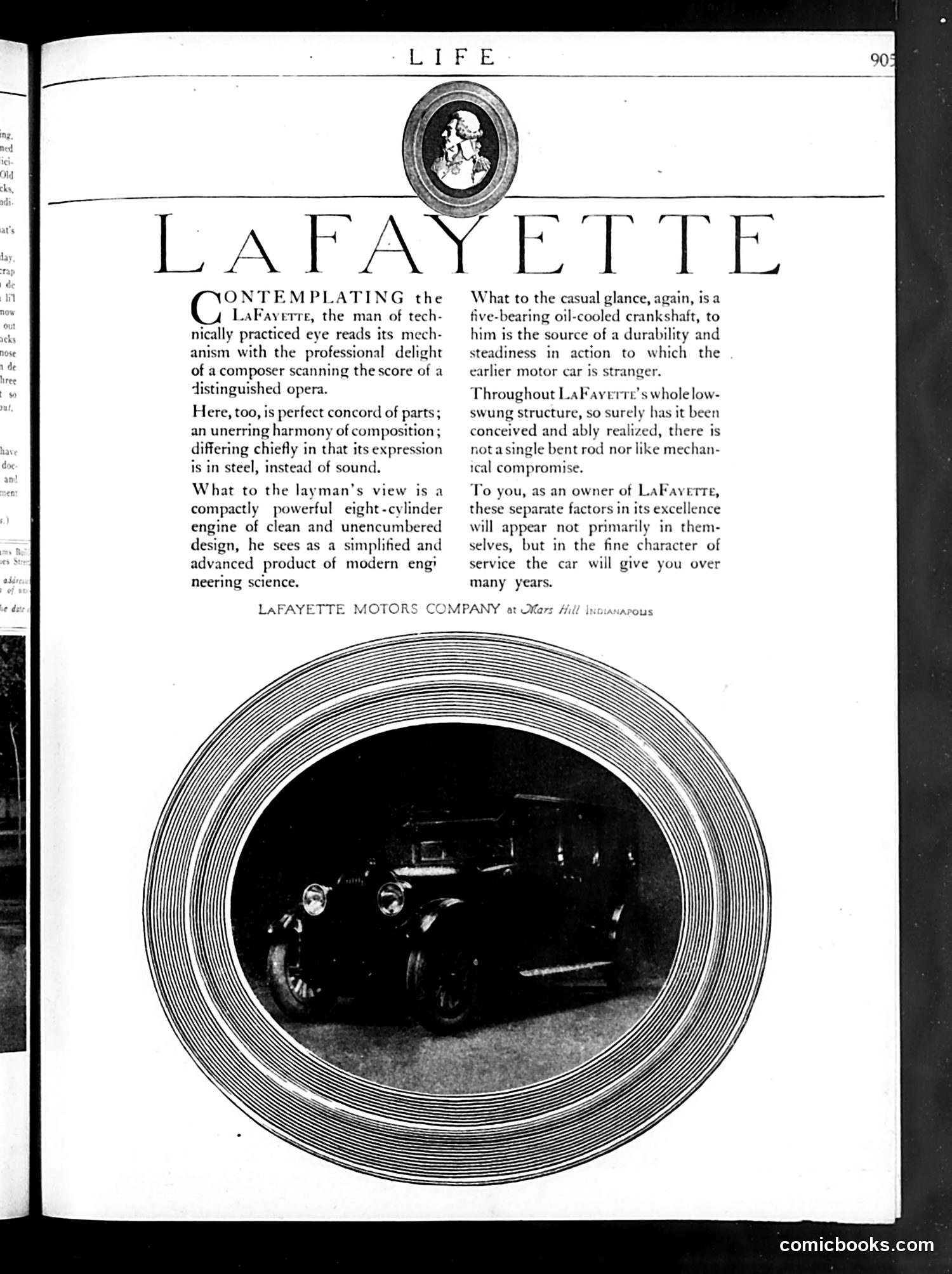
This is **not a cartoon or satire**—it's a straightforward automobile advertisement from *Life* magazine (page 903). The page promotes the Lafayette automobile, manufactured by Lafayette Motors Company in Indianapolis. The text uses elevated, almost poetic language to market the car to different audiences: to technically-minded owners, it emphasizes engineering precision (eight-cylinder engine, oil-cooled crankshaft, five-bearing design); to average buyers, it promises reliability and durability. The small oval portrait at top appears to be a historical figure (possibly the Marquis de Lafayette, namesake of the brand), and a photograph of the actual car is displayed in a decorative circular frame at the bottom. This represents typical early 20th-century automotive advertising strategy: using technical jargon and appeals to both sophistication and practical value to justify the car's purchase price and quality.
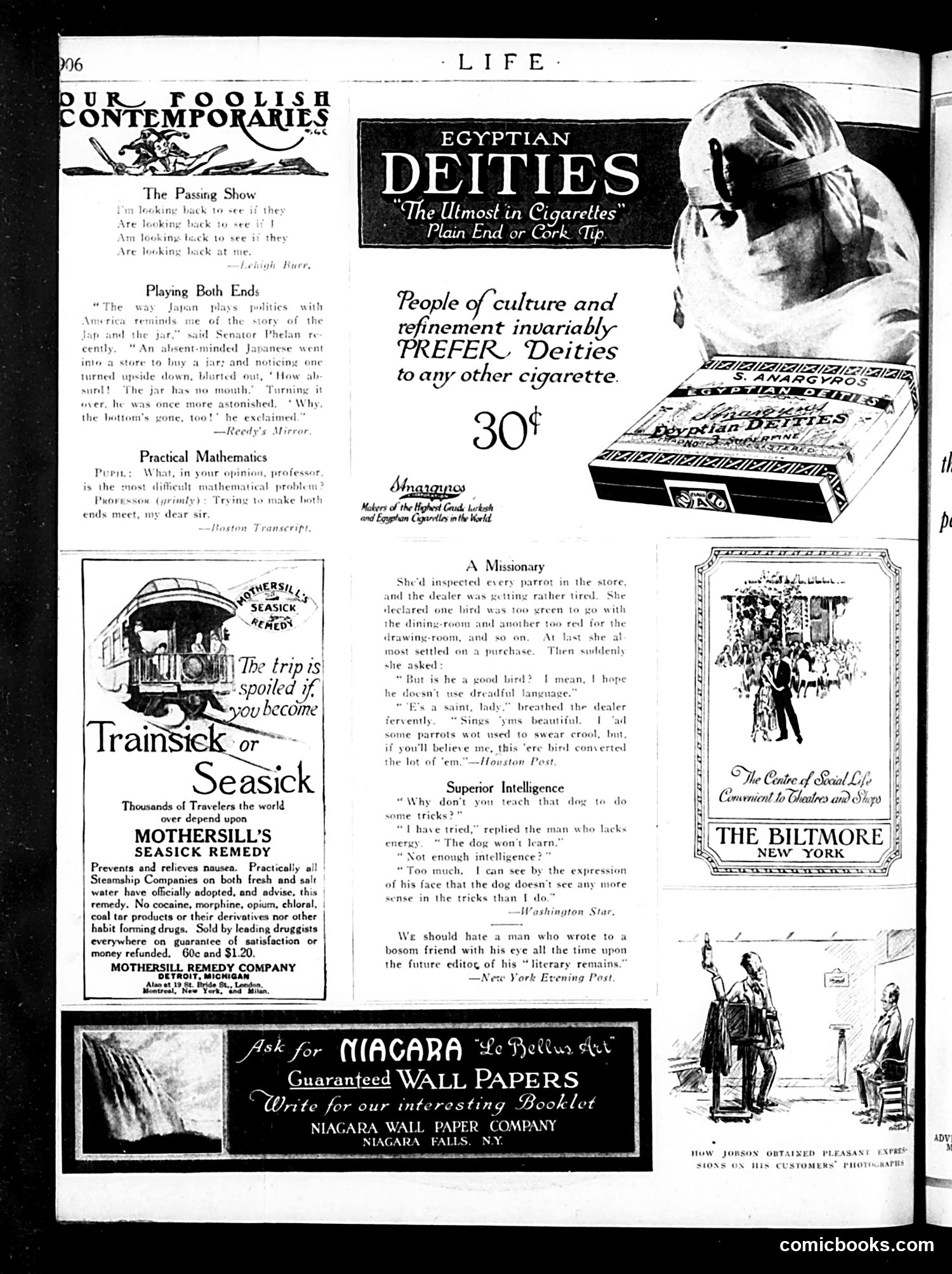
This page is primarily **advertising**, with minimal editorial cartoon content. The main items are: **"Our Foolish Contemporaries" section** (top left): Contains three brief satirical quips mocking contemporary figures or trends—likely politicians or public figures of the era, though the OCR errors make specific references unclear. **Major advertisements:** - **Egyptian Deities cigarettes**: A full-page ad claiming people of "culture and refinement" prefer this brand—typical period tobacco marketing using aspirational messaging. - **Mothersill's Seasick Remedy**: Promotes a patent medicine guaranteed to prevent nausea, marketed to steamship travelers. - **Niagara Wall Paper**: Advertises decorative wallpaper. **Humorous anecdotes** (center/right): Brief joke pieces about a missionary inspecting parrots and a man training a dog, likely included as filler content. **The Biltmore hotel advertisement** appears lower right. The page reflects early 20th-century Life magazine's format: mixing light satire with commercial advertising, without substantial political cartooning visible here.
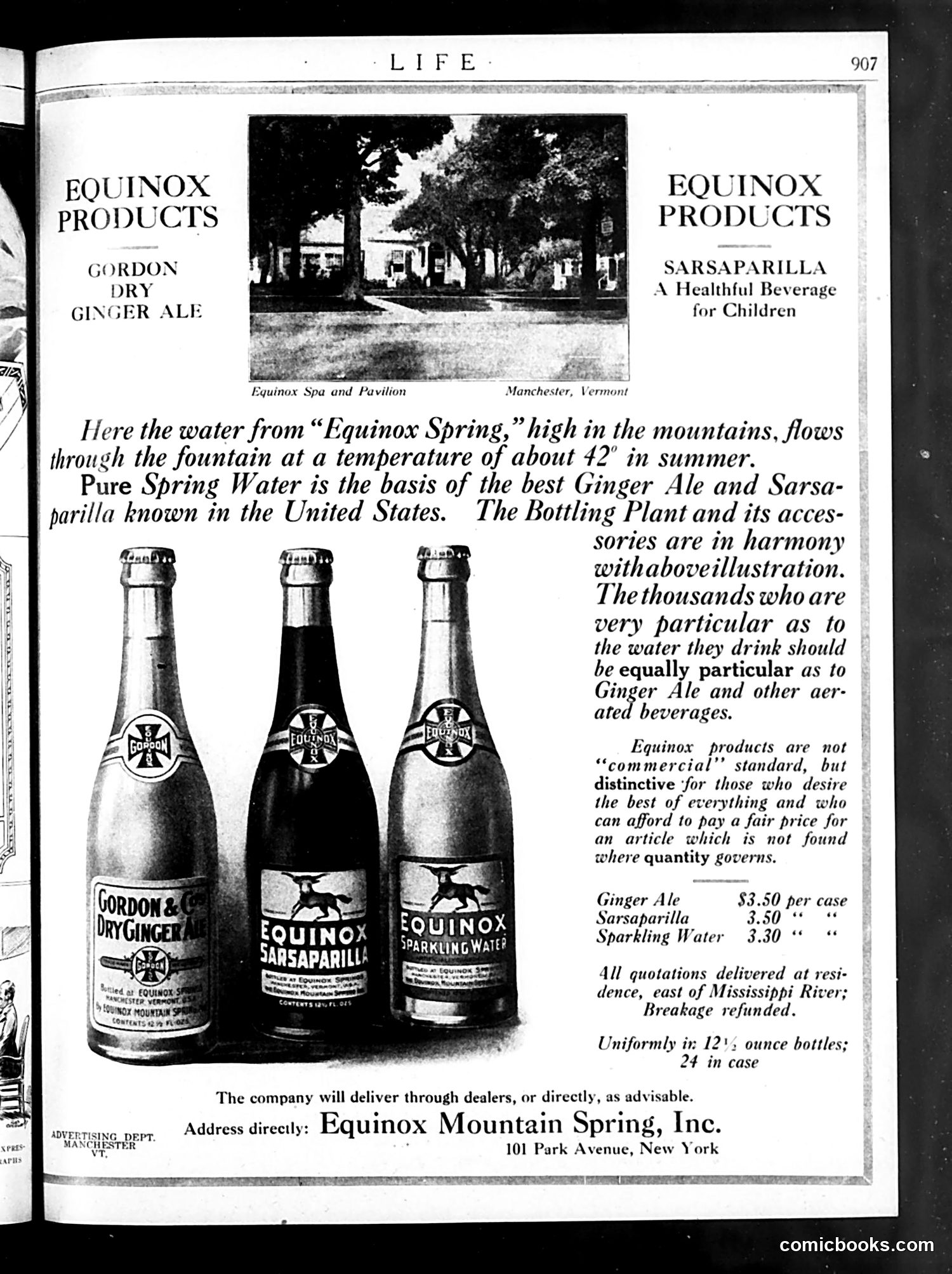
The page promotes **Equinox Mountain Spring, Inc.**, a beverage company based in Manchester, Vermont. It advertises three products: Gordon Dry Ginger Ale, Equinox Sarsaparilla ("A Healthful Beverage for Children"), and Equinox Sparkling Water. The ad emphasizes the purity of the spring water source (flowing at 42° in summer) and positions these as premium, non-commercial products for discriminating consumers willing to pay higher prices. Three product bottles are displayed centrally, with a photograph of the Equinox Spa and Pavilion building above. Pricing is listed ($3.50-$3.30 per case for 12.5-ounce bottles), along with delivery terms. The company address is 101 Park Avenue, New York. This represents typical early-20th-century advertising strategy: marketing mineral spring beverages as health tonics with emphasis on natural purity and exclusivity rather than mass-market appeal.
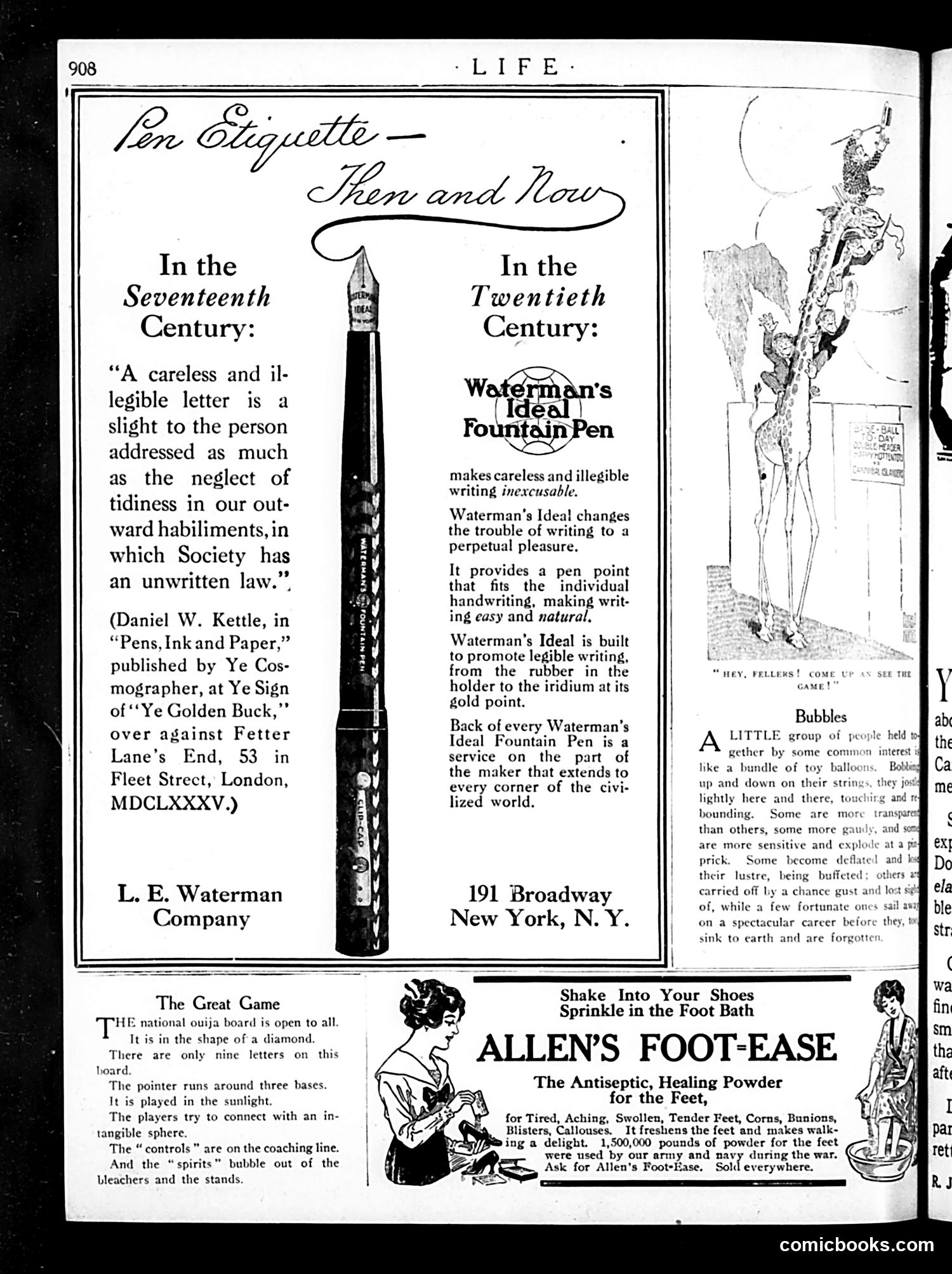
This page is primarily **advertising**, not satire or political commentary. The dominant feature is a Waterman's Ideal Fountain Pen advertisement that contrasts writing standards across centuries. A 17th-century quote emphasizes that illegible letters insult the recipient, while the 20th-century pitch argues that Waterman pens make poor handwriting "inexcusable"—positioning the product as a solution to social embarrassment. The page includes two minor pieces: "The Great Game" (a baseball metaphor using spiritualism language—"ouija board," "spirits," "controls"—to describe the sport's unpredictability), and "Bubbles" (a brief meditation on fate, comparing people to soap bubbles with varying destinies). An Allen's Foot-Ease powder advertisement appears at bottom, noting wartime military use. The content reflects early 20th-century consumer culture and social anxieties about propriety and personal presentation.
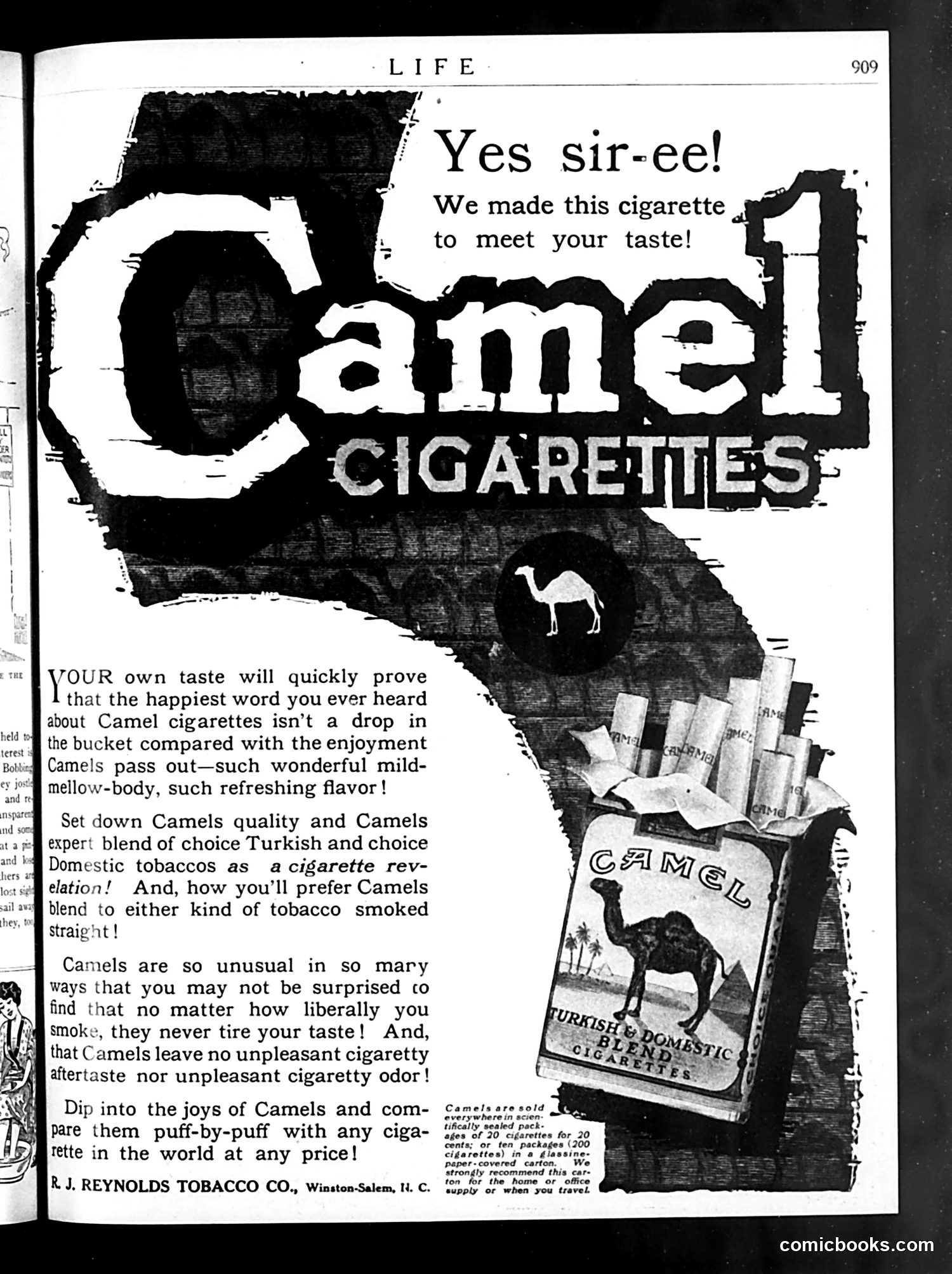
This page is **not a cartoon or satire**—it's a **straightforward cigarette advertisement** for Camel cigarettes by R.J. Reynolds Tobacco Co. The ad features the Camel logo (a camel illustration) and uses a mock-military tone ("Yes sir-ee!") to appeal to consumers, likely men. The copy emphasizes that Camels are "made to your taste," highlighting their blend of Turkish and domestic tobacco and claiming they leave no unpleasant aftertaste or odor. The humor, if any, is mild—the forced enthusiasm and exaggerated claims ("never tire your taste") would read as typical 1920s-30s advertising hyperbole to modern readers. The page belongs in *Life* magazine's advertising section, not its editorial/satirical content. **What's striking to modern readers**: the complete absence of health warnings and the casual, aggressive marketing of cigarettes as a desirable, tasteful product—practices now heavily restricted by law.
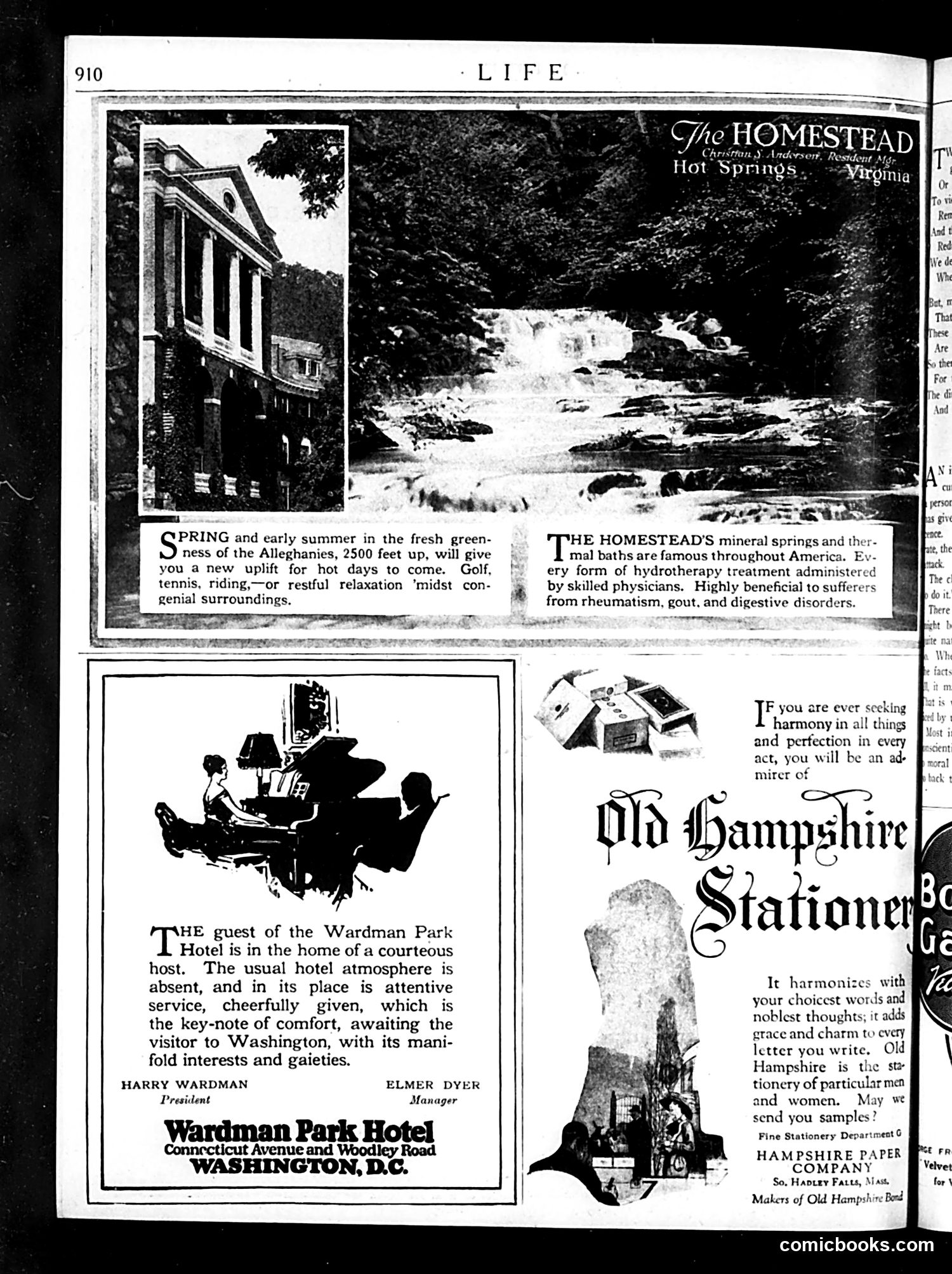
This page is primarily **advertising**, not political satire. It contains four distinct ads from circa 1920s Life magazine: 1. **The Homestead** (Hot Springs, Virginia) — promotes mineral springs and hydrotherapy for treating rheumatism and digestive disorders, appealing to wealthy tourists seeking health treatments. 2. **Wardman Park Hotel** (Washington, D.C.) — advertises luxury hospitality, emphasizing attentive service and access to the nation's capital's attractions for affluent visitors. 3. **Old Hampshire Stationery** — markets high-quality writing paper to "particular men and women," using pretentious language about "grace and charm." 4. A small illustration showing a piano and formal social scene, likely accompanying hotel advertising. These are straightforward commercial pitches to upper-class readers, typical of Life's revenue model. There is no apparent political commentary or satire on this particular page—it's purely consumer-oriented advertising for leisure, hospitality, and luxury goods.
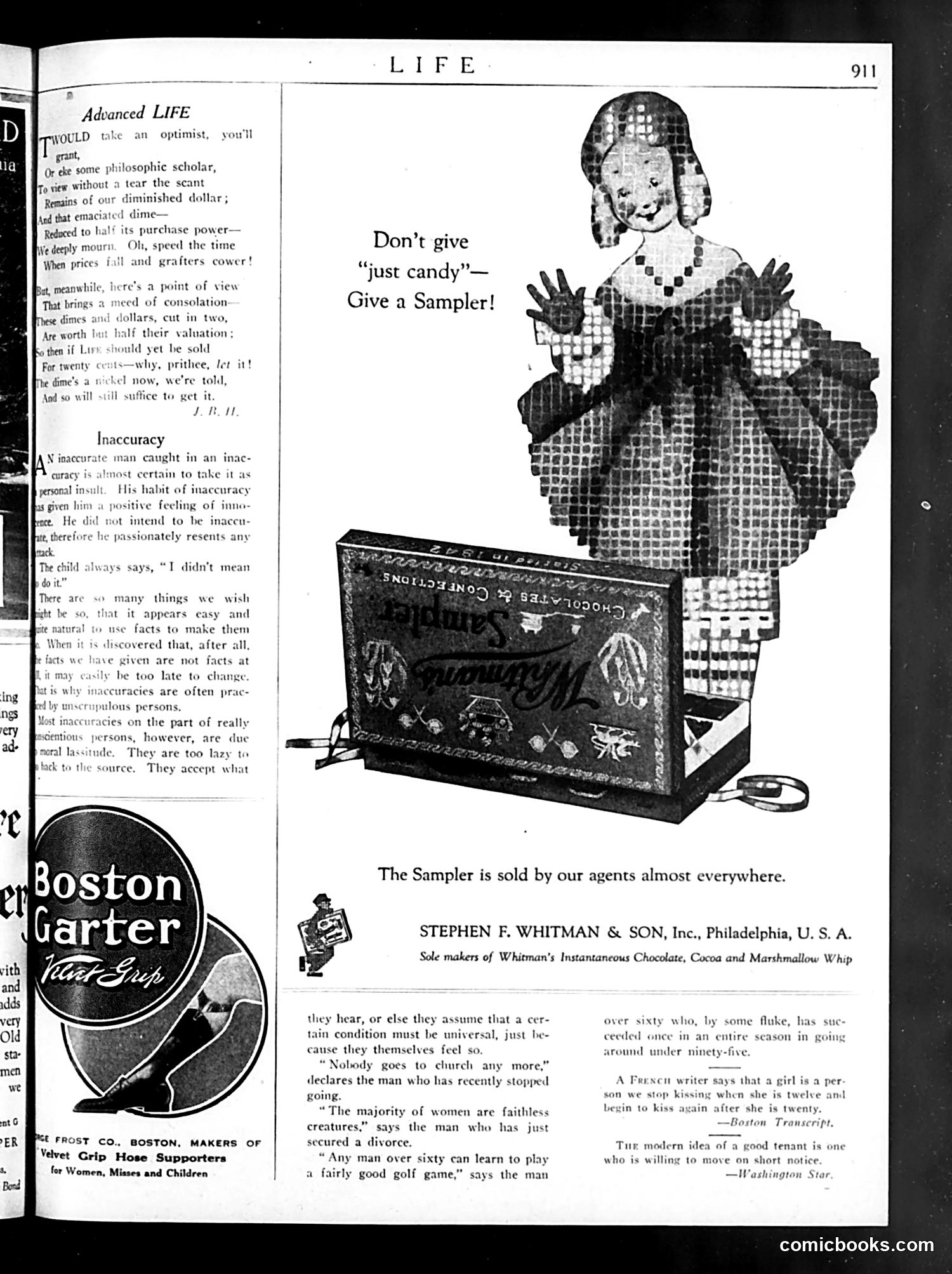
This page contains mixed content: a poem about economic deflation, an essay on inaccuracy, and advertisements. **The Poem "Advanced LIFE"** addresses the devalued dollar during economic hardship (likely post-WWI inflation). It uses sardonic wit: if the dollar has lost half its purchasing power, why not sell *Life* magazine for twenty cents instead of a dime? The joke is darkly ironic—accepting economic reality while mocking both the situation and those profiting from it ("grafters"). **"Inaccuracy"** is a brief moral essay criticizing people who state opinions as facts without verification. The examples mock human nature: the man who claims "nobody goes to church" because *he* stopped, or the divorcé who generalizes about women's faithlessness. **The Main Advertisement** promotes Whitman's chocolate samplers as superior gift-giving versus "just candy"—appealing to refined taste and thoughtfulness. **Minor Advertisements** include Frost Co.'s hose supporters and Boston Quarter margarine. The page reflects early 20th-century concerns: economic instability, social criticism through humor, and consumer product marketing.
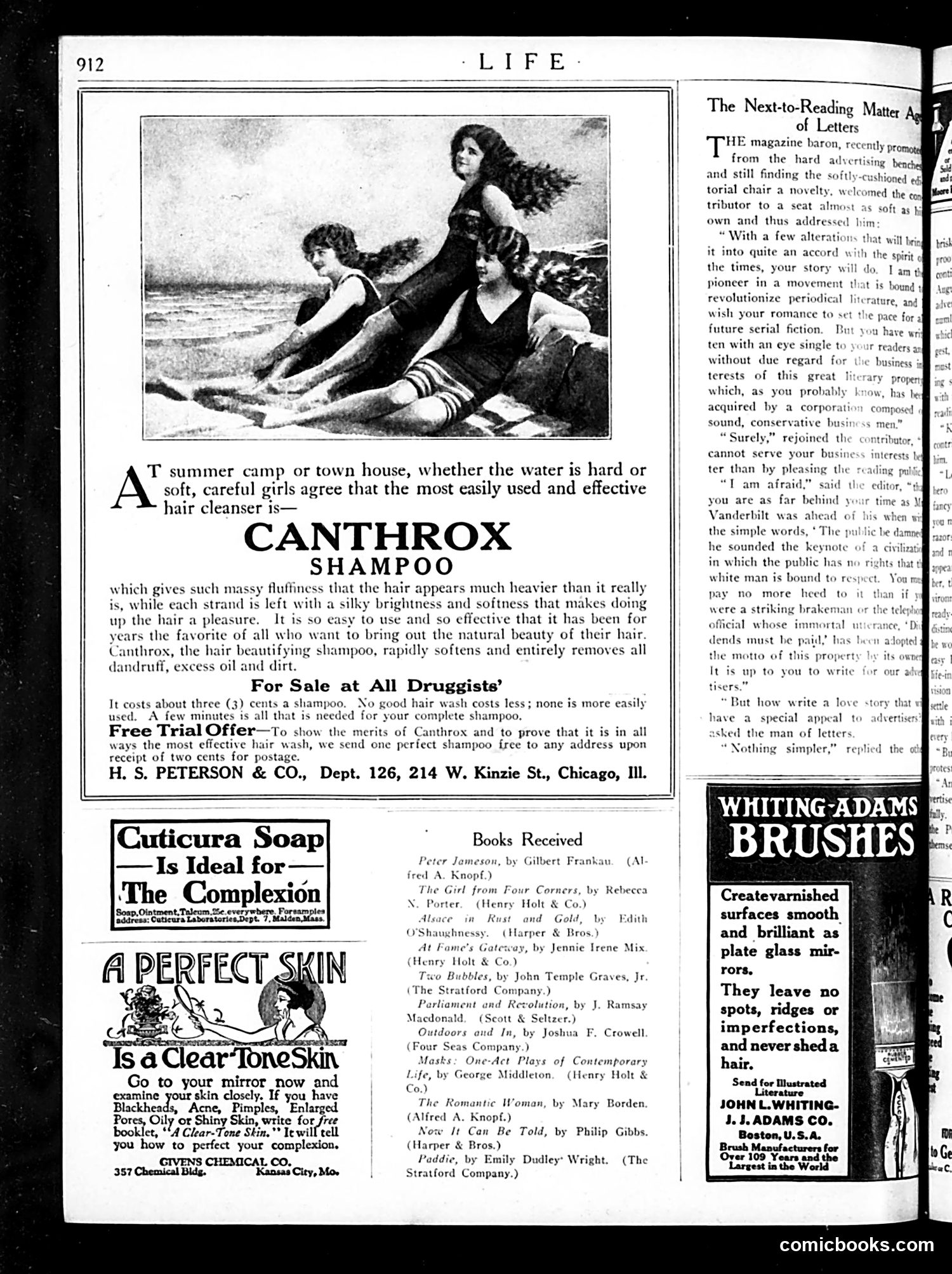
This page is primarily **advertising with some editorial content** — not a political cartoon. The main visual is a photograph of three young women at a beach or waterside, used to advertise Canthrox Shampoo. The editorial section titled "The Next-to-Reading Matter" is a short satirical piece about magazine publishing. It depicts a fictional exchange between a magazine editor and a romance writer. The editor pressures the author to write stories that serve advertisers' interests rather than artistic merit, comparing this commercialism unfavorably to the ethical standards of figures like Vanderbilt. The writer protests that romance stories shouldn't be tailored to advertising needs. **The satire's point**: Early 20th-century magazine editors were increasingly beholden to advertisers (like the shampoo and soap ads surrounding this text), compromising editorial integrity. The piece critiques this commercialization of literature — though ironically, the critique appears amid the very advertisements it mocks.
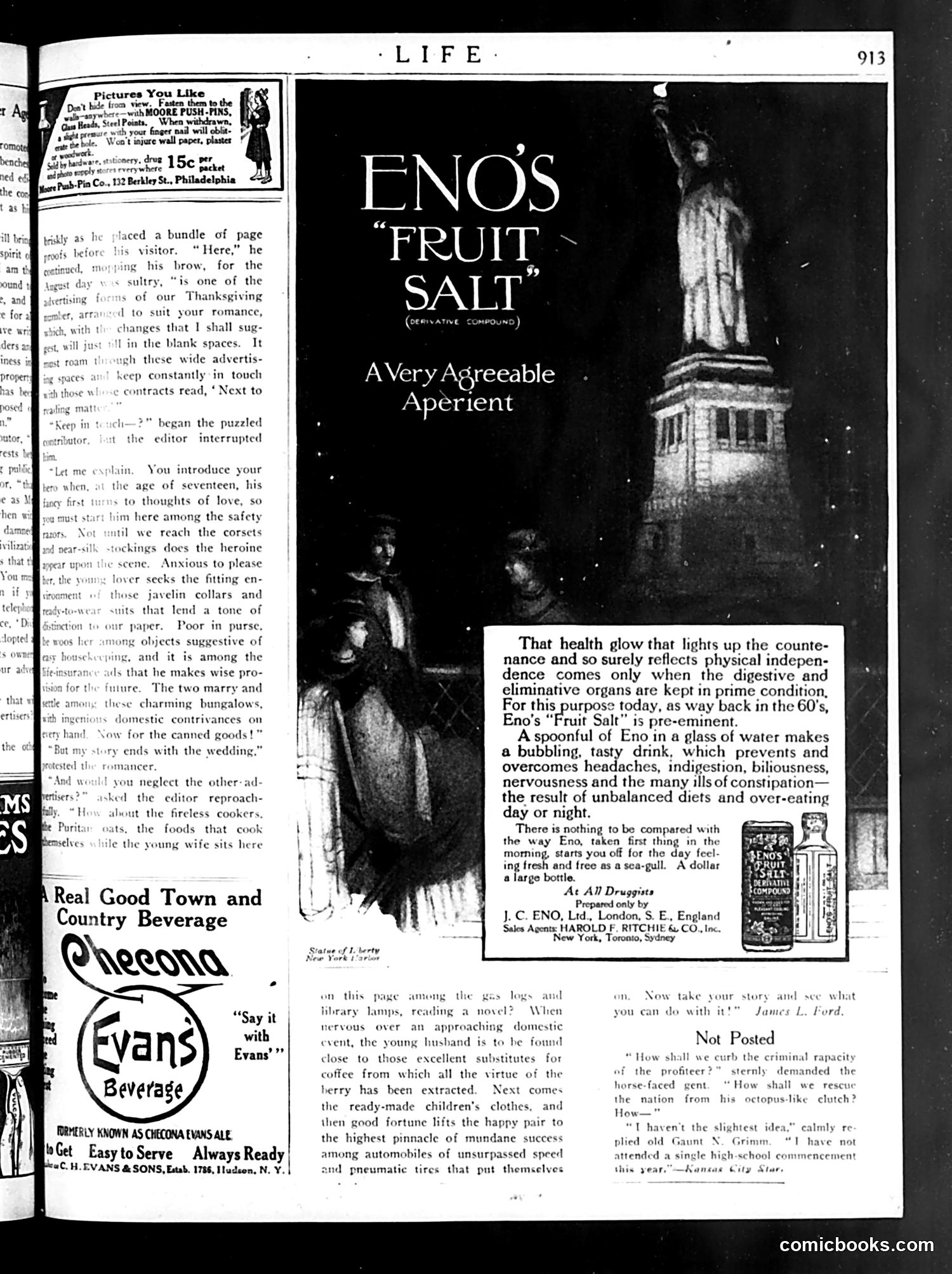
This page primarily features **advertising rather than political satire**. The dominant content is a large advertisement for **Eno's Fruit Salt**, a digestive remedy marketed as a cure for indigestion, constipation, and related ailments—typical patent medicine advertising of the era. The left side contains partial text of what appears to be a **fiction editor's dialogue** about crafting a romance story, discussing plot elements like young love, domestic settings, and bungalows—likely satirizing formulaic romantic fiction popular at the time. Below that is an advertisement for **Evans Beverage** (formerly known as Chicona Evans Ale), marketed as "a real good town and country beverage." At the bottom right are brief joke snippets labeled "Not Posted," including vague references to "the profiteer" and concerns about "criminal rapacity"—likely wartime-era commentary on war profiteers, a common satirical target during or after WWI, though context is unclear from this excerpt alone. The page reflects early 20th-century concerns: digestive health anxieties, formulaic popular literature, and war-related economic grievances.
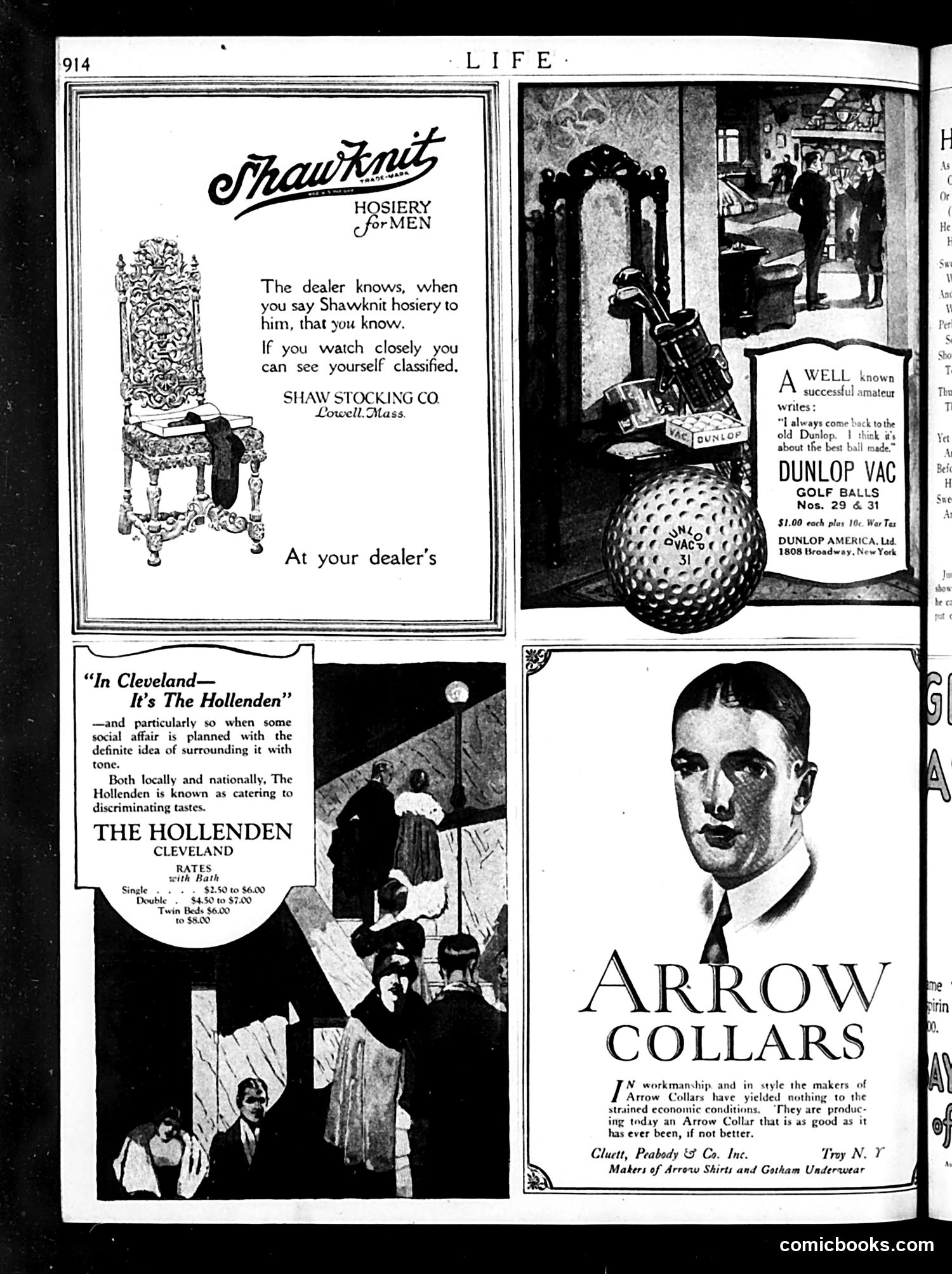
This page consists entirely of **vintage advertisements**, not political cartoons or satire. It contains four ads: 1. **Shawknit Hosiery** — markets men's socks, suggesting that wearing this brand signals refined taste to dealers and others who observe you 2. **The Hollenden Hotel** (Cleveland) — promotes upscale lodging for discriminating clientele planning social events 3. **Dunlop Vac Golf Balls** — features an endorsement from a "well-known successful amateur" golfer 4. **Arrow Collars** — asserts the brand maintains quality despite economic hardship ("difficult economic conditions"), emphasizing durability and style The page reflects early 20th-century consumer culture targeting middle and upper-class men through appeals to **status, taste, and respectability**. The repeated emphasis on "discrimination," "tone," and "quality" suggests these products signal social standing to observers. The reference to economic conditions hints this was published during or after a recession, when manufacturers stressed value despite inflation.
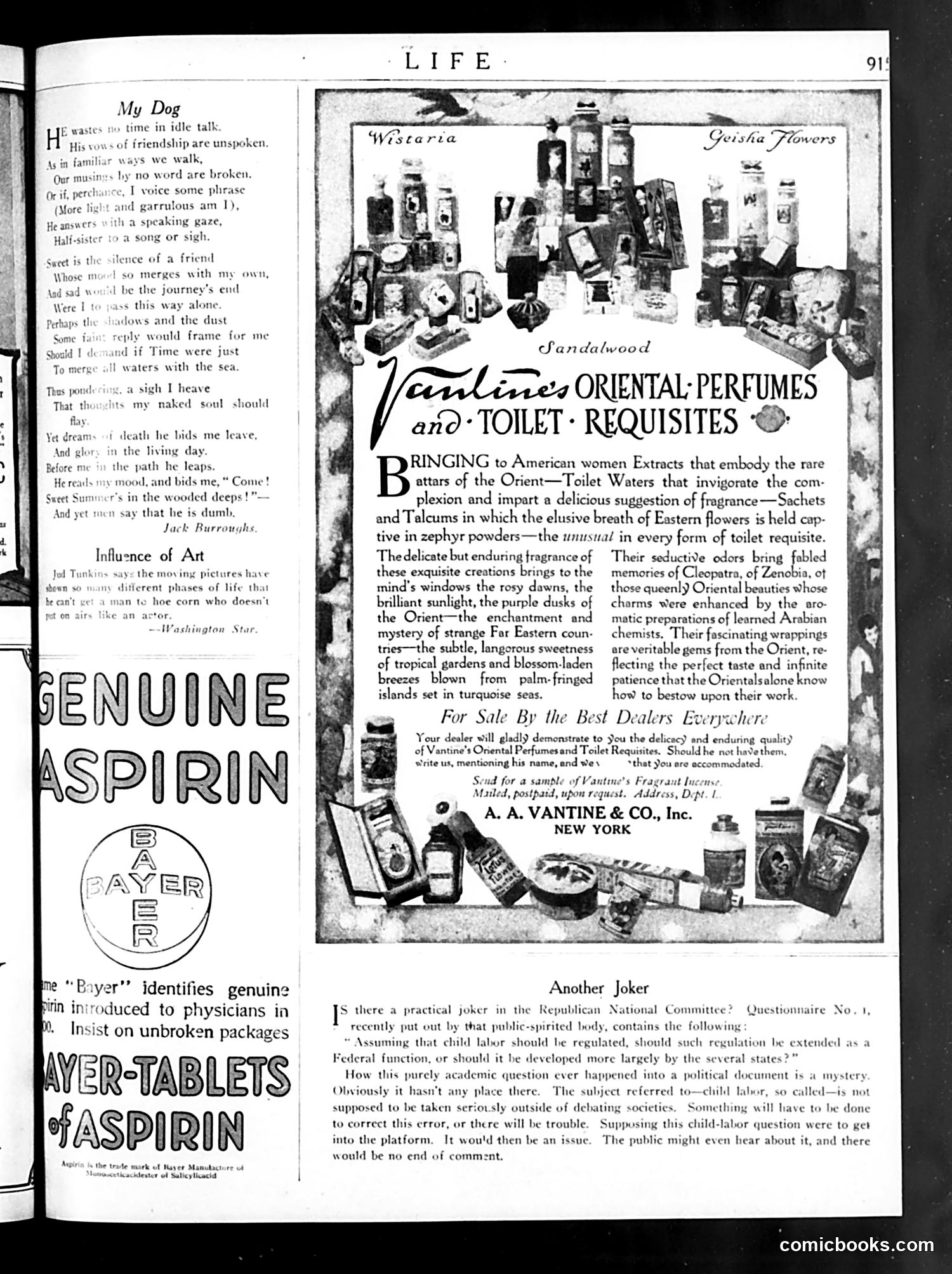
This page contains three distinct sections: **"My Dog"** — A sentimental poem by Jack Burroughs celebrating canine companionship through silent understanding, contrasting the dog's quiet loyalty with human chattiness. **Vantine's Perfume Advertisement** — A full-page ad for Oriental perfumes and toiletries marketed to American women, emphasizing exotic Eastern mystique (Cleopatra, Arabian chemistry) to sell luxury goods. **"Another Joker"** — A brief satirical piece questioning whether a Republican National Committee questionnaire included a "child labor" question as a practical joke. The satire is that this academic regulation question has *no business* in political documents—it's so inflammatory that if it accidentally became party platform, the public would actually debate it seriously, creating unwanted controversy. The joke critiques careless Republican drafting. **"Influence of Art"** — A one-line quip suggesting actors' exposure to diverse roles makes them unreliable judges of practical matters. The page is primarily advertising with light satirical commentary.
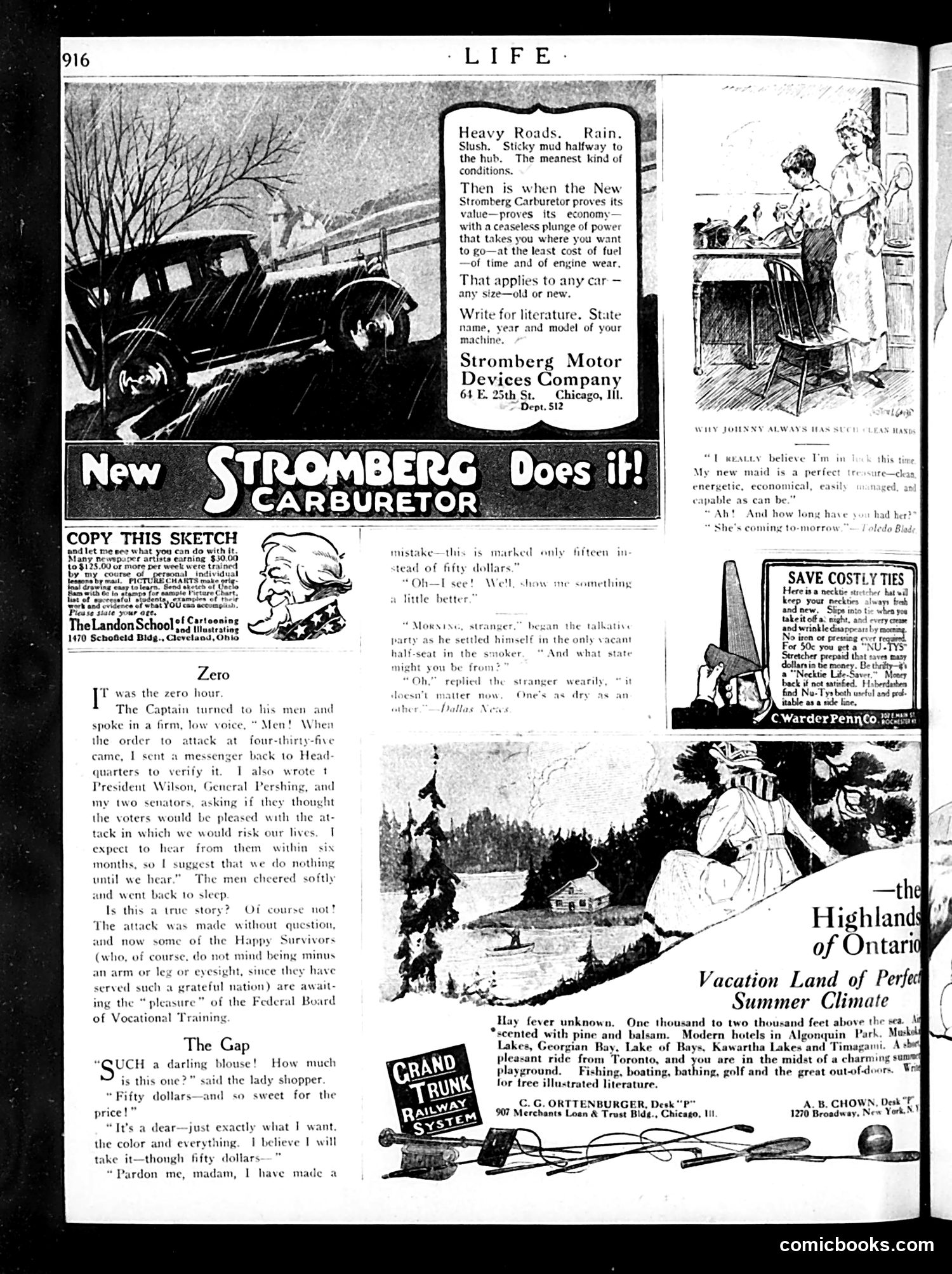
This page is primarily **advertising with embedded short fiction/humor**. The main content includes: **"Zero"** — A satirical WWI story mocking military bureaucracy. A captain humorously delays attacking enemy forces to seek approval from President Wilson, General Pershing, and two senators before risking soldiers' lives. The joke critiques excessive caution and red tape; the punchline reveals the attack proceeded anyway, leaving disabled veterans dependent on government vocational training. **"The Gap"** — A brief comedic dialogue between a shopper and clerk about a blouse's price ($50), where the clerk initially misstates the cost as $15, then corrects himself. The humor lies in the customer's relief at the "correction" being equally expensive. **Advertisements** dominate: Stromberg Carburetors (top), Landon School of Cartooning, NuTys neckties, Grand Trunk Railway System, and Ontario vacation tourism. The page reflects 1920s American concerns: post-WWI veteran welfare, consumerism, and automotive technology.
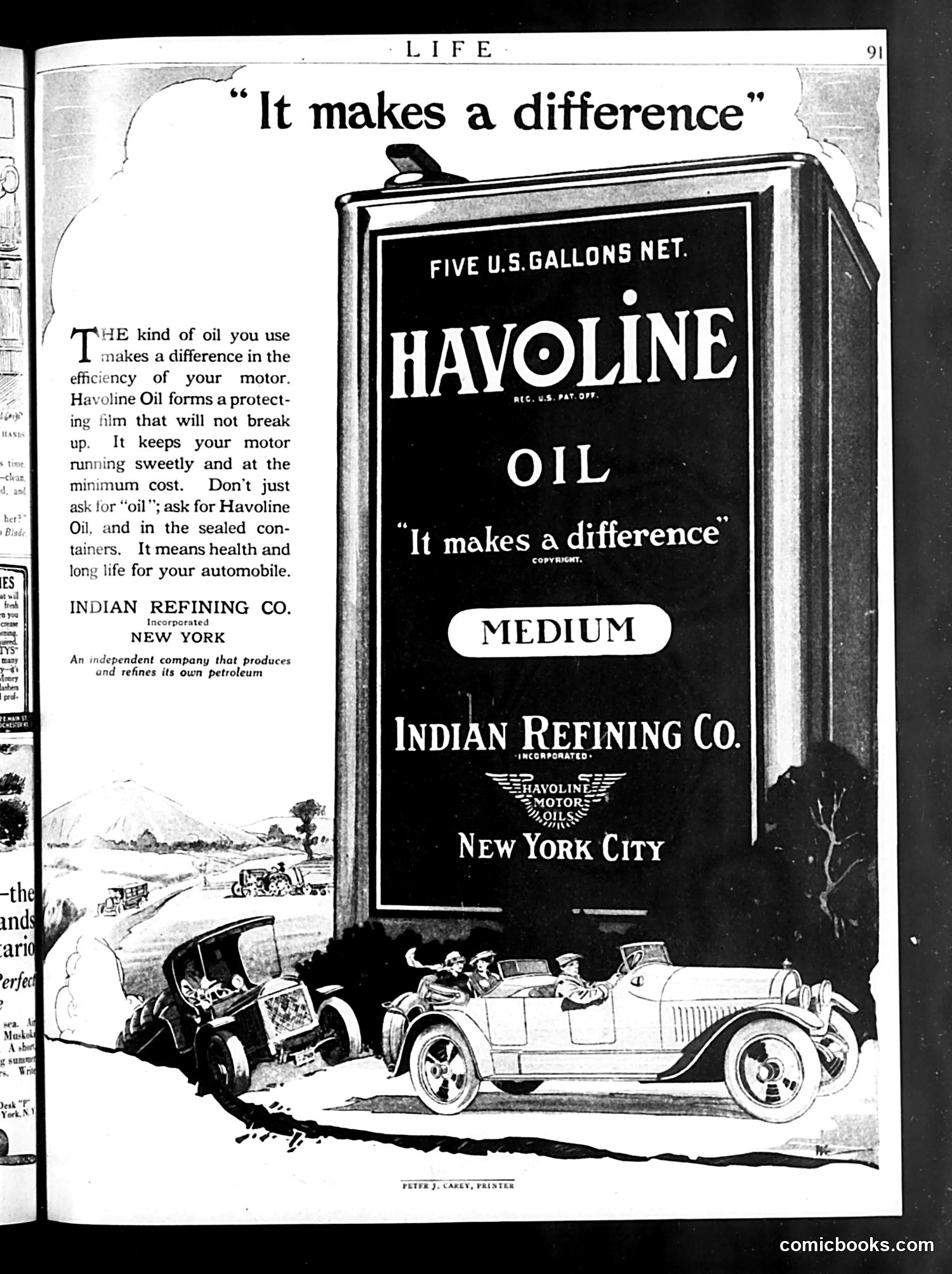
This is a **full-page advertisement**, not a political cartoon. It promotes Havoline Motor Oil by Indian Refining Co. of New York City. The ad uses the tagline **"It makes a difference"** twice—emphasizing that choosing the right oil brand matters for automobile performance. The central image shows a large oil can alongside illustrations of early automobiles, with one vehicle appearing damaged, contrasting with another in better condition. The copy stresses that Havoline Oil forms a protective film that keeps motors running smoothly and affordably, and advises customers to specifically request the brand by name rather than generic "oil." This reflects early automotive culture when motor oil quality was still variable and brand selection genuinely affected engine longevity—a practical sales pitch rather than satire. The vintage automobiles and sealed-container emphasis date this to the 1910s-1920s era.
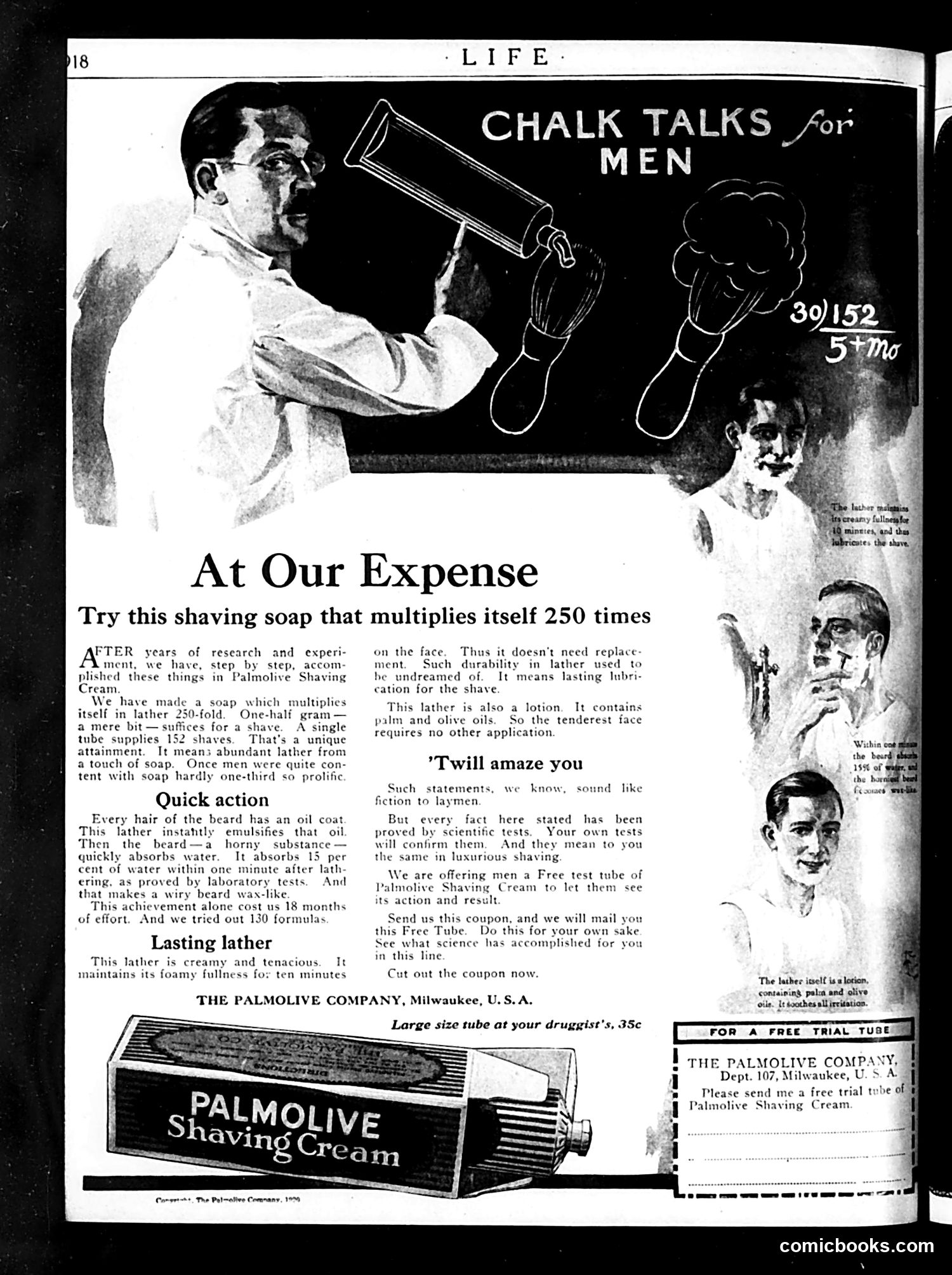
This page is primarily a **Palmolive Shaving Cream advertisement**, not a political cartoon. The "Chalk Talks for Men" headline refers to the illustrated demonstrations of the product's benefits shown by the man at the blackboard. The satire is subtle and directed at **advertising claims themselves** rather than politics. Life magazine, known for lampooning consumer culture, presents Palmolive's extravagant boasts—that the cream "multiplies itself 250 times" and requires only half a gram per shave—with tongue-in-cheek earnestness. The phrase "At Our Expense" suggests Life is mocking the company's willingness to spend lavishly on research claims. The repeated assurance that claims are "proved by scientific tests" and "not fiction" reads as satirical commentary on how advertising exploits consumer skepticism through pseudo-scientific language. The accompanying photographs of satisfied male faces reinforce the ad's persuasive intent, which Life itself appears to be gently ridiculing through its presentation.
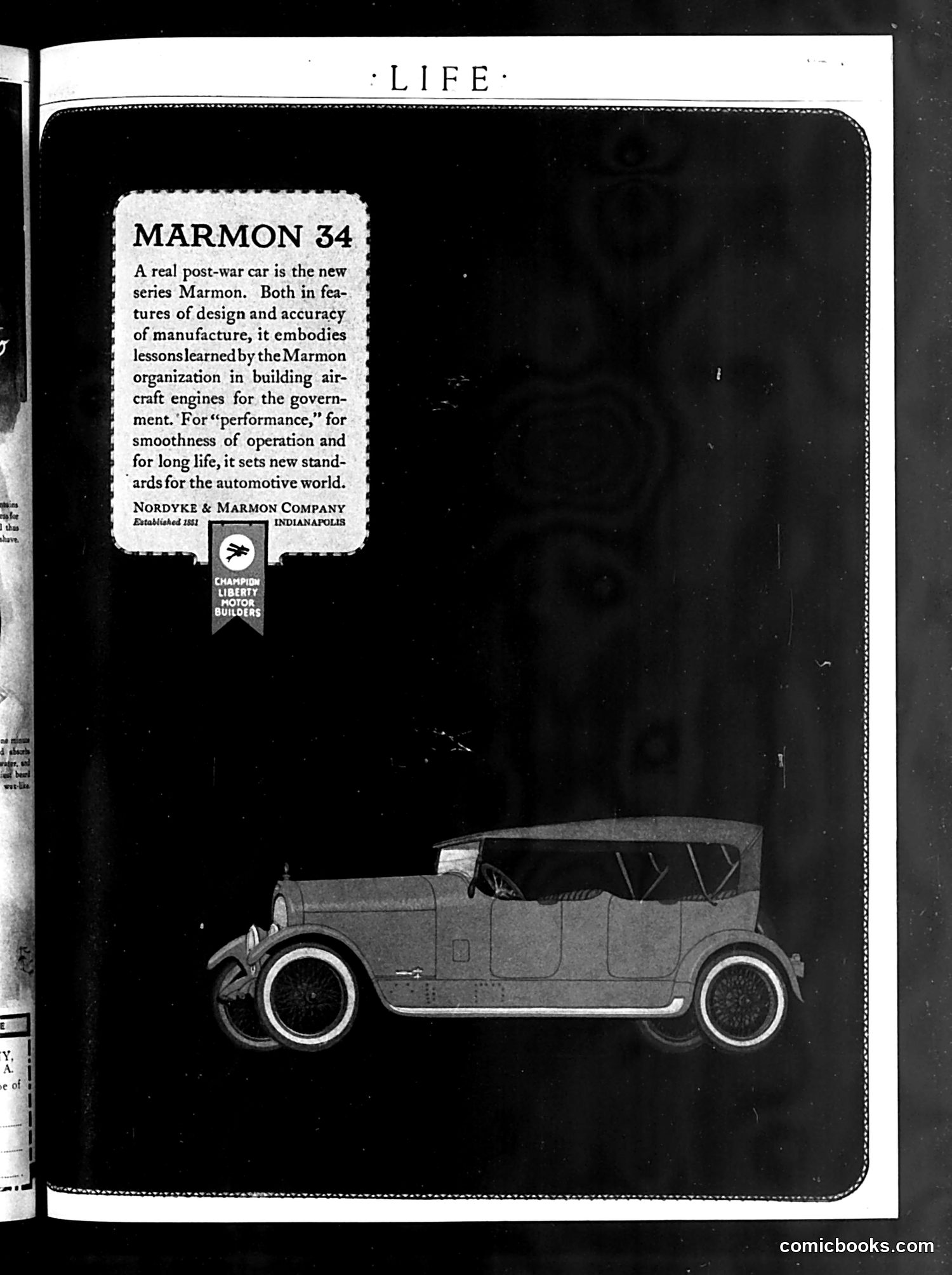
This is a **car advertisement**, not a political cartoon. It appears in *Life* magazine promoting the Marmon 34 automobile. The ad emphasizes the car's post-World War I credibility by highlighting that Marmon built aircraft engines for the U.S. government during the war. This was a marketing strategy: companies leveraged their military manufacturing experience to suggest reliability and precision engineering for civilian products. The text claims the Marmon 34 applies wartime lessons to achieve superior "performance," smooth operation, and longevity—positioning it as setting new automotive standards. The small badge at bottom left indicates "Champion Liberty Motor" association, further reinforcing patriotic/military connections. This reflects the 1920s trend of war-profiteering companies rebranding themselves as trustworthy civilian manufacturers.
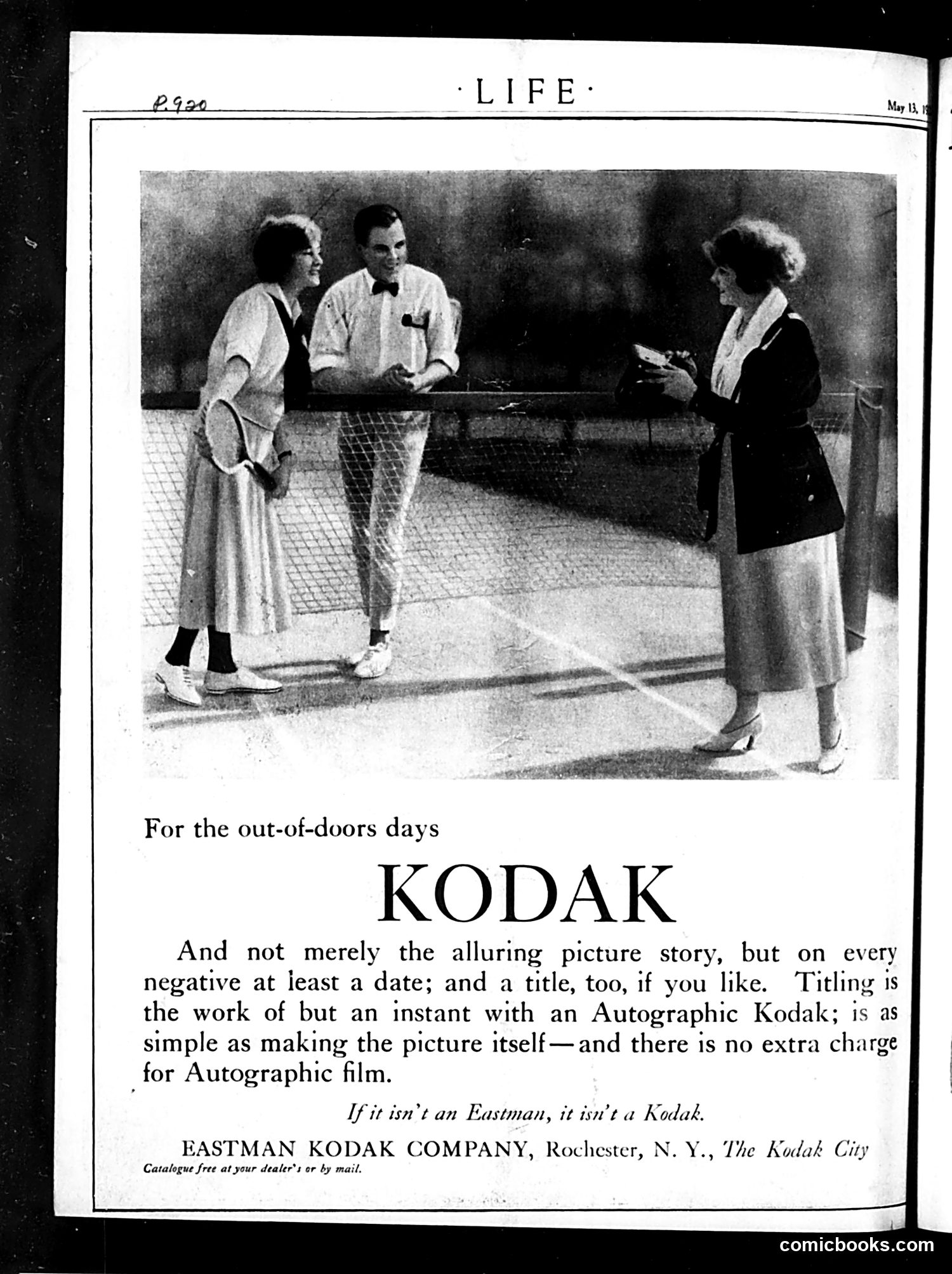
This is primarily a **product advertisement**, not political satire or editorial cartoon. It's a Kodak camera advertisement from *Life* magazine (dated May 13, based on visible header). The image shows three people at a tennis court: two women holding rackets and a man in the center. The ad promotes Kodak's "Autographic" camera feature, which allowed users to write dates and titles directly onto film negatives instantly—a technical innovation for the era. The humor is gentle and lifestyle-oriented rather than satirical: the advertisement suggests Kodak cameras are perfect for casual outdoor activities like tennis, capturing not just "alluring picture stories" but also metadata (dates/titles). The slogan "If it isn't an Eastman, it isn't a Kodak" emphasizes brand ownership by Eastman Kodak Company. This reflects early 20th-century consumer advertising using attractive social scenes to market leisure photography.