
Life, 1920-05-13 · page 25 of 52
Life — May 13, 1920 — page 25: what you’re looking at
What you’re looking at
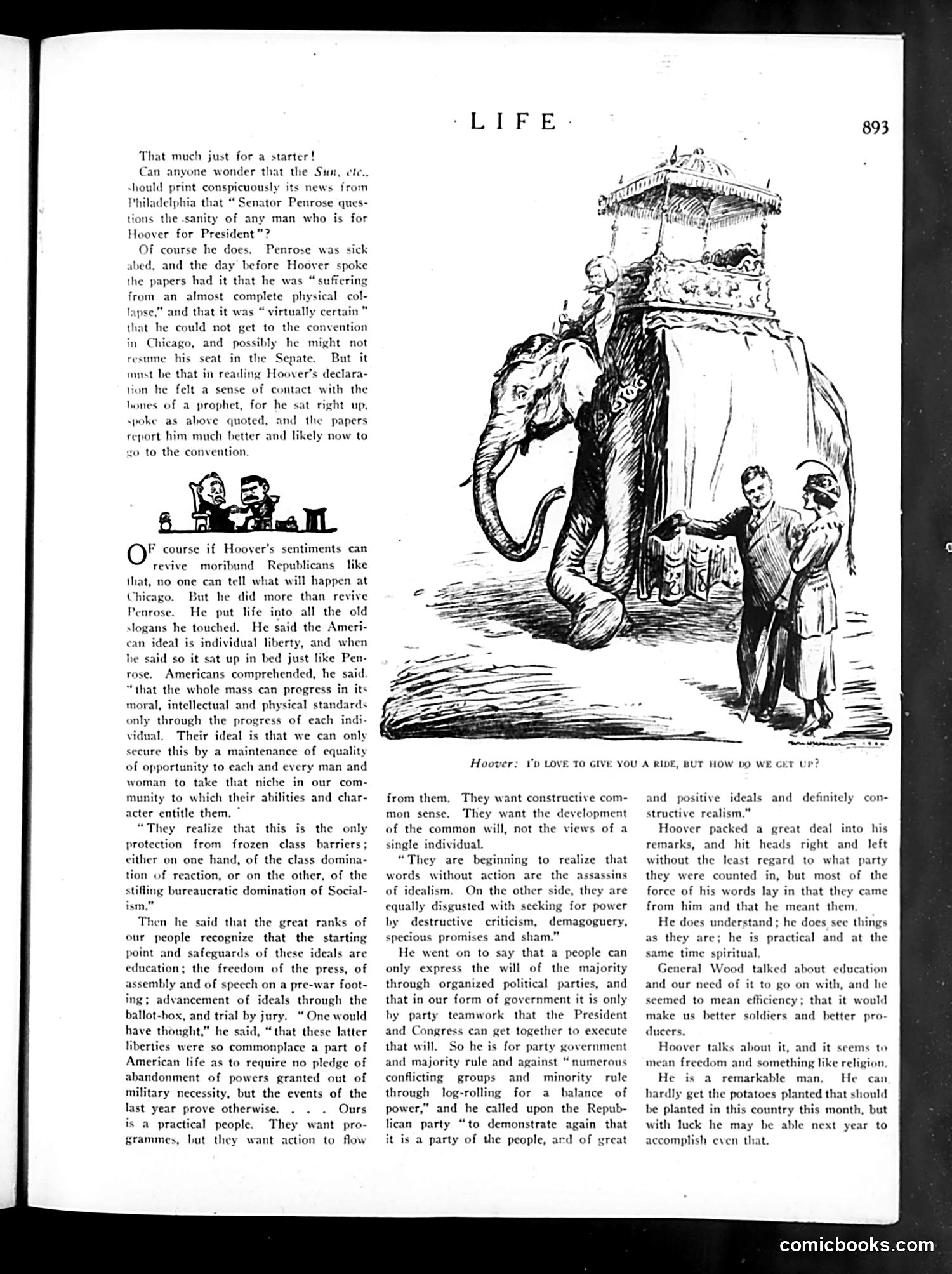
This 1928 Life magazine page satirizes Herbert Hoover's presidential campaign and its effect on Republican Party morale. The cartoon depicts an elephant (the Republican symbol) carrying a howdah (ornate carriage) with Hoover inside, while Senator Boies Penrose—depicted as elderly and infirm—stands below asking how to climb aboard. The joke references Penrose's reported "complete physical collapse" the day before Hoover's speech, yet Penrose recovered enough to attend the Chicago convention after hearing Hoover's address. The satire suggests Hoover's rhetoric was so inspiring it literally revived a dying politician. The article praises Hoover's speech emphasizing individual liberty, equality of opportunity, education, and free press—traditional Republican ideals. The cartoon's humor lies in the absurdity of elderly party leadership struggling to board the "Hoover express," implying the candidate energized even moribund Republicans.
📄 Transcribed text from this page (OCR, searchable)
Machine-transcribed from the original scan — historical spelling and the odd misread are preserved.
That much just for a starter! Can anyone wonder that the Sun, ete., should print conspicuously its news from Philadelphia that “ Senator Penrose ques- tions the sanity of any man who is for Hoover for President”? Of course he does. Penrose was sick abed, and the day before Hoover spoke the papers had it that he was “suffering from an almost complete physical col- lapse,” and that it was “ virtually certain” that he could not get to the convention in Chicago, and possibly he might not resume his seat in the Senate. But it nust be that in reading Hoover's declara- tion he felt a sense of contact with the hones of a prophet, for he sat right up, spoke as above quoted, and the papers report him much hetter and likely now to xo to the convention * course if Hoover's sentiments can revive moribund Republicans like that, no one can tell what will happen at But he did more than revive He put life into all the old slogans he touched. He said the Ameri- can ideal is individual liberty, and when he said so it sat up in bed just like Pen- Americans comprehended, he said “that the whole mass can progress in its moral, intellectual and physical standards only through the progress of each indi- vidual. Their ideal is that we can only secure this by a maintenance of equality of opportunity to each and every man and woman to take that niche in our com- munity to which their abilities and char- acter entitle them. © “They realize that this is the only protection from frozen class harriers; either on one hand, of the class domina- tion of reaction, or on the other, of the stifling bureaucratic domination of Social- ism.” Then he said that the great ranks of our people recognize that the starting point and safeguards of these ideals are education; the freedom of the press, of assembly and of speech on a pre-war foot- ing; advancement of ideals through the ballot-box, and trial by jury. “ One would have thought,” he said, “that these latter liberties were so commonplace a part of American life as to require no pledge of abandonment of powers granted out of military necessity, but the events of the last year prove otherwise. . . . Ours is a practical people. They want pro- grammes, but they want action to flow Chicago. Penrose. rose. Hoover: 1'b LOVE TO GIVE YOU A RIDE, BUT HOW DO WE GET t from them. They want constructive com- mon sense. They want the development of the common will, not the views of a single individual. “They are beginning to realize that without action are the On the other side, they are words sassins of idealism. equally disgusted with seeking for power by destructive criticism, demagoguery, specious promises and sham.” He went on to say that a people can only express the will of the majority through organized political parties, and that in our form of government it is only by party teamwork that the President and Congress can get together to execute that will, So he is for party government and majority rule and against “numerous conflicting groups and minority rule through log-rolling for a balance of power,” and he called upon the Repub- lican party “to demonstrate again that it is a party of the people, ard of great and positive ideals and definitely con- structive realism.” Hoover packed a great deal into his remarks, and hit heads right and left without the least regard to what party they were counted in, but most of the force of his words lay in that they came from him and that he meant them. He does understand; he does see things as they are; he is practical and at the same time spiritual General Wood talked about education and our need of it to go on with, and he seemed to mean efficiency; that it would make us better soldiers and better pro- ducers. Hoover talks about it, and it seems to mean freedom and something like religion He is a remarkable man. He hardly get the potatoes planted that should be planted in this country this month, but with luck he may be able next year to accomplish even that. can comicbooks.com