
Life, 1920-05-13 · page 28 of 52
Life — May 13, 1920 — page 28: what you’re looking at
What you’re looking at
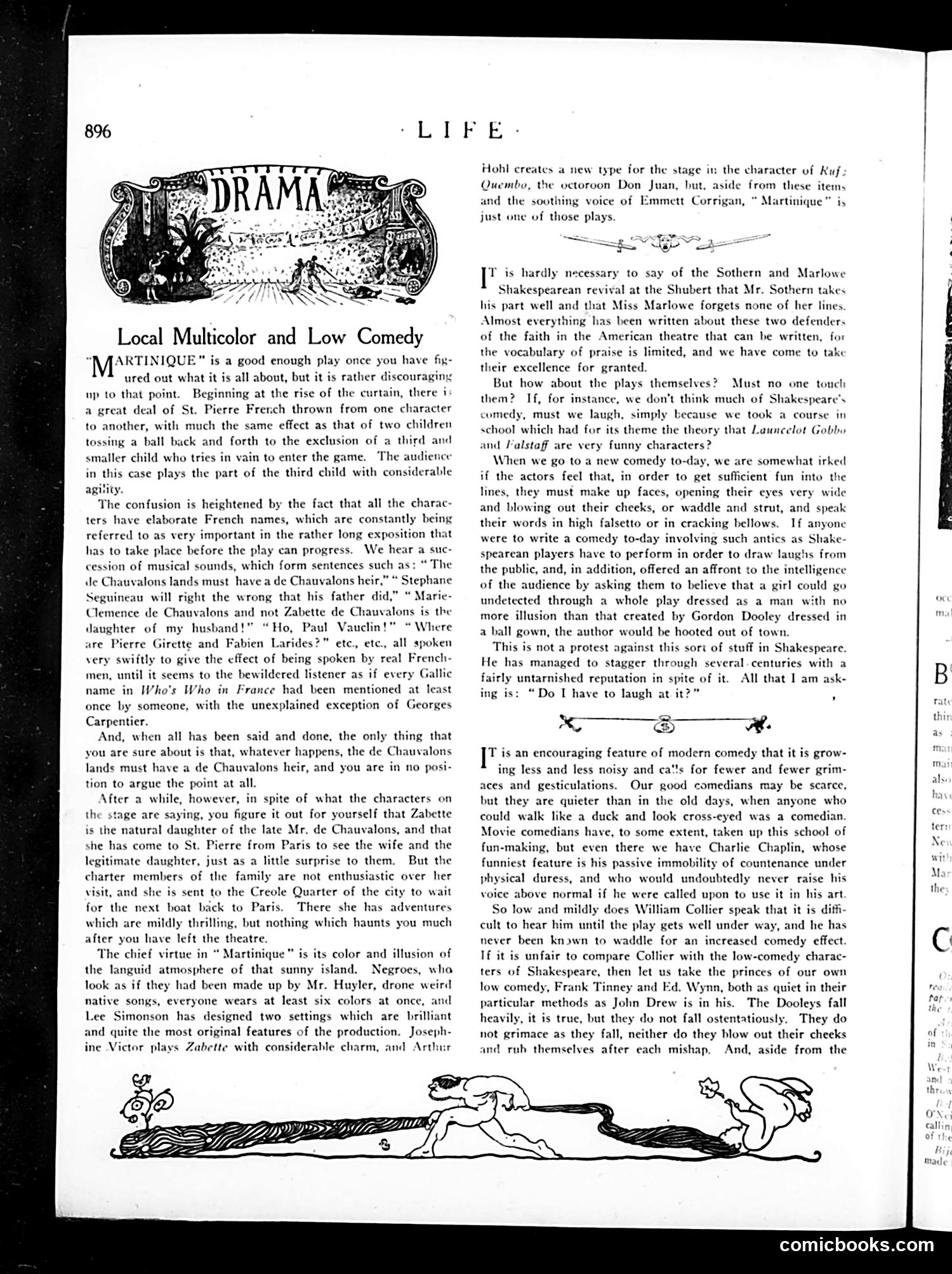
This page reviews two theatrical productions. The main text critiques the play "Martinique," a French colonial drama featuring elaborate character names and French dialogue that confuses the audience. The reviewer finds the plot simple (an illegitimate daughter visits her father's family) but praises the scenic design by Lee Simonson and performances by actors playing tropical characters. The second review discusses a Shakespeare revival starring Sothern and Marlowe at the Shubert Theatre. The critic acknowledges their excellent performances but challenges the assumption that audiences must automatically laugh at "funny" Shakespearean characters like Launcelot Gobbo and Falstaff simply because tradition dictates they should. The reviews exemplify early 20th-century theater criticism, questioning both exotic spectacle and blind reverence for classical drama.
📄 Transcribed text from this page (OCR, searchable)
Machine-transcribed from the original scan — historical spelling and the odd misread are preserved.
Local Multicolor and Low Comedy “N AARTINIQUE” is a good enough play once you have fix- ured out what it is all about, but it is rather discouraging up to that point. Beginning at the rise of the curtain, there is a great deal of St. Pierre French thrown from one character to another, with much the same effect as that of two children tossing a ball back and forth to the exclusion of a third and smaller child who tries in vain to enter the game. The audience in this case plays the part of the third child with considerable agitity. The confusion is heightened by the fact that all the char ters have elaborate French names, which are constantly being referred to as very important in the rather long exposition that has to take place before the play can progress. We hear a suc- cession of musical sounds, which form sentences such as: “ The «le Chauvalons lands must have a de Chauvalons heir,” “ Stephane Seguineau will right the wrong that his father did,” “ Marie- Clemence de Chauvalons and not Zabette de Chauvalons is the daughter of my husband!” “Ho, Paul Vauclin!” “Where are Pierre Girette and Fabien Larides?” etc. ete. all spoken very swiftly to give the effect of being spoken by real French- men, until it seems to the bewildered listener as if every Gallic name in Who's Who in France had been mentioned at least once by someone, with the unexplained exception of Georges Carpentier. And, when all has been said and done, the only thing that you are sure about is that, whatever happens, the de Chauvalons lands must have a de Chauvalons heir, and you are in no posi- tion to argue the point at all After a while, however, in spite of what the characters on the ge are saying, you figure it out for yourself that Zabette is the natural daughter of the late Mr. de Chauvalons, and that she has come to St. Pierre from Paris to see the wife and the legitimate daughter, just as a little surprise to them. But the charter members of the family are not enthusiastic over her visit, and she is sent to the Creole Quarter of the city to wait for the next boat back to Paris. There she has adventures which are mildly thrilling, but nothing which haunts you much after you have left the theatre. The chief virtue in “ Martinique” is its color and illusion of the languid atmosphere of that sunny island. Negroes, wha look as if they had been made up by Mr. Huyler, drone weird native songs, everyone wears at least six Lee Simonson has designed two settings which are brilliant and quite the most original features of the production. Joseph- Zabette with considerable charm, and Arthur ine Victor play FE- Hohl creates a new type for the stage in the character of Kuf Quembo, the octoroon Don Juan, but, aside from these items and the soothing voice of Emmett Corrigan, “ Martinique” is just one of those plays. i is hardly necessary to say of the Sothern and Marlowe Shakespearean revival at the Shubert that Mr. Sothern takes his part well and that Miss Marlowe forgets none of her lines. Almost everything has been written about these two defenders of the faith in the American theatre that can be written, for the vocabulary of praise is limited, and we have come to take their excellence for granted. But how about the plays themselves? Must no one toucl them? If, for instance, we don’t think much of Shakespeare's comedy, must we laugh, simply because we took a course in school which had for its theme the theory that Launcelot Gobbo and Falstaff are very funny characters? When we go to a new comedy to-day, we are somewhat irked if the actors feel that, in order to get sufficient fun into the lines, they must make up faces, opening their eyes very wide and blowing out their cheeks, or waddle and strut, and speak their words in high falsetto or in cracking bellows. If anyone were to write a comedy to-day involving such antics as Shake- spearean players have to perform in order to draw laughs from the public, and, in addition, offered an affront to the intelligence of the audience by asking them to believe that a girl could go undetected through a whole play dressed as a man with no more illusion than that created by Gordon Dooley dressed in a ball gown, the author would be hooted out of town. This is not a protest against this sort of stuff in Shakespeare. al-centuries with a He has managed to stagger through sev fairly untarnished reputation in spite of it. All that I am ask- ing is: “Do I have to laugh at it?” ’ x <3) we. T is an encouraging feature of modern comedy that it is grow- ing less and less noisy and ca'!s for fewer and fewer grim- aces and gesticulations. Our good comedians may be scarce, but they are quieter than in the old days, when anyone who could walk like a duck and look cross-eyed was a comedian. Movie comedians have, to some extent, taken up this school of fun-making, but even there we have Charlie Chaplin, whose funniest feature is his passive immobility of countenance under physical duress, and who would undoubtedly never raise his voice above normal if he were called upon to use it in his art So low and mildly does William Collier speak that it is diffi- cult to hear him until the play gets well under way, and he has never been known to waddle for an increased comedy effect. If it is unfair to compare Collier with the low-comedy charac- ters of Shakespeare, then let us take the princes of our own low comedy, Frank Tinney and Ed. Wynn, both as quiet in their particular methods as John Drew is in his. The Dooleys fall heavily, it is true, but they do not fall ostentatiously. They do not grimace as they fall, neither do they blow out their cheeks ind rub themselves after each mishap. And, aside from the comicbooks.com