
Life, 1920-05-13 · page 24 of 52
Life — May 13, 1920 — page 24: what you’re looking at
What you’re looking at
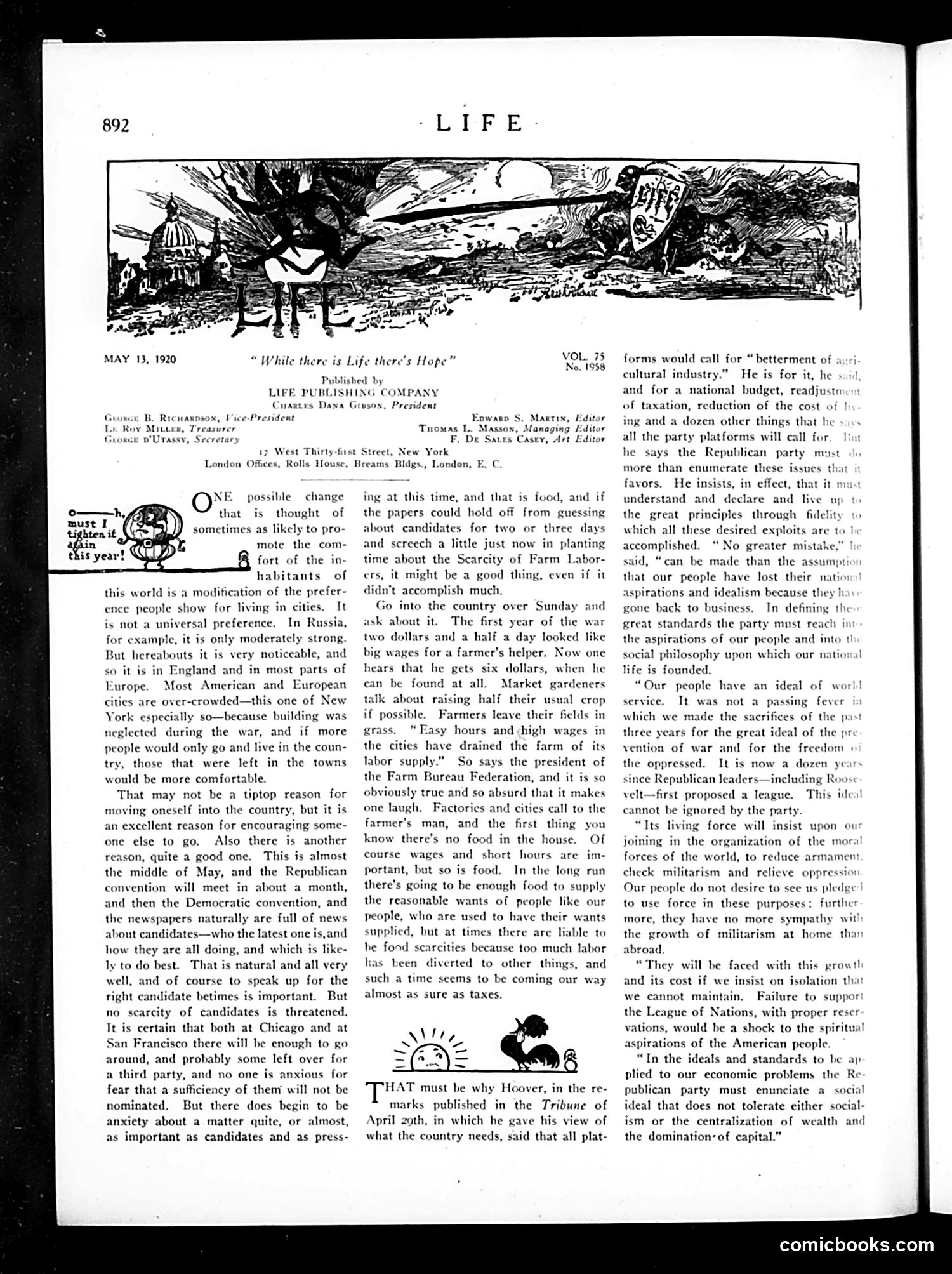
This page combines editorial commentary with a decorative header illustration. The main text addresses post-WWI America's urban overcrowding and an emerging farm labor crisis. **The Central Issues:** The editorial argues that encouraging migration from congested cities (especially New York) to the countryside would benefit everyone. More significantly, it highlights a critical food shortage threat caused by farm labor depletion—workers have abandoned agricultural work for better wages and "easy hours" in factories and cities. **The Political Context:** Published during election season (Republican and Democratic conventions were imminent in 1920), the piece criticizes newspapers for obsessing over candidates while ignoring the genuine crisis: insufficient farm labor threatens food supply. The editorial cites Herbert Hoover's recent comments on national needs, suggesting agricultural support should be a platform priority. **The Satire:** The piece mocks the absurdity that while cities overflow with people, farms lack workers, creating food scarcity—yet political discourse ignores this tangible problem for speculation about candidates.
📄 Transcribed text from this page (OCR, searchable)
Machine-transcribed from the original scan — historical spelling and the odd misread are preserved.
MAY 13, 1920 “While there is Pub Life there's Hope” Vou shed by LIFE. PUBLISHING COMPANY Curaatys Daya Growce B. Ricwarnsox, Vice-President Ly Roy Minter, Treasurer Guorce p'Urassy, Secretary 17 West Thirty-fir Gtwsox, President Epwarp S. Martin, Editor Tuomas L. Masson, Managing Editor F, Dr Sates Casey, Art Editor st Street, New York London Offices, Rolls House, Breams Bldgs., London, I change that is thought of sometimes as likely to pro- mote the com- fort of the in- habitants of this world is a modification of the prefer- possible ence people show for living in cities. It is not a universal preference. In Russia, for example, it is only moderately strong. But hereabouts it is very noticeable, and so it is in England and in most parts of Europe. Most American and European cities are over-crowded—this one of New York especially so—because building was neglected during the war, and if more people would only go and live in the coun- try, those that were left in the towns would be more comfortable. That may not be a tiptop reason for moving oneself into the country, but it is an excellent reason for encouraging some- one else to go. Also there is another reason, quite a good one. This is almost the middle of May, and the Republican convention will meet in about a month, and then the Democratic convention, and the newspapers naturally are full of news about candidates—who the latest one is,and how they are all doing, and which is lik ly to do best. That is natural and all very well, and of course to speak up for the right candidate betimes is important. But no scarcity of candidates is threatened. It is certain that both at Chicago and at San Francisco there will he enough to go around, and probably some left over for a third party, and no one is anxious for fear that a sufficiency of them will not be nominated. But there does begin to be anxiety about a matter quite, or almost, as important as candidates and as press- ing at this time, and that is food, and the papers could hold off from guessing about candidates for two or three days and screech a little just now in planting time about the Scarcity of Farm Labor- ers, it might be a good thing, even if it didn’t accomplish much. Go into the country over Sunday and ask about it. The first year of the war two dollars and a half a day looked like big wages for a farmer’s helper. Now one hears that he gets six dollars, when he can be found at all. Market gardeners talk about raising half their usual crop if possible. Farmers leave their fields in “Easy hours and high wages in the cities have drained the farm of its labor supply.” grass. So says the president of the Farm Bureau Federation, and it is so obviously true and so absurd that it makes one laugh. Factories and cities call to the farmer's man, and the first thing you know there’s no food in the house. Of course and short hours im- portant, but so is food. In the long run there's going to be enough food to supply the reasonable wants of people like our people, who are used to have their wants supplied, but at times there are liable to he fond searcities because too much labor has been diverted to other things, and wages are such a time seems to be coming our way almost as sure as taxes. \ly Save HAT must be why Hoover, in the re- marks published in the Tribune of April 20th, in which he gave his view of what the country needs, said that all plat- forms would call for “ betterment of cultural industry.” He is for it, and for a national budget, readjustn of taxation, reduction of the cost of | he ing and a dozen other things that he all the party platforms will call for he says the Republican party mast more than enumerate these issues that 1 favors. He insists, in effect, that it mu understand and declare and live w the great principles through fidelity which all these desired exploits are accomplished. “No greater mistake, said, “can be made than the assumpt that our people have lost their natior aspirations and idealism because they gone back to business. In defining great standards the party must rea the aspirations of our people and into tl social philosophy upon which our national life is founded. “Our people have an ideal of worl! service. ch iv It was not a passing fever i which we made the sacrifices of the past three years for the great ideal of the pr vention of war and for the freedom « the oppressed. since Republican leaders: velt—first proposed a league. cannot be ignored by the party. Its living force will insist upon oi It is now a dozen years including Roose This ideal joining in the organization of the moral forces of the world, to reduce armament check militarism and relieve oppressior Our people do not desire to see us pledge to use force in these purposes: further more, they have no more sympathy wit the growth of militarism at home thar abroad. “They will be faced with this growt! and its cost if we insist on isolation that we cannot maintain, Failure to suppor the League of Nations, with proper reser vations, would be a shock to the spiritual aspirations of the American people. “In the ideals and standards to he ap plied to our economic problems the Re publican party must enunciate a social ideal that does not tolerate either social- ism or the centralization of wealth and the domination: of capital.” comicbooks.com