
Life, 1920-05-13 · page 33 of 52
Life — May 13, 1920 — page 33: what you’re looking at
What you’re looking at
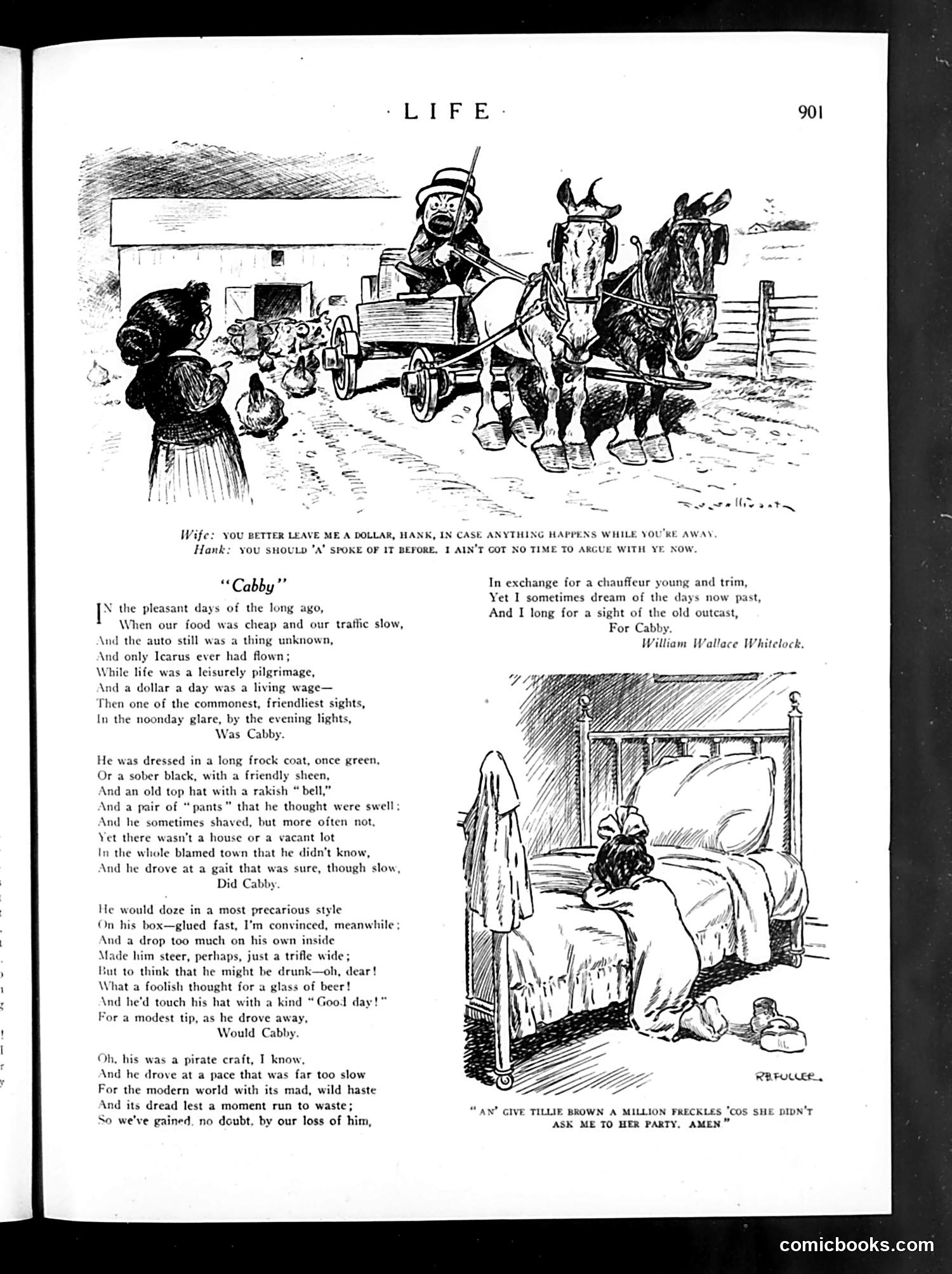
This page presents a sentimental poem by William Wallace Whitelock mourning the disappearance of horse-drawn taxi drivers ("cabbies") displaced by automobiles. The poem romanticizes the old cabby as a fixture of urban life—friendly, unhurried, and intimately familiar with his city's neighborhoods. The satire is gentle but pointed: the poem contrasts the leisurely pace and human connection of the horse-cab era with the "mad, wild haste" of the modern motorized world. The cabby represents a vanishing working class, rendered obsolete by technological progress. The top illustration shows a woman negotiating with a cabby before he departs—a scene of ordinary life now "lost." The bottom cartoon depicts a child's bedtime prayer, unrelated but typical of *Life*'s mixed editorial content. Together, these nostalgic pieces reflect early 20th-century ambivalence about rapid modernization.
📄 Transcribed text from this page (OCR, searchable)
Machine-transcribed from the original scan — historical spelling and the odd misread are preserved.
Wife: you BETTER LEAVE ME A DOLLAR, HANK, IN CASE ANYTHING HAPPENS WHILE YOU'RE AWAY Hank: you SHOULD 'A’ SPOKE OF IT BEFORE. I AIN'T COT NO TIME TO ARGUE WITH YE NOW. “Cabby” In exchange for a chauffeur young and trim, Yet I sometimes dream of the days now past, And I long for a sight of the old outcast, For Cabby. William Wallace Whitelock. N the pleasant days of the long ago, When our food was cheap and our traffic slow, And the auto still was a thing unknown, And only Icarus ever had flown; While life was a leisurely pilgrimage, And a dollar a day was a living wage— Then one of the commonest, friendliest sights, In the noonday glare, by the evening lights, Was Cabby. He was dressed in a long frock coat, once green, Or a sober black, with a friendly sheen, And an old top hat with a rakish “ bell,” And a pair of “pants” that he thought were swell; And he sometimes shaved, but more often not, Yet there wasn't a house or a vacant lot In the whole blamed town that he didn’t know, And he drove at a gait that was sure, though slow, Did Cabby. He would doze in a most precarious style On his box—glued fast, I'm convinced, meanwhile ; And a drop too much on his own inside Made him steer, perhaps, just a trifle wide ; But to think that he might be drunk—oh, dear! What a foolish thought for a glass of beer! And he'd touch his hat with a kind “Good day!” For a modest tip, as he drove away, Would Cabby. Oh, his was a pirate craft, I know, And he drove at a pace that was far too slow For the modern world with its mad, wild haste And its dread lest a moment run to waste; So we've gained. no doubt, by our loss of him, RBFULLER, AN’ GIVE TILLIE BROWN A MILLION FRECKLES "COS SHE DIDN'T ASK ME TO HER PARTY. AMEN” comicbooks.com