
A complete issue · 52 pages · 1919
Life — July 3, 1919
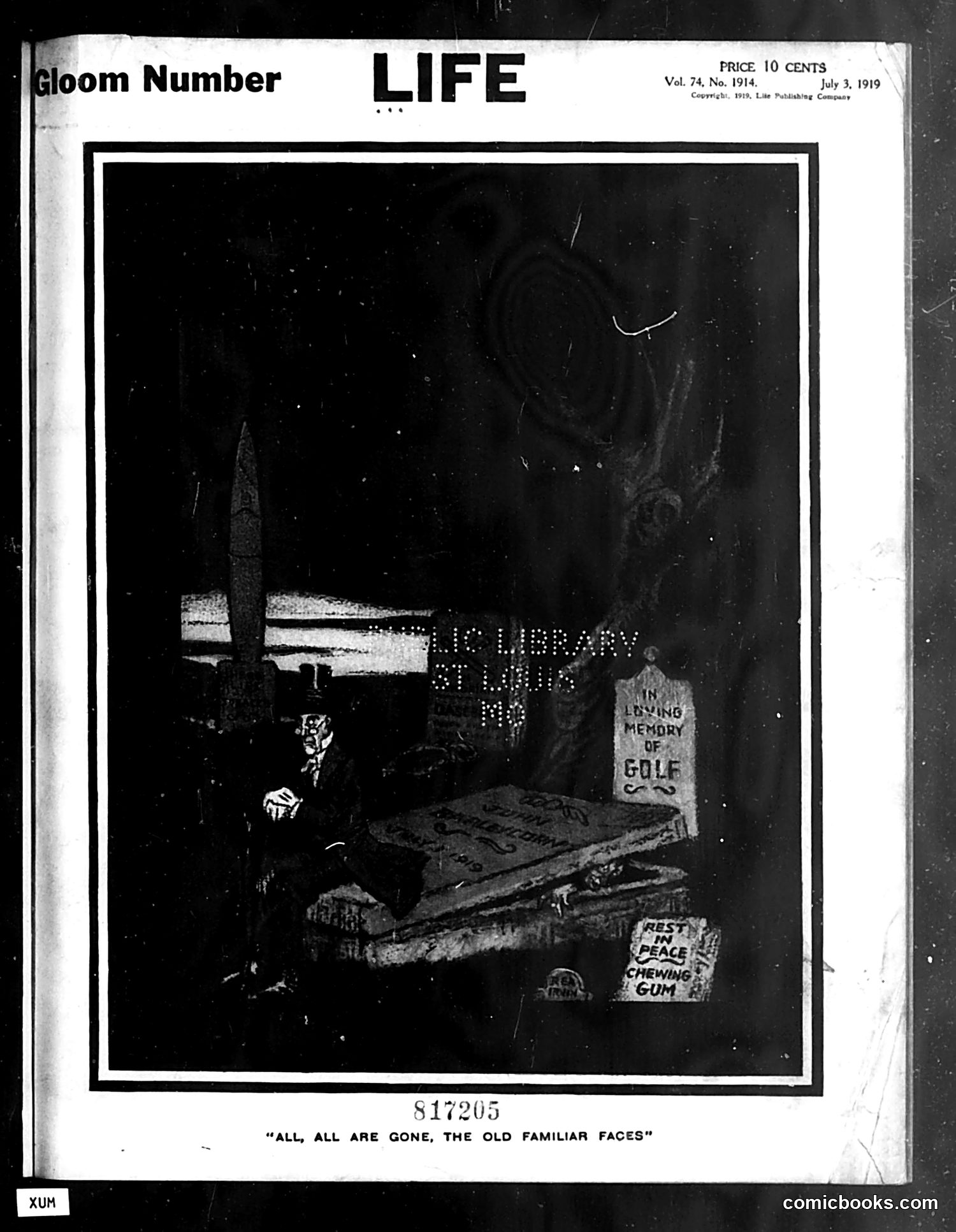
This is a graveyard scene from Life magazine (July 3, 1919), titled with a quote suggesting loss of the familiar. The image shows graves with headstones reading "In Loving Memory of Golf" and "Rest in Peace Chewing Gum," treating recreational activities as deceased. This appears to satirize post-World War I American society, likely critiquing either wartime restrictions on leisure activities or broader cultural anxieties about changing social norms following the war. The personification of golf and chewing gum as "dead" suggests these everyday pleasures have disappeared or been fundamentally altered. The exact historical context—whether referencing specific legislation, rationing, or cultural shifts—is unclear from the image alone, though Prohibition began in 1919.
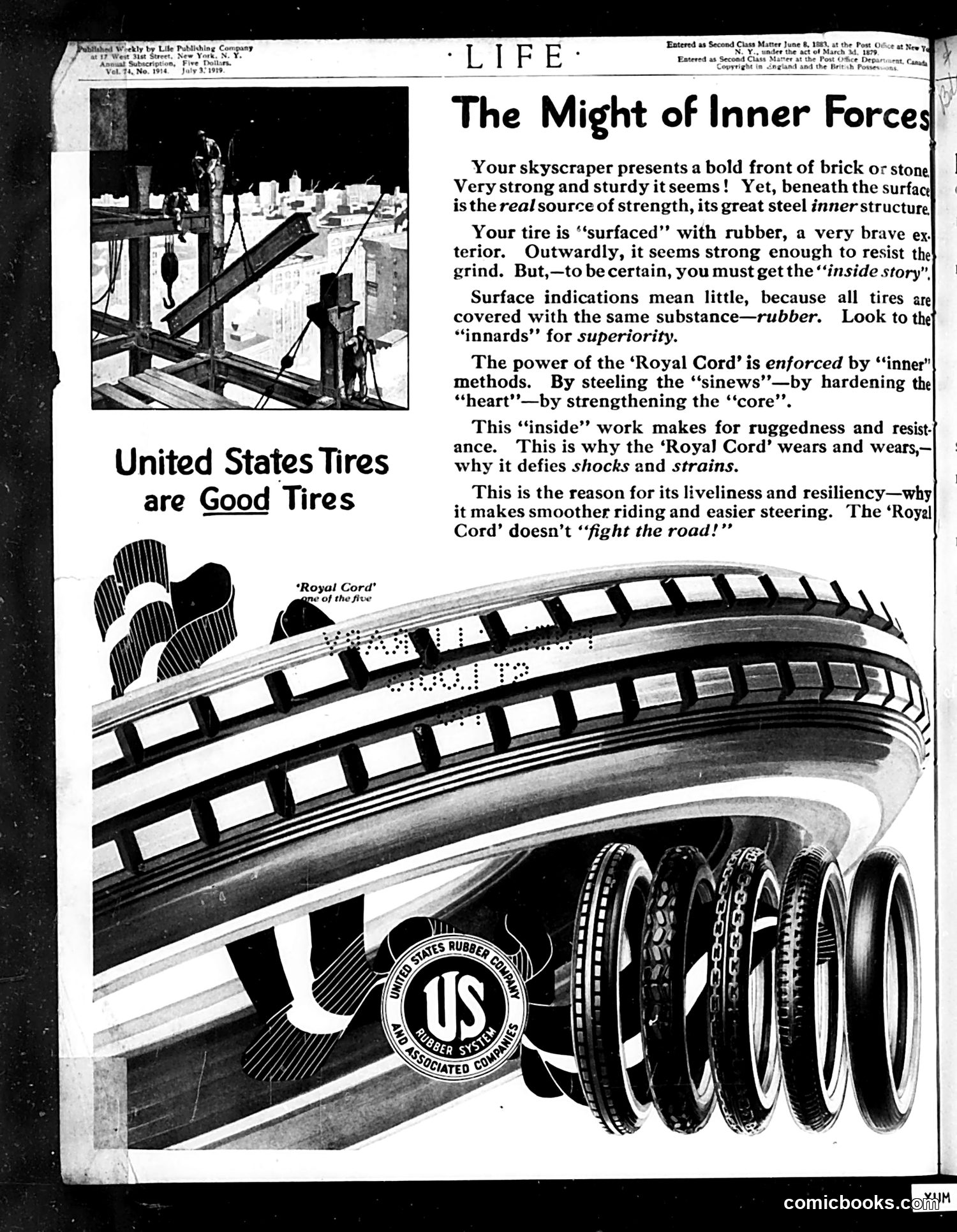
This is primarily a **United States Tires advertisement**, not satire or political commentary. The page promotes "Royal Cord" brand tires by explaining their construction. The ad uses an architectural metaphor: just as a skyscraper's strength comes from its inner steel frame (visible in the top photograph), tire quality depends on hidden internal structure, not just the visible rubber surface. The text emphasizes that Royal Cord tires have superior "inner methods"—reinforced "sinews" and "core"—making them more durable and providing better handling. The large illustration shows the tire's internal cross-section with visible reinforcement patterns. This was typical early-20th-century advertising, using technical explanation and metaphor to justify premium pricing for a consumer product.
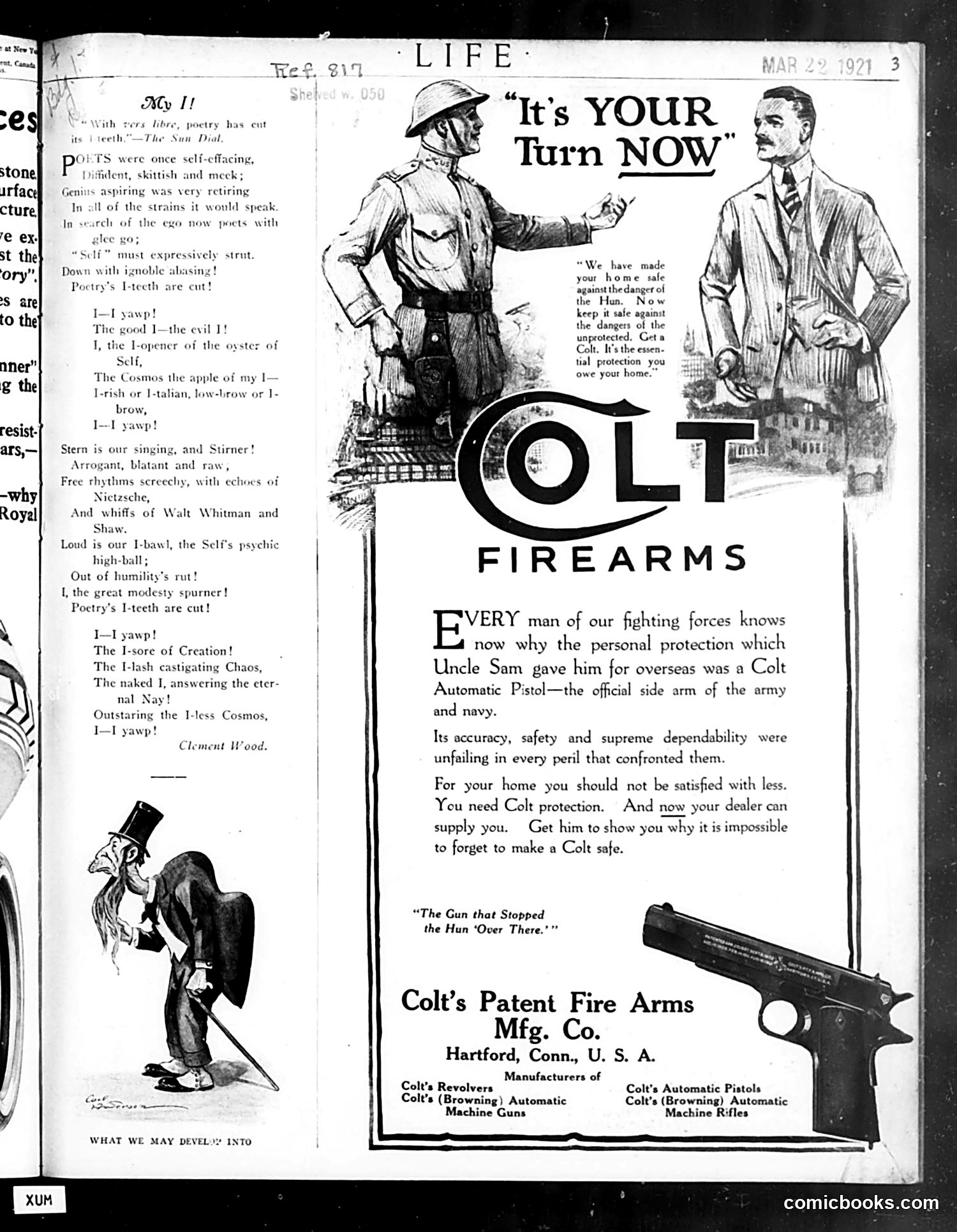
This March 1921 LIFE page contains two distinct elements: **Left side**: A poem titled "No. 11" by Clement Wood critiquing poetry itself—satirizing pretentious, self-important poets who employ obscure references and affected language. The accompanying cartoon shows a caricatured figure in a top hat, suggesting mockery of literary pretension. **Right side**: A Colt Firearms advertisement disguised as editorial content. It uses post-WWI patriotism to market handguns for "home protection," claiming soldiers carried Colt pistols overseas and suggesting civilians now need equivalent protection. The ad targets post-war anxiety about safety. The juxtaposition appears intentional—satirizing both literary pretension and commercial opportunism exploiting public concerns, typical of LIFE magazine's satirical approach.
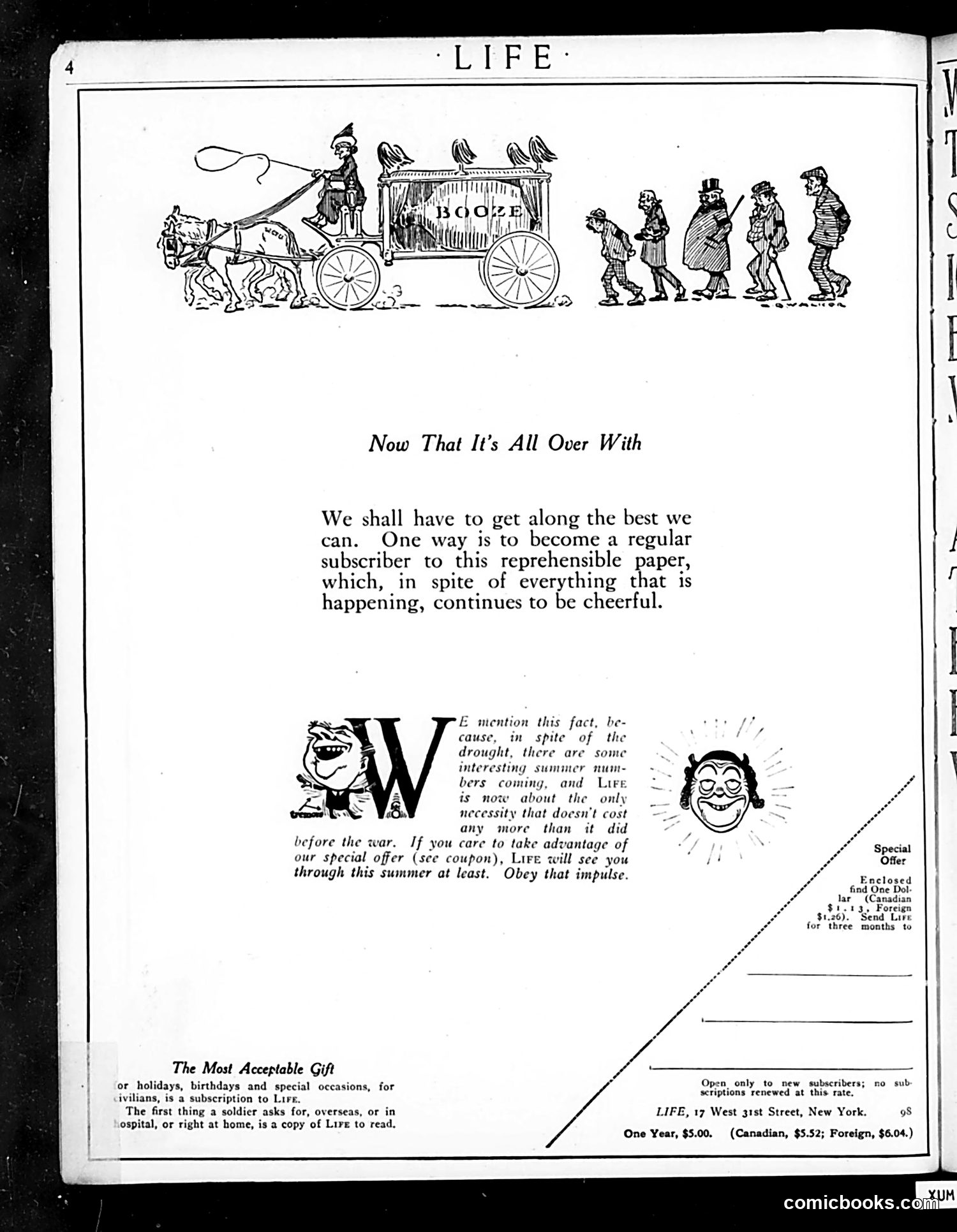
This page is primarily **advertising for Life magazine subscriptions**, not political commentary. The main cartoon depicts a horse-drawn wagon labeled "BOOZE" being chased by figures—likely representing law enforcement or temperance advocates, referencing Prohibition era concerns. The headline "Now That It's All Over With" suggests this relates to a concluded conflict, possibly WWI (the page mentions soldiers). The text promotes subscribing to Life as a way to "get along the best we can" during uncertain times while staying "cheerful." The "Special Offer" section advertises discounted subscriptions ($1.50 for three months, new subscribers only). The lower section pitches Life subscriptions as "The Most Acceptable Gift" for civilians or soldiers. This is essentially a wartime-era magazine advertisement emphasizing humor and normalcy through subscription.
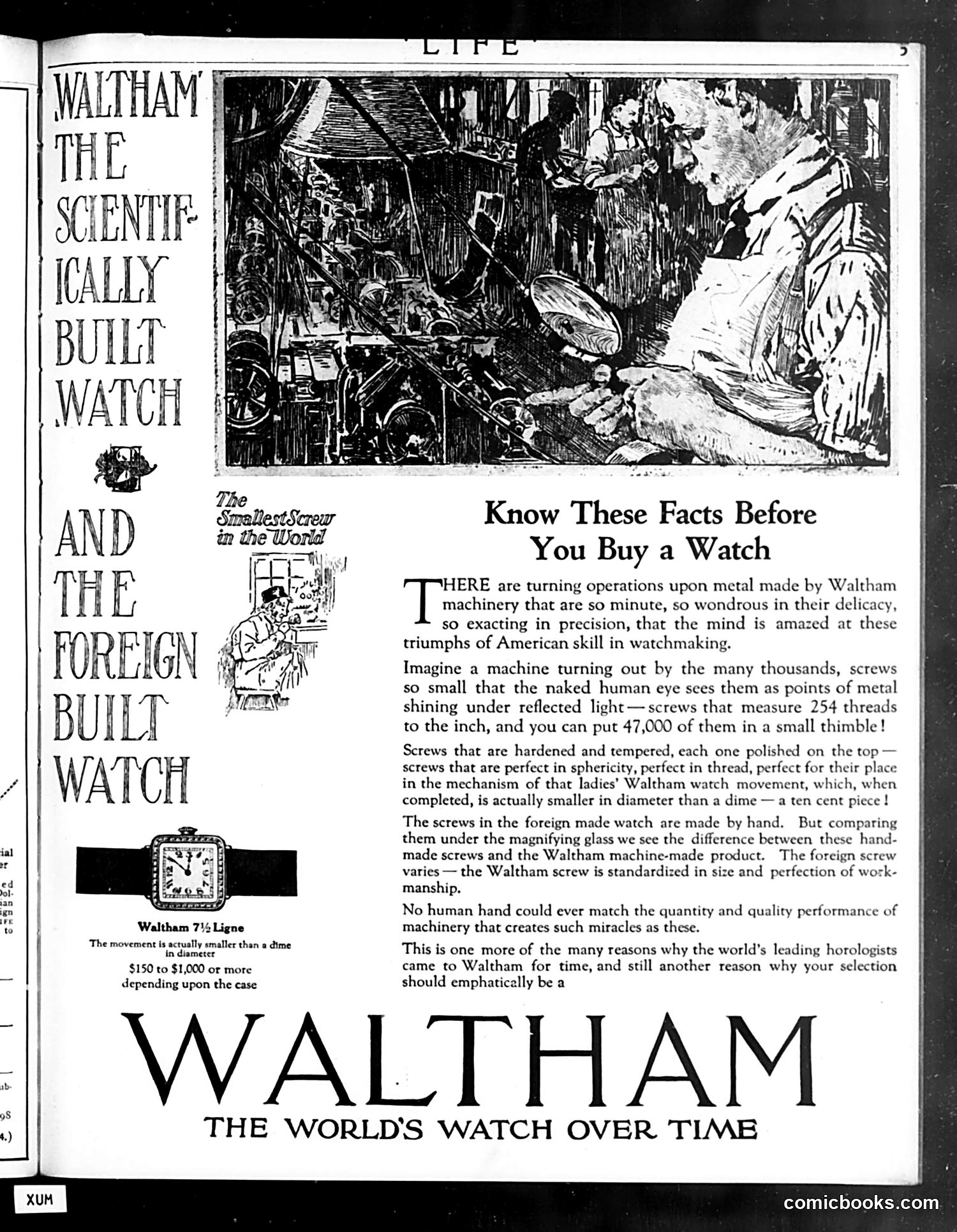
This is primarily a **product advertisement**, not satire. The page promotes Waltham watches by emphasizing American manufacturing superiority over foreign competitors. The left sidebar contrasts "Waltham the scientifically built watch" with "the foreign built watch," establishing a nationalist marketing angle. The main text boasts about precision manufacturing—specifically highlighting screws so tiny that 47,000 fit in a thimble, and machine-made consistency that surpasses hand-crafted foreign alternatives. The illustration shows a watchmaker at work. The advertisement appeals to buyers' pride in American industrial achievement and craftsmanship, positioning Waltham as the superior choice for "the world's leading horologists." This reflects early-20th-century American confidence in industrial production capabilities.
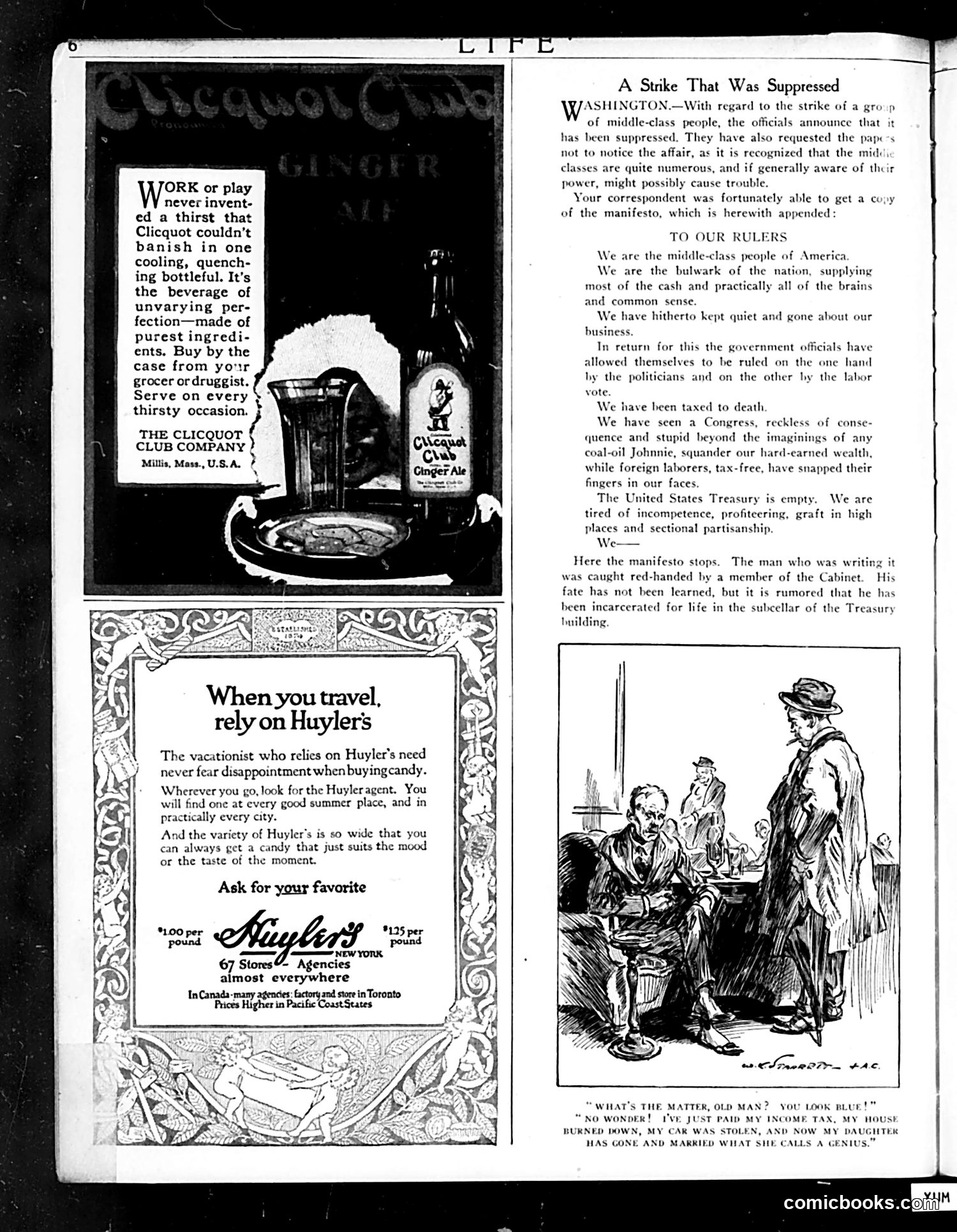
This Life magazine page combines political satire with advertising. The main article, "A Strike That Was Suppressed," reports on a middle-class strike in Washington that authorities shut down. The manifesto excerpt expresses grievances: excessive taxation, congressional incompetence, graft, and an empty Treasury. The text notes the writer was caught and possibly imprisoned in the Treasury building's subceller. The satire critiques government corruption and mismanagement while ironically depicting middle-class Americans as the nation's economic backbone—yet powerless against political abuse. The lower half contains unrelated advertisements for Clicquot Club beverages and Huyler's candies, typical of Life's format. The cartoon illustration (right) appears humorous but its specific reference is unclear from the visible text alone.
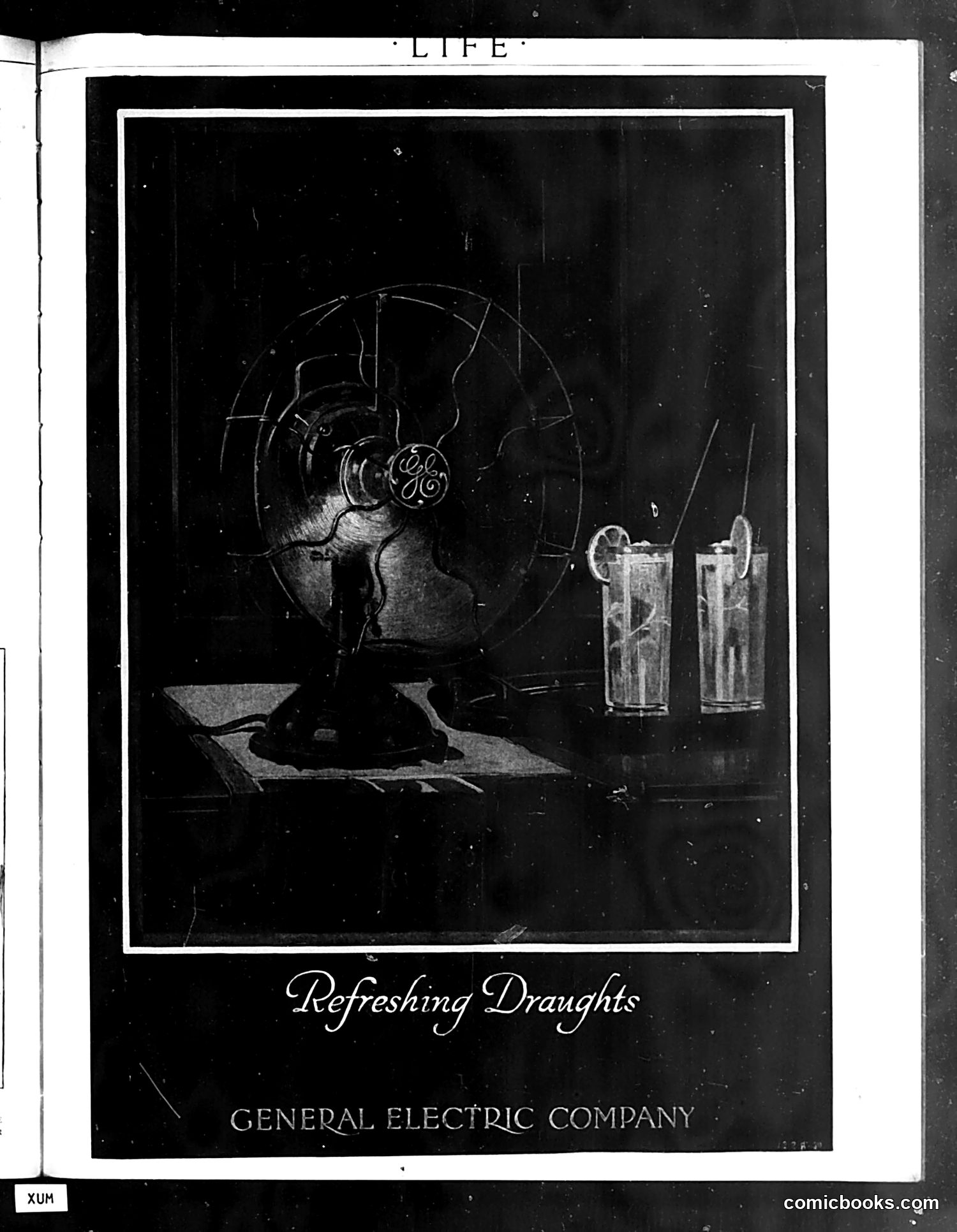
This is a General Electric Company advertisement from *Life* magazine, not political satire. The image shows a vintage electric fan prominently displayed, with two glasses of what appears to be cold beverages beside it. The advertisement's title, "Refreshing Draughts," is a pun: "draught" refers both to air circulation from a fan and to drinking beverages. The visual joke combines these meanings—the fan provides cooling air while the drinks provide literal refreshment. This reflects early-to-mid 20th century consumer advertising that emphasized how electrical appliances improved domestic comfort and leisure. The ad promotes GE's electric fans as essential household technology for hot weather relief, a significant selling point before widespread air conditioning.
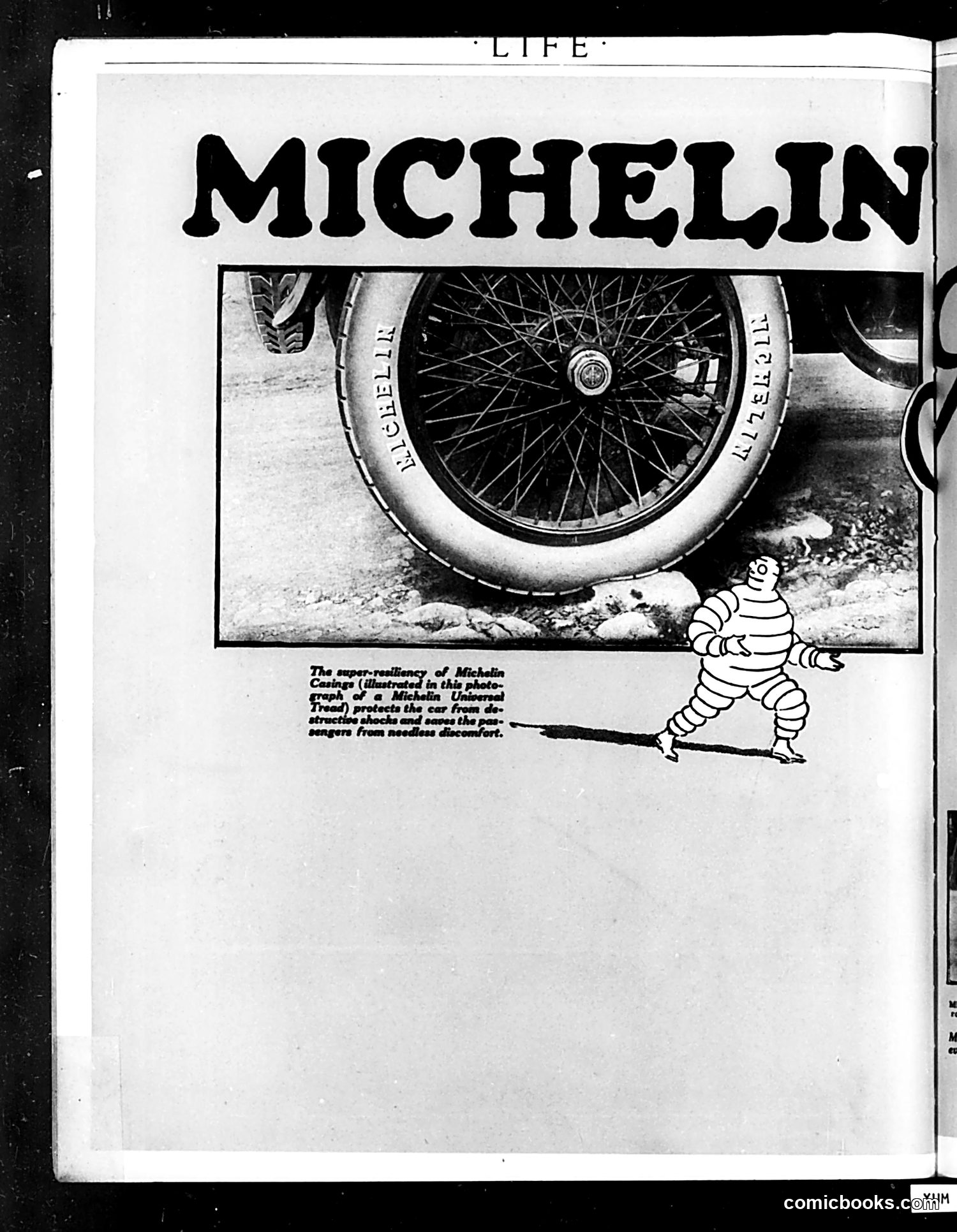
This is a Michelin tire advertisement from *Life* magazine. The page features a large photograph of a Michelin tire mounted on a vehicle wheel, displaying the tire's white sidewall and tread pattern clearly. Below the tire image stands the iconic **Michelin Man** (Bibendum), the company's mascot—a rotund, anthropomorphic figure made of stacked tire rings. He points to accompanying text (partially legible) that appears to promote the tire's protective qualities and comfort features for vehicles. The advertisement leverages the recognizable Michelin Man character to make the product appeal to consumers. This is straightforward commercial advertising rather than political satire—the page demonstrates how *Life* magazine balanced satirical content with paid advertisements.
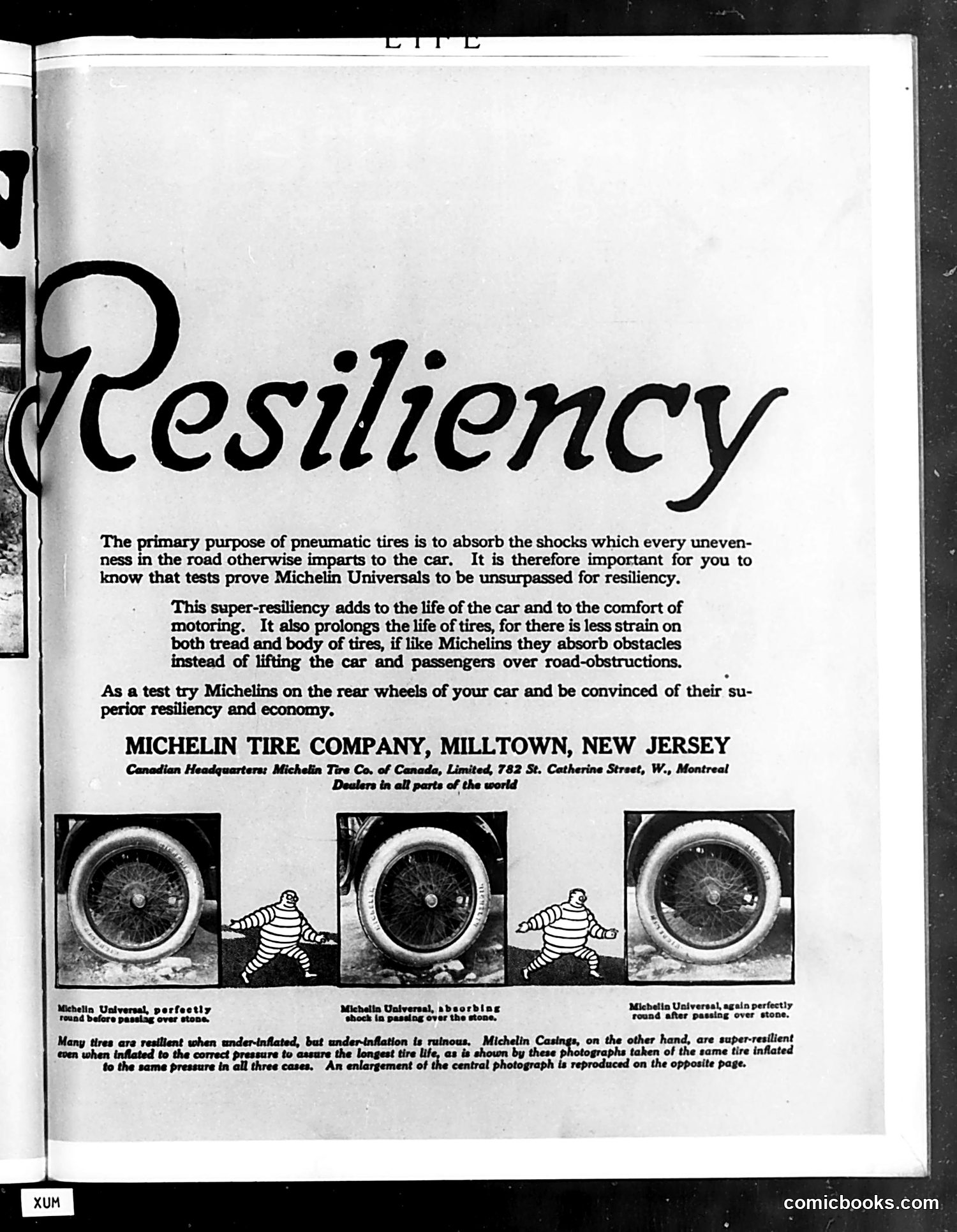
This is an **advertisement for Michelin tires**, not satire or political commentary. The page promotes pneumatic tire resilience through visual demonstration. The central imagery features the **Michelin Man** (a character made of stacked tire rings) in three photographs alongside actual tires. The accompanying captions demonstrate how Michelin tires absorb shocks from road obstacles—specifically, the mascot is shown: 1. Before passing over a stone 2. Absorbing shock while passing over it 3. After passing, with the tire remaining intact The ad emphasizes that Michelin tires' superior resilience extends vehicle and tire life while improving passenger comfort. The text contrasts this with under-inflated tires, positioning Michelin as the premium choice. This is straightforward product marketing rather than satirical content.
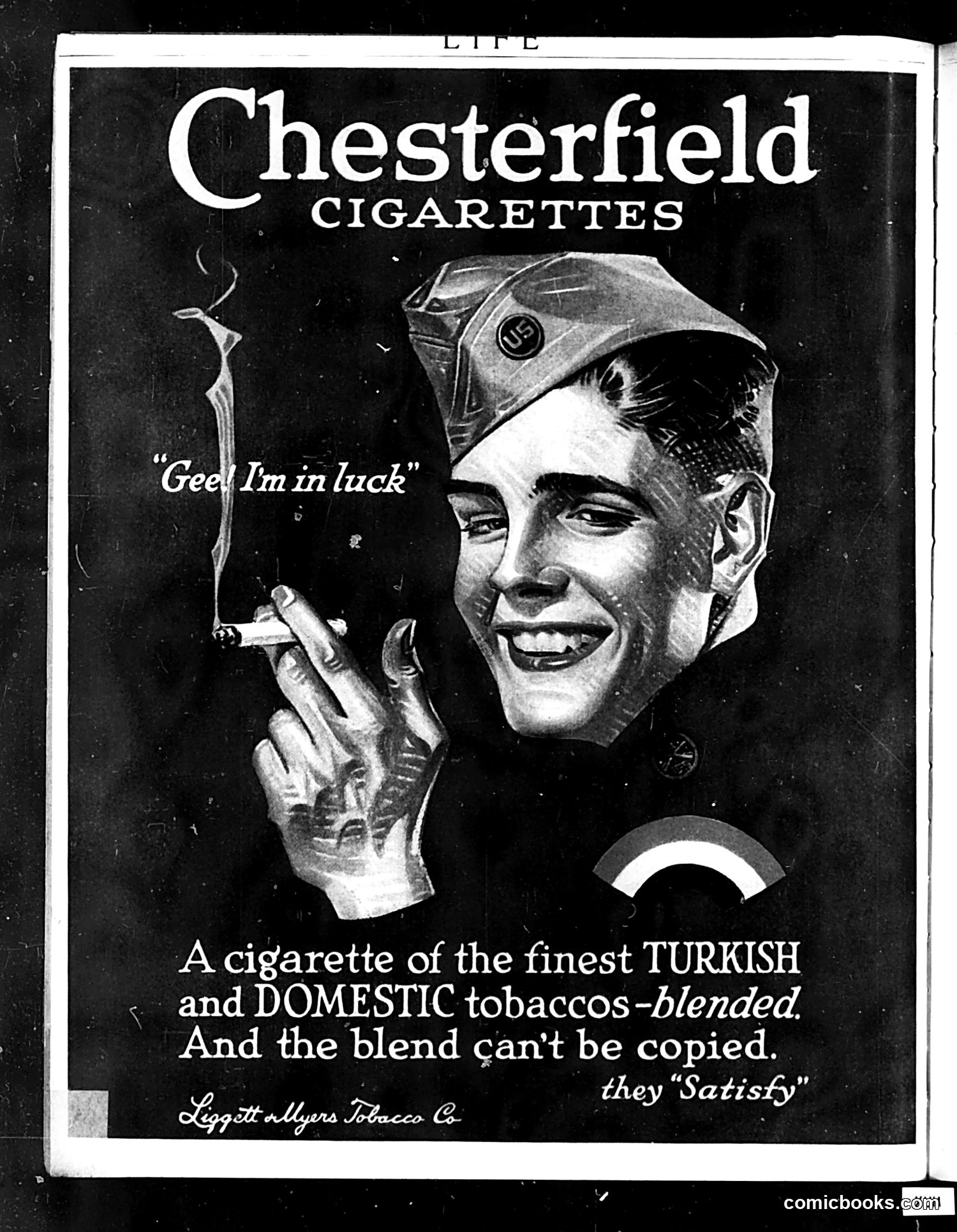
This is a **cigarette advertisement**, not political satire. It features a smiling soldier wearing a military cap, smoking a Chesterfield cigarette with the slogan "Gee, I'm in luck." The ad emphasizes that Chesterfield offers "a cigarette of the finest TURKISH and DOMESTIC tobaccos—blended. And the blend can't be copied. They 'Satisfy.'" **Context for modern readers:** This appears to target **WWI or WWII-era soldiers**, using patriotic military imagery to sell cigarettes. The soldier's luck references the comfort cigarettes supposedly provided troops. Such advertisements were common in wartime, marketing smoking as a morale booster. The claim that their blend "can't be copied" is a competitive marketing assertion. This reflects a historical period when tobacco advertising prominently featured soldiers without health warnings.
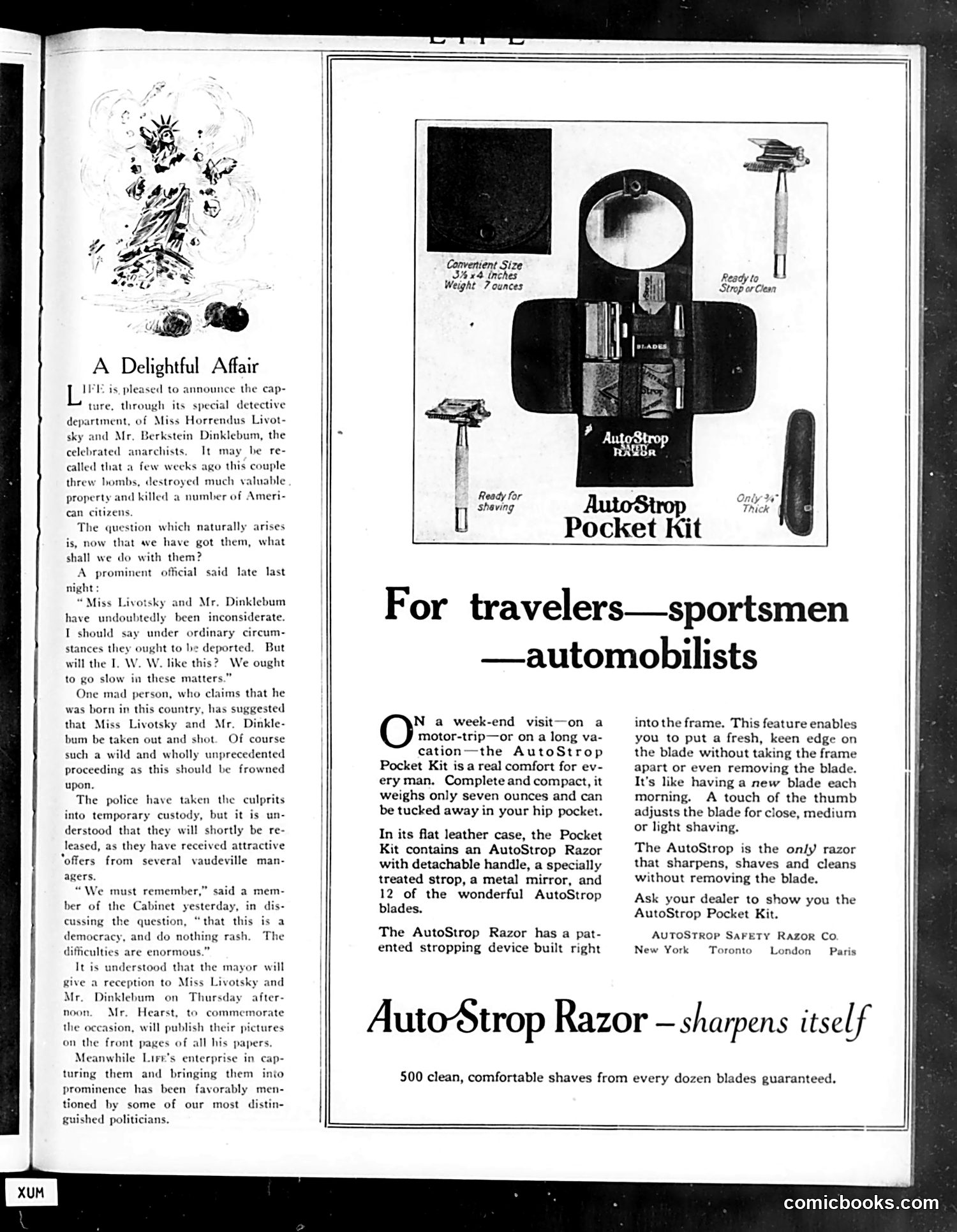
This page is **primarily an advertisement** for the AutoStrop Pocket Kit razor, occupying roughly two-thirds of the right side. The **left column** contains a brief satirical article titled "A Delightful Affair" referencing Miss Litvotsky and Mr. Berkstein Dinklebaum, described as "celebrated anarchists" who threw bombs, destroying property and killing American citizens. The piece discusses their capture and quotes officials debating their fate, with sarcastic commentary about the situation being "unprecedented" and "a democracy." The article appears to satirize contemporary **anarchist concerns** (likely early 20th century), using dark humor to comment on how authorities and society handle such cases. However, the specific historical event referenced remains unclear from this excerpt alone. The razor advertisement is unrelated to the political content.
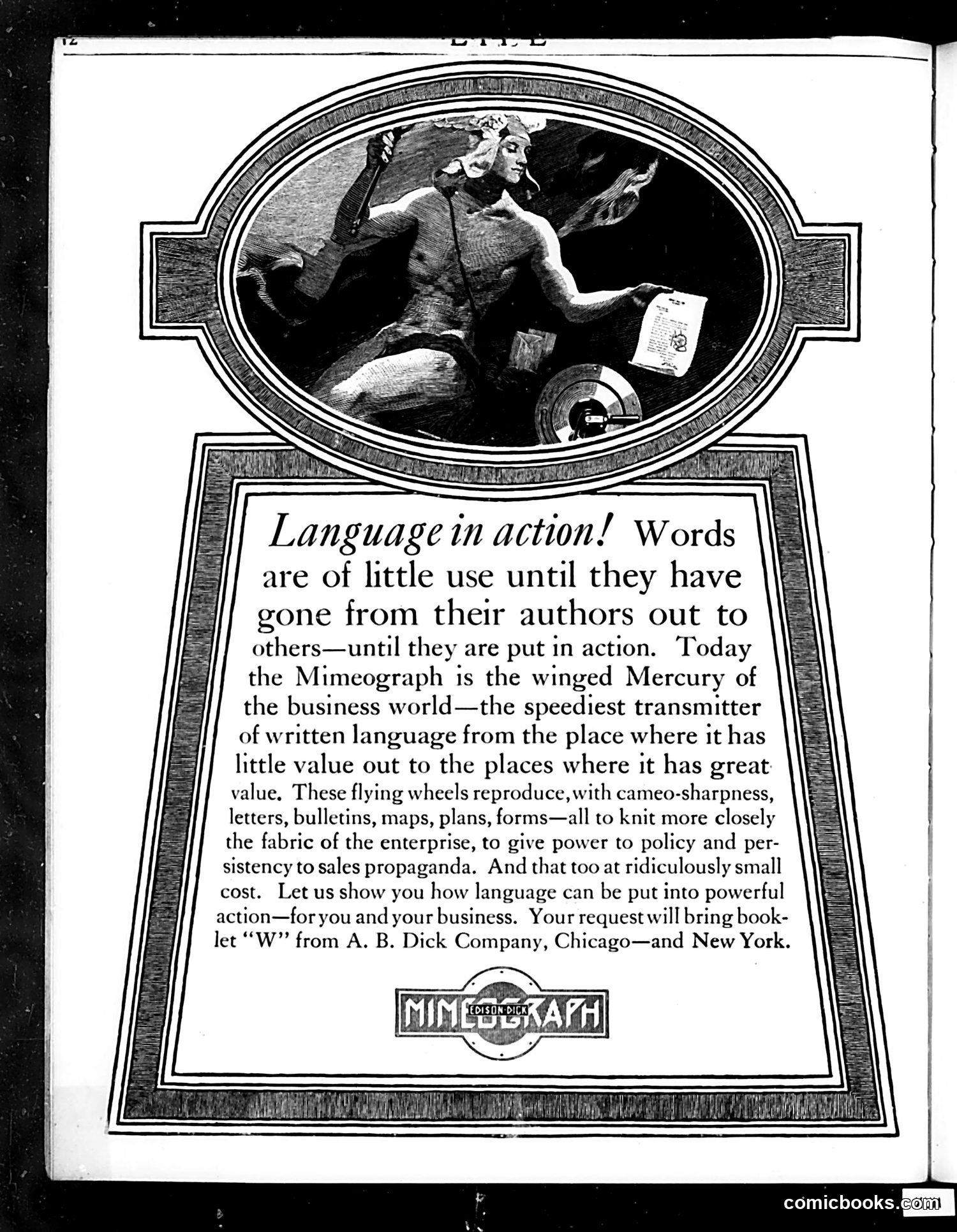
This is a **Mimeograph machine advertisement** from *Life* magazine, not political satire. The image shows Mercury (the Roman god, depicted with winged hat and staff) personifying the mimeograph as a swift messenger of business communications. The ad's pitch: the Mimeograph is "the winged Mercury of the business world"—the speediest way to reproduce and distribute written documents (letters, bulletins, maps, forms) from headquarters to branch offices. The metaphor suggests rapid, efficient transmission of information. The text emphasizes the machine's value in scaling business communications inexpensively, enabling "policy and...sales propaganda" consistency across enterprises. This reflects early-20th-century office technology's importance to corporate administration. The ad directs readers to request "booklet 'W'" from A.B. Dick Company, the mimeograph manufacturer, in Chicago and New York.
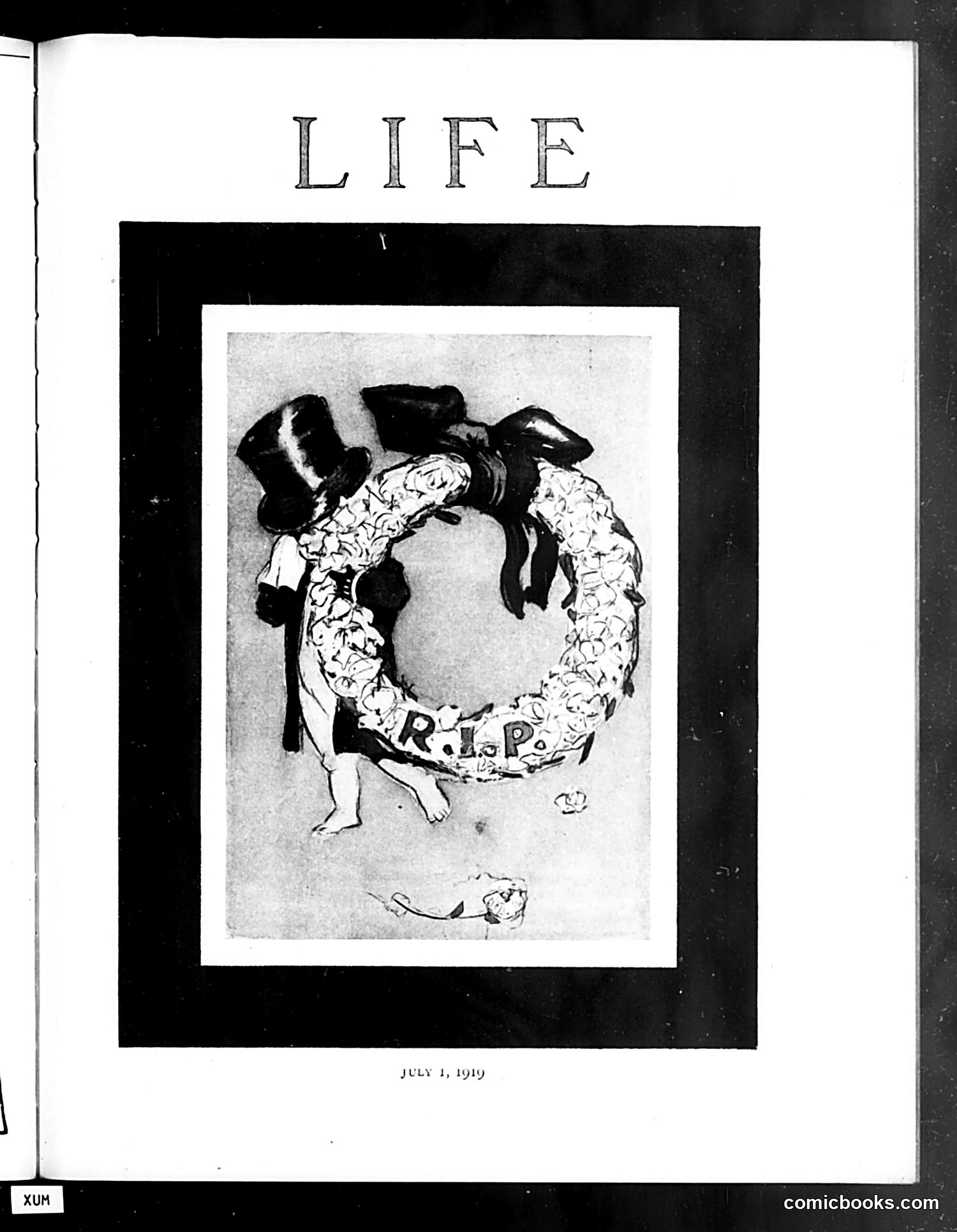
This is a title page for Life magazine dated July 1, 1919. The illustration shows a cherub or cupid figure wearing a top hat, holding what appears to be a wreath marked "R.I.P." (Rest in Peace). The wreath is decorated with flowers and black ribbons. The imagery suggests a satirical commentary on death or mourning, likely referencing post-World War I themes given the 1919 date—just after the war's November 1918 conclusion. The juxtaposition of a festive, childlike cherub figure with symbols of death creates dark humor typical of Life magazine's satirical style. Without additional context or visible article titles, the specific subject being mourned remains unclear, though it likely relates to contemporary political or social commentary from the immediate post-war period.
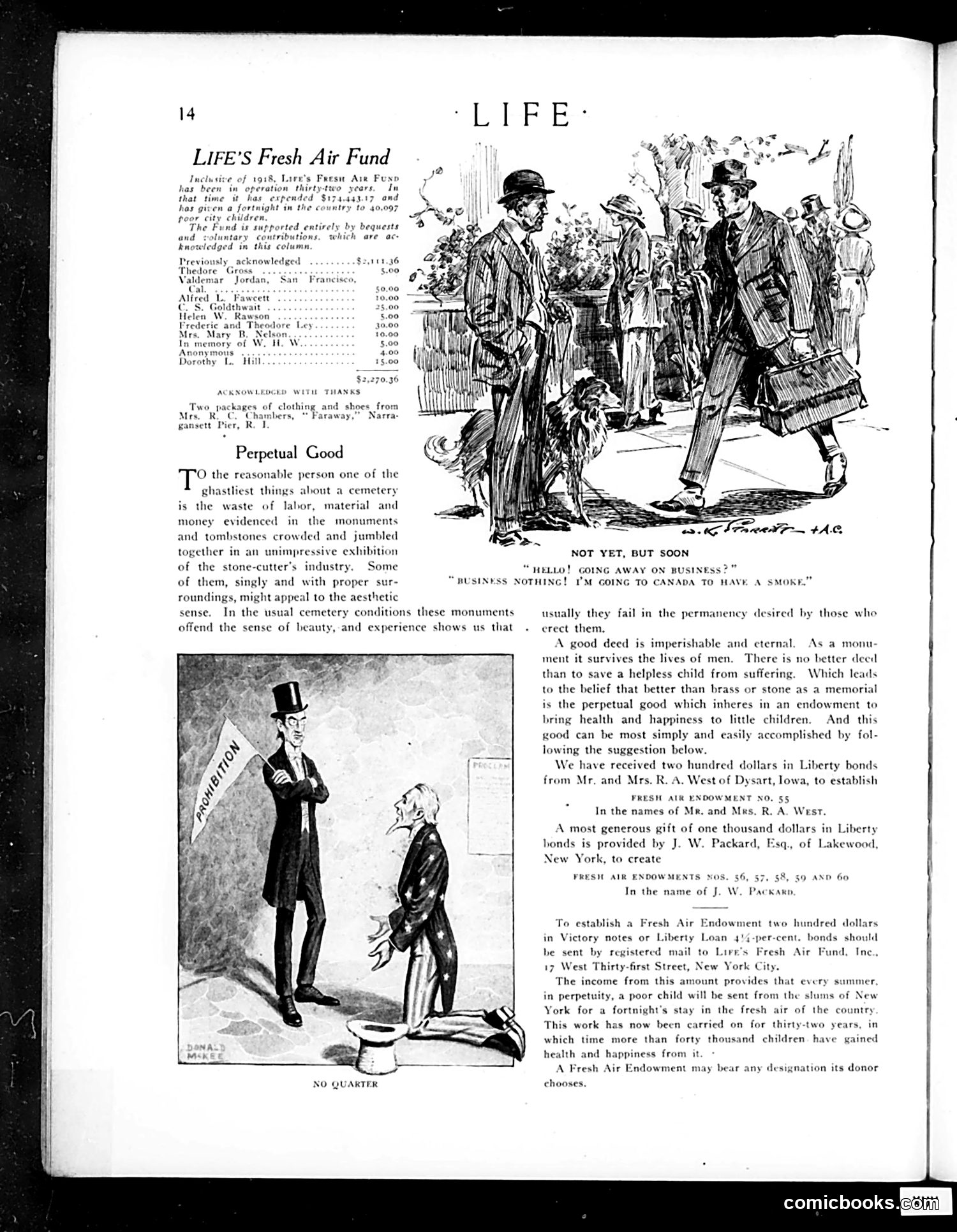
This page contains two distinct cartoons about charity and social obligation. **Top cartoon ("Not Yet, But Soon")**: Shows well-dressed men encountering a homeless person with a dog. The dialogue satirizes business excuses—a man claims he's "going away on business" to avoid giving charity, promising to help "soon." The point: wealthy individuals constantly defer charitable obligations with convenient pretexts. **Bottom cartoon ("No Quarter")**: Depicts a well-dressed man confronting a beggar woman, labeled "Petition." The man holds a sign reading "Politician," implying politicians refuse to acknowledge or support charitable causes—they give "no quarter" (no mercy/assistance). Both cartoons critique the wealthy and powerful for evading social responsibility toward the poor and suffering, a recurring theme in Life's social satire.
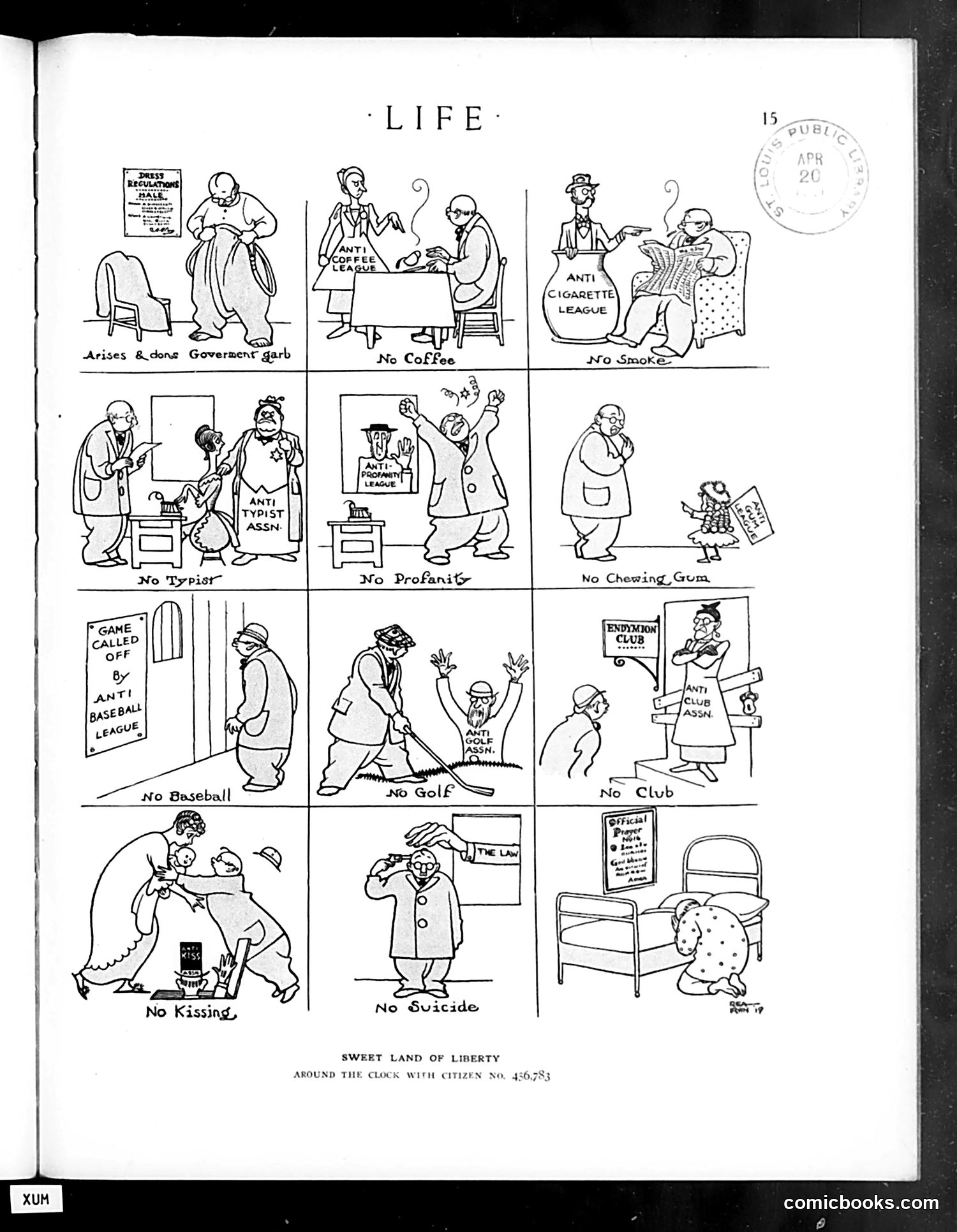
This satirical comic page titled "Sweet Land of Liberty: Around the Clock with Citizen No. 426283" mocks various Progressive Era reform movements of the early 20th century through twelve panels showing ridiculous restrictions placed on an ordinary citizen. Each panel depicts a different civic "league" or organization imposing absurd prohibitions: no government garb, coffee, smoking, typist, profanity, chewing gum, baseball, golf, clubs, kissing, or suicide. The final panel shows a man confined to bed with an "Official Permit" required even for sleep. The cartoon satirizes the proliferation of moralistic reform organizations and their invasive regulatory impulses. It suggests these well-intentioned groups collectively threaten individual liberty by controlling nearly every aspect of daily life, reducing citizens to heavily-monitored compliance with ever-multiplying rules.
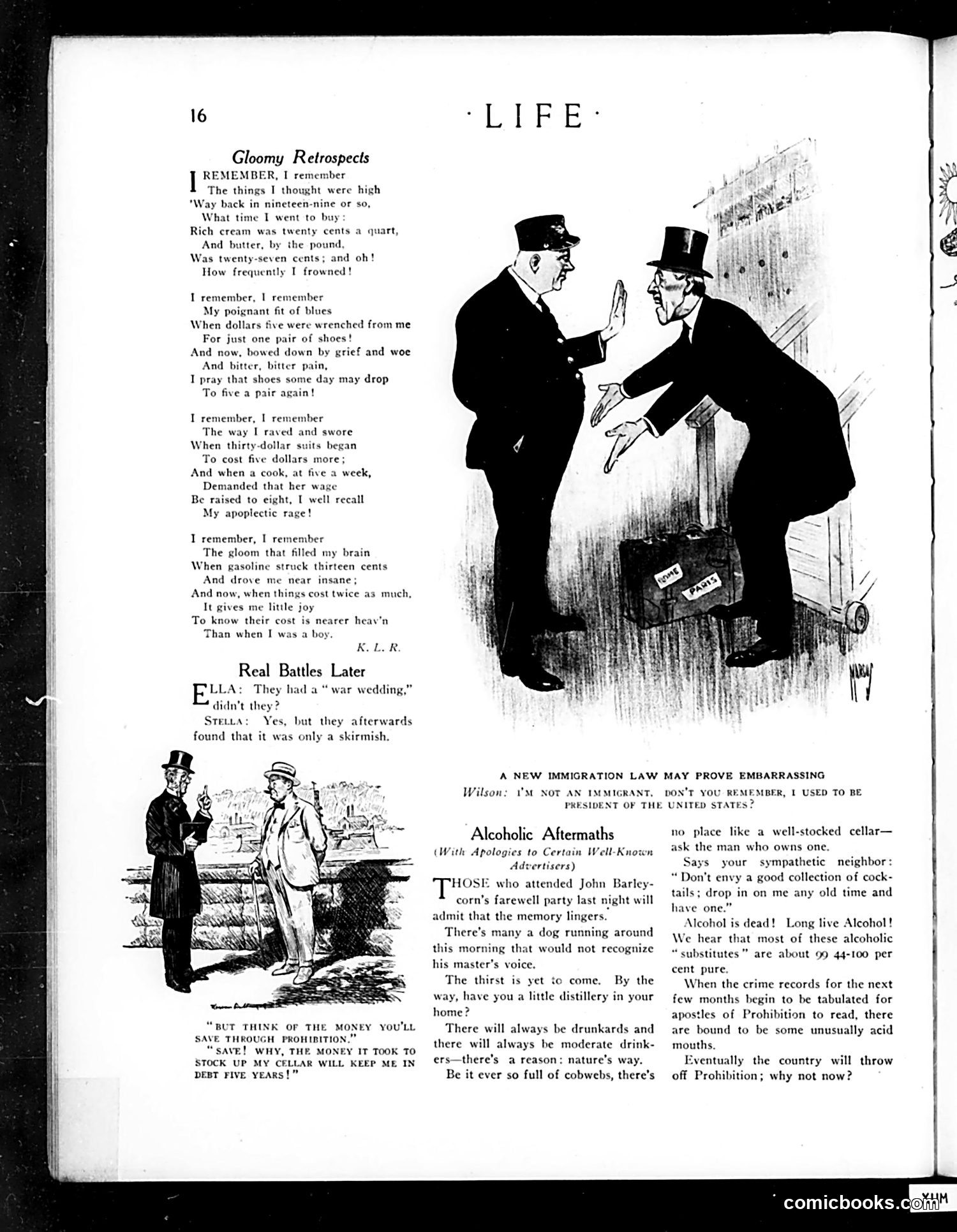
This page satirizes **inflation and the rising cost of living** in early 20th-century America. The poem "Gloomy Retrospects" (attributed K.L.R.) uses nostalgia to mock people complaining about price increases. The speaker recalls 1909 when cream cost 20¢/quart, butter 27¢/pound, shoes cost $5, and cooks earned $5/week—treating these as hardships. Now that prices have doubled, he realizes his old complaints were petty, though he still yearns for those cheaper days. The lower section addresses **Prohibition**. The "War Wedding" joke suggests newlyweds' union was as brief/insignificant as wartime. The immigration cartoon shows Wilson defending himself against charges of being foreign—likely referencing nativist anxieties. "Alcoholic Aftermaths" satirizes **Prohibition's hypocrisy**: despite the alcohol ban, people maintain home distilleries and mock enforcement while claiming substitutes are "99 44-100% pure"—a reference to Ivory soap's advertising slogan, suggesting commercial irony.
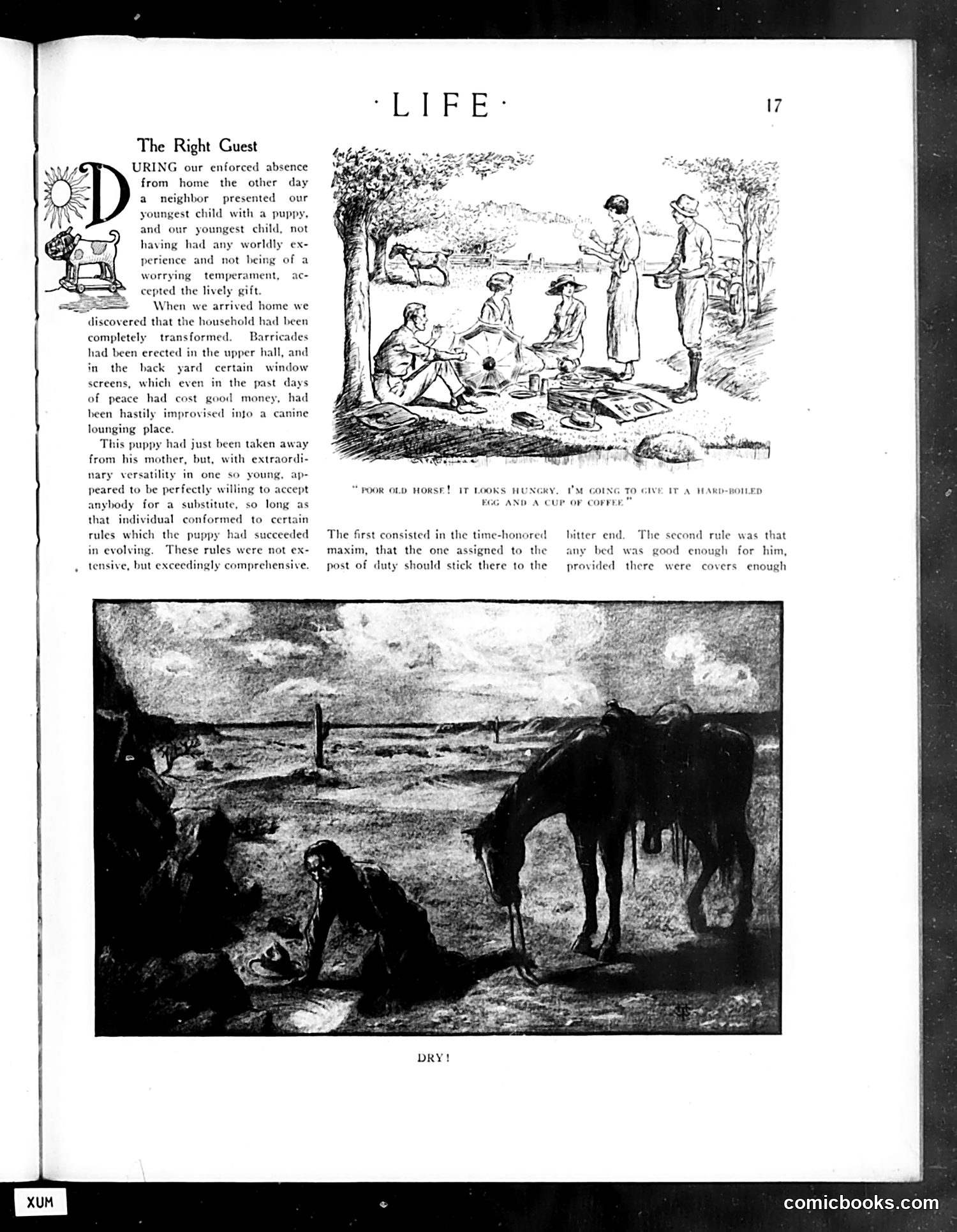
This humorous domestic piece satirizes the demands of a newly acquired puppy. The article describes how a neighbor's gift transforms the household—barricades erected, window screens repurposed into a dog pen—forcing the family to accommodate the animal's rigid "rules." The top cartoon shows a picnic scene where someone offers a hard-boiled egg and coffee to a horse, humorously misinterpreting the animal's needs. The bottom photograph depicts a gaunt horse standing over a prone figure, captioned "DRY!"—the punchline being the contrast between the offered refreshments and the horse's actual state. The satire targets the absurdity of guests (animal or human) who impose impossible demands and refuse to be satisfied. The "right guest" is one who adapts to circumstances, while the "wrong guest"—like this demanding puppy or ungrateful horse—creates chaos through inflexible requirements. It's gentle domestic humor about unwelcome houseguests.
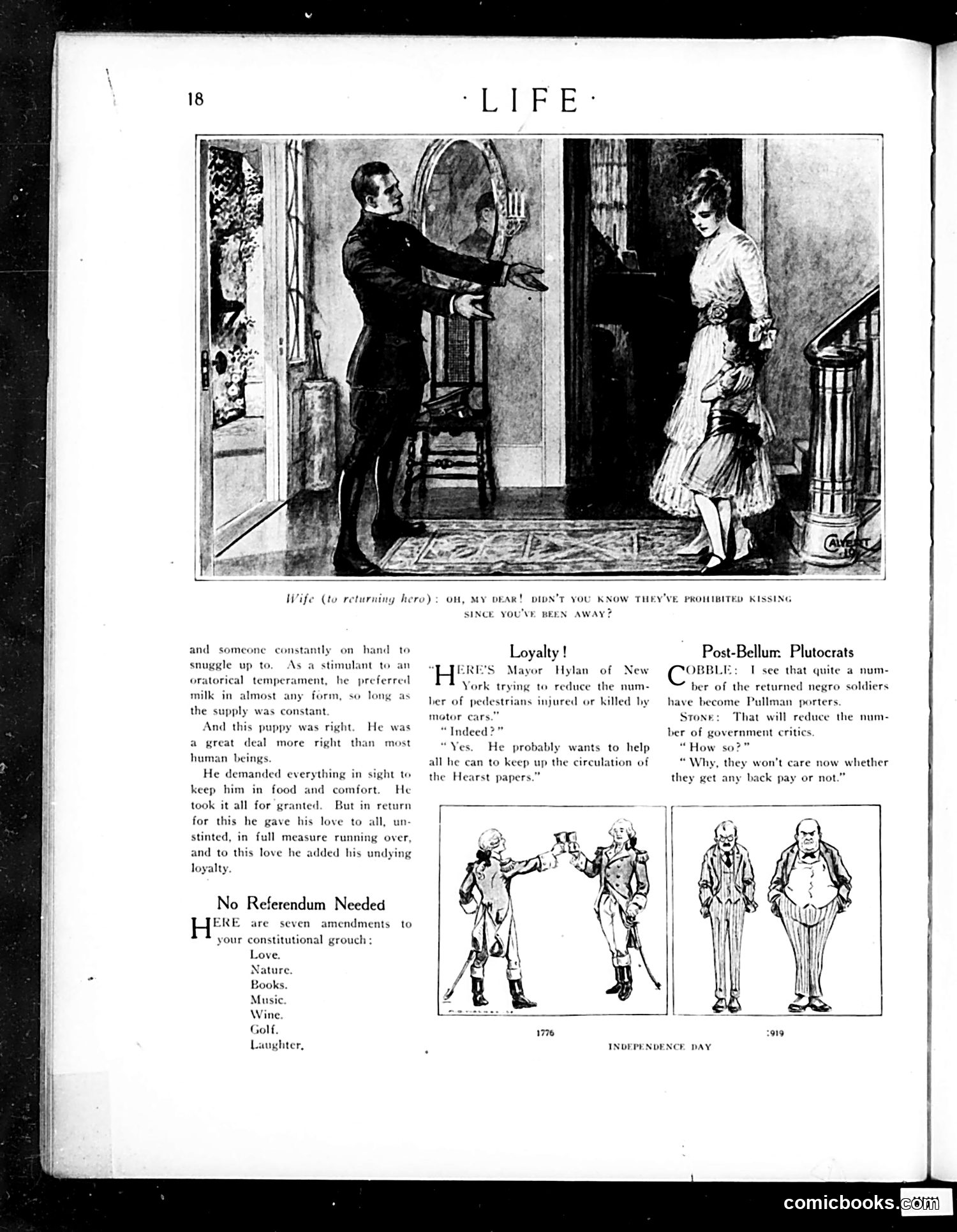
The page contains satirical commentary on post-WWI America: **Top cartoon**: A wife greets her returning soldier husband, joking that kissing has been "prohibited" during his absence—a humorous domestic jab at how long he's been away. **"Loyalty!" section**: Mocks Mayor Hylan of New York's traffic safety efforts. The joke suggests Hylan wants to reduce pedestrian deaths from cars to increase circulation of William Randolph Hearst's newspapers—implying the mayor is a Hearst puppet. **"Post-Bellum Plutocrats"**: Dark satire on Black soldiers returning home. The exchange suggests wealthy industrialists are "solving" racial tensions by funneling Black veterans into low-status Pullman porter jobs, where they'll be too economically dependent to criticize the government or demand back pay. It's biting social commentary on the failure to integrate or fairly compensate Black soldiers after WWI. **"No Referendum Needed"**: Lists seven amendments to life's "constitutional grouch"—essentially seven simple things that make life worth living. The "Independence Day" cartoons (1776/1919) appear to contrast historical and contemporary American ideals.
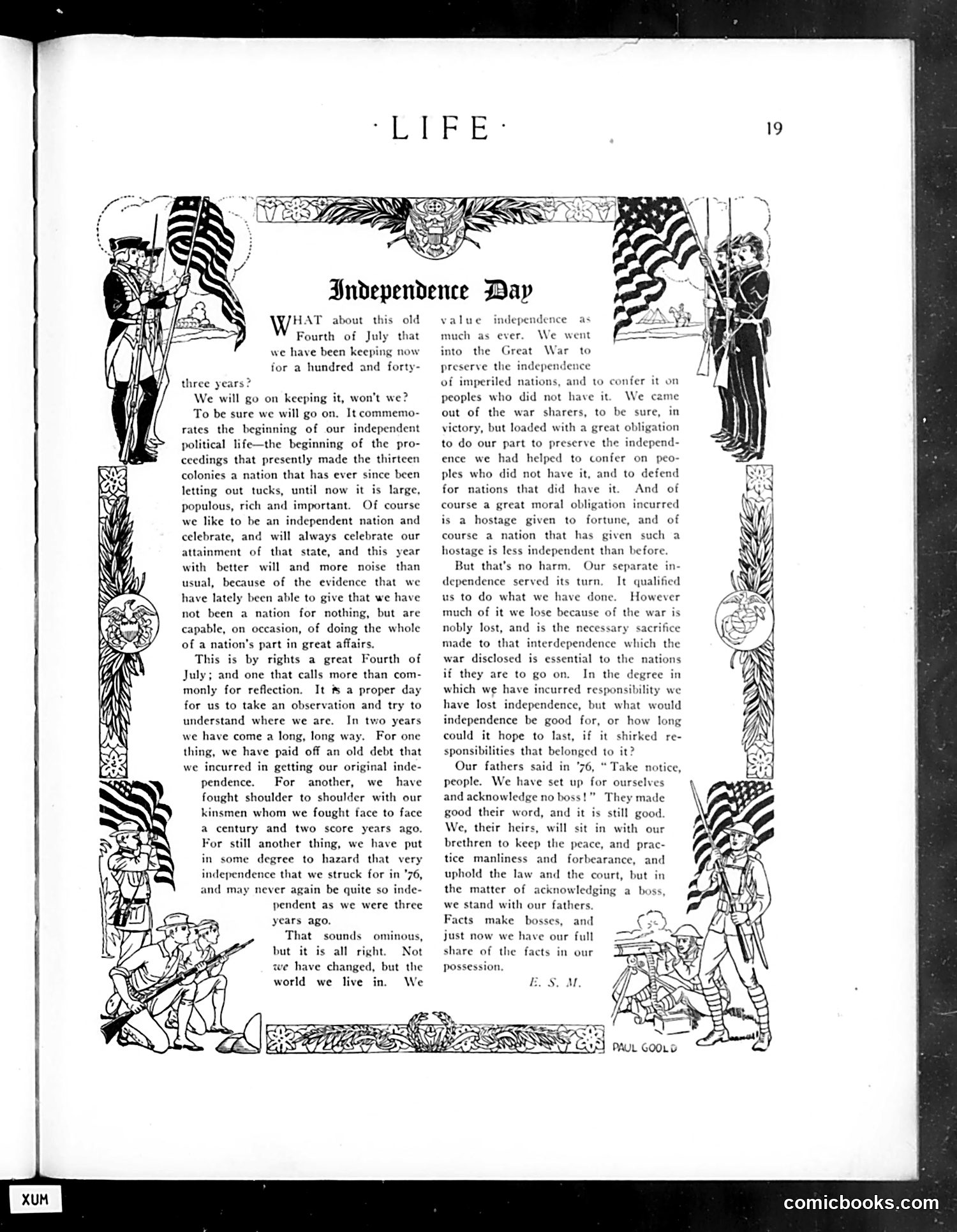
This is a patriotic editorial essay, not a political cartoon, published around the post-WWI period (the text references "two years" since America's involvement in "the Great War"). The decorative border features colonial-era American soldiers and patriotic imagery. The piece argues that American independence has evolved. While the nation celebrated 140 years of independence from Britain, WWI has created new obligations: the U.S. fought to secure independence for other nations and now shares responsibility for maintaining global peace. The author (signed E.S.M.) reconciles this apparent paradox by claiming America hasn't abandoned independence—rather, the world has changed, requiring "interdependence." The essay concludes that accepting shared responsibility with other nations reflects, not contradicts, the Founders' principles. The phrase "we stand with our fathers" suggests continuity between 1776 ideals and current international commitments. This reflects post-war debates about American isolationism versus global engagement.
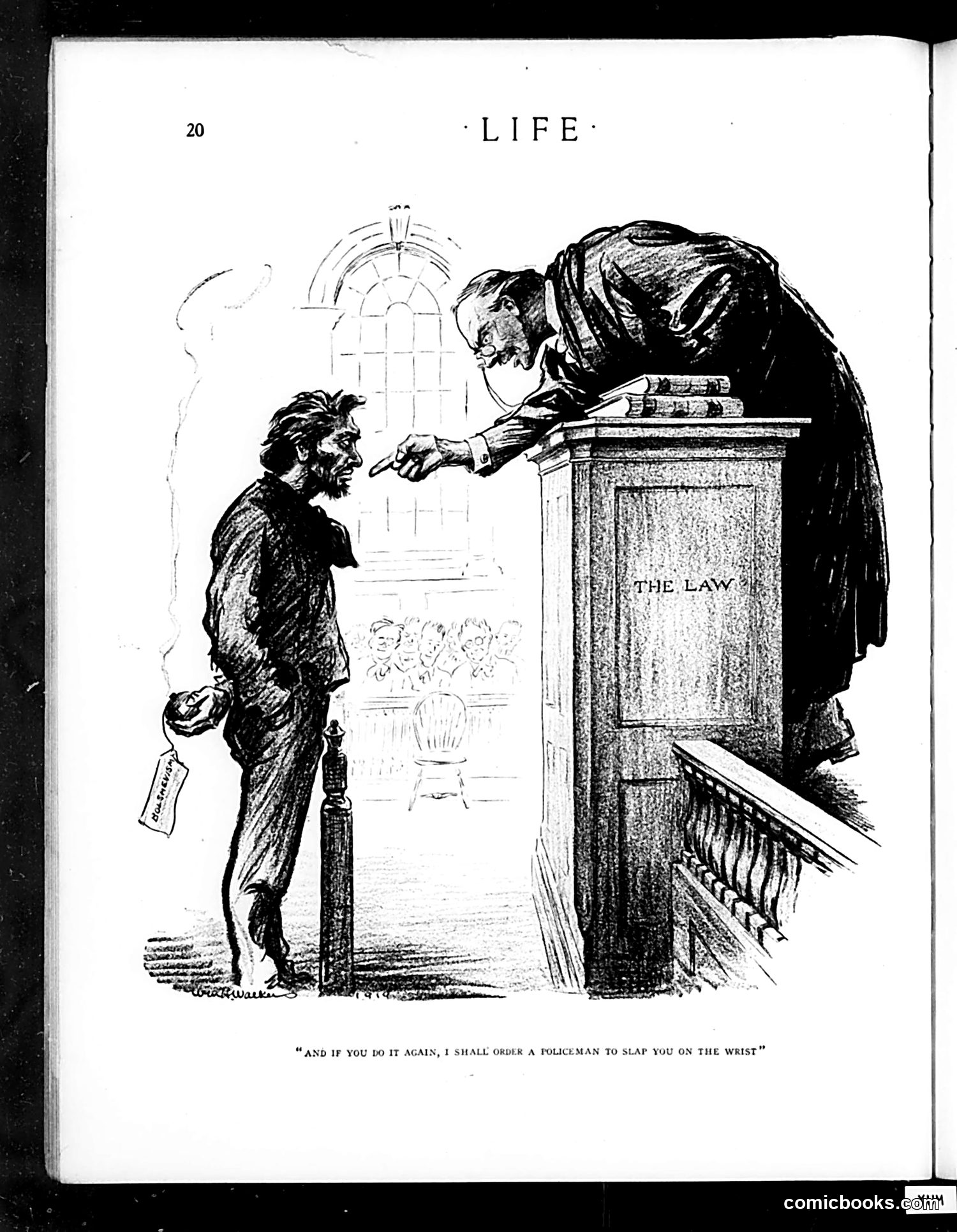
This political cartoon satirizes weak judicial punishment. A stern judge sits elevated behind a podium labeled "THE LAW," addressing a disheveled man standing below—apparently someone repeatedly brought before the court. The judge's threatened punishment—ordering a policeman to "slap you on the wrist"—is absurdly mild, suggesting the judiciary's leniency toward offenders. The satire targets the inadequacy of the legal system's deterrents. The figure's shabby appearance and repeated offenses suggest habitual criminality, yet the judge threatens only a symbolic wrist-slap rather than genuine consequences. This mocks either lenient judges, insufficient laws, or both—implying that such weak punishments fail to actually deter crime or protect society, making "the law" ineffectual rather than fearsome.
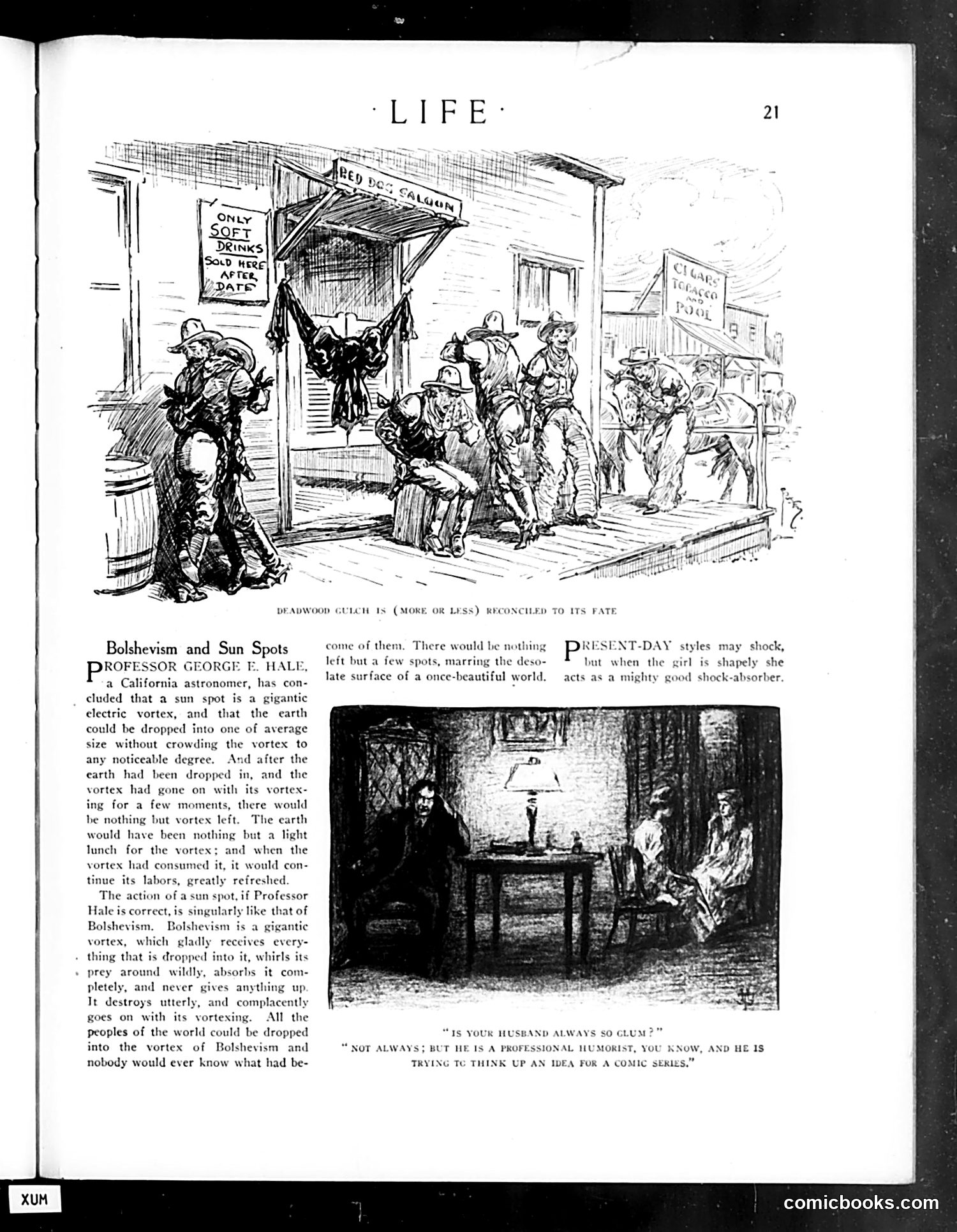
**Upper Cartoon:** "Deadwood Gulch Is (More or Less) Reconciled to Its Fate" A Western saloon scene depicting the decline of the Old West frontier town. The satire suggests that frontier settlements like Deadwood, once vital, are now accepting their obsolescence—they've been absorbed into modern civilization much like a vortex consumes its prey. **Article: "Bolshevism and Sun Spots"** This piece compares Professor George E. Hale's astronomical theory about sun spots (destructive vortexes) to Bolshevism. The satire equates the Soviet revolutionary movement to an all-consuming force that destroys everything it encounters and "never gives anything up"—suggesting Bolshevism as an existential threat that obliterates whatever enters it, leaving nothing behind. **Lower Cartoon:** A domestic humor scene where a wife questions her husband's constant clumsiness. His response—that he's a professional humorist working on comic series ideas—mocks humorists' self-absorption and their tendency to weaponize real-life mishaps for material. The page reflects 1920s American anxieties about Bolshevism and modernization alongside lighter domestic comedy.
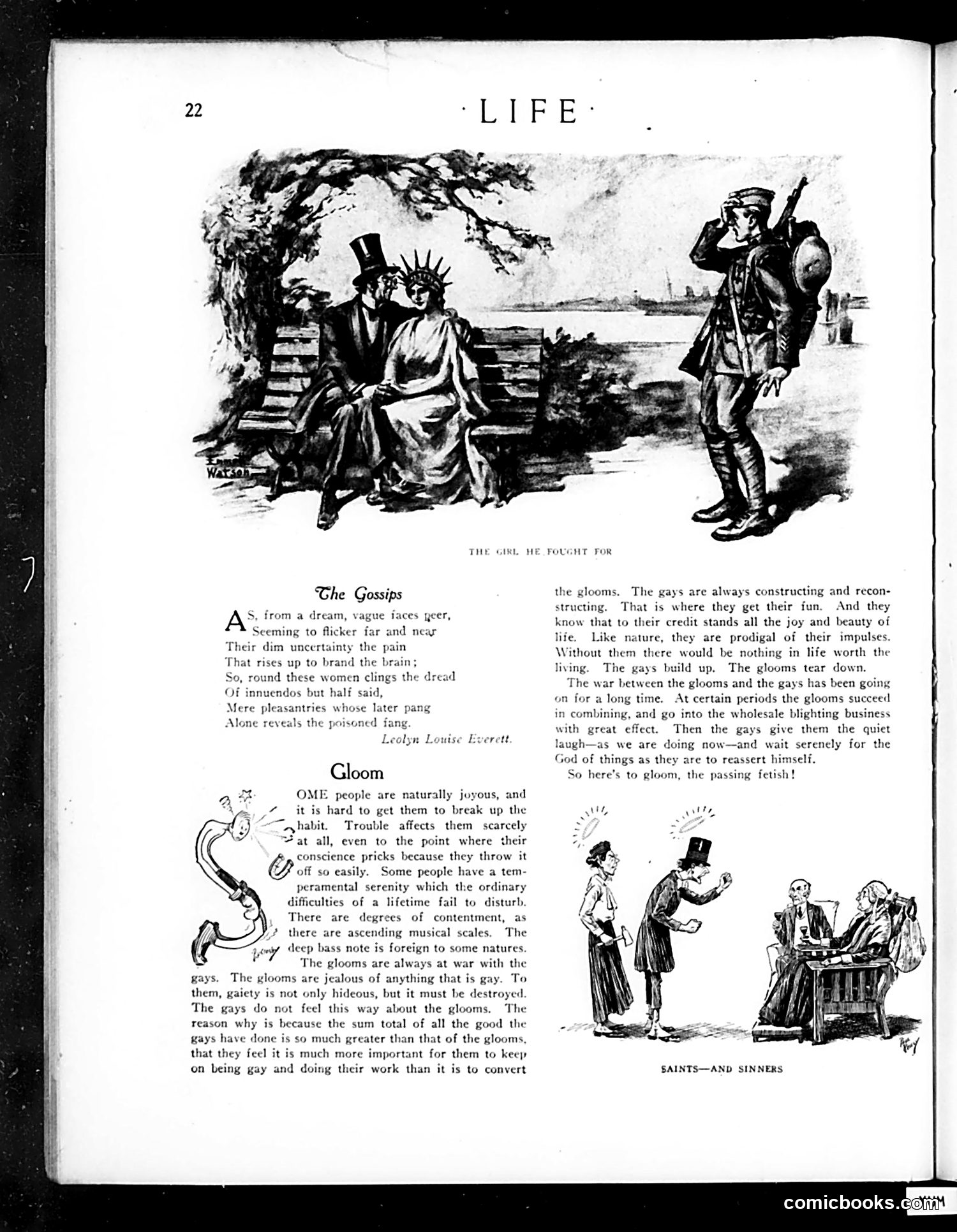
This page presents Life's satirical commentary on temperament and social types. The top illustration shows a romantic couple being observed by gossips—the "girl he fought for" is watched and judged by idle tongues beneath a gnarled tree. The main text contrasts two personality types: the "gays" (meaning cheerful, joyful people) versus the "glooms" (pessimists and killjoys). Life argues this is a centuries-old conflict. The glooms, jealously hostile to happiness itself, work to destroy gaiety and spread misery. The gays, by contrast, build up society through optimism and creative energy, and they've accomplished so much good that converting the glooms seems less important than continuing their joyful work. The satirical point: pessimistic, contentious people are motivated by envy of others' happiness, while genuinely optimistic people are too productive and fulfilled to waste effort on converting them. The lower illustrations show various "saints and sinners"—social types embodying these opposing philosophies.
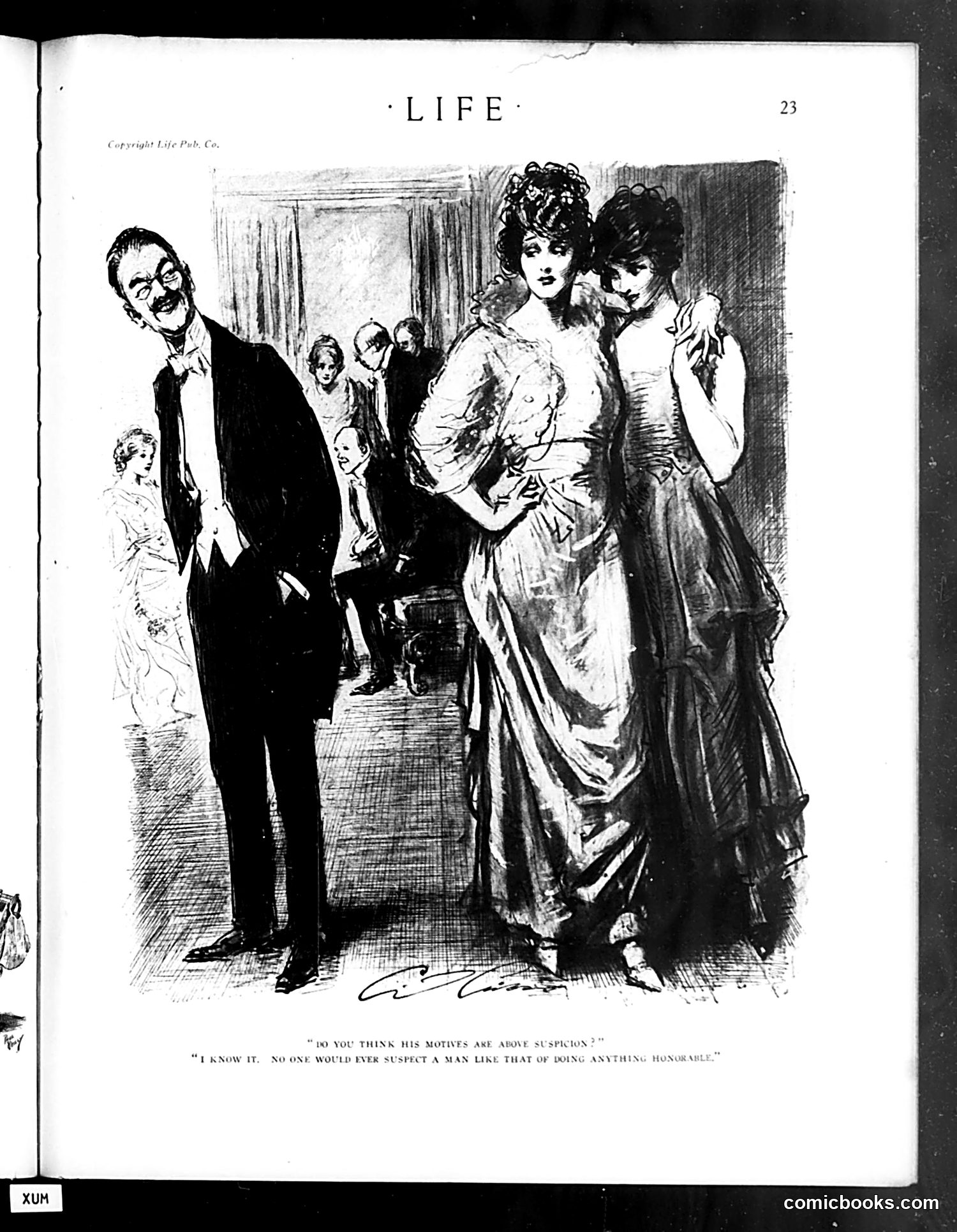
This satirical illustration from *Life* magazine depicts an elegant social gathering where a woman questions a man's motives regarding another gentleman's character. The caption's irony is the joke: the woman claims no one would suspect this particular man of dishonorable conduct—implying that his appearance (well-dressed, refined) makes him seem trustworthy, yet the very question about his motives suggests he's actually suspect. The satire targets class-based assumptions: that outward respectability and social polish guarantee honest character. The cartoon mocks how people judge others by superficial markers of gentility rather than actual behavior. It's commentary on the gap between appearance and reality in Gilded Age or early 20th-century high society—suggesting that a man's honorable *look* can mask questionable *actions*.
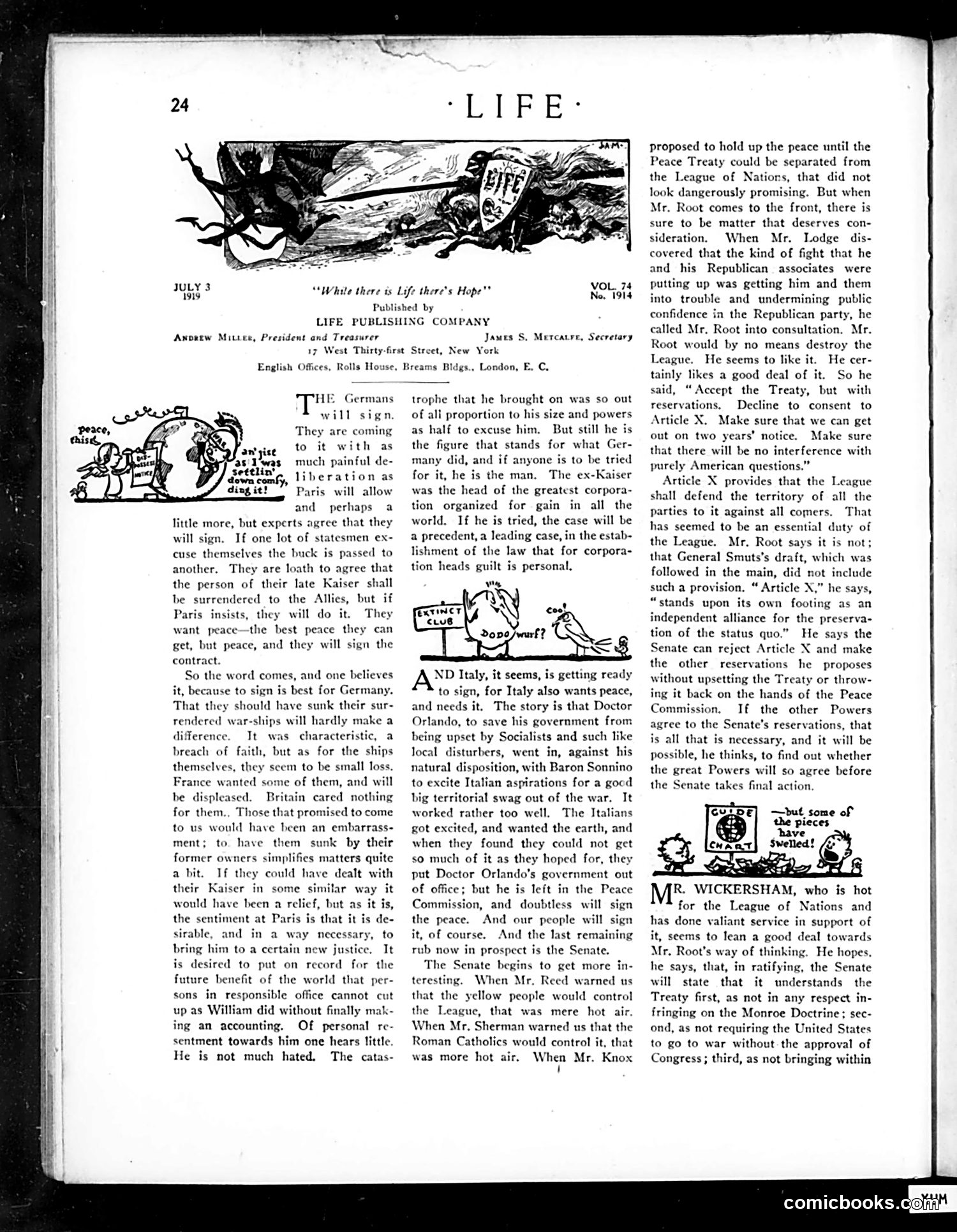
This page discusses post-World War I peace negotiations, specifically Germany and Italy's reluctance but expected signing of peace treaties. The cartoons mock the parties' hesitation: The top cartoon shows Germany as a reluctant figure being dragged toward signing ("While there is Life there's Hope"). A lower cartoon depicts Italy at a "Peace Club," also resisting but ultimately expected to comply. The text identifies **Senator Henry Cabot Lodge** and **Elihu Root** as Republican opponents of the League of Nations clause in the Peace Treaty. The author suggests Root's involvement signals serious political obstruction ahead. The satire targets American Senate Republicans who wanted to separate the League from the Treaty or reject Article X (collective security), viewing their concerns about Catholic or Asian control of the League as "hot air"—baseless fearmongering masking partisan resistance to President Wilson's internationalist agenda. The cartoon ridicules both European war-weariness and American isolationist opposition to the peace settlement.
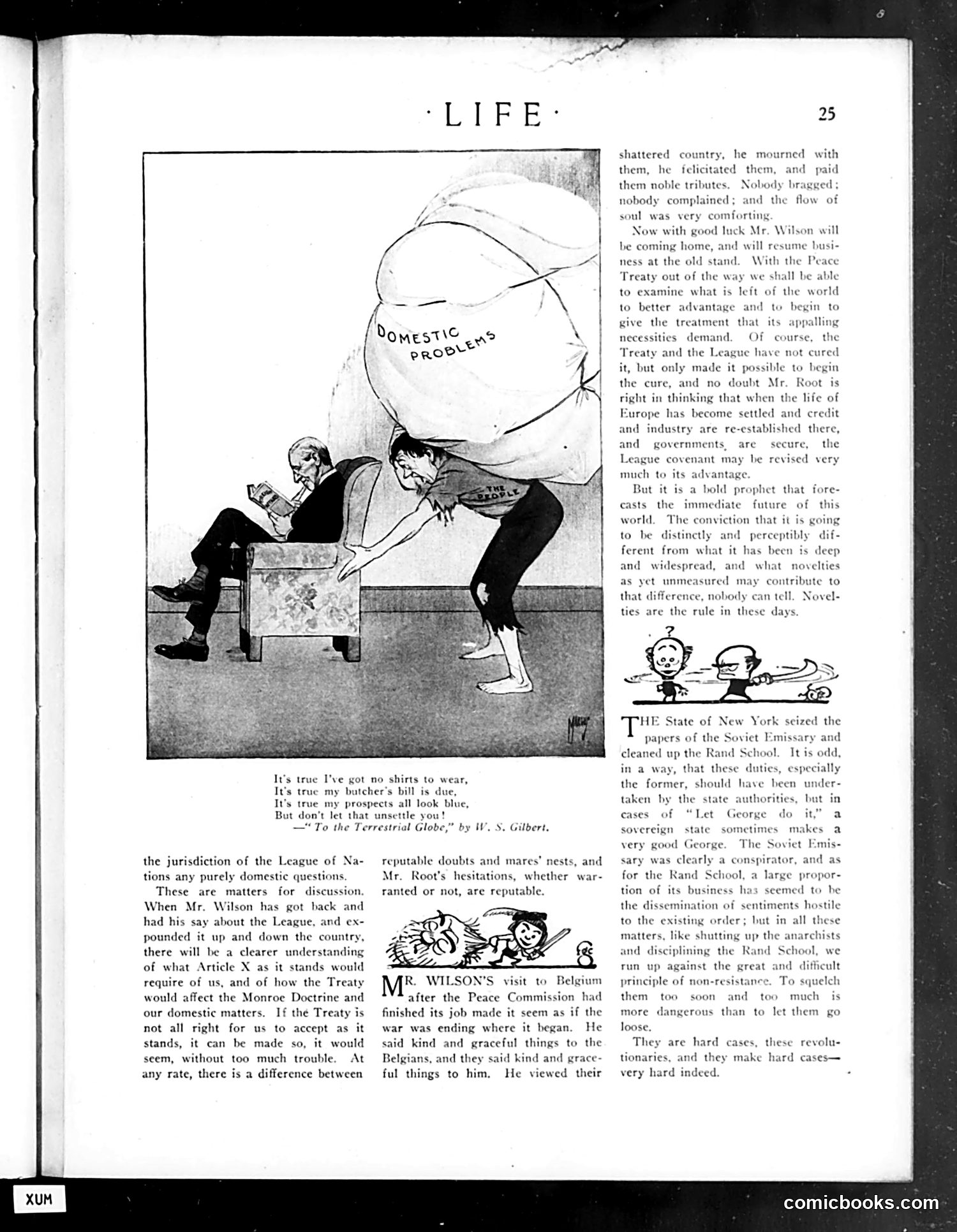
The main cartoon depicts two figures struggling beneath a massive boulder labeled "DOMESTIC PROBLEMS." This illustrates the satirical point of the surrounding article: President Wilson's focus on the League of Nations and Peace Treaty negotiations abroad has left America's urgent home issues unaddressed and crushing. The text discusses Wilson's recent Belgium visit and his plans to resume business "at the old stand," suggesting domestic concerns have been neglected during post-WWI peace efforts. The article acknowledges these are "hard cases"—referencing contemporary challenges like Soviet communism, the Rand School (a socialist institution), and revolutionary activity in America. The Gilbert epigraph about financial troubles ("no shirts to wear," "butcher's bill is due") reinforces this theme: personal/national problems persist regardless of grand diplomatic achievements. The cartoon's visual metaphor of two men crushed by domestic burdens while the peace process proceeds elsewhere captures the satire's core message.
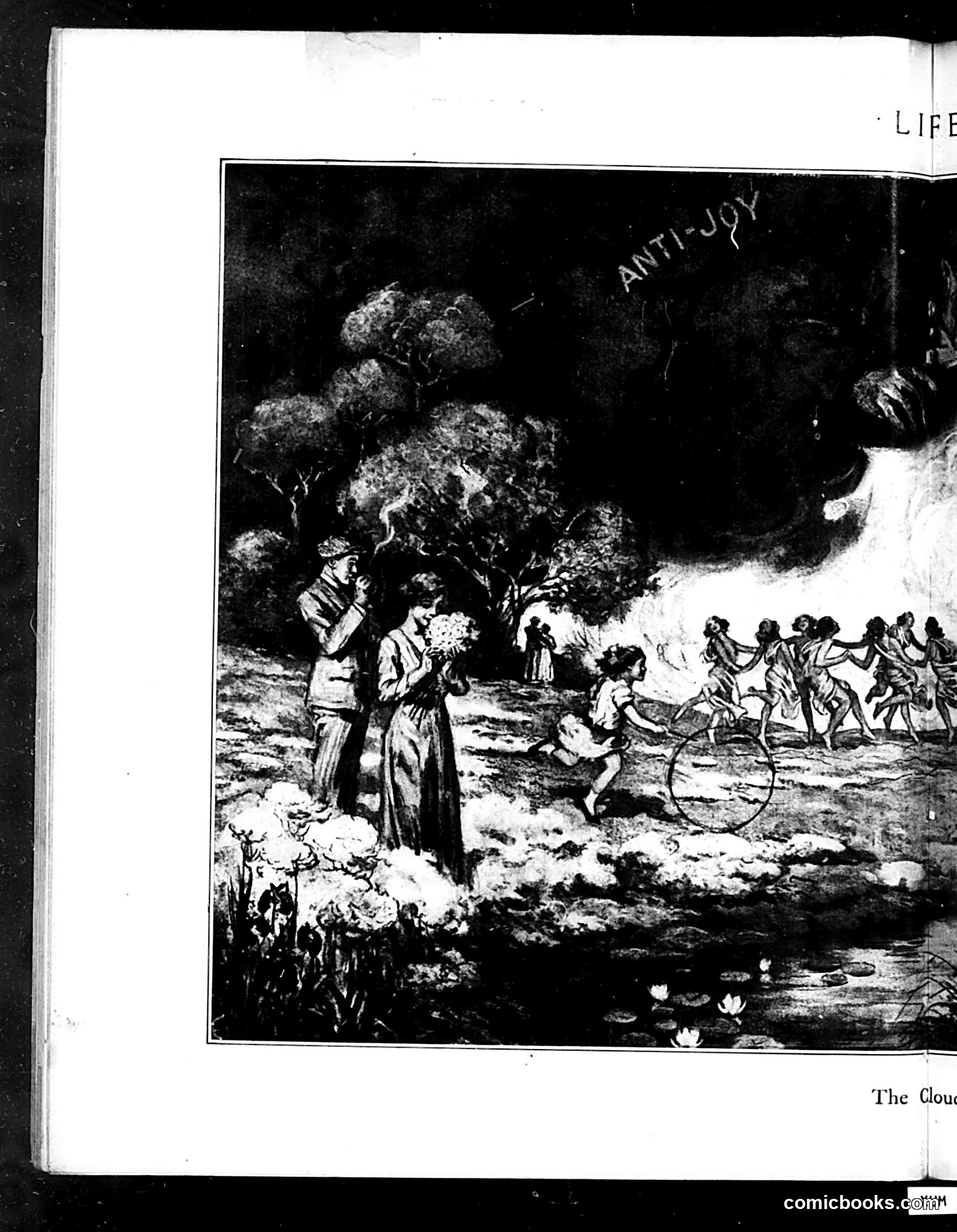
This appears to be a page from *Life* magazine showing an illustration titled "The Cloud" (visible at bottom). The image depicts a nocturnal scene with two well-dressed figures (a man and woman) standing together on the left, observing a group of figures dancing or celebrating on the right near a body of water with willow trees. The word "ANTI-JOY" is handwritten at the top of the illustration. Without complete caption text or publication date, the specific satirical target is unclear. However, the composition suggests social commentary—possibly critiquing either celebratory excess ("anti-joy" as ironic commentary) or contrasting different social classes or behaviors. The nocturnal, somewhat dreamlike quality and the observers' posed distance from the revelry suggest this may be satirizing attitudes toward modern leisure, morality, or social divisions. More context would be needed for precise interpretation.
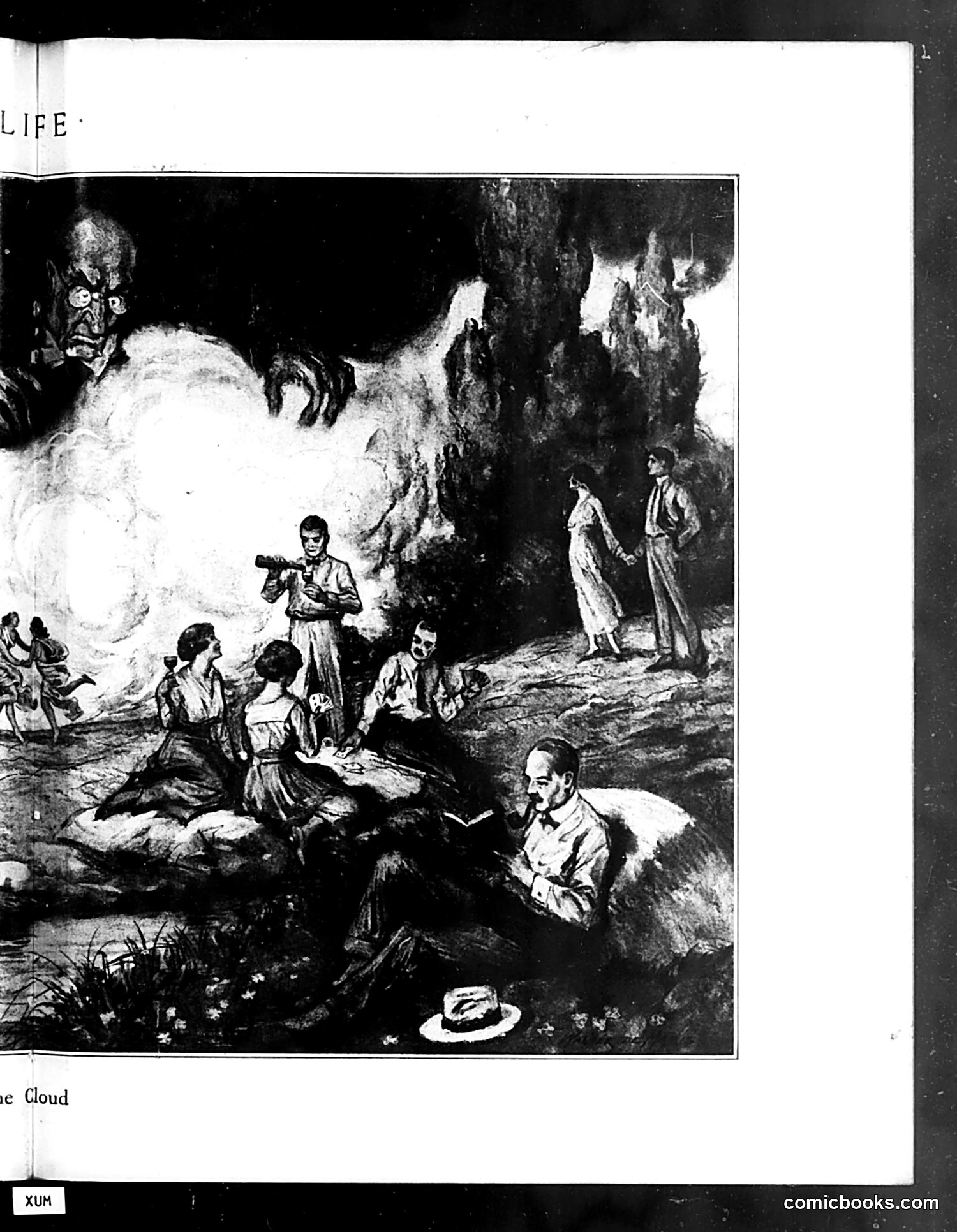
This appears to be a dramatic illustration titled "The Cloud" depicting a scene of human figures gathered in a mountainous or cavernous landscape. A large, ominous cloud or smoke formation dominates the upper portion, suggesting danger or foreboding. The composition shows several people in various states of distress or concern—some seated, others standing or gesturing. A figure in the center holds what appears to be surveying or measuring equipment. The atmospheric quality and style suggest this is likely a literary or allegorical illustration rather than political satire. Without additional context from the surrounding page content, the specific social or political commentary remains unclear, though the dramatic staging suggests commentary on human vulnerability to natural forces or catastrophic events.
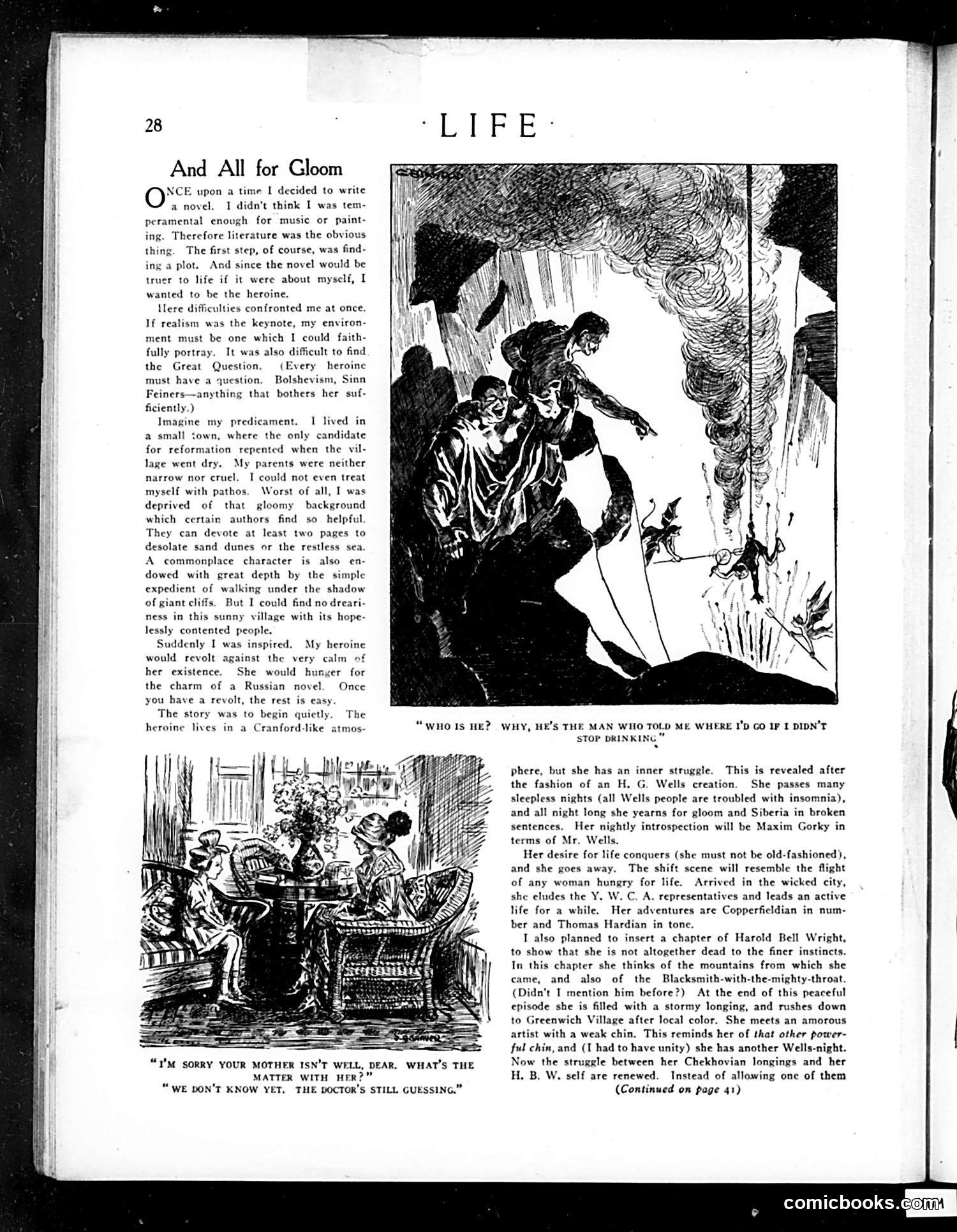
This is a satirical essay about amateur novelists, not a political cartoon. The author mocks aspiring writers who construct overwrought plots by slavishly imitating fashionable literary models. The piece ridicules the heroine's contrived struggle: she lives in a pleasant small town but manufactures existential despair by romanticizing Russian gloom and Siberian suffering. The author parodies the formulaic borrowing from popular writers—H.G. Wells (psychological introspection), Maxim Gorky (Russian angst), Thomas Hardy (tragedy), Harold Bell Wright (moral redemption), and Chekhov (romantic conflict). The two cartoon panels appear to joke about doctors and family illness, mocking medical uncertainty rather than illustrating the essay. The satire targets not politics but literary pretension: the notion that authentic novels require manufactured suffering and that earnest young writers achieve depth merely by copying established literary conventions.
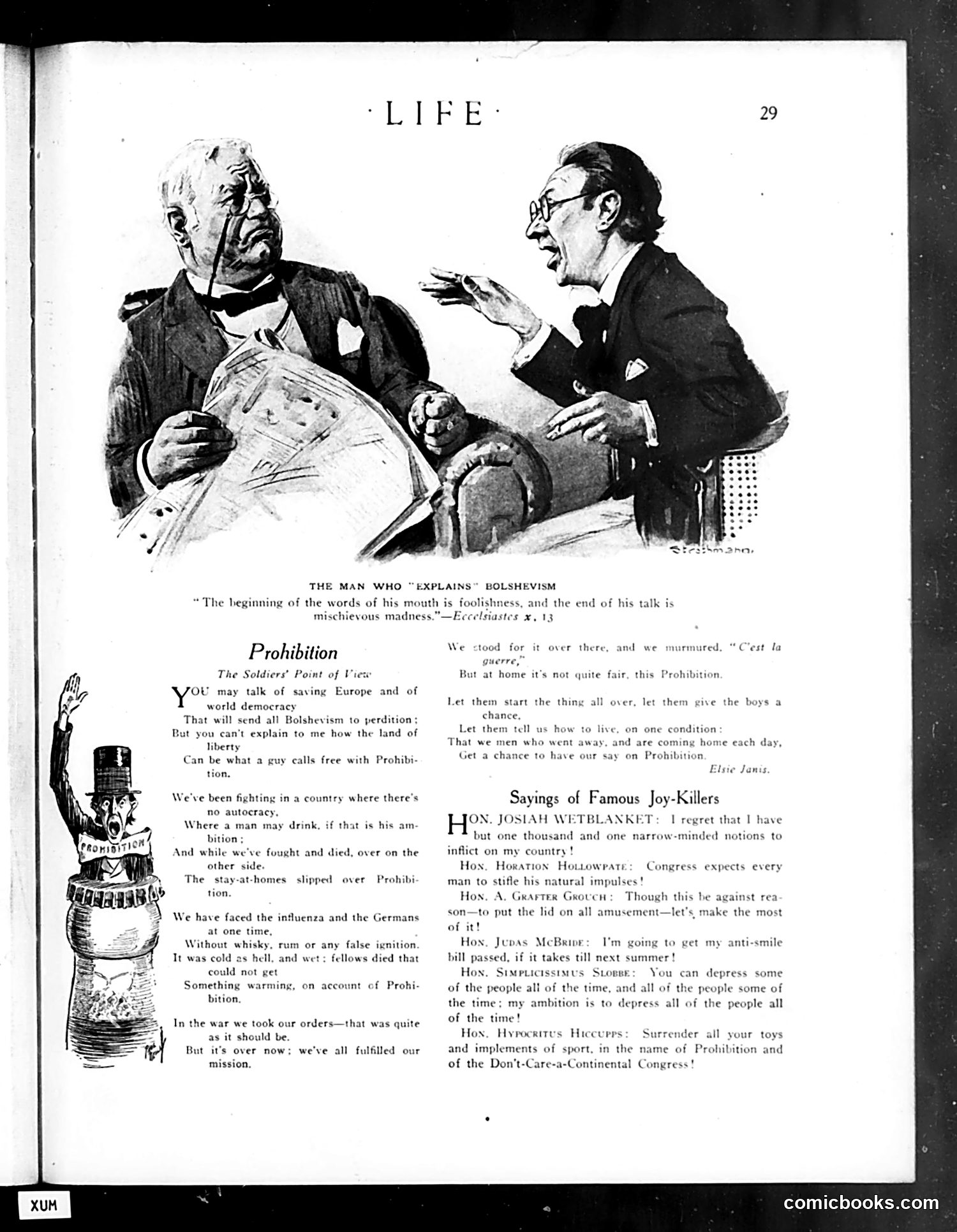
This page satirizes **Prohibition** (the 1920-1933 ban on alcohol) from soldiers' and citizens' perspectives. **Top cartoon**: Shows a man frantically explaining Bolshevism to a skeptical listener—mocking Prohibition advocates who conflate alcohol restrictions with protecting America from communist "red menace." **"Soldiers' Point of View"**: A soldier's complaint that while fighting in Europe for "democracy and liberty," America imposed Prohibition at home—an ironic constraint he didn't face in war-torn countries. He argues soldiers sacrificed without alcohol; civilians shouldn't restrict it during peacetime. **"Sayings of Famous Joy-Killers"**: Mock quotes from fictitious politicians with absurd names ("Wetblanket," "Graften Grouch," "Hypocrites Hiccuprs") who support strict Prohibition. The satire ridicules anti-alcohol crusaders as joyless killjoys imposing unnecessary moral tyranny. **Overall message**: Life mocks Prohibition as un-American government overreach and hypocrisy, particularly unjust to soldiers who endured real hardships.
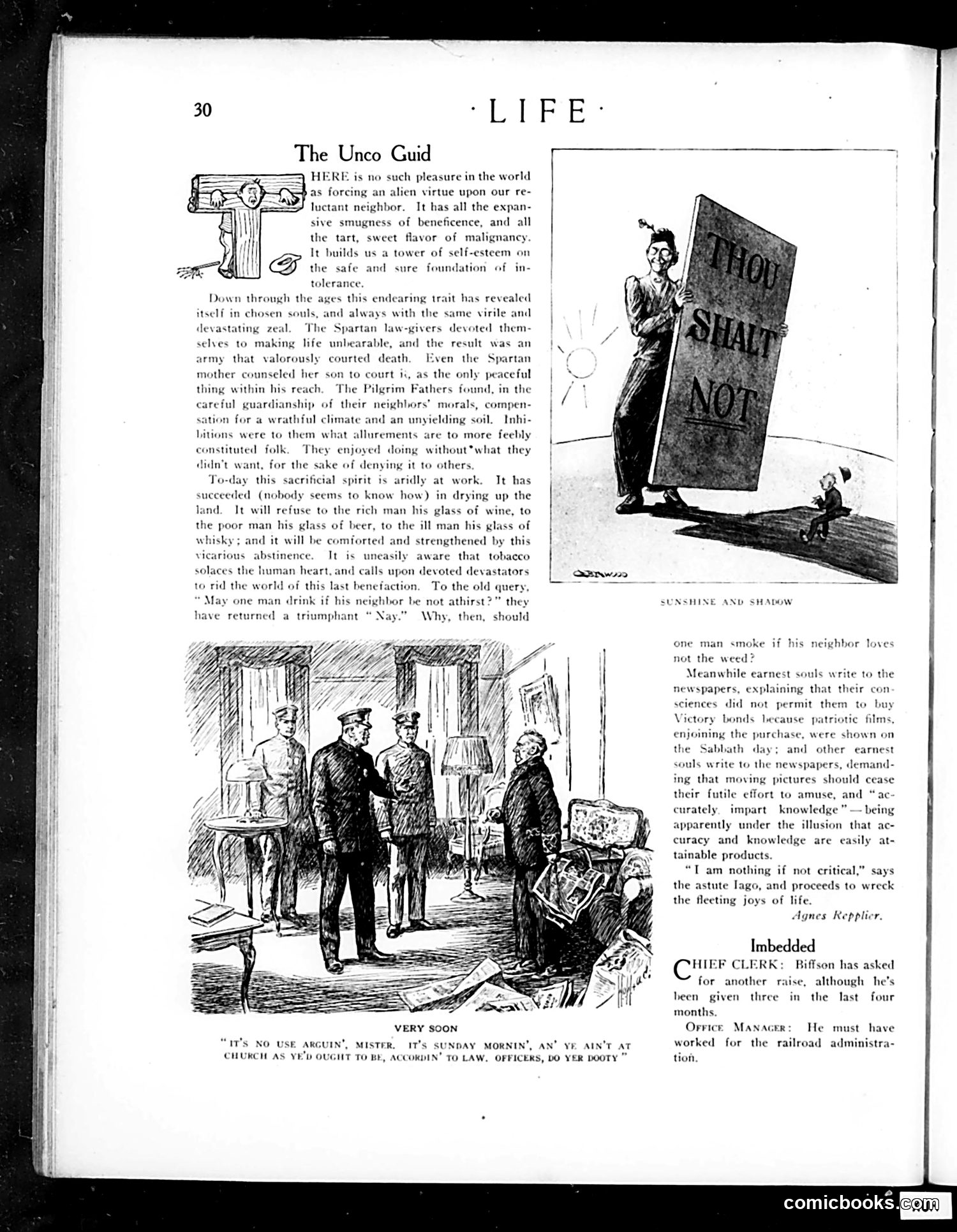
This essay satirizes self-righteous moral crusaders who impose virtue on others. The title references Robert Burns's poem about the "unco guid"—the self-righteously pious. The main cartoon ("Very Soon") shows police officers forcing a man to church on Sunday, illustrating enforced morality. The accompanying text mocks Prohibition-era reformers and religious activists who deny others pleasures (alcohol, tobacco, movies) while claiming moral superiority. The essay references historical examples: Spartans making life "unbearable," Pilgrim Fathers controlling neighbors' morals. It attacks contemporary "earnest souls" who won't buy Victory bonds because patriotic films screen on the Sabbath, or who demand movies cease entertaining in favor of being "accurate." The bottom cartoon ("Imbedded") is unrelated office humor about employee raises. The satire targets American Progressivism's moralistic impulse—the assumption that restricting others' freedoms serves the greater good.
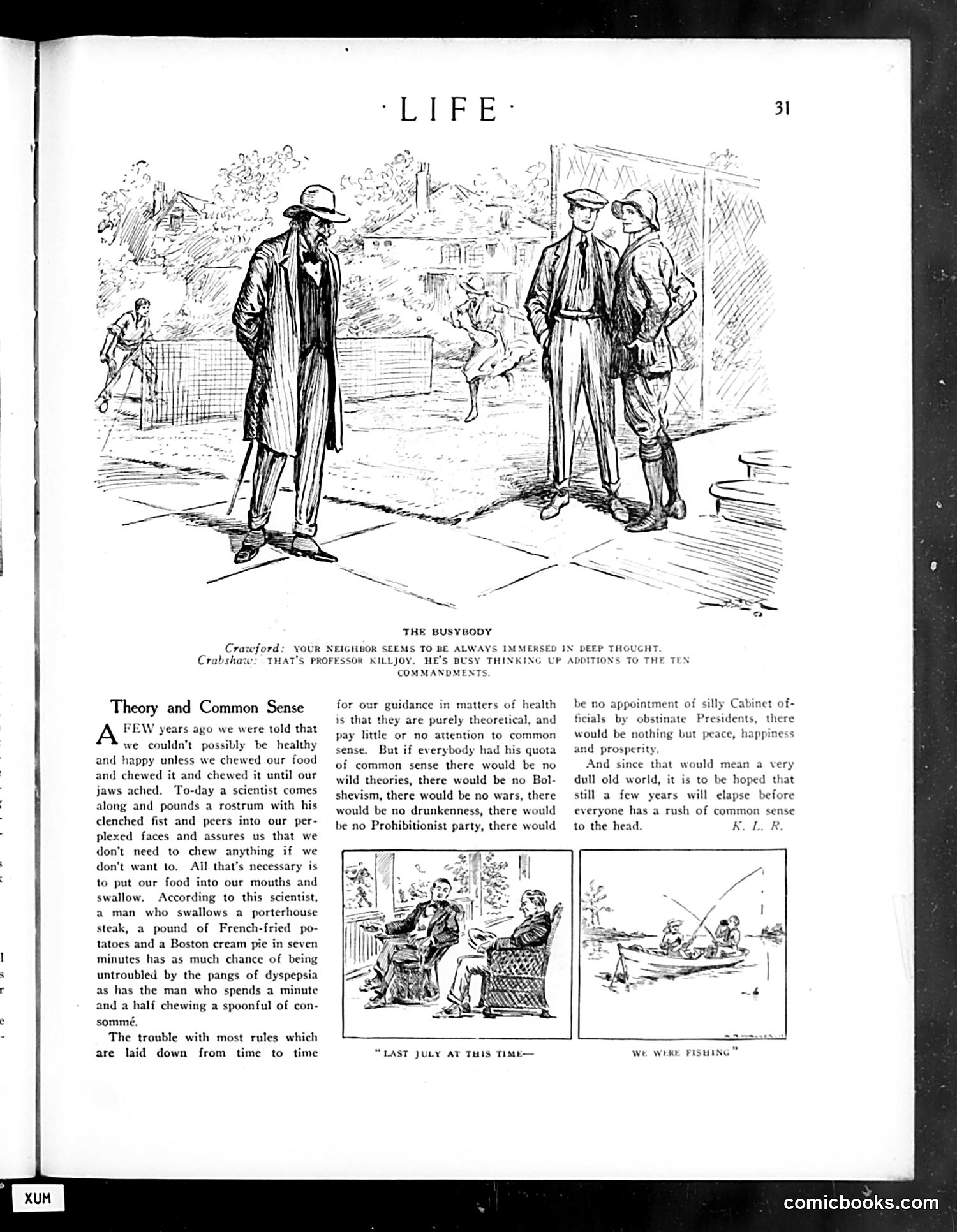
**The top cartoon** mocks the archetypal "busybody" neighbor—a man obsessively preoccupied with his own thoughts while children play nearby. The joke: Crawford observes that their neighbor "Professor Killjoy" is always "thinking up additions to the Ten Commandments"—satirizing the type of self-righteous person who constantly invents new rules and restrictions for others. **The article below** extends this critique, mocking conflicting scientific health fads. It references the trendy chewing-obsession movement (likely Horace Fletcher's "Fletcherism"), then contrasts it with modern scientists claiming such rules are unnecessary. The author argues both extremes lack common sense. **The satire's target**: The piece attacks pseudo-scientific crazes and those who impose rules on society. It includes references to Bolshevism, Prohibition, and obstinate Presidents—suggesting all ideological movements that ignore practical reality deserve ridicule. The underlying message: common sense matters more than fashionable theories.
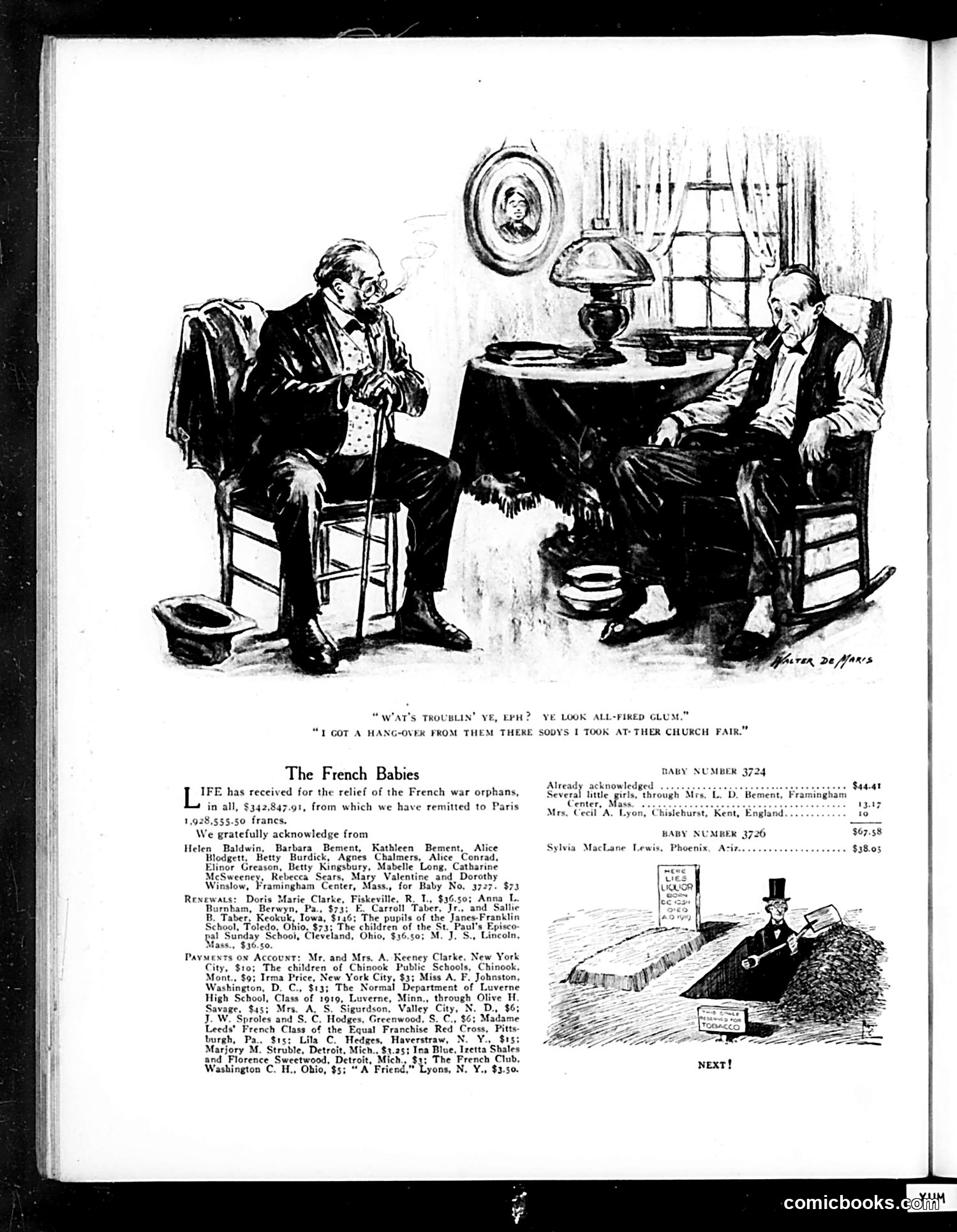
The top cartoon is a humorous domestic scene: two men discuss hangovers, with one blaming "sodys" (sodas) he consumed at a church fair. This appears to be satirizing Prohibition-era America, where alcohol was officially banned but still consumed—the joke suggests even "innocent" church events involved drinking, or perhaps mocks those who blamed everyday items for intoxication. The main body of the page is a fundraising acknowledgment, not satire. It lists donations received by *Life* magazine for French war orphans relief following World War I. The page documents contributors' names and amounts, ranging from individuals to school classes and organizations. This represents *Life's* charitable work supporting post-WWI humanitarian relief—a serious fundraising effort, not comedic content. The small illustration labeled "NEXT!" at bottom appears promotional.
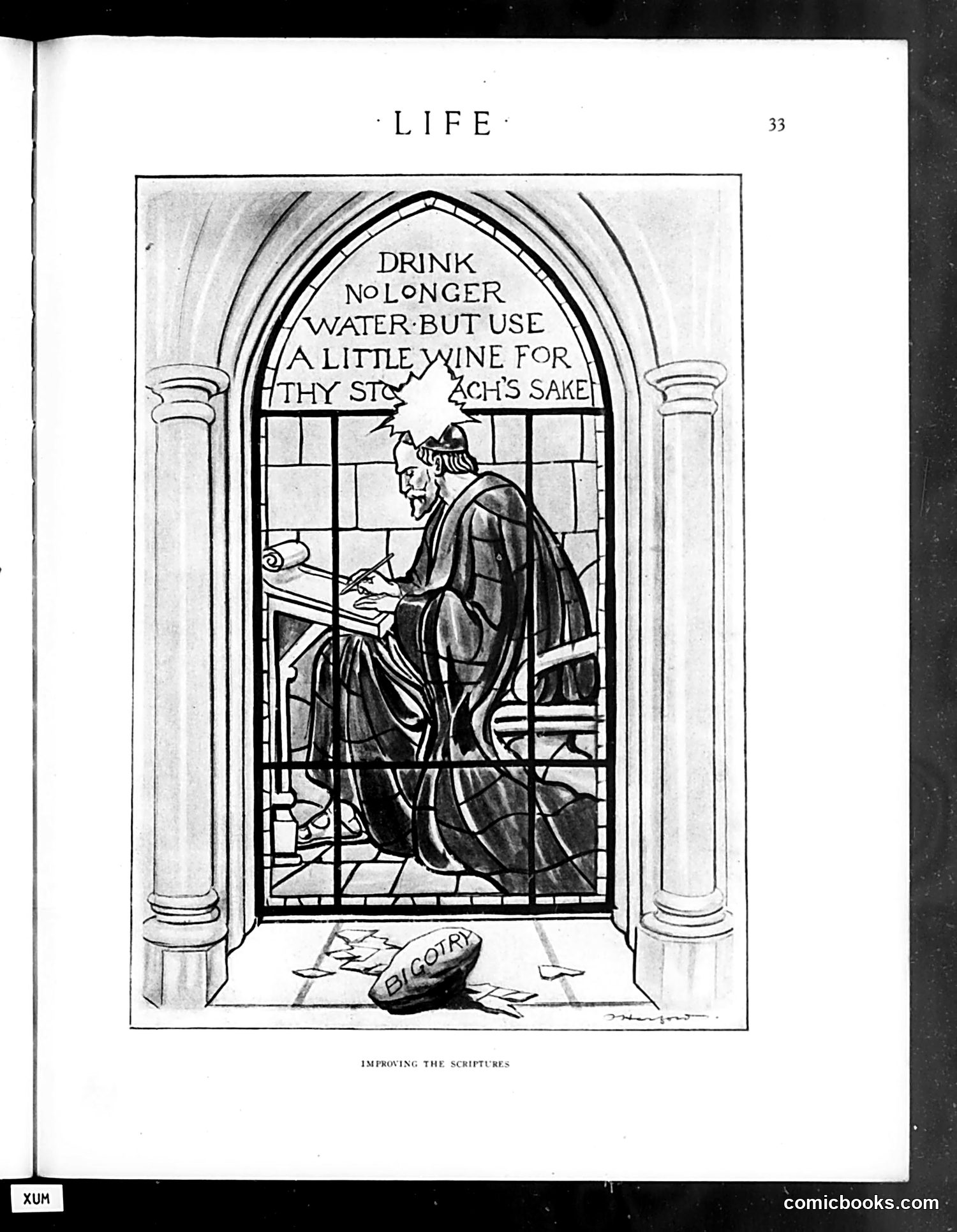
This satirical cartoon depicts a medieval monk or scholar at his desk, revising Biblical text. The caption reads: "DRINK NO LONGER WATER BUT USE A LITTLE WINE FOR THY STOMACH'S SAKE." The joke targets Prohibition-era hypocrisy. A figure labeled "BIGOTRY" lies discarded at the doorway, suggesting the cartoon criticizes those who selectively "interpret" scripture to justify alcohol consumption while supporting Prohibition laws. The satire mocks religious figures or temperance advocates who cherry-pick Biblical passages to support their positions—"improving the scriptures" by emphasizing verses that suit their agenda while ignoring prohibition-aligned passages. This appears to be commentary on the tension between strict Prohibition enforcement and religious justifications some offered for drinking.
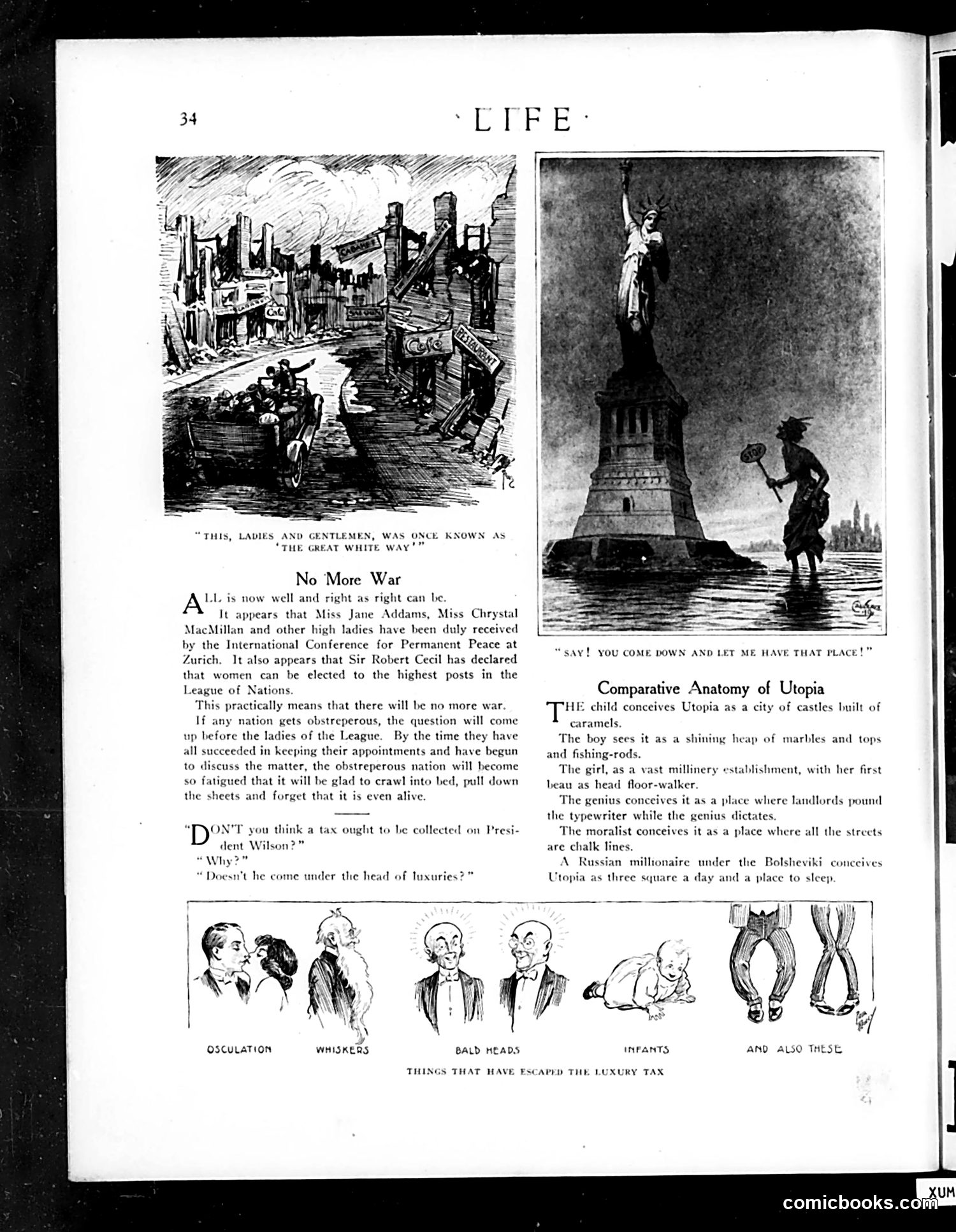
This page satirizes post-WWI idealism and social absurdities. **"No More War"** mocks the League of Nations by suggesting that if women delegates (Jane Addams, Chrystal MacMillan, Sir Robert Cecil mentioned) handle disputes, wars will end—not through strength but because women will be so busy with scheduling and discussion that hostile nations will simply tire out and surrender. It's sardonic commentary on both women's newfound political involvement and the League's ineffectiveness. The Wilson joke treats the U.S. President as a luxury item subject to taxation—a dig at his prominence or perceived extravagance. **"Comparative Anatomy of Utopia"** contrasts naive visions of paradise across different groups: children imagine candy castles, boys want toys, girls envision fashion retail, geniuses see reversed class hierarchies, moralists want order, and—notably—a Russian millionaire under Bolshevism dreams only of basic survival ("three square a day"). This darkly satirizes the Russian Revolution's material devastation. The bottom strip catalogs items escaping luxury tax (facial features, infants)—absurdist humor about taxation.
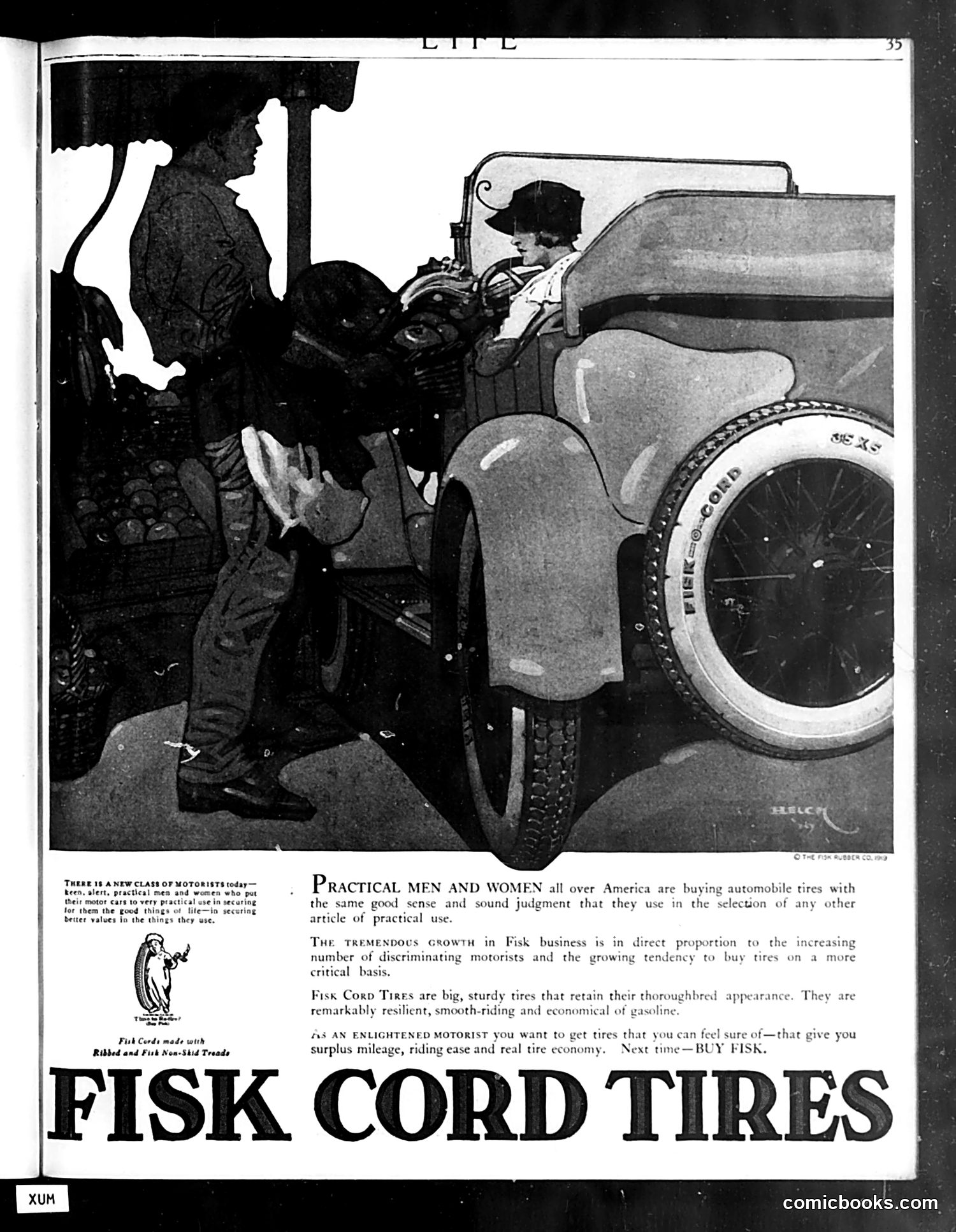
This is primarily a **tire advertisement**, not political satire. The page promotes Fisk Cord Tires to early automobile owners. The image shows a well-dressed couple in a motor car—representing the "new class of motorists" mentioned in the text. The advertisement appeals to practical, discriminating consumers who apply "sound judgment" to purchasing decisions, positioning tire-buying as a mark of intelligence and good taste. The text emphasizes that Fisk's business growth reflects an increasing number of "discriminating motorists"—a marketing strategy that flatters buyers by associating the brand with wisdom and refinement. The tires are described as "sturdy," "resilient," and economical. A small mascot (the Fisk boy logo) appears in the lower left. This reflects the early 20th-century automobile boom, when owning a car was still relatively novel and represented a certain social status.
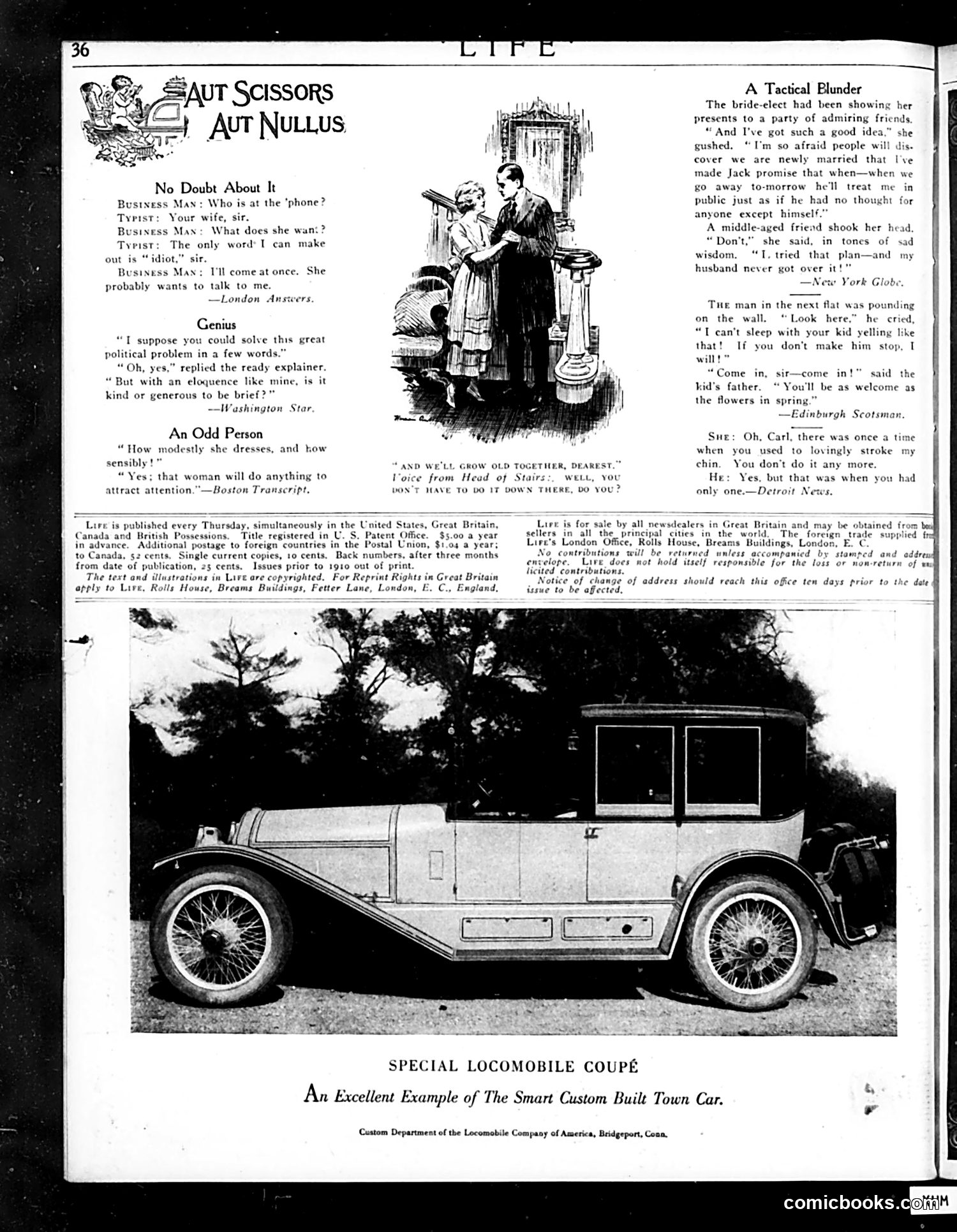
This page contains several brief satirical jokes typical of early 20th-century humor magazines, plus an automobile advertisement. **The Cartoons/Jokes:** 1. **"No Doubt About It"**: A businessman's typist receives his wife's call. The joke is that his wife only needs to say one word—"idiot"—for him to understand she wants him home immediately, suggesting marital tension or the wife's low opinion of him. 2. **"An Odd Person"**: A woman dresses modestly to *attract* attention rather than avoid it—satirizing paradoxical female behavior or vanity. 3. **"A Tactical Blunder"**: A newlywed bride promises to ignore her husband in public to hide their recent marriage, but an older friend warns this backfired in her own marriage, implying the husband took her at her word permanently. 4. **Other brief jokes**: Include marital complaints (noisy children, aging spouses losing affection). **The Advertisement**: Features a Locomobile luxury automobile, described as a "smart custom built town car." These represent typical domestic humor of the era—largely focused on marriage, wives, and gender relations—rather than political satire.
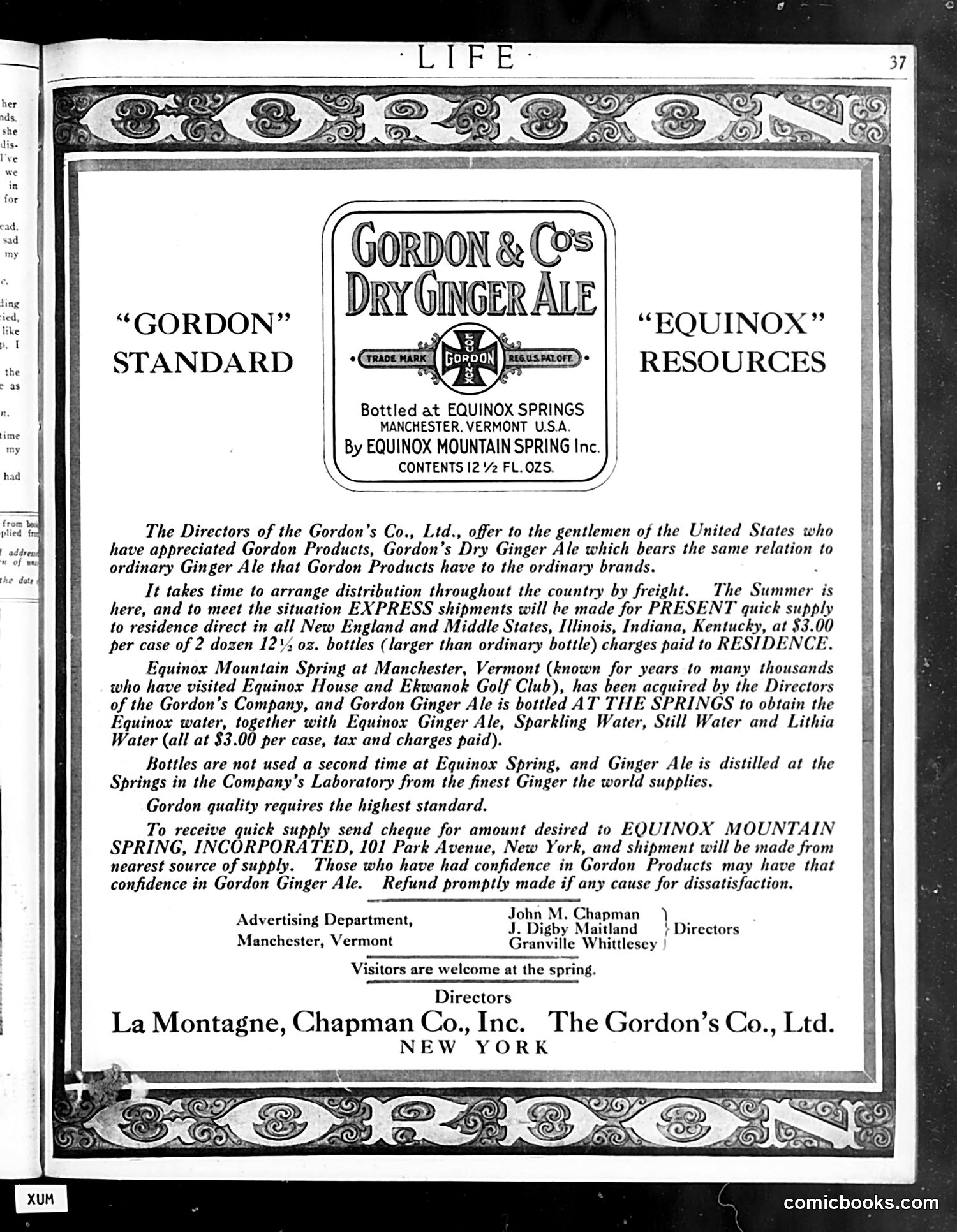
This is **not a cartoon or satire**—it is a **full-page advertisement** for Gordon's Dry Ginger Ale, published in *Life* magazine (page 37). The ad promotes a premium ginger ale bottled at Equinox Springs in Manchester, Vermont. It positions Gordon's as a superior product, claiming it bears the same relation to ordinary ginger ale as Gordon Products (presumably other goods) do to ordinary brands. Key marketing appeals include: - **Sourcing prestige**: bottled at a famous Vermont spring known to wealthy visitors of Equinox House and golf club - **Quality assurance**: bottles reused only once; ginger distilled on-site from "finest ginger the world supplies" - **Convenience**: express summer shipping available to residences across the Northeast and Midwest at $3.00 per case - **Money-back guarantee**: refunds offered for dissatisfaction The directors are listed, and customers are invited to visit the spring. This reflects early-20th-century marketing emphasizing natural springs, purity, and exclusivity as luxury product differentiators.
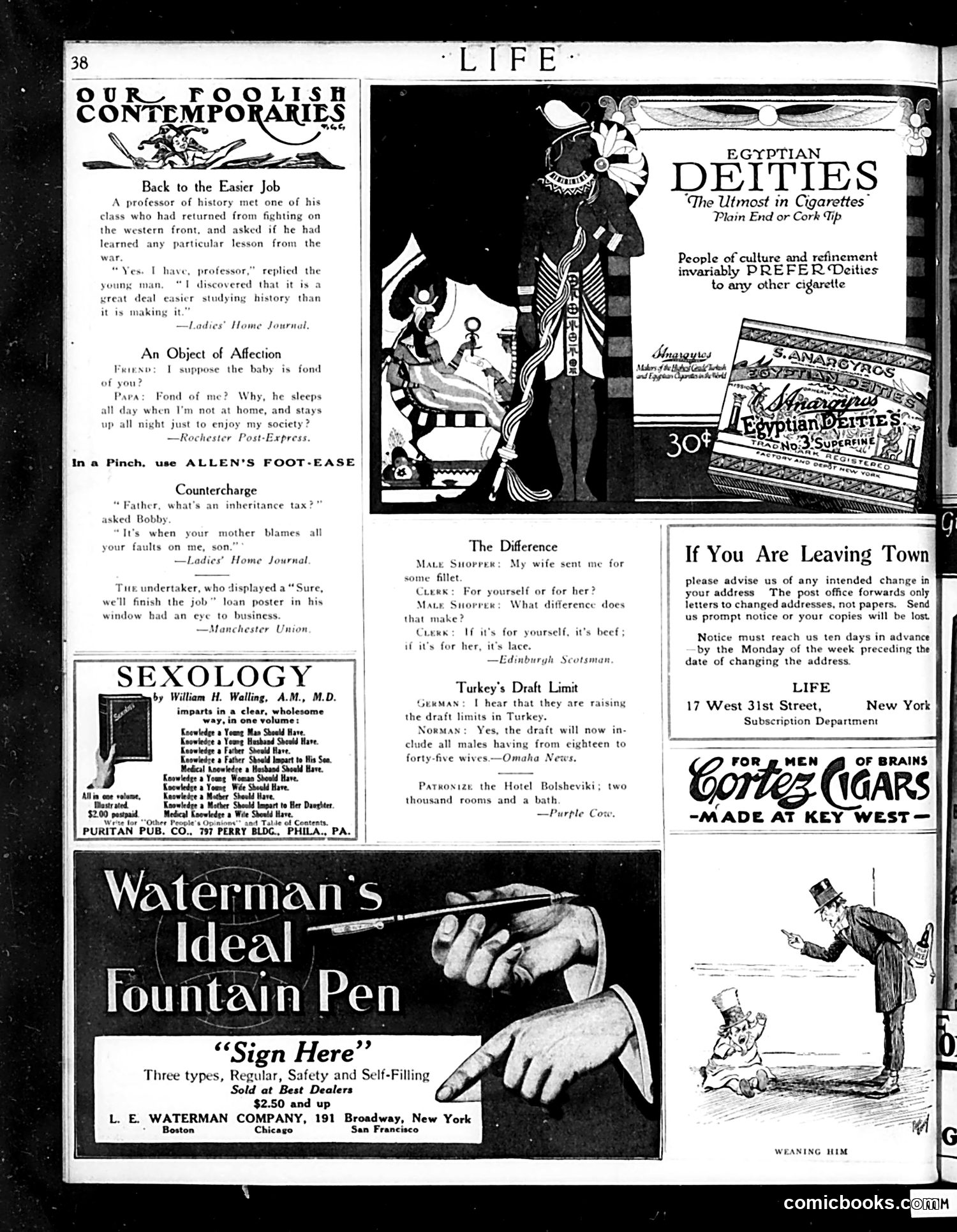
This page is primarily **advertising and humor snippets** typical of Life's satirical format. **Main Content:** The "Our Foolish Contemporaries" section collects brief jokes mocking everyday absurdities. The opening anecdote contrasts academic history with WWI combat, suggesting that *experiencing* history is harder than studying it—a pointed post-war commentary. Other jokes target domestic life: a baby who sleeps when father's away (implying the child dislikes him), inheritance taxes reframed as marital blame, and a joke about Turkish draft limits expanding to include men with many wives (mocking polygamy and Ottoman practices). **Advertisements:** The page features period product ads: Allen's Foot-Ease, a "Sexology" self-help book, Egyptian Deities cigarettes (appealing to "culture and refinement"), Cortez cigars, and Waterman fountain pens. **Tone:** Typical of 1920s Life—domestically focused humor, light social satire, and marketing of consumer goods to middle-class readers.
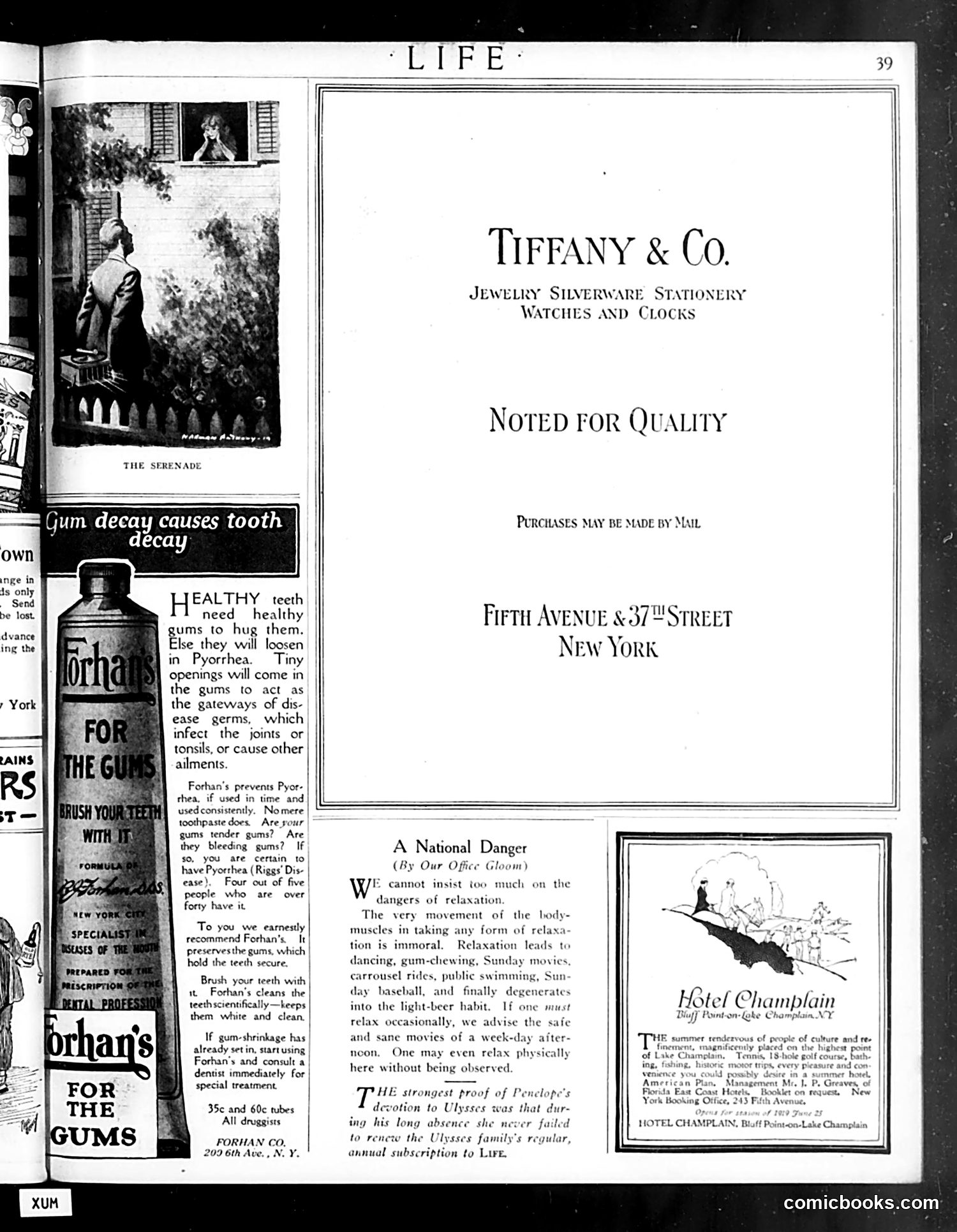
This page contains a satirical editorial titled "A National Danger" mocking early 20th-century moral panic about leisure activities. The piece sarcastically condemns "relaxation" itself, claiming innocent activities like dancing, movies, swimming, and baseball inevitably lead to moral decay and "the light-beer habit." The satire targets puritanical social attitudes of the era—the anxiety among cultural conservatives about modern amusements and their supposed corrupting influence. By presenting relaxation as inherently immoral and listing absurdly mundane activities alongside serious vices, Life ridicules overwrought moral reformism. The concluding joke about Penelope (Odysseus's faithful wife) renewing a *Life* subscription during his absence is self-promotional humor, suggesting the magazine itself offers "safe" leisure for the morally conscientious. The surrounding advertisements (Tiffany & Co., Forhan's toothpaste) are period commercial content.
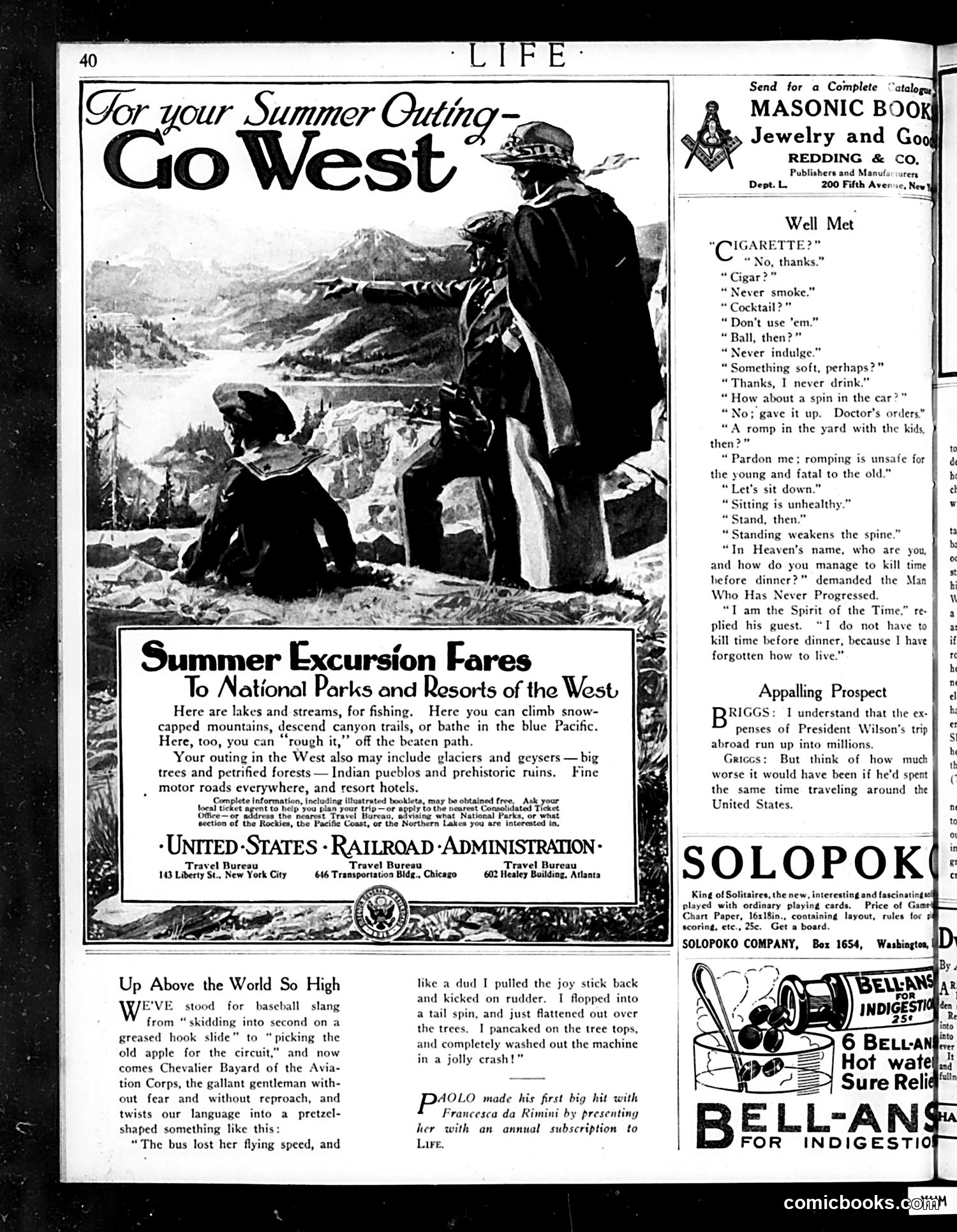
This page is primarily **advertising and humor**, not political satire in the traditional sense. The main advertisement promotes **Western train travel** through the United States Railroad Administration, encouraging summer tourism to national parks and resorts. The illustration shows well-dressed tourists enjoying mountain scenery. The humor pieces include: 1. **"Up Above the World So High"**: Mocks **aviator jargon** from World War I. A pilot ("Chevalier Bayard of the Aviation Corps") uses absurdly colorful flying slang—"pancaked," "washed out," "joy stick," "rudder"—to describe a crash landing. The joke ridicules how military aviation has introduced bizarre new vocabulary into American English. 2. **"Well Met"**: A dialogue satirizing the **health-conscious fad** of the 1920s, where a person obsessively avoids everything—smoking, drinking, exercise, sitting, standing—claiming each is dangerous. The "Spirit of the Time" character embodies this era's contradictory wellness obsession. 3. **"Appalling Prospect"**: Brief joke about **President Wilson's European travel expenses** being cheaper than domestic travel. The page reflects 1920s American humor and advertising culture.
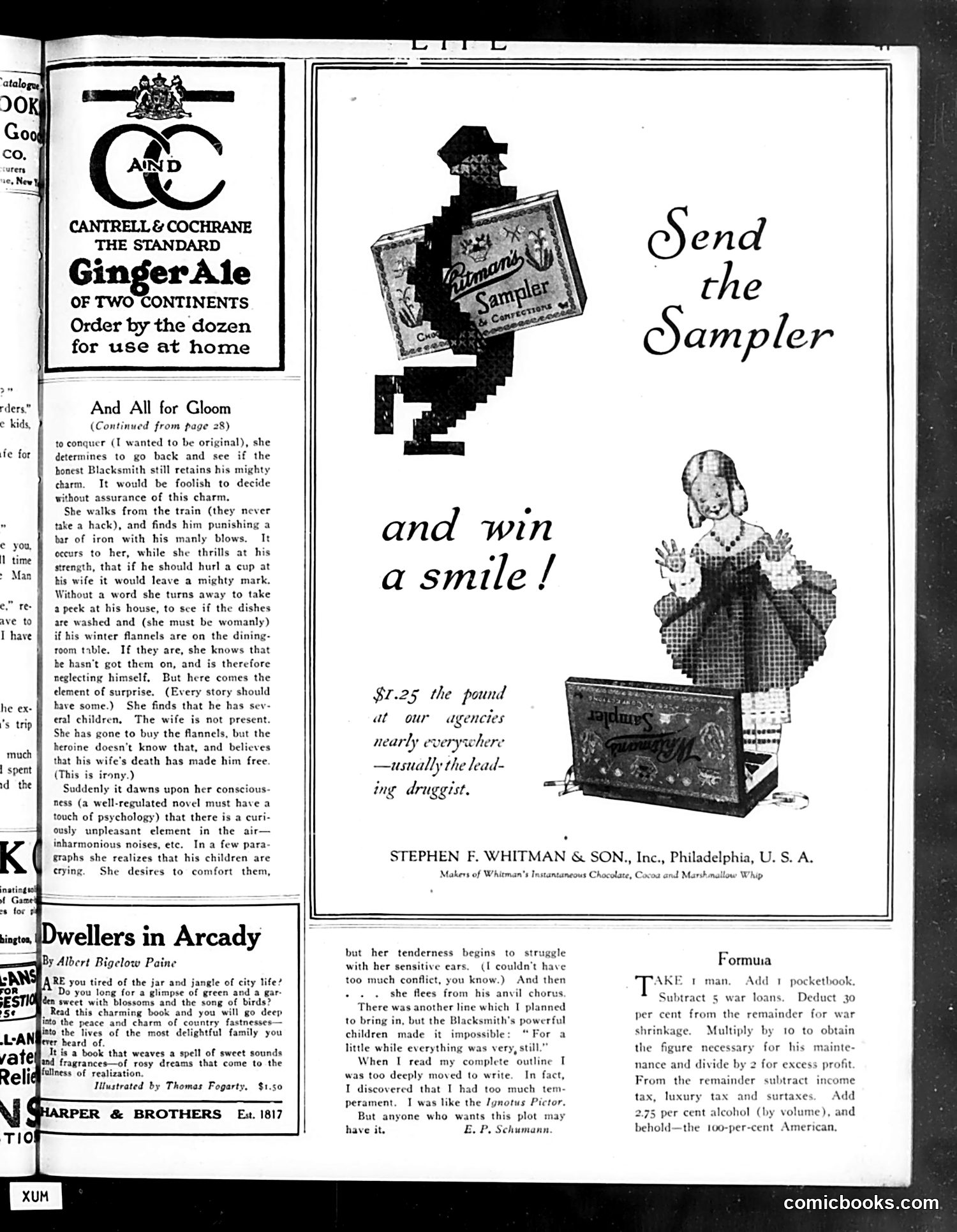
This page mixes editorial content with advertisements. The main article, "And All for Gloom" (continued from previous page), appears to be a satirical short story or serialized fiction about a woman who revisits a blacksmith after years apart, only to discover he now has several children and domestic chaos—the "anvil chorus" of crying kids. The humor comes from romantic expectations meeting messy reality. The advertisements include: - **Cantrell & Cochrane Ginger Ale** (top left) - **Whitman's Sampler chocolates** (center/right): A vintage confection ad showing a woman holding a sampler box, promising "$1.25 the pound" and offering a contest to "win a smile" - **"Dwellers in Arcady"** book advertisement (bottom left) - A humorous **formula** (bottom right) mocking postwar financial calculations The overall tone is lighthearted domesticity and consumer culture typical of early 20th-century American magazines.
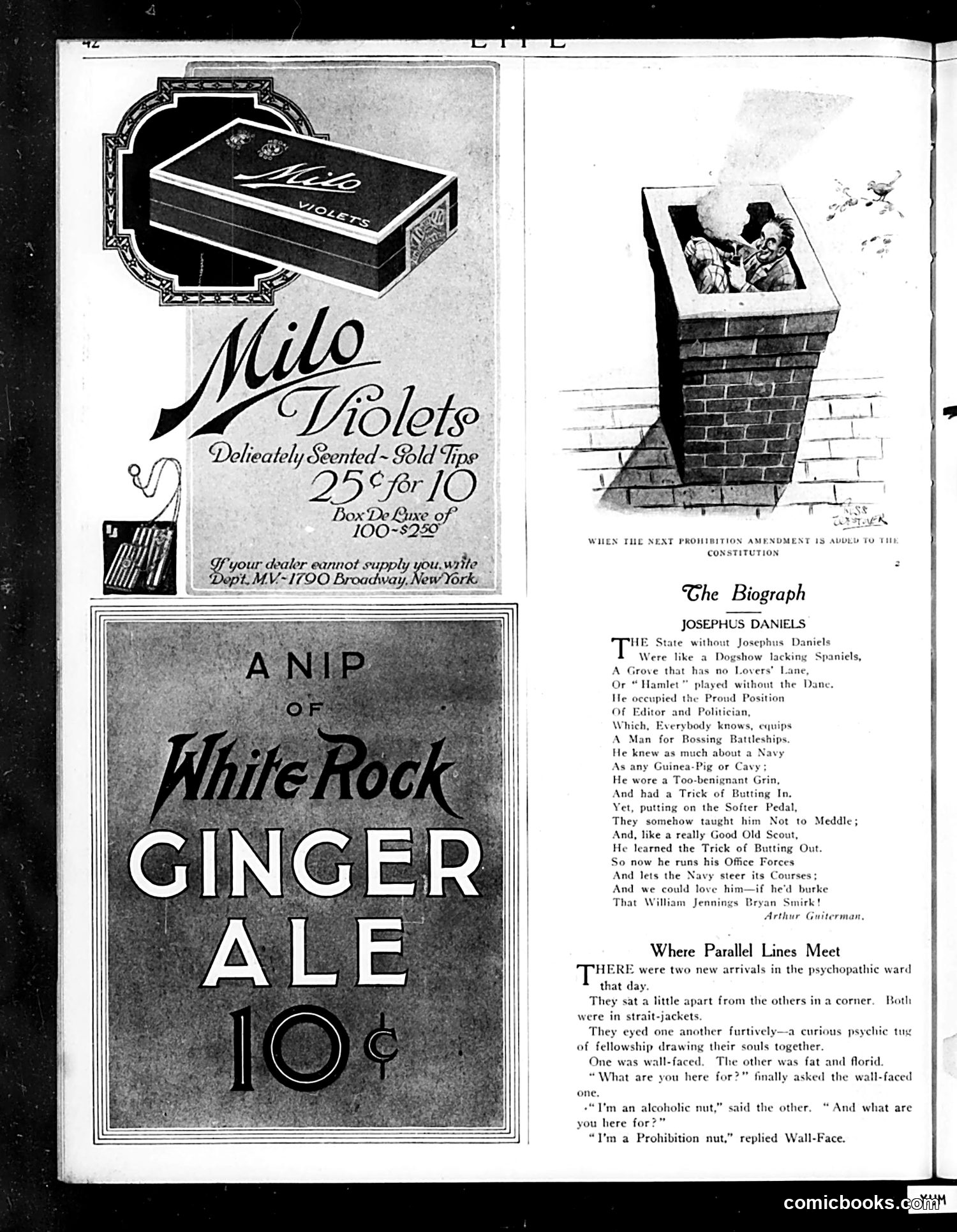
This Life magazine page contains **Prohibition-era satire** from approximately the 1920s. The cartoon titled "When the Next Prohibition Amendment Is Added to the Constitution" depicts two asylum inmates—one representing alcoholism, the other representing Prohibition enforcement—as equally insane. This is cutting satire: the joke argues that *both* excessive drinking and zealous Prohibition advocacy are forms of madness worthy of institutionalization. The biographical poem about **Josephus Daniels** (Secretary of the Navy under Wilson) mocks his simultaneous roles as editor and naval administrator, suggesting he's unqualified. The "William Jennings Bryan Smirk" reference implies self-righteous moralism—Bryan was a famous Prohibition advocate. Together, these pieces satirize **Prohibition itself as absurd policy**, treating its supporters and the alcoholism it supposedly addressed as equally ridiculous social problems. The tone reflects Life magazine's sophisticated, skeptical stance toward Prohibition during its enforcement (1920-1933).
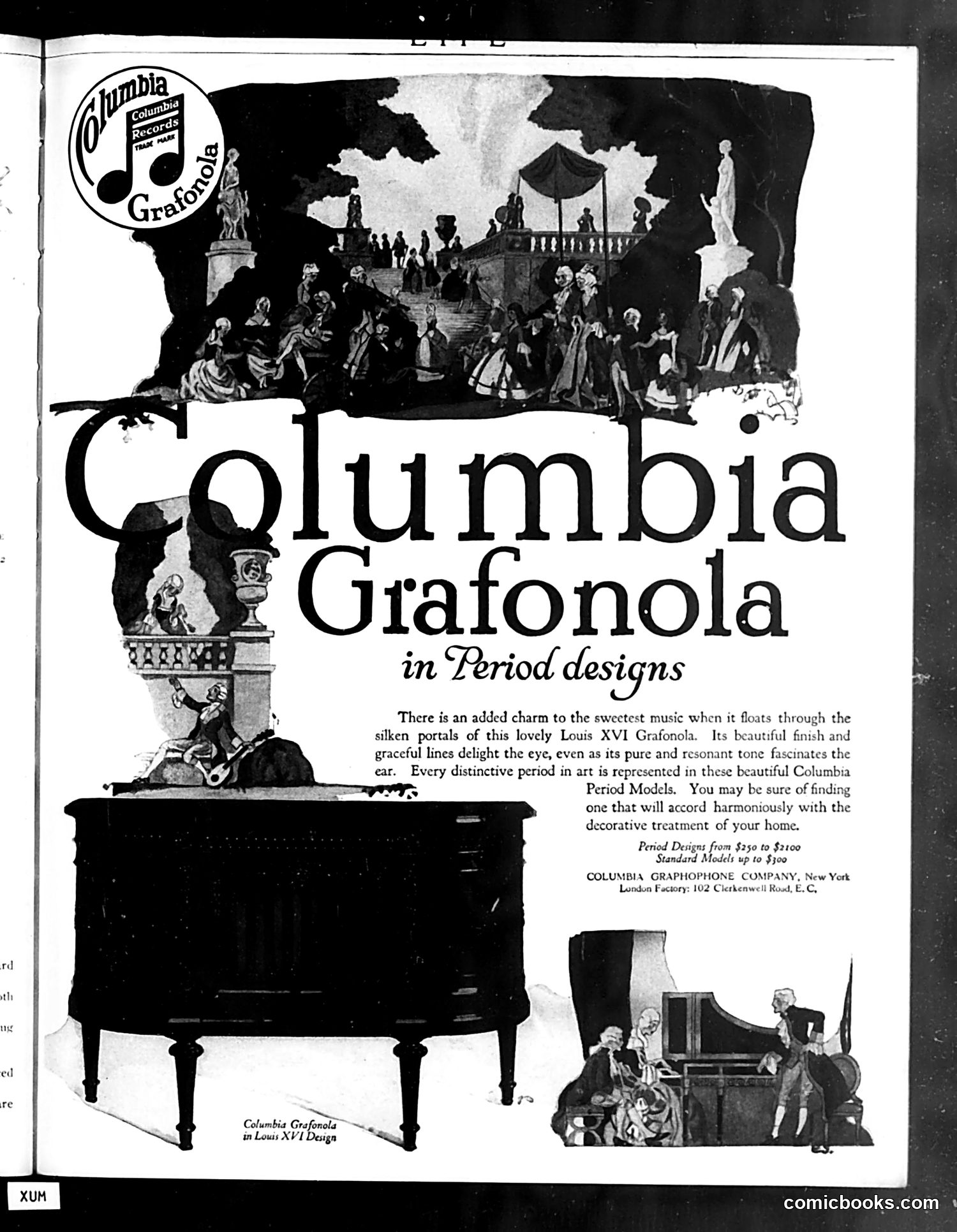
This is **not a political cartoon** but rather a **product advertisement** for Columbia's Grafonola (an early phonograph/gramophone). The page showcases the company's "Period Models"—gramophones designed to match various historical interior design styles, particularly Louis XVI (18th-century French rococo). The imagery emphasizes luxury and artistic sophistication: the ornate cabinet design, the silhouetted period scene at top showing aristocratic gatherings, and the lower illustration of people enjoying classical music. The sales pitch appeals to wealthy consumers' desire for **aesthetic harmony** between their music device and home décor. Priced $250-$2,100 (substantial sums in this era), these were luxury goods marketed as objects combining **modern technology with period elegance**—allowing buyers to display cultural refinement and good taste. This reflects early 20th-century consumer culture targeting the affluent middle and upper classes.
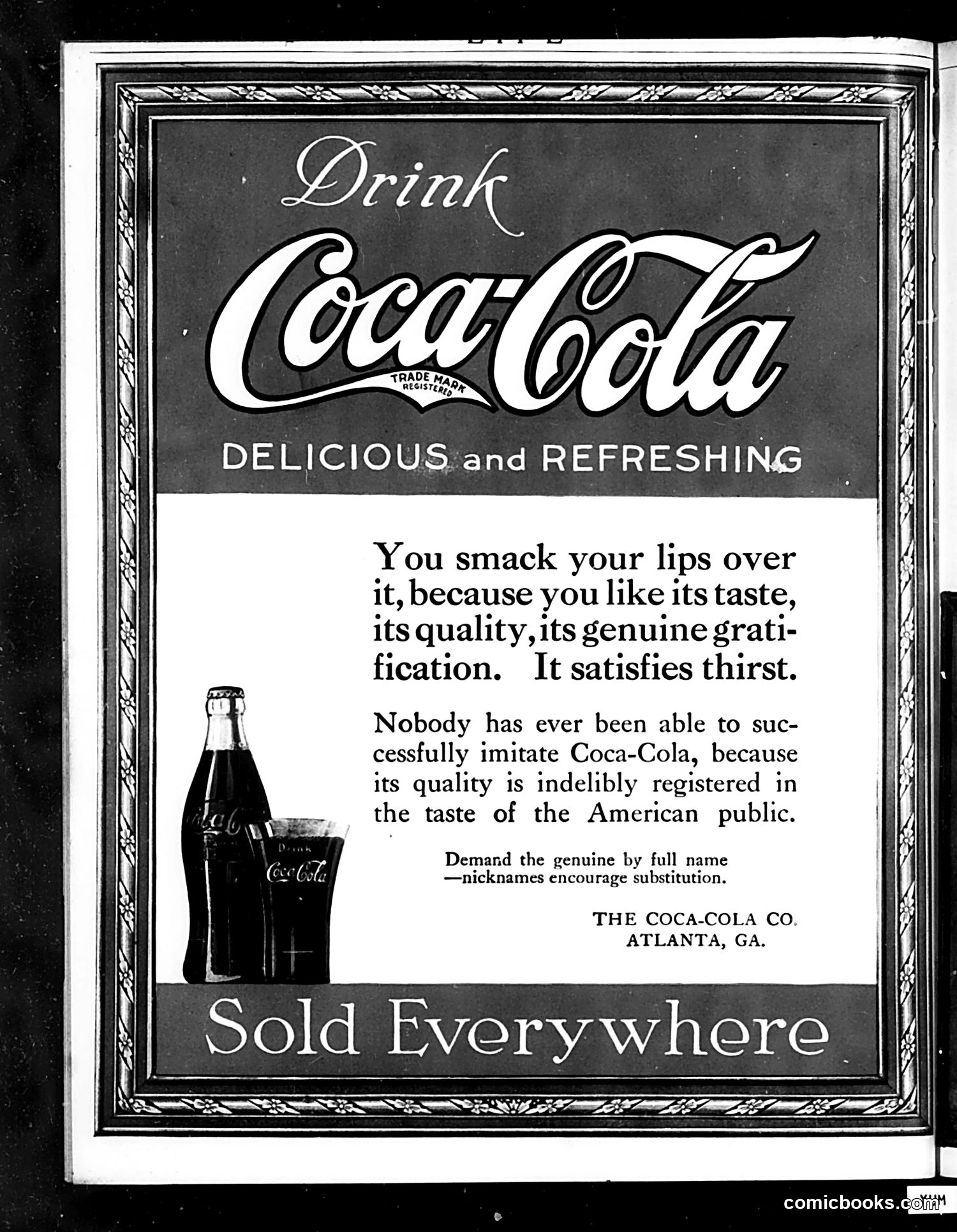
This is a **Coca-Cola advertisement**, not a political cartoon or satire. The page shows a vintage ad from *Life* magazine featuring: **Content:** - The iconic Coca-Cola script logo and bottle with glass - Marketing copy emphasizing taste, quality, and genuine gratification - A warning against imitation products and "nicknames" (likely referring to generic terms like "cola") **Historical Context:** The ad reflects early 20th-century consumer culture concerns about brand authenticity and product substitution. The emphasis on demanding "the genuine by full name" suggests competitors were using similar names or knockoffs were common. The phrase "indelibly registered in the taste of the American public" asserts Coca-Cola's market dominance and brand loyalty. This is straightforward advertising rather than satirical commentary—a demonstration of how major corporations used magazine space to reinforce brand identity and discourage alternatives.
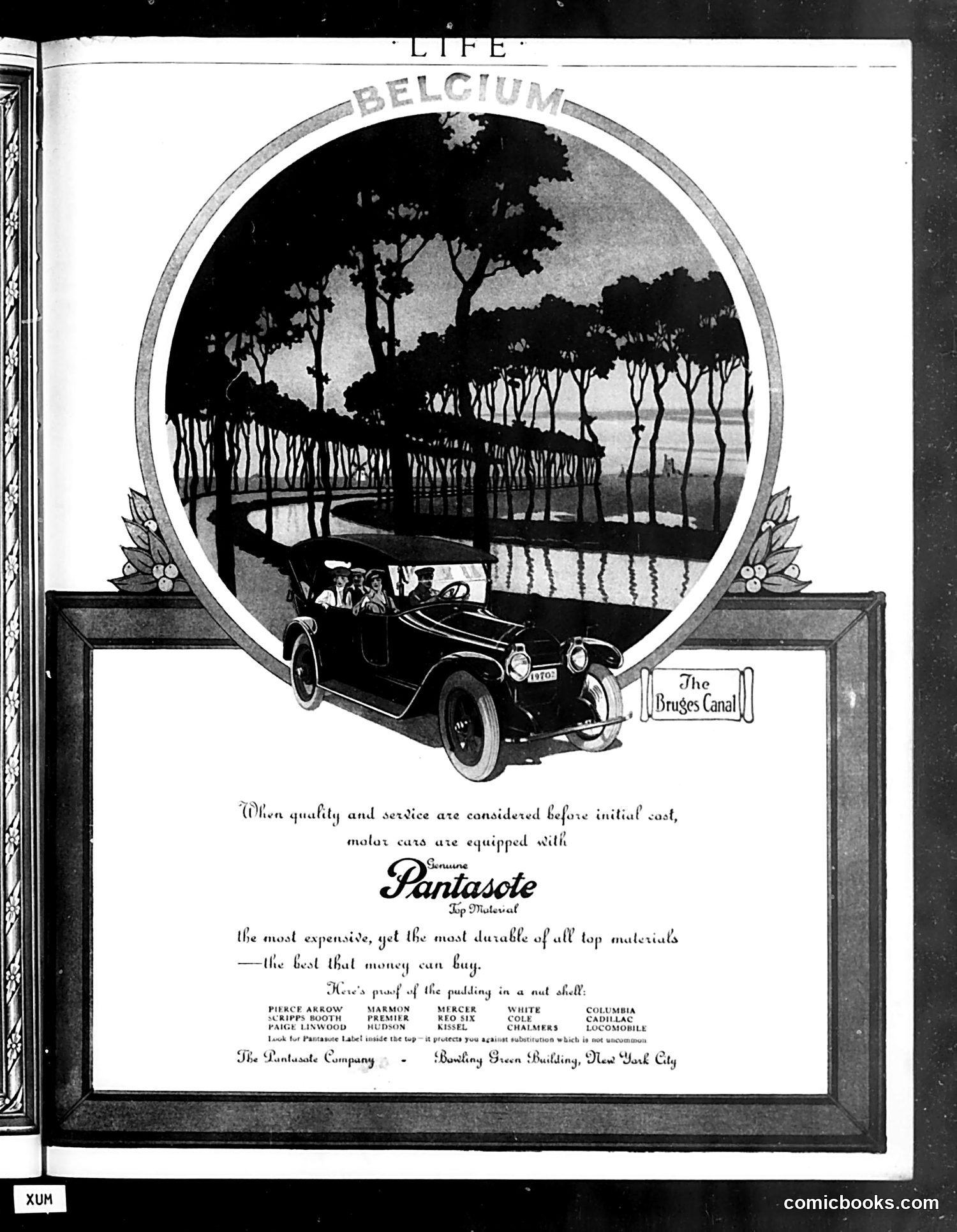
This is primarily a **car advertisement**, not political satire. It's a Pantasote automobile top material ad from The Pantasote Company (Roaring Green Building, New York City). The page features a vintage motor car positioned beneath a circular vignette of "The Bruges Canal" in Belgium—a picturesque European scene with trees and water. The ad argues that quality materials matter: when buyers prioritize durability over initial cost, they should equip cars with Pantasote tops, described as "the most expensive, yet the most durable of all top materials—the best that money can buy." The Belgian canal imagery suggests sophistication and European elegance, positioning the product as premium. The tagline "Here's proof of the pudding in a nut shell" emphasizes practical value. Various fabric options are listed (Pierce-Arrow, Packard, Mercer, etc.), indicating widespread automotive use. This is commercial marketing, not editorial content or satire.
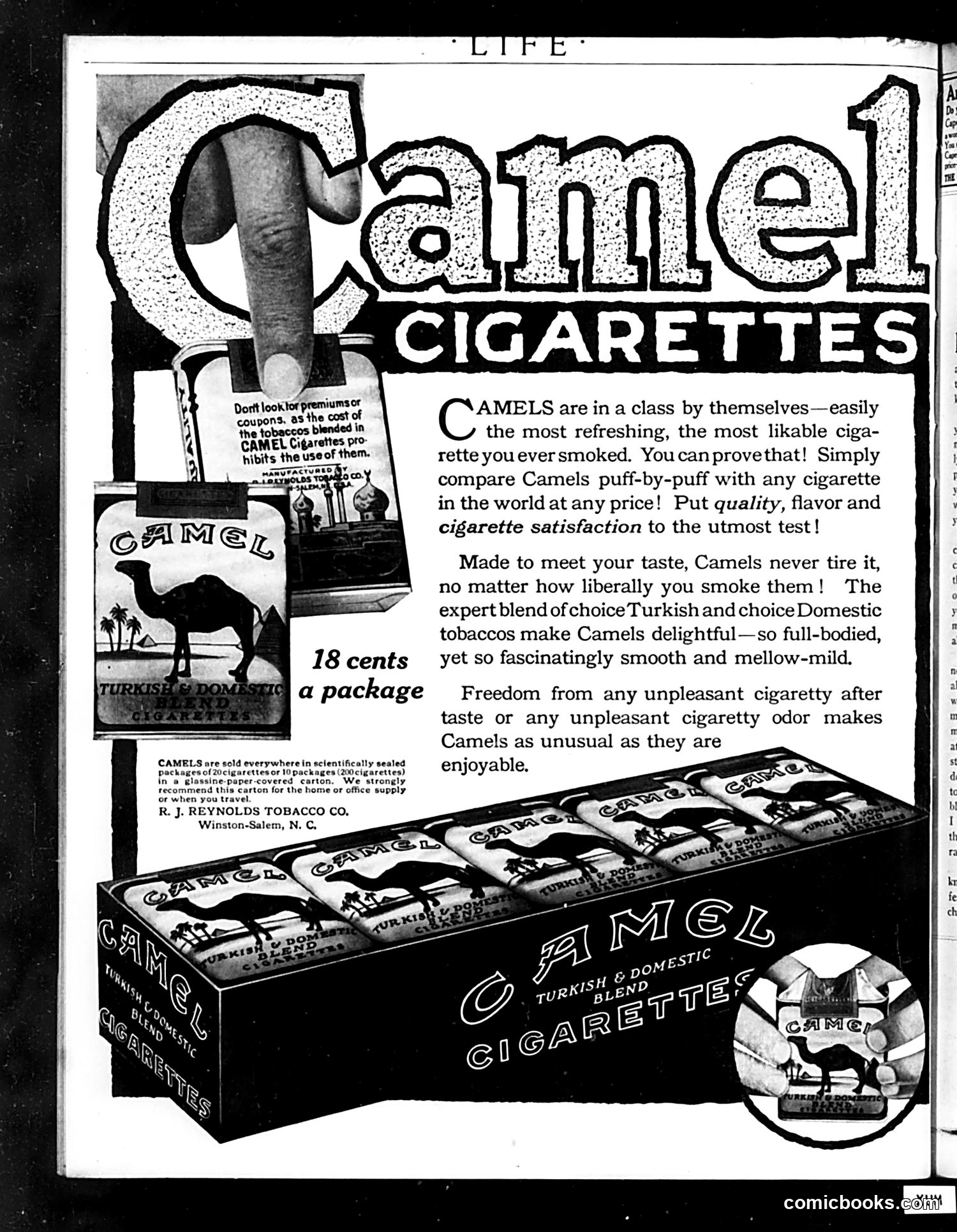
This is a **cigarette advertisement**, not a political cartoon. It appears in *Life* magazine (likely 1920s-early 1930s based on styling and 18-cent pricing). The page features Camel cigarettes advertising their "Turkish and Domestic blend." The prominent camel logo and imagery emphasize the product's exotic appeal. The ad claims Camels are superior in "quality, flavor and cigarette satisfaction" and notably advertises **freedom from unpleasant cigarette odor and aftertaste**—a selling point acknowledging widespread social concerns about smoking's effects. The manufacturer (R.J. Reynolds) explicitly recommends buying cartons for "home or office supply," normalizing cigarette consumption as routine household goods. **For modern readers:** This represents pre-regulation tobacco marketing that made health/comfort claims now prohibited, and reflects an era when cigarette advertising in mainstream magazines was standard and uncontroversial.
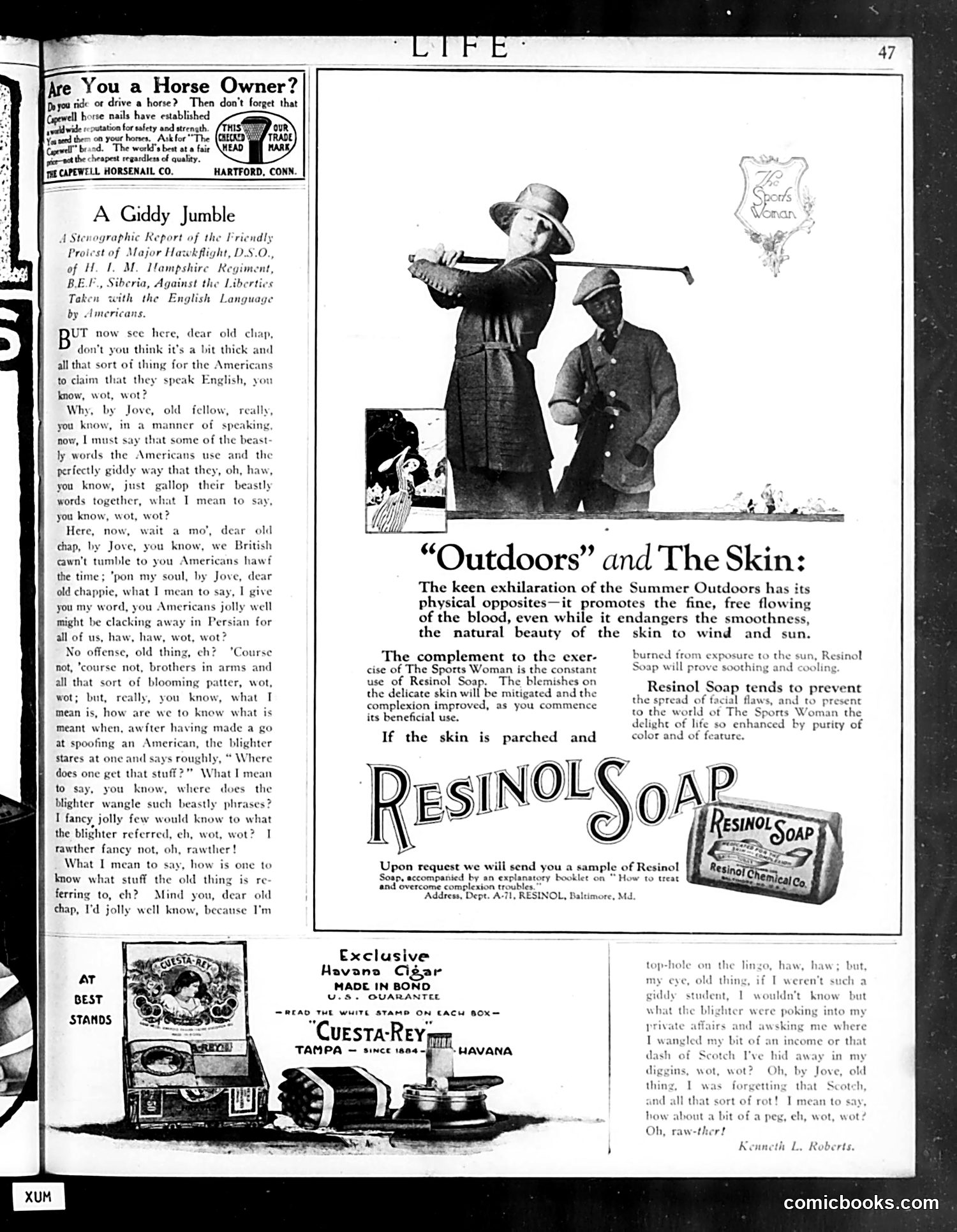
This satirical article presents a fictional British military officer (Major Hawkflight, stationed in Siberia during WWI) complaining that Americans butcher the English language. The humor relies on British stereotypes—the officer himself uses affected British expressions ("wot, wot," "by Jove," "old chap," "rawther") while claiming Americans speak incomprehensibly. His rambling, repetitive speech ironically demonstrates that *British* English can be just as confusing and verbose. The implied joke: both groups speak English badly in different ways, but the British officer is too oblivious to recognize his own linguistic peculiarities. The article likely reflects actual WWI-era tensions between American and British forces, mocking British condescension toward American troops. The page also contains period advertisements (Resinol Soap, Cuesta-Rey cigars, horseshoe nails), typical of Life magazine's format.
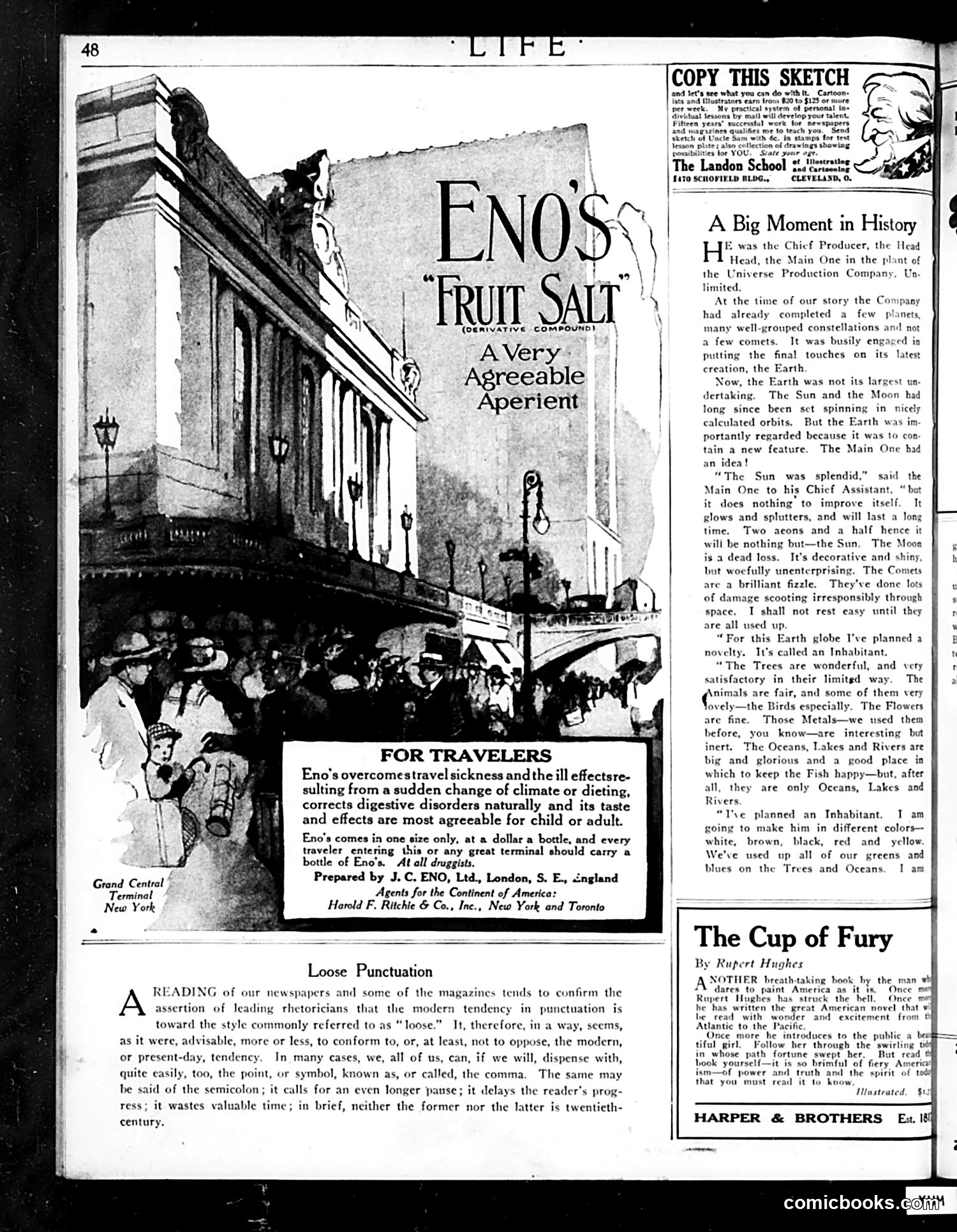
This page contains primarily **advertisements and literary content** rather than political satire. The main visual element is an **Eno's Fruit Salt advertisement** depicting a grand Victorian building with crowds below—promoting a digestive remedy for travelers experiencing stomach upset from climate or diet changes. The copy emphasizes the product's universal appeal for "child or adult." The text content includes: 1. **"A Big Moment in History"**—a science fiction narrative about a cosmic "Main One" designing Earth, describing its features (Sun, Moon, comets, Trees, Animals, Birds, Flowers, Oceans, and Lakes). This appears to be serialized fiction. 2. **"Loose Punctuation"**—an essay discussing modern trends toward minimal punctuation in newspapers and magazines, debating whether to abandon the comma. 3. **"The Cup of Fury"** advertisement by Rupert Hughes, promoting his novel about America and featuring a "beautiful girl." The page reflects early 20th-century magazine format: commercial products mixed with fiction and opinion pieces. No clear political satire is evident.
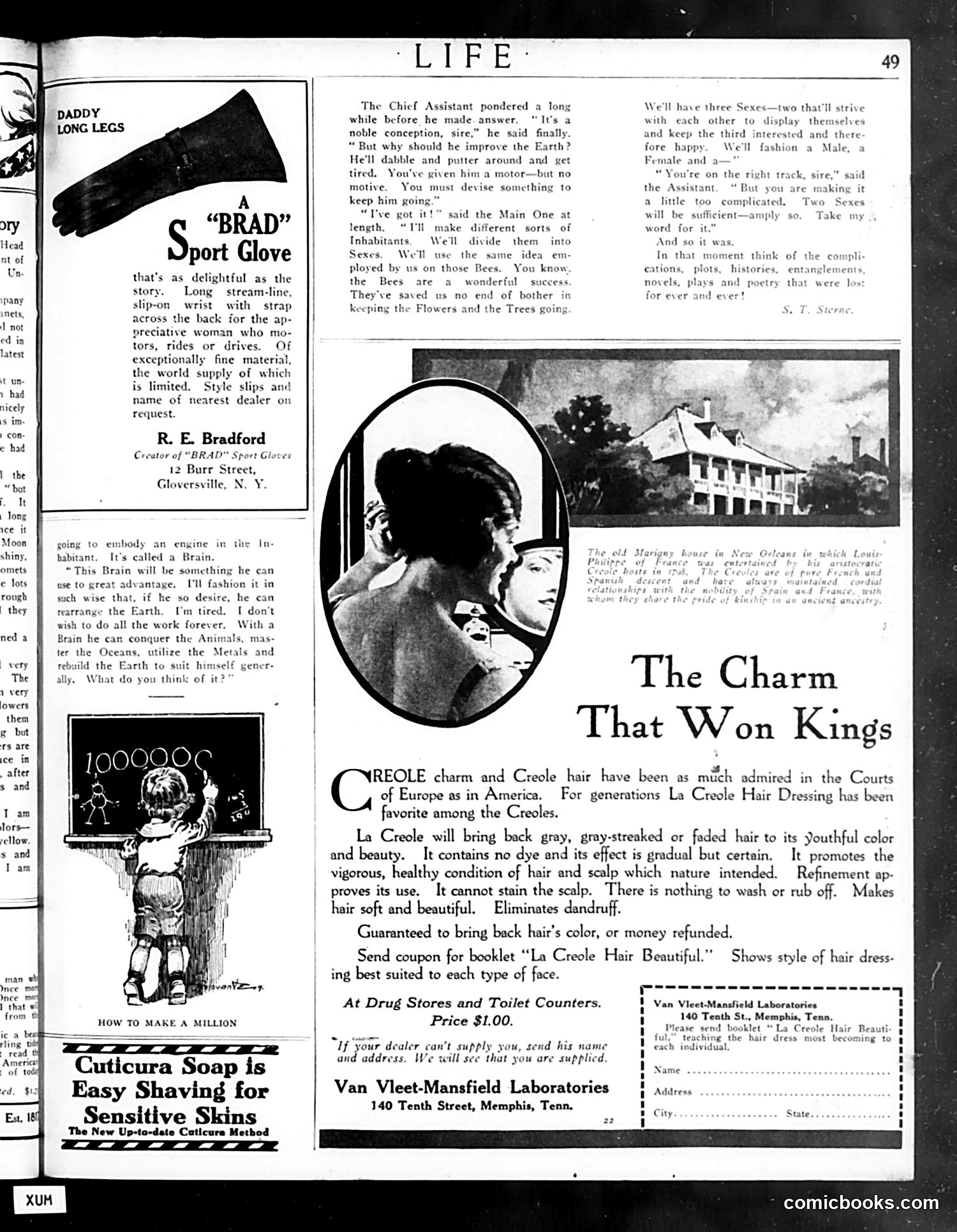
This page mixes editorial content with period advertising. The main satirical piece appears to be a dialogue between a "Main One" and "Chief Assistant"—likely divine or cosmic figures—debating how to create humans. Their solution: give mankind a "Brain" and three sexes to keep each other entertained and motivated, since humans would otherwise tire of improving Earth. The satire targets human nature and motivation, suggesting people need competitive drives and romantic/sexual conflict to remain productive. It's a cynical commentary on what drives civilization. The advertisements reflect era-typical marketing: "BRAD" sport gloves, Cuticura soap for sensitive skin, and notably "La Creole Hair Dressing"—a product marketing hair restoration to Black consumers using racial terminology common to the 1920s-30s period. These ads reveal the magazine's contemporary audience and accepted marketing language of that era. The overall page blends philosophical satire with commercial messaging typical of Life magazine's format.
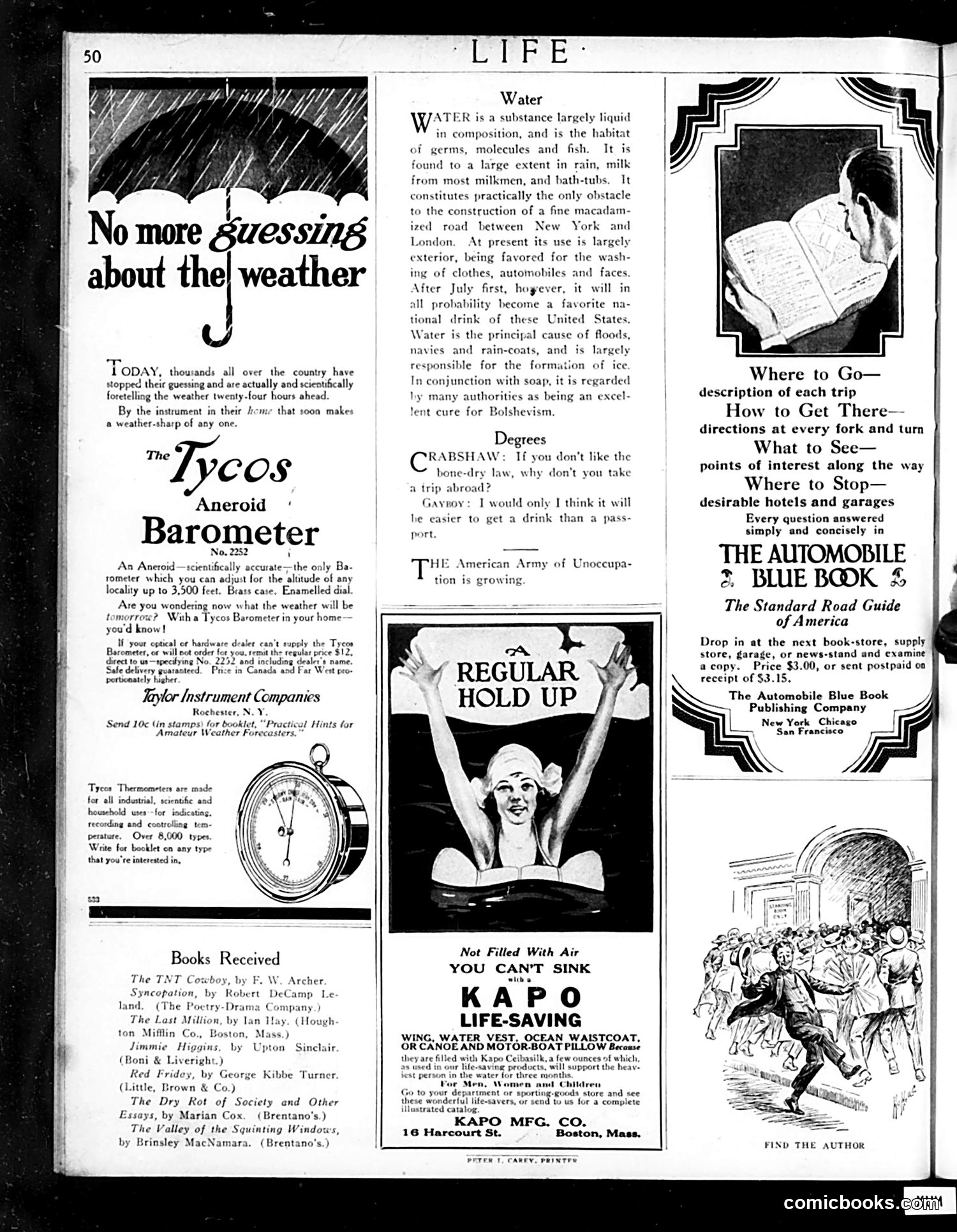
This page is primarily **advertising and book notices** rather than political satire. However, it contains one relevant social commentary: The "Degrees" section presents a brief dialogue between characters named Crabshaw and Gaynor about Prohibition ("bone-dry law"). Gaynor jokes that after Prohibition passes, getting a drink abroad will be easier than obtaining a passport—a satirical jab at the impending ban on alcohol in America. The page also includes a humorous definition of "Water" that mocks Prohibition by predicting water will become "a favorite national drink" after July 1st (when Prohibition would take effect), and jokes that it's "regarded by many authorities as being an excellent cure for Bolshevism." Most of the page consists of period advertisements: a Tycos barometer for weather prediction, the Automobile Blue Book travel guide, and Kapo life-saving vests. The "Regular Hold Up" ad features a life-vest demonstration, unrelated to crime despite its title.
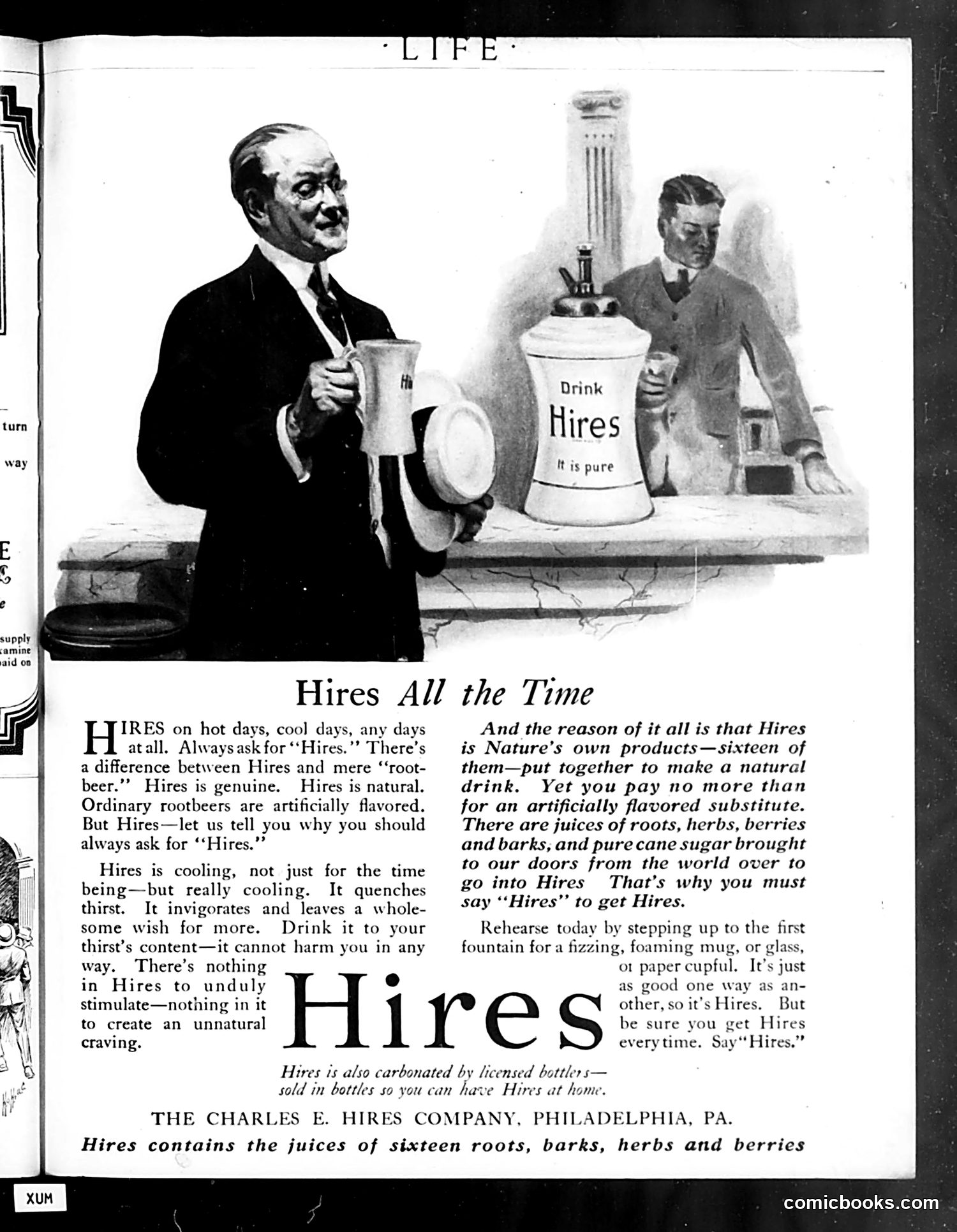
This is primarily a **product advertisement**, not satire. It promotes Hires root beer by contrasting it with generic "root-beer." The illustration shows two men in formal dress examining a large Hires bottle labeled "It is pure." The ad's argument centers on **authenticity and natural ingredients**: Hires contains "sixteen roots, barks, herbs and berries" from around the world, versus artificially flavored competitors. The text emphasizes Hires is "genuine" and "natural," won't cause "unnatural craving," and is safe ("cannot harm you in any way")—claims typical of early 20th-century patent medicine marketing, when consumers worried about artificial additives. The humor is mild: the ad urges customers to "rehearse" by saying "Hires" at fountains, treating brand-name loyalty as something needing practice. This reflects an era when "natural" and "pure" were powerful marketing claims, and companies competed on authenticity rather than flavor variety.
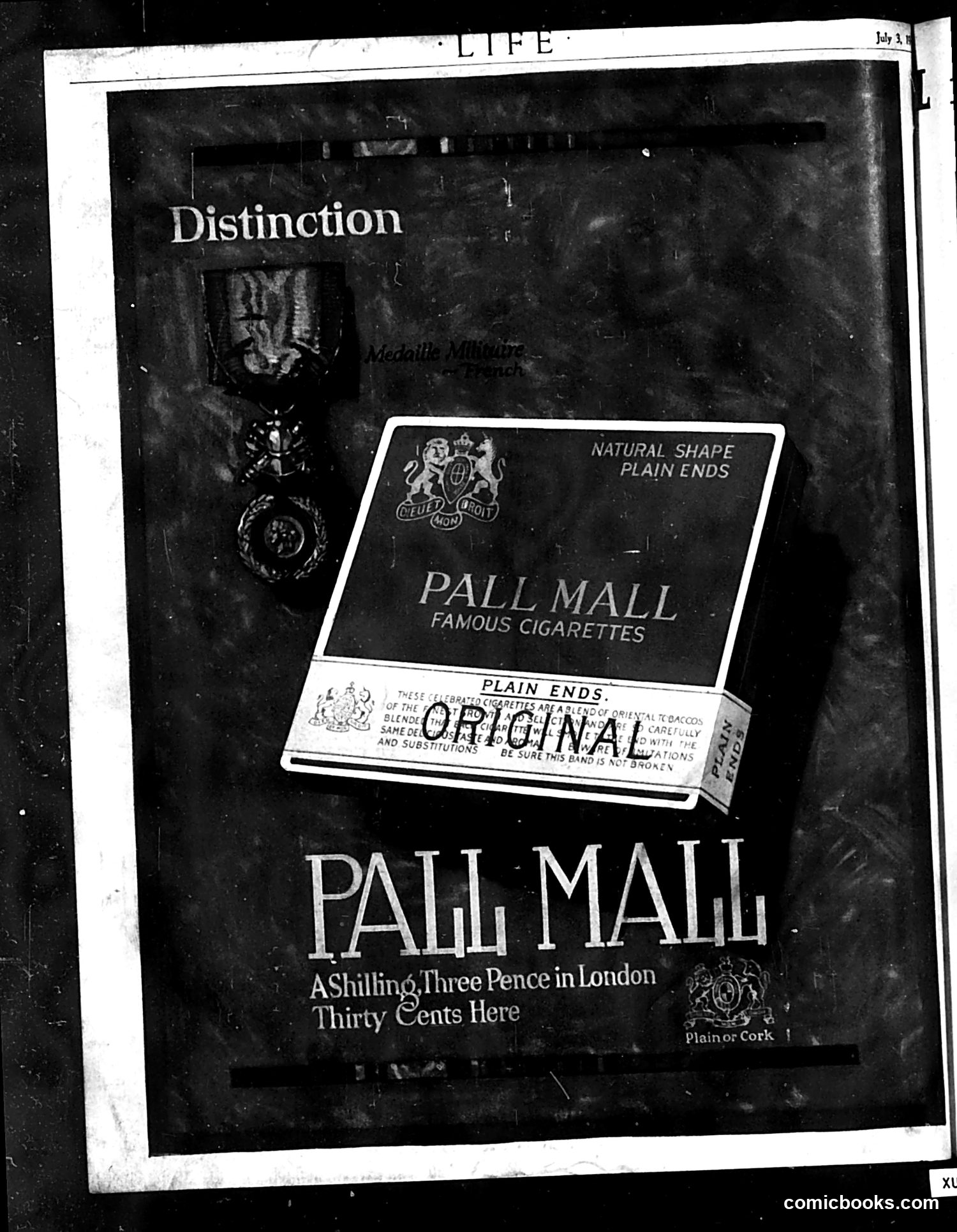
This page is primarily an **advertisement for Pall Mall cigarettes**, not a political cartoon. The ad emphasizes the product's "natural shape" and "plain ends," positioning it as a quality cigarette brand available in both London (at one shilling, three pence) and America (thirty cents). The word "Distinction" at the top suggests the brand's marketing appeal to consumers seeking prestige. The visible heraldic crests and medals reference the brand's claimed heritage and quality standards. This appears in *Life* magazine as a paid advertisement showcasing a consumer product popular in the early-to-mid twentieth century. There is no satirical commentary visible—it's straightforward commercial promotion typical of period magazine advertising.