
Life, 1919-07-03 · page 19 of 52
Life — July 3, 1919 — page 19: what you’re looking at
What you’re looking at
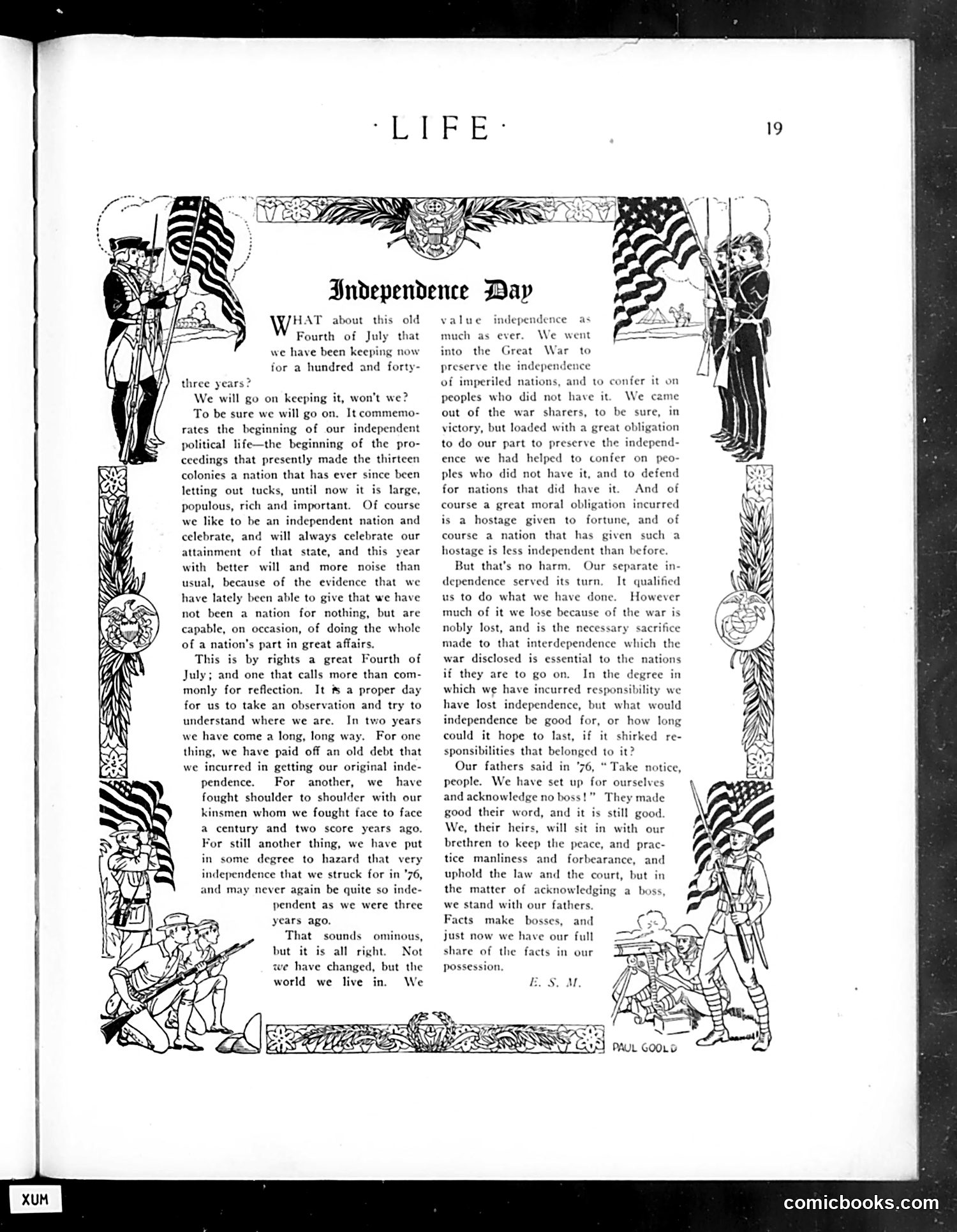
This is a patriotic editorial essay, not a political cartoon, published around the post-WWI period (the text references "two years" since America's involvement in "the Great War"). The decorative border features colonial-era American soldiers and patriotic imagery. The piece argues that American independence has evolved. While the nation celebrated 140 years of independence from Britain, WWI has created new obligations: the U.S. fought to secure independence for other nations and now shares responsibility for maintaining global peace. The author (signed E.S.M.) reconciles this apparent paradox by claiming America hasn't abandoned independence—rather, the world has changed, requiring "interdependence." The essay concludes that accepting shared responsibility with other nations reflects, not contradicts, the Founders' principles. The phrase "we stand with our fathers" suggests continuity between 1776 ideals and current international commitments. This reflects post-war debates about American isolationism versus global engagement.
📄 Transcribed text from this page (OCR, searchable)
Machine-transcribed from the original scan — historical spelling and the odd misread are preserved.
Independence Day HAT about this old Fourth of July that we have been keeping now for a hundred and forty- We will go on keeping it, won't we? To be sure we will go on. It commemo- rates the beginning of our independent political life—the beginning of the pro- ceedings that presently made the thirteen colonies a nation that has ever since been letting out tucks, until now it is large, populous, rich and important. Of course we like to be an independent nation and celebrate, and will always celebrate our attainment of that state, and this year with better will and more noise than usual, because of the evidence that we have lately been able to give that we have not been a nation for nothing, but are capable, on occasion, of doing the whole of a nation’s part in great affairs, This is by rights a great Fourth of July; and one that calls more than com- monly for reflection. It #& a proper day for us to take an observation and try to understand where we are. In two years we have come a long, long way. For one thing, we have paid off an old debt that we incurred in getting our original inde- pendence. For another, we have fought shoulder to shoulder with our kinsmen whom we fought face to face a century and two score years ago. For still another thing, we have put in some degree to hazard that very independence that we struck for in '76, and may never again be quite so inde- pendent as we were three years ago. That sounds ominous, but it is all right. Not we have changed, but the world we live in. We value independence as much as ever. We went into the Great War to preserve the indep nce of imperiled nations, and to confer it on peoples who did not have it. We came out of the war sharers, to be sure, in victory, but loaded with a great obligation to do our part to preserve the independ- ence we had helped to confer on peo- ples who did not have it, and to defend for nations that did have it. And of course a great moral obligation incurred is a hostage given to fortune, and of course a nation that has given such a hostage is less independent than before. But that’s no harm. Our separate in- dependence served its turn. It qualified us to do what we have done. However much of it we lose because of the war is nobly lost, and is the necessary sacrifice made to that interdependence which the war disclosed is essential to the nations if they are to go on. In the degree in which we have incurred responsibility we have lost independence, but what would independence be good for, or how long could it hope to last, if it shirked re- sponsibilities that belonged to it? Our fathers said in '76, “ Take notice, people. We have set up for ourselves and acknowledge no boss!" They made good their word, and it is still good We, their heirs, will sit in with our brethren to keep the pe: and prac- tice manliness and forbearance, and uphold the law and the court, but in the matter of acknowledging a boss, we stand with our fathers, Facts make bosses, and just now we have our full -* share of the facts in our possession, comicbooks.com