
Life, 1919-07-03 · page 30 of 52
Life — July 3, 1919 — page 30: what you’re looking at
What you’re looking at
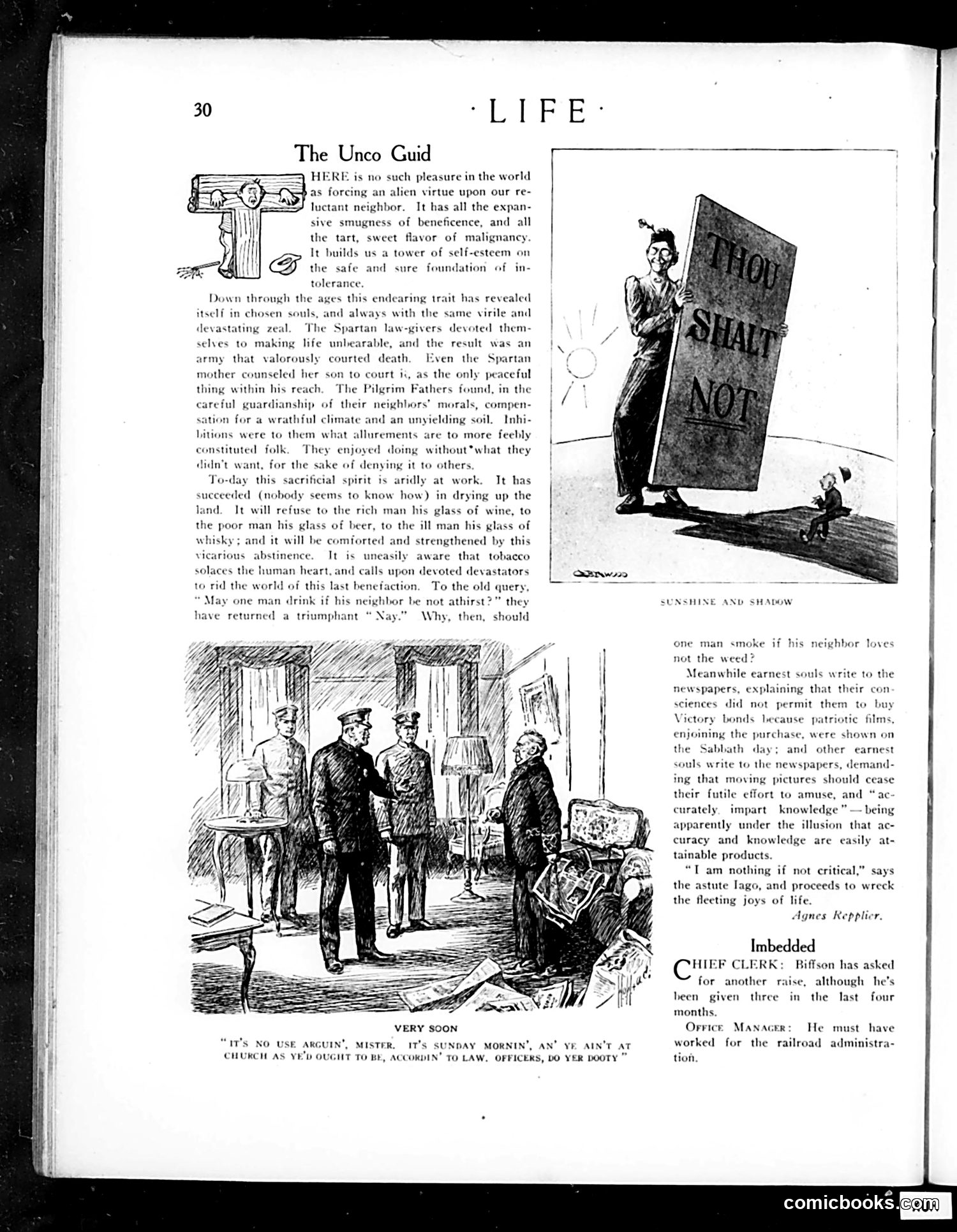
This essay satirizes self-righteous moral crusaders who impose virtue on others. The title references Robert Burns's poem about the "unco guid"—the self-righteously pious. The main cartoon ("Very Soon") shows police officers forcing a man to church on Sunday, illustrating enforced morality. The accompanying text mocks Prohibition-era reformers and religious activists who deny others pleasures (alcohol, tobacco, movies) while claiming moral superiority. The essay references historical examples: Spartans making life "unbearable," Pilgrim Fathers controlling neighbors' morals. It attacks contemporary "earnest souls" who won't buy Victory bonds because patriotic films screen on the Sabbath, or who demand movies cease entertaining in favor of being "accurate." The bottom cartoon ("Imbedded") is unrelated office humor about employee raises. The satire targets American Progressivism's moralistic impulse—the assumption that restricting others' freedoms serves the greater good.
📄 Transcribed text from this page (OCR, searchable)
Machine-transcribed from the original scan — historical spelling and the odd misread are preserved.
*LIFE * The Unco Guid HERE is no such pleasure in the world as forcing an alien virtue upon our re- luctant neighbor. It has all the expan- sive smugness of beneficence, and all the tart, sweet flavor of malign ney. It builds us a tower of self-esteem on the safe and sure foundation of in- toleran ed and always with the same virile and Down through the ages this endearing trait has reve itself in chosen souls devastating zeal, The Spartan law-givers devoted them- selves to making life unbearable, and the result was an army that valorously courted death. Even the Spartan s the only peaceful athers found, in the mother counseled her son to court i The Pilgrim thing within his reach. careful guardianship of their neighbors’ morals, compen- unyielding soil, Inhi- Litions were to them what allurements are to more feebly constituted folk didn’t want, for the sake of denying it To-day this sacrificial spirit is aridly at work. Tt has succeeded (nobody seems to know how) in drying up the land. It will re sation for a wrathful climate and a They enjoyed doing without*what they others, use to the rich man his glass of wine, to ¢ poor man his glass of beer, to the ill man his glass of isky; and it will be comiorted and strengthened by: this ious abstinence. It is uneasily aware that tobacco vie solaces the human heart, and calls upon devoted devastators to rid the world of this last benefaction. To the old query, “ May one man drink if his neighbor be not athirst?” they have returned a triumphant “Nay.” Why, then, should VERY SOON “IT's NO USE ARGUL ; MISTER. IT’S SUNDAY MORNIN’, AN’ YF CHURCH AS YE'D OUGHT TO BE, ACCORKDIN’ TO LAW, OFFICERS, DO YER DOOTY ” AIN'T AT SUNSHINE AND SHADOW one man smoke if his neighbor loves not the we Meanwhile earnest souls write to the newspapers, explaining that their con sciences did not permit them to. buy Vietory bonds because patriotic films, ining the purchase, were shown on Sabbath day; and other earnest souls write to the newspapers, demand- ing that moving pictures should cease their futile effort to amuse, and “ac. curately, impart knowledge” — being apparently under the illusion that ac- curacy and knowledge are easily at- tainable products. “Tam nothing if not critical,” says the astute Iago, and proceeds to wreck the fleeting joys of life. Agnes Kepplier. Imbedded HIEF CLERK: Biffson has asked for another raise, although he’s heen given three in the last four months. Orrice Manacer: He must have worked for the railroad administra- tion, ee comicbooks Earl