
Life, 1919-07-03 · page 25 of 52
Life — July 3, 1919 — page 25: what you’re looking at
What you’re looking at
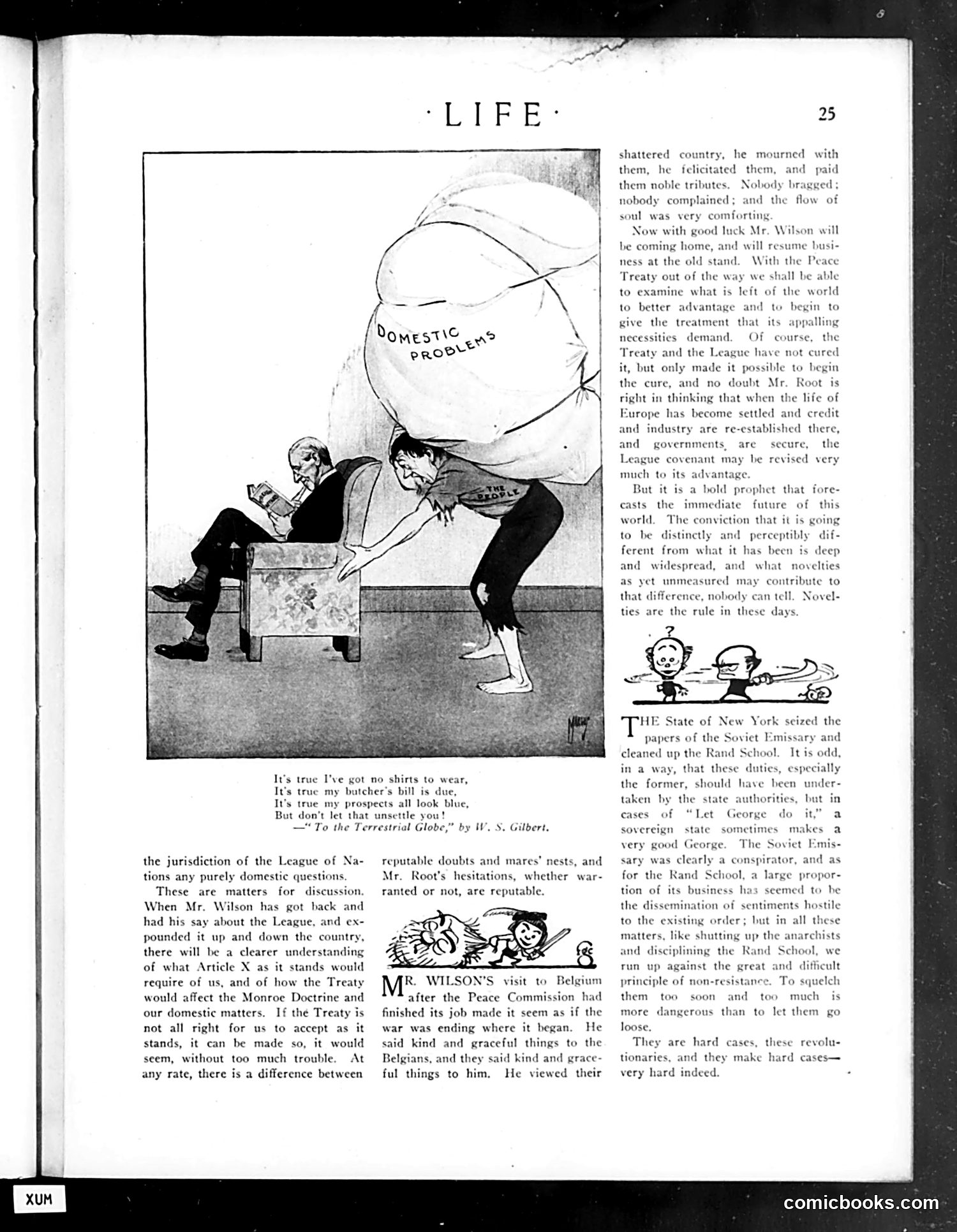
The main cartoon depicts two figures struggling beneath a massive boulder labeled "DOMESTIC PROBLEMS." This illustrates the satirical point of the surrounding article: President Wilson's focus on the League of Nations and Peace Treaty negotiations abroad has left America's urgent home issues unaddressed and crushing. The text discusses Wilson's recent Belgium visit and his plans to resume business "at the old stand," suggesting domestic concerns have been neglected during post-WWI peace efforts. The article acknowledges these are "hard cases"—referencing contemporary challenges like Soviet communism, the Rand School (a socialist institution), and revolutionary activity in America. The Gilbert epigraph about financial troubles ("no shirts to wear," "butcher's bill is due") reinforces this theme: personal/national problems persist regardless of grand diplomatic achievements. The cartoon's visual metaphor of two men crushed by domestic burdens while the peace process proceeds elsewhere captures the satire's core message.
📄 Transcribed text from this page (OCR, searchable)
Machine-transcribed from the original scan — historical spelling and the odd misread are preserved.
It’s true I've got no shirts to w It’s true my butcher's bill is due, It’s true my prospects all look blue, But don’t let that unsettle you! —To the Terrestrial Globe,” by W. S. Gilbert, the jurisdiction of the League of Na- — reputable doubts and mares’ nests, and tions any purely domestic questions. Mr. Root's hesitations, whether war- These are matters for discussion. ranted or not, are reputable. When Mr. Wilson has got back and had his say about the League, ex- pounded it up and down the country, there will be a clearer understanding of what Article X as it stands would require of us, and of how the Treaty R. WILSON’S visit to Belgium would affect the Monroe Doctrine and after the Peace Commission had our domestic matters. If the Treaty is finished its job made it seem as if the not all right for us to accept as it war was ending where it began. He stands, it can be made so, it would said kind and graceful things to the seem, without too much trouble. At Belgians, and they said kind and grace- any rate, there is a difference between ful things to him, He viewed their shattered country, he mourned with them, he felicitated them, and paid them noble tributes. Nobody bragged ; nobody complained; and the flow of soul v very comfortin ‘ow with good luck Mr. Wilson will be coming home, and will resume busi- ness at the old stand. With the Peace Treaty out of the way we shall be able to examine what is left of the world to better advantage and to begin to give the treatment that its Ning necessities demand. Of course, the Treaty and the League have not cured it, but only made it possible to begin the cure, and no doubt Mr. Root is right in thinking that when the life of Europe has become settled and credit and industry are re-established there, and governments, are secure, the League covenant may be revised very much to its advantage. But it is a bold prophet that fore- casts the immediate future of this world. The conviction that it is going to be distinctly and perceptibly dif- ferent from what it has been is deep and widespread, and what novelties as yet unmeasured may contribute to that difference, nobody can tell. Novel- ties are the rule in these days. HE State of New York seized the papers of the Soviet Emissary and cleaned up the Rand School. It is odd, in a way, that these duties, especially the former, should have been under- taken by the state authorities, but in cases of “Let Georg sovereign state sometimes very good George. The Soviet Emis- sary was clearly a conspirator, and as for the Rand School, a large propor- tion of its business has seemed to be the dissemination of sentiments hostile to the existing order; but in all these matters, like shutting up the anarchists and disciplining the Rand School, we run up against the great and difficult principle of non-resistanee. To squelch them too soon and too much is more dangerous than to let them go loose. They are hard cases, these revolu- tionaries, and they make hard cases— very hard indeed. comicbooks.com