
Life, 1919-07-03 · page 28 of 52
Life — July 3, 1919 — page 28: what you’re looking at
What you’re looking at
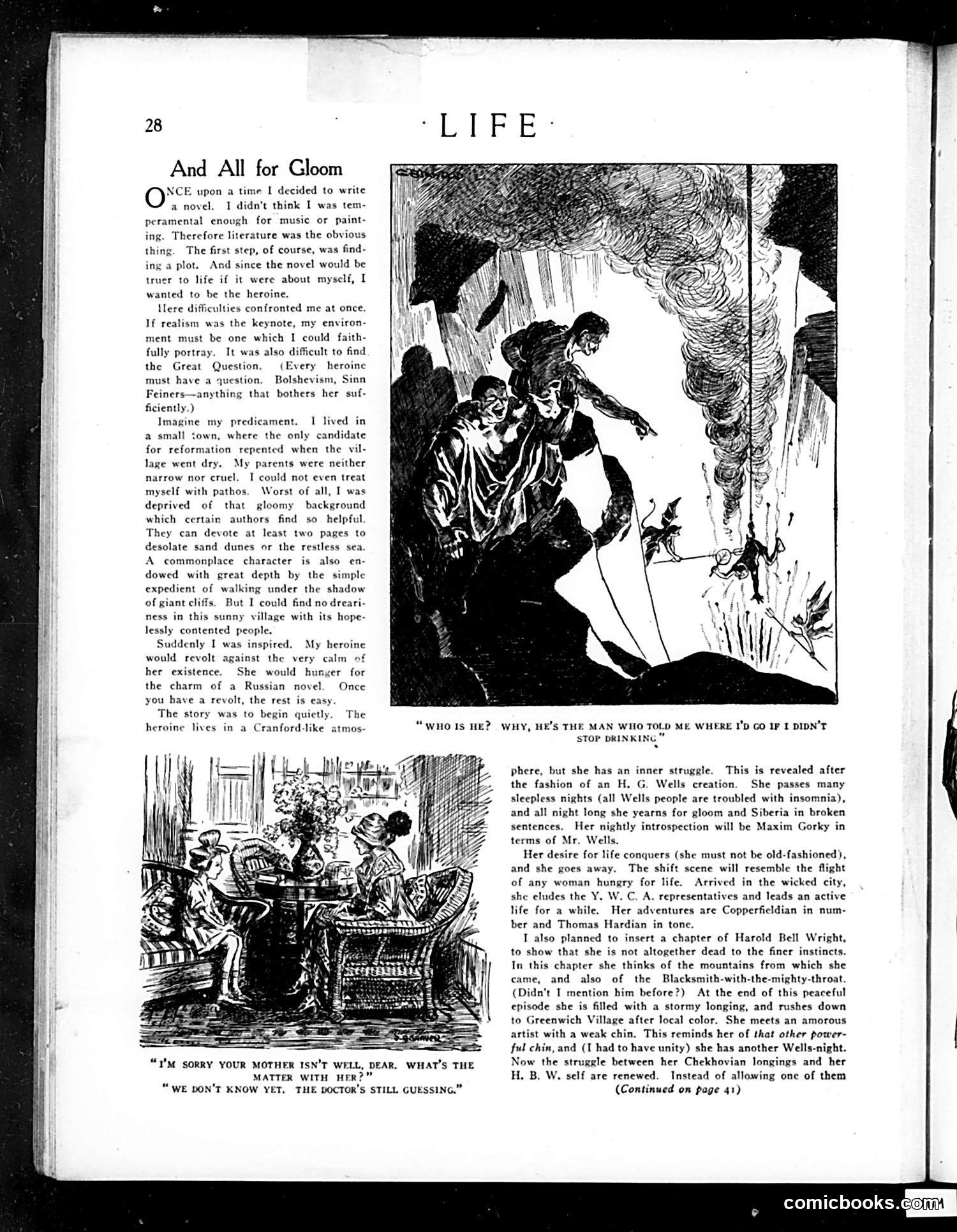
This is a satirical essay about amateur novelists, not a political cartoon. The author mocks aspiring writers who construct overwrought plots by slavishly imitating fashionable literary models. The piece ridicules the heroine's contrived struggle: she lives in a pleasant small town but manufactures existential despair by romanticizing Russian gloom and Siberian suffering. The author parodies the formulaic borrowing from popular writers—H.G. Wells (psychological introspection), Maxim Gorky (Russian angst), Thomas Hardy (tragedy), Harold Bell Wright (moral redemption), and Chekhov (romantic conflict). The two cartoon panels appear to joke about doctors and family illness, mocking medical uncertainty rather than illustrating the essay. The satire targets not politics but literary pretension: the notion that authentic novels require manufactured suffering and that earnest young writers achieve depth merely by copying established literary conventions.
📄 Transcribed text from this page (OCR, searchable)
Machine-transcribed from the original scan — historical spelling and the odd misread are preserved.
28 And All for Gloom CE upon a time I decided to write a novel. I didn’t think I was tem- peramental enough for music or paint- ing. Therefore literature was the obvious thing. The first step, of course, was find- ing a plot. And since the novel would be truer to life if it were about myself, I wanted to be the heroine. Here difficulties confronted me at once. If realism was the keynote, my environ- ment must be one which I could faith- fully portray. It was also difficult to find the Great Question. (Every heroine must have a question. Bolshevism, Sinn iners—anything that bothers her suf- ficiently.) Imagine my predicament. I lived in a small town, where the only candidate for reformation repented when the vil- lage went dry. My parents were neither narrow nor cruel. I could not even treat myself with pathos. Worst of all, I was deprived of that gloomy background which certain authors find so helpful They can devote at least two pages to desolate sand dunes or the restless sea. A commonplace character is also en- dowed with great depth by the simple expedient of walking under the shadow of giant cliffs. But I could find no dreari- ness in this sunny village with its hope- lessly contented people. Suddenly I was inspired, My heroine would revolt against the very calm of her existence. She would hunger for the charm of a Russian novel. Once you have a revolt, the rest is easy. The story was to begin quietly. The heroine lives in a Cranford-like atmos- “Y'M SORRY YOUR MOTHER ISN'T WELL, DEAR, WHAT'S THE MATTER WITH HER?" “WE DON'T KNOW YET. THE DOCTOR'S STILL GUESSING.” “WwHo Is HE? WHY, HE’S THE MAN WHO TOLD ME WHERE I'D GO IF I DIDN’T STOP DRINKING phere, but she has an inner struggle. This is revealed after the fashion of an H. G. Wells creation. She passes many sleepless nights (all Wells people are troubled with insomnia), and all night long she yearns for gloom and Siberia in broken sentences. Her nightly introspection will be Maxim Gorky in terms of Mr. Wells. Her desire for life conquers (she must not be old-fashioned), and she goes away. The shift scene will resemble the flight of any woman hungry for life. Arrived in the wicked city, she eludes the Y. W. C. A. representatives and leads an active life for a while. Her adventures are Copperfieldian in num- ber and Thomas Hardian in tone. I also planned to insert a chapter of Harold Bell Wright, to show that she is not altogether dead to the finer instincts. In this chapter she thinks of the mountains from which she came, and also of the Blacksmith-with-the-mighty-throat (Didn't I mention him before?) At the end of this peaceful episode she is filled with a stormy longing, and rushes down to Greenwich Village after local color. She meets an amorous artist with a weak chin. This reminds her of that other power- ful chin, and (I had to have unity) she has another Wells-night. Now the struggle between her Chekhovian longings and her H. B. W. self are renewed. Instead of allowing one of them (Continued on page 41) comicbooks.