
Life, 1919-07-03 · page 24 of 52
Life — July 3, 1919 — page 24: what you’re looking at
What you’re looking at
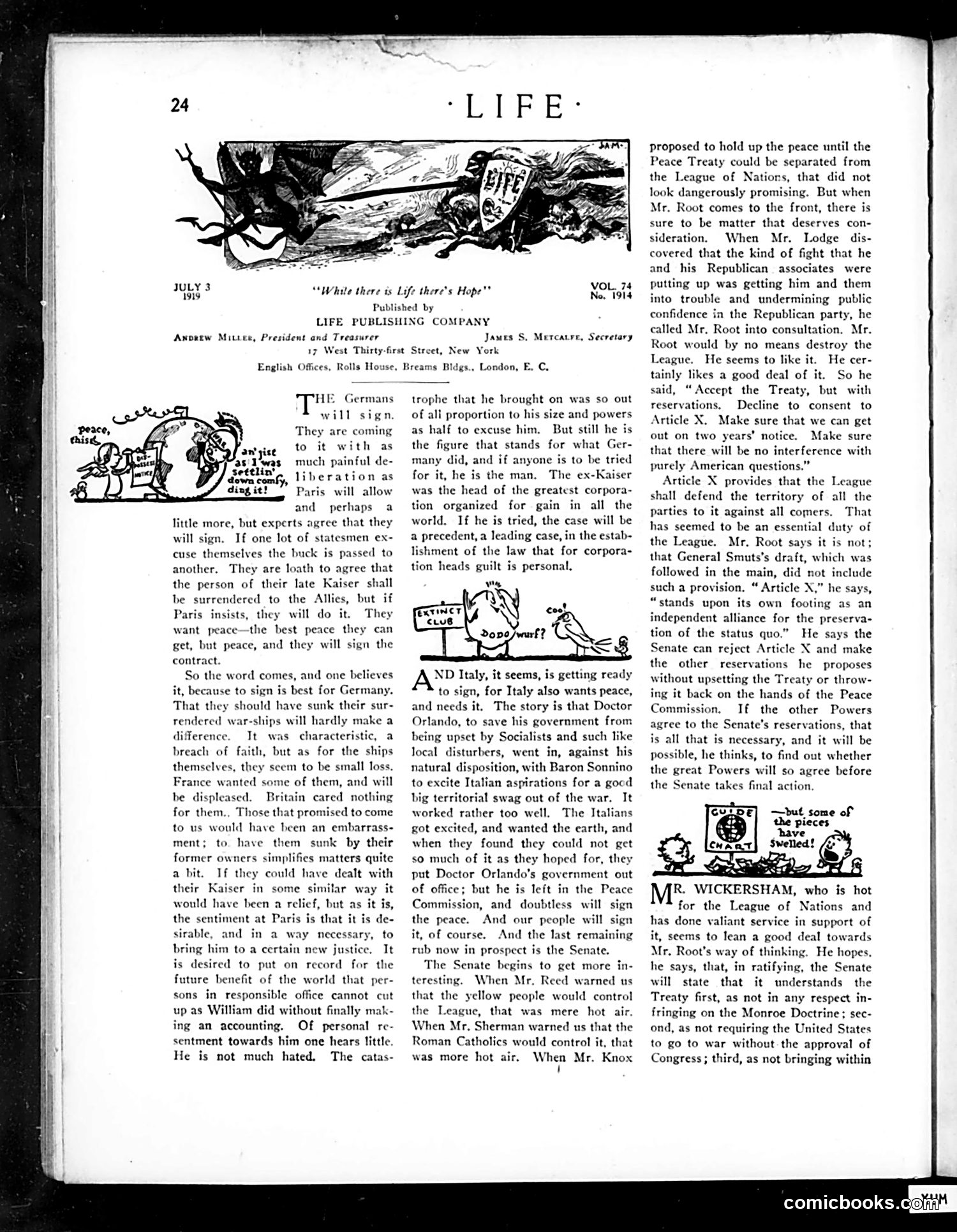
This page discusses post-World War I peace negotiations, specifically Germany and Italy's reluctance but expected signing of peace treaties. The cartoons mock the parties' hesitation: The top cartoon shows Germany as a reluctant figure being dragged toward signing ("While there is Life there's Hope"). A lower cartoon depicts Italy at a "Peace Club," also resisting but ultimately expected to comply. The text identifies **Senator Henry Cabot Lodge** and **Elihu Root** as Republican opponents of the League of Nations clause in the Peace Treaty. The author suggests Root's involvement signals serious political obstruction ahead. The satire targets American Senate Republicans who wanted to separate the League from the Treaty or reject Article X (collective security), viewing their concerns about Catholic or Asian control of the League as "hot air"—baseless fearmongering masking partisan resistance to President Wilson's internationalist agenda. The cartoon ridicules both European war-weariness and American isolationist opposition to the peace settlement.
📄 Transcribed text from this page (OCR, searchable)
Machine-transcribed from the original scan — historical spelling and the odd misread are preserved.
“While there is Life there's Hope"* VOL. 74 No. 1914 Published by LIFE Awpeew Mittee, President and Treasurer PUBLISHING COMPANY James 17 West Thirty-first Street, New York English Offices, Rolls House, Breams Bld iP RE Germans il 1 sign. They are coming to it with as much painful de- liberation as will allow and perhaps a little more, but experts agree that they will sign. If one lot of statesmen ex- cuse themselves the buck is passed to another, They are loath to agree that the person of their late Kaiser shall be surrendered to the Allies, but if Paris insists, they will do They want peace—the best peace they can get, but peace, and they will sign the contract. So the word comes, and one believes it, because to sign is best for Germany. That they should have sunk their sur- rendered war-ships will hardly make a difference. It was characteristic, a breach of faith, but as for the ships themselves, they seem to be small loss. France wanted some of them, and will be displeased. Britain cared nothing for them., Those that promised to come to us would have been an embarrass- ment; to. have them sunk by their former owners simplifies matters quite a bit. If they could have dealt with their Kaiser in some similar way it would have been a relief, but as it is, the sentiment at Paris is that it is de- sirable, and in a way necessary, to bring him to a certain new justice. It is desired to put on record for the future benefit of the world that per- sons in responsible office cannot cut up as William did without finally mak- ing an accounting. Of personal re- sentment towards him one hears little. He is not much hated. The catas- Paris s., London, E, C. trophe that he brought on was so out of all proportion to his size and powers as half to excuse him. But still he is the figure that stands for what Ger- many , and if anyone is to be tried for it, he is the man. The ex-Kaiser was the head of the greatest corpora- tion organized for gain in all the world. If he is tried, the case will be a precedent, a leading case, in the estab- lishment of the law that for corpora- tion heads guilt is personal. We D Italy, it seems, is getting ready to sign, for Italy also wants peace, and needs The story is that Doctor Orlando, to save his government from being upset by Socialists and such like local disturbers, went in, against his natural disposition, with Baron Sonnino to excite Italian aspirations for a good big territorial swag out of the war. It worked rather too well, The Italians got excited, and wanted the earth, and when they found they could not get so much of it as they hoped for, they put Doctor Orlando's government out of office; but he is left in the Peace Commission, and doubtless will sign the peace. And our people will sign it, of course. And the last remaining rub now in prospect is the Senate. The Senate begins to get more in- teresting. When Mr, Reed warned us that the yellow people would control the League, that was mere hot air. When Mr, Sherman warned us that the Roman Catholics would control it, that was more hot air. When Mr. Knox i proposed to hold up the peace until the Peace Treaty could be separated from the League of Nations, that did not look dangerously promising. But when Mr. Root comes to the front, there is sure to be matter that deserves con- sideration. When Mr. Lodge dis- covered that the kind of fight that he and his Republican associates were putting up was getting him and them into trouble and undermining public confidence in the Republican party, he called Mr. Root into consultation. Mr. Root would by no means destroy the League. He seems to like it. He cer- tainly likes a good deal of it. So he said, ccept the Treaty, but with Decline to consent to Article X. Make sure that we can get out on two years’ notice. Make sure that there will be no interference with purely American questions.” Article X provides that the League shall defend the territory of all the parties to it against all comers. That has seemed to be an essential duty of the League. Mr. Root says it is not; that General Smuts’s draft, which was followed in the main, did not include such a provision. “ Article X,” he says, stands upon its own footing as an independent alliance for the preserva- tion of the status quo.” He says the Senate can reject Article X and make the other reservations he proposes without upsetting the Treaty or throw- ing it back on the hands of the Peace Commission. If the other Powers gree to the Senate’s reservations, that is all that is necessary, and it will be possible, he thinks, to find out whether the great Powers will so agree before the Senate takes final action. reservations, but some of the pieces R. WICKERSHAM, who is hot for the League of Nations and has done valiant service in support of it, seems to lean a good deal towards Mr. Root’s way of thinking. He hopes, he says, that, in ratifying, the Senate will state that it understands the Treaty first, as not in any respect in- fringing on the Monroe Doctrine; sec- ond, as not requiring the United States to go to war without the approval of Congress; third, as not bringing within comicbooks.