
Life, 1919-07-03 · page 22 of 52
Life — July 3, 1919 — page 22: what you’re looking at
What you’re looking at
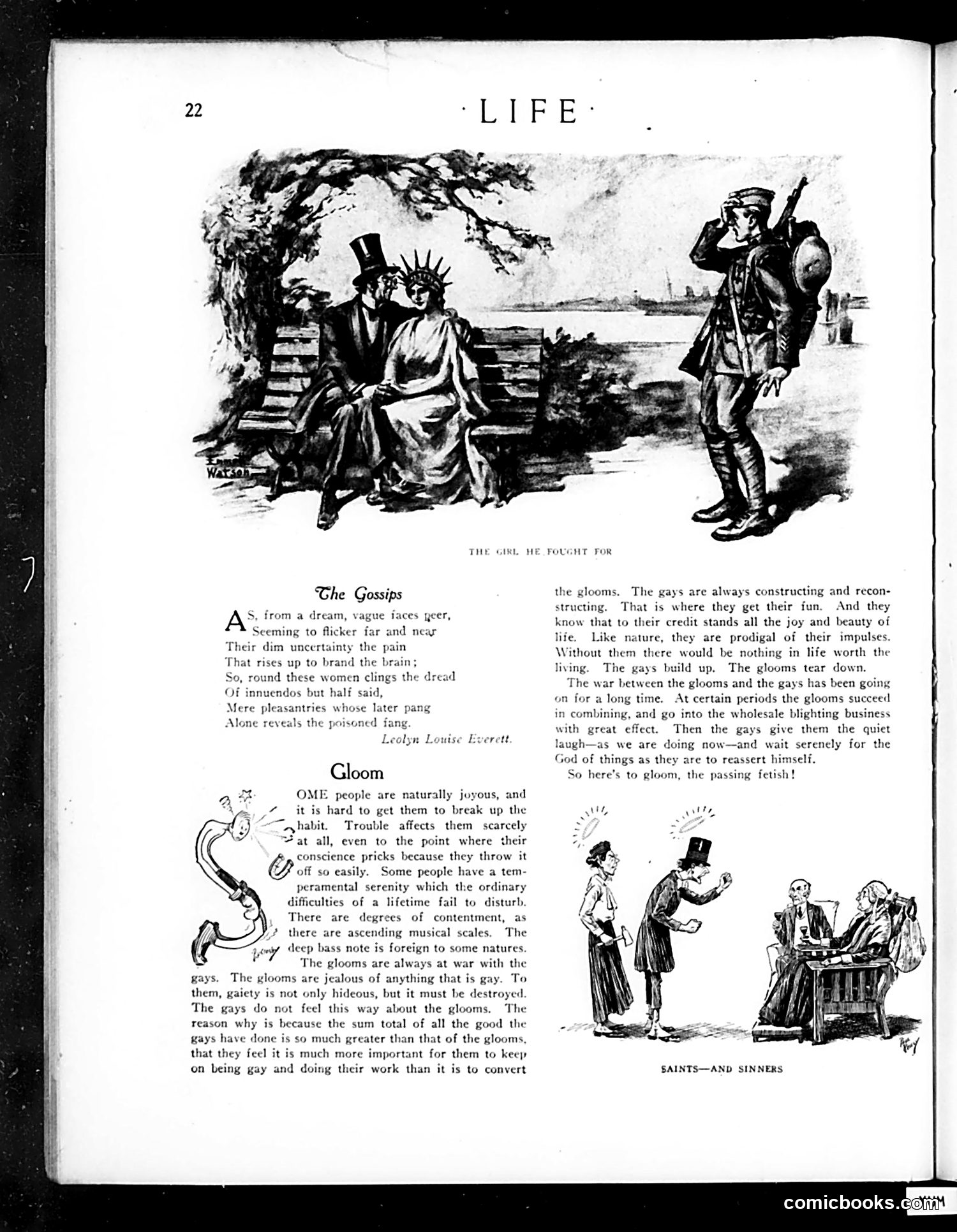
This page presents Life's satirical commentary on temperament and social types. The top illustration shows a romantic couple being observed by gossips—the "girl he fought for" is watched and judged by idle tongues beneath a gnarled tree. The main text contrasts two personality types: the "gays" (meaning cheerful, joyful people) versus the "glooms" (pessimists and killjoys). Life argues this is a centuries-old conflict. The glooms, jealously hostile to happiness itself, work to destroy gaiety and spread misery. The gays, by contrast, build up society through optimism and creative energy, and they've accomplished so much good that converting the glooms seems less important than continuing their joyful work. The satirical point: pessimistic, contentious people are motivated by envy of others' happiness, while genuinely optimistic people are too productive and fulfilled to waste effort on converting them. The lower illustrations show various "saints and sinners"—social types embodying these opposing philosophies.
📄 Transcribed text from this page (OCR, searchable)
Machine-transcribed from the original scan — historical spelling and the odd misread are preserved.
GIRL HE FOUGHT FOR The Gossips ne glooms. The gays are always constructing and recon- structing. That is where they get their fun. And they know that to their credit stands all the joy and beauty of life. Like nature, they are prodigal of their impulses. Without them there would be nothing in life worth the living. The gays build up. The glooms tear down. The war between the glooms and the gays has been going on for a long time. At certain periods the glooms su dd in combining, and go into the wholesale blighting business with great effect. Then the gays give them the quiet laugh—as we are doing now—and wait serenely for the God of things as they are to reassert himself. Gloom So here’s to gloom, the passing fetish! OME people are naturally joyous, and 7 it is hard to get them to break up the < ally “—,,habit. Trouble affects them scar a4 ~ at all, even to the point where their OP tt se cas pricks because they throw it from a dream, vague faces yeer, Seeming to flicker far and near Their dim uncertainty the pain That rises up to brand the brain; So, round these women clings the dread Oi innuendos but hali said, Mere pleasantries whose later Alone reveals the poisoned fang. Le off so easily. Some people have a tem- peramental serenity which the ordinary difficulties of a lifetime fail to disturb. There are degrees of contentment, as there are ascending musical scales. The ~y deep bass note is foreign to some natures. The glooms are always at war with the s. The glooms are jealous of anything that is gay. To them, gaiety is not only hideous, but it must be destroyed. The gays do not feel this way about the glooms, The reason why is because the sum total of all the good the gays have done is so much greater than that of the glooms, that they feel it is much more important for them to keep on being gay and doing their work than it is to convert SAINTS—AND SINNERS comicbooks.c¢omy