
A complete issue · 40 pages · 1918
Life — January 31, 1918
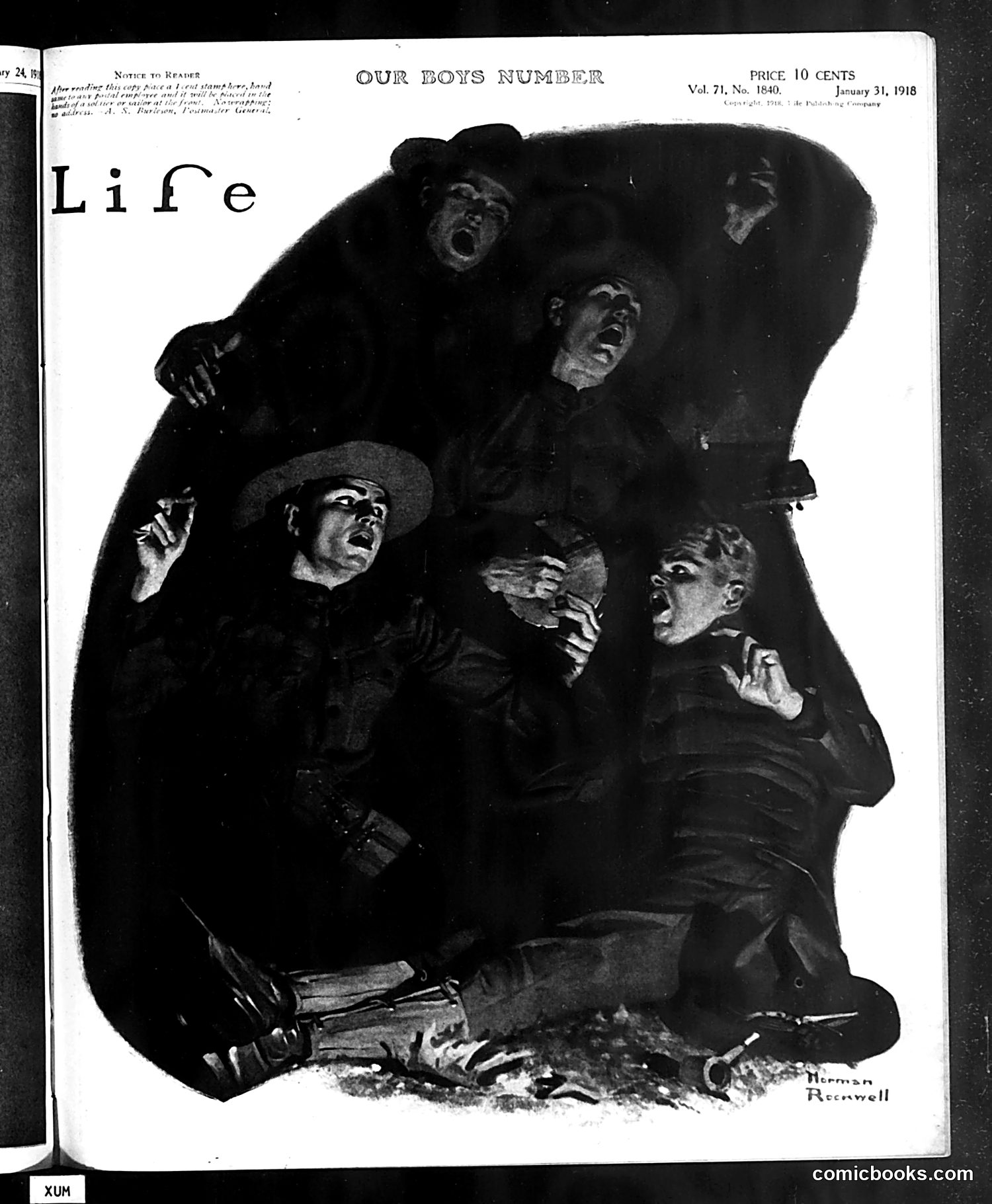
This is the cover of Life magazine's "Our Boys Number" during World War I. The illustration by Herman Reenwell depicts a large, menacing figure (likely representing Germany or the German threat) looming over several smaller figures representing American soldiers or "boys." Their expressions show distress or fear as they gaze upward at this threatening presence. The satire plays on anxieties about young American men being sent to fight in WWI. Published just months before major U.S. involvement intensified, the image evokes both the physical danger soldiers faced and the emotional toll on families sending their sons to war. The "Our Boys" title underscores this theme of national concern for America's youth on the battlefield.
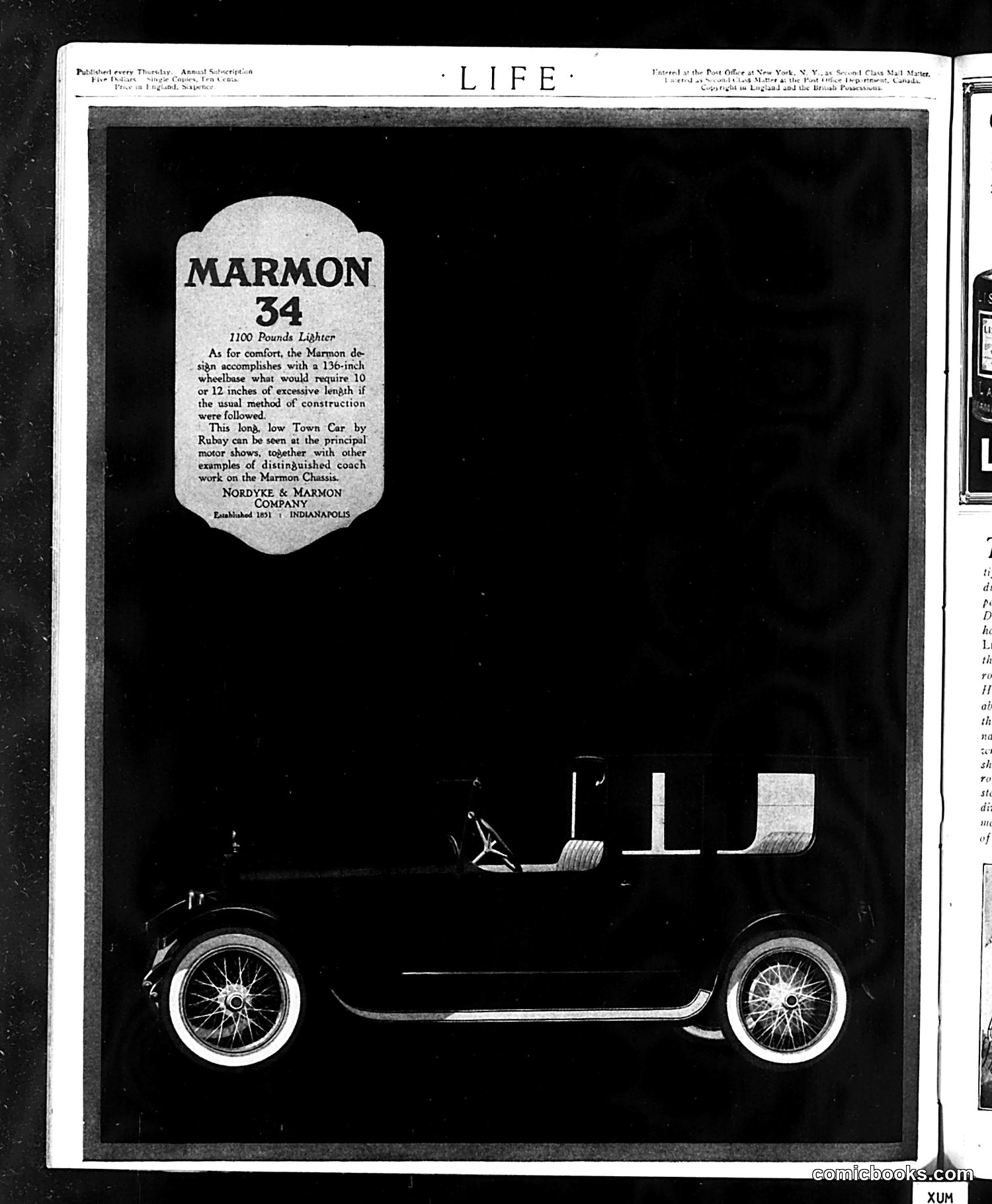
This page is **primarily an advertisement**, not political satire or commentary. It promotes the Marmon 34, a 1100-pound automobile manufactured by Nordyke & Marmon Company of Indianapolis. The advertisement emphasizes the car's efficiency and engineering: it notes the vehicle's lightweight design and mentions its 136-inch wheelbase, comparing its proportions to heavier competing vehicles. The text highlights that this "long, low Town Car by Rubury" has been displayed at motor shows alongside other coach-built examples. The stark black background with minimalist side-view illustration is typical of 1910s-1920s automotive advertising, designed to showcase the vehicle's sleek profile and engineering credentials to potential buyers. There is no satire or political meaning intended.
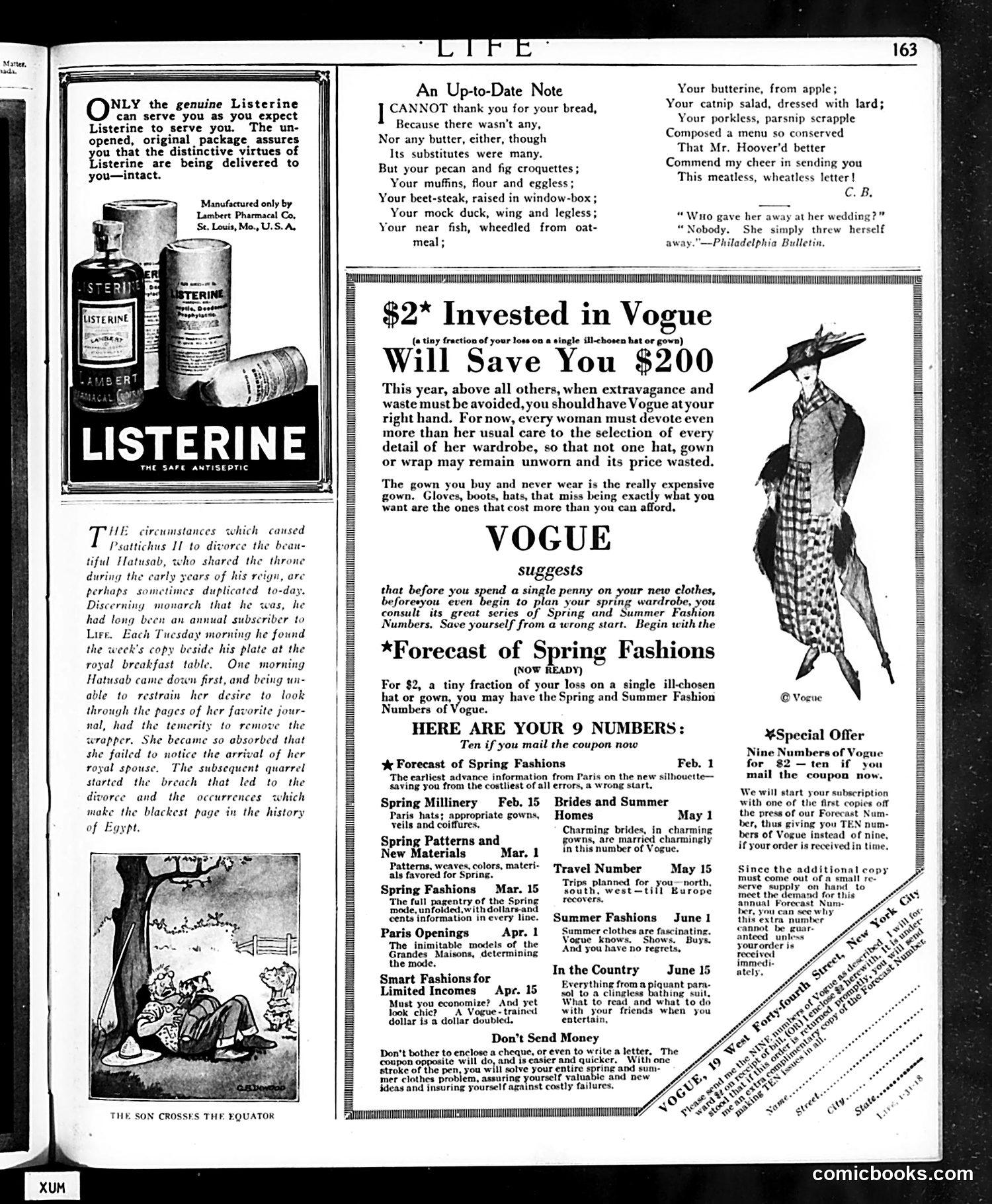
This page is primarily **advertising and fashion content** rather than political satire. The left side features a **Listerine antiseptic advertisement** promoting the product's germicidal properties, with bottles displayed and text claiming it serves as "the safe antiseptic." The dominant center content is a **Vogue fashion promotion** offering a "$2 investment" that promises to "save you $200" through a forecast of spring fashions. The offer encourages readers to subscribe to Vogue's fashion forecasting service to avoid costly wardrobe mistakes. The right side shows an **illustrated woman in 1920s attire** modeling a patterned spring outfit—typical fashion journalism of the era. A small cartoon at the bottom left ("The Son Crosses the Equator") appears unrelated to the main content. The page reflects 1920s consumer culture and women's interest in economical fashion planning during an era of changing social roles.
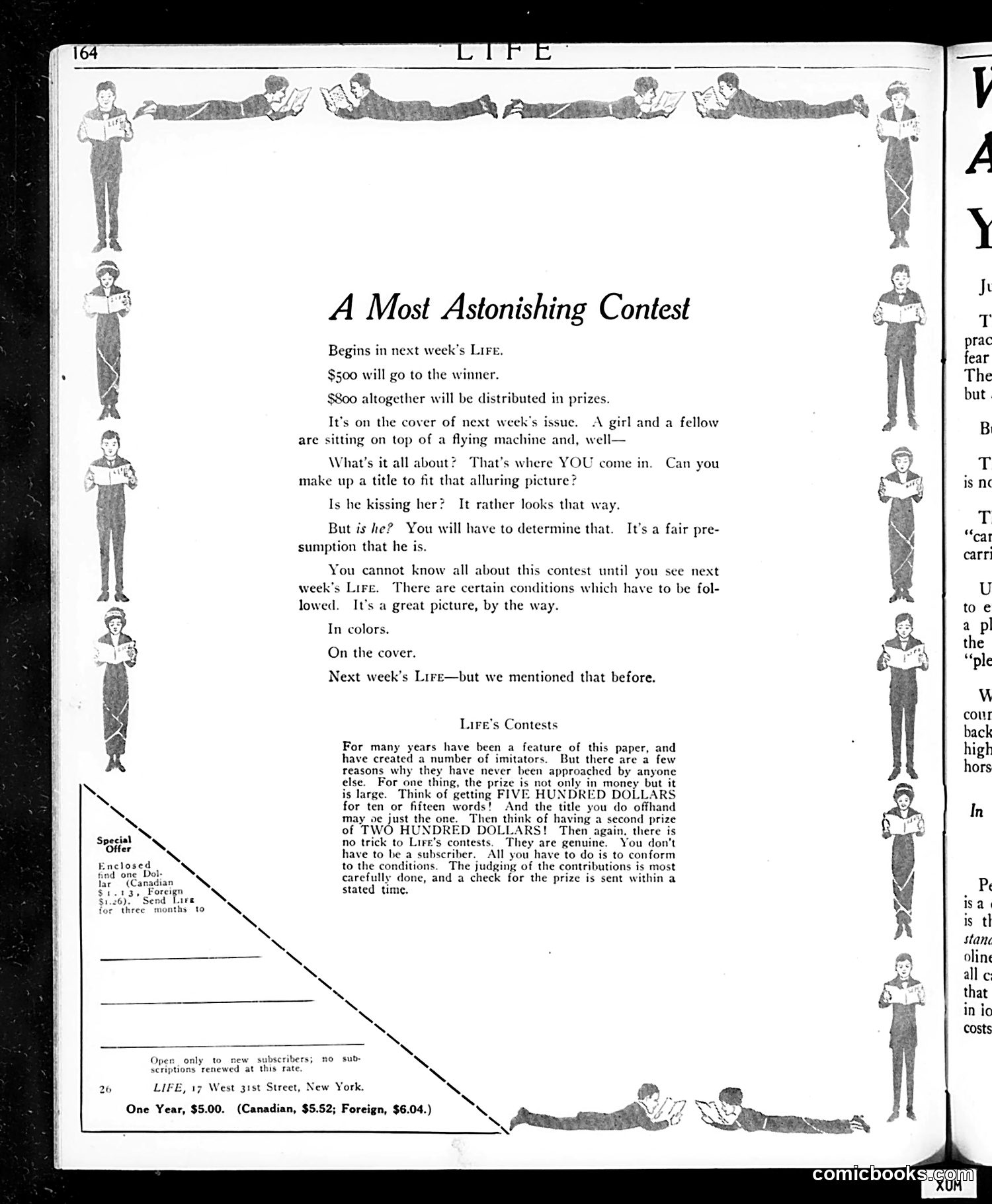
This page announces a contest for Life magazine readers. The central visual gimmick involves a cover image (shown next week) depicting a man and woman on a flying machine in an ambiguous pose—the text notes it "rather looks" like he's kissing her, but challenges readers to create their own caption explaining what's happening. The contest offers $500 to the winner and $800 in total prizes. It emphasizes that Life's contests are "genuine"—no subscription required, just conforming to stated conditions. The page borders feature illustrated figures in period athletic/casual wear, serving as decorative elements typical of early 20th-century magazine design. This represents Life's tradition of reader engagement through humor and competition.
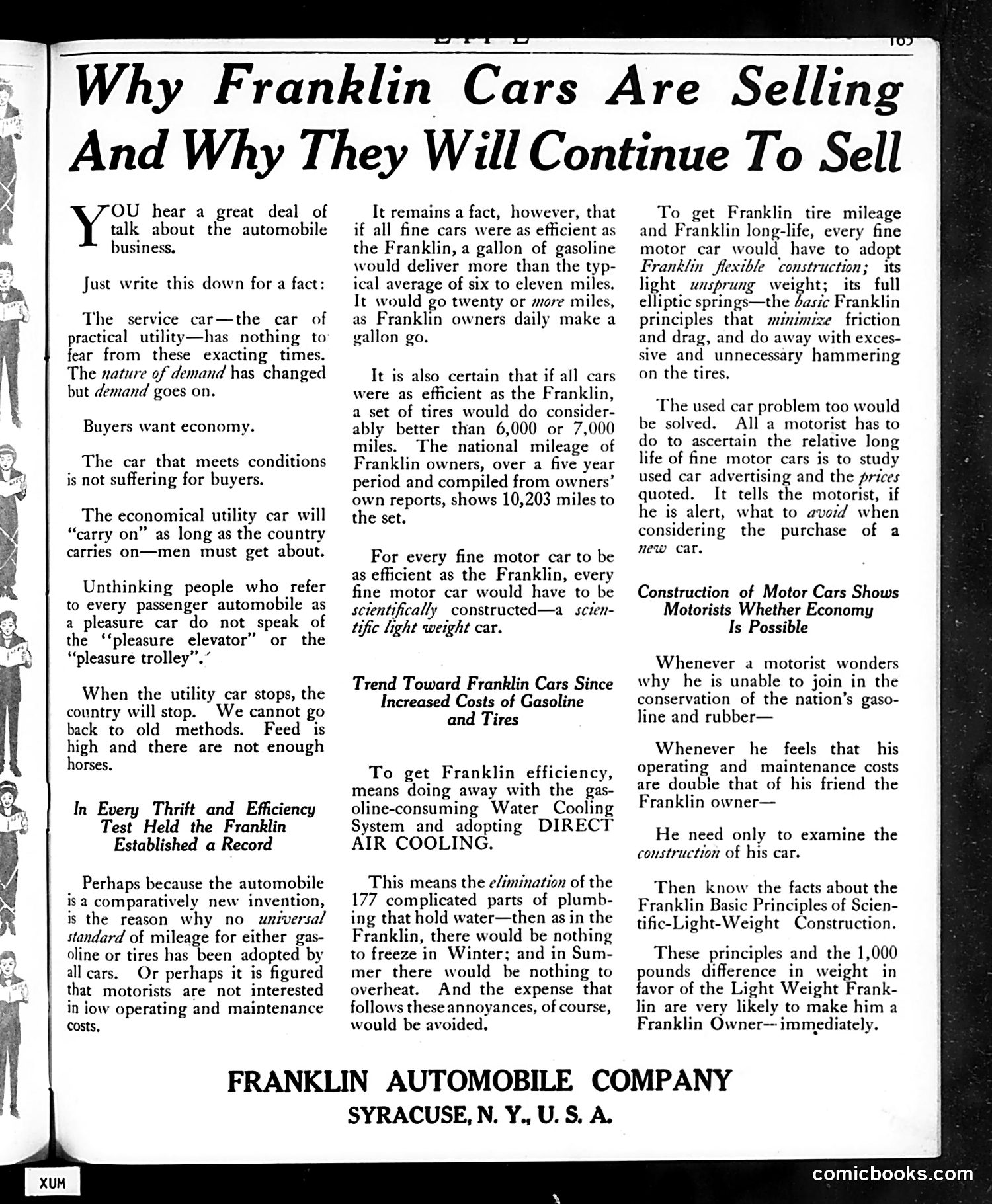
This page is **advertising, not satire or political commentary**. It's a Franklin Automobile Company advertisement from Syracuse, New York. The ad argues that Franklin cars will continue selling because they meet consumer demand for economical, efficient vehicles. Key claims include: Franklin cars achieve superior gas mileage (10,203 miles average per gallon reported by owners), their light-weight construction minimizes friction and maintenance costs, and they use innovative air-cooling instead of water-cooling systems. The text addresses skeptics by explaining why utility cars remain viable despite economic changes, and positions Franklin's engineering principles as superior to competitors. This is straightforward product promotion highlighting technical advantages, not satirical commentary.
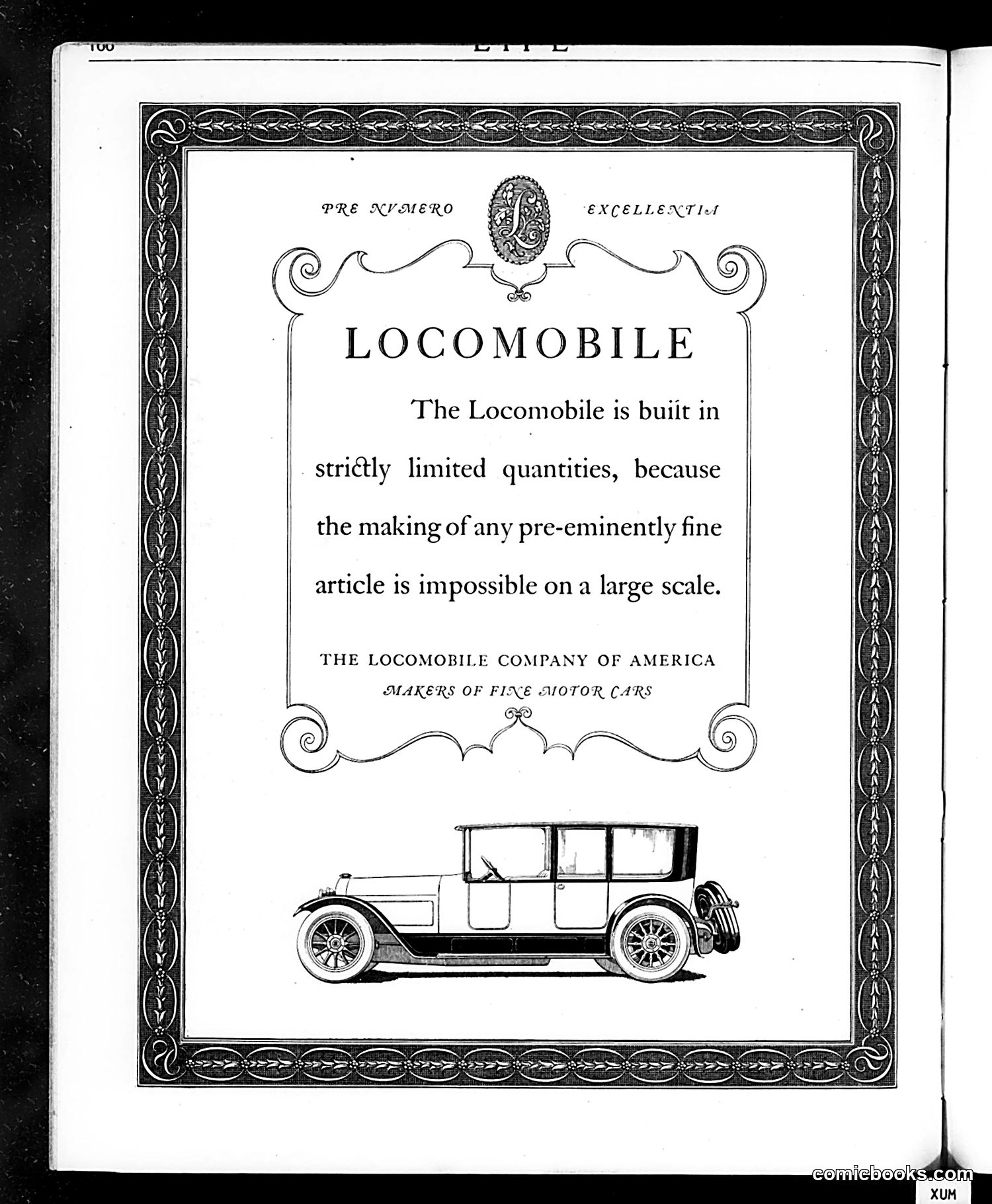
This page is **not a cartoon or satire** — it's a **automobile advertisement** for the Locomotile Company of America, one of the early American motor car manufacturers. The ad uses prestige marketing typical of the era, claiming the Locomotile is "built in strictly limited quantities" because "the making of any pre-eminently fine article is impossible on a large scale." This appeals to wealthy buyers by suggesting exclusivity and superior craftsmanship. The ornate decorative border and formal typography convey luxury. The illustration shows a touring car (open-air passenger vehicle) typical of the 1910s-1920s era. This represents standard early automotive advertising positioning high-end cars as luxury goods for the affluent, contrasting with mass-produced competitors like Ford's Model T.
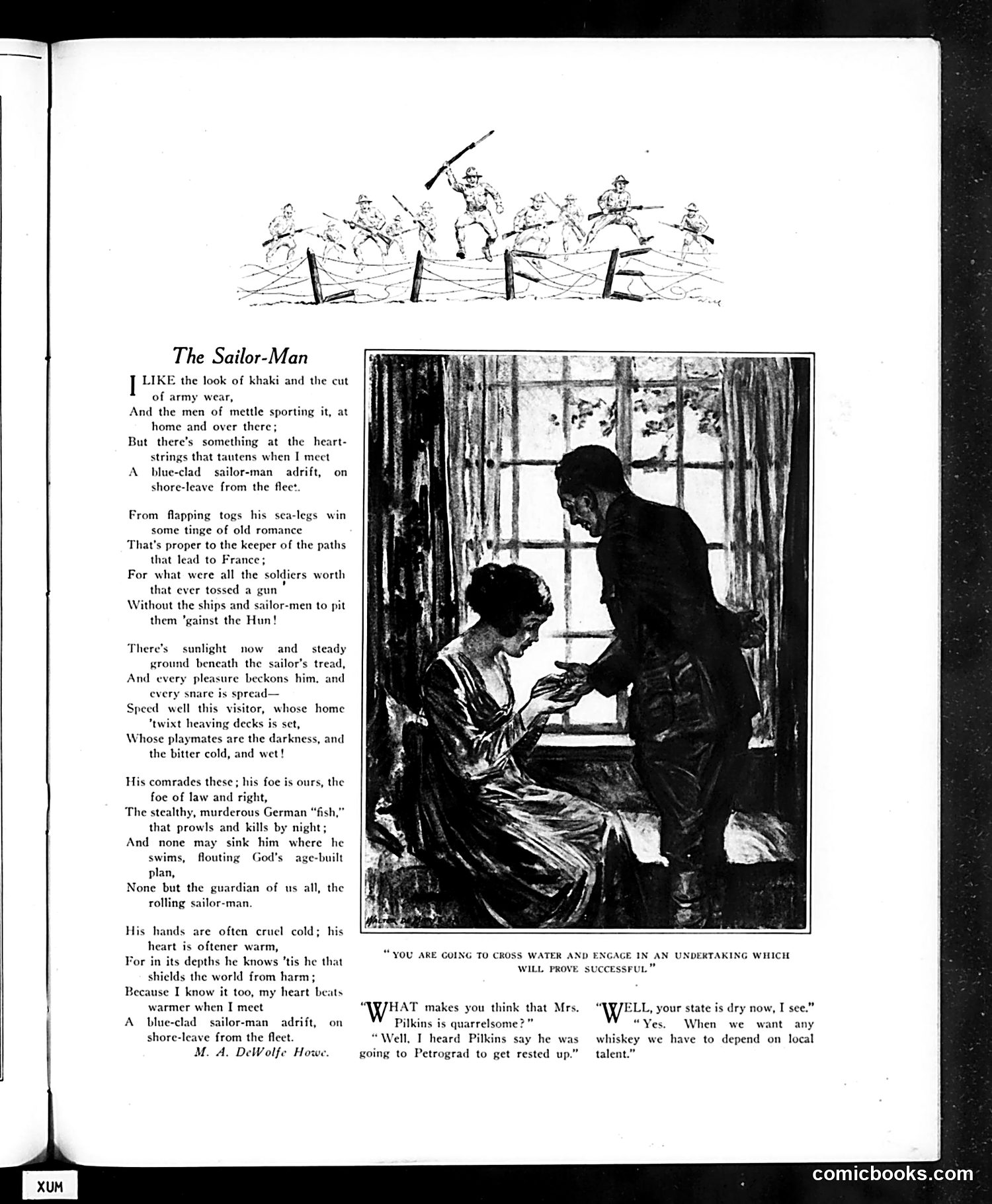
This page features a poem by M.A. DeWolfe Howe celebrating sailors' wartime contributions. The illustrated scene shows a woman and sailor in domestic conversation by a window, with a caption indicating discussion of cross-water military engagement. The poem romanticizes the sailor as a defender of national interest, referencing "the stealthy, murderous German 'fish'" (submarines) and praising sailors who "shield the world from harm." The dialogue below discusses Mrs. Pilkins' quarrelsomeness and mentions Petrograd (Russia), suggesting this was written during WWI when naval warfare and Russian politics were current events. The decorative header shows soldiers attacking fortifications, reinforcing martial themes. The overall message glorifies military service and sacrifice during wartime.
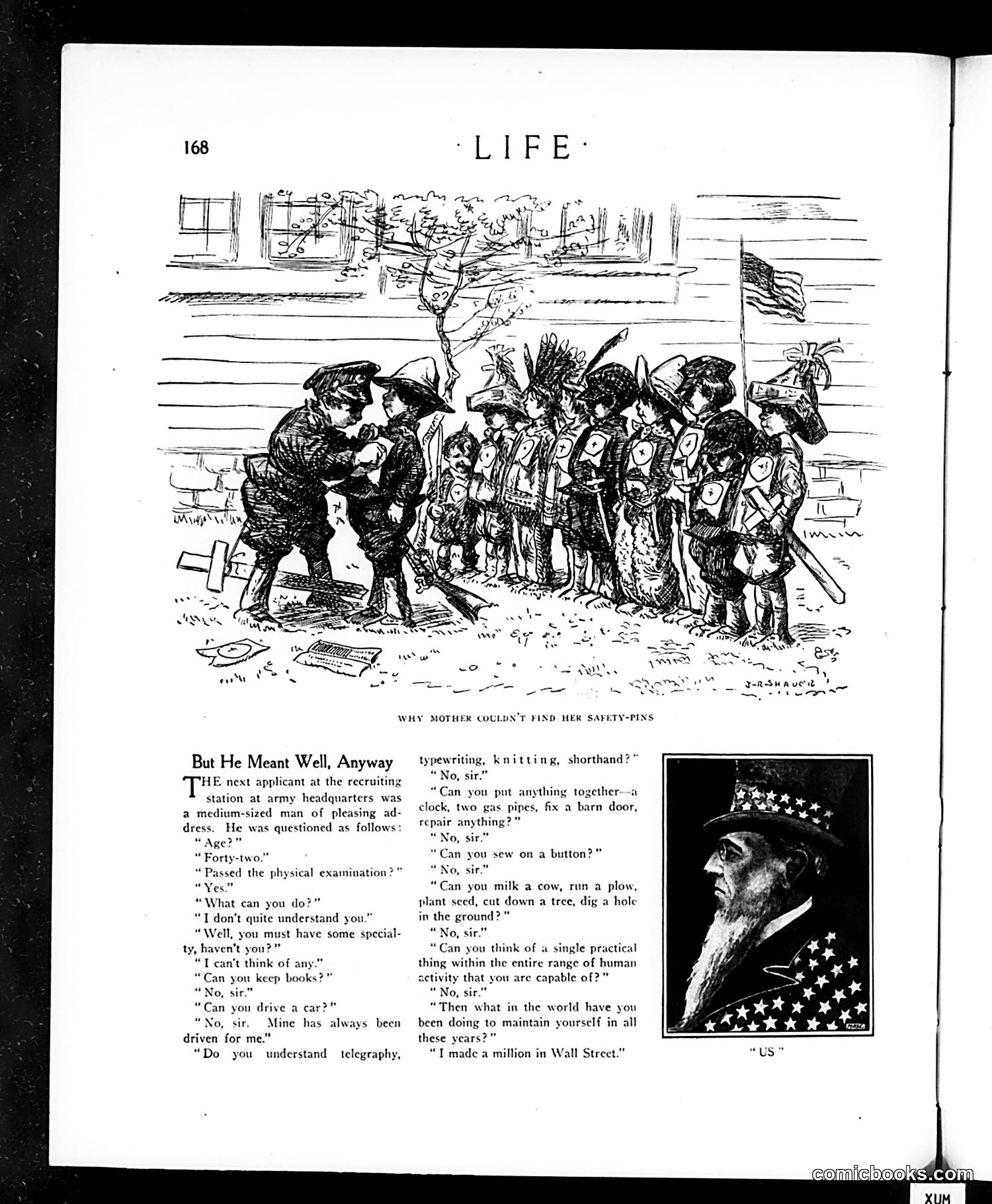
**Main Cartoon:** "Why Mother Couldn't Find Her Safety-Pins" The sketch depicts a military recruitment scene where an officer interviews a man of "pleasing address" aged forty-two. The joke is visual: behind them stands a line of Boy Scouts in uniform, apparently the source of the missing safety-pins. The satire targets both the Boy Scout movement (popular early 20th century) and military recruitment, suggesting the scouts' uniforms or gear consume domestic resources. **Accompanying Story:** "But He Meant Well, Anyway" Documents a farcical job interview where the applicant claims zero practical skills (cannot drive, sew, milk a cow, etc.) but boasts of making "a million in Wall Street." The satire mocks wealthy financiers as useless despite their money—a critique of capitalism and the disconnect between Wall Street success and actual competence or social contribution. The portrait captioned "US" appears patriotic decoration.
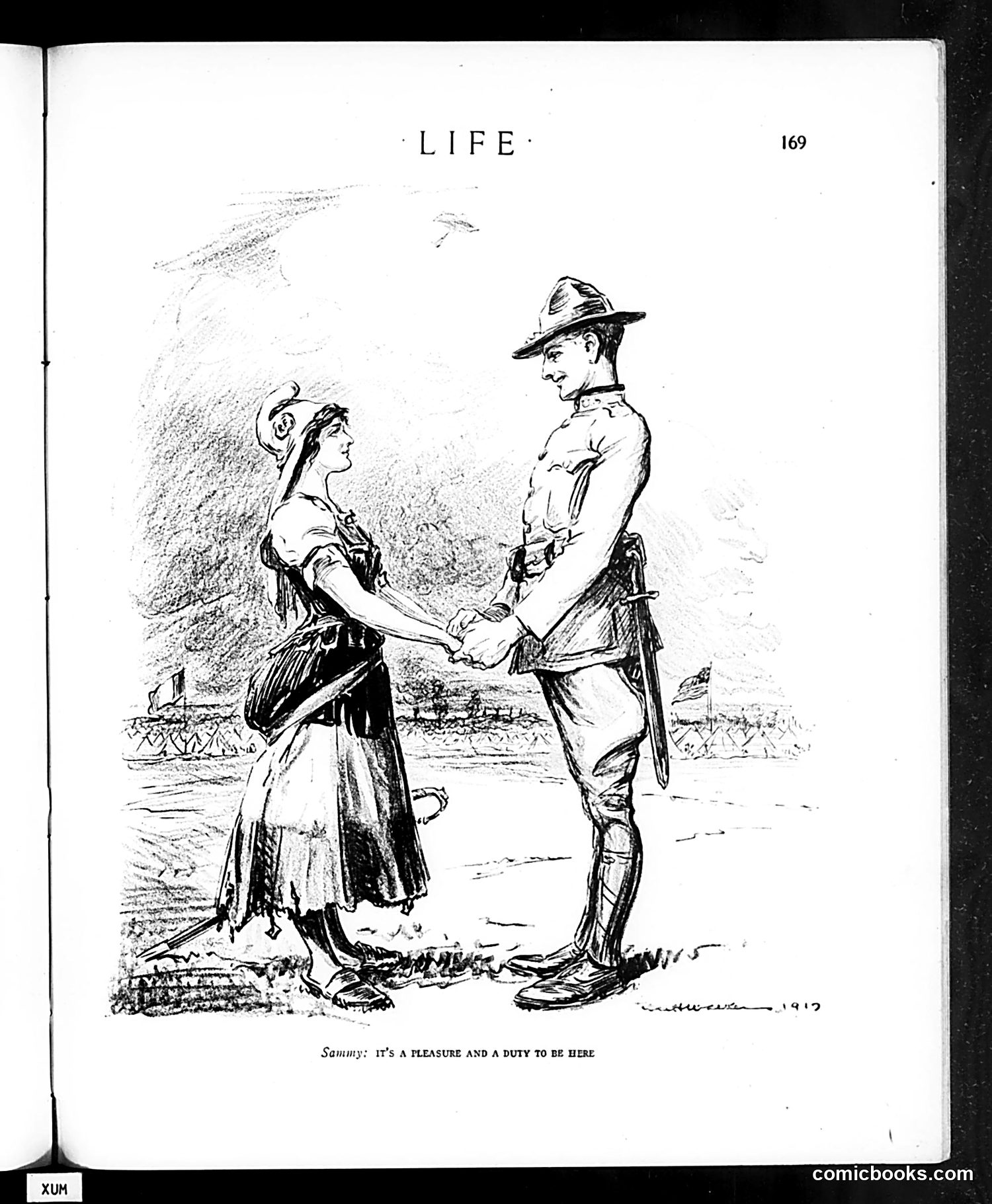
This single-panel cartoon depicts a soldier in World War I military uniform (identifiable by the campaign hat, puttees, and tunic style) meeting a young woman in civilian dress. The caption reads: "Sammy: it's A PLEASURE AND A DUTY TO BE HERE." The cartoon appears to be patriotic propaganda or morale-building content from the WWI era. "Sammy" was a common personification for American soldiers during this period. The image romanticizes military service by showing a soldier expressing both pleasure and dutiful commitment to his service, while the presence of the woman suggests domestic/romantic ties to home that soldiers were fighting to protect. The sketch style and composition are typical of Life's satirical illustration work from this period.
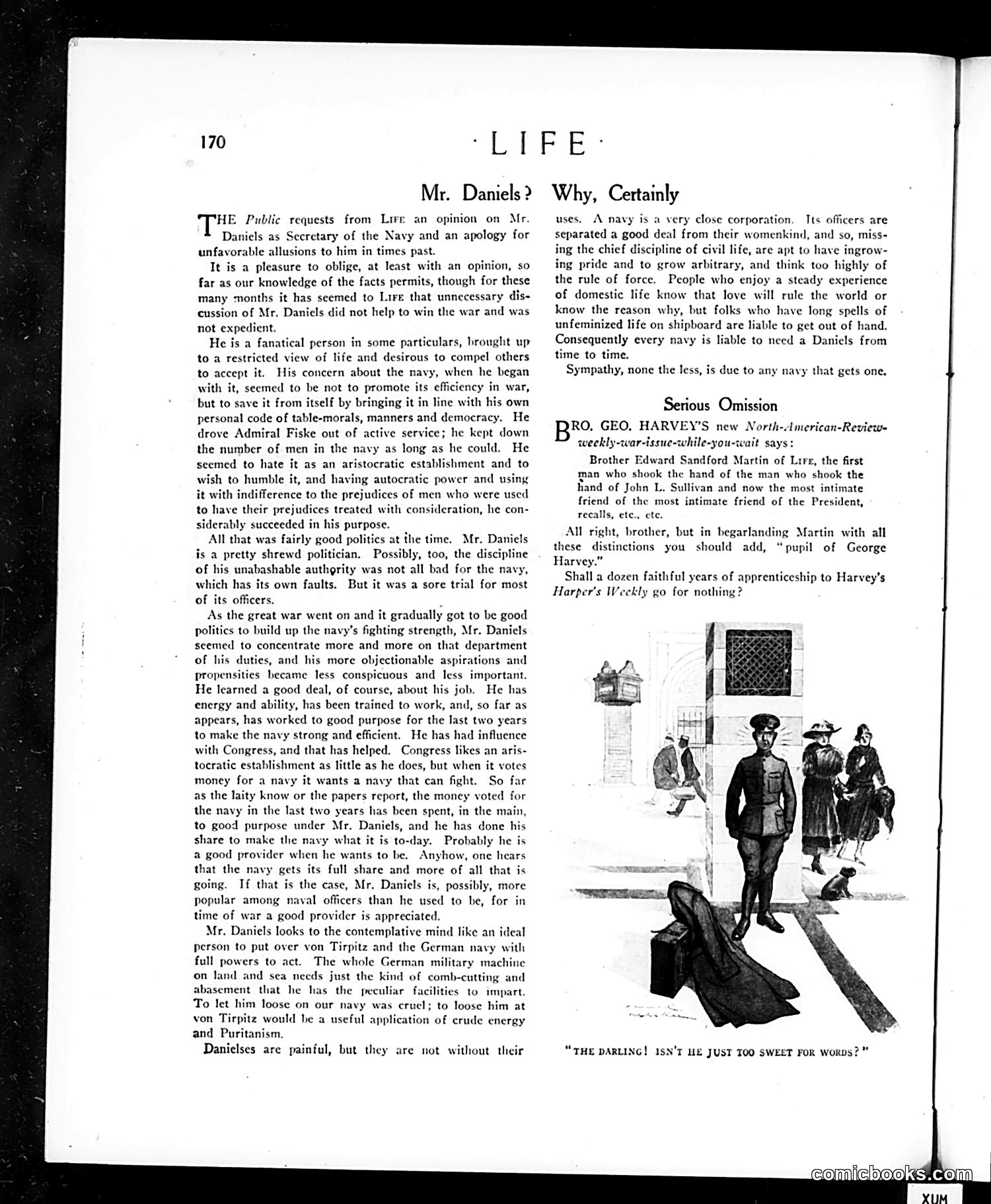
This page critiques Josephus Daniels, Secretary of the Navy, through two separate pieces. The main article defends Daniels against criticism, acknowledging he's somewhat fanatical but crediting him with strengthening naval efficiency during wartime through discipline and democratic principles. The "Serious Omission" section sarcastically attacks George Harvey's *North American Review* for praising Harvey's friend (likely President Wilson) while omitting Daniels' contributions to naval preparedness. The illustration at bottom depicts what appears to be women suffragists or female workers, with the caption "THE DARLING! ISN'T HE JUST TOO SWEET FOR WORDS?"—likely mocking Daniels' progressive stance on women's roles during this era.
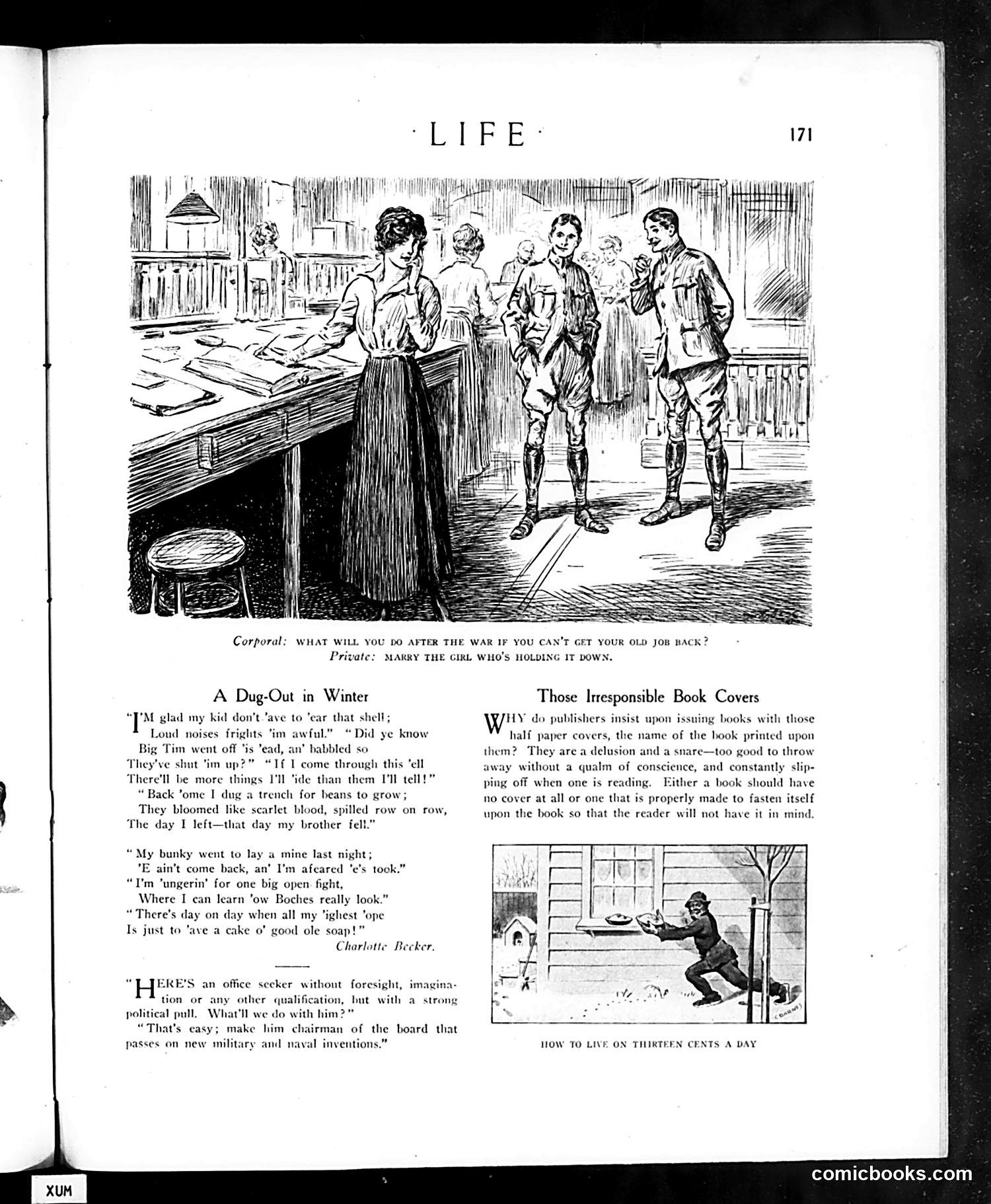
**Main Illustration:** A WWI-era scene showing soldiers in military uniforms speaking with a woman at what appears to be a desk or counter. The caption reads: "Corporal: WHAT WILL YOU DO AFTER THE WAR IF YOU CAN'T GET YOUR OLD JOB BACK? Private: MARRY THE GIRL WHO'S HOLDING IT DOWN." **Context:** This satirizes post-war employment anxieties. During WWI, women entered the workforce replacing enlisted men. The joke reflects contemporary concern that returning soldiers would face job competition from women who'd proven capable in traditionally male positions. The "solution" of marriage was a common contemporary presumption that women would leave jobs upon marrying. **Other Content:** The page also includes a poem "A Dug-Out in Winter" by Charlotte Becker about trench conditions, and an article critiquing irresponsible book cover design.
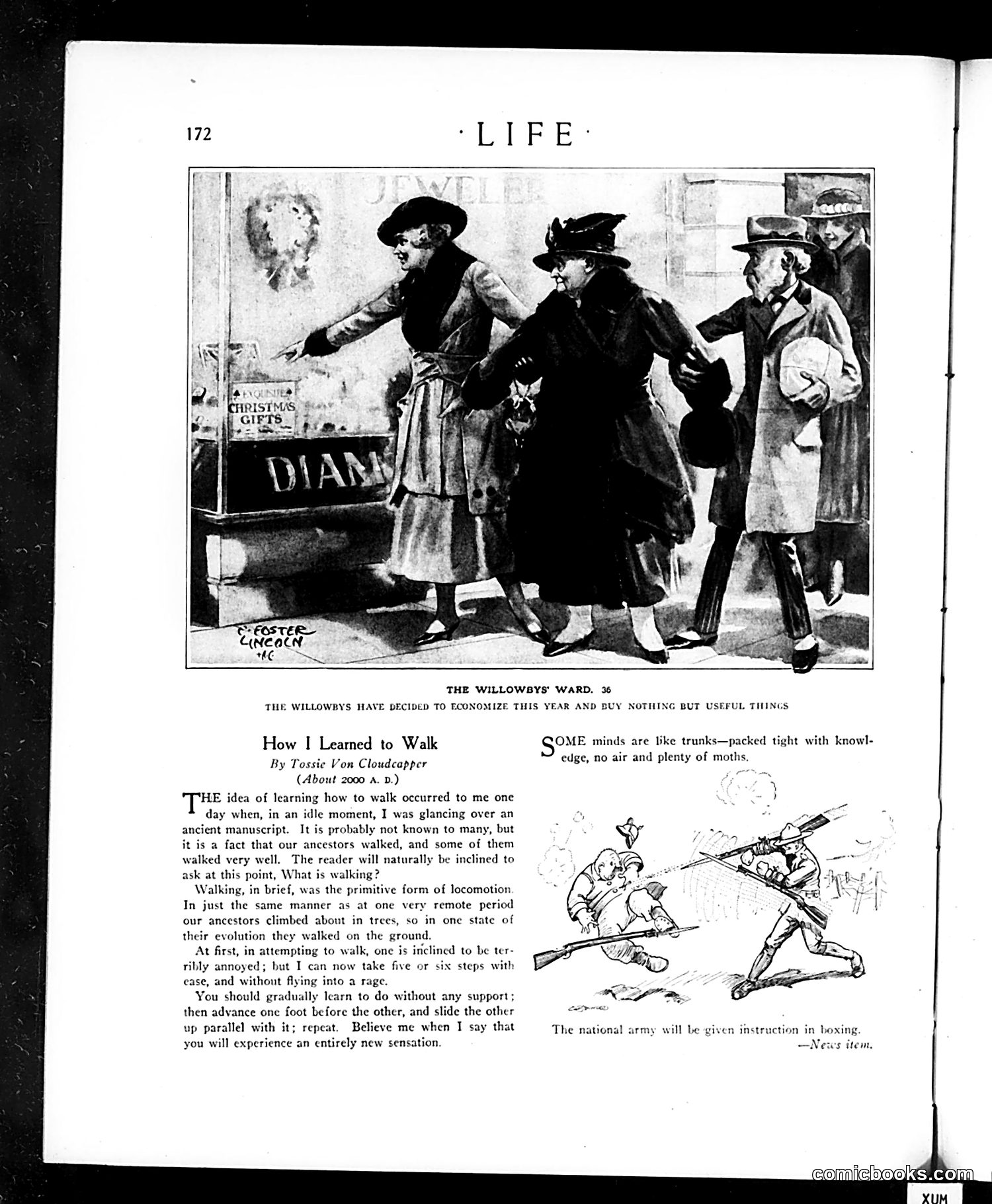
**The Cartoon ("The Willowbys' Ward"):** The top illustration satirizes upper-class economizing. During what appears to be a period of economic constraint, the wealthy Willowby family has decided to "buy nothing but useful things." The cartoon shows them window-shopping at a store displaying luxuries, unable to resist temptation despite their stated resolution. The humor lies in the gap between their stated austerity and evident desire for frivolous purchases. **The Article ("How I Learned to Walk"):** Tossie Von Cloudcapper's humorous piece describes learning to walk as if it were a remarkable discovery—treating basic human locomotion as novel knowledge. The accompanying sketch shows military boxing instruction, likely satirizing trendy physical culture movements of the era. Both reflect early 20th-century American anxieties about consumer culture and aspirational self-improvement.
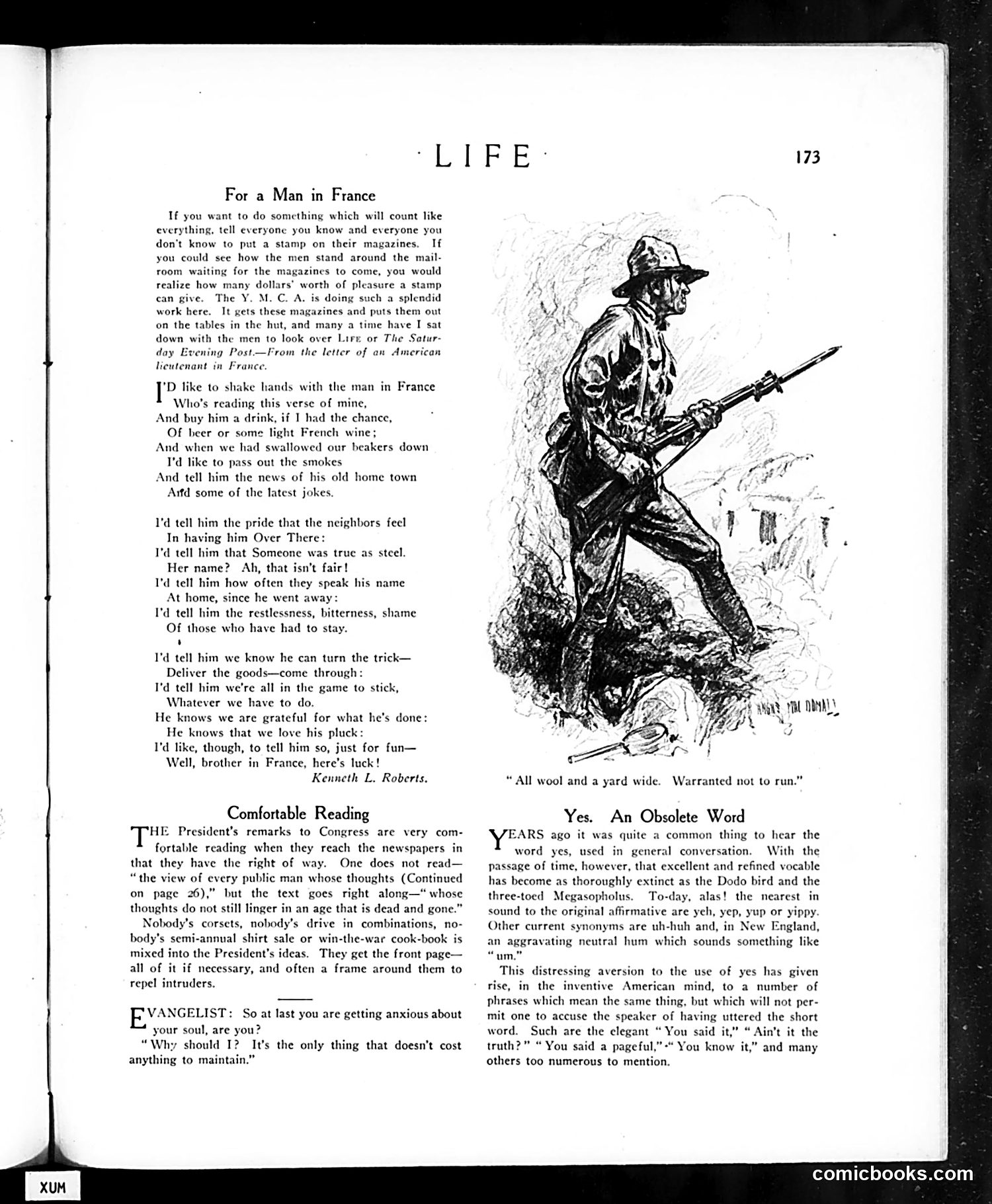
This page contains a poem titled "For a Man in France" by Kenneth L. Roberts, accompanied by an illustration of a WWI soldier in combat gear on rocky terrain with a rifle. The poem expresses the desire to communicate with American soldiers fighting in France during World War I, describing what the speaker would tell such a soldier: news from home, pride in his service, reassurance about a sweetheart's faithfulness, and encouragement about victory. The accompanying illustration depicts a typical WWI American soldier in period-accurate uniform and equipment, reinforcing the patriotic message of the poem. Below are two unrelated short pieces: "Comfortable Reading" (about presidential remarks to Congress) and "Yes. An Obsolete Word" (discussing the declining use of "yes" in American conversation).
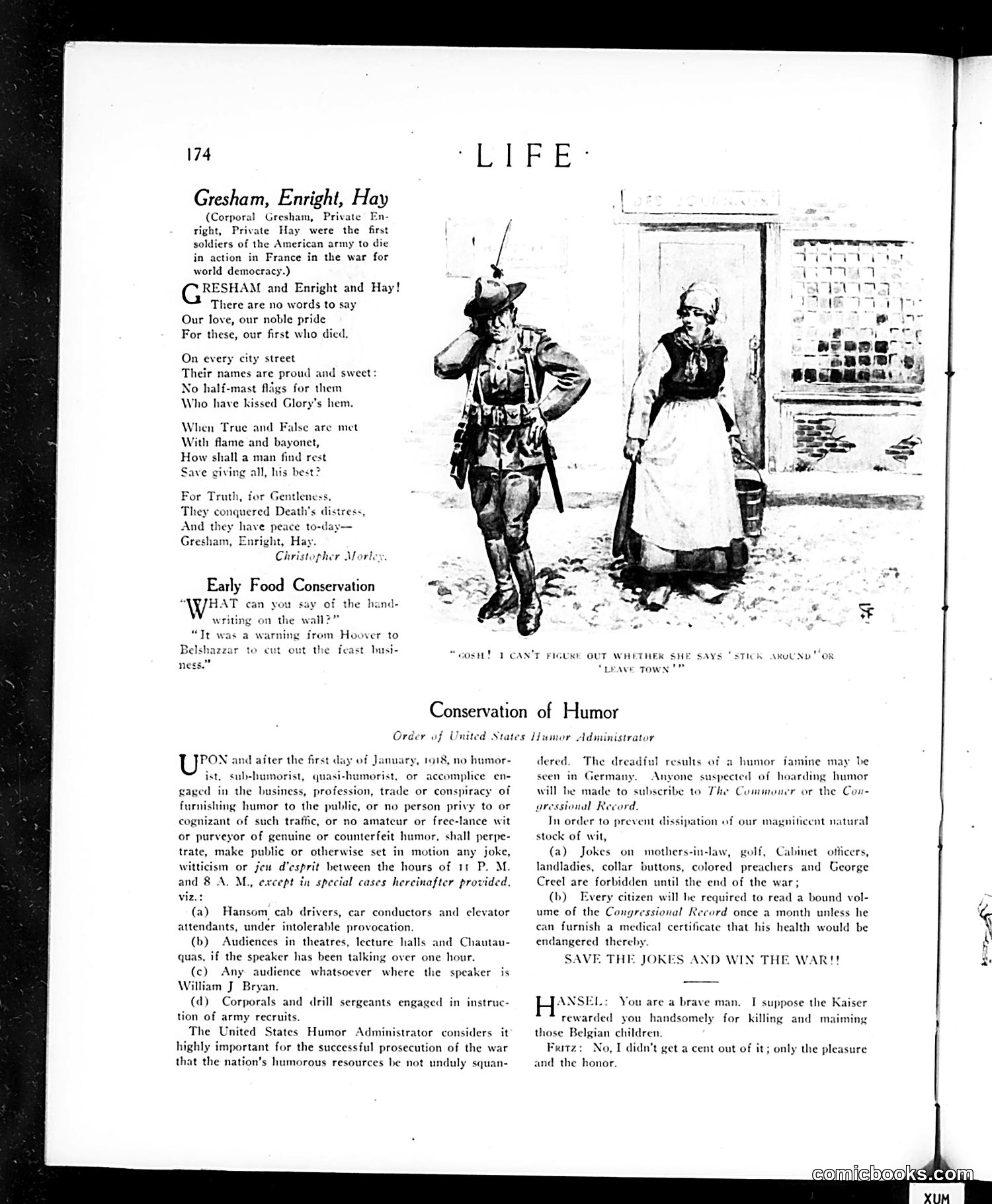
This page contains two distinct sections: **"Gresham, Enright, Hay"** — A patriotic poem by Christopher Morley commemorating three soldiers who died in World War I, establishing a solemn, honoring tone. **"Early Food Conservation"** — A cartoon depicting a soldier and woman, with the caption about whether she says "stick around" or "leave town." This satirizes domestic food rationing during WWI, likely mocking either a woman's conflicting signals or the tension between soldiers and the home front during wartime scarcity. **"Conservation of Humor"** — A formal order from the U.S. Humor Administrator (a fictional position) that satirizes government overreach by proposing to ban certain jokes during wartime. It specifically forbids humor about mothers-in-law, golf, and other topics, sarcastically suggesting patriotism requires suppressing natural humor to "win the war." The page overall satirizes American WWI-era regulations and propaganda.
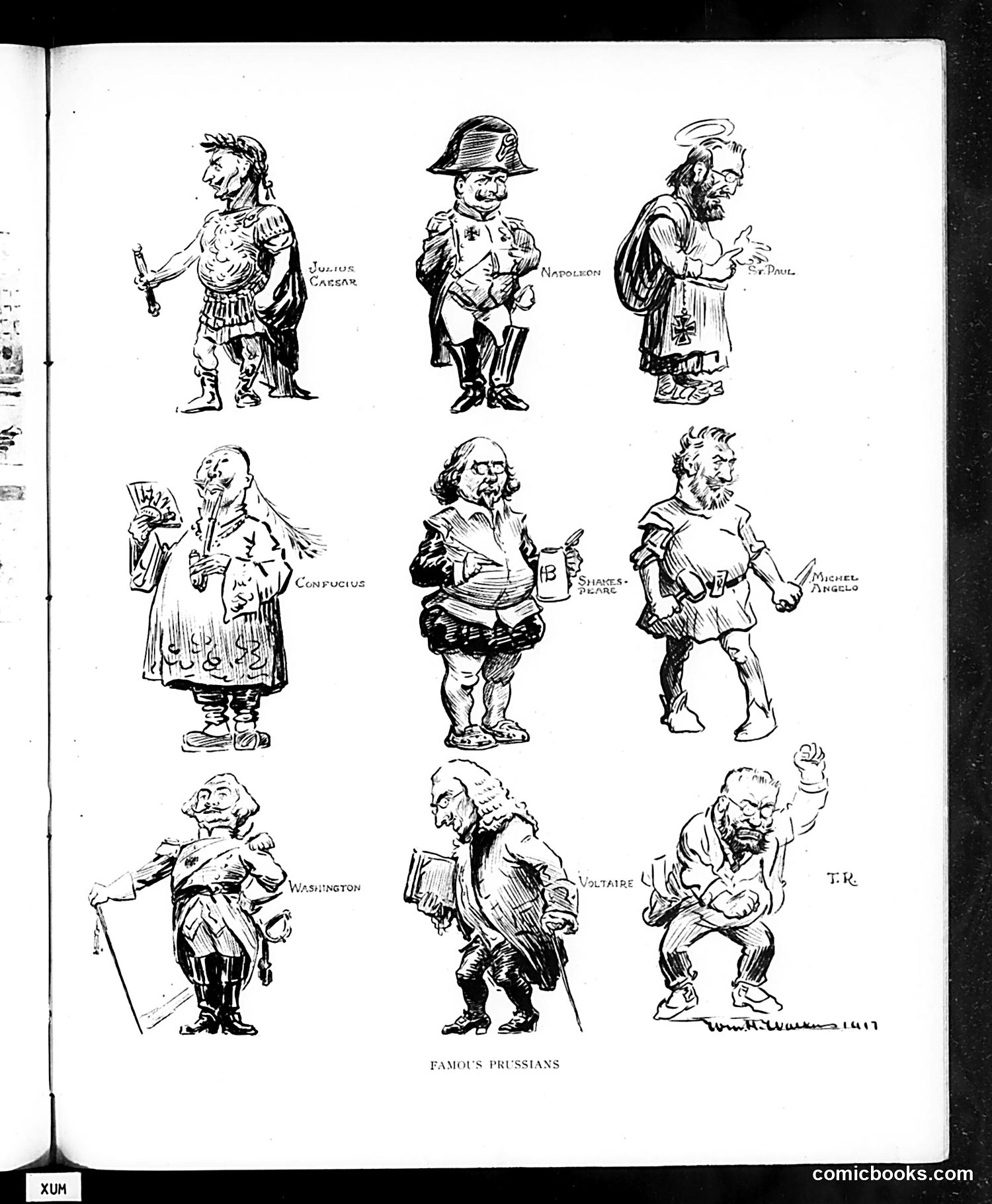
This page presents nine caricatured historical and contemporary figures labeled as "Famous Prussians." The drawings satirize Prussian militarism and authority by depicting: **Historical figures**: Julius Caesar, Napoleon, and St. Paul are included—famous non-Prussians—seemingly to mock Prussian claims to greatness by association. **Historical/philosophical figures**: Confucius, Shakespeare, and Michelangelo represent cultural achievements, again non-Prussian. **Contemporary figures**: Washington and Voltaire appear, likely representing Enlightenment values the cartoon suggests Prussia rejects. The final figure labeled "T.R." (Theodore Roosevelt) suggests contemporary political commentary, possibly critiquing American or international political alignment with Prussian militarism during the early 20th century. The satire's core message appears to be that Prussia inappropriately claims credit for achievements of other cultures while embodying militaristic values.
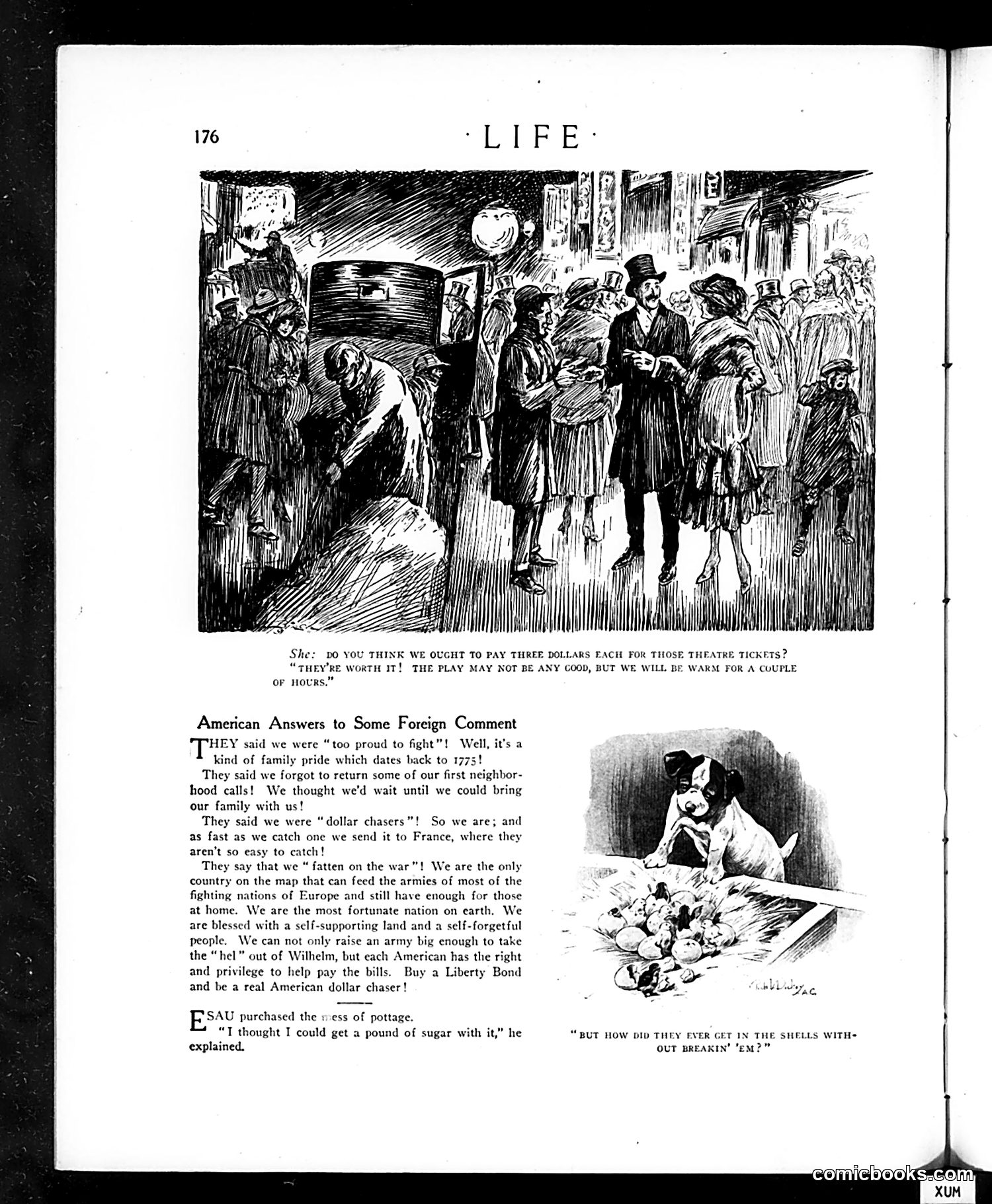
**Top Cartoon:** A couple debates paying $3 for theatre tickets, justifying the expense not for entertainment quality but for warmth—likely referencing wartime heating shortages or economic hardship during WWI. **Main Article:** "American Answers to Some Foreign Comment" defends American neutrality and later war involvement against European criticism. It responds to accusations that Americans were cowardly ("too proud to fight"), greedy ("dollar chasers"), and profiteering from war. The piece references 1773 (American Revolution), appeals to American exceptionalism and self-sufficiency, and promotes Liberty Bonds as patriotic duty. The reference to "Wilhelm" means Kaiser Wilhelm II, indicating this was published during U.S. involvement in WWI. **Bottom cartoon:** Shows a dog with a puzzle—apparently shells (ammunition) somehow contained without breaking, likely satirizing industrial production or the logistics of war manufacture. The page overall promotes American patriotism and financial support for the war effort.
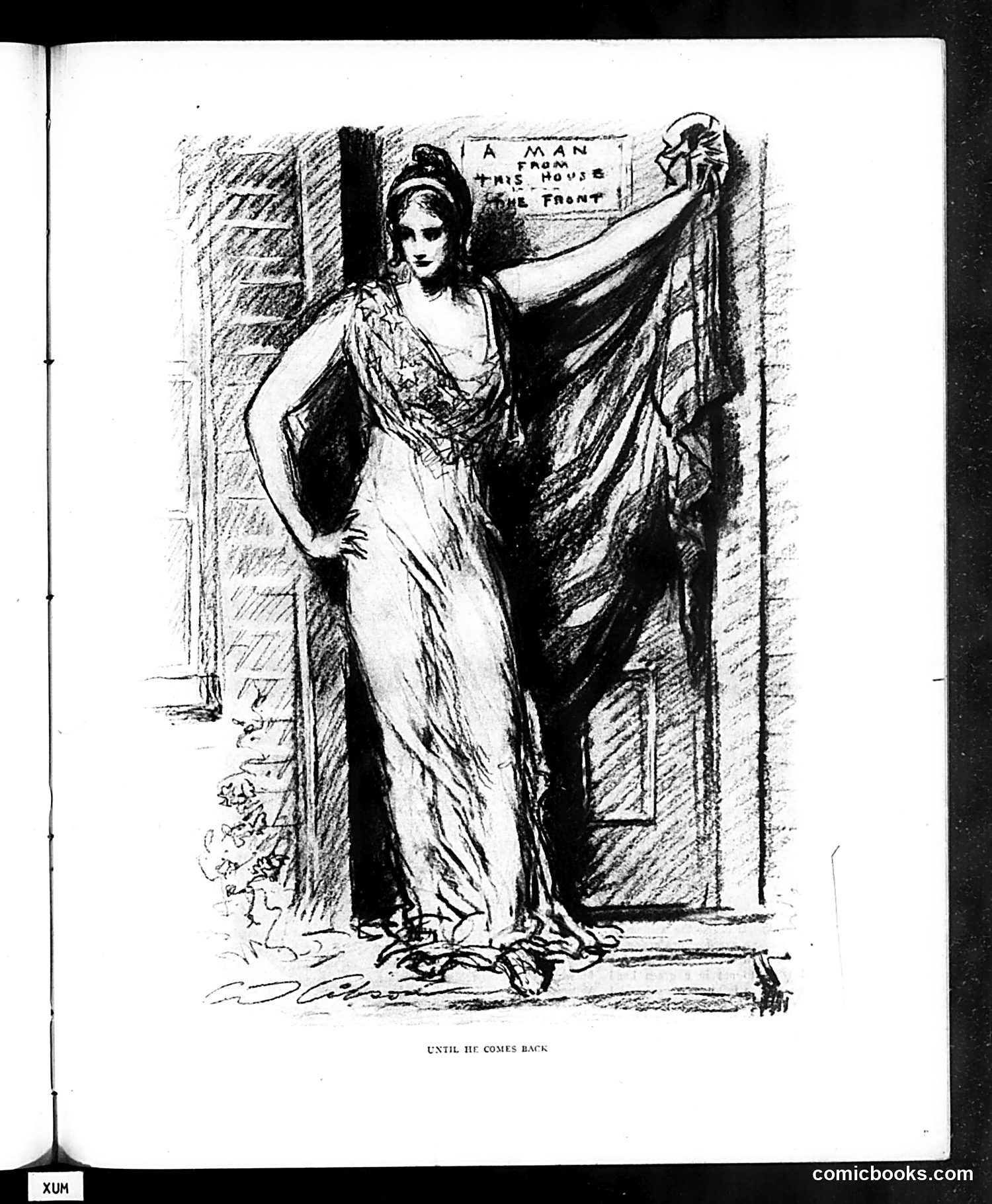
This sketch depicts a woman standing in a doorway, holding up fabric or clothing while gazing outward. The sign behind her reads "A Man of This House Came Front" (likely "A Man of This House Came to the Front"). The cartoon appears to be WWI-era satire addressing the "home front" experience. It likely comments on women left behind while men served in combat. The woman's elegant dress and waiting pose suggest she's maintaining domestic life and perhaps romantic fidelity during her husband's or partner's military service. The title "Until He Comes Back" emphasizes this theme of waiting. The satire likely mocks either the sentimentality of wartime separation or, conversely, questions women's constancy—a common satirical subject in Life magazine during this period. The exact political or social critique remains somewhat unclear without additional context.
This editorial page critiques President Wilson's appointment of **Harry Garfield as Coal Administrator** during WWI's fuel crisis. The small cartoon at top (showing figures labeled "mister") appears to illustrate the coal shortage's domestic impact. The article argues Garfield—a college president and scholar—lacks the specialized "coal facts" needed for this wartime job, despite his patriotism and effort. The satire suggests Wilson excels at abstract ideas and ideology but struggles with practical personnel decisions and managing people. The author proposes Wilson should focus on "editorial" (policy/ideas) while delegating "business organization" (implementation/administration) to competent professionals. This reflects broader WWI-era debates about appointing civilians versus specialists to emergency positions—Wilson appointed similar amateurs to head the War and Navy departments. The piece's tone is sympathetic to both Garfield and Wilson while critiquing the fundamental mismatch between intellectual capability and administrative need.
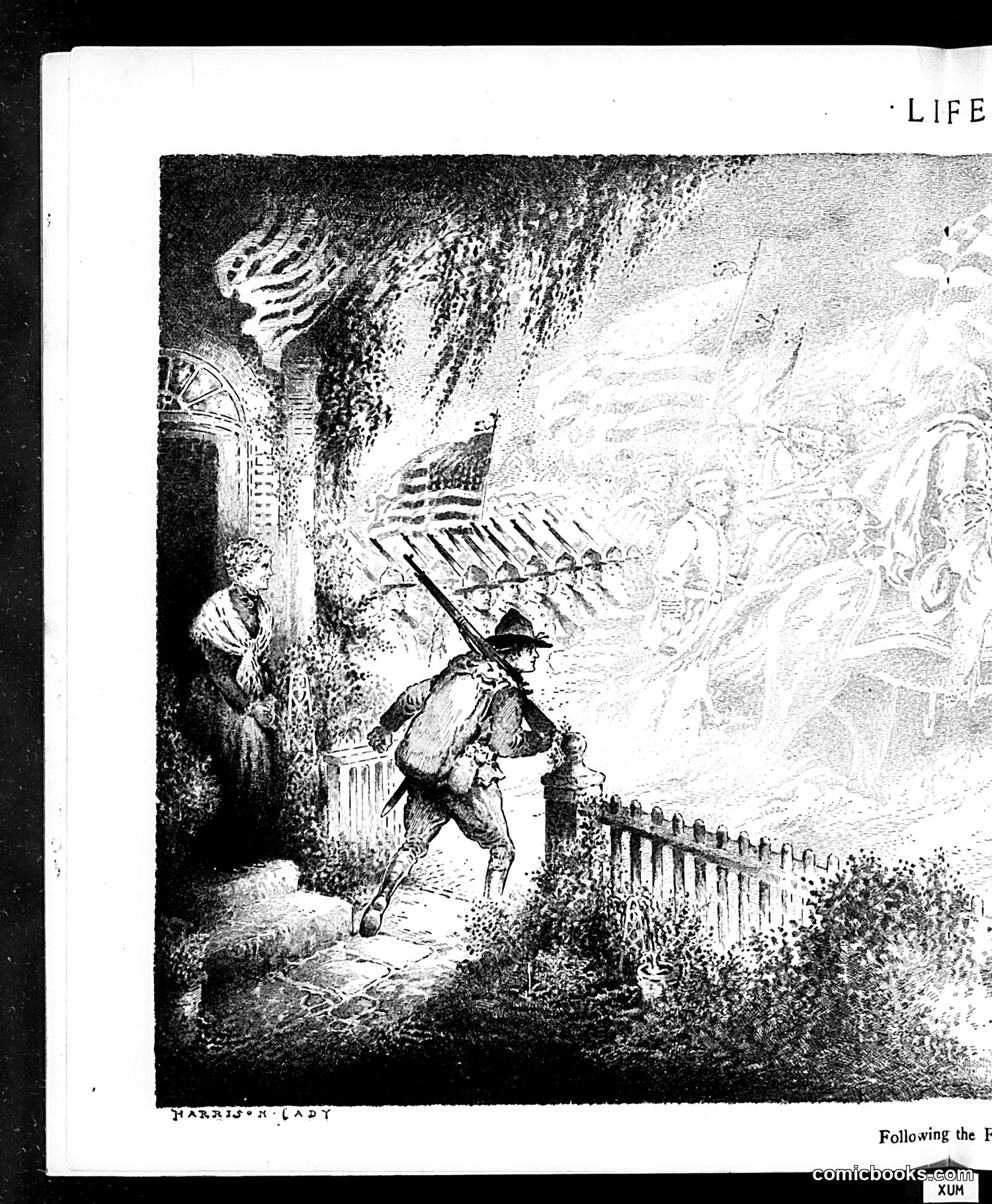
This appears to be a satirical illustration from *Life* magazine, credited to "Harrison Cady" (visible as signature). The image shows a portly, well-dressed man in a top hat fleeing or rushing through a garden or estate setting, seemingly escaping from something threatening behind him—possibly represented by the dark, ominous foliage or architectural elements looming above. The caption begins "Following the F..." (text cut off), which makes the specific target unclear. However, the cartoon's style suggests social or political satire, likely mocking a wealthy or prominent figure. The man's corpulent physique and formal dress suggest commentary on upper-class excess or vulnerability. Without the complete caption, the precise meaning—whether this references a specific scandal, legal trouble, or political event—cannot be definitively determined.
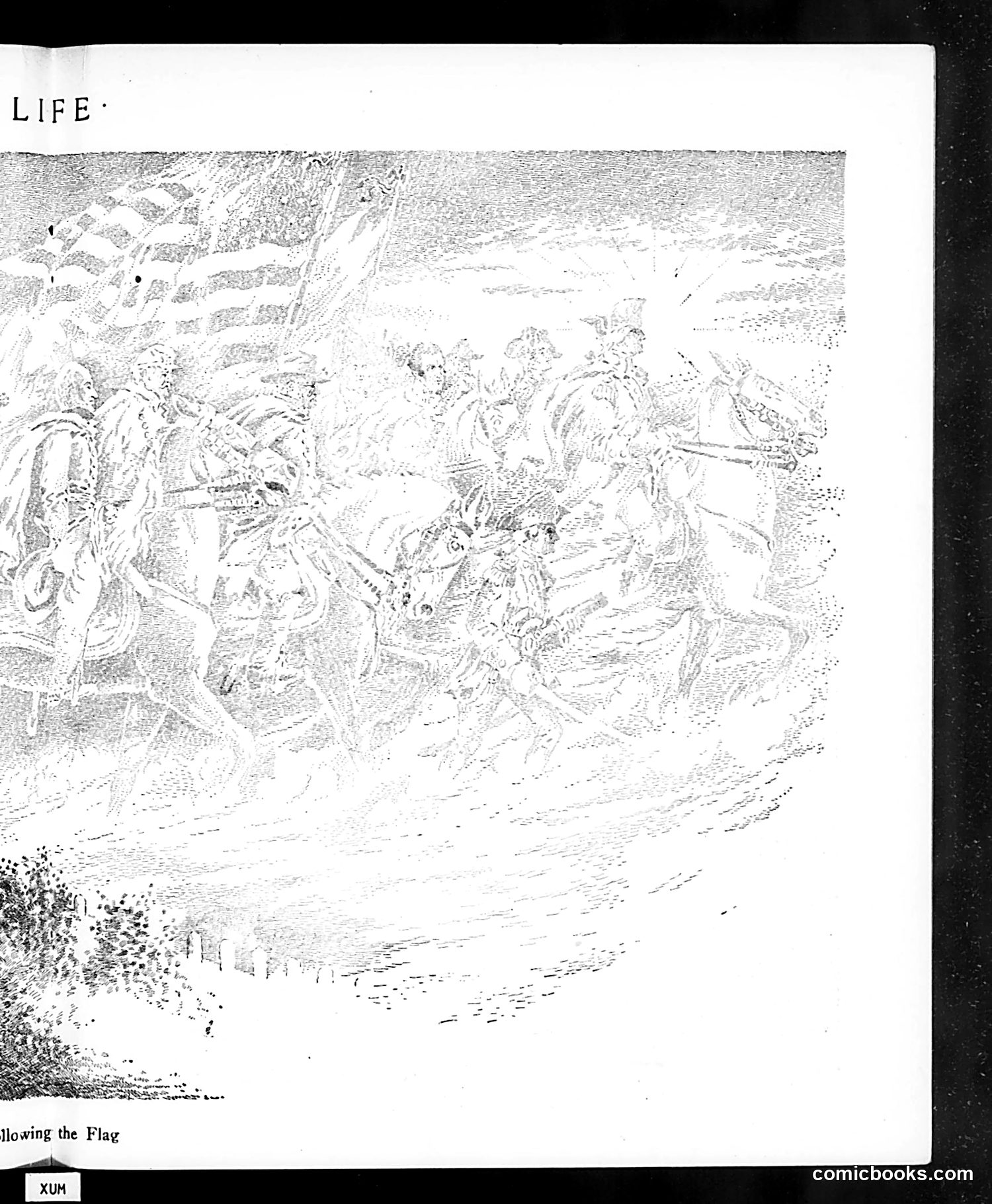
This page from *Life* magazine appears to be a historical military or patriotic illustration, though the image quality makes specific details difficult to discern. The sketch depicts what seems to be soldiers or military figures in an active scene, possibly related to a flag—suggested by the partial text "llowing the Flag" (likely "Following the Flag"). The engraved or stippled style is typical of *Life's* satirical illustrations from the late 19th or early 20th century. Without clearer visibility of faces, uniforms, or additional context, I cannot definitively identify specific political figures or events being satirized. The martial subject matter suggests commentary on military affairs or patriotism, but the exact target of satire remains unclear from this image.
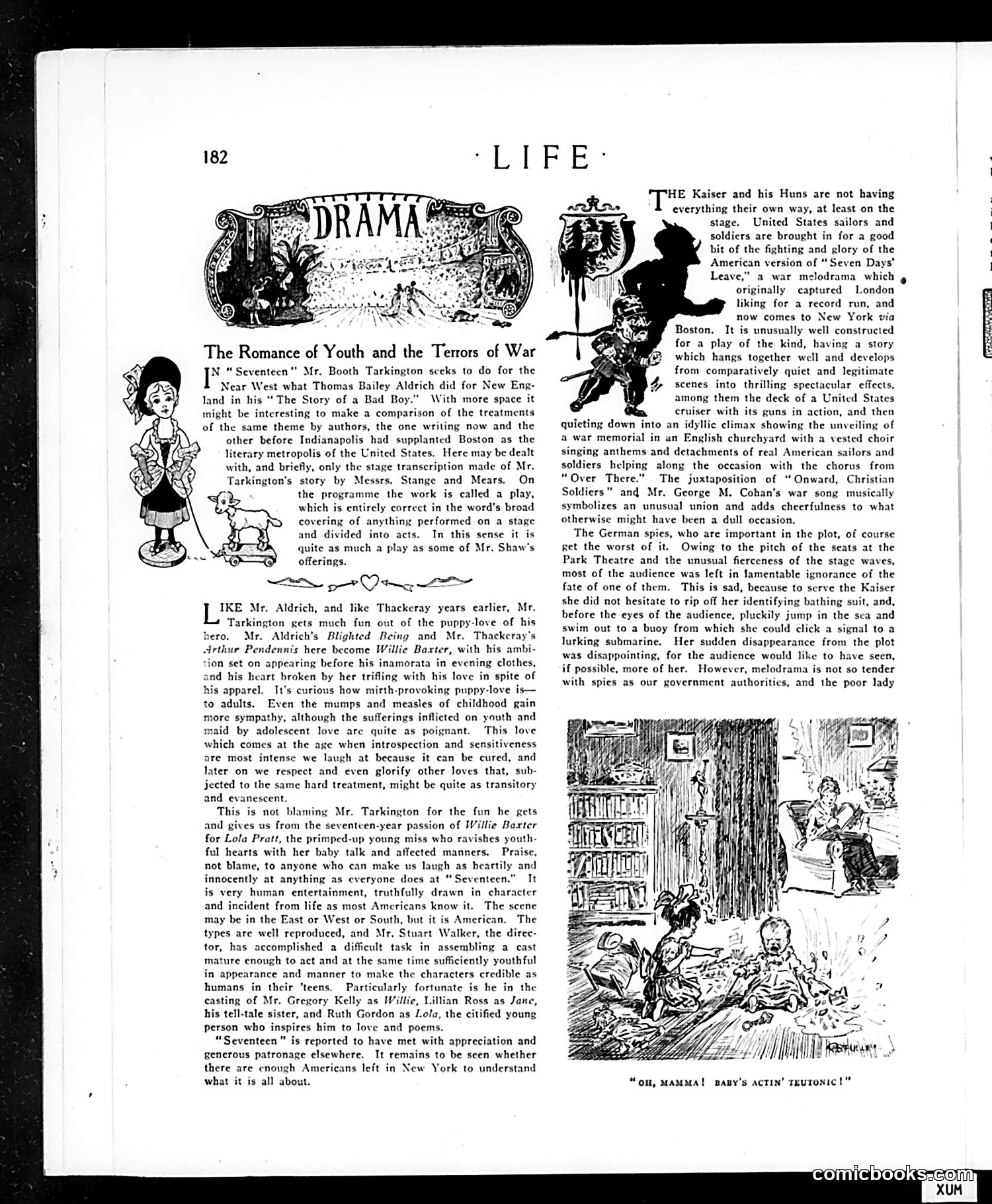
This page reviews two Broadway plays. The main review covers **"Seventeen,"** adapted from Booth Tarkington's novel about teenage romance—specifically the protagonist Willie Baxter's puppy-love infatuation with the affected young woman Lola Pratt. The critic praises how the play humorously captures adolescent sentimentality, comparing it to earlier literary treatments by Thackeray and Aldrich. The review notes the production's success in casting age-appropriate actors and achieving authentic American characterization. A secondary review discusses **"Seven Days' Leave,"** a war melodrama featuring American soldiers and sailors fighting Germans. The critic observes that unlike the Kaiser's forces dominating the stage elsewhere, this play gives American forces prominence, moving from spectacular battle scenes to quieter romantic climaxes. The illustration (captioned "OH, MAMMA! BABY'S ACTIN' JEJUNIC!") depicts a domestic scene, likely referencing the teenage melodrama of "Seventeen."
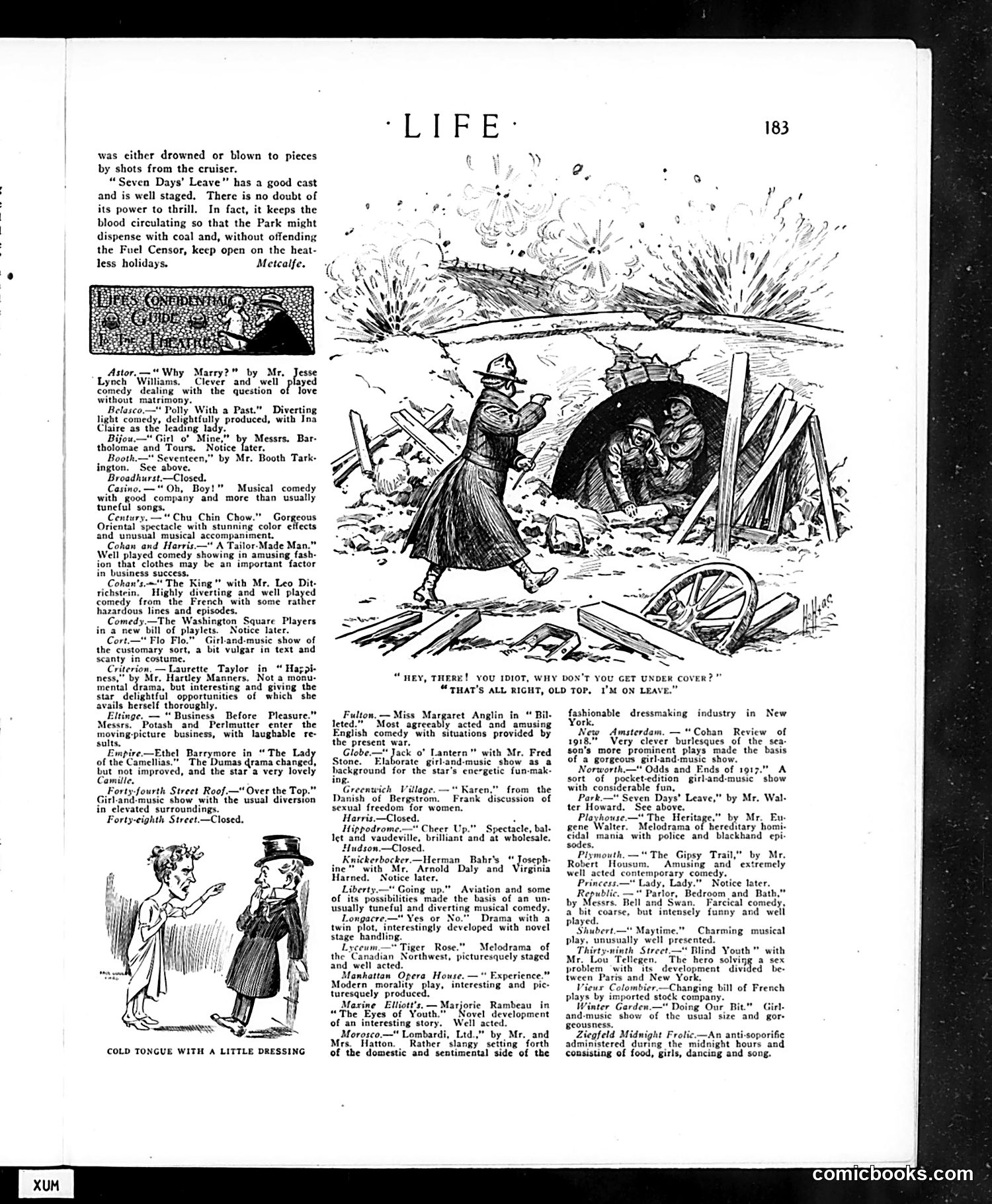
This page is primarily theater reviews from Life magazine. The main cartoon depicts a **WWI soldier on leave** amid battlefield wreckage, responding to another soldier's warning to take cover. The soldier replies casually: "That's all right, old top, I'm on leave." **The satire**: The humor contrasts the soldier's carefree attitude—treating wartime danger as something he can ignore because he has temporary leave—with the absurdity of that logic. The title, "Cold Tongue with a Little Dressing," suggests the soldier is being served a quip rather than practical advice. **Historical context**: This appears from a WWI-era Life magazine (references to "Fuel Censor" and wartime rationing support this), when American soldiers were actively deployed. The joke mocks the false sense of security soldiers might feel during brief furloughs, or satirizes their gallows humor about combat danger. The cartoon comments on the disconnect between military danger and soldiers' attempts at nonchalance—a theme Life frequently explored during the war.
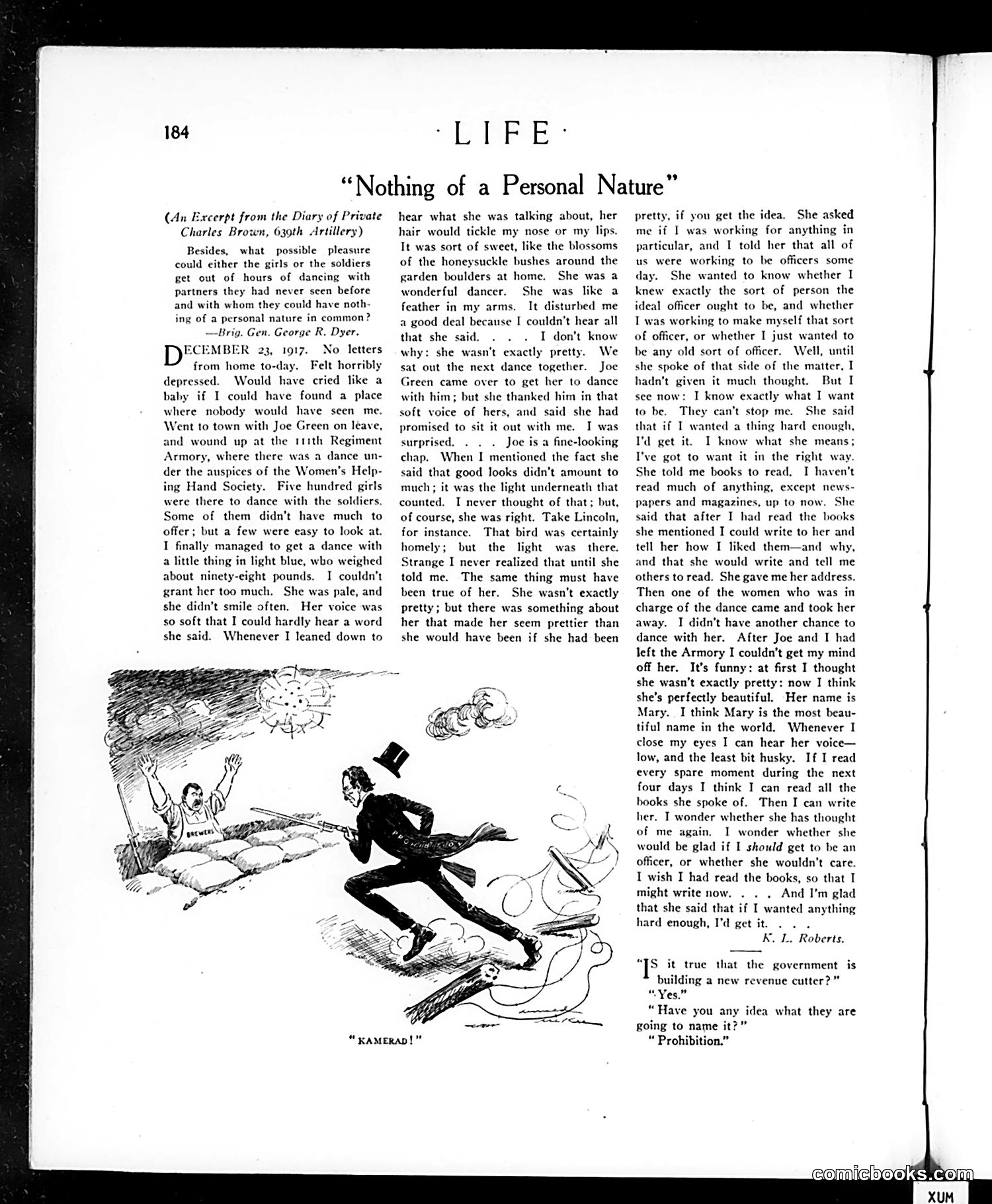
This page satirizes a military authority's claim that soldiers and women shouldn't dance together because they share "nothing of a personal nature in common." The diary entry (from a Private Charles Brown) directly contradicts this by showing a soldier meeting a young woman at a 1917 wartime dance and forming a genuine emotional connection. Despite her plain appearance, he becomes deeply attracted to her through meaningful conversation about character, ambition, and intellectual growth. The cartoon "KAMERAD!" depicts a man in formal dress tumbling comically—likely representing the absurdity of the general's position being upended by reality. **The satire's point:** Military leadership wrongly assumes soldiers and civilian women cannot connect meaningfully. The soldier's account proves the opposite—real human connection transcends superficial attraction and occurs through genuine interaction. The general's restrictive policy contradicts basic human nature and romantic experience.
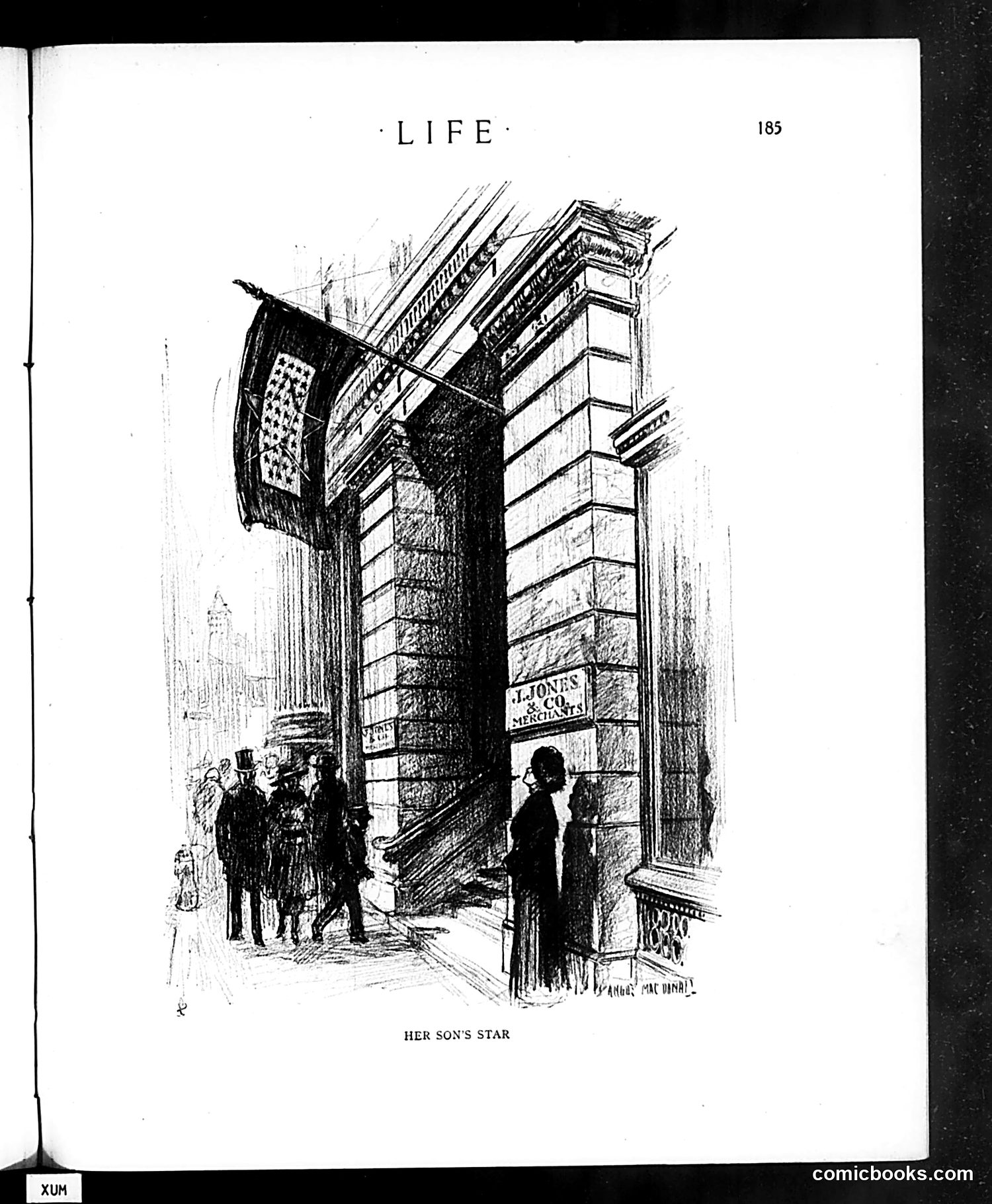
This is a satirical sketch titled "Her Son's Star" from Life magazine (page 185). The drawing depicts a street scene outside what appears to be a prestigious business building (marked "LIONS & CO MERCHANTS"), with several well-dressed men in formal attire and top hats. The cartoon's satire likely concerns **social climbing or maternal pride** — the title suggests a mother's son has achieved prominence or success, indicated by the prominent storefront or business location. The formal dress and architectural grandeur emphasize the aspirational nature of the scene. Without additional context about the specific historical period or references, the exact target of the satire remains somewhat unclear, though it appears to mock either pretentiousness about business success or a mother's exaggerated pride in her son's social standing.
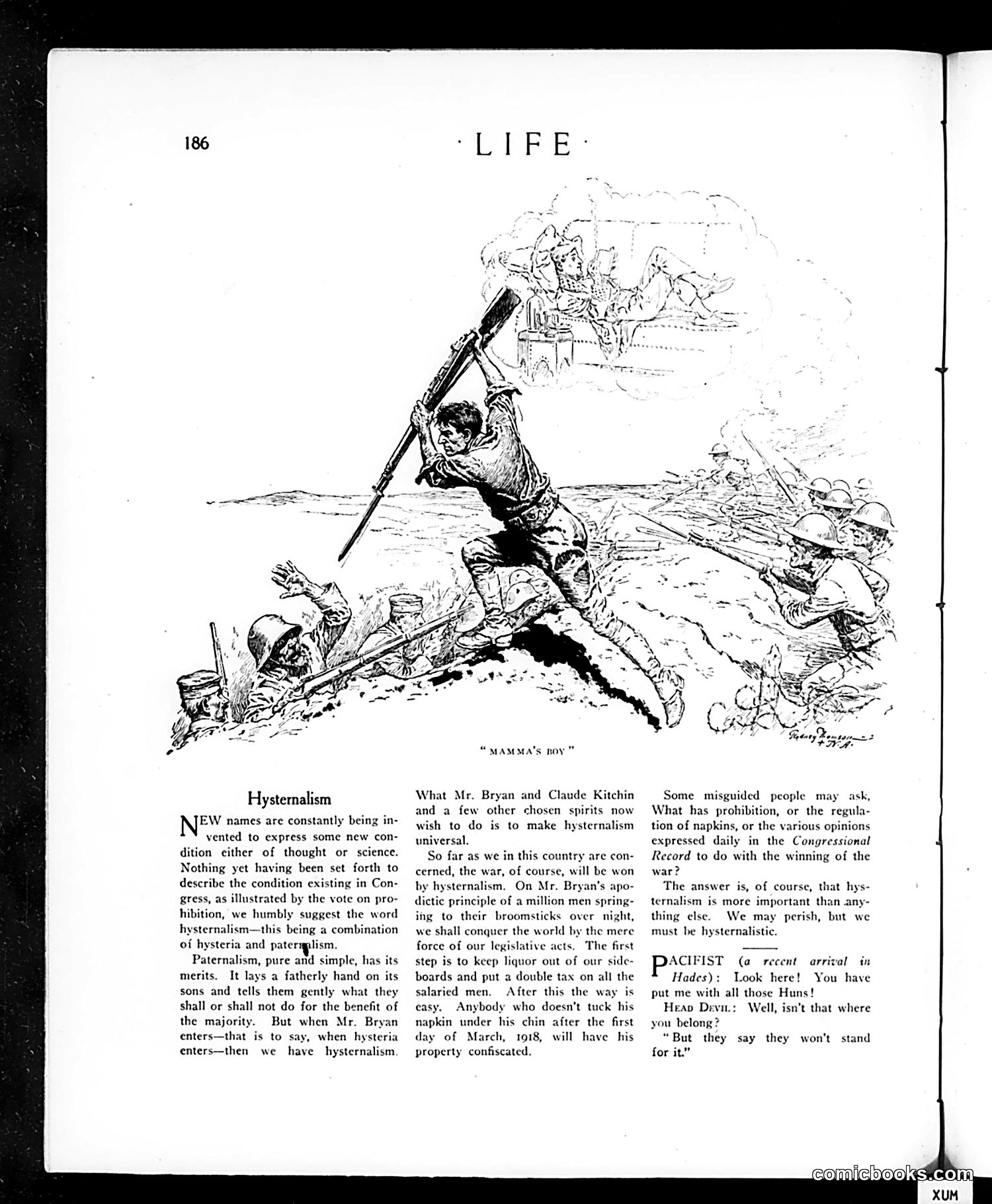
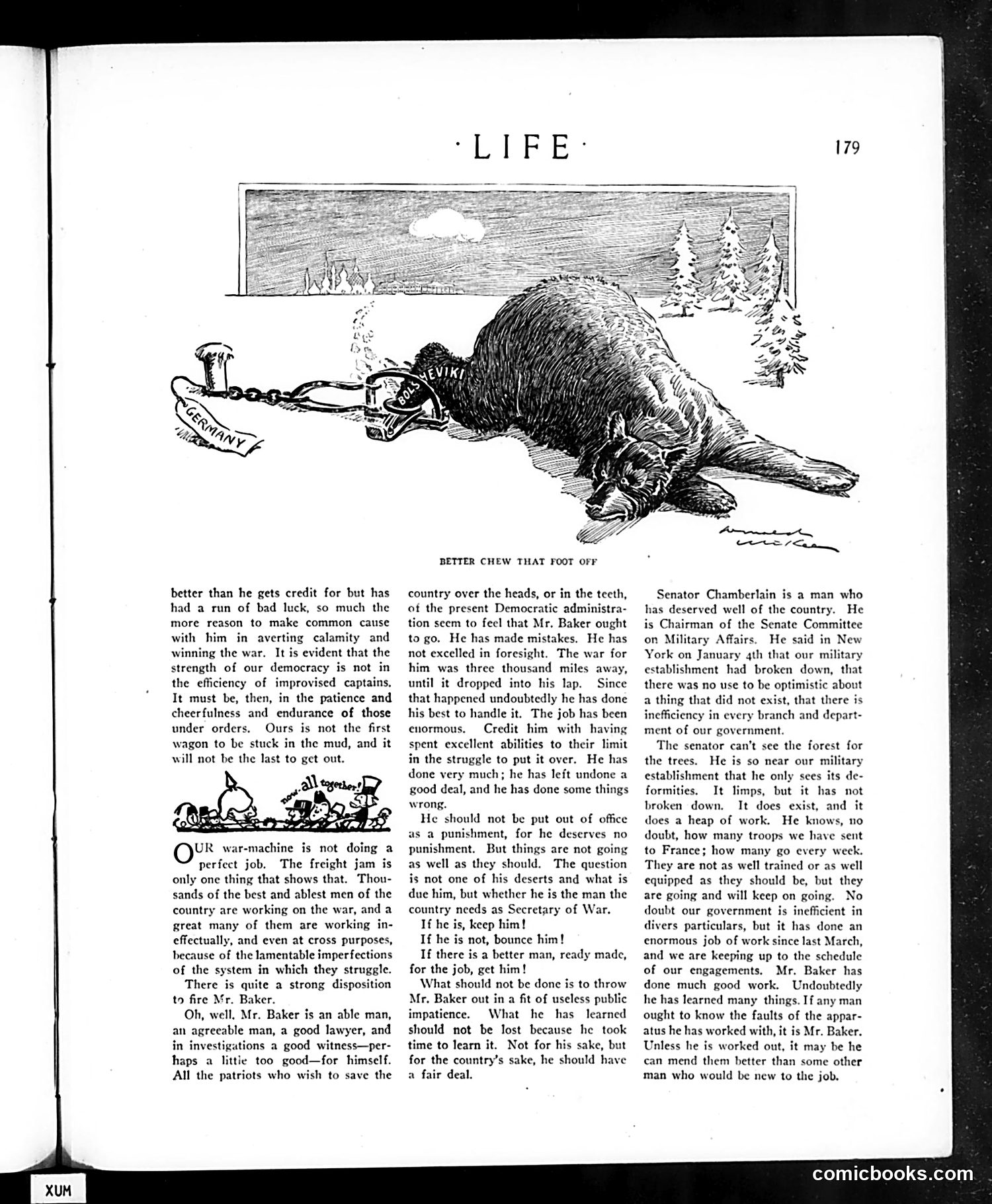
This satirical piece attacks what the author calls "hysternalism"—a coinage blending "hysteria" and "paternalism" to criticize Congressional overreach during World War I. The main target is **William Jennings Bryan** and Representative Claude Kitchin, who advocated for prohibition. The author mocks their approach as emotional rather than logical, claiming they prioritize domestic legislation (banning alcohol, regulating napkins) over actual war strategy. The cartoon depicts a soldier with a telescope observing enemy positions, while on the ground soldiers charge forward—visual metaphor for misplaced priorities. The small dialogue at page's bottom between a "Pacifist" and the "Head Devil" satirizes pacifists' complaints about being grouped with Germans ("Huns"). The piece suggests pacifists and war-resisters belong together morally. The satire's core: these reformers mistake legislative control for military competence, substituting "hysteria" for pragmatic warmaking.
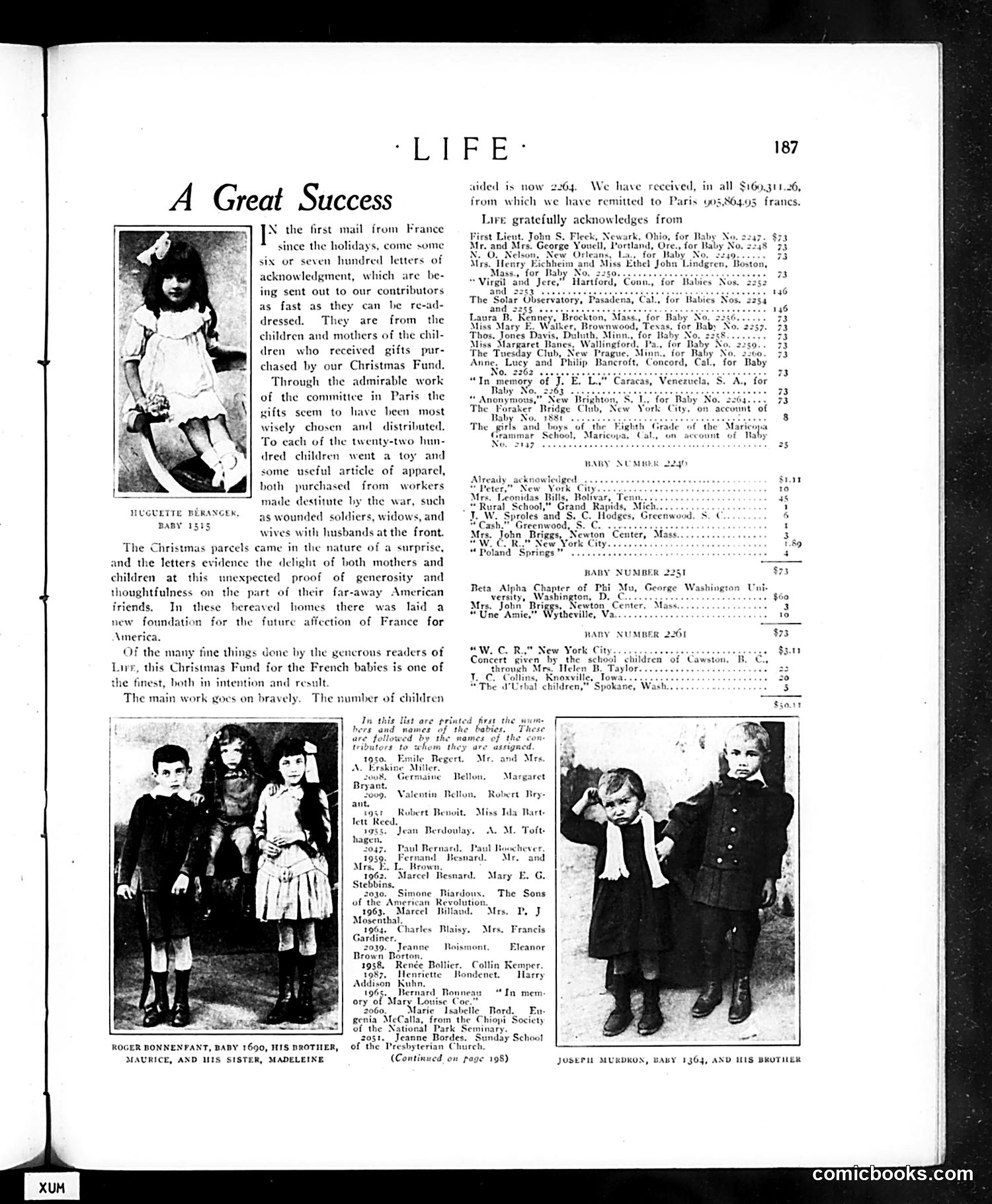
This page documents "A Great Success"—a Christmas charitable campaign by *Life* magazine supporting French war orphans (likely from World War I, based on references to "wounded soldiers" and wartime devastation). The article describes how *Life* readers donated toys and clothing through a Paris committee, which distributed gifts to approximately 2,200 children whose families were destroyed by war. The page includes: - **Huguette Béranges, Baby 1515** (left photograph): One recipient child - **Joseph Murdkon, Baby 1364** (right photograph): Another recipient with his brother - **Multiple named donors** listed with baby numbers assigned to each child they sponsored The "satire" here is gentle—*Life* is proudly showcasing American generosity toward impoverished European children, contrasting wealthy American readers with desperate French families. The numbered "babies" system creates an emotional connection between donor and recipient. This represents *Life*'s role as both satirical publication and serious advocate for social causes during the post-WWI relief period.
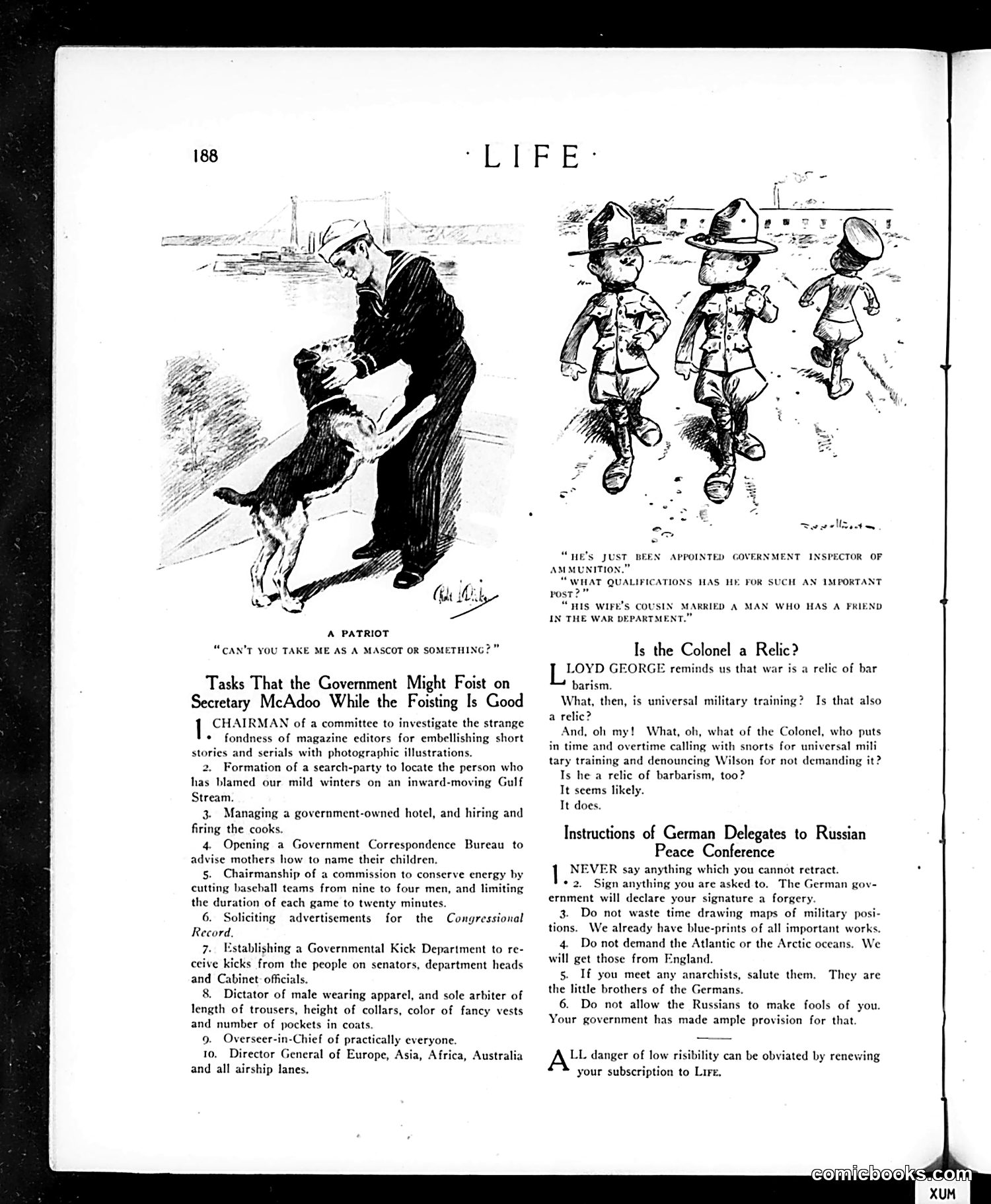
This satirical page mocks American government inefficiency during World War I, likely targeting Secretary of the Treasury William McAdoo. **"A Patriot" cartoon** (left): Shows a sailor with a small dog, asking to be taken "as a mascot or something." The satire suggests even a dog might be pressed into government service given the era's absurd bureaucratic expansion. **Main list** proposes ridiculously trivial or absurd tasks for McAdoo—from investigating magazine editors' use of photographs to appointing a "Dictator of male wearing apparel"—mocking government overreach and wartime busybodying. **"Government Inspector" joke** satirizes nepotism and unqualified appointments in wartime government: a man gets a munitions inspector position solely through family connections to someone in the War Department. **"Is the Colonel a Relic?"** criticizes military hawks who advocate universal military training while attacking President Wilson, suggesting these warmongers are themselves outdated. **"German Delegates" section** is satirical enemy propaganda, mocking German negotiating tactics at Russian peace talks—suggesting Germans exploit Russian weakness while pretending good faith.
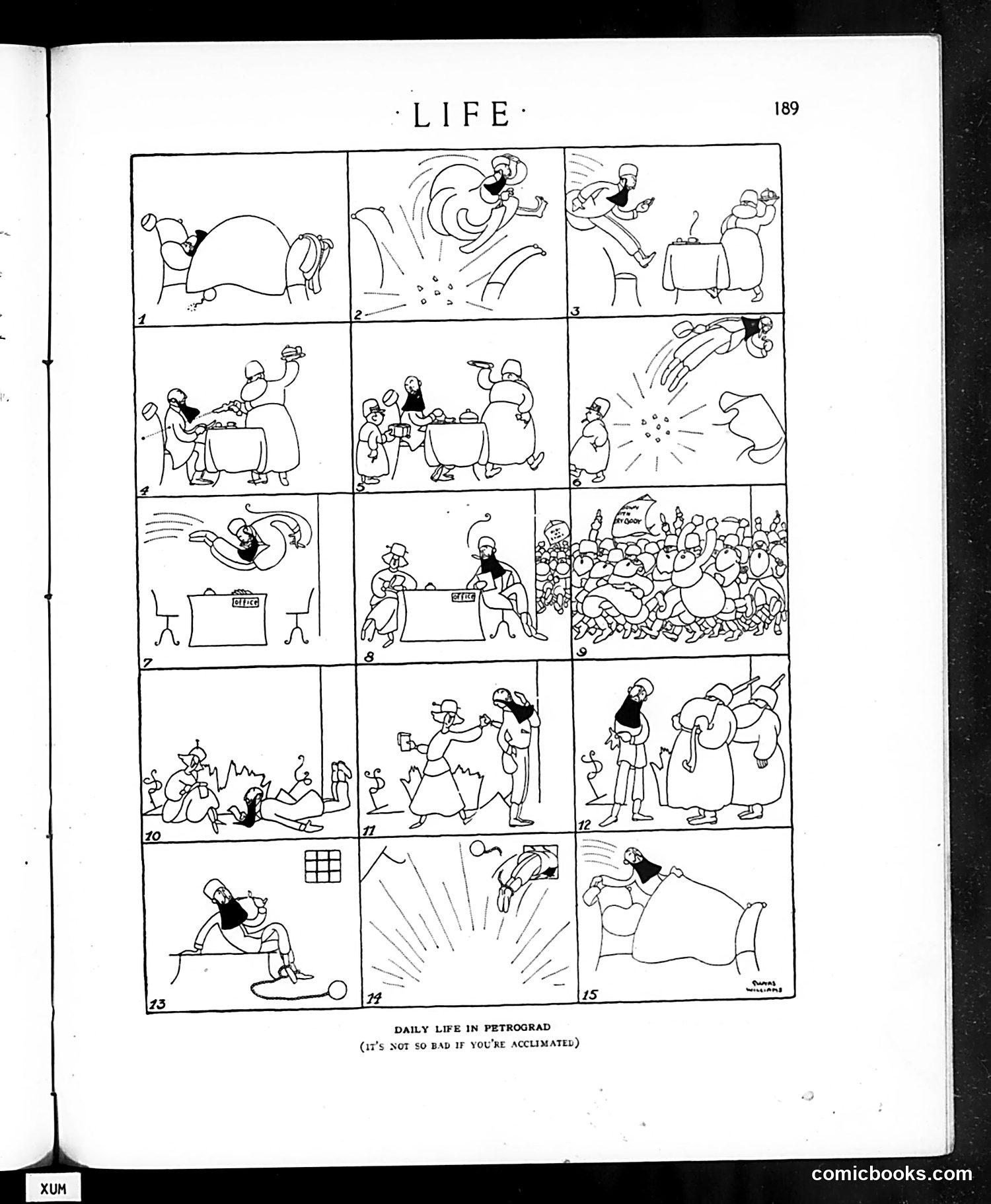
This is a satirical comic strip about life in Petrograd (now St. Petersburg), Russia during a period of hardship—likely the Russian Revolution era or early Soviet period. The title's parenthetical "(it's not so bad if you're acclimated)" is deeply ironic. The strip depicts escalating chaos and deprivation: people struggling with basic activities like sleeping and eating, fighting over food, dealing with explosions and violence, and eventually mass unrest. Each panel shows citizens becoming increasingly accustomed to absurd dangers and shortages. The satire targets how populations normalize extraordinary suffering under authoritarian or chaotic conditions. By showing "acclimation" to disaster, the cartoonist mocks both the regime's conditions and perhaps human adaptation to dystopian circumstances. The humor is dark—suggesting that surviving such conditions requires abandoning normal expectations of safety and stability.
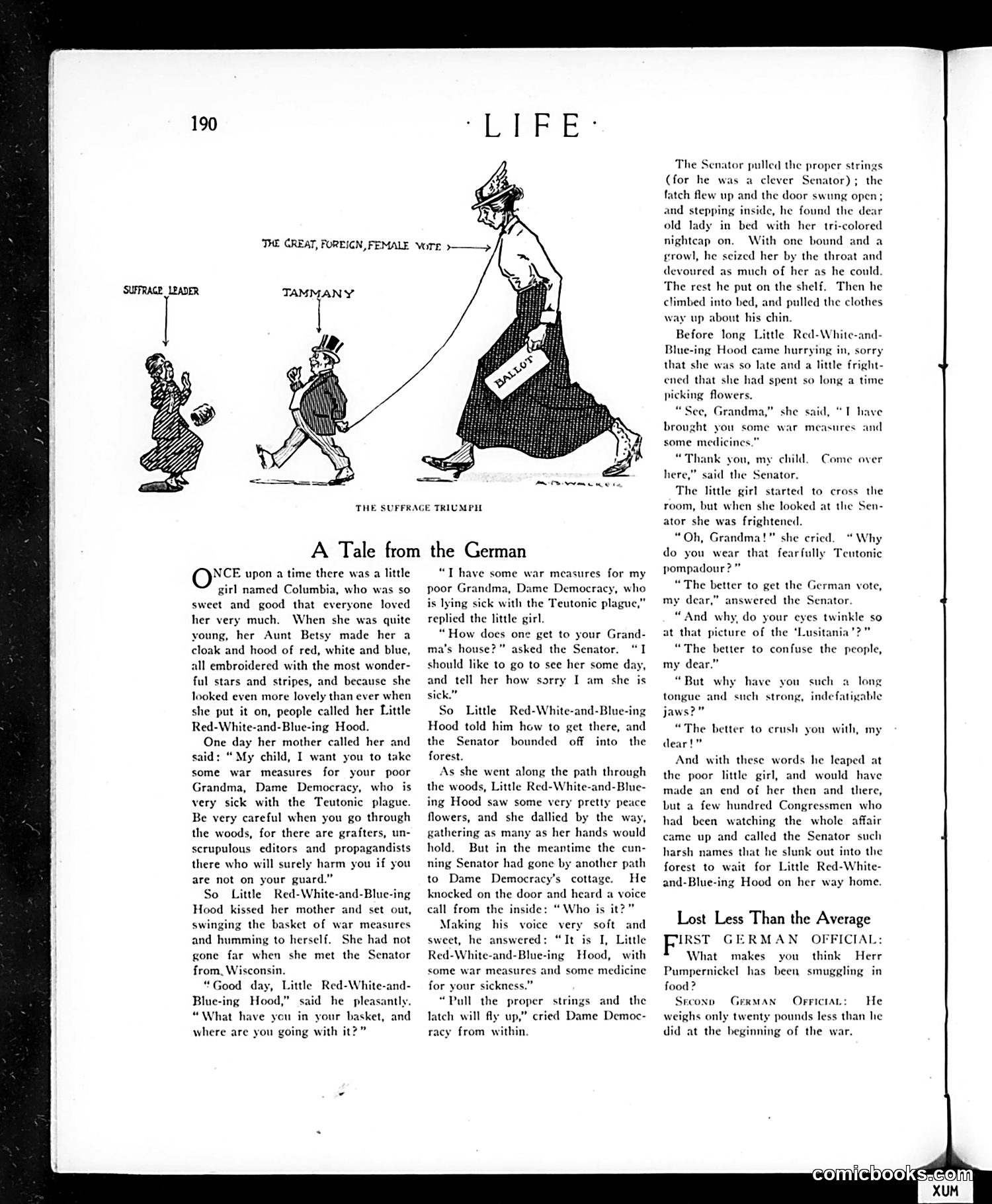
This page contains a wartime allegory mocking a U.S. Senator's duplicity regarding war measures and democracy. Using a twisted Little Red Riding Hood narrative, it depicts: **The figures**: Columbia (America, dressed in patriotic red-white-blue) as innocent "Little Red-White-and-Blue-ing Hood"; "Dame Democracy" as the grandmother; a cunning Senator (likely anti-war or isolationist, from Wisconsin based on OCR hints) as the wolf. **The satire**: The Senator pretends sympathy for Democracy's "Teutonic plague" (German threat) while secretly undermining her—devouring her and impersonating her with a "fearfully Teutonic pompadour" to manipulate voters. His stated goals: getting German votes, confusing the people, and crushing opposition. **The point**: Criticizes wartime politicians for cynical exploitation—claiming patriotism while pursuing selfish political interests at Democracy's expense. Congress ultimately intervenes, forcing the Senator's retreat. The cartoon trio at top illustrates "The Suffrage Triumph," linking women's voting power to this political accountability narrative.
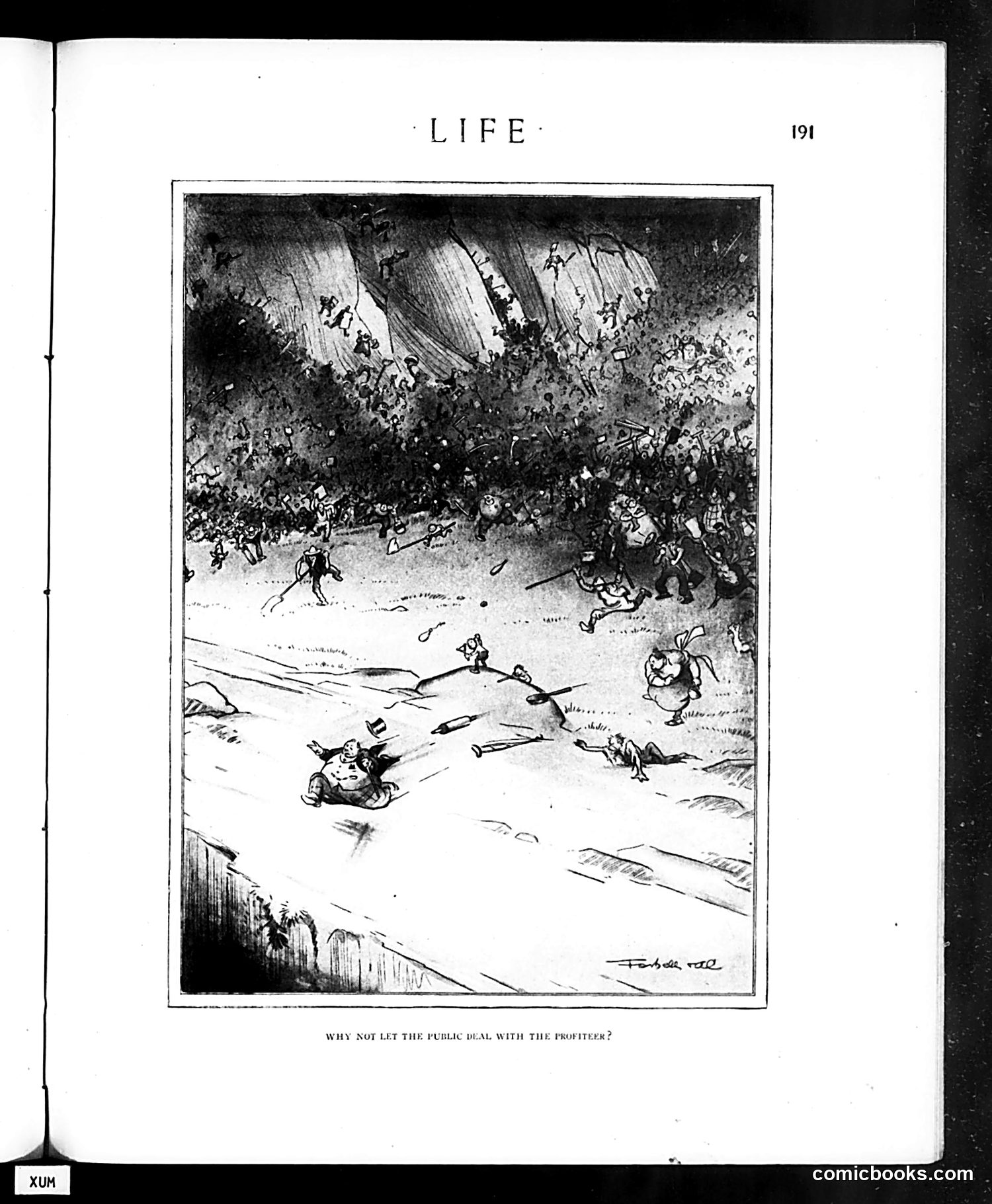
This political cartoon from *Life* magazine depicts what appears to be a public execution or violent confrontation, with crowds gathered around fallen figures in an arena-like setting. The caption reads "WHY NOT LET THE PUBLIC DEAL WITH THE PROFITEER?" The satire suggests frustration with wartime profiteering—likely from World War I era, when merchants exploited shortages for excess profits. Rather than government regulation, the cartoon sarcastically proposes letting an angry mob of ordinary citizens directly punish profiteers themselves. The gruesome imagery emphasizes public outrage at those exploiting their fellow citizens during national crisis. The cartoon advocates for stronger action against war profiteers, though expressed through darkly humorous, violent satire rather than literal intent.
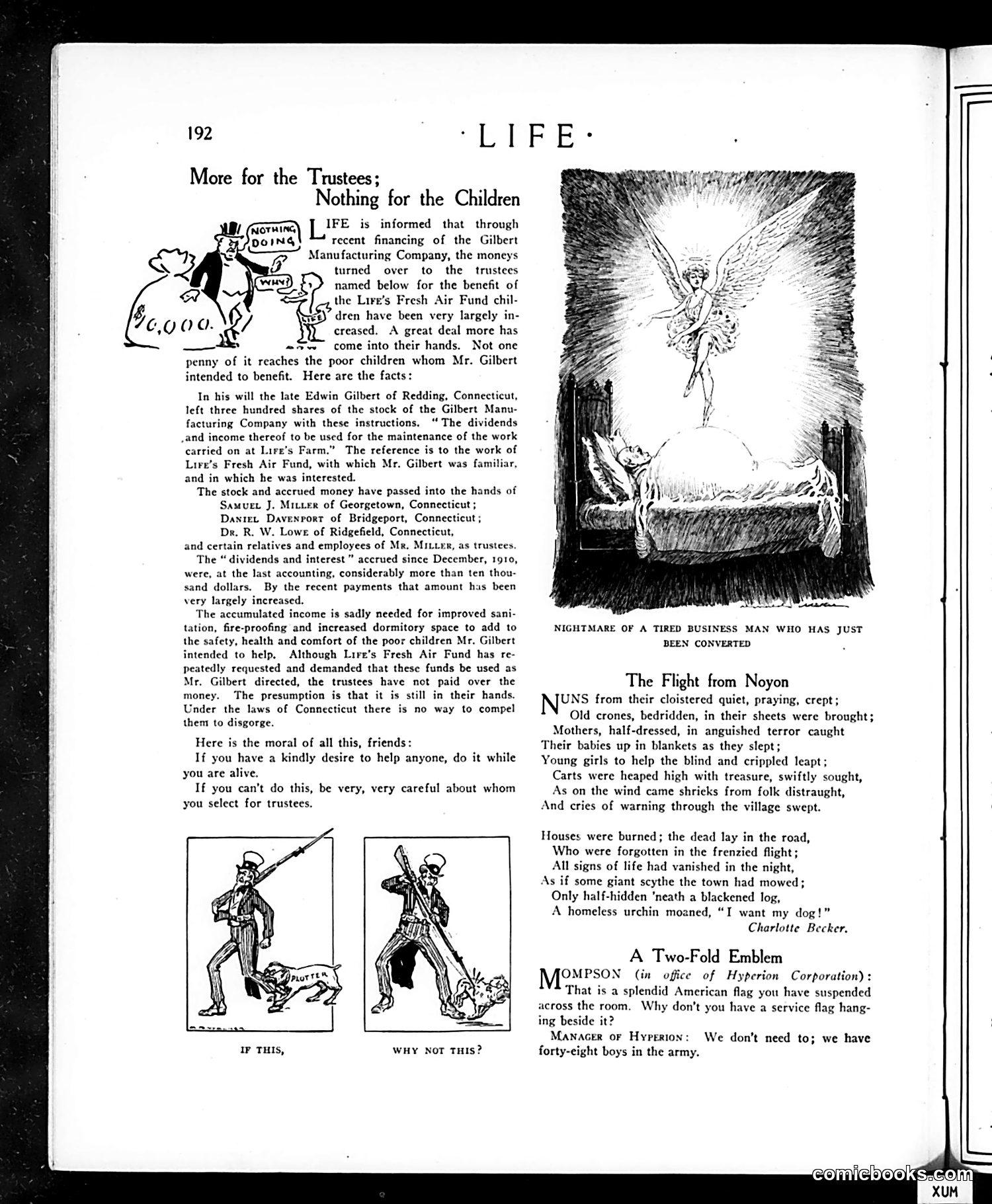
**Main Article: "More for the Trustees; Nothing for the Children"** This is an exposé of embezzlement disguised as legal trusteeship. Edwin Gilbert willed stock dividends from his manufacturing company to Life's Fresh Air Fund (a charitable organization for poor children). However, the named trustees—Samuel J. Miller, Daniel Davenport, and Dr. R. W. Lowe—have accumulated over $10,000 in accrued dividends since 1910 without disbursing them as Gilbert intended. The article criticizes Connecticut law's inability to compel the trustees to release the funds. The two-panel cartoon below contrasts appropriate charity ("IF THIS") with the trustees' behavior ("WHY NOT THIS?"), showing a man helping versus ignoring a person in need. **Secondary Content:** "The Flight from Noyon" is a poem about civilian evacuation during wartime (appears WWI-related, referencing the French town). "A Two-Fold Emblem" is a brief satirical dialogue mocking a factory manager's patriotism: he displays an American flag but won't acknowledge that forty-eight of his employees are in the military.
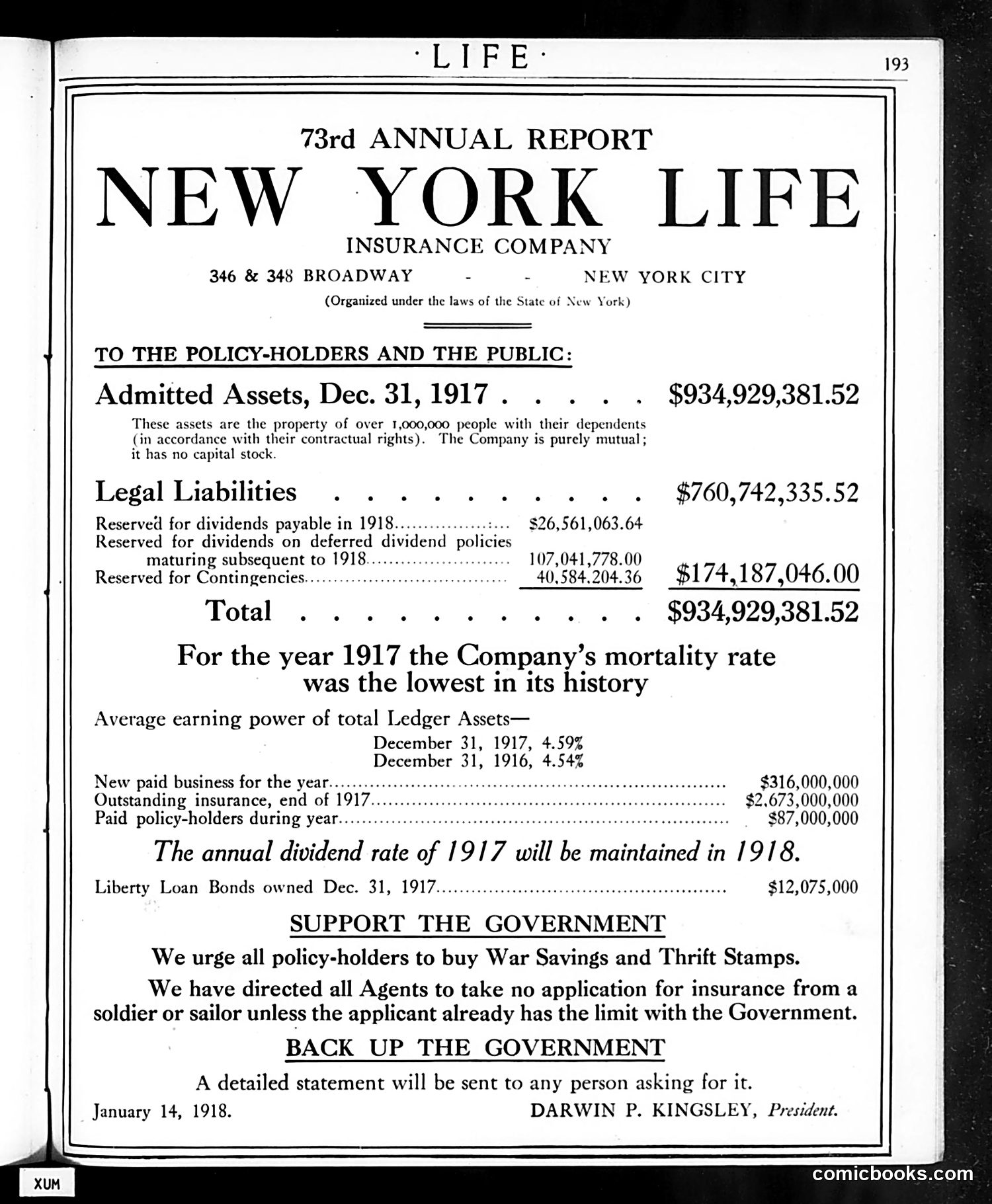
This is **not a cartoon page** but rather a **corporate financial report and patriotic advertisement** published in *Life* magazine during World War I. The New York Life Insurance Company's 73rd annual report (dated January 14, 1918) presents financial data alongside wartime messaging. The company showcases strong assets ($934 million) and improved mortality rates to reassure policyholders. The patriotic messaging is the notable element: the company urges policyholders to buy War Savings Stamps and Liberty Loan Bonds, and has instructed agents to refuse insurance applications from soldiers/sailors unless they already hold the government's maximum coverage. This reflects corporate cooperation with WWI financing efforts. The reference to "lowest mortality rate in its history" and maintained dividend rates suggests the company used the war period to demonstrate financial stability and reliability to its 1+ million policyholders—positioning itself as both profitable and patriotic.
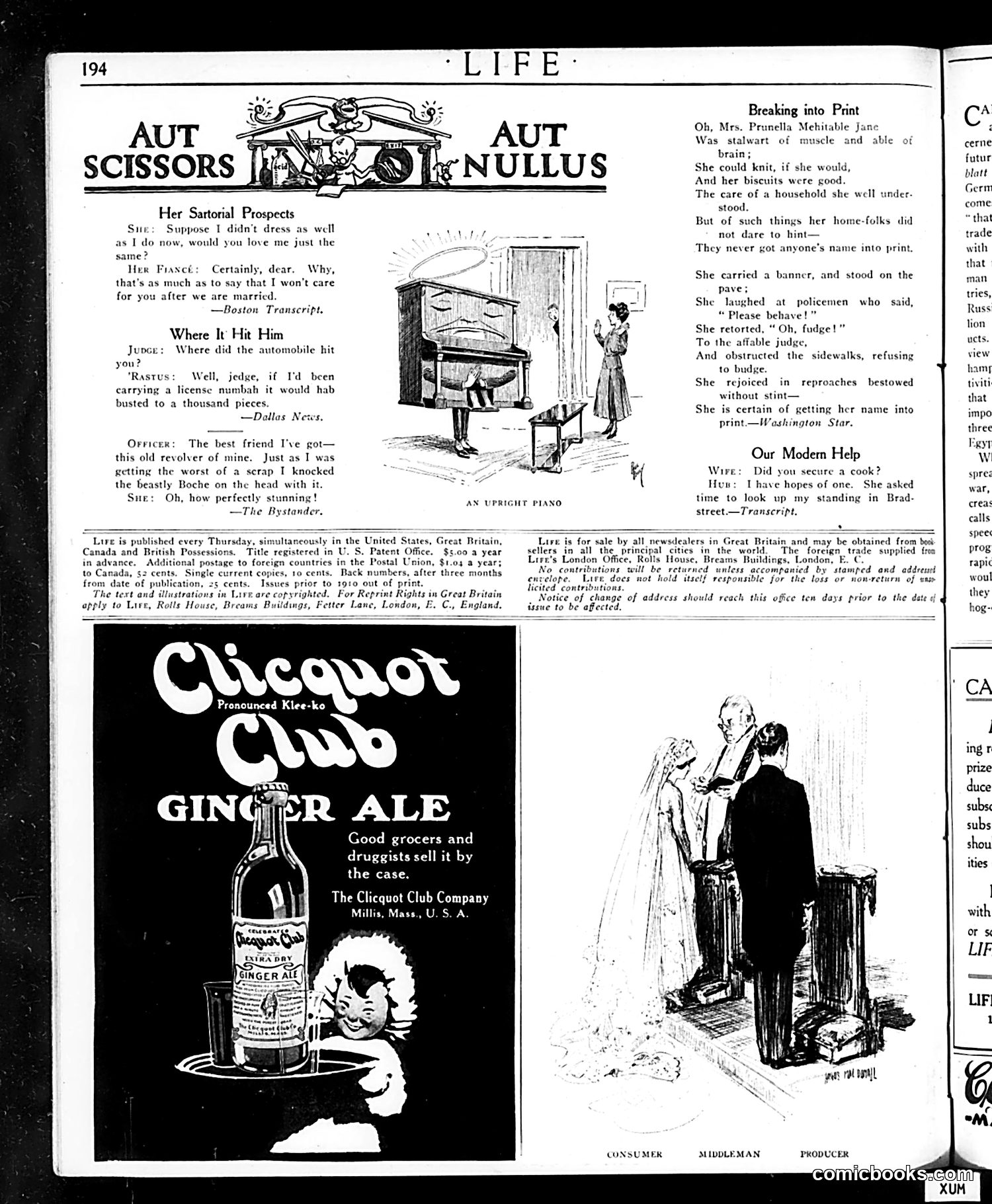
This page from *Life* contains three unrelated satirical jokes and advertisements typical of early 20th-century American humor magazines. **The three jokes** mock romantic relationships and social absurdities: a fiancé admitting he won't care about his bride's appearance after marriage; a Black man ("Rastus") making a pun about a car accident destroying his license plate instead of him; and a soldier praising his revolver for saving him in a fight with "the beastly Boche" (German soldiers from WWI). **"Breaking into Print"** satirizes women's suffrage activism through the story of Mrs. Prunella Mehitable Jane, who gains newspaper attention only by protesting publicly and obstructing sidewalks—implying suffragettes crave publicity rather than substantive change. **"Our Modern Help"** jokes that even hired help now check applicants' financial creditworthiness via Bradstreet's (a credit-rating company), mocking social pretension among working-class women. The **Clicquot Club Ginger Ale advertisement** fills the lower half, promoting the beverage through druggists and grocers.
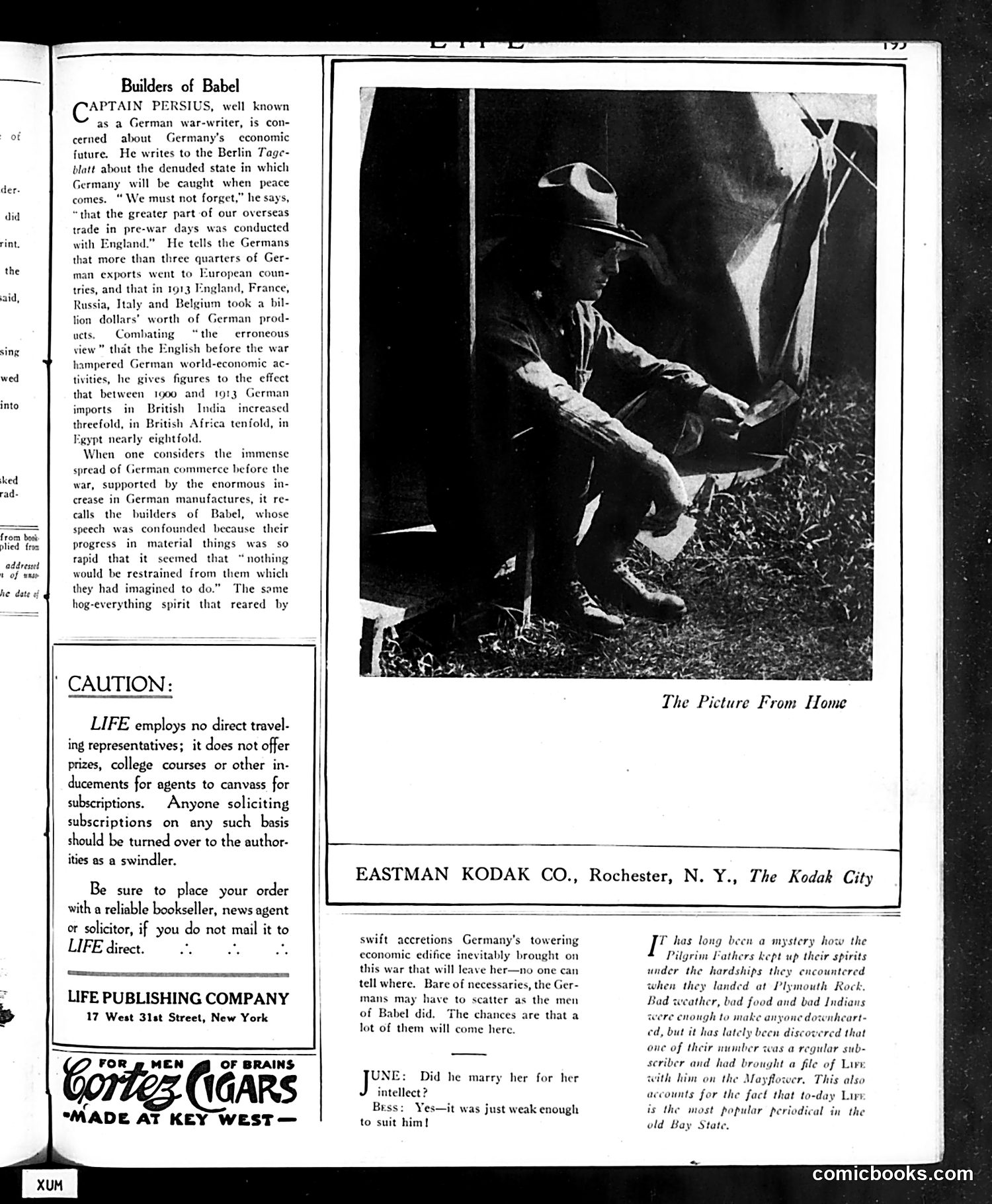
This article compares Germany's pre-war economic expansion to the Biblical Tower of Babel—a cautionary tale about ambition and overreach. **The argument:** Captain Persius, a German war-writer, documented Germany's massive export trade (75% to Europe; $1 billion annually by 1913 from major powers). Life's editor sardonically notes this "hog-everything spirit" parallels Babel's builders, whose rapid material progress made them believe nothing could be withheld from them—until God confused their speech and scattered them. **The satire's point:** Germany's economic aggressiveness, though impressive, bred the same hubris that caused Babel's collapse. Now, after losing WWI, Germany faces similar scattering—its men may become diaspora, including emigration to America ("chances are that a lot of them will come here"). The joke uses religious allegory to frame German imperial ambition as doomed overconfidence, implying God-like consequences for such greed. It reflects post-WWI American skepticism toward Germany's pre-war economic model.
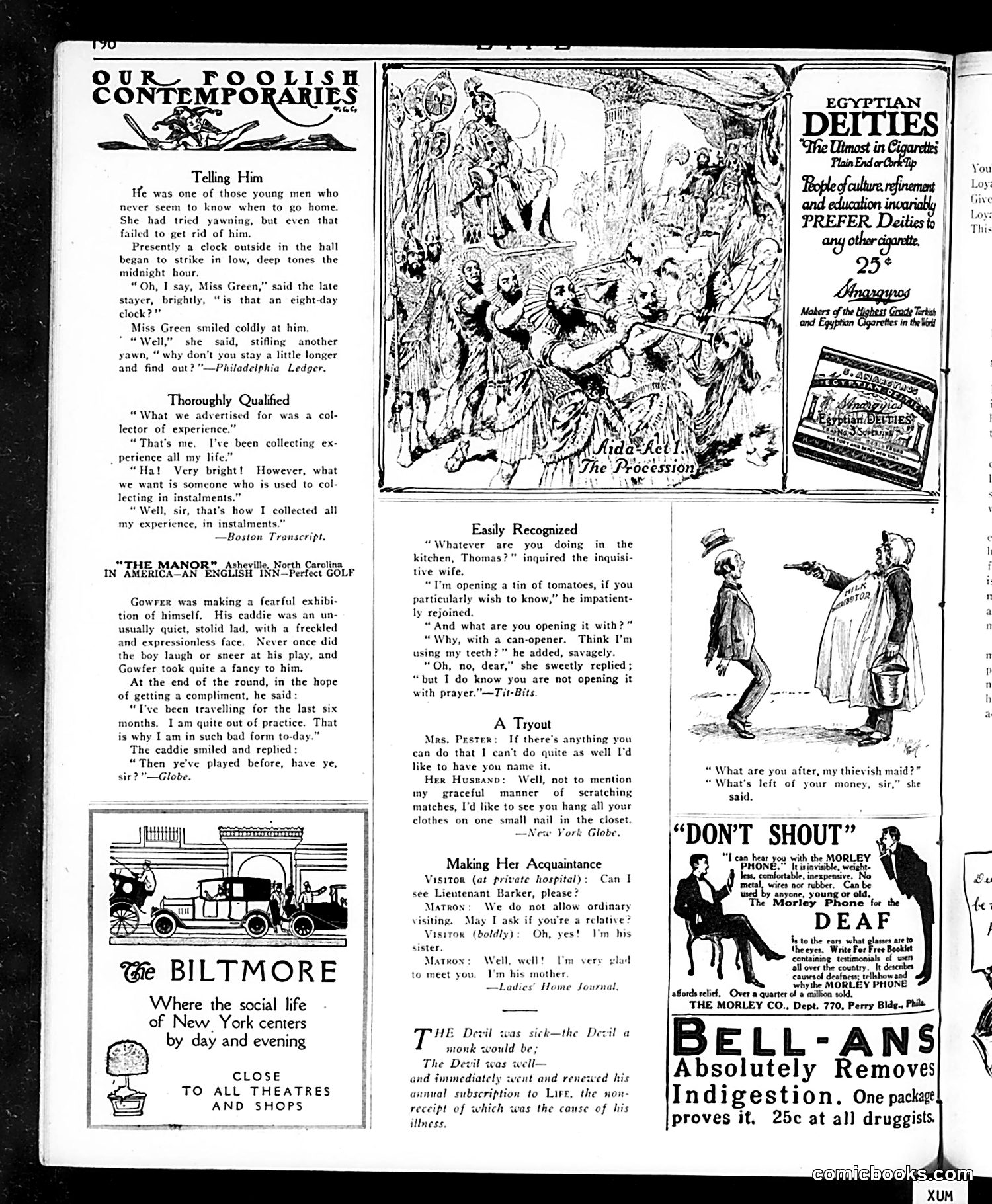
This page collects humorous short anecdotes mocking social awkwardness and domestic situations of the era. The main cartoons satirize: **"Telling Him"**: A young man overstays his welcome at a lady's home. She responds to his question about an "eight-day clock" with sarcasm—implying he's so oblivious he might stay that long. The joke targets socially dense bachelors. **"Thoroughly Qualified"**: A job applicant claims to have collected "experience in instalments"—a satirical jab at people who conflate life mistakes with actual qualifications. **Other anecdotes** mock domestic friction (wives nagging husbands about can-openers and prayer) and pompous social hierarchies (hospital matrons). The page is primarily **humorous filler content**—light social satire targeting middle-class etiquette failures. Advertisements (Egyptian Deities cigarettes, The Biltmore hotel, Bell-Ans indigestion remedy) occupy significant space, typical of Life's revenue model.
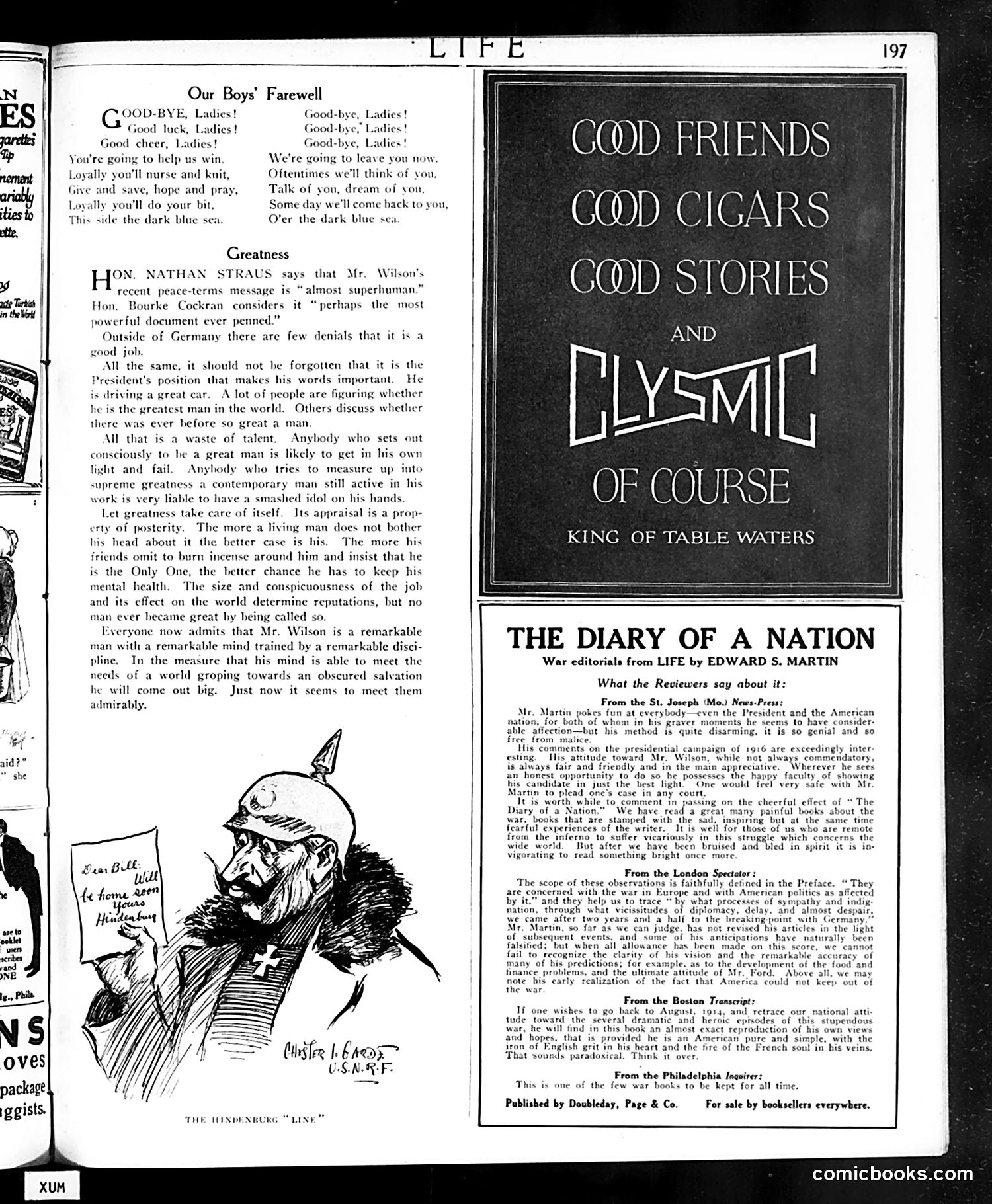
This page contains two distinct elements: **Left side:** A poem titled "Our Boys' Farewell" and an essay on "Greatness" discussing President Wilson's recent peace proposal. The essay praises Wilson's intellect and position while cautioning against excessive hero-worship of living leaders—arguing that greatness should speak for itself rather than be proclaimed. **Right side:** A political cartoon labeled "The Hindenburg 'Live'" depicts a German military officer (appears to be a caricature of a Prussian general, likely meant to represent German militarism broadly) with a Spiked Prussian helmet. Below it is advertising for *The Diary of a Nation*, a book of war editorials by Edward S. Martin from *Life* magazine, with positive reviews praising Martin's balanced commentary on Wilson and the war. The cartoon's placement alongside Wilson content suggests satirical commentary on German versus American leadership during World War I.
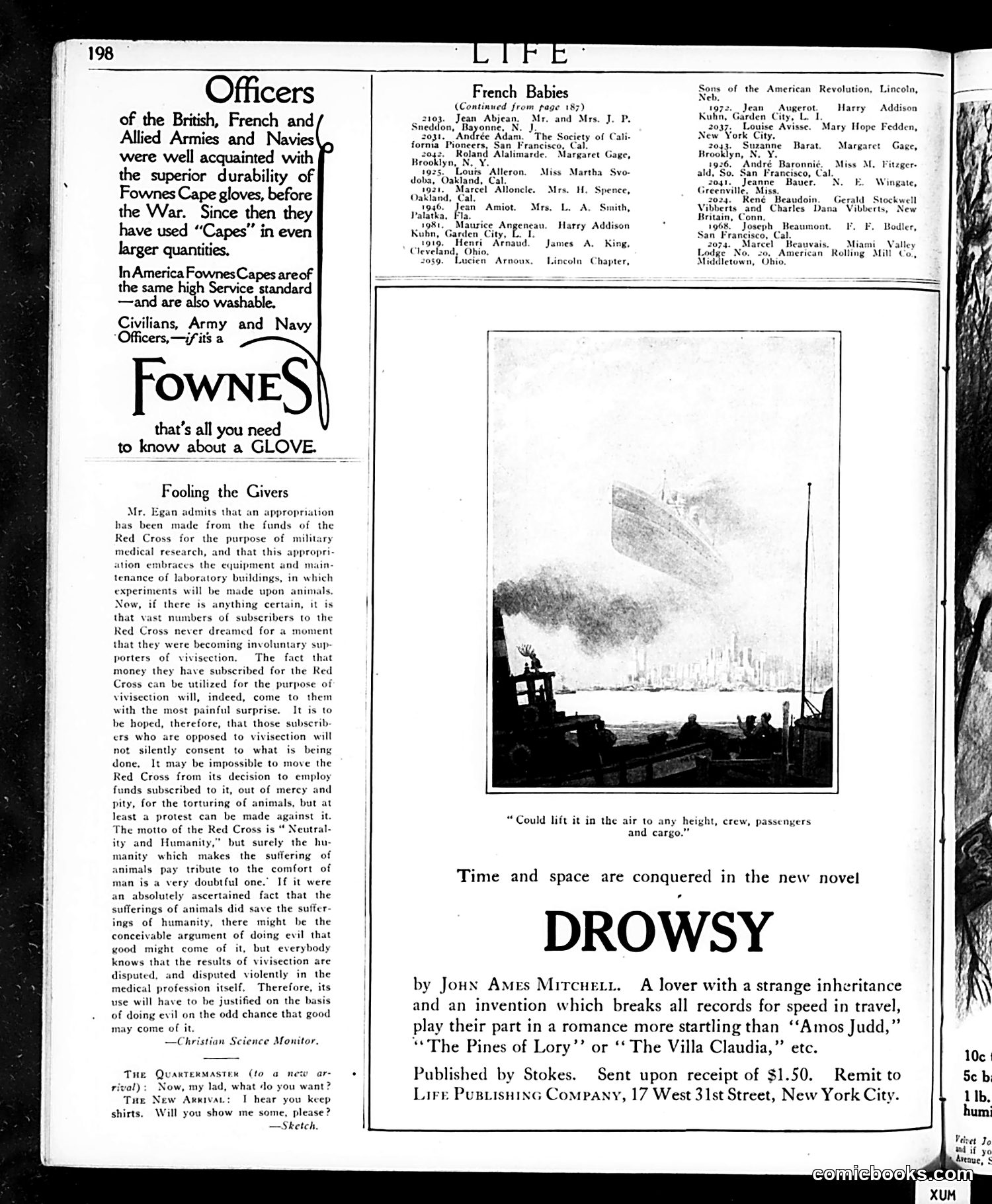
This page combines advertising, a moral critique, and book promotion typical of Life's format. **Left side:** A Fownes Cape gloves advertisement claims superior durability, referencing their use by WWI military officers. The ad targets civilians, army, and navy personnel. **Center:** "Fooling the Givers" critiques Red Cross misuse of funds. The piece argues that donors unknowingly funded vivisection (animal experimentation) for military medical research—a betrayal of the Red Cross's humanitarian mission. The author advocates for donor protest, though acknowledging practical impossibility of redirecting funds. This reflects early 20th-century animal welfare concerns and wartime skepticism about institutional accountability. **Right side:** Book advertisements, including "Drowsy" by John Ames Mitchell—promoting a romance involving fast travel and inheritance themes. The page reflects WWI-era concerns: military readiness, charitable transparency, and escapist literature.
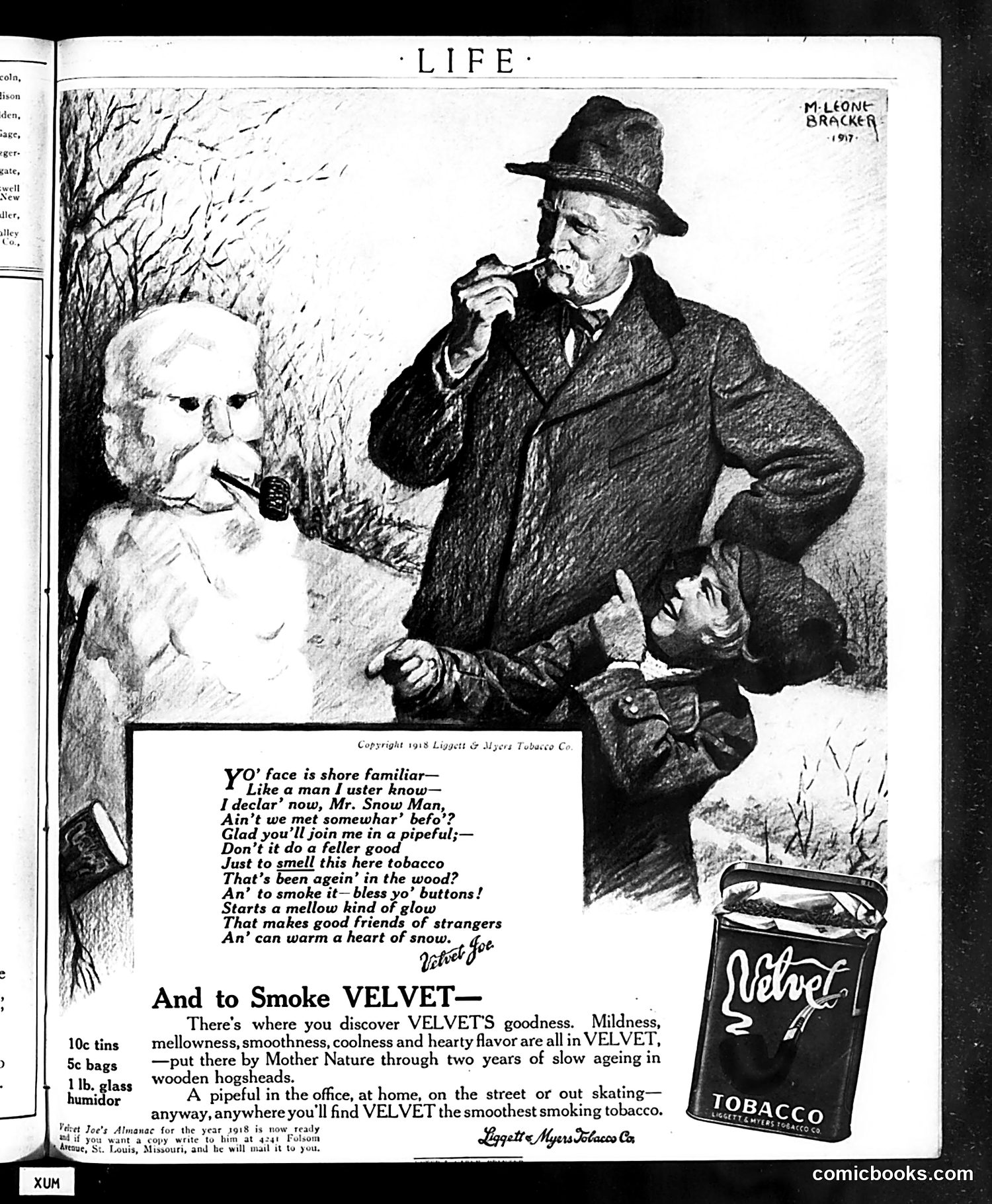
This is primarily a **tobacco advertisement** rather than political satire. The illustration depicts "Velvet Joe," a folksy, rural character who encounters a snowman in winter woods. The narrative uses rustic dialect ("shore familiar," "declar' now") to establish Joe as an everyman figure offering tobacco to the snowman—a whimsical personification suggesting the product's universal appeal. The advertisement's core message: Velvet tobacco creates friendship and warmth ("makes good friends of strangers / An' can warm a heart of snow"). The copy emphasizes product qualities—mildness, smoothness, aging in wooden casks—while the rural setting and dialect aim for homey authenticity. The artist is credited as M. Leone Bracker (1917). This reflects early 20th-century advertising strategy: using relatable characters and sentimental storytelling to sell consumer goods. The 1918 dating places this during WWI, though no political content is evident on this page.
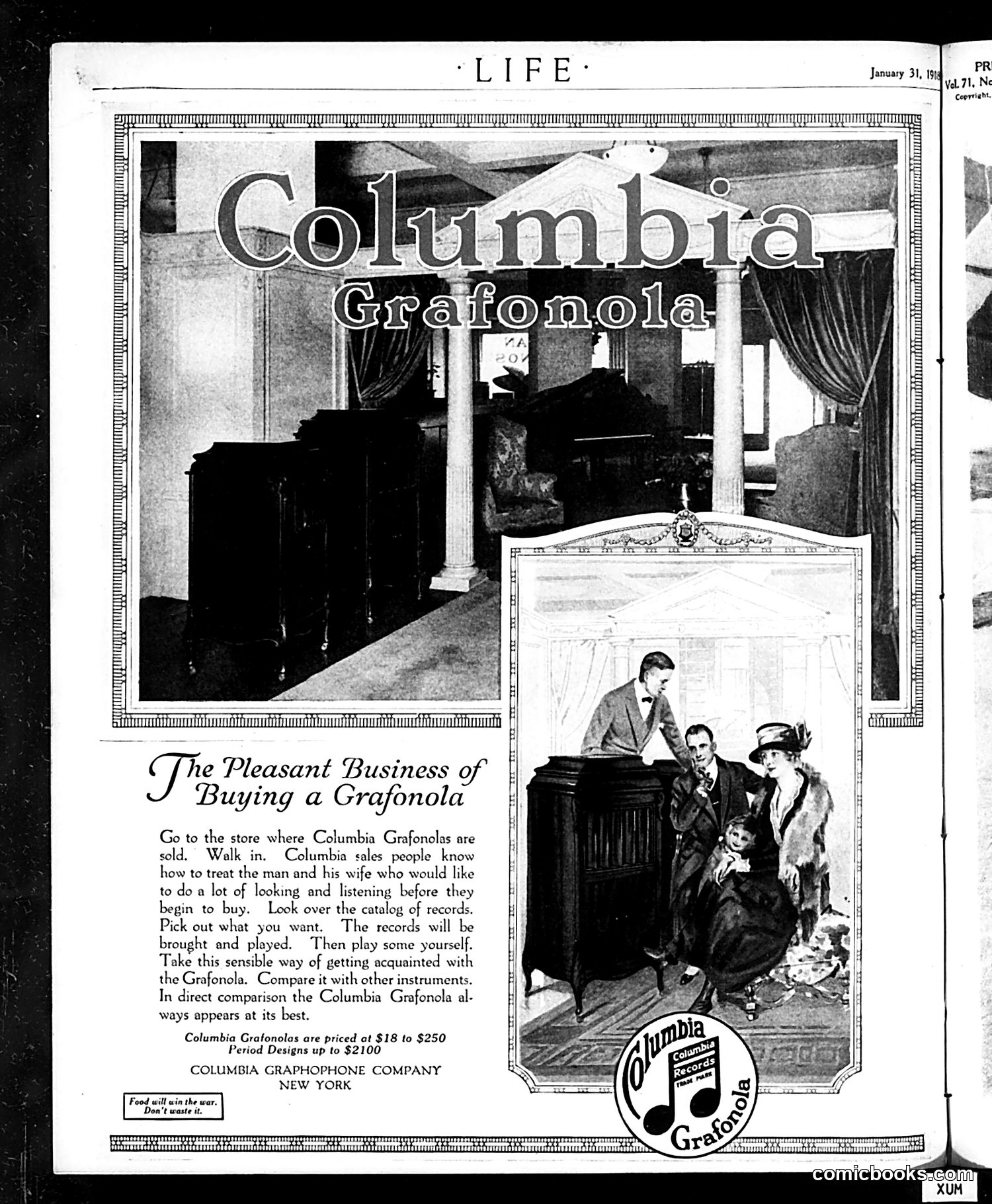
This is a **product advertisement**, not political satire. It promotes Columbia Grafonolas (early phonographs/record players) from the World War I era, as evidenced by the patriotic footer "Food will win the war, Don't waste it." The advertisement uses a domestic scene showing a salesman demonstrating a Grafonola to a family (man, woman, and children) in a store. The pitch emphasizes the "pleasant business" of leisurely auditioning records before purchase—a novel consumer experience at the time. The accompanying interior photograph shows an elegant living room with the device, suggesting it as a desirable home furnishing. Prices ranging from $18 to $2,100 indicate a broad market, from affordable to luxury models. No caricatures or political figures are present. This is straightforward early 20th-century consumer marketing highlighting the novelty of hearing music on demand before buying.