
Life, 1918-01-31 · page 10 of 40
Life — January 31, 1918 — page 10: what you’re looking at
What you’re looking at
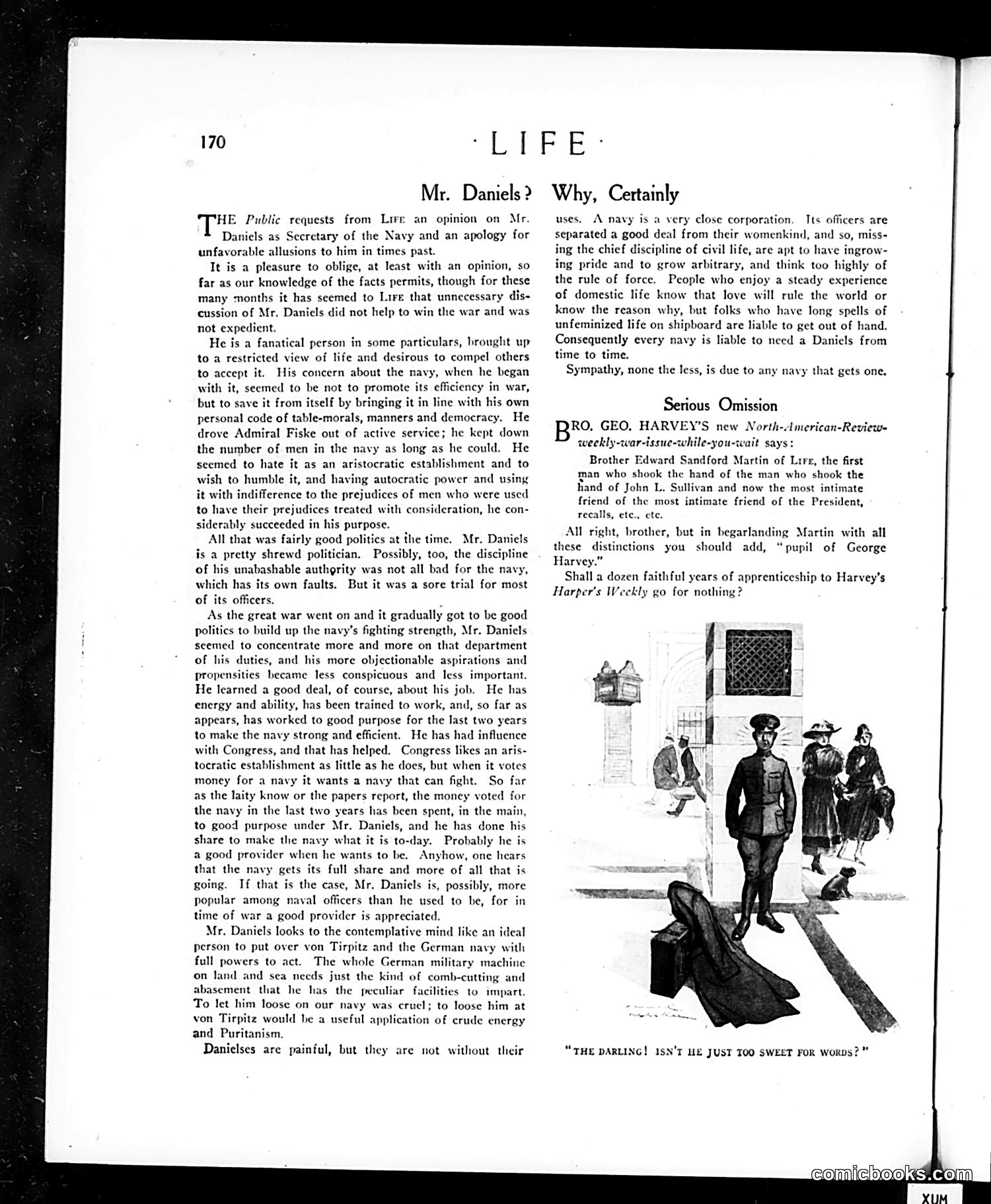
This page critiques Josephus Daniels, Secretary of the Navy, through two separate pieces. The main article defends Daniels against criticism, acknowledging he's somewhat fanatical but crediting him with strengthening naval efficiency during wartime through discipline and democratic principles. The "Serious Omission" section sarcastically attacks George Harvey's *North American Review* for praising Harvey's friend (likely President Wilson) while omitting Daniels' contributions to naval preparedness. The illustration at bottom depicts what appears to be women suffragists or female workers, with the caption "THE DARLING! ISN'T HE JUST TOO SWEET FOR WORDS?"—likely mocking Daniels' progressive stance on women's roles during this era.
📄 Transcribed text from this page (OCR, searchable)
Machine-transcribed from the original scan — historical spelling and the odd misread are preserved.
Mr. Daniels > HE Public requests from Lire an opinion on Mr. Daniels as Secretary of the Navy and an apology for unfavorable allusions to him in times past. It is a pleasure to oblige, at least with an opinion, so far as our knowledge of the facts permits, though for these many months it has seemed to Lire that unnecessary dis- cussion of Mr. Daniels did not help to win the war and was not expedient. He is a fanatical person in some particulars, brought up to a restricted view of life and desirous to compel others to accept it. His concern about the navy, when he began with it, seemed to be not to promote its efficiency in war, but to save it from itself by bringing it in line with his own personal code of table-morals, manners and democracy. He drove Admiral Fiske out of active service; he kept down the number of men in the navy as long as he could. He seemed to hate it as an aristocratic establishment and to wish to humble it, and having autocratic power and using it with indifference to the prejudices of men who were used to have their prejudices treated with consideration, he con- siderably succeeded in his purpose. All that was fairly good politics at ihe time. Mr. Daniels is a pretty shrewd politician. Possibly, too, the discipline of his unabashable authority was not all bad for the navy, which has its own faults. But it was a sore trial for most of its officers, . the great war went on and it gradually got to be good politics to build up the navy’s fighting strength, Mr. Daniels seemed to concentrate more and more on that department of his duties, and his more objectionable aspirations and propensities became less conspicuous and less important. He learned a good deal, of course, about his job. He has energy and ability, has been trained to work, and, so far as appears, has worked to good purpose for the last two years to make the navy strong and efficient. He has had influence with Congress, and that has helped. Congress likes an aris- tocratic establishment as little as he does, but when it votes money for a navy it wants a navy that can fight. So far as the laity know or the papers report, the money voted for the navy in the last two years has been spent, in the main, to good purpose under Mr. Daniels, and he has done his share to make the navy what it is to-day. Probably he is a good provider when he wants to be. Anyhow, one hears that the navy gets its full share and more of all that is going. If that is the case, Mr. Daniels is, possibly, more popular among naval officers than he used to be, for in time of war a good provider is appreciated. Mr. Daniels looks to the contemplative mind like an ideal person to put over von Tirpitz and the German navy with full powers to act. The whole German military machine on land and sea needs just the kind of comb-cutting and abasement that he has the peculiar facilities to impart. To let him loose on our navy was crucl; to loose him at von Tirpitz would be a useful application of crude energy and Puritanism, Danielses are painful, but they are not without their “LIFE- Why, Certainly uses. A navy is a very close corporation. Tts officers are separated a good deal from their womenkind, and so, miss- ing the chief discipline of civil life, are apt to have ingrow- ing pride and to grow arbitrary, and think too highly of the rule of force. People who enjoy a steady experience of domestic life know that love will rule the world or know the reason why, but folks who have long spells of unfeminized life on shipboard are liable to get out of hand. Consequently every navy is liable to need a Daniels from time to time. Sympathy, none the less, is due to any navy that gets one. Serious Omission RO. GEO. HARVEY'S new North weekly-war-issuc-while-you-wait say Brother Edward Sandford Martin of Lire, the first man who shook the hand of the man who shook the Rand of John L. Sullivan and now the most intimate friend of the most intimate friend of the President, recalls, ete., ete. All right, brother, but in begarlanding Martin with all these distinctions you should add, “pupil of George Harvey.” Shall a dozen faithful years of apprenticeship to Harvey's Harper's Weekly go for nothing? Imerican-Review= ISN'T HE JUST 100 SWEET FOR worDs?"” “THE DARLING!